 How to resolve AdBlock issue?
News

Over the last decade, smartphones have become ubiquitous not just for sending texts and staying abreast of news, but also for monitoring daily activity levels.
Among the most common, and arguably the most meaningful, tracking method for daily physical activity is step counting.
Counting steps is far more than a fad: The U.S. Department of Health and Human Services dedicated a sizable portion of its most recent physical activity guidelines to documenting the relationship between daily step counts and several chronic diseases.
Unfortunately, the guidelines have little to say about how step counts might be used to aid in weight management, an outcome of critical importance given the high rates of overweight and obesity in the U.S.
In the early 1980s, fewer than 14% of adults in the U.S. were classified as having obesity. Today, just over 40 years later, the prevalence of obesity is greater than 40% in the adult population, and current trends suggest that almost half of adults in the U.S. will be obese by 2030.
I am a professor of exercise science at Kennesaw State University, and our lab has been conducting studies examining relationships among step counts and a number of health outcomes.
While the evidence is clear that increasing numbers of adults are living in a chronic energy surplus that leads to weight gain, a key question is – why? What has changed so dramatically since 1980 that could explain why obesity rates have tripled?
Although the American diet is likely a key contributor, a wealth of research points to a reduction in physical activity as a major culprit behind the expanding waist lines – and step counts are an excellent indicator of physical activity.
Step counts may – or may not – lead to weight loss
A number of recent studies have looked at whether increasing step counts can lead to weight loss over a certain period of time. One large-scale study called a meta-analysis concluded that increasing physical activity by way of step counts was effective for attaining modest weight loss. However, many if not most studies examining the effect of exercise on weight loss report modest outcomes, with results that are variable and often disappointing.
That may be in part because the step count targets used in many weight management studies are most often set in an arbitrary manner, such as targeting 10,000 steps per day. Or, if they’re individualized at all, they’re based on initial behavioral characteristics, like adding a given number of steps to what a person is already accumulating in a typical day. Rarely, if ever, are the step targets in research studies based on any physical attributes of the participants.
My team’s research has compiled weight, body fat percentages and average step counts for large numbers of adults between 19 and 40 years of age. From that data, we have identified a way to determine specific step count goals based on key physical attributes – namely, baseline body weight and composition, and the desired body composition.
When it comes to health, it is important to remember that body weight does not tell the whole story. In fact, body composition is much more predictive of health status than body weight. Someone who weighs more than another person may be in better health if they have more muscle mass and a lower percentage of body fat than the other person who weighs less but has a higher proportion of body fat.
Parsing the numbers
We have used our data to develop a model that predicts average daily step counts per unit of fat mass from body fat percentage. We believe that this model can be used to determine how much people would need to walk to achieve a specific amount of weight and body fat reduction.
Take, for instance, a man who weighs 175 pounds (80 kilograms), of which 25% is fat. Our model suggests that he walks an average of 10,900 steps a day. Then consider another man who weighs 220 pounds (100 kilograms), of which 20% is fat. Although they have different amounts of lean mass, both men have about 44 pounds (20 kilograms) of fat. So our model predicts that the heavier man walks an average of 15,300 steps a day. In other words, the heavier person has a lower percentage of body fat and walks more to maintain that leaner body composition.
A person’s body fat percentage is every bit as important as their weight. That’s because how much muscle you have affects how hungry you get, as well as how many calories you burn. Muscle mass requires energy to maintain, and this requirement leads to increased appetite, which means taking in more calories. In this example, the heavier man probably eats more than the lighter man in order to maintain his lean muscle mass, and he must walk more to maintain his lower body fat percentage.
If you want to lose body fat, and therefore weight, you basically have two choices: You can eat less, or you can move more. Eating less means you’ll be hungry a lot, and that’s uncomfortable, unpleasant and, for most people, not sustainable. Moving more, on the other hand, can allow you to eat until you’re full and keep body fat off – or even lose it.
Therefore, we wanted to know how much a person who eats until they’re full might have to move to offset the calories they’re eating.
Step counts for weight loss
Currently, our model applies to young adults, but we are now collecting data for middle-aged and older adults too. To use this model, you need to first have your body composition determined, a service that is being offered by increasing numbers of fitness centers and medical practices. With our model, you must determine your body weight and fat weight in kilograms – to do this, simply divide your weight in pounds by 2.2.
With this information in hand, our model can provide a step count target that is specific to a person’s current body weight and body fat percentage, and their goal for fat loss and weight reduction.
For example, our model predicts that a woman weighing 155 pounds (70 kilograms) with 30% body fat currently accumulates an average of about 8,700 steps per day. If she wants to lose about 10 pounds and reach a body fat percentage around 25%, she could consult the model and discover that people who maintain that body composition accumulate an average of about 545 steps per kilogram of fat per day. Since she currently has about 46 pounds (21 kilograms) of fat, her goal would be to accumulate a total of 11,450 steps per day.
While that may seem at first glance to be a sizable increase in daily steps, most people can accumulate 1,000 steps in 10 minutes or less. So even with a comfortable pace, this additional daily dose of walking would take fewer than 30 minutes. Furthermore, steps can be accumulated throughout the day, with longer or more frequent trips, or both, to restrooms, vending machines and the like.
While steps certainly can be accumulated in dedicated walking sessions, such as a 15-minute walk during lunch hour and another 15-minute walk in the evening, they can also be accumulated in shorter, more frequent bouts of activity.
Researchers have learned a great deal in the past 70 years about appetite and energy expenditure: Appetite imposes a drive for food based largely on our fat-free mass, no matter how active or inactive we are, and we must accumulate enough physical activity to counter the calories that we take in through our diet if we want to maintain an energy balance – or exceed our intake to lose weight.
Bob Buresh, Professor of Exercise Science, and Director of the Exercise Physiology Lab, Kennesaw State University
This article is republished from The Conversation under a Creative Commons license. Read the original article.

Since ChatGPT’s release in late 2022, many news outlets have reported on the ethical threats posed by artificial intelligence. Tech pundits have issued warnings of killer robots bent on human extinction, while the World Economic Forum predicted that machines will take away jobs.
The tech sector is slashing its workforce even as it invests in AI-enhanced productivity tools. Writers and actors in Hollywood are on strike to protect their jobs and their likenesses. And scholars continue to show how these systems heighten existing biases or create meaningless jobs – amid myriad other problems.
There is a better way to bring artificial intelligence into workplaces. I know, because I’ve seen it, as a sociologist who works with NASA’s robotic spacecraft teams.
The scientists and engineers I study are busy exploring the surface of Mars with the help of AI-equipped rovers. But their job is no science fiction fantasy. It’s an example of the power of weaving machine and human intelligence together, in service of a common goal.
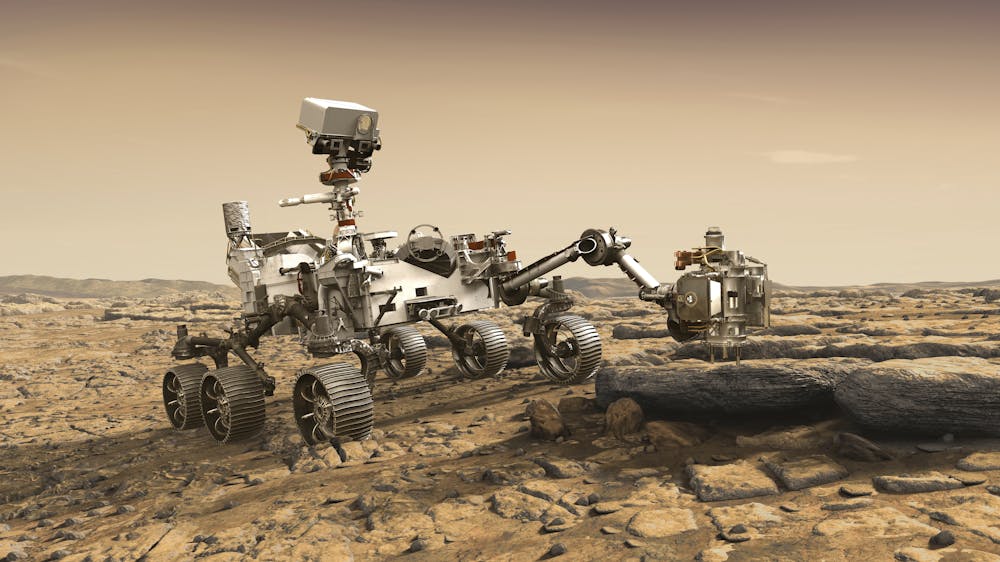
Instead of replacing humans, these robots partner with us to extend and complement human qualities. Along the way, they avoid common ethical pitfalls and chart a humane path for working with AI.
The replacement myth in AI
Stories of killer robots and job losses illustrate how a “replacement myth” dominates the way people think about AI. In this view, humans can and will be replaced by automated machines.
Amid the existential threat is the promise of business boons like greater efficiency, improved profit margins and more leisure time.
Empirical evidence shows that automation does not cut costs. Instead, it increases inequality by cutting out low-status workers and increasing the salary cost for high-status workers who remain. Meanwhile, today’s productivity tools inspire employees to work more for their employers, not less.
Alternatives to straight-out replacement are “mixed autonomy” systems, where people and robots work together. For example, self-driving cars must be programmed to operate in traffic alongside human drivers. Autonomy is “mixed” because both humans and robots operate in the same system, and their actions influence each other.
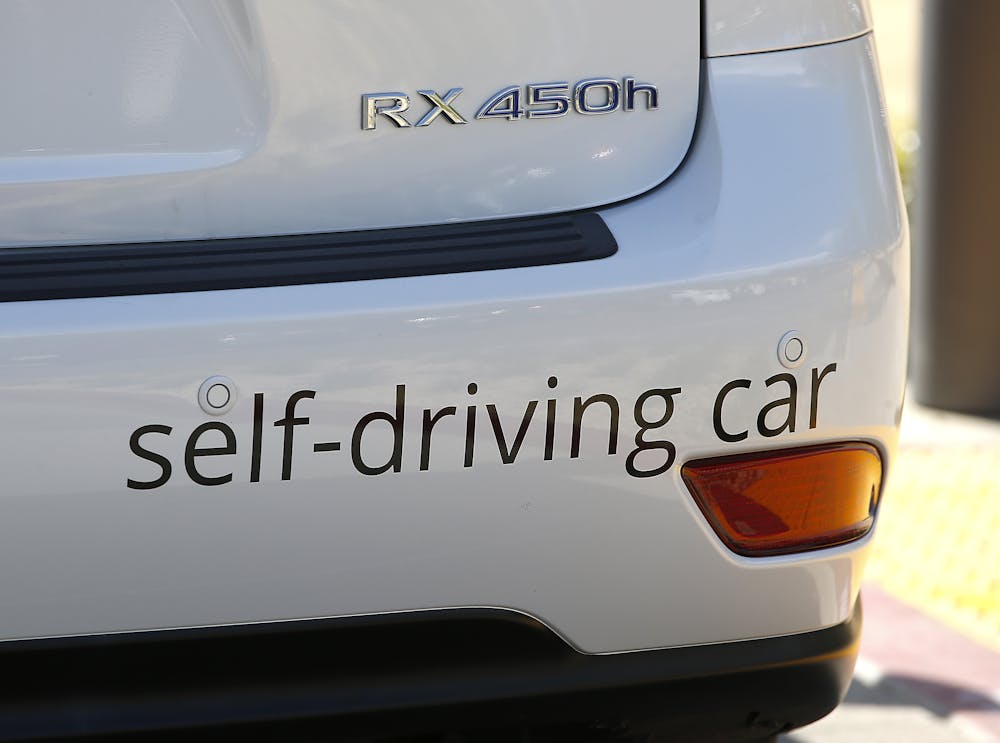
However, mixed autonomy is often seen as a step along the way to replacement. And it can lead to systems where humans merely feed, curate or teach AI tools. This saddles humans with “ghost work” – mindless, piecemeal tasks that programmers hope machine learning will soon render obsolete.
Replacement raises red flags for AI ethics. Work like tagging content to train AI or scrubbing Facebook posts typically features traumatic tasks and a poorly paid workforce spread across the Global South. And legions of autonomous vehicle designers are obsessed with “the trolley problem” – determining when or whether it is ethical to run over pedestrians.
But my research with robotic spacecraft teams at NASA shows that when companies reject the replacement myth and opt for building human-robot teams instead, many of the ethical issues with AI vanish.
Extending rather than replacing
Strong human-robot teams work best when they extend and augment human capabilities instead of replacing them. Engineers craft machines that can do work that humans cannot. Then, they weave machine and human labor together intelligently, working toward a shared goal.
Often, this teamwork means sending robots to do jobs that are physically dangerous for humans. Minesweeping, search-and-rescue, spacewalks and deep-sea robots are all real-world examples.
Teamwork also means leveraging the combined strengths of both robotic and human senses or intelligences. After all, there are many capabilities that robots have that humans do not – and vice versa.
For instance, human eyes on Mars can only see dimly lit, dusty red terrain stretching to the horizon. So engineers outfit Mars rovers with camera filters to “see” wavelengths of light that humans can’t see in the infrared, returning pictures in brilliant false colors.

Meanwhile, the rovers’ onboard AI cannot generate scientific findings. It is only by combining colorful sensor results with expert discussion that scientists can use these robotic eyes to uncover new truths about Mars.
Respectful data
Another ethical challenge to AI is how data is harvested and used. Generative AI is trained on artists’ and writers’ work without their consent, commercial datasets are rife with bias, and ChatGPT “hallucinates” answers to questions.
The real-world consequences of this data use in AI range from lawsuits to racial profiling.
Robots on Mars also rely on data, processing power and machine learning techniques to do their jobs. But the data they need is visual and distance information to generate driveable pathways or suggest cool new images.
By focusing on the world around them instead of our social worlds, these robotic systems avoid the questions around surveillance, bias and exploitation that plague today’s AI.
The ethics of care
Robots can unite the groups that work with them by eliciting human emotions when integrated seamlessly. For example, seasoned soldiers mourn broken drones on the battlefield, and families give names and personalities to their Roombas.
I saw NASA engineers break down in anxious tears when the rovers Spirit and Opportunity were threatened by Martian dust storms.

Unlike anthropomorphism – projecting human characteristics onto a machine – this feeling is born from a sense of care for the machine. It is developed through daily interactions, mutual accomplishments and shared responsibility.
When machines inspire a sense of care, they can underline – not undermine – the qualities that make people human.
A better AI is possible
In industries where AI could be used to replace workers, technology experts might consider how clever human-machine partnerships could enhance human capabilities instead of detracting from them.
Script-writing teams may appreciate an artificial agent that can look up dialog or cross-reference on the fly. Artists could write or curate their own algorithms to fuel creativity and retain credit for their work. Bots to support software teams might improve meeting communication and find errors that emerge from compiling code.
Of course, rejecting replacement does not eliminate all ethical concerns with AI. But many problems associated with human livelihood, agency and bias shift when replacement is no longer the goal.
The replacement fantasy is just one of many possible futures for AI and society. After all, no one would watch “Star Wars” if the ‘droids replaced all the protagonists. For a more ethical vision of humans’ future with AI, you can look to the human-machine teams that are already alive and well, in space and on Earth.
Janet Vertesi, Associate Professor of Sociology, Princeton University
This article is republished from The Conversation under a Creative Commons license. Read the original article.

UPDATE: AS OF 2:30 P.M. FAMILY CONFIRMED THAT HE HAS BEEN LOCATED, IS SAFE AND HEADED HOME.
NORTHERN CALIFORNIA — A search is underway in northern Napa County for a missing and endangered Lucerne man.
The Napa County Sheriff’s Office confirmed that they are attempting to locate Greg Restani.
Restani, 74, was last seen driving southbound in the area of Highway 29 and Butts Canyon Road near Middletown just before 3 p.m. Thursday afternoon.
He has dementia and recently had cataract surgery on his left eye, according to information provided by family and friends.
Restani drives a 1999 white two-door Honda Accord, license plate 6SKV125, with a damaged headlight and front-end damage on the passenger side.
He had reportedly run out of gas and told someone who stopped to speak with him, “I’m gonna turn myself around.”
He is a white male adult, standing 6 feet, 1 inch tall, and weighing 135 pounds, with tattoos on his forearms.
He was last seen wearing black Converse tennis shoes, faded Levi’s jeans and a light blue t-shirt.
The Napa County Sheriff’s Office said a six-member team is now conducting a search along Highway 29 inside the Napa County line.
Anyone with information should contact the Napa County Sheriff’s Office, 707-965-1158, or call 911.
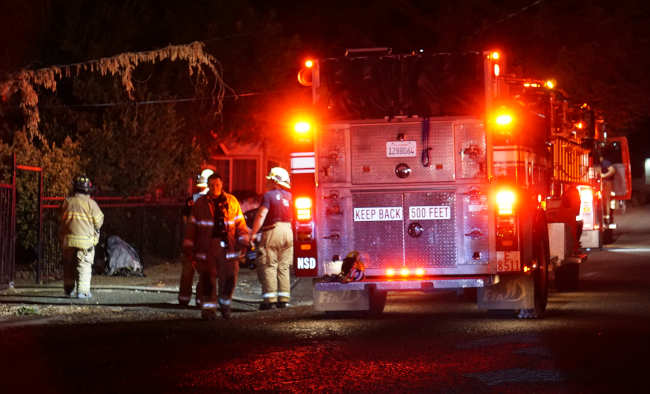
NICE, Calif. — A home in Nice sustained serious damage in a Thursday evening fire.
Northshore Fire reported that the fire was first dispatched at 6:43 p.m.
Firefighters responded to the stick built home, in the 6700 block of Keeling Avenue, on the report of a room on fire.
Two people were at home at the time the fire broke out. There were no injuries.
Within 15 minutes firefighters had knocked down the blaze, which they kept from spreading to vegetation or other nearby homes and structures.
Although the fire was contained to the room of origin, there was extensive smoke damage. Officials estimated that 50% of the home sustained damage.
Resources responding to the scene from Northshore Fire and Cal Fire included a total of five engines, one water tender, one medic unit, the Northshore Support Team, and two overhead of command staff.
The cause of the fire was not reported.
Email Elizabeth Larson at
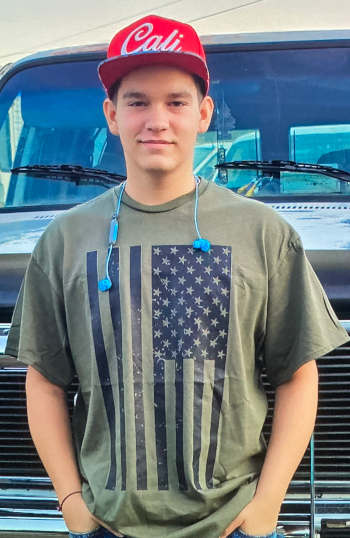
CLEARLAKE, Calif. — The Clearlake Police Department is seeking assistance in locating a missing teenage boy.
Police are trying to locate Connor Howells, 14.
Connor was last seen on Thursday in the area of 31st Avenue in Clearlake, wearing a dark gray shirt, blue jeans and white shoes.
He is described as a white male juvenile with short brown hair, and hazel eyes. He is 5 feet 10 inches tall, and weighs 150 pounds.
If you have any information regarding his whereabouts, please contact the Clearlake Police Department at 707-994-8251, Extension 1.
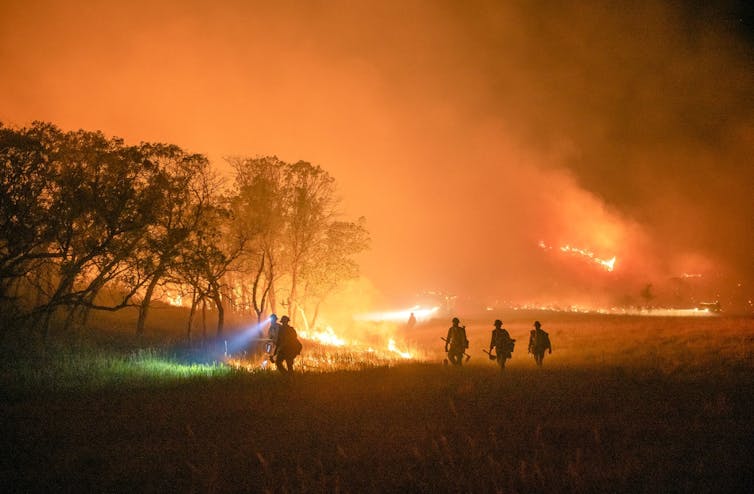
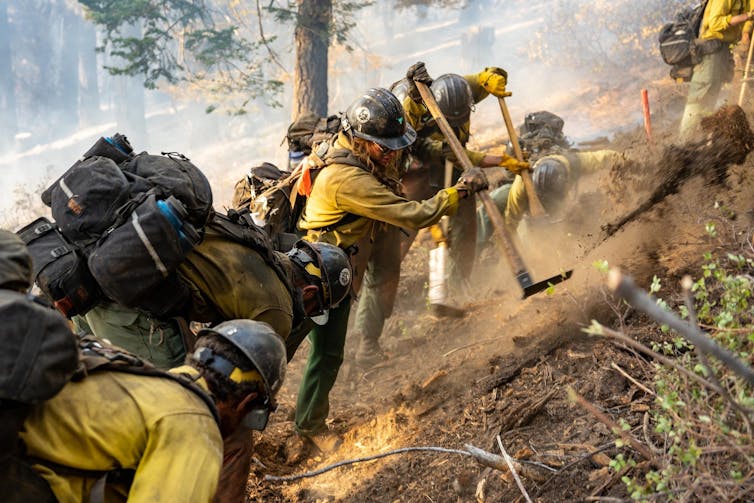
Radios crackle with chatter from a wildfire incident command post. Up the fireline, firefighters in yellow jerseys are swinging Pulaskis, axlike hand tools, to carve a fuel break into the land.
By 10 a.m., these firefighters have already hiked 3 miles up steep, uneven terrain and built nearly 1,200 feet of fireline.
It’s physically exhausting work and essential for protecting communities as wildfire risks rise in a warming world. Hotshot crews like this one, the U.S. Forest Service’s Lolo Hotshots, are the elite workforce of the forests. When they’re on the fireline, their bodies’ total daily energy demands can rival that of the cyclists in the Tour de France, as my team’s research with wildland fire crews shows.
These firefighters are also caught in Congress’ latest budget battle, where demands by far-right House members to slash federal spending could lead to a governmentwide shutdown after the fiscal year ends on Sept. 30, 2023.
After extreme fire seasons in 2020 and 2021, Congress funded a temporary bonus that boosted average U.S. Forest Service wildland firefighter pay by either 50% or US$20,000, whichever was lower. But that increase expires after Sept. 30, knocking many federal firefighters back to earning the minimum $15 per hour.
Legislation to make the raise permanent is pending before Congress, which is now preoccupied. A short-term pay boost may be possible, but that doesn’t solve the long-term pay problem. And if the government shuts down, federal firefighters will likely be working without immediate pay. The National Federation of Federal Employees warns that a large number of firefighters could quit if their pay also drops.
Firefighters push their bodies to extremes
Life on the fireline is demanding. Pack straps dig into the neck and shoulders with each swing of the Pulaski. It’s a constant reminder that everything wildland firefighters need, they carry – all day.
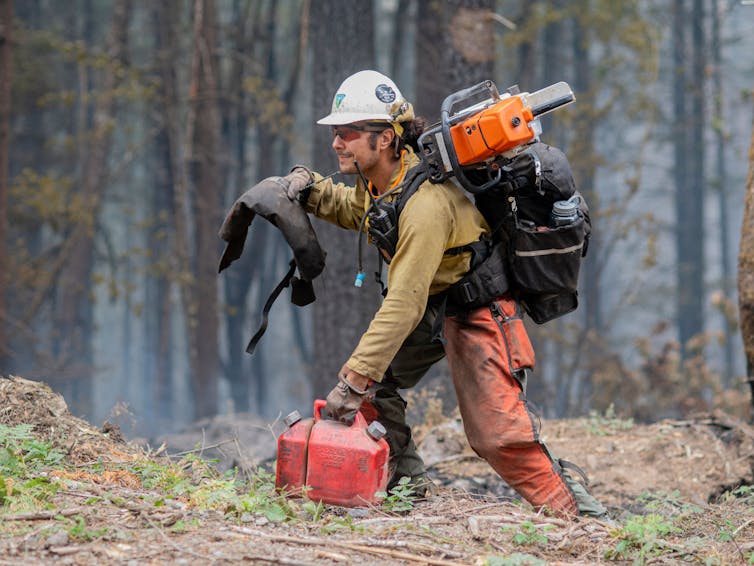
The critical water and food items, supplies, extra gear and fireline tools – Pulaskis, chain saws and fuel – add up to an average gear weight often exceeding 50 pounds.
Hiking with a load and digging firelines with hand tools burns about 6 to 14 calories per minute. Heart rates rise in response to an increased pace of digging.
Measured with the same techniques used to quantify the energy demands of Tour de France riders, wildland firefighters demonstrate an average total energy expenditure approaching 4,000 to 5,000 calories per day. Some days can exceed the Tour’s average of about 6,000 calories, equivalent to around 12 McDonald’s Happy Meals. Add to that a daily water need of 1.5 to over 2 gallons.
This isn’t just for a few days. Fire season in the western United States can last five months or more, with most Hotshot crews accumulating four to five times the number of operational days of the 22-day Tour de France and over 1,000 hours of overtime.
The physical demand of a day on the fireline
My team has been measuring the physical strain and total energy demands of work on an active wildfire, with the goal of finding ways to improve firefighter fueling strategies and health and safety on the line.
The crew members we work with are outfitted with a series of lightweight monitors that measure heart rate, as well as movement patterns and speed, using GPS. Each participant swallows a temperature-tracking sensor before breakfast that will record core body temperature each minute throughout the work shift.
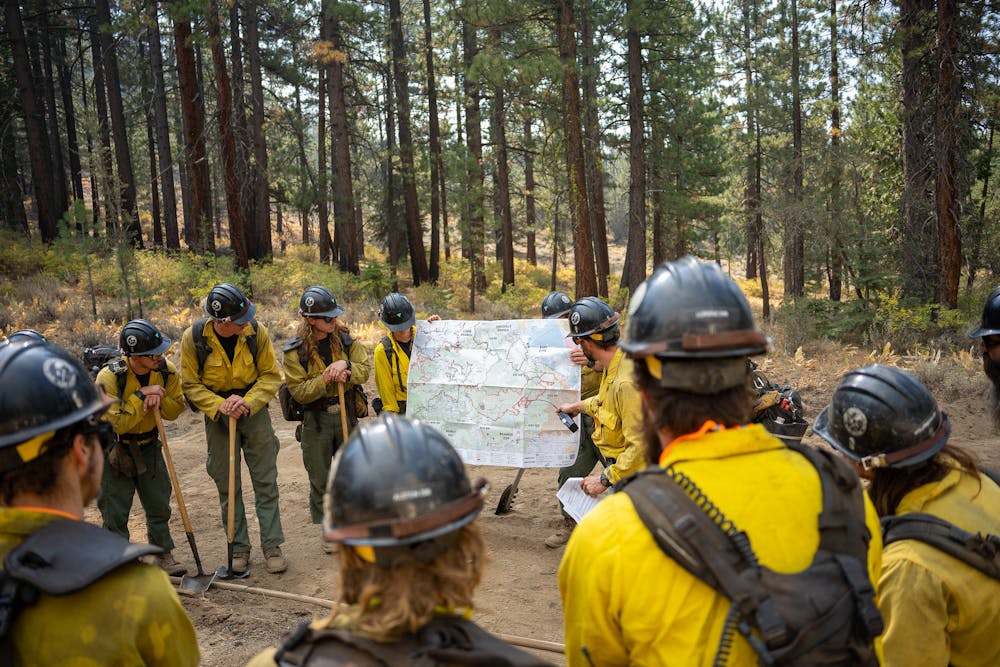
As the work shift progresses, the Hotshots constantly monitor their surroundings and self-regulate their nutrient and fluid intake, knowing their shift could last 12 to 16 hours.
During intense activity in high heat, their fluid intake can increase to 32 ounces per hour or more.
The highest-intensity activity is generally during the early morning hike to the fireline. However, the metabolic demands can sharply increase if crews are forced into a rapid emergency evacuation from the fire.
My team’s research has found that the most effective way for wildland firefighters to stay fueled is to eat small meals frequently throughout the work shift, similar to the patterns perfected by riders in the Tour. This preserves cognitive health, helping firefighters stay focused and sharp for making potentially lifesaving decisions and keenly aware of their ever-dynamic surroundings, and boosts their work performance. It also helps slow the depletion of important muscle fuel.
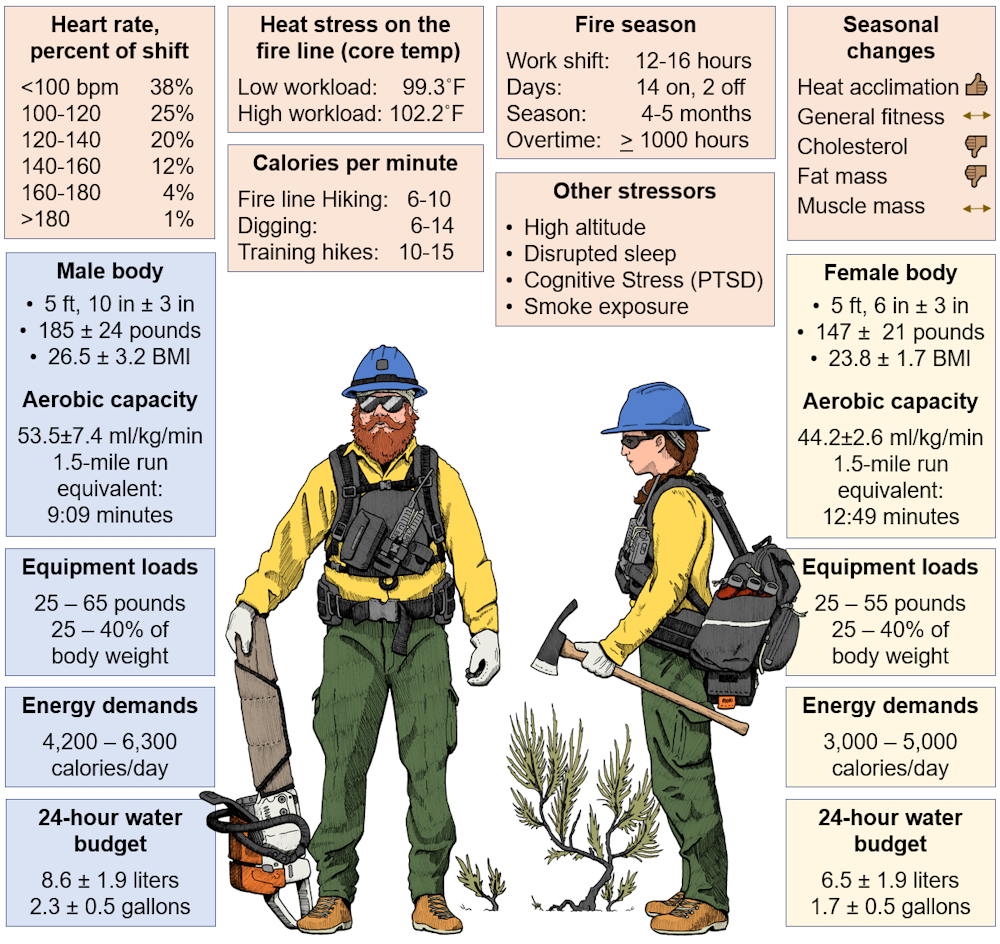
Although crews gradually acclimatize to the heat over the season, the risk for heat exhaustion is ever present if the work rate is not kept in check. This cannot be prevented by simply drinking more water during long work shifts. However, regular breaks and having a strong aerobic capacity provides some protection by reducing heat stress and overall risk.
The season takes a toll
Hotshots are physically fit, and they train for the fire season just as many athletes train for their competition season. Most crew members are hired temporarily during the fire season – typically from May to October, but that’s expanding as the planet warms. And there are distinct fitness requirements for the job. The physical preparations are demanding, take months and are expected, even when temporary crew members are not officially employed by the agencies.
Still, with the immense physical demands of the job, crew members often experience a decay in metabolic and cardiovascular health and an increase in cholesterol, blood lipids and body fat. It is unclear why such a hardworking job often makes firefighters less healthy, requiring an off-season reset to recover, retrain and rebuild.
The season causes damage. This unfolds counter to the commonly accepted benefits of regular exercise. Pollutant and smoke exposure, lapses in nutrition, sleep disorders and chronic stress during the season seem to gradually poke holes in the Hotshot armor.
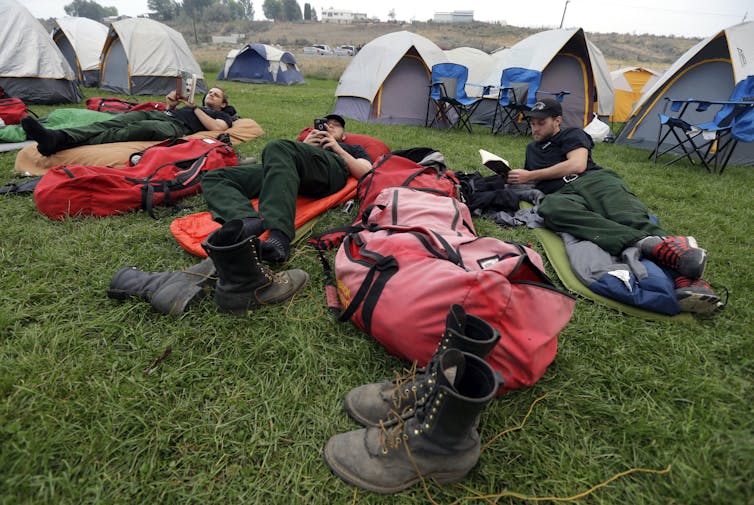
Progressive intervention strategies can help, such as educational programs on specific physical training and nutritional needs, mindfulness training to reduce the risk of job-oriented anxiety and depression, and emotional support for crew members and families. However, these require agency and congressional investment, a commitment beyond ensuring pay raises remain intact. Removing either is synonymous with taking away critical tools for the job on the firelines.
Developing offseason practices that pay close attention to both physical and mental health recovery can help limit harm to firefighters’ health. Many Hotshots have bounced back and returned season after season. However, a government shutdown and failure to act on pay with no thought to the health and safety of front-line fire crews could worsen crew retention in an already dwindling workforce.
This is an update to an article originally published Aug. 8, 2023.
Brent C. Ruby, Professor of exercise and work physiology, University of Montana
This article is republished from The Conversation under a Creative Commons license. Read the original article.