 How to resolve AdBlock issue?
News
The event aimed to facilitate the reintegration of justice-involved individuals into society by offering a range of services, including record expungement, information about college education opportunities, and even free tattoo removal services.
Additionally, attendees had the valuable opportunity to learn from inspirational keynote speakers who have successfully transitioned from incarceration to leading fulfilling lives.
"Lake County Probation Department is dedicated to empowering justice-involved individuals with the resources they need to embark on transformative journeys," said Chief Probation Officer Wendy Mondfrans. "We are thankful for the participation of the inspirational speakers who shared their inspirational stories with us. This event underscores the profound, positive influence that access to resources can have on justice-involved individuals."
The speakers included Randall Cole, an accomplished author and substance abuse counselor; Caressa Smith, the dedicated manager of the Hope Center and a passionate advocate for second chances; Jennifer Nauert, a substance abuse disorder counselor holding a master's degree from Cal Poly Humboldt; and Elizabeth Quiroz, a distinguished author, co-founder of the Redemption House, and a master's candidate in Social Justice and Human Rights at Arizona State University.

Between the record-breaking global heat and extreme downpours, it’s hard to ignore that something unusual is going on with the weather in 2023.
People have been quick to blame climate change – and they’re right: human-caused global warming plays the biggest role. The weekslong heat wave that started in June 2023 in Texas, the U.S. Southwest and Mexico would have been virtually impossible without it, one study found.
However, the extremes this year are sharper than anthropogenic global warming alone would be expected to cause. September temperatures were far above any previous September, and around 3.1 degrees Fahrenheit (1.75 degrees Celsius) above the preindustrial average, according to the European Union’s earth observation program.
July was Earth’s hottest month on record, also by a large margin, with average global temperatures more than half a degree Fahrenheit (a third of a degree Celsius) above the previous record, set just a few years earlier in 2019.
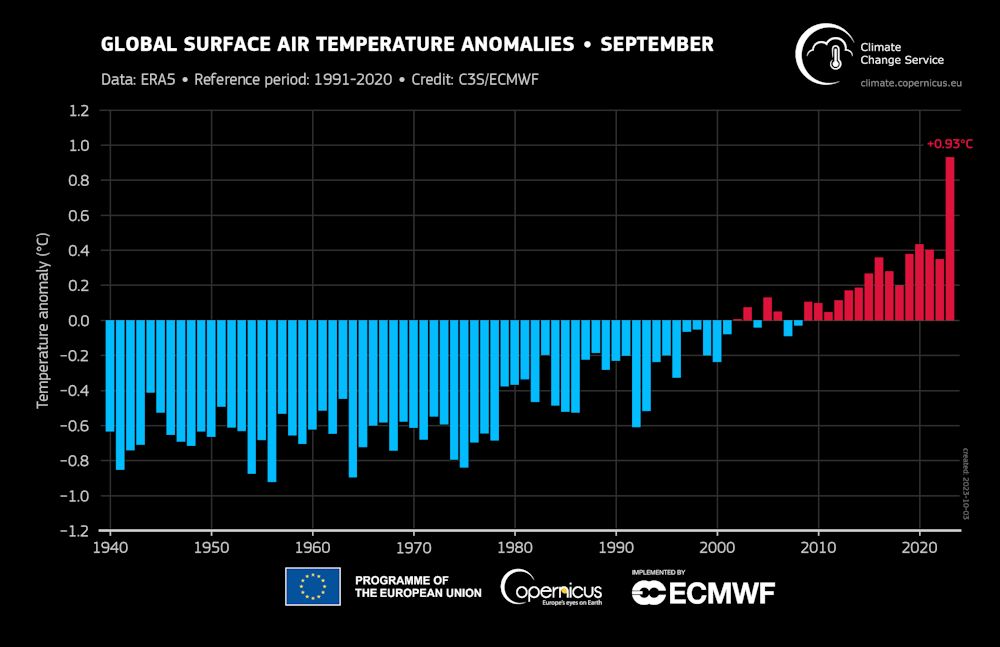
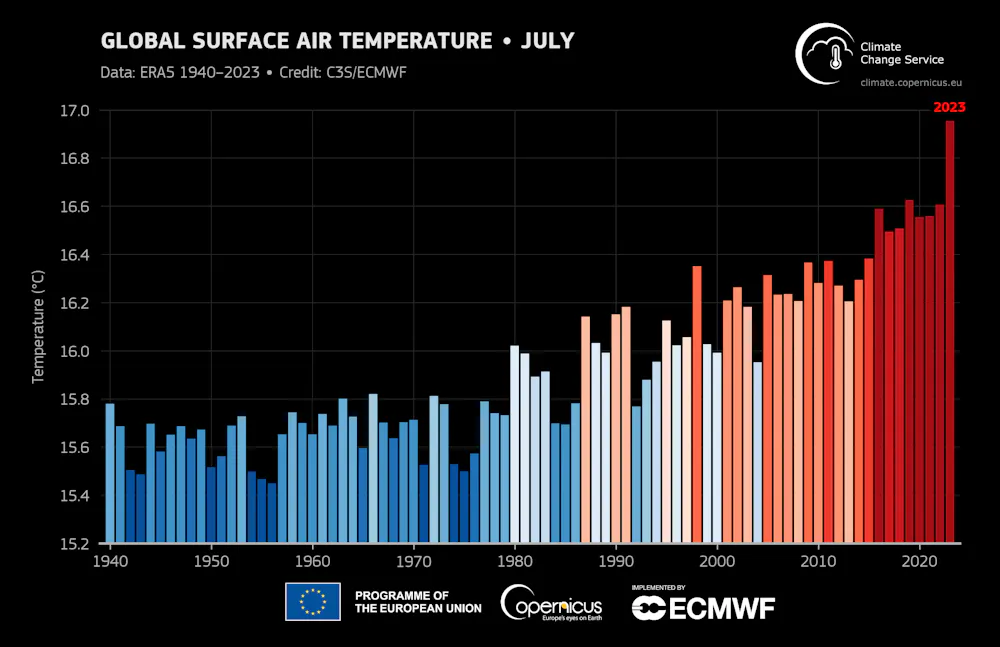
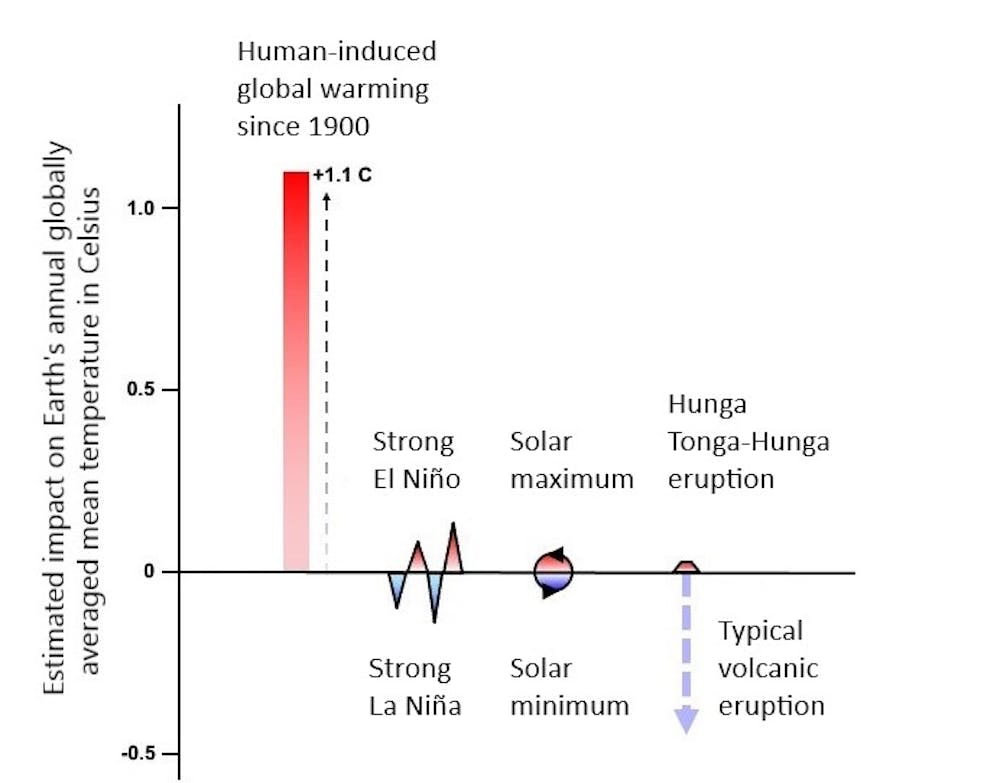
Human activities have been increasing temperatures at an average of about 0.2 F (0.1 C) per decade. But this year, three additional natural factors are also helping drive up global temperatures and fuel disasters: El Niño, solar fluctuations and a massive underwater volcanic eruption.
Unfortunately, these factors are combining in a way that is exacerbating global warming. Still worse, we can expect unusually high temperatures to continue, which means even more extreme weather in the near future.
How El Niño is involved
El Niño is a climate phenomenon that occurs every few years when surface water in the tropical Pacific reverses direction and heats up. That warms the atmosphere above, which influences temperatures and weather patterns around the globe.
Essentially, the atmosphere borrows heat out of the Pacific, and global temperatures increase slightly. This happened in 2016, the time of the last strong El Niño. Global temperatures increased by about 0.25 F (0.14 C) on average, making 2016 the warmest year on record. A weak El Niño also occurred in 2019-2020, contributing to 2020 becoming the world’s second-warmest year.
El Niño’s opposite, La Niña, involves cooler-than-usual Pacific currents flowing westward, absorbing heat out of the atmosphere, which cools the globe. The world just came out of three straight years of La Niña, meaning we’re experiencing an even greater temperature swing.
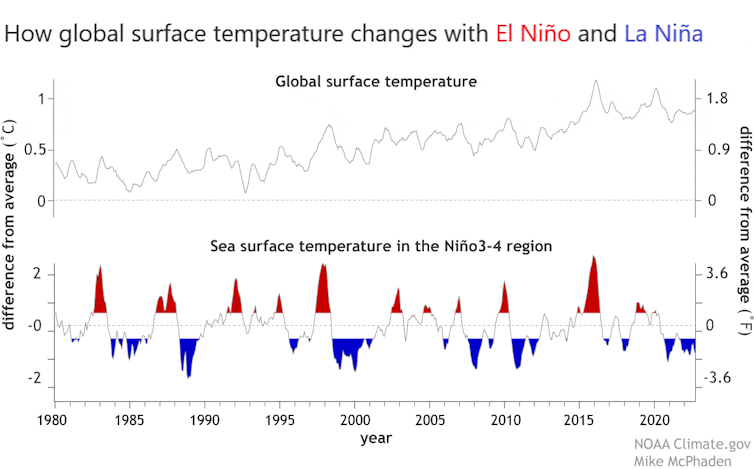
Based on increasing Pacific sea surface temperatures in mid-2023, climate modeling now suggests a 90% chance that Earth is headed toward its first strong El Niño since 2016.
Combined with the steady human-induced warming, Earth may soon again be breaking its annual temperature records. June 2023 was the hottest in modern record. July saw global records for the hottest days and a large number of regional records, including an incomprehensible heat index of 152 F (67 C) in Iran.
Solar fluctuations
The Sun may seem to shine at a constant rate, but it is a seething, churning ball of plasma whose radiating energy changes over many different time scales.
The Sun is slowly heating up and in half a billion years will boil away Earth’s oceans. On human time scales, however, the Sun’s energy output varies only slightly, about 1 part in 1,000, over a repeating 11-year cycle. The peaks of this cycle are too small for us to notice at a daily level, but they affect Earth’s climate systems.
Rapid convection within the Sun both generates a strong magnetic field aligned with its spin axis and causes this field to fully flip and reverse every 11 years. This is what causes the 11-year cycle in emitted solar radiation.
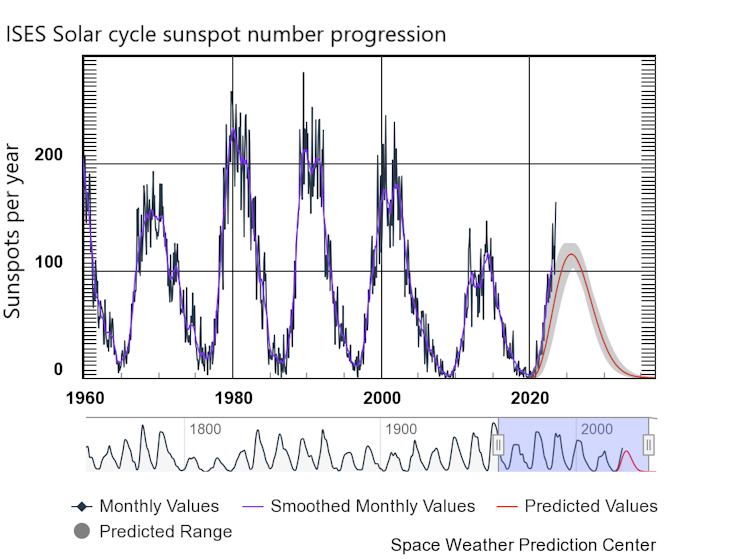
Earth’s temperature increase during a solar maximum, compared with average solar output, is only about 0.09 F (0.05 C), roughly a third of a large El Niño. The opposite happens during a solar minimum. However, unlike the variable and unpredictable El Niño changes, the 11-year solar cycle is comparatively regular, consistent and predictable.
The last solar cycle hit its minimum in 2020, reducing the effect of the modest 2020 El Niño. The current solar cycle has already surpassed the peak of the relatively weak previous cycle (which was in 2014) and will peak in 2025, with the Sun’s energy output increasing until then.
A massive volcanic eruption
Volcanic eruptions can also significantly affect global climates. They usually do this by lowering global temperatures when erupted sulfate aerosols shield and block a portion of incoming sunlight – but not always.
In an unusual twist, the largest volcanic eruption of the 21st century so far, the 2022 eruption of Tonga’s Hunga Tonga-Hunga Ha’apai, is having a warming and not cooling effect.
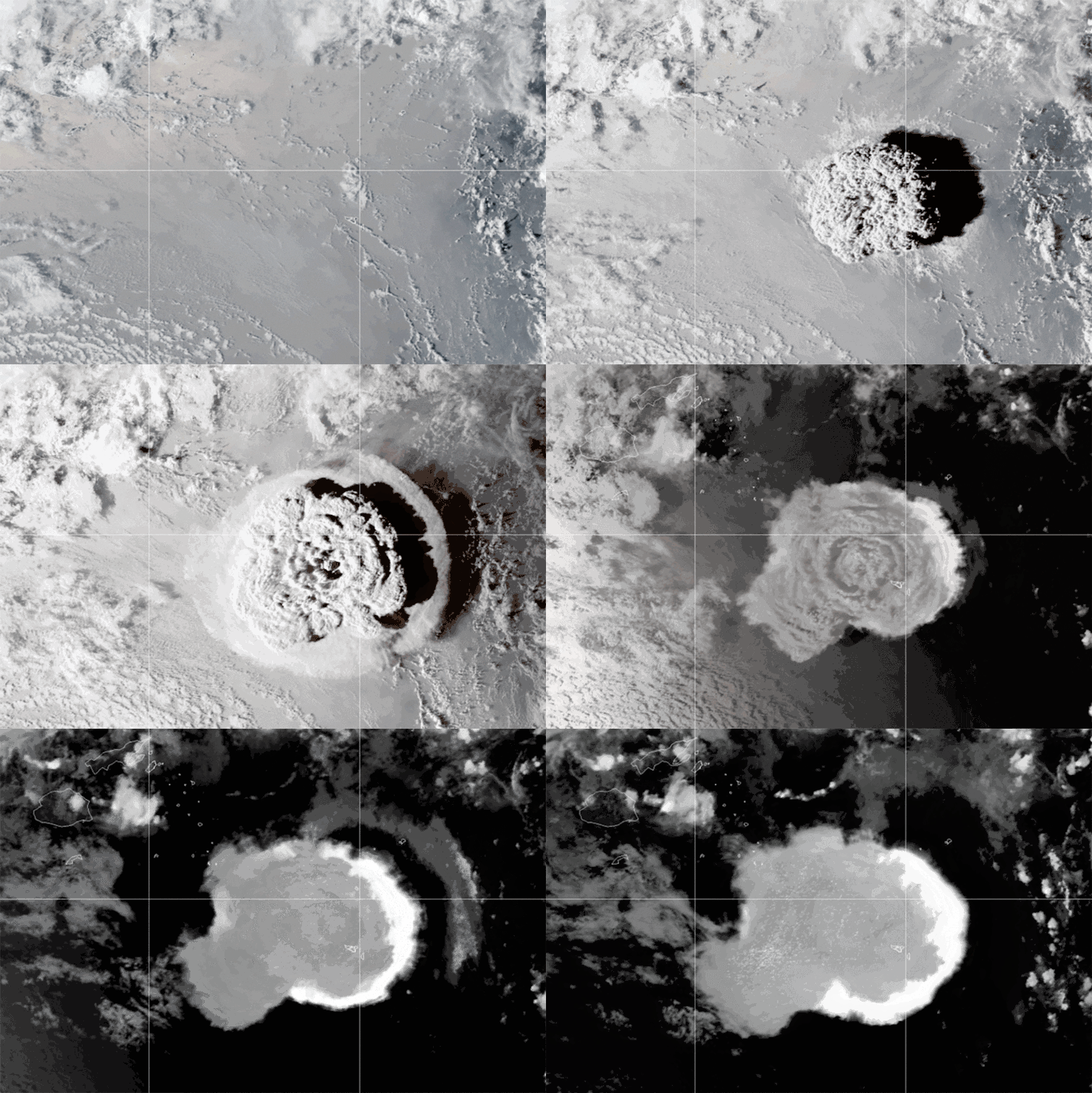
The eruption released an unusually small amount of cooling sulfate aerosols but an enormous amount of water vapor. The molten magma exploded underwater, vaporizing a huge volume of ocean water that erupted like a geyser high into the atmosphere.
Water vapor is a powerful greenhouse gas, and the eruption may end up warming Earth’s surface by about 0.06 F (0.035 C), according to one estimate. Unlike the cooling sulfate aerosols, which are actually tiny droplets of sulfuric acid that fall out of the atmosphere within one to two years, water vapor is a gas that can stay in the atmosphere for many years. The warming impact of the Tonga volcano is expected to last for at least five years.
Underlying it all: Global warming
All of this comes on top of anthropogenic, or human-caused, global warming.
Humans have raised global average temperatures by about 2 F (1.1 C) since 1900 by releasing large volumes of greenhouse gases, particularly carbon dioxide, into the atmosphere. The amount of carbon dioxide in the atmosphere is up 50%, primarily from the combustion of fossil fuels in vehicles and power plants. The warming from greenhouse gases is actually greater than 2 F (1.1 C), but it has been masked by other human factors that have a cooling effect, such as air pollution.
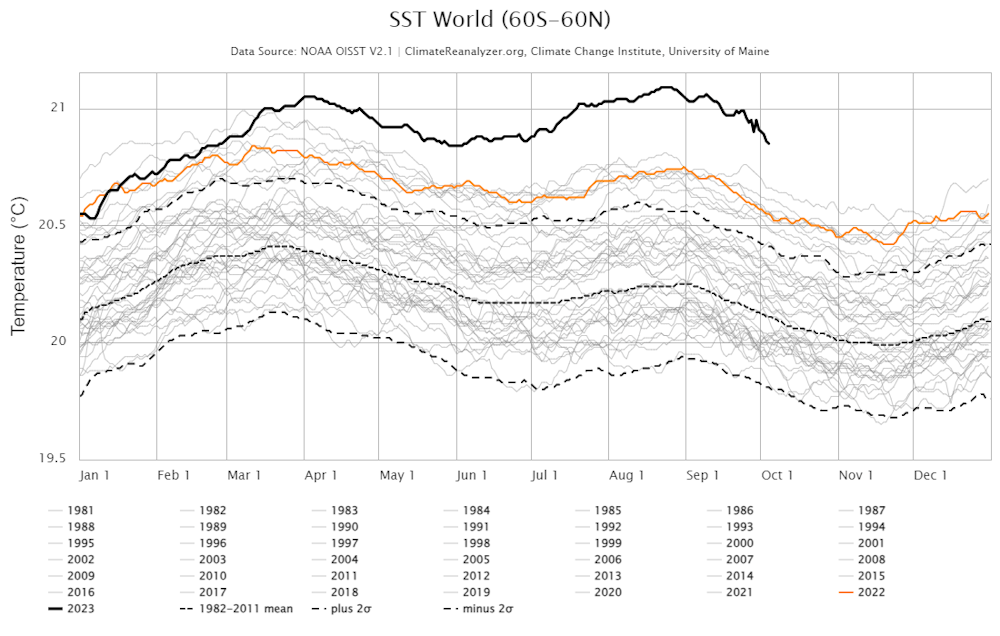
If human impacts were the only factors, each successive year would set a new record as the hottest year ever, but that doesn’t happen. The year 2016 was the warmest in part because temperatures were boosted by the last large El Niño.
What does this mean for the future?
The next couple of years could be very rough.
If a strong El Niño develops over the coming months as forecasters expect, combined with the solar maximum and the effects of the Hunga Tonga-Hunga Ha’apai eruption, Earth’s temperatures will likely continue to soar.
As temperatures continue to increase, weather events get more extreme. The excess heat can mean more heat waves, forest fires, flash floods and other extreme events, climate models show.

In January 2023, scientists wrote that Earth’s temperature had a greater than 50% chance of reaching 2.7 F (1.5 C) above preindustrial era temperatures by the year 2028, at least temporarily, increasing the risk of triggering climate tipping points with even greater human impacts. Because of the unfortunate timing of several parts of the climate system, it seems the odds are not in our favor.
This article, originally published July 27, 2023, has been updated with September’s record heat.
Michael Wysession, Professor of Earth, Environmental, and Planetary Sciences, Arts & Sciences at Washington University in St. Louis
This article is republished from The Conversation under a Creative Commons license. Read the original article.


Curious Kids is a series for children of all ages. If you have a question you’d like an expert to answer, send it to
How do we know the age of the planets and stars? – Swara D., age 13, Thane, India
Measuring the ages of planets and stars helps scientists understand when they formed and how they change – and, in the case of planets, if life has had time to have evolved on them.
Unfortunately, age is hard to measure for objects in space.
Stars like the Sun maintain the same brightness, temperature and size for billions of years. Planet properties like temperature are often set by the star they orbit rather than their own age and evolution.
Determining the age of a star or planet can be as hard as guessing the age of a person who looks exactly the same from childhood to retirement.
Sussing out a star’s age
Fortunately, stars change subtly in brightness and color over time. With very accurate measurements, astronomers can compare these measurements of a star to mathematical models that predict what happens to stars as they get older and estimate an age from there.
Stars don’t just glow, they also spin. Over time, their spinning slows down, similar to how a spinning wheel slows down when it encounters friction. By comparing the spin speeds of stars of different ages, astronomers have been able to create mathematical relationships for the ages of stars, a method known as gyrochronology.
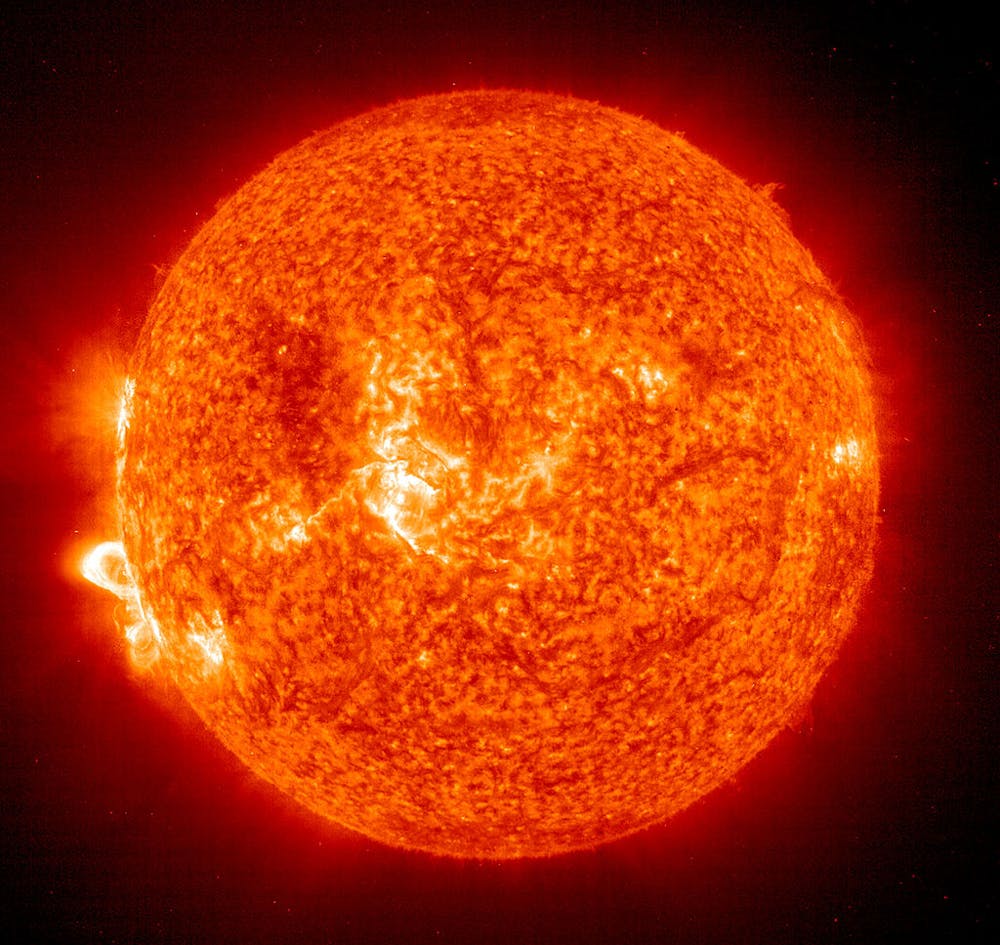
A star’s spin also generates a strong magnetic field and produces magnetic activity, such as stellar flares – powerful bursts of energy and light that occur on stars’ surfaces. A steady decline in magnetic activity from a star can also help estimate its age.
A more advanced method for determining the ages of stars is called asteroseismology, or star shaking. Astronomers study vibrations on the surfaces of stars caused by waves that travel through their interiors. Young stars have different vibrational patterns than old stars. By using this method, astronomers have estimated the Sun to be 4.58 billion years old.
Piecing together a planet’s age
In the solar system, radionuclides are the key to dating planets. These are special atoms that slowly release energy over a long period of time. As natural clocks, radionuclides help scientists determine the ages of all kinds of things, from rocks to bones and pottery.
Using this method, scientists have determined that the oldest known meteorite is 4.57 billion years old, almost identical to the Sun’s asteroseismology measurement of 4.58 billion years. The oldest known rocks on Earth have slightly younger ages of 4.40 billion years. Similarly, soil brought back from the Moon during the Apollo missions had radionuclide ages of up to 4.6 billion years.
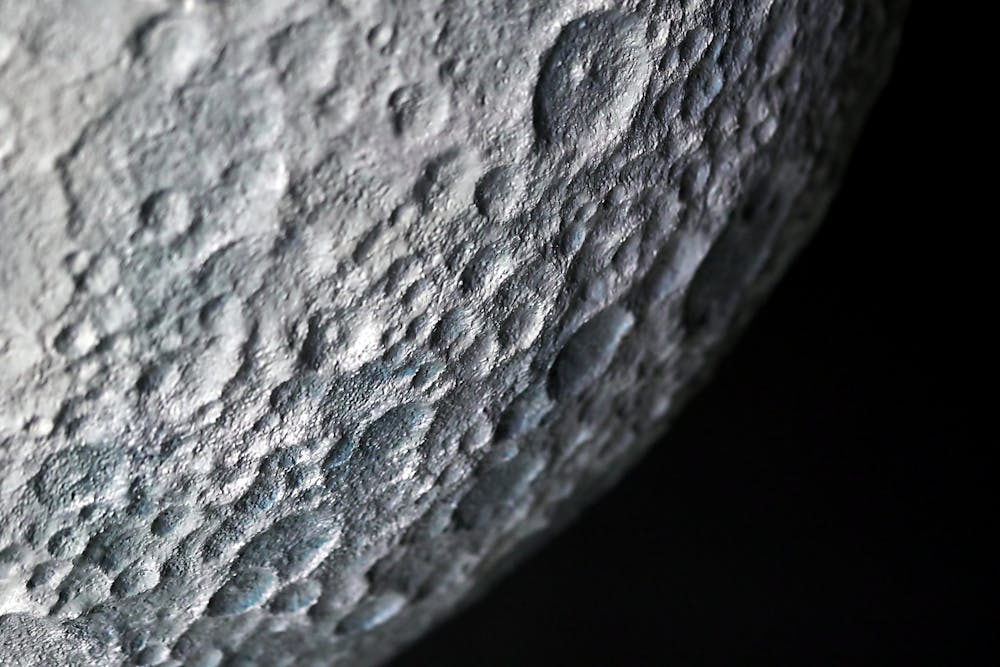
Although studying radionuclides is a powerful method for measuring the ages of planets, it usually requires having a rock in hand. Typically, astronomers only have a picture of a planet to go by. Astronomers often determine the ages of rocky space objects like Mars or the Moon by counting their craters. Older surfaces have more craters than younger surfaces. However, erosion from water, wind, cosmic rays and lava flow from volcanoes can wipe away evidence of earlier impacts.
Aging techniques don’t work for giant planets like Jupiter that have deeply buried surfaces. However, astronomers can estimate their ages by counting craters on their moons or studying the distribution of certain classes of meteorites scattered by them, which are consistent with radionuclide and cratering methods for rocky planets.
We cannot yet directly measure the ages of planets outside our solar system with current technology.
How accurate are these estimates?
Our own solar system provides the best check for accuracy, since astronomers can compare the radionuclide ages of rocks on the Earth, Moon, or asteroids to the asteroseismology age of the Sun, and these match very well.
Stars in clusters like the Pleiades or Omega Centauri are believed to have all formed at roughly the same time, so age estimates for individual stars in these clusters should be the same. In some stars, astronomers can detect radionuclides like uranium – a heavy metal found in rocks and soil – in their atmospheres, which have been used to check the ages from other methods.
Astronomers believe planets are roughly the same age as their host stars, so improving methods to determine a star’s age helps determine a planet’s age as well. By studying subtle clues, it’s possible to make an educated guess of the age of an otherwise steadfast star.
Hello, curious kids! Do you have a question you’d like an expert to answer? Ask an adult to send your question to
And since curiosity has no age limit – adults, let us know what you’re wondering, too. We won’t be able to answer every question, but we will do our best.
Adam Burgasser, Professor of Astronomy & Astrophysics, University of California, San Diego
This article is republished from The Conversation under a Creative Commons license. Read the original article.
The commission will meet at 5:30 p.m. Wednesday, Oct. 11, in the council chambers at Lakeport City Hall, 225 Park St.
The council chambers will be open to the public for the meeting. Masks are highly encouraged where 6-foot distancing cannot be maintained.
The agenda is available here.
To speak on an agenda item, access the meeting remotely here; the meeting ID is 814 1135 4347, pass code is 847985.
To join by phone, dial 1-669-444-9171; for one tap mobile, +16694449171,,81411354347#,,,,*847985#.
Comments can be submitted by email to
On the agenda is city staff’s request for the Planning Commission to consider making a recommendation to the City Council regarding whether to permit retail storefront cannabis businesses and/or temporary cannabis events in Lakeport.
Community Development Director Joey Hejnowicz’s report for the meeting recommends that the Planning Commission have a study session on retail storefront cannabis businesses and temporary cannabis events and provide discussion and input on the topics.
Hejnowicz said the Lakeport City Council passed Chapter 5.34 of the Lakeport Municipal Code in 2018. It regulates commercial cannabis activities in the city.
He said cannabis retailers with storefront sales are not included in Chapter 5.34. “Nearby jurisdictions including Clearlake, Ukiah, Willits, Ft. Bragg and the County of Lake all permit retail storefront cannabis sales to various degrees. Five years has passed since Chapter 5.34 was enacted and staff would like to provide City Council the opportunity to revisit the retail storefront cannabis business discussion understanding the Council’s views on the matter may have changed.”
Email Elizabeth Larson at

NORTHERN CALIFORNIA — An attorney who has served in several Northern California counties, including Lake, has been appointed as a judge by Gov. Gavin Newsom.
John Hinely, of Colusa County, has been appointed to serve as a judge in the Sutter County Superior Court, Newsom’s office said Thursday.
Hinely has served as a commissioner for the Superior Courts of Colusa, Glenn, Plumas and Tehama counties since 2022.
He also has served as a defense attorney in Lake County.
He was an adjunct professor at Cal Northern School of Law from 2021 to 2023 and an attorney at the California Department of Housing and Community Development from 2020 to 2022.
Hinely served as a judge pro tem at the Colusa County Superior Court from 2019 to 2022 and was a sole practitioner from 2008 to 2020.
He earned a Juris Doctor degree from Cal Northern School of Law.
Hinely fills the vacancy of a new position created on July 1, 2022.
He is registered without party preference.

CLEARLAKE, Calif. — Clearlake Animal Control has more than a dozen new dogs in need of new homes.
The Clearlake Animal Control website lists 52 adoptable dogs.
This week’s new dogs include “Smiley,” a male pit bull mix with a gray coat.

There also is “Doggie,” a male German shepherd mix with a tan coat.
The shelter is located at 6820 Old Highway 53. It’s open from 9 a.m. to 6 p.m. Tuesday through Saturday.
For more information, call the shelter at 707-762-6227, email
This week’s adoptable dogs are featured below.
Email Elizabeth Larson at