 How to resolve AdBlock issue?
News

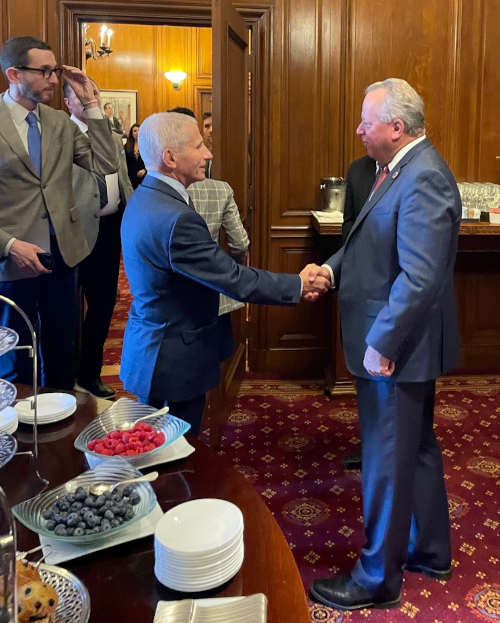
SAN FRANCISCO – At a ceremony inside San Francisco City Hall last week, Sen. Bill Dodd, D-Napa, joined Senator Scott Weiner and Assemblymember Phil Ting, D-San Francisco, in honoring Dr. Anthony Fauci.
Fauci is the former director of the National Institute of Allergy and Infectious Diseases and chief medical advisor to the president who guided the nation through the coronavirus pandemic.
“It was truly an honor to meet Dr. Fauci, whose steadfast commitment to science and medicine saved so many lives,” Sen. Dodd said. “He was our North Star during the pandemic, guiding us with unflinching honesty through the darkest times to a course that ultimately led to reduced infections. Even before that, he worked tirelessly in the fight against other deadly threats including the AIDS epidemic and a host of other infectious diseases. It’s my privilege to be able to recognize him for his lifetime of achievement.”
Sen. Dodd presented Dr. Fauci with and official Senate resolution Wednesday inside the office of San Francisco Mayor London Breed.
Co-signers on the resolution were Sen. Scott Wiener, D-San Francisco, and Assembly member Phil Ting, D-San Francisco.
Dodd, who formerly represented Lake County in the state Assembly, now represents the Third Senate District, which includes all or portions of Napa, Solano, Yolo, Sonoma, Contra Costa, and Sacramento counties.
Reading ability among U.S. students remained low in 2022, with 37% of fourth graders and 30% of eighth graders scoring below the basic proficiency levels for reading set by the National Assessment of Educational Progress.
Although the COVID-19 school shutdowns are responsible for some of the learning loss, the numbers weren’t particular good prior to the pandemic, either – reading scores for U.S. students have been low for decades.
SciLine interviewed Dr. Shayne Piasta, a professor of reading and literacy at The Ohio State University and a faculty associate at the Crane Center for Early Childhood Research and Policy. Piasta discussed the various methods of reading instruction and how to get kids to love it.
Below are some highlights from the discussion. Answers have been edited for brevity and clarity.
What is meant by the ‘science of reading’? And what are the misconceptions?
Shayne Piasta: The science of reading refers to the accumulated knowledge base we have from scientific research about the reading process, its components, how reading skills develop and how we can best support those who are learning to read.
One of the misconceptions I see is that the science of reading is equated with phonics instruction.
But the science of reading is a knowledge base, not a specific approach. Phonics instruction is a specific approach, whereby one is explicitly and intentionally teaching children all of those important links between letters and sounds, both at an individual letter level – like learning the alphabet – and at higher skill levels, such as learning about some complex spelling conventions that we have in the English language.
Although phonics instruction is a necessary component in learning to read, phonics instruction alone, without attending to other key reading components, such as language, comprehension, and concept and background knowledge, is insufficient.
What critical components are needed for a reading curriculum to be successful?
Shayne Piasta: First and foremost, I would expect a reading program to have a scope and sequence, meaning there is predetermined content of what’s going to be covered. And then that it’s in a particular order, often building from more simple skills or concepts to more complex ones.
This might apply to phonics instruction, where we’re going from simple letter sound correspondences and building up to more complex associations between letters, spelling patterns and how words are pronounced.
Any successful reading program should have a scope and sequence. It should definitely have it for the phonics component, but it should have it for other components as well.
What role does background knowledge play in learning to read?
Shayne Piasta: We’re learning more and more about how critical concept knowledge and background knowledge are for successful reading.
To understand the meaning being conveyed by text, which is the ultimate goal, children use the information they already know to make sense of text. A famous example involves a study in which children read a written passage about baseball. Children who knew a lot about baseball best understood the passage, regardless of reading ability.
This highlights the role of concept and background knowledge as foundations for understanding text meaning, and thus, reading comprehension.
Any reading curriculum should have opportunities for children to build those skills – to learn about our world, to make connections with the world, to make connections across different sources and types of information. This is particularly important given the diversity of classrooms. Educators cannot assume that children share certain knowledge or backgrounds.
Teachers need to provide opportunities to discuss and learn about concepts that children will read about. This includes topics like baseball as well as academic concepts like photosynthesis. And then they bring that conceptual and background knowledge with them when they’re going to read a new piece about a certain topic so they can actually make sense of it.
Again, it’s not phonics only. It’s phonics and these opportunities to support knowledge building as well as language skills.
Are any approaches especially effective for children from marginalized backgrounds?
Shayne Piasta: There are many evidence-based practices for building language for both children who speak English only and those who are English learners. This includes exposing children to more complex grammar during conversations and using routines to improve awareness of new vocabulary words.
The science of reading applies to all learners. Most practices that we would recommend are going to be helpful for students from a range of different backgrounds. That being said, it’s important to be able to identify the strengths and the learning needs of individual children.
How can parents support kids who are learning to read?
Shayne Piasta: For parents, I would recommend focusing on creating positive literacy environments at home. That is, having children see you reading, having children see you writing, and being clear about how literacy plays a role in your everyday life – not just having storybook time together or reading together, but doing activities like making grocery lists together.
Or maybe you could point out, “Hey, I’m reading these instructions so I can put together this piece of Ikea furniture.” So you’re really highlighting all of the important roles that literacy plays in daily life. In doing so, you can help children build positive connections with those reading opportunities so that it’s fun, engaging and something they want to do.
Watch the full interview to hear more.
SciLine is a free service based at the nonprofit American Association for the Advancement of Science that helps journalists include scientific evidence and experts in their news stories.
Shayne Piasta, Professor of Reading and Literacy, The Ohio State University
This article is republished from The Conversation under a Creative Commons license. Read the original article.
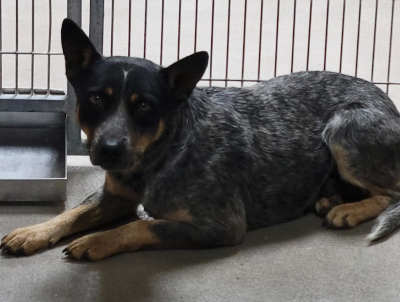
LAKE COUNTY, Calif. — Lake County Animal Care and Control has more new dogs waiting to be adopted.
Dogs available for adoption this week include mixes of boxer, German shepherd, hound, Labrador retriever pit bull, Siberian husky, schnauzer, shepherd and Yorkshire terrier.
Dogs that are adopted from Lake County Animal Care and Control are either neutered or spayed, microchipped and, if old enough, given a rabies shot and county license before being released to their new owner. License fees do not apply to residents of the cities of Lakeport or Clearlake.
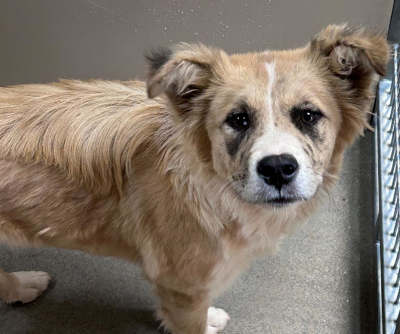
Some of this week’s dogs include “Rusty,” a 2-year-old Australian cattle dog with a blue and black coat. He’s in kennel No. 25, ID No. LCAC-A-6097.
A 9-month-old female collie mix is in kennel No. 12, ID No. LCAC-A-5984. She has a brown and white coat.
There also is a 4-year-old male SIberian husky with a red and white coat. He is in kennel No. 24, ID No. LCAC-A-5891.
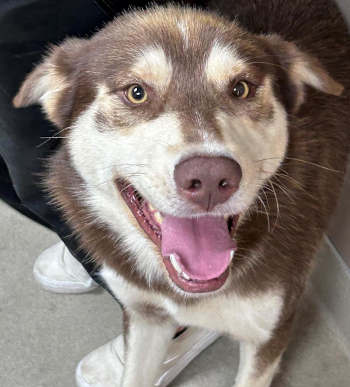
Those dogs and the others shown on this page at the Lake County Animal Care and Control shelter have been cleared for adoption.
Call Lake County Animal Care and Control at 707-263-0278 or visit the shelter online for information on visiting or adopting.
Email Elizabeth Larson at
Though a doomed star exploded some 20,000 years ago, its tattered remnants continue racing into space at breakneck speeds — and NASA's Hubble Space Telescope has caught the action.
The nebula, called the Cygnus Loop, forms a bubble-like shape that is about 120 light-years in diameter. The distance to its center is approximately 2,600 light-years. The entire nebula has a width of six full Moons as seen on the sky.
Astronomers used Hubble to zoom into a very small slice of the leading edge of this expanding supernova bubble, where the supernova blast wave plows into surrounding material in space.
Hubble images taken from 2001 to 2020 clearly demonstrate how the remnant's shock front has expanded over time, and they used the crisp images to clock its speed.
By analyzing the shock's location, astronomers found that the shock hasn't slowed down at all in the last 20 years, and is speeding into interstellar space at over half a million miles per hour – fast enough to travel from Earth to the Moon in less than half an hour.
While this seems incredibly fast, it's actually on the slow end for the speed of a supernova shock wave. Researchers were able to assemble a "movie" from Hubble images for a close-up look at how the tattered star is slamming into interstellar space.
"Hubble is the only way that we can actually watch what's happening at the edge of the bubble with such clarity," said Ravi Sankrit, an astronomer at the Space Telescope Science Institute in Baltimore, Maryland. "The Hubble images are spectacular when you look at them in detail. They're telling us about the density differences encountered by the supernova shocks as they propagate through space, and the turbulence in the regions behind these shocks."
A very close-up look at a nearly two-light-year-long section of the filaments of glowing hydrogen and ionized oxygen shows that they look like a wrinkled sheet seen from the side. "You're seeing ripples in the sheet that is being seen edge-on, so it looks like twisted ribbons of light," said William Blair of the Johns Hopkins University, Baltimore, Maryland. "Those wiggles arise as the shock wave encounters more or less dense material in the interstellar medium." The time-lapse movie over nearly two decades shows the filaments moving against the background stars but keeping their shape.
"When we pointed Hubble at the Cygnus Loop we knew that this was the leading edge of a shock front, which we wanted to study. When we got the initial picture and saw this incredible, delicate ribbon of light, well, that was a bonus. We didn't know it was going to resolve that kind of structure," said Blair.
Blair explained that the shock is moving outward from the explosion site and then it starts to encounter the interstellar medium, the tenuous regions of gas and dust in interstellar space.
This is a very transitory phase in the expansion of the supernova bubble where invisible neutral hydrogen is heated to one million degrees Fahrenheit or more by the shock wave's passage.
The gas then begins to glow as electrons are excited to higher energy states and emit photons as they cascade back to low energy states. Further behind the shock front, ionized oxygen atoms begin to cool, emitting a characteristic glow shown in blue.
The Cygnus Loop was discovered in 1784 by William Herschel, using a simple 18-inch reflecting telescope. He could have never imagined that a little over two centuries later we'd have a telescope powerful enough to zoom in on a very tiny slice of the nebula for this spectacular view.
The Hubble Space Telescope is a project of international cooperation between NASA and ESA. NASA's Goddard Space Flight Center in Greenbelt, Maryland, manages the telescope. The Space Telescope Science Institute (STScI) in Baltimore, Maryland, conducts Hubble science operations. STScI is operated for NASA by the Association of Universities for Research in Astronomy, in Washington, D.C.
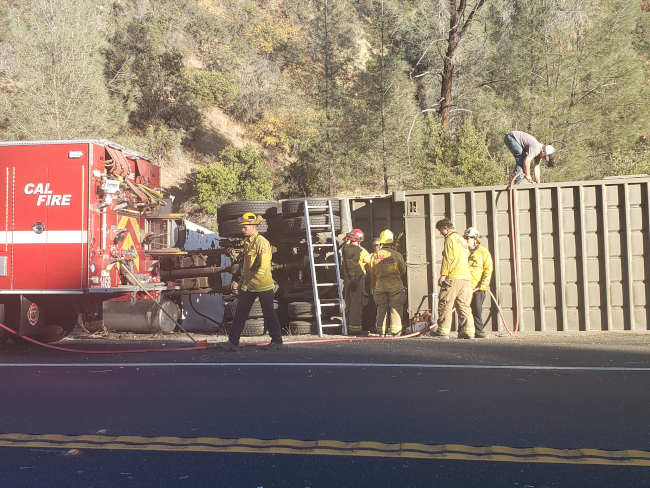
LAKE COUNTY, Calif. — A big rig hauling a load of cattle overturned on Highway 20 on Friday afternoon east of Clearlake Oaks, resulting in a multiagency animal rescue operation that lasted into the evening.
The California Highway Patrol first reported the crash at 12:26 p.m. near mile post marker 38 and Cache Creek, east of Clearlake Oaks.
Early reports from the scene said the truck had initially been blocking the highway.
California Highway Patrol Sgt. Joel Skeen told Lake County News at the scene Friday evening that the big rig driver was traveling eastbound on Highway 20 pulling a double-decker livestock trailer with 79 head of cattle on board.
Skeen said it appeared that the driver took the turns in that stretch of highway too fast. As a result, the big rig and trailer — the latter of which was top-heavy — flipped over onto their side.
The driver was uninjured, Skeen said.
Skeen said the truck was traveling with its load of cattle from Fortuna en route to Tennessee.
He said some of the cows were killed in the crash, but most survived.
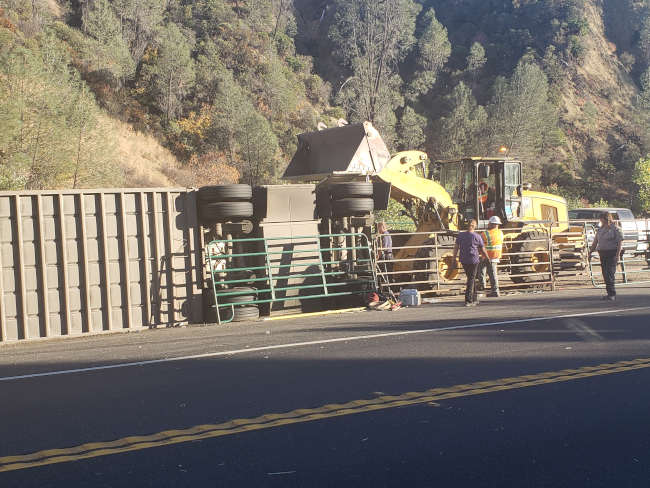
Firefighters used a saw to cut through the metal trailer and its compartments to free the animals.
By 5:30 p.m., about 30 to 40 of the cows had been removed from the trailer, Skeen said.
Lake County Animal Care and Control staff and firefighters used metal livestock corral panels to direct the cows into pickup-drawn trailers that took them from the scene.
In addition to the CHP and Animal Care and Control, agencies that were part of the rescue — which Skeen called “quite the operation” — included Cal Fire, Northshore Fire, Caltrans, the Lake County Sheriff’s Office, Lake County Fire and Lake County Environmental Health.
Skeen said at that time that it was expected to take another few hours to remove all of the animals before moving the damaged truck and trailer.
A veteran of the CHP, Skeen said the incident “is a new one for me.”
Shortly before 10 p.m., the CHP reported that both lanes of Highway 20 at the crash site were closed in order to remove the semi.
Email Elizabeth Larson at

LAKE COUNTY, Calif. — The Lake County Sheriff’s Office is asking for the community’s help in locating an Upper Lake man who was last seen in August.
Christopher Vetter, 22, was last seen in Upper Lake in the early hours of Wednesday, Aug. 9, the sheriff’s office said Friday.
Vetter is described as a white male adult, standing 5 feet 9 inches tall. He weighs 120 pounds and has a thin build, with brown medium-length hair, brown eyes and unshaven facial hair.
Authorities said Vetter has a medical condition and doesn’t have his medication.
“It is unlike him to be away from home, without contacting his family, for so long,” the agency said.
The sheriff’s office said its deputies have been working closely with Vetter’s family to gather information as to his whereabouts and follow up on all available leads.
Anyone with information is asked to contact Sgt. Jeff Mora at 707-262-4000 or via email at