 How to resolve AdBlock issue?
News
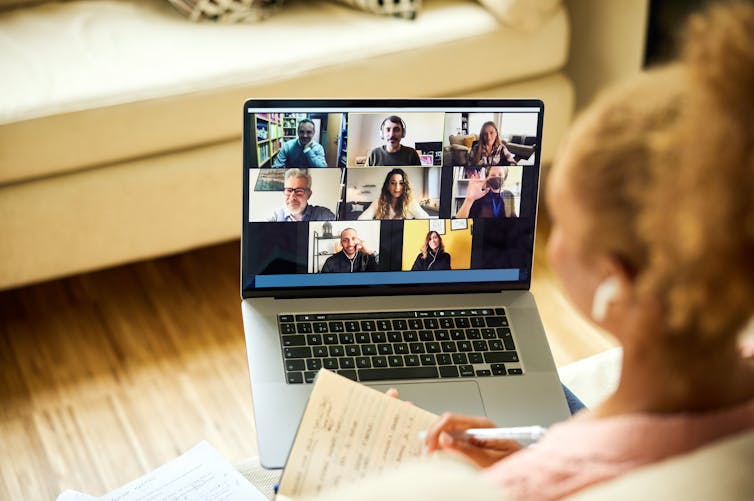
The COVID-19 pandemic ushered in a new era of digital connection: In the absence of in-person gatherings, many people instead found themselves face-to-face with their co-workers and loved ones on a screen.
Videoconferencing has provided many benefits and conveniences. However, it isn’t surprising that constantly seeing ourselves on screens might come with some downsides as well.
Prior to the pandemic, studies showed that surgeons were seeing increasing numbers of patients requesting alterations of their image to match filtered or doctored photos from social media apps. Now, several years into the pandemic, surgeons are seeing a new boom of cosmetic surgical requests related to videoconferencing. In one study of cosmetic procedures during the pandemic, 86% of cosmetic surgeons reported videoconferencing as the most common reason for cosmetic concerns among their patients.
Despite the fact that many aspects of life have returned to some version of pre-pandemic normal, it’s clear that videoconferencing and social media will be with us for the foreseeable future. So what does that mean when it comes to appearance satisfaction and making peace with the image that’s reflected back at us?
For the past 10 years, I have worked as a specialist in obsessive-compulsive disorders, eating disorders and anxiety. Since the pandemic, I, too, have seen increasing numbers of therapy clients reporting that they struggle with appearance concerns related to videochatting and social media.
Zooming in on image and appearance dissatisfaction
Every person has perceptions and thoughts about their appearance. These can be neutral, negative or positive. We all look at ourselves in the mirror and may have even experienced distress while looking at our reflection.
There are a number of factors that may lead to appearance dissatisfaction. A preoccupation with thoughts, feelings or images of one’s own appearance is linked to the action of “mirror gazing,” or staring at one’s reflection. Researchers suggest that this type of selective self-focused attention and mirror gazing can lead to negative fixations on specific attributes or minor flaws, which in turn intensify the preoccupation with these attributes.
Other factors that can contribute to appearance dissatisfaction include low self-esteem, societal beliefs around appearance, peer and parental influences, temperament and genetic predispositions to mental health conditions.
Appearance dissatisfaction and negative evaluations of self are associated with depression, lower self-esteem, habitual negative thinking and increased social anxiety. What’s more, research suggests that these preoccupations can contribute to the development of eating disorders and disordered eating behaviors, such as frequently restricting food intake or exercising without refueling.
The ‘Zoom’ effect
With the ubiquity of Zoom meetings, FaceTime calls, selfies and the constancy of documenting our lives on social media, access to our own image can often feel inescapable. And for some people, this can magnify feelings of appearance dissatisfaction that may have been more fleeting before the Zoom era.
Since the pandemic, screen time has increased for both adults and children. What’s worse, recent research suggests that the video and photo reflections we see of ourselves are distorted.
Videoconferencing, taking selfies and posting on social media are visually based activities where appearance is often the primary focus. All of them have in common the fact that a person’s image is either live or shared in an immediate manner. Perhaps not surprisingly, these image-based platforms have been significantly associated with appearance dissatisfaction, anxiety, depression and eating disorders.
One study found that those who engaged in more videochatting appearance comparisons, meaning those who looked at others’ appearance during a video call and sized up their own appearance in comparison, experienced lower appearance satisfaction. This study also found that people who used more photo-editing features on videochat platforms were more likely to compare themselves with others and spend more time looking at themselves on video calls.
One thing that is unique to videoconferencing is that it allows people to easily compare themselves with others and watch themselves sharing and speaking in real time. A 2023 study found that discomfort with one’s appearance during videoconferencing led to an increased fixation on appearance, which in turn led to impaired work performance.
Researchers also suggest that appearance dissatisfaction is associated with virtual-meeting fatigue. The research reports that this could be due to negative self-focused attention, cognitive overload and anxiety around being stared at or being negatively evaluated based on appearance.
This last point is notable because of the difficulty videochatters have determining where other users are looking. Using the concept of the “spotlight effect” − our tendency as humans to overestimate how much others are judging our appearance − this difficulty may lead to more anxiety and individuals believing that others are evaluating their appearance during a video call.
How to combat appearance dissatisfaction in the digital age
If you find yourself criticizing your appearance every time you hop onto a videoconference call, it may be time to evaluate your relationship with your appearance and seek out help from a qualified therapist.
Here are some questions to consider to help determine whether your thought patterns or behaviors are problematic:
-
How much of my day is spent thinking about my appearance?
-
What sort of behaviors am I doing around my appearance?
-
Do I feel distressed if I do not perform these behaviors?
-
Does this behavior align with my values and how I want to be spending my time?
Another strategy is to be intentional about focusing on what other people are saying in a videoconference instead of peering at your own face.
When it comes to helping others who might be struggling with appearance dissatisfaction, it is important to focus on the person’s innate qualities beyond appearance. People should be conscious of their comments, no matter how well intentioned. Negative comments about appearance have been linked to worsened self-esteem and mental health. When viewing yourself or your peers on video and social media, try focusing on the person as a whole and not as parts of a body.
Reducing screen time can make a difference as well. Research shows that reducing social media use by 50% can improve appearance satisfaction in both teens and adults.
When used in moderation, videoconferencing and social media are tools to connect us with others, which ultimately is a key piece in satisfaction and well-being.
Emily Hemendinger, Assistant Professor of Psychiatry, University of Colorado Anschutz Medical Campus
This article is republished from The Conversation under a Creative Commons license. Read the original article.
Appeals court orders Lake County Superior Court to consider insanity plea by man convicted of murder
In a 26-page unpublished opinion filed on Sept. 25, the First Appellate District Court of Appeals for California’s Division 2 ruled on the case of The People v. Timmons.
An “unpublished” opinion means that it cannot be cited in cases as a legal precedent, as opposed to “published” opinions of the appellate court, which can be used as precedent and authority for lower courts.
The case involves Willy Tujays Timmons, 43, sentenced in March 2022 to 16 years to life in state prison for the June 2017 killing of Vanessa Yvette Niko.
In November 2021, a jury convicted Timmons of second-degree murder, torture, inflicting injury resulting in a traumatic condition and aggravated mayhem, and special allegations of use of a deadly weapon and personally inflicting bodily injury.
The appellate ruling noted that Timmons’ sole contention in the appeal, filed in May 2022, is that “the trial court erred when it refused to allow him to enter a plea of not guilty by reason of insanity to the charges in the latest indictment filed against him.”
The court noted, “We agree, and we therefore reverse the order denying the request to enter a plea of not guilty by reason of insanity. The judgment is affirmed insofar as it adjudicates defendant’s guilt.”
The filing explains that a psychologist who examined Timmons in late 2017 “found he exhibited symptoms of schizophrenia, paranoid type, with delusions, as well as of methamphetamine use disorder.”
Niko, 35, was a mother of six, three of whom were children she had with Timmons. Their youngest child was 11 months old when she died.
On the day he killed her, Timmons picked up Niko and took her to a home on Bridge Arbor Road in Upper Lake. A deputy who later responded to the scene witnessed Timmons assaulting Niko, striking her in the head with a rock. She died a short time later.
Former District Attorney Don Anderson convened special criminal grand juries which indicted Timmons on the charges for which he eventually was convicted.
The appellate ruling documented Timmons’ efforts to disqualify three of his court-appointed attorneys — Tom Quinn, Andrea Sullivan and Mitchell Hauptman — through Marsden motions.
In the case of Quinn — who would not offer comment for this story — “there has been a complete breakdown in the relationship between Mr. Quinn and Mr. Timmons which would make it impossible for Mr. Quinn to effectively represent Mr. Timmons,” which is why the Lake County Superior Court granted the Marsden motion and relieved Quinn as counsel.
Sullivan was appointed to represent Timmons but later was removed after she only had one 15-minute phone call with him during 11 months, according to the appeal document.
In July 2021, Timmons sought to have Hauptman removed from his case due to neglect.
In a hearing, Hauptman stated, “I have to agree with Mr. Timmons. It is an unusual position for me to take. I don’t mean to dodge the work, but as a matter of fact, I have seen him only once. I have been ignoring phonecalls [sic] that have been made on his behalf. I have declined to pursue needs that he suggested are appropriate. And I generally find myself beyond the similar malaise of the Covid most—just not really able to focus or get involved in this particular case. And I did discuss that with Mr. Timmons. It just seemed unfair to have a lawyer quite as disinterested as I find myself.”
Hauptman was removed and the court appointed a new attorney, Thomas Feimer, who along with Sullivan runs Lake Indigent Defense, which holds Lake County’s indigent defense contract.
The appeal notes that Feimer had just three months to review the case and prepare for trial, and that he “faced communication challenges, due to among other things a COVID-19 outbreak and quarantine at the jail and defendant’s resistance to discussing his case for fear of being recorded at jail.”
It was Feimer who informed the court in October 2021 that based on his review of the case, “it appears that Mr. Timmons attempted to or did enter a not guilty by reason of insanity plea in 2018,” and thus he “intends to enter that plea once again, to the extent that it is not entered currently.”
“The court stated it had reviewed the case file and found that no NGI appeared to have been previously entered to the charges in the superseding indictment. The court then ordered the parties to brief the issue,” the document said.
On Oct. 25, 2021, five days before the trial started, Feimer filed a brief requesting entry of the not guilty by reason of insanity, or NGI, plea.
Three days later, Judge J. David Markham held a hearing on the request, during which Quinn testified that Timmons had entered the NGI place “on a couple of occasions.” Quinn suggested that the matter “became procedurally convoluted” because “we don’t really do grand juries too often in this county, and in this case we did two of them.
“Quinn confirmed defendant never expressed a desire to proceed in ‘any other different way,’” the appeal document said.
Timmons also testified during the hearing, and Feimer argued that Timmons had not shown a desire to withdraw his NGI please.
“One could argue, well, his lawyers didn’t do anything in the intervening time to do that,” Feimer is quoted as saying in the appellate document. “However, I think it kind of ignores a basic reality that Mr. Timmons is not an attorney. That’s why he has representation. NGI pleas are procedurally complex things. I think it’s somewhat unjust to penalize him for not following the strict technical requirements of it.”
Ultimately, Markham ruled that Timmons had failed to enter an NGI plea and that the failure “falls squarely on the shoulders of the defendant.” He denied Timmons’ request to enter it at that point.
A month later, on Nov. 17, 2021, Timmons was convicted by a jury following his trial. He was sentenced in March 2022 and filed the appeal two months later.
The appellate process
Feimer told Lake County News in a Wednesday interview that he didn’t handle the appeal, as appeals are a very specialized type of law.
When a case is appealable and he’s instructed to do so by a client, Feimer said he files a notice of appeal.
There is a group called the First District Appellate Project, which works to put together the case record and then appoints the defendant a lawyer. It’s a process not unlike appointing a public defender in a lower court, Feimer explained.
In reviewing the case, the appellate court cited the Sixth Amendment Center’s report, released earlier this year, into the indigent defense contract in Lake County. That’s because Timmons had cited it in his case when claiming that it is common for indigent defendants in Lake County to bring Marsden motions against attorneys.
When considering the Lake County Superior Court’s decision to not let Timmons enter the NGI plea, the appeals court found, “The court’s reasoning is hard to follow. First, the court’s comments appear to be internally inconsistent. In one paragraph it acknowledged the evidence showed that defense counsel ‘harbored a belief that an NGI plea had been entered.’ But in the following paragraphs, the court took a seemingly inconsistent view. It suggested that counsel could not have held such a belief, because if they did hold such a belief, then that would mean they were incompetent for doing nothing to prepare for the sanity phase of trial. In addition, when the court stated there was no evidence that counsel were ‘so incompetent’ in that regard because none of them affirmatively admitted to his or her incompetence in a declaration or testimony, it imposed an evidentiary rule that is not based on any law as far as we know.”
The justices concluded that the court set up “an arbitrary rule” which “it then relied upon to avoid having to scrutinize the inactions of defendant’s attorneys with respect to the NGI defense.”
As such, the justices concluded that the Lake County Superior Court abused its discretion in denying Timmons’ request to enter an NGI pleas.
“In so concluding, we note defendant’s comment that ‘[i]t is understandable that the trial court was frustrated with the age of this case before it went to trial. . . .’ We are also mindful of the challenges facing overworked attorneys of indigent defendants, particularly in the wake of the pandemic. At the same time, however, in our view it was unfair for the court to impute the delay in tendering an NGI plea to the charges entirely on defendant, and then use that as a basis to deny his request to enter such a plea, for the reasons stated above. Moreover, this is not a case involving a defendant seeking to enter an NGI plea as part of a calculated scheme of delay. To the contrary, defendant here made known to everyone his intent to enter a plea of NGI to the superseding indictment at the outset, but, because the issue ‘got kind of lost [in the] shuffle[ ],’ he was unable to formally enter the plea.”
What’s next
The justices upheld Timmons’ guilt in the murder, and remanded the case to the trial court to allow Timmons to enter his NGI plea to the charges in the superseding indictment handed down by the second grand jury Anderson had convened.
Feimer said there’s no court date scheduled yet in Lake County. First, the appellate court must issue a remittitur, which will be sent to the local court.
“That is the signal to the superior court that the case is finished at the appellate level and that it’s time for the superior court to take action by placing it on calendar and having him transported from the prison,” Feimer said.
Timmons is serving his term at the Correctional Training Facility in Soledad. If the process goes forward, it’s expected that he would be transported back to the Lake County Jail during the proceedings.
If Timmons comes back to Lake County, Feimer said he would ordinarily still be Timmons’ attorney.
The appellate court did not reverse the jury verdict, they just reversed and remanded the case back to the Lake County Superior Court in order to allow Timmons to enter the NGI plea.
Should Timmons return, the court will appoint psychologists to evaluate Timmons and there could be a jury trial just on that issue, Feimer explained.
However, Feimer said the question now is, whether Timmons will want to go through with it.
“He may personally wish to leave things as they are,” said Feimer.
That’s because, if Timmons were found not guilty by reason of insanity, Feimer said Timmons would be sent to a state hospital rather than a prison.
“The issue is, he’s eligible for parole after a certain date currently,” said Feimer.
If Timmons went to a state hospital, theoretically he could be released if they find out he’s not a danger to others. However, Feimer said it’s also very possible he could spend the rest of his life there.
“And that oftentimes happens, especially in a case like this,” Feimer said.
Feimer added that Timmons “may find that his options look better if he simply remains in prison.”
He said he is now looking into whether Timmons has to come back to Lake County for the proceedings and what options he has if he wants to avoid moving forward.
Feimer said Timmons could return and not enter a plea in the proceedings.
“If that’s the case, then the trial result would likely just stand as it is,” Feimer said.
Email Elizabeth Larson atTribal and community leaders and elected officials have urged the Biden Administration to expand the existing monument to protect the area along the eastern edge of the existing monument known as Molok Luyuk.
Molok Luyuk is Patwin for “Condor Ridge” and is a name provided by the Yocha Dehe Wintun Nation.
The area is currently known as “Walker Ridge.”
The expansion of the national monument would safeguard public lands that are sacred to the Yocha Dehe Wintun Nation and are critically important to protect in the face of a changing climate.
“Tuleyome is grateful to our Congressional champions, Sen. Padilla and Representatives Garamendi and Thompson, for their continued support of the effort to expand Berryessa Snow Mountain National Monument,” said Tuleyome Executive Director Sandra Schubert. “We appreciate their most recent updated letter to President Biden and Interior Department Secretary Deb Haaland urging the Administration to use its authority under the Antiquities Act of 1906 to protect the entirety of Molok Luyuk. By building on the letter they sent earlier this year, they reaffirm their support of this important effort.”
Schubert added, “We also appreciate that the updated letter continues to reiterate the requests that Secretary Haaland order the U.S. Board on Geographic Names to rename ‘Walker Ridge’ to ‘Condor Ridge’ and ‘Molok Luyuk’ in the Patwin language of the Yocha Dehe Wintun Nation and other local Indigenous tribes. The Yocha Dehe Wintun Nation’s connection to this area stretches back thousands of years. The land is of tremendous present-day cultural and religious importance to the Tribe and includes sites central to their origin stories. They have advocated for the protection of these lands, a return to an Indigenous name, and the establishment of co-management with federally recognized tribes.”
Schubert said Tuleyome’s coalition members, many of whom are at California’s 30x30 partnership gathering on Wednesday celebrating conservation efforts across the state, continues to urge President Biden to use his authority under the Antiquities Act to expand Berryessa Snow Mountain National Monument to include all of Molok Loyuk.
In addition to being sacred to local tribes, the region is home to imperiled wildlife including bald and golden eagles, badgers, peregrine falcons and over 30 species of rare plants.
These BLM- managed lands include oak woodlands, rocky outcroppings with unique geology, meadows of wildflowers, forests of pine, and the world’s largest stand of McNab cypress.
The area is also popular for recreation including hiking, sightseeing, mountain biking, camping, horseback riding, and off-highway vehicle use on designated routes.
The expansion would help improve access to the outdoors for the region’s residents and visitors alike. Incorporating this federally-owned land into the existing national monument would improve land management and public access, and protect sensitive wildlife, prime habitat areas, and cultural resources.
To learn more about this effort and to sign a petition in support of the expansion of the Berryessa Snow Mountain National Monument, visit www.expandberryessa.org.
The event will be held from 9 a.m. to 2 p.m. in the public parking lot north of the Fifth Street boat ramp in downtown Lakeport.
This event is limited to city of Lakeport residents and business owners; those dropping off trash and solid waste will be required to provide photo identification and a copy of a current city of Lakeport utility bill.
Participants are asked to follow these guidelines:
• Stay in vehicle while Lakeport Disposal staff unloads materials.
• Two visits maximum per each address.
Acceptable materials: Household trash; televisions; appliances (stoves, washers, dryers, dishwashers and water heaters); electronic waste; mattresses; household furniture; unusable clothes, blankets, towels; and similar materials.
Not acceptable: Refrigerators, hot tubs/spas, air conditioners, construction debris, used tires and household hazardous waste.
For more details, please see the city’s website or contact Lakeport Disposal at 707-263-6080.


On Oct. 12, National Farmers’ Day, Americans honor the hardworking people who keep the world fed and clothed.
But the farming labor force has a problem: It’s aging rapidly.
The average American farmer is 57 and a half years old, according to the most recent data from the U.S. Department of Agriculture. That’s up sharply from 1978, when the figure was just a smidge over 50.
As researchers who study well-being in rural areas, we wanted to understand this trend and its implications. So we dug into the data.
Amber waves of graying
We found that the average age of farmers was fairly consistent across the country, even though the general population’s age varies quite a bit from place to place.
For example, the average Maine farmer is just a few months older than the average farmer in Utah, even though the average Maine resident is more than a decade older than the average Utahn.
To be fair, we did find some local differences. For example, in New York County – better known as Manhattan – the average farmer is just north of 31. Next door in Hudson County, New Jersey, the average farmer is more than 72.
On the whole, though, America’s farming workforce is getting older. If the country doesn’t recruit new farmers or adapt to having fewer, older ones, it could put the nation’s food supply at risk. Before panicking, though, it’s worth asking: Why is this happening?
A tough field to break into
To start, there are real barriers to entry for young people – at least those who weren’t born into multigenerational farming families. It takes money to buy the land, equipment and other stuff you need to run a farm, and younger people have less wealth than older ones.
Young people born into family farms may have fewer opportunities to take them over due to consolidation in agriculture. And those who do have the chance may not seize it, since they often report that rural life is more challenging than living in a city or suburb.
The overall stress of the agriculture industry is also a concern: Farmers are often at the mercy of weather, supply shortages, volatile markets and other factors entirely out of their control.
In addition to understanding why fewer younger people want to go into agriculture, it’s important to consider aging farmers’ needs. Without younger people to leave the work to, farmers are left with intense labor — physically and mentally – to accomplish, on top of the ordinary challenges of aging.
In other words, the U.S. needs to increase opportunities for younger farmers while also supporting farmers as they age.
Opportunities to help
The USDA already has programs to aid new farmers, as well as farmers of color and female farmers, and those who operate small farms. Expanding these programs’ reach and impact could help bring new talent into the field.
Congress could do just that when it reauthorizes the farm bill – a package of laws covering a wide range of food – and agriculture-related programs that get passed roughly every five years.
The farm bill also includes nutrition aid and funds telehealth and training and educational outreach for farmers, all of which could help meet the needs of young and aging farmers alike. Notably, the Cooperative Extension Service offers programs that range from 4-H and youth development, including introduction to agriculture, to providing on-site technical help.
Congress was supposed to reauthorize the farm bill by Sept. 30, 2023, but it missed that deadline. It now faces a new deadline of Dec. 31, but due to dysfunction in the House of Representatives, many expect the process to drag on into 2024.
Also in 2024, the USDA will release its next Census of Agriculture, giving researchers new insight into America’s farming workforce. We expect it will show that the average age of U.S. farmers has reached a new all-time high.
If you believe otherwise – well, we wouldn’t bet the farm.
David R. Buys, Associate Professor of Health, Mississippi State University; John J. Green, Director of the Southern Rural Development Center & Professor of Agricultural Economics, Mississippi State University, and Mary Nelson Robertson, Assistant Professor of Human Development and Family Science, Mississippi State University
This article is republished from The Conversation under a Creative Commons license. Read the original article.
Special Districts Administrator Scott Harter and members of the Lake County Rodeo Association Board took the proposal to the Board of Supervisors at its Oct. 3 meeting.
Harter said his staff and rodeo board members have been discussing the idea for six to eight months.
Specifically, the rodeo board is interested in making its long-term home on an 86-acre portion of an 1,186-acre Special Districts property in north Lakeport, northwest of Highway 29 and Whalen Way.
Harter said Public Services Director Lars Ewing supports using the property in conjunction with county parks. There is also the possibility of using it as a public access trail head for equestrian trails.
He said the supervisors have talked with Animal Care and Control Director Jonathan Armas about using the site to facilitate large animal sheltering during emergencies and evacuations.
Harter said he has met three to four times with the rodeo board to talk through the concept and explore the potential impact on Special Districts operations, “and we finally reached a point now where it makes sense to come to the board,” before they start negotiating a lease.
He said he wanted to know if the board is supportive before moving on to the next steps.
Board Chair Jessica Pyska thanked Harter for bringing the matter to the board. “This is a very exciting opportunity.”
Lake County Rodeo Association Board member Aaron Hiatt was on hand to speak to the board about the proposal.
He said he had contacted Harter eight months ago about the property, which at that time was leased from the county by a cattle rancher.
Hiatt said it had been brought to his attention that the county was no longer interested in continuing the lease with the rancher, and that the rodeo could possibly lease it.
“We as a rodeo organization have been around for 93 years,” said Hiatt.
When he first joined the board years ago, he said he couldn’t understand why they kept doing things over and over again without a permanent home.
Every year, they go through the labor intensive process of putting up panels and then taking them down again in a short period of time, Hiatt said.
“We were looking for a place that we could call our own,” he said.
That’s when Hiatt said he called Harter.
Ultimately if it’s possible, Hiatt said the rodeo association would like to purchase the property so it could be a permanent home.
In the meantime, they would like to move forward with leasing the property and putting in place the infrastructure needed to do an event.
“You’re right, you need a permanent home,” said Supervisor Michael Green, whose district includes the property in question. “I think kicking the tires on this property is appropriate.”
Green said he loved the proposed interim use of the property, thinks it could lead to even greater things and he supported moving forward.
Supervisor Bruno Sabatier said it’s an “absolutely appropriate” use for the property. Sabatier said the county owns about 7,000 acres of land and he doesn’t want the county to own what it doesn’t need. He suggested there are opportunities for private enterprise and development.
Vice Chair Moke Simon said Lake County has young people who compete and qualify for competitions. “The rodeo is a big part of what we are in Lake County,” he said.
Simon said it would not only support youth but also be an economic driver.
Pyska said all of her nieces and nephews compete in rodeo, with her nieces having gone to rodeo national competitions. She said having a facility where a big rodeo event can be hosted would instill some pride in Lake County.
Supervisor EJ Crandell said a lot of people also ride horses on Hogback Ridge and that would be a good area to connect to the proposed rodeo site.
The board reached consensus to have staff move forward with discussions on next steps with the rodeo association.
Email Elizabeth Larson at