 How to resolve AdBlock issue?
News
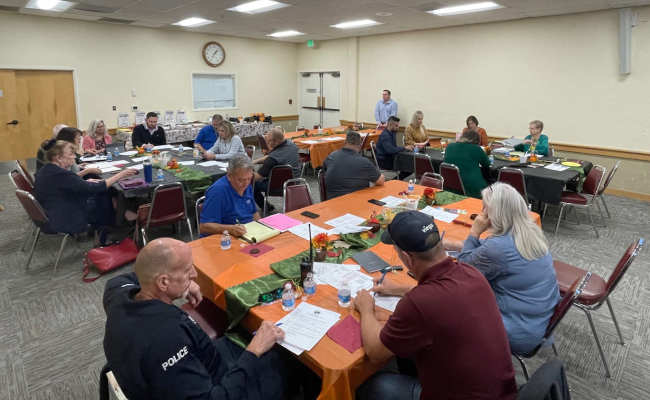
LAKEPORT, Calif. — The city of Lakeport is set to launch its latest outreach effort to engage and support businesses.
Lakeport’s Business Walk Program is designed to familiarize the business community with resources available to them.
City staff, members of the Lakeport Economic Development Advisory Committee, or LEDAC, and community volunteers gathered on Tuesday to form teams that will contact local business owners and managers during October and November.
The program’s purpose is to demonstrate the city’s commitment to supporting businesses while gaining information about challenges and barriers to their success.
Findings from the visits will be compiled by LEDAC and presented to the City Council in early 2024.
The City’s Economic Development Strategic Plan identified annual in-person visits as an important element in the support and retention of existing local businesses.
LEDAC is an advocate for a strong and positive Lakeport business community, and serves as a conduit between the City and the community for communicating the goals, activities and progress of Lakeport’s economic and business programs.
The committee meets bi-monthly at City Hall on the second Wednesday, 7:30 to 9 a.m.
The next meeting is on Nov. 8; all meetings are open to the public.
Contact City Manager Kevin Ingram for more information at telephone 707-263-5615, Extension 104.
Large-capacity magazines are firearm magazines capable of holding more than 10 rounds of ammunition.
The en banc court’s order, which was issued Tuesday, concludes that the state is likely to succeed on the merits in defending the large-capacity restrictions and that maintaining the restrictions pending appeal is in the best interest of the public safety of Californians.
“We are relieved that the court considered the public safety of Californians in its decision to grant our motion and maintain the restrictions on large-capacity magazines pending a decision on appeal,” said Bonta. “With the stay, California’s restrictions on large capacity magazines — a key component in our efforts to fight gun violence — remain in effect.”
Bonta added, “Californians should know that the purchase, manufacture, or transfer of large-capacity magazines is against the law. We will continue to fight for California’s authority to keep our communities safe from weapon enhancements that cause mass casualties. The Supreme Court was clear that New York State Rifle & Pistol Association v. Bruen does not create a regulatory straitjacket for states and that cases should be evaluated on the text of the Second Amendment and its history and tradition of regulation.”
On Sept. 26, Bonta filed the motion in the Ninth Circuit Court of Appeals to stay a district-court decision striking down California’s restrictions on large-capacity magazines.
In it, he urged the Ninth Circuit to issue a stay of the decision pending appeal to ensure that the protections remained in place to prevent gun-related deaths and injuries in California communities while the Ninth Circuit addresses the merits of the case.
The Ninth Circuit granted Attorney General Bonta’s motion, which argued that the district court’s application of the U.S. Supreme Court’s decision in Bruen is deeply flawed and ignores relevant historical laws.
In fact, since Bruen,10 other federal district court decisions have considered Second Amendment challenges to similar restrictions on large-capacity magazines. All but one of those decisions have rejected the challenge.
These courts have repeatedly recognized that large-capacity magazines are not protected by the Second Amendment or that restrictions on such magazines are consistent with a historical tradition of regulating particularly dangerous weapons technologies as they spread and cause harm.
The district court reached its decision by focusing on the supposed popularity of the technology and by ignoring relevant historical laws, despite the guidance laid out by Bruen.
A copy of the court’s order can be read below.
[10] Duncan Stay Order[1][1] by LakeCoNews on Scribd

Many of the world’s largest public and private companies will soon be required to track and report almost all of their greenhouse gas emissions if they do business in California – including emissions from their supply chains, business travel, employees’ commutes and the way customers use their products.
That means oil and gas companies like Chevron will likely have to account for emissions from vehicles that use their gasoline, and Apple will have to account for materials that go into iPhones.
It’s a huge leap from current federal and state reporting requirements, which require reporting of only certain emissions from companies’ direct operations. And it will have global ramifications.
California Gov. Gavin Newsom signed two new rules into law on Oct. 7, 2023. Under the new Climate Corporate Data Accountability Act, U.S.- companies with annual revenues of US$1 billion or more will have to report both their direct and indirect greenhouse gas emissions starting in 2026 and 2027. The California Chamber of Commerce opposed the regulation, arguing it would increase companies’ costs. But more than a dozen major corporations endorsed the rule, including Microsoft, Apple, Salesforce and Patagonia.
The second law, the Climate-Related Financial Risk Act, requires companies generating $500 million or more to report their financial risks related to climate change and their plans for risk mitigation.
As a professor of economics and public policy, I study corporate environmental behavior and public policy, including whether disclosure laws like these work to reduce emissions. I believe California’s new rules represent a significant step toward mainstreaming corporate climate disclosures and potentially meaningful corporate climate actions.
Many big corporations are already reporting
Most of the companies covered by California’s climate disclosure rules are multinational corporations. They include technology companies such as Apple, Google and Microsoft; giant retailers like Walmart and Costco; and oil and gas companies such as ExxonMobil and Chevron.
Many of these large corporations have been preparing for mandatory disclosure rules for several years.
Close to two-thirds of the companies listed in the S&P 500 index voluntarily report to CDP, formerly called the Carbon Disclosure Project. CDP is a nonprofit that surveys companies on behalf of institutional investors about their carbon management and plans to reduce carbon emissions.

Many of them also face reporting requirements elsewhere, including in the European Union, the United Kingdom, New Zealand, Singapore and cities like Hong Kong.
Moreover, some of the same U.S. companies, notably banks and asset managers that operate or sell products in Europe, have already started to comply with the EU’s Sustainable Finance Disclosure Regulation. Those regulations require companies to report how sustainability risks are integrated into investment decision-making.
While California isn’t the first place to mandate climate disclosures, it is the fifth-largest economy in the world. So, the state’s new laws are poised to have substantial influence worldwide. Subsidiaries of companies that didn’t have to report their emissions before will now be subject to disclosure requirements. California is in effect exercising its immense market leverage to establish climate disclosures as standard practice in the U.S. and beyond.
California also has a history of being a test bed for future federal U.S. policies. The U.S. government is considering broader emissions reporting requirements. But California’s new rules go further than either the U.S. Securities and Exchange Commission’s proposed corporate climate disclosure rules or President Joe Biden’s proposed disclosure rules for federal contractors.
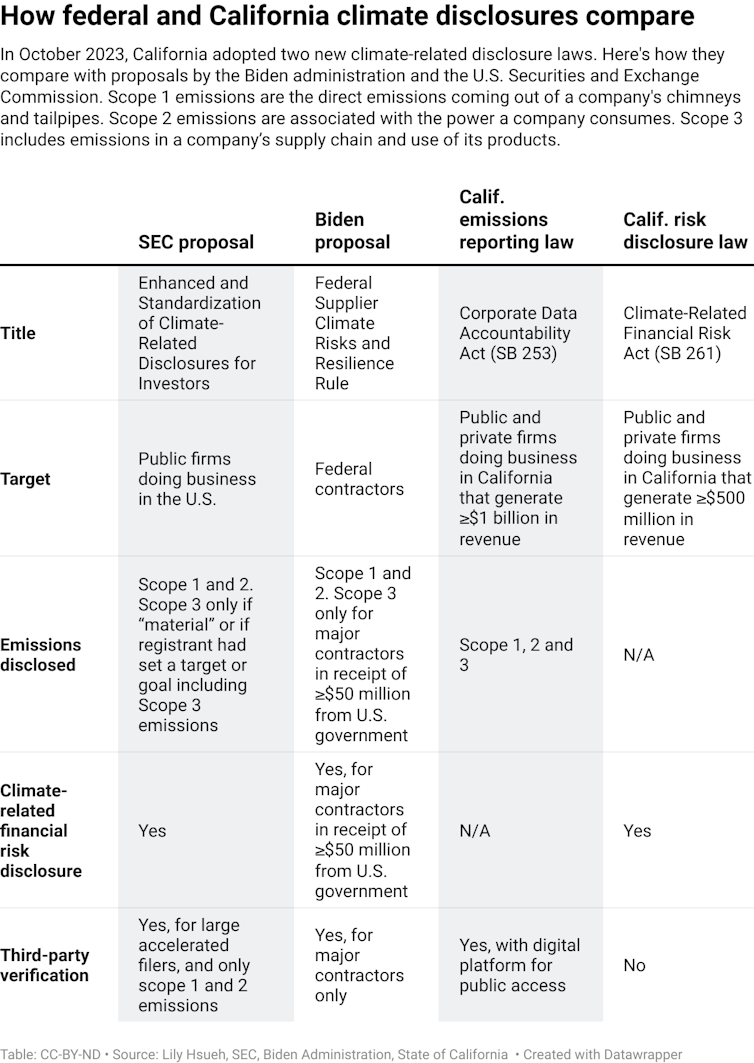
The most controversial part of the new disclosure rules involves scope 3 emissions. These are emissions from a company’s suppliers and its consumers’ use of its products, and they are notoriously difficult to track accurately.
California’s new emissions reporting law directs the California Air Resources Board, which will develop the regulations and administer them, to allow some leeway in scope 3 reporting as long as the reports are made with a reasonable basis and disclosed in good faith. It’s also important to note that at this point the disclosure laws don’t require companies to cut these emissions, only to report them. But tracking scope 3 emissions does highlight where companies could pressure suppliers to make changes.
What can disclosures achieve?
The plethora of climate disclosure mandates globally suggest that policymakers and investors around the world perceive climate disclosures as driving actions that protect the environment. The big question is: Do disclosure rules actually work to reduce emissions?
My research shows that voluntary carbon disclosure systems like CDP’s that focus on reporting corporate sustainability outputs, such as having science-based emissions targets, tend not to be as effective as those that focus on outcomes, such as a company’s actual carbon emissions.
For example, a company could earn an A or B grade from CDP and still increase its entitywide carbon emissions, notably when it does not face regulatory pressure.
In contrast, a recent study of the U.K.’s 2013 disclosure mandate for U.K.-incorporated listed firms found that companies reduced their operational emissions by about 8% relative to a control group, with no significant changes to their profitability. When companies report their emissions, they can gain important knowledge about inefficiencies in their operations and supply chains that weren’t evident before.
Ultimately, a well-designed disclosure program, whether voluntary or mandatory, needs to focus on consistency, comparability and accountability. Those traits allow companies to demonstrate that their climate pledges and actions are real and not just a front for greenwashing.
Lily Hsueh, Associate Professor of Economics and Public Policy, Arizona State University
This article is republished from The Conversation under a Creative Commons license. Read the original article.
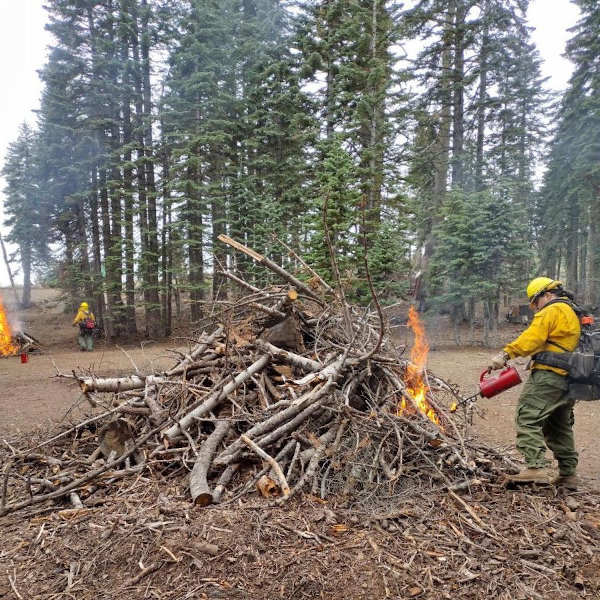
MENDOCINO NATIONAL FOREST, Calif. — Forest personnel are planning several prescribed fire operations at campgrounds and administrative sites this fall and winter, as weather patterns shift to cooler temperatures and wetter conditions.
Work began on the ground earlier this month with successful ignitions on the Grindstone Ranger District at the Red Bluff Recreation Area.
Grindstone District fire personnel started with pile burns in higher elevations and will be moving down to lower elevations as weather conditions permit.
Last week, firefighters burned piles at the Letts Lake and Mill Valley campgrounds.
This week, Upper Lake Ranger District fire personnel will potentially burn 40 acres of piles in the Lake Pillsbury basin or 20 to 130 acres of understory burning at Howard Mill, depending on weather conditions.
Fire managers conduct prescribed fire activities during the safest possible “burn windows” in the coming months.
Numerous factors including wind, humidity, air quality, fuel moisture and availability of fire crew personnel must be met before crews are authorized to move forward with burning.
Residents and visitors are asked to avoid areas where prescribed fires are being conducted.
Some smoke may be visible. Fires are carefully monitored. Local fire and government authorities are notified prior to burn days and kept informed throughout operations.
Prescribed fire is a tool that uses fire under planned ignitions to mimic the natural role of fire in the environment.
Without fire, hazardous fuels can build up and carry wildfire from the forest floor to tree canopies, creating extreme fire behavior that poses risk to firefighters, surrounding
communities and natural resources.
Maps, locations, photos and updates on planned prescribed burn activities will be available on Inciweb at https://bit.ly/MNF-2023-RX.
MIDDLETOWN, Calif. — This week, the Middletown Area Town Hall will open its board nomination process and hear about new recreation plans.
MATH will meet at 7 p.m. Thursday, Oct. 12, in the Middletown Community Meeting Room/Library at 21256 Washington St., Middletown. The meeting is open to the public.
To join the meeting via Zoom click on this link; the meeting ID is 832 1989 2440. Call in at 669-900-6833.
On the Thursday agenda is the election for MATH Board seats in 2024.
The group will review the process and the open seats and open nominations.
Nominations will continue to be accepted through December.
MATH’s next meeting will take place on Nov. 9.
The MATH Board includes Chair Monica Rosenthal, Vice Chair Todd Fiora, Secretary Ken Gonzalez, Rosemary Córdova and Bill Waite, and alternates Julia Bono and Tom Darms.
MATH — established by resolution of the Lake County Board of Supervisors on Dec. 12, 2006 — is a municipal advisory council serving the residents of Anderson Springs, Cobb, Coyote Valley (including Hidden Valley Lake), Long Valley and Middletown.
For more information email
Email Elizabeth Larson at
On Sunday, Gov. Gavin Newsom vetoed AB 273, which would have established additional requirements for social workers, probation officers, and juvenile courts when a child or non-minor dependent is missing from foster care, including immediate notification requirements, hearing timelines, and due diligence reporting deadlines.
Assemblymember James C. Ramos (D-San Bernardino), the bill’s author, and Yurok Tribal Chairman Joe James responded by pointing out the increased risk to Native American children due to shortfalls in the system.
In his veto message, Newsom said he is directing the California Department of Social Services to work with county partners to assess existing protocols and identify any needed improvements. With that information, Newsom said, the Department of Social Services “will work with the author and stakeholders to inform additional guidance, training, or recommend statutory changes to protect all foster youth, especially tribal youth.”
Newsom raised issue with the bill’s estimated $10 million in ongoing costs to the state’s general
fund to support the administrative workload for counties, automation costs, and additional workload for the courts, funding not contemplated in the annual budget.
He said he and the Legislature worked to close a budget shortfall of more than $300 million, and that this year “the Legislature sent me bills outside of this budget process that, if all enacted, would add nearly $19 billion of unaccounted costs in the budget, of which $11 billion would be ongoing. With our state facing continuing economic risk and revenue uncertainty, it is important to remain disciplined when considering bills with significant fiscal implications, such as this measure.”
In response, Ramos said, “I am disappointed and saddened by the governor’s veto of AB 273. When foster children go missing, county practices are routinely out of compliance with both federal and state law, and the minimum California Department of Social Services guidance standards. This carelessness can lead to grave, life changing, even lethal consequences for children. The potential risk is magnified for Native American children in the system. It is long past due for us to do better by our children.”
He said he was heartened by Newsom’s direction to the California Department of Social Services.
“I will work with the administration, the bill’s sponsors, the Alliance for Children’s Rights, California Tribal Families Coalition and Yurok Tribe and the Department, to ensure that local counties are consistently employing the best practices and protocols to locate, place, and stabilize missing foster children,” Ramos said.
He cited a July 2022 report by NBC about a Health and Human Services regional inspector not complying with screening or reporting requirements when foster children are missing.
That same news report stated, “In 36 states, the average number of days foster children were missing varied from seven to 46, and nine states reported that missing children disappeared for more than 50 days on average.”
NBC also cited a National Foster Youth Institute estimate that 60 percent of child sex-trafficking victims have been in foster care or another part of the child welfare system.
Indian foster youth are even more vulnerable, Ramos’ office said.
Native American children enter the child welfare system at a rate that is 2.7 times their representation in the population, the highest of any racial group (AFDC 2020). National data shows that 85% of all missing Indigenous children over a 10-year period were endangered runaways. Nationally, American Indian or Alaska Native children had the highest rate of victimization at 14.8 per 1,000 children in the population of the same race or ethnicity.
“It’s critical that we do all we can to support our missing foster youth, especially as we know that disproportionate numbers of these missing and vulnerable youth then become part of the grim statistics around child trafficking or in tribal communities, victims of our Missing and Murdered Indigenous People cases,” Ramos said.
James said the Yurok Tribe, in partnership with tribal leaders, and communities of color who are also disproportionately impacted by the foster care system, “know that our children are our most valuable resource and must be protected.”
He added, “While we are disappointed AB 273 was vetoed, we want to thank Assemblymember Ramos and the State legislature for their hard work and commitment to our children, and the children of many other under-represented poor people in California. In the spirit of addressing the crisis of Missing and Murdered Indigenous People and ending the pipeline from the foster care system to MMIP, we will continue to fight for our children’s safety and protection, and for their futures.”