 How to resolve AdBlock issue?
News
The council will meet at 6 p.m. Thursday, Oct. 5, in the council chambers at Clearlake City Hall, 14050 Olympic Drive.
The meeting will be broadcast live on the city's YouTube channel or the Lake County PEGTV YouTube Channel.
Community members also can participate via Zoom or can attend in person.
The agenda can be found here.
Comments and questions can be submitted in writing for City Council consideration by sending them to City Clerk Melissa Swanson at
To give the council adequate time to review your questions and comments, please submit your written comments before 4 p.m. Thursday, Oct. 5.
The meeting will start with the swearing in of new police department employees, and presentations of proclamations declaring October 2023 as Domestic Violence Awareness
Month and Breast Cancer Awareness Month.
On the agenda is a public hearing in order to close out a Community Development Block Grant for Code Enforcement.
Under business, the council will consider increasing its expenditures with the Downey Brand law firm from $250,000 to $500,000.
City Manager Alan Flora’s report explains that this year he executed the contract with Downey Brand “primarily related to the recent onslaught by the Koi Nation to challenge all economic development projects in the City of Clearlake.”
Flora continued, “On March 3, 2023 the Koi filed a lawsuit against the City, challenging the CEQA determination for the 18th Avenue Road Improvement Project. In July the Koi Nation filed a second lawsuit against the City, this time regarding the Burns Valley Sports Complex and Recreation Center Project. The 18th Avenue project is scheduled for trial on October 20th, with no trial date set yet for the Burns Valley lawsuit.”
He said that in March the council authorized $250,000 to be spent in defense of these projects and that some additional funds will be required. That is why city staff is requesting an additional $250,000 be authorized, for a total of $500,000.
“While the City continues to believe these lawsuits and the tribe’s actions to be an overreach and frivolous, significant taxpayer funds will nonetheless be required to defend these projects,” Flora wrote.
In other business, the council will consider selling a city-owned property at 15903 36th Ave. to Jerry Lambert and Alexis Silimon.
Management Analyst Crystal Melanson’s report to the council explains that in March Lambert and Silimon were approved for the City’s Homestead Program by the Housing Committee.
The Homestead Program offers participants a city-owned lot at no cost or $10,000 toward the purchase of a privately owned lot, Melanson said.
She said Lambert and Silimon chose the city-owned lot for the site of their new home.
The council also will consider possible action related to Golden State Water Co.’s request for a rate increase. Under the different scenarios, rates could rise between 32 and 41 percent over a three-year period.
On the meeting's consent agenda — items that are considered routine in nature and usually adopted on a single vote — are warrants and City Council minutes, minutes of the Aug. 9 Lake County Vector Control District Board meeting, approval of contract with BPR Consulting Group for the 2023-2024 fiscal year not to exceed $100,000 for building inspection and plan review services, accept interest in real property conveyed by trustee deed upon sale dated July 19 from Placer Foreclosure Co., approval of Amendment No. 3 to the Clearlake Municipal Employees Association Memorandum of Understanding deleting the senior maintenance worker premium
pay, award of contract for the Senior Center Kitchen Remodel Project to Pro-Ex Construction in the amount of $593,880.00 and authorize the city manager to approve up to 10% for additional unforeseen contract amendments, authorization of road closure for the Robert Viramontes Memorial Soap Box Derby.
The council will hold a closed session after the meeting to discuss two cases of existing litigation involving the Koi Nation of Northern California.
Email Elizabeth Larson at
It will take place beginning at 11:20 a.m. Pacific Time.
The purpose of the test is to help ensure that Wireless Emergency Alerts, or WEA, and the Emergency Alert System, or EAS, continue to be effective ways to warn the public about emergencies, particularly those on the national level.
In case the Oct. 4 test is postponed due to widespread severe weather or other significant events, the backup testing date is Oct. 11.
All major U.S. wireless providers participate in Wireless Emergency Alerts and will transmit the national test to their subscribers.
If your mobile phone is on and within range of an active cell tower from a participating wireless provider, you should receive the national test.
Wireless providers will transmit the national test for 30 minutes, but your phone should only receive it once.
The WEA portion of the test will be directed to all consumer cell phones. The test message will display in either English or in Spanish, depending on the language settings of the wireless handset.
The WEA message will read “THIS IS A TEST of the National Wireless Emergency Alert System. No action is needed.”
The EAS portion of the test is scheduled to last approximately one minute and will be conducted with the participation of radio and television broadcasters, cable systems, satellite radio and television providers, and wireline video providers.
The EAS test message will state: “This is a nationwide test of the Emergency Alert System, issued by the Federal Emergency Management Agency, covering the United States from 14:20 to 14:50 hours ET (11:20 – 11:50 PST). This is only a test. No action is required by the public.”
Torrential downpours sent muddy water racing through streets in Libya, Greece and Spain and flooded parts of Hong Kong and New York City in September 2023. Thousands of people died in the city of Derna, Libya. Zagora, Greece, saw a record 30 inches of rain, the equivalent of a year and a half of rain falling in 24 hours.
A few weeks earlier, monsoon rains triggered deadly landslides and flooding in the Himalayas that killed dozens of people in India.
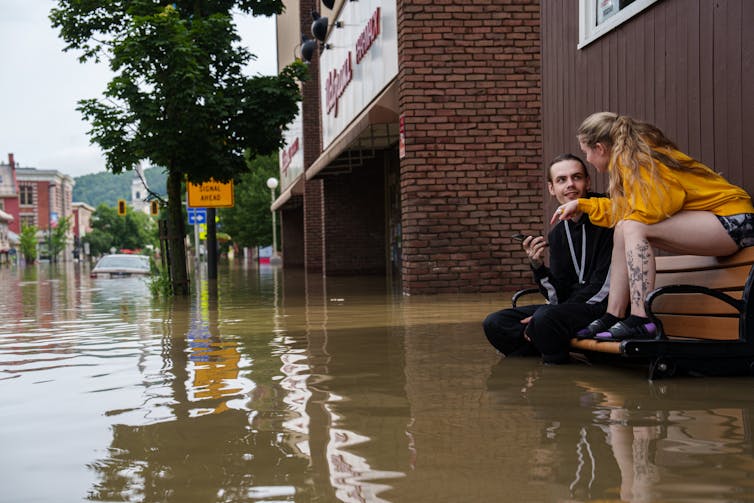
After severe flooding on almost every continent this year, including mudslides and flooding in California in early 2023 and devastating floods in Vermont and New York in July, it can seem like extreme rainfall is becoming more common.
So, what role does global warming play in this? And importantly, what can we do to adapt to this new reality?
As a climate scientist with a background in civil engineering, I am interested in exploring the links between the science of climate change and extreme weather events on one hand and the impacts those events have on our daily lives on the other. Understanding the connections is crucial in order to develop sound strategies to adapt to climate change.
Thirstier atmosphere, more extreme precipitation
As temperatures rise, the warmer atmosphere can hold more water vapor. Evaporation of water from land and oceans also increases. That water has to eventually come back to land and oceans.
Simply, as the atmosphere absorbs more moisture, it dumps more precipitation during storms. Scientists expect about a 7% increase in precipitation intensity during extreme storms for every 1 degree Celsius (1.8 degrees Fahrenheit) of warming.
This increase in the amount of moisture that air can hold is what scientists call the Clausius Clapeyron relationship. But other factors, such as changes in wind patterns, storm tracks and how saturated the air is, also play a role in how intense the precipitation is.
Liquid vs. frozen: Rain matters most
One factor that determines the severity of floods is whether water falls as rain or snow. The almost instantaneous runoff from rain, as opposed to the slower release of water from melting snow, leads to more severe flooding, landslides and other hazards – particularly in mountain regions and areas downstream, where about a quarter of the global population lives.
A higher proportion of extreme rainfall rather than snow is believed to have been a key contributor to the devastating floods and landslides in the Himalayas in August 2023, though research is still underway to confirm that. Additionally, a 2019 examination of flood patterns across 410 watersheds in the Western U.S. found that the largest runoff peaks driven by rainfall were more than 2.5 times greater than those driven by snowmelt.
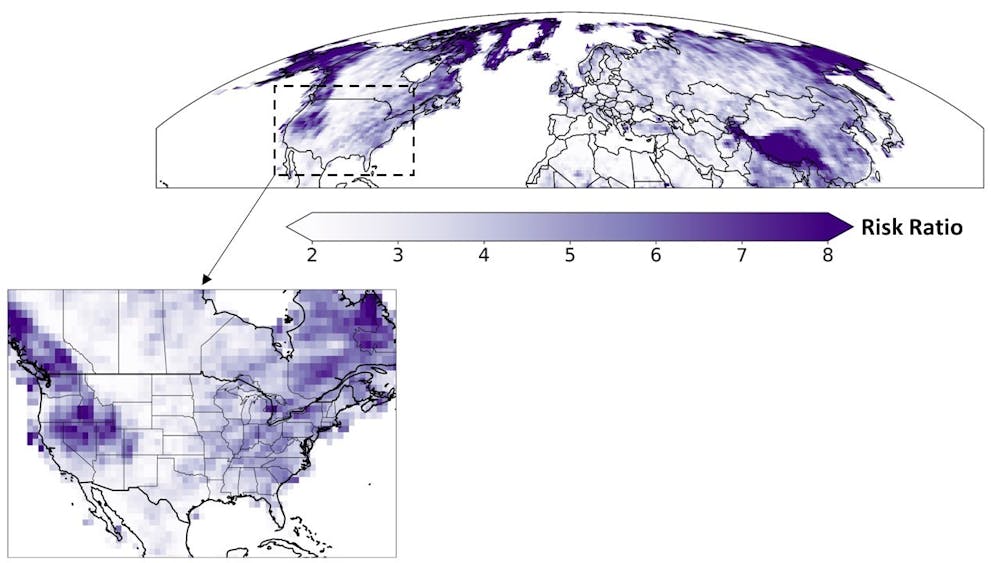
In a 2023 study in the journal Nature, my colleagues and I demonstrated that the intensity of extreme precipitation is increasing at a faster rate than the Clausius Clapeyron relationship would suggest – up to 15% per 1 C (1.8 F) of warming – in high-latitude and mountain regions such as the Himalayas, Alps and Rockies.
The reason for this amplified increase is that rising temperatures are shifting precipitation toward more rain and less snow in these regions. A larger proportion of this extreme precipitation is falling as rain.
In our study, we looked at the heaviest rains in the Northern Hemisphere since the 1950s and found that the increase in the intensity of extreme rainfall varied with altitude. Mountains in the American West, parts of the Appalachian Mountains, the Alps in Europe and the Himalayas and Hindu Kush mountains in Asia also showed strong effects. Furthermore, climate models suggest that most of these regions are likely to see a sevenfold-to-eightfold increase in the occurrence of extreme rainfall events by the end of the 21st century.
Flooding isn’t just a short-term problem
Deaths and damage to homes and cities capture the lion’s share of attention in the aftermath of floods, but increased flooding also has long-term effects on water supplies in reservoirs that are crucial for communities and agriculture in many regions.
For example, in the Western U.S., reservoirs are often kept as close to full capacity as possible during the spring snowmelt to provide water for the dry summer months. The mountains act as natural reservoirs, storing winter snowfall and then releasing the melted snow at a slow pace.
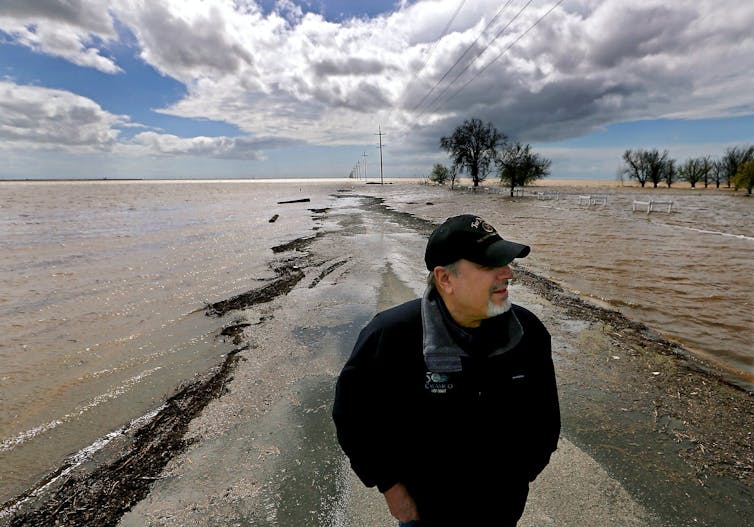
However, our recent findings suggest that with the world rapidly shifting toward a climate dominated by heavy downpours of rain – not snow – water resource managers will increasingly have to leave more room in their reservoirs to store large amounts of water in anticipation of disasters to minimize the risk of flooding downstream.
Preparing for a fiercer future
Global efforts to reduce greenhouse gas emissions have been increasing, but people still need to prepare for a fiercer climate. The destructive storms that hit the Mediterranean region in 2023 provide a cogent case for the importance of adaptation. They shattered records for extreme precipitation across many countries and caused extensive damage.
A main factor that contributed to the catastrophe in Libya was the bursting of aging dams that had managed water pouring down from mountainous terrain.
This underscores the importance of updating design codes so infrastructure and buildings are built to survive future downpours and flooding, and investing in new engineering solutions to improve resiliency and protect communities from extreme weather. It may also mean not building in regions with high future risks of flooding and landslides.
This article, originally published Sept. 19, 2023, has been updated with flooding in New York City.
Mohammed Ombadi, Assistant Professor of Climate and Space Sciences Engineering, University of Michigan
This article is republished from The Conversation under a Creative Commons license. Read the original article.
The shelter is located at 1111 Whalen Way in Lakeport, in a facility that formerly served as Lake County’s juvenile hall.
On Monday, the sheriff’s office responded to the shelter for a coroner investigation, said Lauren Berlinn, the sheriff’s spokesperson.
Berlinn said the male decedent was last seen by shelter staff around 2 a.m. Monday.
He was found deceased in his bed when shelter staff made their morning rounds at approximately 6:30 a.m., Berlinn said.
An autopsy will be conducted to determine the cause of death, said Berlinn, who noted that there are no signs of foul play.
“As a shelter resident, the staff knew the decedent to be respectful and rule-abiding. Lake County Sheriff’s Office is actively working to locate the next of kin, so at this time, the decedent's identity will not be released,” Berlinn said.
In July 2020, the Board of Supervisors approved a contract with the Oroville-based Elijah House to run an emergency COVID-19 shelter at the former juvenile hall, as Lake County News has reported.
Elijah House stopped operating the shelter in September 2022.
On Jan. 24, the Board of Supervisors approved a contract with the Sunrise Special Services Foundation to run a warming shelter at the facility for three months.
The contract has been renewed since then for continued operations, with Redwood Community Services expected to take over operations later this year and continue to operate it to provide housing for homeless individuals.
Berlinn told Lake County News that this is the first time the sheriff’s office has responded to the shelter for a coroner investigation.
Email Elizabeth Larson at
The Garden Harvest Gala will take place on Sunday, Oct. 22.
It will be held from 5 to 8 p.m. at Boatique Winery, 8255 Red Hills Road in Kelseyville.
The event will feature a beautiful farm to fork family style dinner by Rosey Cooks, groovy jazz music by blue.hour, a local art auction and Cobb’s famous dessert auction.
Tickets are available at www.bpt.me/event/6137931.
The meeting will begin at 4 p.m. at the Moose Lodge, located at 15900 Moose Lodge Lane in Clearlake Oaks.
The meeting will be available via Zoom. The meeting ID is 986 3245 2684, pass code is 666827.
The guest speaker for the Wednesday meeting will be Community Development Department Director Mireya Turner.
Turner will speak about the Clearlake Oaks Roadmap Taskforce update, the Cannabis Ordinance Task Force update and commercial cannabis projects.
In other business, the group will get an update on Spring Valley, including illegal cannabis cultivation, FireWise Community safety and Spring Valley Lake recovery.
ERTH also will discuss the latest on Klaus Park, the new park to be built with donated land and proceeds in Clearlake Oaks.
There also will be an update from Northshore Fire Protection District, a report from Supervisor EJ Crandell, new business and announcements.
The group’s next meeting will take place on Nov. 1.
ERTH’s members are Denise Loustalot, Jim Burton, Tony Morris and Pamela Kicenski.
For more information visit the group’s Facebook page.