 How to resolve AdBlock issue?
News
“California continued its strong job growth over the past year,” said EDD Director Nancy Farias. “EDD will continue to work closely with workforce development partners across California to support workers and employers.”
The EDD’s Labor Day update showcased the top five in-demand middle-skill occupations in each of the state’s 15 economic regions.
Lake County is located in the North Bay economic region.
That region had an overall 3.9% unemployment rate for the July reporting period, ranking it No. 4 of the 15 regions statewide.
The EDD reported the following statistics on the North Bay region’s top job openings for 2020 to 2030.
High-skill occupations
General and operations managers: 11,530 projected job openings, $116,473 average annual wage, 168 job advertisements.
Registered nurses: 7,950 projected job openings, $160,717 average annual wage, 802 job advertisements.
Project management specialists and business operations specialists, all other: 7,710 projected job openings, $102,649 average annual wage, 56 job advertisements.
Elementary school teachers, except special education: 5,430 projected job openings, $85,087 average annual wage, 140 job advertisements.
Accountants and auditors: 4,960 projected job openings, $87,737 average annual wage, 81 job advertisements.
Middle-skill occupations
Bookkeeping, accounting and auditing clerks: 8,330 projected job openings, $57,527 average annual wage, 135 job advertisements.
Heavy and tractor-trailer truck drivers: 7,900 projected job openings, $58,434 average annual wage, 259 job advertisements.
Medical assistants: 6,830 projected job openings, $58,879 average annual wage, 153 job advertisements.
Teaching assistants, except postsecondary: 5,500 projected job openings, $41,822 average annual wage, 191 job advertisements.
Nursing assistants: 4,640 projected job openings, $45,152 average annual wage, 125 job advertisements.
Entry-level occupations
Home health and personal care aides: 40,760 projected job openings, $34,698 average annual wage, 296 job advertisements.
Fast food and counter workers: 32,560 projected job openings, $37,004 average annual wage, 280 job advertisements.
Cashiers: 31,220 projected job openings, $36,494 average annual wage, 158 job advertisements.
Retail salespersons: 21,340 projected job openings, $38,013 average annual wage, 860 job advertisements.
Waiters and waitresses: 20,470 projected job openings, $35,463 average annual wage, 302 job advertisements.
Jobs driving the state’s economic growth
The EDD is also releasing its annual California Jobs Market Briefing, which highlights labor market trends and identifies the industries driving the state’s ongoing labor force expansion.
California has maintained strong post-pandemic job growth, averaging over 35,200 jobs gained per month in 2023, and completely recovering key industry job totals that had bottomed out during the Pandemic.
The state has completely recovered the approximately 2.7 million jobs lost during that period, and in some industries, eclipsed job growth gained before the pandemic.
California’s economy now includes more than 18.1 million jobs as of July 2023 — a total of 443,500 more jobs in the state than were in place prior to the pandemic outbreak.
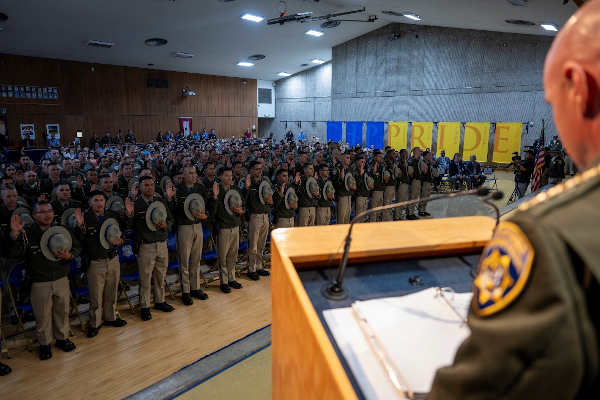
The California Highway Patrol welcomed more than 100 of California’s newest members of law enforcement during a graduation ceremony at the CHP Academy in West Sacramento.
The Friday ceremony was the culmination of more than six months of intense training, hard work and determination.
“I applaud these men and women for dedicating themselves to public service, and their commitment to protecting the people of California,” said CHP Commissioner Sean Duryee. “As cadets, we provide them with an extensive amount of training to ensure they are up to the task of providing the highest level of Safety, Service, and Security that is expected from our department.”
At the CHP Academy, cadet training starts with nobility in policing, leadership, professionalism and ethics, and cultural diversity.
Cadets also receive instruction on mental illness response and crisis intervention techniques.
Training also includes vehicle patrol, crash investigation, first aid and the apprehension of suspected violators, including those who drive under the influence of alcohol or drugs.
Cadets are trained in traffic control, report writing, recovery of stolen vehicles, assisting the motoring public, issuing citations, emergency scene management, and knowledge of various codes, including the California Vehicle Code, Penal Code and Health and Safety Code.
This graduating class of 112 officers, including eight women, will report for duty on Sept. 11 to one of the CHP’s 103 Area offices throughout the state.
Meanwhile, a new class of 125 cadets are expected to begin their 26-week training at the CHP Academy that same day, which will bring the total number of cadets in training to approximately 350.
Last year, the CHP launched a multi-year recruitment campaign to recruit and hire 1,000 officers.
If you are interested in an exciting career that offers diversity, challenges, and opportunities, the CHP invites you to apply to become a part of its professional organization.
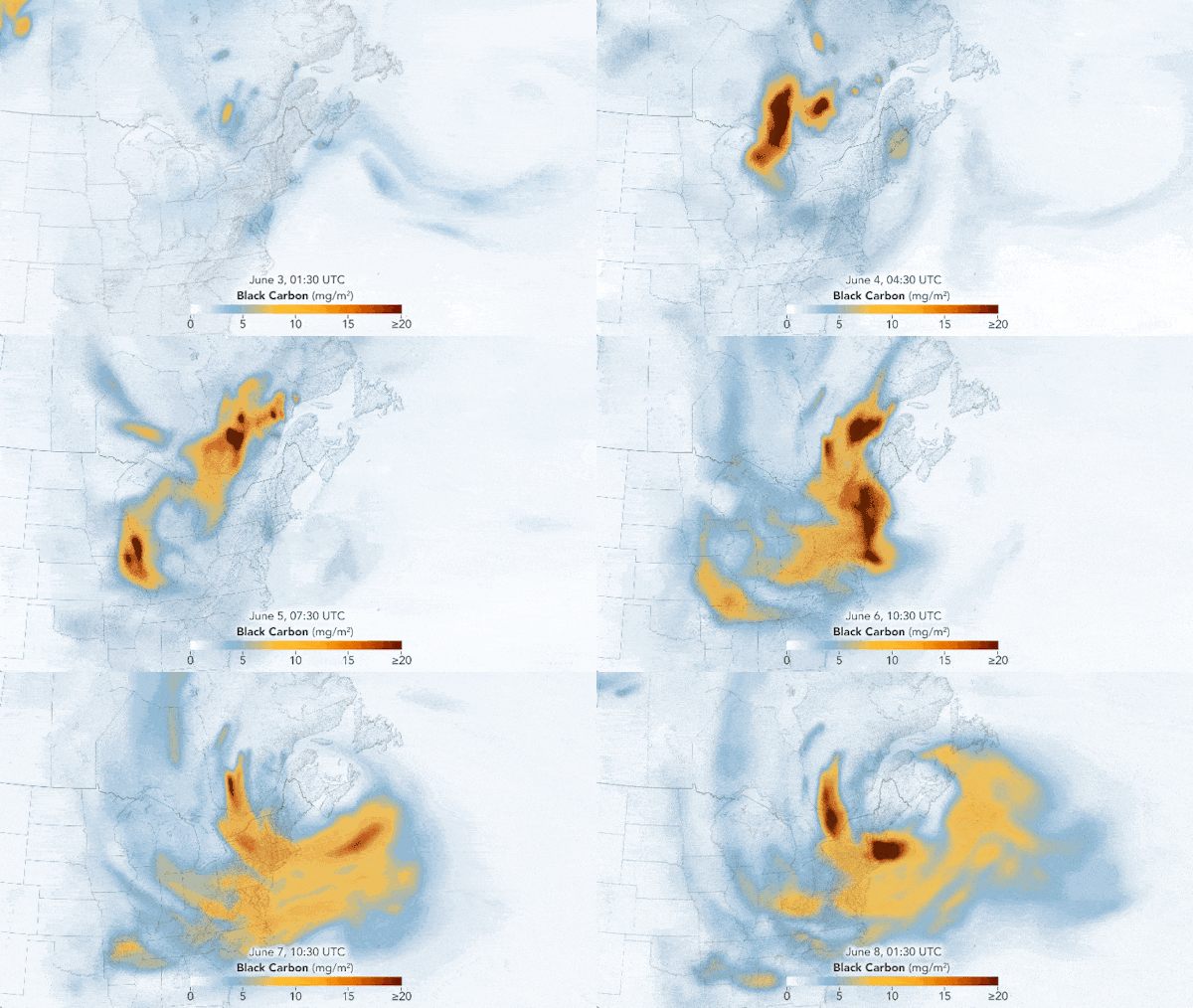
Canada’s seemingly endless wildfires in 2023 introduced millions of people across North America to the health hazards of wildfire smoke. While Western states have contended with smoky fire seasons for years, the air quality alerts across the U.S. Midwest and Northeast this summer reached levels never seen there before.
The smoke left the air so unhealthy in Philadelphia on June 7, 2023, that the Phillies-Detroit Tigers Major League Baseball game was postponed. That same week, New York City residents hunkered down indoors for several days as a smoky haze hung over the city, turning the skies orange and exposing millions of people to the worst air quality in the world.
Smoke also drifted into the Midwest, triggering the highest air quality index levels in the Chicago area in at least 24 years, forcing the cancellation of numerous summer activities and leaving residents with raspy voices. In several states, people woke up to smoky skies day after day.
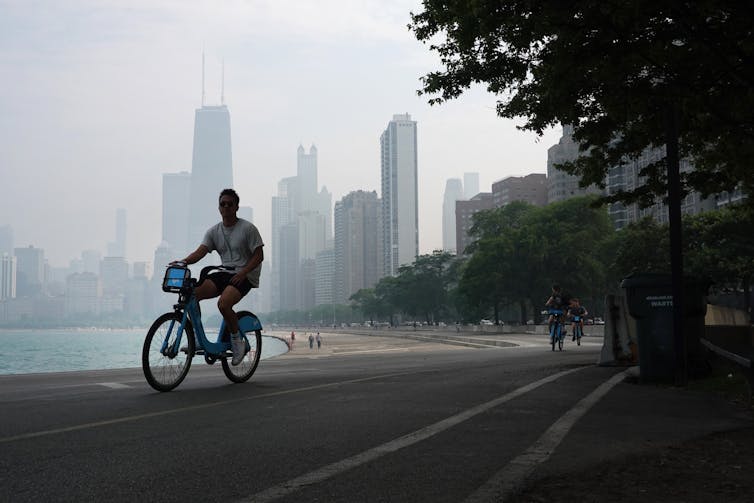
The pressing question on many people’s minds: “Is this the new normal?” From our perspective as air quality scientists, we think the answer is likely “yes.”
Global warming means more fires
The wildfire smoke of 2023 highlights an emerging air quality trend. The U.S. had seen decades of falling levels of fine particulate matter pollution, PM2.5, thanks to environmental regulations and cleaner engines, factories and power plants. But wildfires’ contribution to air pollution is increasing again, resulting in flat or rising levels of air pollution in much of the country.
Climate models predicted this reality as global temperatures rise. Hotter, drier conditions, coupled with dry grasses and underbrush that accumulated over decades of fire suppression, have made large wildfires more common. Computer simulations of the future in a warming climate show more smoky days, higher smoke concentrations, larger burned areas and higher emissions – which further fuel climate change.
While prescribed fire and forest thinning can help reduce the number and intensity of fire outbreaks, smoke exposure is still likely to increase because of the increases in burned area anticipated as a result of large-scale shifts in temperature and moisture.
In short, people will need to learn to live with wildfire smoke. It won’t be every year, but we’re likely to see summers like 2023 more often.
Fortunately, there are several tools and strategies for managing a smokier future.
Preparing for smoky days
Managing the risk of wildfire smoke starts with making smart personal choices.
Think of smoke waves like heat waves: They’re easier to face if you’re prepared and know they’re coming. That means paying attention to forecasts and having face masks, air monitors and clean-air shelters available.
Inhaling PM2.5 and the chemicals in wildfire smoke can exacerbate asthma, worsen existing respiratory and cardiac problems and leave people more susceptible to respiratory infection. People caring for individuals sensitive to smoke, such as young children and older adults, will need to plan for their needs in particular.

To prepare, read up on the risks and warning signs from public health professionals. Living with wildfire smoke may mean using air filtration devices, wearing N95 or KN95 masks on bad air days, modifying outdoor commuting patterns and activity schedules and changing household ventilation choices.
What schools and communities can do
Living with smoke will also require changes to how schools, businesses, apartment buildings and government buildings operate.
Schools can start with setting a threshold for canceling outdoor activities and making sure staff are ready to meet the needs of kids with asthma.
Building managers may need to rethink air filtration and ventilation and deploy air quality sensors. Communities will also need contingency plans for festivals and recreation venues, as well as rules for business to protect outdoor workers.
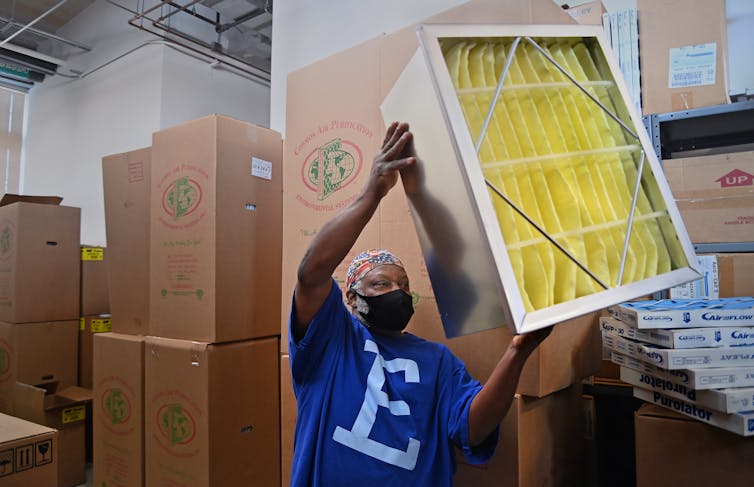
Decisions on how to deal with smoke can be complicated. For example, selecting an air purifier can be a daunting task, with over 900 products on the market. The effectiveness of different smoke management interventions are not well known and can vary depending on small implementation details, such as how a mask fits the wearer’s face, whether exterior doors and windows seal tightly and whether filters are installed properly and are replaced often enough.
Improving smoke monitoring and forecasting
The U.S. has an extensive air quality monitoring and forecasting system to help provide some early warning. It uses ground-based air quality monitors, satellite remote sensing systems to detect smoke and fires and computer systems that tie observations together with wind, chemistry and weather. These are supplemented by expert guidance from meteorologists.
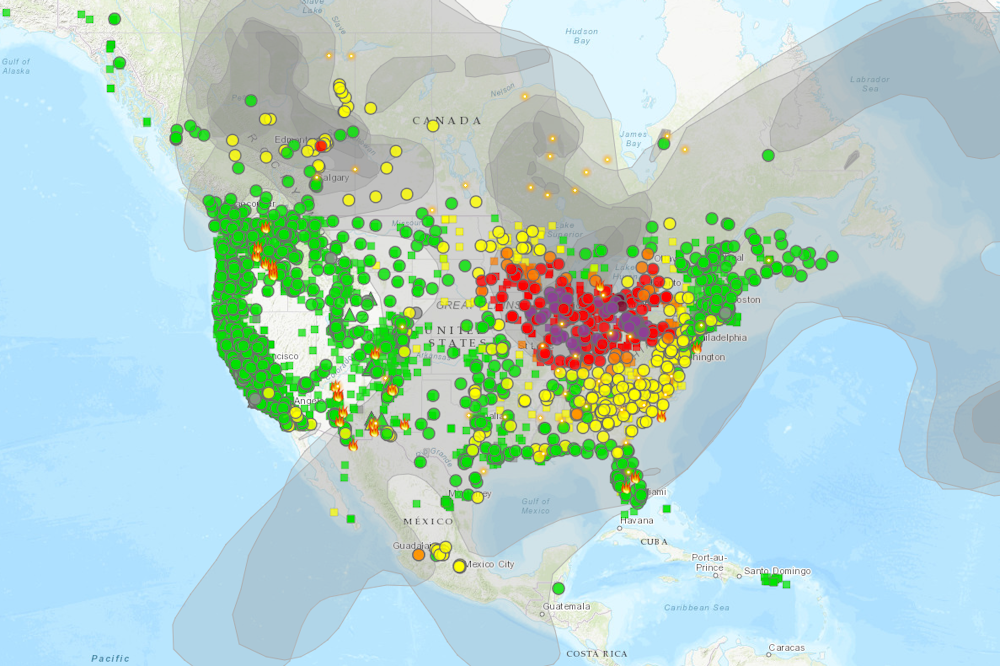
However, for average people trying to make decisions about the safety of outdoor activities, the current forecasting system is wanting. This is especially true when smoke blows in from fires far away, or when rapidly changing smoke emission rates and complex wind patterns lead to conflicting forecasts and advisories.
A few key improvements would go a long way for practical decision making around wildfire smoke, like whether to delay the start of soccer practice:
-
Knowledge of how fires evolve hour by hour can improve the smoke estimates going into the forecast models.
-
Providing smoke forecasts at neighborhood scale can better inform individuals and cities of pending risks.
-
More accurate 10-day forecasts would allow communities to plan.
-
Merging seasonal weather forecasts of precipitation, humidity and winds with satellite assessments of fuel conditions could enhance emergency planning for firefighters to help anticipate which regions and periods present the highest risks of fire and smoke.
Maintaining a strong air quality monitoring network is also important. State and local government agencies have reduced the number of ground monitors by about 10% from its peak in 2001. Smoke estimates from satellites and low-cost portable sensors can help, but they work best when they can be cross-calibrated to a well-maintained network of high-accuracy monitors.
We still have a lot to learn
More effective adaptations to smoke will require more research to better understand the factors that make some people more vulnerable to harm from smoke, the effects of cumulative impacts of exposures to environmental stressors and smoke over the life span, and the efficacy and cost-effectiveness of adaptations.
For example, clean-air shelters – the equivalent to a cooling center during extreme heat – are gaining attention, but there is only limited guidance on what constitutes a clean-air shelter and where and when they would be used. A 2023 Government Accountability Office report called for better coordination to help target resources where they can be most effective.
Living with smoke is emerging as a new reality. Next-generation tools need to be both clear and resilient to the compound hazards that develop when smoke hits simultaneously with other challenges, such as extreme heat.
Charles O. Stanier, Professor of Chemical and Biochemical Engineering, University of Iowa; Gregory Carmichael, Professor of Chemical and Biochemical Engineering, University of Iowa, and Peter S. Thorne, University of Iowa Distinguished Chair, Professor of Environmental Health, University of Iowa
This article is republished from The Conversation under a Creative Commons license. Read the original article.
The U.S. Department of Labor’s report on the history of Labor Day explains that it focuses on the social and economic achievements of American workers.
“The holiday is rooted in the late nineteenth century, when labor activists pushed for a federal holiday to recognize the many contributions workers have made to America’s strength, prosperity and well-being,” the Department of Labor said.
“Before it was a federal holiday, Labor Day was recognized by labor activists and individual states. After municipal ordinances were passed in 1885 and 1886, a movement developed to secure state legislation. New York was the first state to introduce a bill, but Oregon was the first to pass a law recognizing Labor Day, on February 21, 1887, the history reported.
The Labor Department said that in 1887, four more states — Colorado, Massachusetts, New Jersey and New York — passed laws creating a Labor Day holiday. By the end of the decade, Connecticut, Nebraska and Pennsylvania had followed suit.
“By 1894, 23 more states had adopted the holiday, and on June 28, 1894, Congress passed an act making the first Monday in September of each year a legal holiday,” the Department of Labor reported.
The meeting will begin at 4 p.m. at the Moose Lodge, located at 15900 Moose Lodge Lane in Clearlake Oaks.
The meeting will be available via Zoom. The meeting ID is 986 3245 2684, pass code is 666827.
This month’s guest speaker is Trevor Oppezzo from Caltrans District 1.
Caltrans is developing the Caltrans Complete Streets proposal, a project focused along Highway 20 in the areas around Upper Lake, Nice, Glenhaven and Clearlake Oaks.
Oppezzo will discuss the proposed improvements as well as hear input at the meeting.
Also on the agenda is an update on Spring Valley covering items including illegal cannabis cultivation, FireWise Community safety and Spring Valley Lake recovery.
Standing agenda items for the meeting include commercial cannabis cultivation projects, the cannabis ordinance task force update, an update from Northshore Fire Protection District, a report from Supervisor EJ Crandell, new business and announcements.
The group’s next meeting will take place on Oct. 4.
ERTH’s members are Denise Loustalot, Jim Burton, Tony Morris and Pamela Kicenski.
For more information visit the group’s Facebook page.

MIDDLETOWN, Calif. — Middletown Libraries across America connected this summer through a unique pen pal program.
In late May, Youth Librarian Mary Geers from Midpointe Library in Middletown, Ohio, contacted the Middletown branch of the Lake County Library.
She proposed connecting young patrons from Middletown libraries across the USA through a pen pal program during Midpointe’s summer reading program “All Together Now.”
Sara Coel and Sheryl Ison at Lake County’s Middletown branch worked with Greers on the initiative, which was a complete success.
Lake County Middletown’s young patrons received 65 letters in return from Middletown, Ohio, and Middletown, New Jersey. The libraries hope to continue the pen pal program during the holiday season.
Unique and creative children’s programming can be found all year round at all four Lake County Library branches, including crafts, “Read to a Dog,” Lego Club and more.
Sign up for library newsletters, follow the library on social media, or watch the events calendar on the library website to join upcoming events.
Visit the Lake County Library at https://library.lakecountyca.gov, on Facebook at https://www.facebook.com/LakeCountyLibrary, Twitter @LakeCoLibrary, Instagram @lakecountylibrary, YouTube @lakecountycalibrary and TikTok @lakecountycalibrary.
To contact the Middletown library by phone, call 707-341-7971.