 How to resolve AdBlock issue?
News
The 303-page report, released in July, includes 14 final reports on various topics.
The report can be downloaded here.
The grand jury can require responses from agencies on its findings.
This year, for two of its investigative topics, “Sex Trafficking: Hiding in Plain Sight” and “America Is Bleeding: School Shootings,” the grand jury required the Clearlake Police Department to respond.
Responses for both of those reports also are required from all of the county’s school districts, the Lakeport Police Department and the Lake County Sheriff’s Office.
Clearlake Police Chief Tim Hobbs was the first public official to offer a response to the report.
Hobbs thanked the grand jurors for their efforts in completing the report, noting it was very detailed and contained a lot of good information.
He said he appreciated the grand jury’s willingness to meet with the police department and learn about challenges and opportunities regarding those two subjects.
Findings for the sex trafficking report were:
1. Human/sex trafficking cases are complex, require lengthy investigations, involve multiple agencies across county, state and country boundaries, and are costly to resolve.
2. Lake Family Resource Center has developed detailed training materials on trafficking.
3. Widespread education on trafficking, especially among youths and persons working with youths, can increase awareness and opportunities for potential intervention.
Hobbs said the police department agreed with all but one of the findings in the report. He said they had a disagreement on a minor point in the first finding; Hobbs said such cases don’t always involve multiple agencies.
The grand jury recommended that the Clearlake Police Department provide annual training on trafficking for their officers and staff, which Hobbs said they do. He said his agency sends staff members to more advanced training when possible.
The school shootings report had six findings:
1. School shootings are still relatively rare, but have been increasing since 2017.
2. The guns used in school shootings usually come from the student’s or a relative’s home.
3. School violence is not uncommon at athletic events.
4. SROs [school resource officers] benefit from specialized training focusing on nonviolent communication, with youths’ social and emotional development.
5. Single entrances and metal detectors at campus entrances are helpful in screening for weapons.
6. School officials’ outreach to parents/guardians to sensitize them to worrisome changes in students’ behavior can help identify at-risk students needing intervention.
There were several recommendations regarding school shootings included, but only two applied to police: That school district officials and law enforcement officers include athletic events in their active shooter response plans and that school district officials hire school resource officers and provide them with specialized training to better understand adolescent development and nonviolent communication.
Hobbs said those recommendations have been implemented.
On July 20, the city entered into a memorandum of understanding with Konocti Unified School District to provide a full-time school resource officer.
Hobbs said that officer attended a course and learned about the issues mentioned in the grand jury report a week before school started in August.
Jim Cyr of Kelseyville, who acted as recording secretary and committee chair for last year’s grand jury and is the foreman for the newly seated 2023-24 grand jury, was in the audience and thanked Hobbs.
The council voted unanimously to approve Hobbs’ proposed response and direct City Clerk Melissa Swanson to send it to the Lake County Superior Court.
In other business on Thursday, the council presented proclamations declaring Sept. 22 as Native American Day and another declaring September 2023 as Senior Center Month, held a public hearing to adopt Resolution 2023-39 renewing Ordinance 261-2022 and the approval of the Clearlake Police Department Military Equipment Report, and awarded a $626,425 contract to Pavement Coatings for the 2023 Double Chip Seal Project.
Email Elizabeth Larson at
The Creek fire began Wednesday afternoon in the area of Highway 29 and Clayton Creek Road, south of Lower Lake.
Cal Fire said Thursday evening that the fire remained at 28 acres, with containment up to 85% by day’s end.
Firefighters remained on scene throughout the day.
At about 5:45 p.m., radio traffic indicated several more units were leaving, with incident command transitioning to a Cal Fire engine.
A cause for the fire has so far not been given.
Email Elizabeth Larson at

CLEARLAKE, Calif. — Clearlake Animal Control has dozens of great dogs waiting to be adopted.
The Clearlake Animal Control website continues to list 31 dogs for adoption.
This week’s dogs include “Mamba,” a nearly 3-year-old male Siberian husky mix with a black, tan and white coat. He has been neutered.

Another adoptable dog waiting for a home is “Waldo,” an American pit bull terrier mix with a gray and white coat.
There also is “Baby,” who is almost 3 years old, and is a female American pit bull terrier mix with a white coat. She is housetrained and spayed.
The shelter is located at 6820 Old Highway 53. It’s open from 9 a.m. to 6 p.m. Tuesday through Saturday.

For more information, call the shelter at 707-762-6227, email
This week’s adoptable dogs are featured below.
Email Elizabeth Larson at

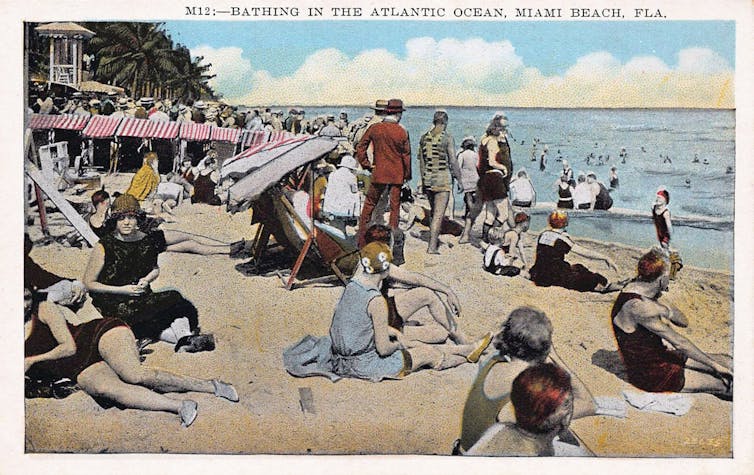
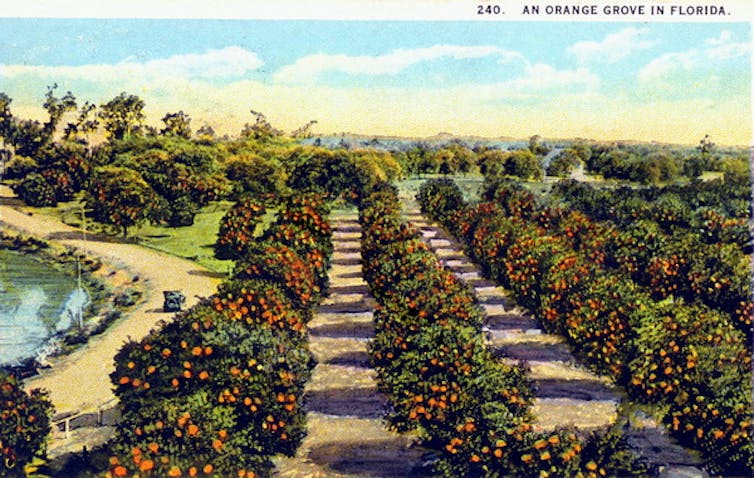
Images of orange groves and Spanish-themed hotels with palm tree gardens filled countless pamphlets and articles promoting Southern California and Florida in the late 19th century, promising escape from winter’s reach.
This vision of an “American Italy” captured hearts and imaginations across the U.S. In it, Florida and California promised a place in the sun for industrious Americans to live the good life, with the perfect climate.
But the very climates that made these semitropical playgrounds the American dream of the 20th century threaten to break their reputations in the 21st century.

In California, home owners now face dangerous heat waves, extended droughts that threaten the water supply, and uncontrollable wildfires. In Florida, sea level rise is worsening the risks of high-tide flooding and storm surge from hurricanes, in addition to turning up the thermostat on already humid heat. Global warming has put both Florida and California at the top of the list of states most at risk from climate change.
My books and research have explored how these two states were sold to the U.S. public like twin Edens. Today, descendants of those early waves of residents are facing a different world.
Selling semitropical climates
As railroads first reached Southern California and the Florida peninsula in the 1870s and 1880s, land, civic and newspaper boosters in each state worked to overturn beliefs that people only thrived in colder climes. In the decades after the Civil War, white Americans living in the North and Midwest had to be persuaded that sun-kissed climates would not do them more harm than good.
Employed by the transcontinental railroads, influential writers like Charles Nordhoff contested eastern notions of Southern California as barren desert where “Anglo-Americans” would inevitably succumb to the “disease” of laziness.
Challenging persistent ideas of a malarial swampland, promoters in Florida, including the state’s own Bureau of Immigration, similarly put a growing emphasis on climate as a vital resource for fruit growers and health seekers.
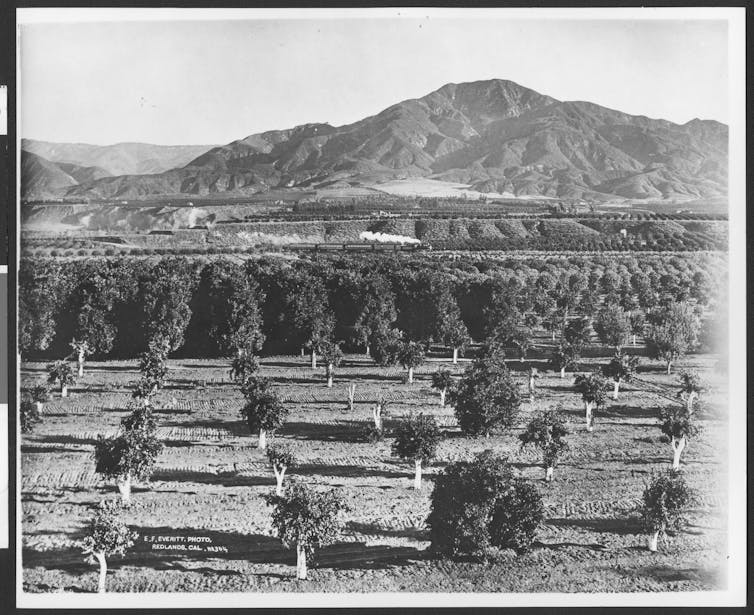
Climate became integral to California’s and Florida’s growing reputation as idealized U.S. destinations. Moreover, it was deemed unlike other natural assets: an inexhaustible resource.
Tourists and settlers gave weight to these claims. “The drawing card of Southern California,” a tourist from Chicago visiting Pasadena wrote in the Chicago Tribune in 1886, “is the beautiful, even climate.” Peninsula Florida was “blessed by nature with a semi-tropical climate,” a visitor wrote in the Atlanta Constitution in 1890. He saw its destiny to attract those who would “bask in the sunlight of a genial clime.”
This proved a compelling vision. In the 1880s, both Southern California and eastern Florida saw booms in settlement and tourism. Southern California’s population more than trebled during the decade to over 201,000, while peninsular Florida’s doubled to over 147,000.
Affluent white Americans weighed up the merits of each: for citrus-growing, winter recuperation, land investment. The differences were, of course, numerous. One state was western, the other southern; one more mountainous, the other flat. Some boosters critiqued their subtropical rival’s climate.
Southern California was too arid, a writer in the Florida Dispatch claimed, a desert “parched for want of water.” Florida, meanwhile, had too much of the stuff, editorials in California replied: a wetland fit for reptiles but potentially deadly to new residents who would wilt in its torrid summers.
Yet Southern California and Florida became connected through economic futures founded upon climate promotion and related industries of citrus, tourism and real estate. If rivals, they shared distinct market ambitions.
“California and Florida can [together] control the citrus trade,” the Los Angeles Times declared in 1885, arguing for mutual benefits in the promotion of oranges. The pair had much to gain from persuading Americans to eat their fruit.

Developers in both also changed the landscape by rerouting water to create communities in once-inhospitable places. In California, the spread of irrigation to turn “desert into garden” enabled the growth of citrus towns such as Riverside, while vast aqueducts conveyed water to thirsty cities like Los Angeles.
In Florida, flawed schemes sought to “reclaim” – essentially drain – wetlands, including the Everglades, where boosters like Walter Waldin sold Americans on a once-in-a-lifetime “opportunity to secure a home and a livelihood in this superb climate.”
An inexhaustible resource
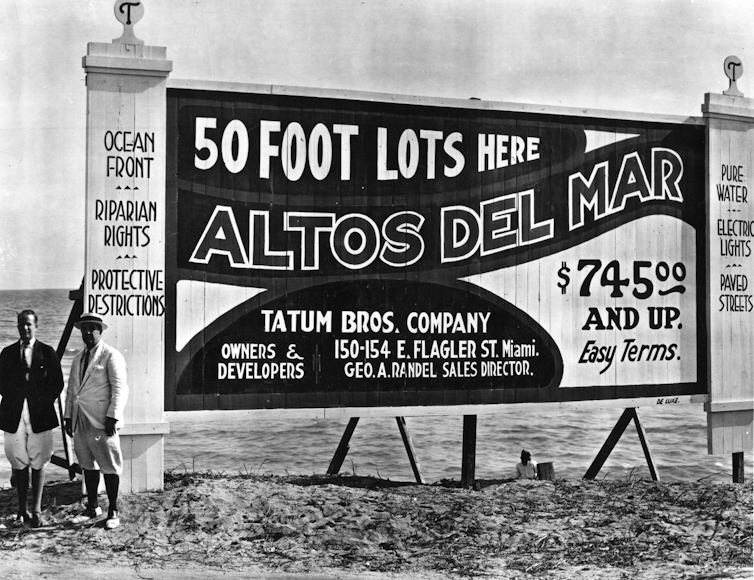
The roaring ‘20s saw a new influx of sun-seeking, automobile-driving Americans drawn by boosters to the beaches and orange groves of Los Angeles County and South Florida.

.jpg)
Comparing Florida and California had become a national pastime as popular as mahjong and crossword puzzles, according to Robert Hodgson, a subtropical horticulturist at the University of California, in 1926.
Hodgson traveled to Florida to act as a judge at an agricultural show in Tampa where, the Los Angeles Times reported in a dig at Florida, he visited everything “from the dizziest pink stucco shore subdivision to the latest aspiring farming colony reclaimed from the alligators.”
.jpg)
Snipes aside, climate and the lifestyle they offered to middle-class Americans set Southern California and Florida apart. Hodgson wrote that they were similarly “blessed by the gods” through a “joint heritage of something like 90% of the subtropical climatic areas of the United States.”
Climate, moreover, was unlike other natural resources. Whereas precious metals or forests could be mined or cut down, climate was different: an infinite resource. It “can never be exhausted by man in his ignorance or cupidity,” he explained.
Climate as crisis
This history of climate-based advertising puts into stark relief the challenges faced by California and Florida in the era of climate crisis.
Today, both confront recurring natural disasters that are exacerbated by human-caused climate change: wildfires in California, hurricanes and flooding in Florida, and increasingly dangerous heat in both.
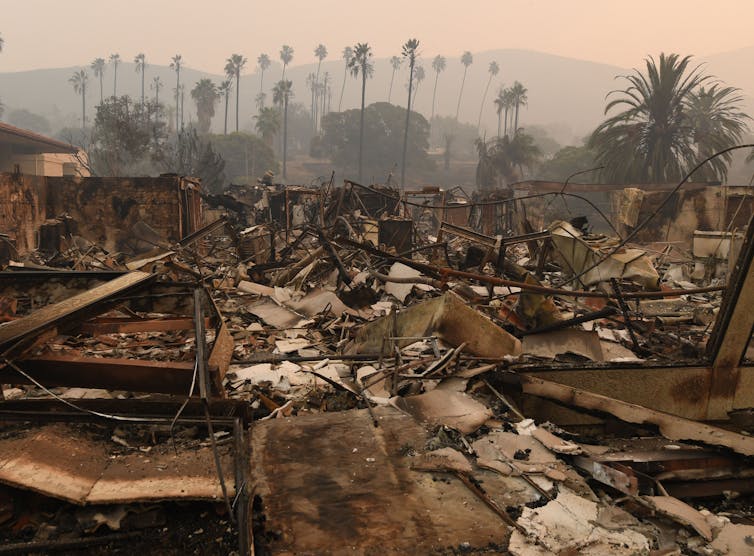
Extensive home-building in wildfire and coastal zones has compounded these risks, with insurance companies now refusing coverage for properties at risk of fires or storm damage, or making it prohibitively expensive.
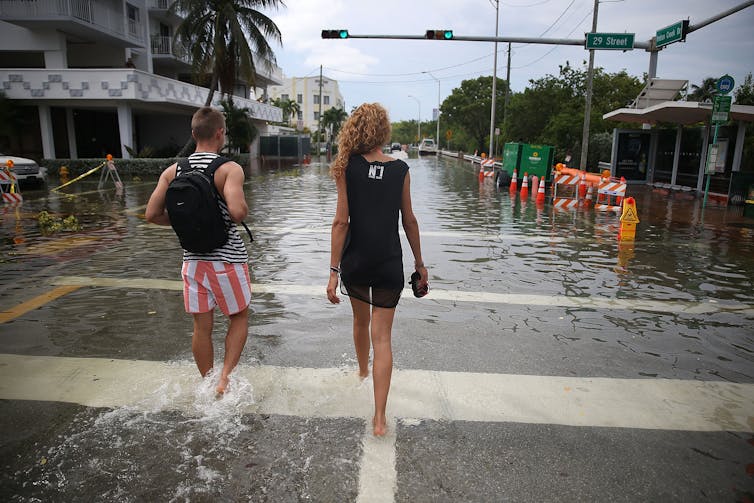
Once marketed successfully as the United States’ two semitropical paradises, Southern California and Florida now share disturbing climate-influenced futures.
These futures bring into question how historic visions of economic growth and the sun-kissed good life that California and Florida have promised can be reconciled with climates that are no longer always genial or sustainable.
Henry Knight Lozano, Senior Lecturer in American History & Director of Liberal Arts, University of Exeter
This article is republished from The Conversation under a Creative Commons license. Read the original article.
The Creek fire began Wednesday in the area of Highway 29 and Clayton Creek Road, south of Lower Lake, at about 3:30 p.m.
Lake County Fire, Cal Fire and other fire agencies from around Lake County were part of the response, along with air resources from Ukiah and Santa Rosa.
By Wednesday night, Cal Fire said the fire was holding at 28 acres, and was 50% percent contained.
Due to the fire’s fast movement toward homes, incident command had called for evacuations throughout a portion of Lower Lake on Wednesday afternoon.
On Wednesday evening, mandatory evacuations in and around Lower Lake were rolled back to warnings, and other areas under evacuation warning were cleared.
A portion of Highway 29 that had been closed due to the fire was reopened by Wednesday evening, the California Highway Patrol reported.
Resources on scene included 100 personnel, three helicopters, 13 engines, two dozers, two water tenders, two crews and four air tankers, Cal Fire said.
Cal Fire said firefighters will be in the area throughout the night and into Thursday working on containment and putting out hot spots.
The Creek fire’s cause remains under investigation, Cal Fire said.
In related news, despite the fire activity earlier in the day, Cal Fire said it was continuing with conducting an overnight flying training mission out of its Boggs Mountain Helitack.
Cal Fire said the training was expected to take place between 8 p.m. Wednesday and 2 a.m. Thursday.
Email Elizabeth Larson at
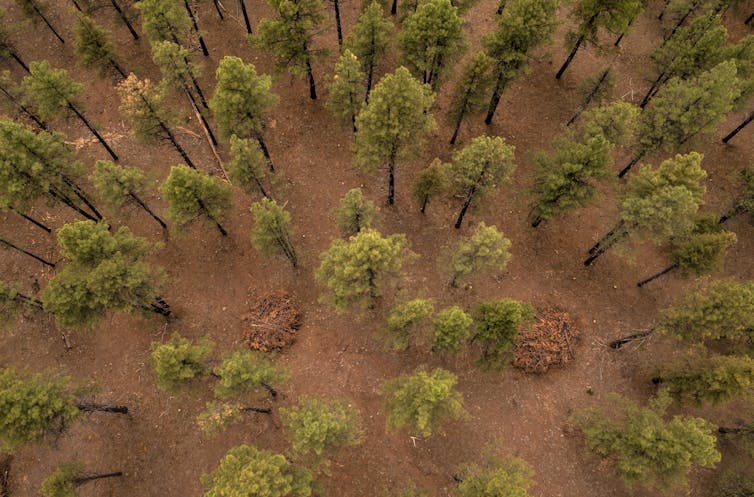
The U.S. government is investing over US$7 billion in the coming years to try to manage the nation’s escalating wildfire crisis. That includes a commitment to treat at least 60 million acres in the next 10 years by expanding forest-thinning efforts and controlled burns.
While that sounds like a lot – 60 million acres is about the size of Wyoming – it’s nowhere close to enough to treat every acre that needs it.
So, where can taxpayers get the biggest bang for the buck?
I’m a fire ecologist in Montana. In a new study, my colleagues and I mapped out where forest treatments can do the most to simultaneously protect communities – by preventing wildfires from turning into disasters – and also protect the forests and the climate we rely on, by keeping carbon out of the atmosphere and stored in healthy soils and trees.
Wildfires are becoming more severe
Forests and fires have always been intertwined in the West. Fires in dry conifer forests like ponderosa pine historically occurred frequently, clearing out brush and small trees in the understory. As a result, fires had less fuel and tended to stay on the ground, doing less damage to the larger, older trees.
That changed after European colonization of North America ushered in a legacy of fire suppression that wouldn’t be questioned until the 1960s. In the absence of fire, dry conifer forests accumulated excess fuel that now allows wildfires to climb into the canopy.
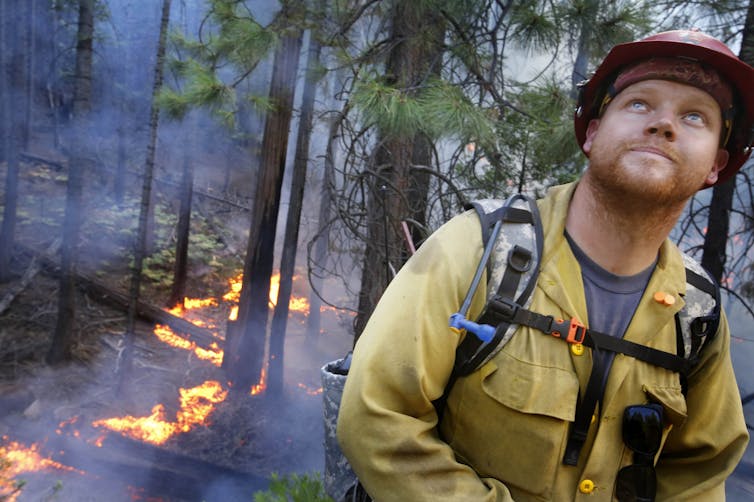
In addition to excess fuels, all forest types are experiencing hotter and drier wildfire seasons due to climate change. And the expanding number of people living in and near forests, and their roads and power lines, increases the risk of wildfire ignitions. Collectively, it’s not surprising that more area is burning at high severity in the West.
In response, the U.S. is facing increasing pressure to protect communities from high-severity wildfire, while also reducing the country’s impact on climate change – including from carbon released by wildfires.
High-risk areas that meet both goals
To find the locations with greatest potential payoff for forest treatments, we started by identifying areas where forest carbon is more likely to be lost to wildfires compared to other locations.
In each area, we considered the likelihood of wildfire and calculated how much forest carbon might be lost through smoke emissions and decomposition. Additionally, we evaluated whether the conditions in burned areas would be too stressful for trees to regenerate over time. When forests regrow, they absorb carbon dioxide from the atmosphere and lock it away in their wood, eventually making up for the carbon lost in the fire.
In particular, we found that forests in California, New Mexico and Arizona were more likely to lose a large portion of their carbon in a wildfire and also have a tough time regenerating because of stressful conditions.
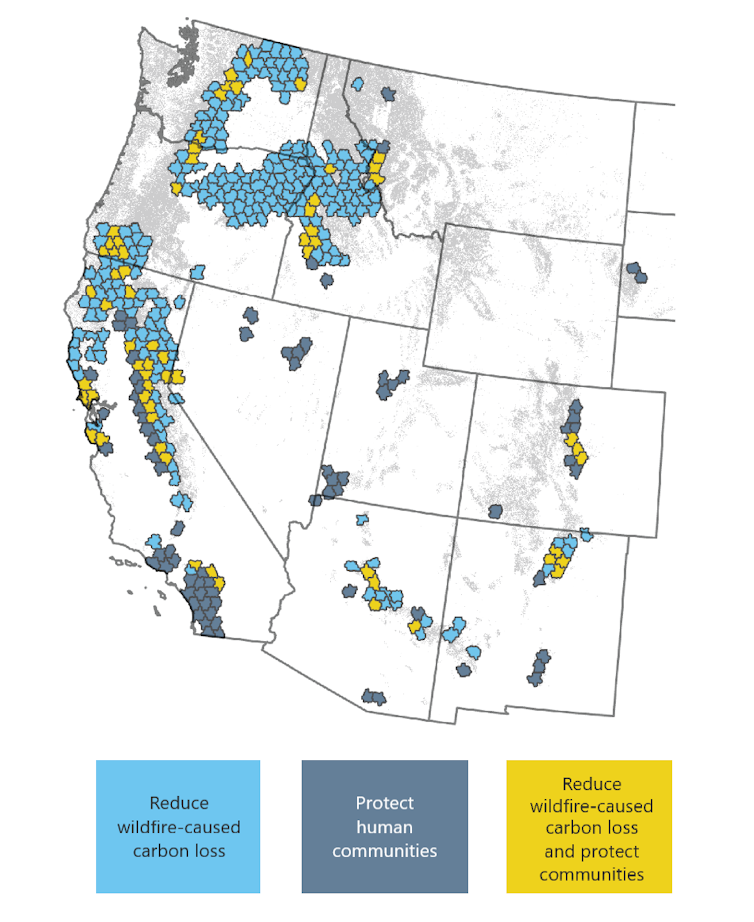
When we compared those areas to previously published maps detailing high wildfire risk to communities, we found several hot spots for simultaneously reducing wildfire risk to communities and stabilizing stored carbon.
Forests surrounding Flagstaff, Arizona; Placerville, California; Colorado Springs, Colorado; Hamilton, Montana; Taos, New Mexico; Medford, Oregon, and Wenatchee, Washington, are among locations with good opportunities for likely achieving both goals.
Why treating forests is good for carbon, too
Forest thinning is like weeding a garden: It removes brush and small trees in dry conifer forests to leave behind space for the larger, older trees to continue growing.
Repeatedly applying controlled burns maintains that openness and reduces fuels in the understory. Consequently, when a wildfire occurs in a thinned and burned area, flames are more likely to remain on the ground and out of the canopy.
Although forest thinning and controlled burning remove carbon in the short term, living trees are more likely to survive a subsequent wildfire. In the long term, that’s a good outcome for carbon and climate. Living trees continue to absorb and store carbon from the atmosphere, as well as provide critical seeds and shade for seedlings to regenerate, grow and recover the carbon lost to fires.
Of course, forest thinning and controlled burning are not a silver bullet. Using the National Fire Protection Agency’s Firewise program’s advice and recommended materials will help people make their properties less vulnerable to wildfires. Allowing wildfires to burn under safe conditions can reduce future wildfire severity. And the world needs to rapidly transition away from fossil fuels to curb climate change impacts that increase the risk of wildfires becoming community disasters.
Jamie Peeler, Postdoctoral Research Fellow, University of Montana
This article is republished from The Conversation under a Creative Commons license. Read the original article.