 How to resolve AdBlock issue?
News
Assemblymember James C. Ramos (D-San Bernardino), the first California Native American elected to the Legislature in 173 years, discussed pushing a new bill to require compliance with the laws in the final weeks of this year’s legislative session.
Ramos, chair of the Assembly Select Committee on Native American Affairs, and Joint Committee on Legislative Audits Chair David Alvarez (D-San Diego) led the hearing and heard testimony from State Auditor Grant Parks.
His report details how the CSU system has failed to comply with the 1990 federal Native American Graves Protection and Repatriation Act, or NAGRPRA, and its 2001 state counterpart, CalNAGPRA.
The auditor’s report released in June cites the CSU system’s lapses and blunders in failing to ensure the timely return of Native American remains and cultural objects.
Ramos, who requested the audit, said, “After decades, CSU has failed to return the human remains of our ancestors to the appropriate tribe. These bones are not objects; they are not academic or archeological trophies to secure career gains or research grants. The remains of our ancestors deserve respectful burial. It is a fundamental human right to be buried according to the customs of one’s people. I know of no other group denied this right.”
“It is clear that California has fallen behind in recognizing the importance of safeguarding and returning Native American remains and artifacts,” Alvarez stated. “As the chair of the Joint Legislative Audit Committee, I recognize the need for a more comprehensive examination of this subject. I express my gratitude to the California State Auditor for thoroughly investigating this matter.”
Almost 30 years since NAGPRA was enacted, only 6% of CSU’s nearly 700,000 remains and items have been repatriated, according to the audit. Key findings from the audit — which reviewed all 23 CSU campuses and conducted on-site reviews at four sites, Chico State University, Sacramento State University, San Diego State University, and San Jose State University — included:
• 12 of the 21 CSU campuses with collections have not finished reviews required by NAGPRA, and 16 campuses have little or no repatriation activities.
• Two campuses returned remains to tribes without following NAGPRA’s requirements for notifying other tribes, and six campuses violated CalNAGPRA by handling collections without first consulting with tribes.
• Campuses lack the policies, funding, and staff to support repatriation efforts.
Ramos is considering emergency legislation to codify the state auditor’s recommendations and make them law. Auditor recommendations include annual progress reports to the Legislature regarding progress toward repatriation, campus protocols, and requiring experienced repatriation coordinators at campuses of more than 100 sets of remains or cultural items.
CSU Interim President Sylvia Alva testified at the hearing along with the following CSU campus representatives:
• Min-Tung “Mike” Lee, president of Sonoma State University, which had the largest number of collections at 185,300 during the audit period, even as the campus review of remains and items has not been completed. Only 0.2% of the collection has been repatriated.
• CSU Chico President Steve Perez, whose campus has the second highest number of collections — 150,200 — and has returned some remains or items but has not followed the process outlined in NAGPRA.
• Luke Wood, president of CSU Sacramento, with the third largest collection numbered at 115,900, with only 5% of the remains and artifacts repatriated. Its review has not been completed.
• Amir Dabirian, provost at CSU Fullerton, a campus with 8,300 collections of which 0.2% have been repatriated.
• Four CSU campuses — Monterey Bay, Stanislaus, Bakersfield, and Los Angeles — have not yet provided data needed to estimate the size of their NAGPRA collections. The state auditor reported these four campuses showed human remains in their collections and disclosed holding more than 100 boxes still requiring review.
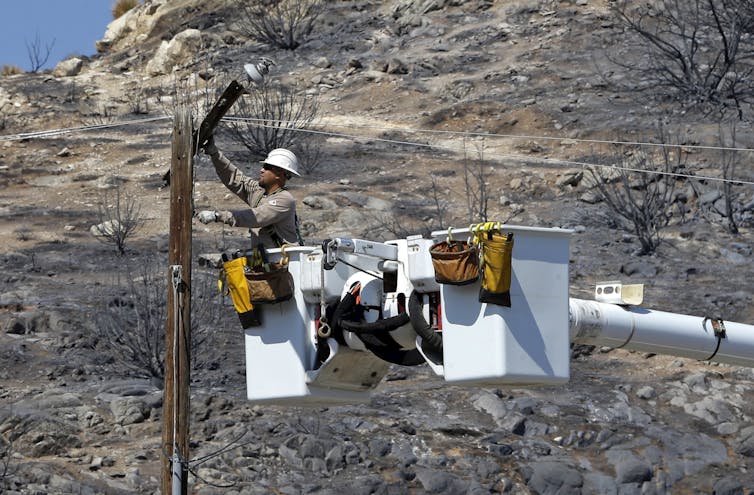
Maui County is suing Hawaiian Electric, claiming the utility was negligent for not shutting off power as strong winds hit the island in the hours before the city of Lahaina burned. While the cause of the devastating Aug. 8, 2023, wildfire is still under investigation, forecasters had warned that powerful winds were expected, and West Maui had exceptionally dry conditions that put it at high risk for wildfires.
In many cases, however, deciding to shut off power isn’t as simple is as it might sound. We asked Tim Lieuwen, executive director of the Strategic Energy Institute at Georgia Tech, about the risks and trade-offs utilities have to weigh in deciding how to respond during fire-risk conditions.
Why are utilities so often suspected in fires?
There are a lot of ways that utility lines, particularly high-voltage lines, can spark fires.
If tree branches are too close to the lines, electricity can arc between the line and the tree. Old equipment can set off sparks. If the weather gets really hot, power lines can sag and touch dry grass or trees. If there’s a lot of wind, that can push a power line into tree branches or damage equipment.
All of those can and have been fire-starters.
In California, a state audit found that electrical power caused 10% of all wildfires and was responsible for nearly 20% of all acres burned from 2016 to 2020. Those were also some of the most destructive fires in state history – including the 2018 fire that destroyed the town of Paradise. Pacific Gas & Electric pleaded guilty to 84 counts of involuntary manslaughter in that case and one felony count of unlawfully starting a fire.
Do utilities have a responsibility for fire safety?
That’s the question at the heart of litigation and debates.
Public utilities’ obligations can vary state to state. In general, regulated utilities have a duty to provide safe, affordable, reliable power to their customers. That can mean making tough choices.
Let’s say it’s really windy, dry and hot – ideal conditions for spreading a wildfire. The utility can shut off power, but that means people don’t have air conditioning in what may be extreme heat. People with health issues – who might need oxygen, for example – might not be able to run essential medical devices.
Electricity is critical infrastructure and a foundational bedrock to many other services. Cellphone service can be lost if transmission towers lack backup power, so when power goes out in a disaster, people could lose access to crucial information. Water pumps used in wells and water treatment also need electricity. Many municipal water systems have backup generators to keep water flowing, but small water systems might not.
Texas learned about cascading dependencies during the deep freeze in February 2021. When power systems failed, the pumps used to send gas and oil through pipelines went out. That meant power plants weren’t getting the gas they needed to operate.
Utilities have to balance the risk of keeping power on with the risks created by shutting power off.
What can utilities do to manage fire risk?
Utilities can make sure they’re careful about trimming trees, cutting grasses and removing other dry fuel that can ignite near power lines.
In really high-risk areas, they can move their lines underground. There’s an effort to do that in California, but estimates show it would be prohibitively expensive to take all high-voltage lines underground.
To give you a sense of the amount of line we’re talking about, in 2021, California utilities reported having nearly 40,000 miles of bare power lines in areas at high risk of wildfires.
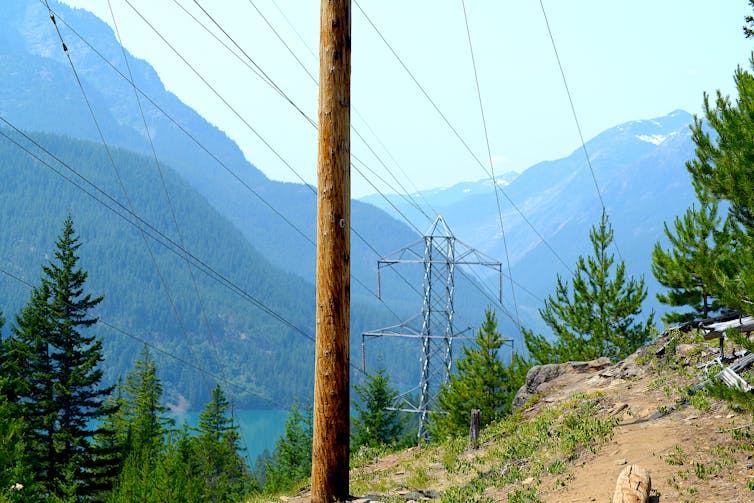
Utilities are constantly actively looking for fire risks, whether it’s replacing old transformers or upgrading lines that might be overloaded or clearing away foliage.
Technology also helps identify risks. Sensors can detect sparks on a power line. Newer tools being tested aim to detect variations in electrical current that could indicate overloaded lines before sparks occur. On hot days, being better able to manage the distribution of power flow of electricity through power lines that are overloaded and potentially overheating could also help avoid problems along power lines.
Another solution is making architectural changes to the electricity grid, where rather than relying on large centralized power stations with high power, long distance transmission lines, power is produced closer to the consumer, ranging from community, to neighborhood, to one’s own home.
For example, rooftop solar and community solar projects can help reduce the need to add more high-voltage transmissions lines to carry power long distances and through high-risk wildlands. The architecture of the grid is rapidly evolving as both rooftop and community solar appear.
How do utilities balance the risks?
It’s easy to oversimplify this. Every solution, every choice, has an impact. You can shut off power during windstorms and largely eliminate the fire risk from power infrastructure. But it also has real consequences for people’s businesses, livelihoods and potentially their health and safety.
As an engineer, I can advise on the risks and develop solutions to minimize those risk through better detection, better equipment and by minimizing the need for lots of electrical lines. However, how to balance those risks and, in particular, address the issue of when a utility should shut off the power, is ultimately a societal choice.
Tim C. Lieuwen, Executive Director of the Strategic Energy Institute, Georgia Institute of Technology
This article is republished from The Conversation under a Creative Commons license. Read the original article.
The fire was reported just before 1 a.m. in the 3300 block of 13th Street, between Country Club and Bush Street.
Initial reports said there was a large smoke column and multiple power lines down as the fire burned in two homes and spot fires ignited a small area of vegetation.
The response included a full wildland dispatch of several Cal Fire engines in addition to Lake County Fire Protection District resources, which had to move around the downed power lines to safely access the fire, based on radio reports.
Radio traffic said the fire was putting off ash that was falling around the immediate area.
Pacific Gas and Electric responded to the scene and cut power to the downed lines, according to scanner reports.
The Clearlake Police Department issued a Nixle alert shortly before 1:30 a.m. asking people to avoid the fire area.
Two burn victims were reported — one a 9-year-old and one a middle-aged female — with both flown out of the county for treatment.
One of the air ambulances confirmed it was headed to the UC Davis Medical Center shortly after 2 a.m. The second copter was off the ground just after 2:30 a.m.
A third individual from another house involved in the fire was reported to have suffered a traumatic lower extremity injury and was transported to the hospital, according to radio traffic.
The vegetation burned totaled about an eighth of an acre. Firefighters reported that the fire in the vegetation and the two houses was contained by 2 a.m., with extensive mop up required.
Shortly before 2 a.m., incident command asked for the Northshore Support Team to respond while the mop up continued.
Dispatch also was directed to contact Golden State Water Co. to inform them that there would be high water usage while the work was underway.
Units began to be released from the scene just before 3 a.m.
More information will be published as it becomes available.
Email Elizabeth Larson at
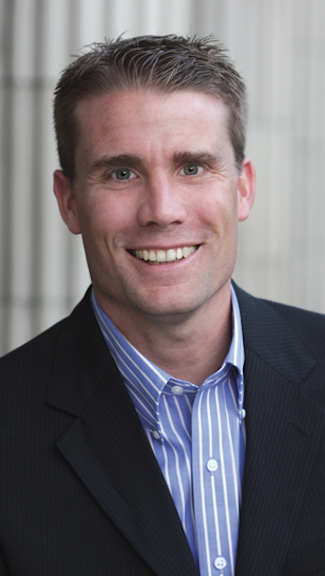
LAKE COUNTY, Calif. — Lake County’s representative in the state Senate is moving into a more powerful and prestigious post.
On Monday, Senate President pro Tempore Toni G. Atkins (D-San Diego) announced that the Senate Democratic Caucus convened and determined that Sen. Mike McGuire (D-Healdsburg) will be the pro tem designee, with a transition to be announced next year.
“Sen. McGuire is a proven leader who has been a tireless champion for communities ravaged by wildfire, expanding educational opportunities, building affordable housing, addressing homelessness, and other priorities for everyday Californians,” said Gov. Gavin Newsom. “I congratulate him on this new role and look forward to the important work ahead with the Senate to continue tackling our current challenges and building a brighter future for all Californians.”
McGuire, 44, now becomes the highest ranking member of the state Senate.
First elected to the Senate in 2014, McGuire has been a strong advocate for Lake County, helping with the recovery effort from the area’s wildland fires and other disasters.
He moved into the Senate majority leader’s job — the second-highest ranking position in the Senate — in January of 2022.
“Words are not enough to express the extent of my gratitude, honor, and humility for being chosen by our united caucus to lead the California Senate. Together, we will meet the challenges ahead with grace, courage, and determination. We will never stop fighting to make the promise of the Golden State real for every Californian,” McGuire said.
Atkins credited McGuire with being integral to several legislative victories during his time as Senate majority leader, including the 2022 climate package and the infrastructure streamlining package negotiated alongside this year’s state budget.
“It is a privilege to be the Senate Leader. Now, the time has come to plan for the next leader, and the Senate Democratic Caucus is unified in its decision to name Sen. Mike McGuire as the pro tem designee,” Atkins said. “I am confident that this will be a seamless transition, and that Sen. McGuire will continue to guide the Senate and California down a path of success. Sen. McGuire has been a key member of my leadership team, a trusted confidant, and time after time, the convener who sets the table to get things done. The Senate and the people of California will be in good hands with Sen. McGuire as their future leader of the Senate.”
Sen. Bill Dodd, D-Napa, who formerly represented Lake County in the Assembly, offered his congratulations to McGuire.
“Nobody works harder than Mike McGuire, whom I’ve had the pleasure of knowing since we were both county supervisors,” Sen. Dodd said. “He’s put in the work as majority leader and he’s proven to be an expert at bringing people together to make real headway in Sacramento. He’s also been an incredible partner on wildfire safety and so many of the top issues facing California. Simply put, he’s the right person at the right time.”
Serving as Senate pro tem since 2018, Atkins was the first woman to hold the position and the first person in 150 years to serve as both pro tem and Assembly speaker.
“Jennifer and I are deeply grateful to Pro Tem Atkins for her tremendous leadership and partnership these past four years, and for her friendship. Through immense challenges and opportunities, Toni has been steadfast in her commitment to working Californians, civil rights, and the environment, and I’m glad that our work together will continue in the months ahead. I thank Toni for her decades of service to the people of our state and know this won’t be the last we see of her in public service,” Newsom said.
“Pro Tem Atkins is one of the most effective and thoughtful leaders of our time. She’s a California trailblazer, a role model for millions, and a dear friend,” said McGuire. “We will work hand-in-glove to finish out the important work that we have all fought so hard for all year — and to ensure a seamless transition into the next chapter of this great institution.”
Dodd also lauded Atkins, calling her a “trailblazing leader.”
“I’m one of the few to serve with her when she was speaker and pro tem. It’s a reality of term limits that we need to elect a new leader, but her service to the state in the Senate and beyond will continue,” Dodd said.
Email Elizabeth Larson at
Andrew Socrates Parras, 52, was killed when his 2017 Chevrolet pickup collided with a tractor trailer just after noon on Friday on Highway 29 north of Diener Drive near Kelseyville.
The California Highway Patrol’s Clear Lake Area office said that, based on its investigation so far, it appears that Parras’ pickup — which was traveling northbound — crossed into the southbound lane and hit the 2016 tractor trailer driven by 53-year-old Dale Brandt of Yuba City.
Parras’ pickup then went off the road and hit a tree, the CHP said.
The CHP said Parras was declared dead at the scene, Brandt was uninjured.
The crash remains under investigation.
Email Elizabeth Larson at
The company said its meteorologists and operations professionals are monitoring a potential dry, northerly windstorm forecast to start early Wednesday morning.
The Sacramento Office of the National Weather Service has issued a fire weather watch from Tuesday evening through Wednesday evening.
Given the windstorm and current conditions including dry vegetation, PG&E has begun sending advanced notifications to customers — via text, email and automated phone call — in targeted areas where PG&E may need to proactively turn power off for safety to reduce the risk of wildfire from energized power lines.
The potential public safety power shut-off, or PSPS, event starting around 3 a.m. on Wednesday could affect approximately 8,000 customers in small portions of seven counties, mostly on the west side of the Sacramento Valley.
The potential shut-off is currently expected to affect approximately 8,000 customers across the following counties:
• Colusa County: 531 customers, 38 Medical Baseline customers.
• Glenn County: 365 customers, 19 Medical Baseline customers.
• Lake County: 50 customers, three Medical Baseline customers.
• Napa County: Eight customers, zero Medical Baseline customers.
• Shasta County: 3,812 customers, 356 Medical Baseline customers.
• Tehama County: 3,249 customers, 352 Medical Baseline customers.
• Yolo County: 30 customers, one Medical Baseline customer.
Customers can look up their address online to find out if their location is being monitored for the potential safety shut-off at www.pge.com/pspsupdates.
Conditions may change. As such, PG&E’s in-house meteorologists, as well as its Emergency Operations Center and its Hazard Awareness & Warning Center, continue to closely monitor conditions.
PG&E representatives will make individual, in-person visits, when possible, to customers enrolled in the company’s Medical Baseline Program who do not verify they have received these important safety communications, with a primary focus on customers who rely on electricity for critical life-sustaining equipment.
PG&E initiates PSPS when the fire-weather forecast is severe enough that people’s safety, lives homes and businesses may be in danger of wildfires.
Factors that can lead to a shut-off include low humidity levels, generally 30% and below; a forecast of high winds, particularly sustained winds above 19 miles per hour and wind gusts above 30 to 40 miles per hour; the condition of dry material on the ground and low moisture content of vegetation; and a red flag warning declared by the National Weather Service; real-time ground observations from PG&E crews working across the service area; and the company’s decision-making process also accounts for the presence of trees tall enough to strike power lines.