 How to resolve AdBlock issue?
News
LAKE COUNTY, Calif. — The California Highway Patrol has released an initial report on a Friday collision that killed a Lake County man.
The crash occurred at 12:05 p.m. on Highway 29 north of Diener Drive near Kelseyville.
A 52-year-old Kelseyville man died in the wreck. The CHP’s Clear Lake Area office said Sunday that it was not releasing the man’s name pending the notification of his family.
The CHP said its preliminary investigation indicates that the Kelseyville resident was driving a 2017 Chevrolet pickup truck northbound on Highway 29 approaching a 2016 Kenworth tractor trailer — driven by 53-year-old Dale Brandt of Yuba City — that was traveling southbound.
For reasons that are still being investigated, the Chevrolet pickup crossed over into the southbound traffic lane and collided with the Kenworth’s trailer, the CHP said.
The pickup continued off the roadway and hit a tree. The CHP said the driver, who was using his safety equipment, was declared dead at the scene.
Brandt did not suffer any injuries, according to the report.
The CHP said the crash remains under investigation.
Email Elizabeth Larson atThis email address is being protected from spambots. You need JavaScript enabled to view it. . Follow her on Twitter, @ERLarson, or Lake County News, @LakeCoNews.
The crash occurred at 12:05 p.m. on Highway 29 north of Diener Drive near Kelseyville.
A 52-year-old Kelseyville man died in the wreck. The CHP’s Clear Lake Area office said Sunday that it was not releasing the man’s name pending the notification of his family.
The CHP said its preliminary investigation indicates that the Kelseyville resident was driving a 2017 Chevrolet pickup truck northbound on Highway 29 approaching a 2016 Kenworth tractor trailer — driven by 53-year-old Dale Brandt of Yuba City — that was traveling southbound.
For reasons that are still being investigated, the Chevrolet pickup crossed over into the southbound traffic lane and collided with the Kenworth’s trailer, the CHP said.
The pickup continued off the roadway and hit a tree. The CHP said the driver, who was using his safety equipment, was declared dead at the scene.
Brandt did not suffer any injuries, according to the report.
The CHP said the crash remains under investigation.
Email Elizabeth Larson at
LAKEPORT, Calif. — The Lakeport Police Department, city of Lakeport, Lake County Behavioral Health and Lake Family Resource Center are partnering to conduct a town hall meeting to address the homelessness and mental illness crisis in our community.
The event will be held on Wednesday, Sept. 27, from 6 to 8 p.m. in the Soper Reese Theatre,
275 S. Main St. in Lakeport.
The intent of the public meeting is to engage with the community, hear your questions and address your concerns.
Homelessness and mental illness are complex issues requiring the collaboration of agencies and the community.
The agenda will include an overview of legislative and voter changes to criminal justice laws over the past decade that impact treatment of individuals, response to mental illness locally, and the constraints faced by agencies in rural areas.
Presenters will discuss the status of the crisis responder program operated cooperatively by Lakeport Police and Lake Family Resource Center.
This call for action in seeking solutions will include a survey for public feedback.
Plan to attend this important town hall event to share your input.
Please contact Chief Brad Rasmussen at the Lakeport Police Department at 707-263-5491 for more information.
The event will be held on Wednesday, Sept. 27, from 6 to 8 p.m. in the Soper Reese Theatre,
275 S. Main St. in Lakeport.
The intent of the public meeting is to engage with the community, hear your questions and address your concerns.
Homelessness and mental illness are complex issues requiring the collaboration of agencies and the community.
The agenda will include an overview of legislative and voter changes to criminal justice laws over the past decade that impact treatment of individuals, response to mental illness locally, and the constraints faced by agencies in rural areas.
Presenters will discuss the status of the crisis responder program operated cooperatively by Lakeport Police and Lake Family Resource Center.
This call for action in seeking solutions will include a survey for public feedback.
Plan to attend this important town hall event to share your input.
Please contact Chief Brad Rasmussen at the Lakeport Police Department at 707-263-5491 for more information.
CLEARLAKE, Calif. — The Clearlake Police Department is attempting to locate a missing woman.
Police are seeking information regarding the whereabouts of Gina Pillow, 45.
Pillow is described as a white female adult, 5 feet5 inches tall and 120 pounds, with blonde hair dyed red and blue eyes.
She was last seen wearing an unknown color shirt and gray pants.
If you have any information regarding her location please contact the Clearlake Police Department at 707-994-8251, Extension 1, for dispatch.
Police are seeking information regarding the whereabouts of Gina Pillow, 45.
Pillow is described as a white female adult, 5 feet5 inches tall and 120 pounds, with blonde hair dyed red and blue eyes.
She was last seen wearing an unknown color shirt and gray pants.
If you have any information regarding her location please contact the Clearlake Police Department at 707-994-8251, Extension 1, for dispatch.
Do you ever wonder how daily resources — lights at the flick of a switch, flowing water at the turn of a tap or irrigation to grow fresh produce — arrive in our homes and stores?
Chances are you live in an area where the natural resources you use are provided by a special district government that manages one or more of these vital services.
The U.S. Census Bureau has released the 2022 Census of Governments — Organization, a compilation of the total count and types of all local governments, including special districts, in the 50 states and the District of Columbia.
The Census Bureau classifies local governments (primarily funded by taxpayer dollars) as either general purpose (counties, municipalities, and townships) or special purpose (independent school districts and special district governments).
Special district governments operate independently from your local county or municipality. They have the legal power to collect their own tax revenues necessary to provide services that benefit our communities, such as irrigation, water treatment, and soil and water conservation.
What are natural resources special districts?
While special districts cover a wide range of services for the public sector, let’s explore those like water supply and flood control that conserve, promote and develop natural resources.
How many natural resources special districts were there in 2022?
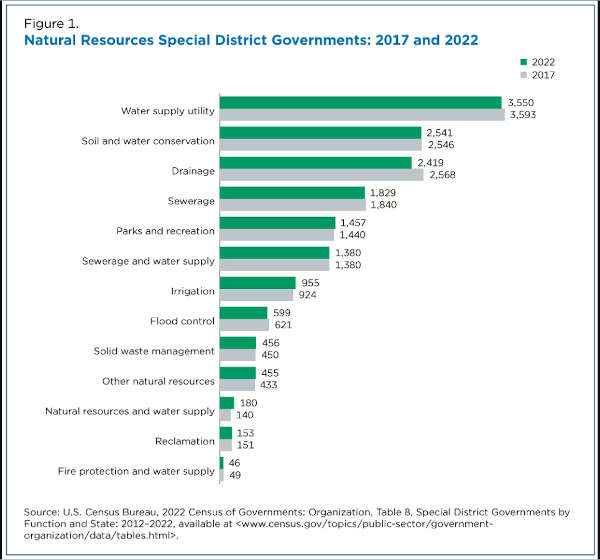
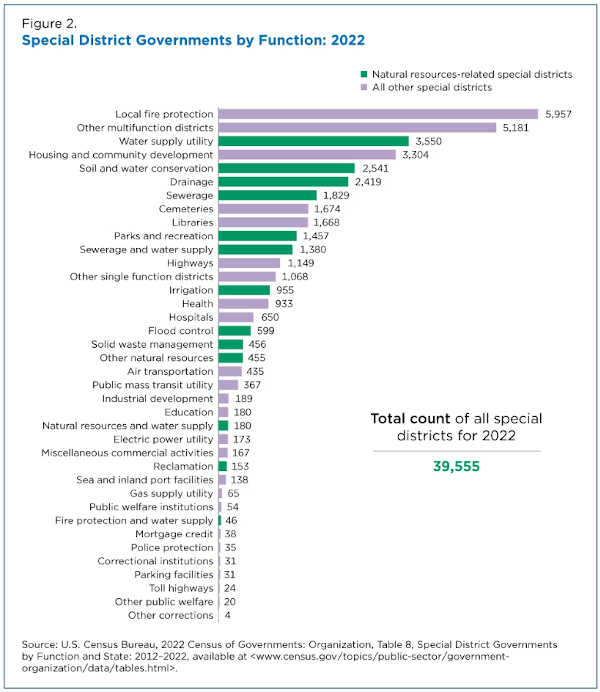
The 2022 Census of Governments — Organization publication shows that 16,020 or 41% of the nation’s 39,555 special district governments in 2022 supported parts of the economy related to natural resources.
In comparison, there were fewer (38,542) special district governments in 2017 but slightly more (16,145) devoted to natural resources.
In general, the number of natural resources special districts remained relatively consistent over the five-year period.
Everyone can appreciate that irrigation and proper water management are critical functions for stable agriculture. The Census of Governments captures several types of these special districts that you may not be aware of, some unique to a geographic region.
• Acequias (ah-SAY-kee-Yuhs):
In the U.S. Southwest, specifically in southern Colorado and parts of New Mexico, acequias are vital to communities’ water operations.
Acequias are special district governments that are community-operated irrigation canals which provide water for domestic and industrial use. Each community that borders an acequia is entitled to use the water and commits to provide the regular maintenance and repairs. An acequia commission (led by a superintendent or mayordomo) oversees the acequia’s operations of the acequia and distribution of the water.
The hydrology of acequias benefits ecological health and farming production and maintains groundwater levels. They are the oldest water management system in the United States. The Census Bureau typically classifies these as drainage or irrigation districts.
• Tax ditch districts:
Prevalent on the East Coast, particularly in Delaware and Maryland, tax ditch districts are another type of natural resources special district that oversee drainage of agricultural lands and water management for resource conservation purposes.
The Census of Governments counts over 200 tax ditch districts in Delaware, ranging in size from a small two-acre system in Wilmington to 56,000 acres in west central Delaware. These districts manage over 2,000 miles of water channels and provide benefits to over 100,000 people, according to the Delaware Department of Natural Resources and Environmental Control.
More information
Government Organization tables provide information about the number of active local governments by type, function, and by state. The data published in August 2023 includes 11 tables of data on local government counts from the 2022 Census of Governments.
Coming in Spring 2024, the Census Bureau will release detailed descriptions of the responsibilities and authorities of local governments in each state and the District of Columbia in the 2022 Individual State Descriptions report.
Robyn Harris, Amber Hennessy, Ava Mckain and Mercera Silva are survey statisticians in the Census Bureau’s Public Sector Frame and Classification Branch.
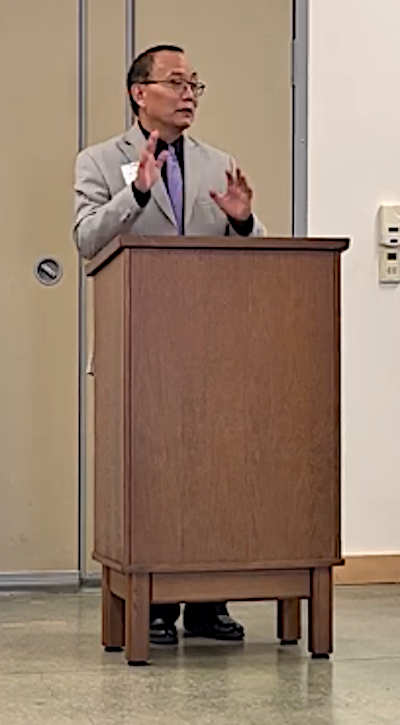
LAKE COUNTY, Calif. — The new chancellor of the Yuba Community College District was officially welcomed to Lake County on Wednesday.
The district’s board voted to hire Dr. Shouan Pan in April, and he took over the job in June, as Lake County News has reported.
A native of China, Pan has lived in the United States since 1985, pursuing his masters and doctoral degrees and holding leadership positions in colleges in Florida, Arizona and, most recently, Washington — where he was chancellor of the Seattle Community Colleges — before making his way to California.
He now presides over the Yuba Community College District, which crosses eight counties and serves an estimated 13,000 students at its Yuba College and Woodland Community College campuses.
Lake County’s campus, in Clearlake, is under Woodland Community College.
That’s where the reception for Pan took place on Wednesday afternoon.
Dignitaries and officials on hand to celebrate Pan at the event included Supervisor Bruno Sabatier; Dr. Santanu Bandyopadhyay, president of Woodland Community College; Ingrid Larsen, dean of the Lake County Campus; Lake County Superintendent of Schools Brock Falkenburg; Clearlake City Councilman Dirk Slooten; and college district board member Doug Harris and President Juan Delgado.
Dr. Pan thanked everyone for coming and honoring him, noting that it speaks of their love and support for the campus.
“It is clear to me what this campus means to the county, to the city, to this region,” Pan said, adding that listening to stories from community members about their experiences with the campus gave him goose bumps.
Community colleges in America are a rare innovation, Pan said.
He explained that after World War II, veterans returning home led to the need to create a new higher educational system for those who weren’t served well in the nation’s traditional — and, in some ways, racist — higher education system. That changed America, where at one point a new college was emerging every week.
Pan said he was grateful to the college district trustees for selecting him as the next chancellor. “This is a rare opportunity for me to continue my love for community college.”
He shared his experiences growing up in China. His father was the only one in the family who had a college degree, and because he had been dubbed an anti-communist, his children struggled to get an education.
Pan said that he was excluded from many things because of how the government targeted his father. Despite his challenges, he was a very good student and would go on to become the first person in his family to get a college degree.
Although he was a good high school student, Pan said he was unsure of himself, and the government determined to send him to the countryside to be a farmer for the rest of his life.
However, thanks to China opening up, Pan was able to come to the United States, where community colleges resonated with him. His two sons, born in the United States, excelled in community college — he said it changed their lives — while they had struggled in university.
Community college is a gateway and equalizer for counties like Lake, Colusa and the other rural counties the district serves, he said.
Pan said they want to be mission centered, and find how to provide training and education that allows those who have historically been underserved to have the equal opportunity to excel and to break the cycle of poverty.
The Lake County Campus, Pan said, “has an important role to play.”
He said he wants to collaborate with community leaders. “We want to be innovative. We have to be responsive, agile, adaptive” to the needs of the county and community.
Pan said the college wants to be sustainable and needs more resources. Still, with its limited resources, he said they need to focus on students and their future.
“I look forward to continuing to come to this county, to this city, to collaborate with you,” and to explore possibilities to serve students and taxpayers well, Pan said.
By honoring him, they are honoring higher education and the campus, Pan said.
The biography of Dr. Pan provided at the event follows in its entirety.
Shouan Pan, Ph.D.
Chancellor, Yuba Community College District
Dr. Shouan Pan comes to the Yuba Community College District from Washington, where he served as chancellor of the Seattle Community Colleges. During his tenure in Seattle, Dr. Pan led the integration of HR, web services, eLearning, IT, international education, corporate training, and initiated the Seattle Promise program that is recognized nationally as a model of equitable student success. Under his leadership, the Seattle Colleges Foundation raised a record amount of funds in support of students, and Equity Diversity and Inclusion priorities. In concert with community partners, the Seattle Community Colleges initiated five no-credit micro-pathway programs, new associate degrees in Fire Sciences, and a Bachelor of Science degree in Computer Science.
Before leading Seattle Community Colleges, Dr. Pan served as President of Mesa Community College; Provost of Broward College-South Campus; Executive Dean of Instruction and Student Services at Florida State College, Jacksonville; Dean of Student Life at Community College of Philadelphia; and Assistant Professor of Educational Psychology, and Recruitment and Retention Administrator at Northern Arizona University.
Dr. Pan centers his leadership practices on fulfilling the community college mission and promoting student and community success. He places emphasis on working with the Board of Trustees, institutional and community stakeholders in formulating a common vision and building consensus on strategic decisions. His success is evidenced in a strong track record of improving student success; building partnerships with educational institutions, businesses, and civic organizations to further institutional goals and community economic development; and securing external resources.
He has been active in higher education at local, state, and national levels, including membership in the American Association of Community Colleges, and the Association of Community College Trustees. He has served on the boards of the National Asian Pacific Islander Council, Campus Compact, Chair Academy, and Economic Development Council of Seattle and King County. He has received honors and awards from organizations including, the League for Innovation in Community Colleges, Phi Theta Kappa International Honor Society, and the Mesa MLK Jr. Celebration Committee. Born and raised in China, Dr. Pan immigrated to the United States in 1985.
He earned a Doctor of Philosophy in Higher Education from Iowa State University, a Master of Education from Colorado State, and a Bachelor of Arts from Hefei Polytechnic University, RP China.
Email Elizabeth Larson at
LAKE COUNTY, Calif. — During the 2022-23 school year, 48% of chronically absent students in Lake County improved their attendance through the Communities for School Success program.
The Lake County Office of Education Communities for School Success program was implemented in partnership with Lake County school districts to address the high chronic absenteeism rates in Lake County schools.
“When students improve their attendance rates, they improve their academic prospects and chances for graduating,” said Lake County Superintendent of Schools Brock Falkenberg.
Chronic absenteeism is defined as missing two or more days of school, excused or unexcused, a month.
During the 2022-23 school year, the attendance liaisons contacted 915 K-12 Lake County students.
Of those students contacted, 75% returned to school within three days of a home visit. Less than half of the contacted students needed a second contact attempt.
Overall, 1,400 contacts or attempts were made by the attendance liaisons.
An attendance liaison is an individual who works directly with students to find solutions to improve their attendance rates. Each liaison is assigned to a single school district.
Barriers that are preventing regular school attendance include trauma, transportation, cultural differences or even students not finding school engaging or fun.
Attendance Liaisons held weekly Social Emotional Learning, or SEL, activities during the lunch break at schools. This was done to support connections between students and the community and to inspire students to want to be at school.
Angie DeMaria, a former Teacher at Terrace Middle School in Lakeport and now principal of Hance Community School, was responsible for implementing this program and overseeing a staff of seven Attendance Liaisons.
“I am proud of my staff and the work they have done to help Lake County students return to school. They not only gave students the resources they need to get to school but also gave students a sense of belonging,” DeMaria said.
This Learning Communities for School Success program is a partnership between LCOE and the Lake County school districts and is grant funded through the California Department of Education.
To learn more about the importance of attendance, visit https://www.lakecoe.org/Attendance.
The Lake County Office of Education Communities for School Success program was implemented in partnership with Lake County school districts to address the high chronic absenteeism rates in Lake County schools.
“When students improve their attendance rates, they improve their academic prospects and chances for graduating,” said Lake County Superintendent of Schools Brock Falkenberg.
Chronic absenteeism is defined as missing two or more days of school, excused or unexcused, a month.
During the 2022-23 school year, the attendance liaisons contacted 915 K-12 Lake County students.
Of those students contacted, 75% returned to school within three days of a home visit. Less than half of the contacted students needed a second contact attempt.
Overall, 1,400 contacts or attempts were made by the attendance liaisons.
An attendance liaison is an individual who works directly with students to find solutions to improve their attendance rates. Each liaison is assigned to a single school district.
Barriers that are preventing regular school attendance include trauma, transportation, cultural differences or even students not finding school engaging or fun.
Attendance Liaisons held weekly Social Emotional Learning, or SEL, activities during the lunch break at schools. This was done to support connections between students and the community and to inspire students to want to be at school.
Angie DeMaria, a former Teacher at Terrace Middle School in Lakeport and now principal of Hance Community School, was responsible for implementing this program and overseeing a staff of seven Attendance Liaisons.
“I am proud of my staff and the work they have done to help Lake County students return to school. They not only gave students the resources they need to get to school but also gave students a sense of belonging,” DeMaria said.
This Learning Communities for School Success program is a partnership between LCOE and the Lake County school districts and is grant funded through the California Department of Education.
To learn more about the importance of attendance, visit https://www.lakecoe.org/Attendance.