 How to resolve AdBlock issue?
News
CLEARLAKE, Calif. – Clearlake city officials said the deadline for outdoor cannabis cultivation permits is fast approaching.
In the city of Clearlake, the outdoor cultivation of marijuana is not permitted without first obtaining an outdoor cultivation permit.
Permits may be obtained at the Clearlake Police Department through the end of the business day on Tuesday, April 30.
The annual permit fee is $250 and allows for the outdoor cultivation of up to six marijuana plants at one time.
City officials said It is a common misconception that state law allows for the cultivation of marijuana on any property and does not prohibit the quantity of plants.
In January of 2018, recreational marijuana use and possession became legal in California.
Pursuant to the law, a person over the age of 21 may cultivate up to six marijuana plants indoors without the approval of a local or state agency, however local jurisdictions have control over the outdoor cultivation in each jurisdiction.
Wanting to work with the citizens of our community and while considering the increasing costs associated with cultivating indoors and the health and safety risk factors, the Clearlake City Council approved the outdoor cultivation of up to six marijuana plants with certain restrictions and guidelines.
Any persons who intend to cultivate marijuana outdoors in city limits are encouraged to obtain their permit prior to April 30.
Those found to be cultivating illegally are subject to fines, immediate abatement of plants and suspension of cultivation privileges for the individual and/or the property.
For additional restrictions and requirements, please visit the city of Clearlake Web site at www.clearlake.ca.us or contact Code Enforcement at 707-995-8251, Extension 309.
In the city of Clearlake, the outdoor cultivation of marijuana is not permitted without first obtaining an outdoor cultivation permit.
Permits may be obtained at the Clearlake Police Department through the end of the business day on Tuesday, April 30.
The annual permit fee is $250 and allows for the outdoor cultivation of up to six marijuana plants at one time.
City officials said It is a common misconception that state law allows for the cultivation of marijuana on any property and does not prohibit the quantity of plants.
In January of 2018, recreational marijuana use and possession became legal in California.
Pursuant to the law, a person over the age of 21 may cultivate up to six marijuana plants indoors without the approval of a local or state agency, however local jurisdictions have control over the outdoor cultivation in each jurisdiction.
Wanting to work with the citizens of our community and while considering the increasing costs associated with cultivating indoors and the health and safety risk factors, the Clearlake City Council approved the outdoor cultivation of up to six marijuana plants with certain restrictions and guidelines.
Any persons who intend to cultivate marijuana outdoors in city limits are encouraged to obtain their permit prior to April 30.
Those found to be cultivating illegally are subject to fines, immediate abatement of plants and suspension of cultivation privileges for the individual and/or the property.
For additional restrictions and requirements, please visit the city of Clearlake Web site at www.clearlake.ca.us or contact Code Enforcement at 707-995-8251, Extension 309.
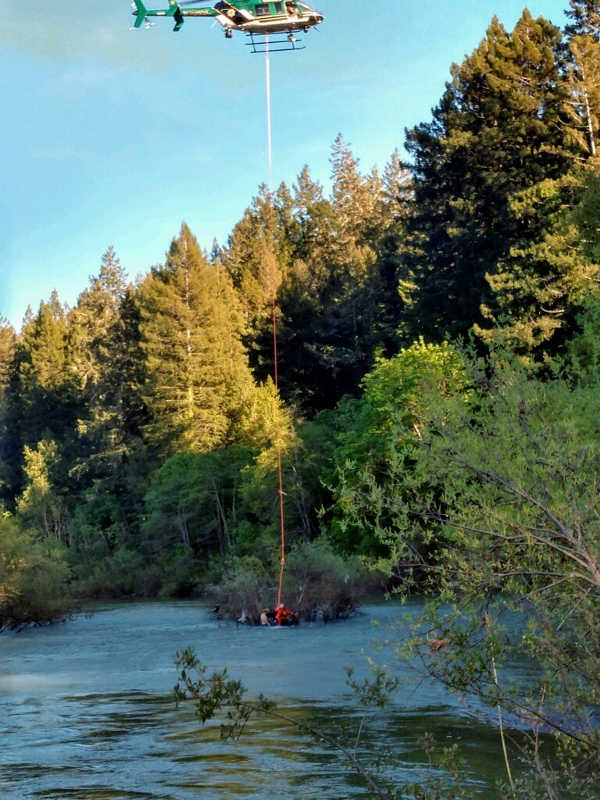
NORTH COAST, Calif. – On Tuesday, the Sonoma County Sheriff’s helicopter crew rescued five people from the Russian River after their inner tubes got stuck on some bushes in the middle of the river near Vacation Beach.
A family of four from Fremont became stranded on the bushes for about two hours and when a good Samaritan tried to help with a rope, he too became stuck in the rushing current, officials said.
A crew from the Sheriff’s Helicopter Unit “Henry-One” received the call around 5:40 p.m. Tuesday, according to the report.
Authorities said the crew flew to the area and found all five in need of assistance.
The crew fastened a 100-foot rope to the bottom of the helicopter and a deputy fastened himself to the bottom of the rope. One by one, using a horse collar device, the crew was able to lift each person out of the river and get them safely to the shore.
Nobody needed further medical attention but the helicopter crew advised that this time of year the water is moving very swiftly and is very cold.
Those people thinking about floating or boating in the river should use extra precaution.
LAKEPORT, Calif. – The Habematolel Pomo’s proposal to place its community center in downtown Upper Lake into federal trust received the Board of Supervisors’ unanimous approval on Tuesday.
The tribe has applied to the Bureau of Indian Affairs to transfer into trust its community center at 9470 Main St., the former Westamerica Bank Upper Lake branch, which the tribe purchased from Hospice Services of Lake County in 2016.
Moving property into trust means that the United States government, acting as trustee, will hold legal title to the land on behalf of the tribe’s current and future generations,
BIA notified the county of the application in a letter received on April 1 and invited it to comment, according to County Administrative Officer Carol Huchingson’s report to the board.
The BIA asked the county for information on property taxes, assessments, government services provided and potential zoning consistency.
Based on the county’s draft letter in response to the BIA’s comment invitation, the taxes on the property total $2,752.38 for the 2018-19 tax year, with an additional $162.62 in assessments.
Regarding public services, the county’s letter explained that the Lake County Sheriff’s Office remains the primary agency providing law enforcement services to the tribe – including the community center property – while the Lake County County Public Works Department maintains the access roads in the area. Many other county agencies also are involved in the area, whether directly or indirectly, the letter states.
The letter said the BIA notice indicates that the tribe intends to retain the existing use of the property, which houses tribal government and related programs.
“No further development is planned, preserving the existing character of the area. Based off this assertion, with the Main Street area in Upper Lake being zoned Commercial, the use described appears to be consistent with current zoning and land uses,” the draft letter stated.
On Tuesday, Huchingson suggested several updates to the letter, including a paragraph stating: “The county is grateful for our longstanding memorandum of understanding with the Habematolel Pomo of Upper Lake, through which the tribe provides a substantial amount of funding to the county. In light of this, the county does not intend to seek any additional agreement with the tribe to offset the small revenue loss resulting from this proposal.”
Also added was a paragraph explaining that Lake County Sheriff Brian Martin has submitted his own separate comments to the BIA indicating his support for the proposal.
Huchingson’s additions to the letter also explained that the tribe has suggested an additional memorandum of understanding for support of local law enforcement efforts, and “we’re grateful for the tribe’s continuing generosity.”
The last of the new language, added to the closing comments, states: “Our board supports this application of the Habematolel Pomo of Upper Lake to place the subject parcel into trust and we look forward to our continuing partnership with the tribe for the betterment of our communities.”
The updated letter met with the board’s approval. There were no additional comments by the board or the public before District 3 Supervisor EJ Crandell moved to approve the letter, which Supervisor Bruno Sabatier seconded and the board approved 5-0.
The board’s approval of the letter in response to the Habematolel Pomo’s application came a week after it signed off on two letters to the BIA in response to two separate fee to trust applications – covering 21 parcels totaling 51 acres – from the Big Valley Rancheria, as Lake County News has reported.
Big Valley leadership said those 21 parcels were part of the original rancheria before termination in the 1950s, which sought to assimilate tribes into mainstream culture, forcing them from their lands.
The tribe had expressed concerns over incorrect information that county staff had included in its original response letters – involving the county’s suggestion that the tribe might have commercial plans for the land, which currently is open space and residential. Had those letters been sent, the tribe said it could have been damaging to the applications.
It took a few weeks of discussions between the board, county staff and the Big Valley tribe to come up with updated letters that the tribe found acceptable. The board voted to approve those updated letters last week.
Email Elizabeth Larson atThis email address is being protected from spambots. You need JavaScript enabled to view it. . Follow her on Twitter, @ERLarson, or Lake County News, @LakeCoNews.
The tribe has applied to the Bureau of Indian Affairs to transfer into trust its community center at 9470 Main St., the former Westamerica Bank Upper Lake branch, which the tribe purchased from Hospice Services of Lake County in 2016.
Moving property into trust means that the United States government, acting as trustee, will hold legal title to the land on behalf of the tribe’s current and future generations,
BIA notified the county of the application in a letter received on April 1 and invited it to comment, according to County Administrative Officer Carol Huchingson’s report to the board.
The BIA asked the county for information on property taxes, assessments, government services provided and potential zoning consistency.
Based on the county’s draft letter in response to the BIA’s comment invitation, the taxes on the property total $2,752.38 for the 2018-19 tax year, with an additional $162.62 in assessments.
Regarding public services, the county’s letter explained that the Lake County Sheriff’s Office remains the primary agency providing law enforcement services to the tribe – including the community center property – while the Lake County County Public Works Department maintains the access roads in the area. Many other county agencies also are involved in the area, whether directly or indirectly, the letter states.
The letter said the BIA notice indicates that the tribe intends to retain the existing use of the property, which houses tribal government and related programs.
“No further development is planned, preserving the existing character of the area. Based off this assertion, with the Main Street area in Upper Lake being zoned Commercial, the use described appears to be consistent with current zoning and land uses,” the draft letter stated.
On Tuesday, Huchingson suggested several updates to the letter, including a paragraph stating: “The county is grateful for our longstanding memorandum of understanding with the Habematolel Pomo of Upper Lake, through which the tribe provides a substantial amount of funding to the county. In light of this, the county does not intend to seek any additional agreement with the tribe to offset the small revenue loss resulting from this proposal.”
Also added was a paragraph explaining that Lake County Sheriff Brian Martin has submitted his own separate comments to the BIA indicating his support for the proposal.
Huchingson’s additions to the letter also explained that the tribe has suggested an additional memorandum of understanding for support of local law enforcement efforts, and “we’re grateful for the tribe’s continuing generosity.”
The last of the new language, added to the closing comments, states: “Our board supports this application of the Habematolel Pomo of Upper Lake to place the subject parcel into trust and we look forward to our continuing partnership with the tribe for the betterment of our communities.”
The updated letter met with the board’s approval. There were no additional comments by the board or the public before District 3 Supervisor EJ Crandell moved to approve the letter, which Supervisor Bruno Sabatier seconded and the board approved 5-0.
The board’s approval of the letter in response to the Habematolel Pomo’s application came a week after it signed off on two letters to the BIA in response to two separate fee to trust applications – covering 21 parcels totaling 51 acres – from the Big Valley Rancheria, as Lake County News has reported.
Big Valley leadership said those 21 parcels were part of the original rancheria before termination in the 1950s, which sought to assimilate tribes into mainstream culture, forcing them from their lands.
The tribe had expressed concerns over incorrect information that county staff had included in its original response letters – involving the county’s suggestion that the tribe might have commercial plans for the land, which currently is open space and residential. Had those letters been sent, the tribe said it could have been damaging to the applications.
It took a few weeks of discussions between the board, county staff and the Big Valley tribe to come up with updated letters that the tribe found acceptable. The board voted to approve those updated letters last week.
Email Elizabeth Larson at
CLEARLAKE, Calif. – As part of the city of Clearlake’s continuing focus on road improvement, this week the Clearlake City Council will consider a list of road projects to submit for state funding and discuss staff’s road maintenance plan for the coming season.
The council will meet in closed session beginning at 5:30 p.m. Thursday, April 25, to discuss a case of potential litigation, existing litigation against Pacific Gas and Electric and conference with labor negotiators before the public portion of the meeting begins at 6 p.m. in the council chambers at Clearlake City Hall, 14050 Olympic Drive.
At the start of the meeting, adoptable pets from Clearlake Animal Control will be introduced and kennel technician Michelle Brooks will be sworn in.
On the agenda is consideration of approval of a list of projects to be submitted to the California Transportation Committee for funding from Senate Bill 1, the Road Repair and Accountability Act of 2017.
A staff report from Adeline Brown, the city’s engineering technician, said SB 1 invests $54 billion over the next decade to fix roads, freeways and bridges in communities across California and puts more dollars toward transit and safety. “These funds will be split equally between state and local investments.”
Brown said the city is proposing the following projects for state funding, with estimated costs:
– Meadowbrook area pavement rehabilitation project: $1.1 million.
– Pearl Avenue/Emory Avenue pavement rehabilitation project: $1.3 million.
– Highlands Park frontage improvement project: $516,000.
– Airport Road regional connector improvements: $1.2 million.
– Modoc/Second Street pavement rehabilitation project: $550,000.
– San Joaquin drainage improvements and pavement rehabilitation: $1.4 million.
– Dam Road roundabout: $4.6 million.
Also on Thursday, the council will consider the city’s road maintenance plan for this year, which includes grading in the Avenues and streets where repairs are needed due to washouts, with the crews also following the Gravel Roads Maintenance and Design Manual, according to a report from Public Works Superintendent Michael Baker.
Baker’s report also explains that pothole repair, crack sealing and miscellaneous work will start on Lakeshore Drive and continue to Olympic Drive and Old Highway 53 before work moves to other streets, “depending on service requests and severity.”
The council will hold a public hearing to consider amendments to Sections 5 and 18 of the Clearlake Municipal Code related to cannabis businesses and consider commercial cannabis amendments to the city zoning code, and hold a public hearing for Konocti County Water District’s request for the city to abandon a street right-of-way on Ballpark Avenue.
In other business, the council will consider the New Clean Water Program agreement between the city of Clearlake, city of Lakeport, county of Lake and the Lake County Watershed Protection District; and consider a resolution certifying appointment of Wendy England as police dispatcher is necessary to fill a critically needed position and requesting an exception from CalPERS to the 180-day wait period and authorizing the chief of police to appoint.
On the consent agenda – items considered noncontroversial and usually accepted as a slate on one vote – are warrant registers; continuation of a declaration of local emergency issued on Oct. 9, 2017, and ratified by council action Oct. 12, 2017; adoption of Resolution No. 2019-19 regarding the digital signatures administrative policy; receipt of and response to the 2018-19 grand jury report regarding Lampson Field; second reading and adoption of an ordinance amending the Clearlake Municipal Code relating to abandoned vehicles.
Email Elizabeth Larson atThis email address is being protected from spambots. You need JavaScript enabled to view it. . Follow her on Twitter, @ERLarson, or Lake County News, @LakeCoNews.
The council will meet in closed session beginning at 5:30 p.m. Thursday, April 25, to discuss a case of potential litigation, existing litigation against Pacific Gas and Electric and conference with labor negotiators before the public portion of the meeting begins at 6 p.m. in the council chambers at Clearlake City Hall, 14050 Olympic Drive.
At the start of the meeting, adoptable pets from Clearlake Animal Control will be introduced and kennel technician Michelle Brooks will be sworn in.
On the agenda is consideration of approval of a list of projects to be submitted to the California Transportation Committee for funding from Senate Bill 1, the Road Repair and Accountability Act of 2017.
A staff report from Adeline Brown, the city’s engineering technician, said SB 1 invests $54 billion over the next decade to fix roads, freeways and bridges in communities across California and puts more dollars toward transit and safety. “These funds will be split equally between state and local investments.”
Brown said the city is proposing the following projects for state funding, with estimated costs:
– Meadowbrook area pavement rehabilitation project: $1.1 million.
– Pearl Avenue/Emory Avenue pavement rehabilitation project: $1.3 million.
– Highlands Park frontage improvement project: $516,000.
– Airport Road regional connector improvements: $1.2 million.
– Modoc/Second Street pavement rehabilitation project: $550,000.
– San Joaquin drainage improvements and pavement rehabilitation: $1.4 million.
– Dam Road roundabout: $4.6 million.
Also on Thursday, the council will consider the city’s road maintenance plan for this year, which includes grading in the Avenues and streets where repairs are needed due to washouts, with the crews also following the Gravel Roads Maintenance and Design Manual, according to a report from Public Works Superintendent Michael Baker.
Baker’s report also explains that pothole repair, crack sealing and miscellaneous work will start on Lakeshore Drive and continue to Olympic Drive and Old Highway 53 before work moves to other streets, “depending on service requests and severity.”
The council will hold a public hearing to consider amendments to Sections 5 and 18 of the Clearlake Municipal Code related to cannabis businesses and consider commercial cannabis amendments to the city zoning code, and hold a public hearing for Konocti County Water District’s request for the city to abandon a street right-of-way on Ballpark Avenue.
In other business, the council will consider the New Clean Water Program agreement between the city of Clearlake, city of Lakeport, county of Lake and the Lake County Watershed Protection District; and consider a resolution certifying appointment of Wendy England as police dispatcher is necessary to fill a critically needed position and requesting an exception from CalPERS to the 180-day wait period and authorizing the chief of police to appoint.
On the consent agenda – items considered noncontroversial and usually accepted as a slate on one vote – are warrant registers; continuation of a declaration of local emergency issued on Oct. 9, 2017, and ratified by council action Oct. 12, 2017; adoption of Resolution No. 2019-19 regarding the digital signatures administrative policy; receipt of and response to the 2018-19 grand jury report regarding Lampson Field; second reading and adoption of an ordinance amending the Clearlake Municipal Code relating to abandoned vehicles.
Email Elizabeth Larson at
LAKEPORT, Calif. – This year the Lakeport Police Department will participate in the DEA National Prescription Take Back Day with its own local event.
Lakeport Police’s event will take place from 10 a.m. to 2 p.m. Saturday, April 27, at the station, 2025 S. Main St.
The event set up will be in the front parking lot of the police station or in the front lobby if there is rain.
Several thousand police agencies are expected to hold events throughout the United States on the same day. These events typically take in around 900,000 pounds of prescription drugs.
Proper disposal of expired or unused prescription drugs saves lives and protects the environment.
This event will further Lakeport Police’s efforts since January to help remove unused or expired dangerous drugs from homes in our community. So far this year, the department has taken in more than 120 pounds of drugs.
Police officers and evidence staff will be on site to assist community members and offer educational materials.
Additionally, there is no cost for community members to dispose of the described medications at the Lakeport Police station and police will not collect information on people disposing of them.
Individuals bringing in medications will be required to check in with a department staff member so that they can verify that only acceptable items are being placed in the container.
All medications shall be in their original container, other suitable plastic pill container or sealed plastic freezer bag. If the prescription medications are in the original container, police recommend that people remove their personal information from the label.
The following are examples of what police will accept: All over-the-counter or prescription medication in pill, tablet or capsule form including schedule II-V controlled and non-controlled substances.
Examples of items they will not accept with this program are illegal drugs, needles, liquids, inhalers or aerosol cans.
Lakeport Police’s event will take place from 10 a.m. to 2 p.m. Saturday, April 27, at the station, 2025 S. Main St.
The event set up will be in the front parking lot of the police station or in the front lobby if there is rain.
Several thousand police agencies are expected to hold events throughout the United States on the same day. These events typically take in around 900,000 pounds of prescription drugs.
Proper disposal of expired or unused prescription drugs saves lives and protects the environment.
This event will further Lakeport Police’s efforts since January to help remove unused or expired dangerous drugs from homes in our community. So far this year, the department has taken in more than 120 pounds of drugs.
Police officers and evidence staff will be on site to assist community members and offer educational materials.
Additionally, there is no cost for community members to dispose of the described medications at the Lakeport Police station and police will not collect information on people disposing of them.
Individuals bringing in medications will be required to check in with a department staff member so that they can verify that only acceptable items are being placed in the container.
All medications shall be in their original container, other suitable plastic pill container or sealed plastic freezer bag. If the prescription medications are in the original container, police recommend that people remove their personal information from the label.
The following are examples of what police will accept: All over-the-counter or prescription medication in pill, tablet or capsule form including schedule II-V controlled and non-controlled substances.
Examples of items they will not accept with this program are illegal drugs, needles, liquids, inhalers or aerosol cans.
As part of STD Awareness Month, health officials are reporting on the resurgence of syphilis and explaining how community members can help prevent it.
Once on the brink of elimination, syphilis cases reached a 24-year high in the United States in 2017.
More than 30,000 cases of the sexually transmitted disease were reported nationally that year – a nearly 11-percent jump since 2016.
In Lake County alone, there were 15 cases of syphilis in 2017, up from 10 in 2016. It is projected that in 2018 and 2019, there will be additional increases in rates of syphilis infection within Lake County. Clearly, syphilis is a renewed health threat for many.
“We know that fighting syphilis is challenging – and that decades of progress have come with a price,” said Gail Bolan, M.D., director of the Centers for Disease Control and Prevention’s Division of STD Prevention. “Fewer healthcare providers are familiar with it, and too many Americans believe it’s a disease of the past. Stigma also remains within communities and the healthcare system.”
While all STDs are serious and need to be treated, syphilis is especially dangerous. Without treatment, it can cause severe health problems affecting the brain, eyes, heart, and other organs. Having syphilis also makes it easier to get HIV.
Syphilis gains ground in new communities, tightens grip on others
During 2016 and 2017, national syphilis rates spiked among men, women, newborns; a majority of age groups; all races and ethnicities; and in almost every region.
Its grasp is stronger and impact deeper for some groups in the US – despite its pervasive return in all populations across the country.
Nationally, the number and rate of babies born with syphilis continues to surge. Men, and especially gay and bisexual men, remain hardest-hit – with data suggesting about half of gay and bisexual men with syphilis are also living with HIV.
“Syphilis is a renewed threat, especially for pregnant women, in whom this STI can have devastating consequences for the baby, including stillbirth,” said Lake County Health Officer Erin Gustafson, M.D., MPH. “It is crucial for all people to have open conversations with partners about STDs, get tested regularly particularly if they have multiple partners, and use condoms every time they have sex.”
While syphilis may affect some groups more than others, its increase across all demographics nationally is a concerning shift that needs attention.
It means this STD has the ability to affect many communities at anytime and anywhere. It means people from all walks of life – including those who think they have slim-to-zero chances of becoming infected – may be at risk. And bottom line, it means practicing prevention is a must for everyone.
Together, we can disrupt syphilis
The good news is that there are a number of ways to prevent syphilis and other STDs. The most reliable way is to not have sex (vaginal, oral or anal), but there are many other tried-and-true options: talking openly with partners and healthcare providers about STDs, testing, and sexual health; using condoms the right way from start to finish; and reducing your number of sexual partners.
Those who test positive for syphilis should get treated right away – and be sure their partner is also treated to lower the risk of getting infected again.
The CDC also has information on how healthcare providers can reduce congenital syphilis and syphilis among gay and bisexual men.
This and other helpful information is available through Syphilis Strikes Back, a campaign devoted exclusively to promoting the prevention, diagnosis, and treatment of syphilis. It seeks to raise awareness, help healthcare providers protect their patients, and empower individuals to take charge of their health.
Once on the brink of elimination, syphilis cases reached a 24-year high in the United States in 2017.
More than 30,000 cases of the sexually transmitted disease were reported nationally that year – a nearly 11-percent jump since 2016.
In Lake County alone, there were 15 cases of syphilis in 2017, up from 10 in 2016. It is projected that in 2018 and 2019, there will be additional increases in rates of syphilis infection within Lake County. Clearly, syphilis is a renewed health threat for many.
“We know that fighting syphilis is challenging – and that decades of progress have come with a price,” said Gail Bolan, M.D., director of the Centers for Disease Control and Prevention’s Division of STD Prevention. “Fewer healthcare providers are familiar with it, and too many Americans believe it’s a disease of the past. Stigma also remains within communities and the healthcare system.”
While all STDs are serious and need to be treated, syphilis is especially dangerous. Without treatment, it can cause severe health problems affecting the brain, eyes, heart, and other organs. Having syphilis also makes it easier to get HIV.
Syphilis gains ground in new communities, tightens grip on others
During 2016 and 2017, national syphilis rates spiked among men, women, newborns; a majority of age groups; all races and ethnicities; and in almost every region.
Its grasp is stronger and impact deeper for some groups in the US – despite its pervasive return in all populations across the country.
Nationally, the number and rate of babies born with syphilis continues to surge. Men, and especially gay and bisexual men, remain hardest-hit – with data suggesting about half of gay and bisexual men with syphilis are also living with HIV.
“Syphilis is a renewed threat, especially for pregnant women, in whom this STI can have devastating consequences for the baby, including stillbirth,” said Lake County Health Officer Erin Gustafson, M.D., MPH. “It is crucial for all people to have open conversations with partners about STDs, get tested regularly particularly if they have multiple partners, and use condoms every time they have sex.”
While syphilis may affect some groups more than others, its increase across all demographics nationally is a concerning shift that needs attention.
It means this STD has the ability to affect many communities at anytime and anywhere. It means people from all walks of life – including those who think they have slim-to-zero chances of becoming infected – may be at risk. And bottom line, it means practicing prevention is a must for everyone.
Together, we can disrupt syphilis
The good news is that there are a number of ways to prevent syphilis and other STDs. The most reliable way is to not have sex (vaginal, oral or anal), but there are many other tried-and-true options: talking openly with partners and healthcare providers about STDs, testing, and sexual health; using condoms the right way from start to finish; and reducing your number of sexual partners.
Those who test positive for syphilis should get treated right away – and be sure their partner is also treated to lower the risk of getting infected again.
The CDC also has information on how healthcare providers can reduce congenital syphilis and syphilis among gay and bisexual men.
This and other helpful information is available through Syphilis Strikes Back, a campaign devoted exclusively to promoting the prevention, diagnosis, and treatment of syphilis. It seeks to raise awareness, help healthcare providers protect their patients, and empower individuals to take charge of their health.