LAKE COUNTY, Calif. – Lake County Animal Care and Control this week has many cool dogs looking for new families.
Dogs available for adoption this week include mixes of bluetick coonhound, Chihuahua, German Shepherd, Great Pyrenees, heeler, Labrador Retriever, pit bull, redbone coonhound, shepherd and wirehaired terrier.
Dogs that are adopted from Lake County Animal Care and Control are either neutered or spayed, microchipped and, if old enough, given a rabies shot and county license before being released to their new owner. License fees do not apply to residents of the cities of Lakeport or Clearlake.
If you're looking for a new companion, visit the shelter. There are many great pets hoping you'll choose them.
The following dogs at the Lake County Animal Care and Control shelter have been cleared for adoption (additional dogs on the animal control Web site not listed are still “on hold”).
“Rio” is a male bluetick coonhound-shepherd mix in kennel No. 7, ID No. 11947. Photo courtesy of Lake County Animal Care and Control. ‘Rio’
“Rio” is a male bluetick coonhound-shepherd mix with a short tricolor coat.
He already has been neutered.
He’s in kennel No. 7, ID No. 11947.
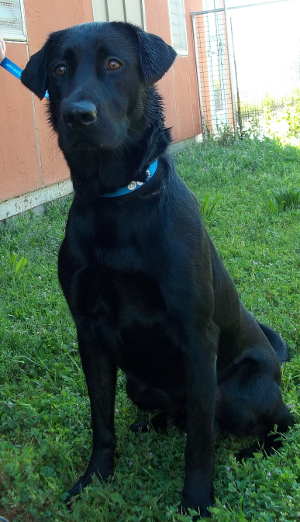
“Bear” is a male Labrador Retriever in kennel No. 8, ID No. 11986. Photo courtesy of Lake County Animal Care and Control. ‘Bear’
“Bear” is a male Labrador Retriever with an all-black coat.
He already has been neutered.
He’s in kennel No. 8, ID No. 11986.
This male pit bull terrier is in kennel No. 13, ID No. 12043. Photo courtesy of Lake County Animal Care and Control.
Male pit bull terrier
This male pit bull terrier has a short brown and white coat.
He’s in kennel No. 13, ID No. 12043.
This male German Shepherd is in kennel No. 19, ID No. 12107. Photo courtesy of Lake County Animal Care and Control. Male German Shepherd
This male German Shepherd has a medium-length black and brown coat.
He already has been neutered.
He’s in kennel No. 19, ID No. 12107.
This male pit bull terrier is in kennel No. 20, ID No. 11958. Photo courtesy of Lake County Animal Care and Control. Male pit bull terrier
This male pit bull terrier has a short black coat.
He’s in kennel No. 20, ID No. 11958.
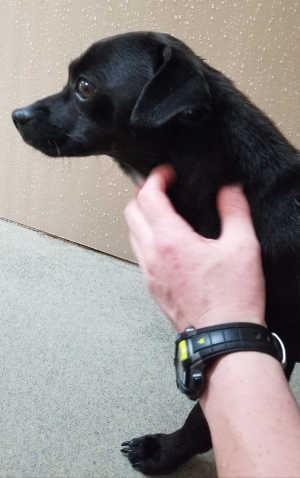
This male Chihuahua-terrier mix is in kennel No. 21a, ID No. 12112. Photo courtesy of Lake County Animal Care and Control. Male Chihuahua-terrier
This male Chihuahua-terrier mix has a short black coat.
He is in kennel No. 21a, ID No. 12112.
This male wirehaired terrier is in kennel No. 21b, ID No. 12113. Photo courtesy of Lake County Animal Care and Control. Male wirehaired terrier
This male wirehaired terrier has a coarse black coat.
He’s in kennel No. 21b, ID No. 12113.
This male Chihuahua is in kennel No. 22, ID No. 12114. Photo courtesy of Lake County Animal Care and Control. Male Chihuahua
This male Chihuahua has a short tricolor coat.
He’s in kennel No. 22, ID No. 12114.
“Copper” is a male redbone coonhound in kennel No. 25, ID No. 11960. Photo courtesy of Lake County Animal Care and Control. ‘Copper’
“Copper” is a male redbone coonhound with a short red coat.
Shelter staff said he is 7 years old. He’s good with other dogs and children, but not cats. He walks well on a leash, is mellow and doesn’t bark that much. He also loves treats.
Copper is in kennel No. 25, ID No. 11960.
“Taya” is a female pit bull terrier in kennel No. 26, ID No. 12005. Photo courtesy of Lake County Animal Care and Control. ‘Taya’
“Taya” is a female pit bull terrier who a short tricolor coat.
He’s in kennel No. 26, ID No. 12005.
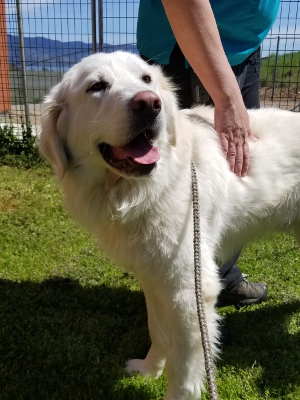
“Little Foot” is a white male Great Pyrenees is in kennel No. 27, ID No. 11854. Photo courtesy of Lake County Animal Care and Control. ‘Little Foot’
“Little Foot” is a white male Great Pyrenees with a long white coat and gold eyes.
Shelter staff said the right home for him will not have cats, small dogs or livestock.
He has been neutered.
Little Foot is in kennel No. 27, ID No. 11854.
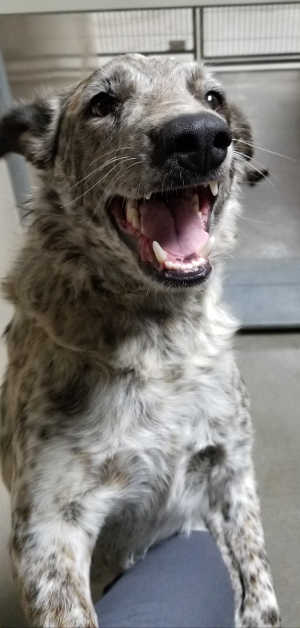
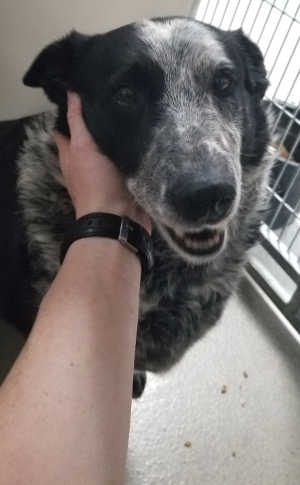
This female heeler is in kennel No. 31, ID No. 11962. Photo courtesy of Lake County Animal Care and Control. Female heeler
This female heeler has a medium-length black and white coat.
She’s in kennel No. 31, ID No. 11962.
This female pit bull terrier is in kennel No. 33, ID No. 11950. Photo courtesy of Lake County Animal Care and Control. Female pit bull terrier
This female pit bull terrier has a short brown and white coat.
She’s in kennel No. 33, ID No. 11950.
Lake County Animal Care and Control is located at 4949 Helbush in Lakeport, next to the Hill Road Correctional Facility.
Office hours are Monday through Friday, 11 a.m. to 5 p.m., and 11 a.m. to 3 p.m., Saturday. The shelter is open from 11 a.m. to 4 p.m. Monday through Friday and on Saturday from 11 a.m. to 3 p.m.
For more information call Lake County Animal Care and Control at 707-263-0278.
Email Elizabeth Larson at This email address is being protected from spambots. You need JavaScript enabled to view it. . Follow her on Twitter, @ERLarson, or Lake County News, @LakeCoNews.
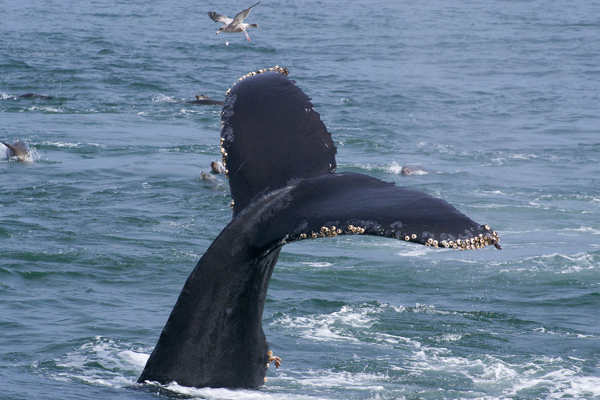
Whale barnacles line the edges of the flukes of a humpback whale. Photo courtesy of Blue Ocean Whale Watch. BERKELEY, Calif. – Barnacles that hitch rides on the backs of humpback and gray whales not only record details about the whales’ yearly travels, they also retain this information after they become fossilized, helping scientists reconstruct the migrations of whale populations millions of years in the past, according to a new University of California, Berkeley, study.
Oxygen isotope ratios in barnacle shells change with ocean condition and allow scientists to chart the migration of the host whale, for example to warmer breeding grounds or colder feeding grounds. Now, marine paleobiologists led by UC Berkeley doctoral student Larry Taylor have discovered that barnacles retain this information even after they fall off the whale, sink to the ocean bottom, and become fossils."
As a result, the travels of fossilized barnacles can serve as a proxy for the peregrinations of whales in the distant past, like GPS trackers from the Pleistocene.
“One of the more exciting things about the paper, in my mind, is that we find evidence for migration in all of these ancient populations, from three different sites and time periods, but also from both humpback and gray whale lineages, indicating that these animals, which lived hundreds of thousands of years ago, were all undertaking migrations similar in extent to those of modern-day whales,” Taylor said.
One surprise finding is that the coast of Panama has been a meeting ground for different subpopulations of humpback whales for at least 270,000 years and still is today. Whales visit Panama from as far away as Antarctica and the Gulf of Alaska.
This information about ancient migration will help scientists understand how migration patterns may have affected the evolution of whales over the past 3 to 5 million years, how these patterns changed with changing climate and help predict how today’s whales will adapt to the rapid climate change happening today.
“We want to understand how malleable migratory behavior has been through time, how rapidly whales have adapted to previous climate changes, and see if this can give us some clues as to how they might respond to the current changes in Earth's climate,” he said. “How will whales cope with that, how will the food base shift, how will the whales themselves respond?”
Taylor and his colleagues, senior author Seth Finnegan, a UC Berkeley associate professor of integrative biology, Aaron O’Dea of the Smithsonian Tropical Research Institute in Panama and Timothy Bralower of Pennsylvania State University in University Park, will publish their findings this week in the journal Proceedings of the National Academy of Sciences.
Riding the whales
Barnacles are crustaceans, like crabs, lobsters and shrimp, that remain stuck in one place their whole lives, encased in a protective hard shell and sticking out their legs to snatch passing food.
Most glue themselves to rocks, boats or pilings, but whale barnacles attach to a whale’s skin by boring down into it. Some whales have been estimated to carry up to 1,000 pounds of barnacles, which are visible when they breech. Clusters of barnacles are used to identify individual whales.
“This gives the barnacle several advantages: a safe surface to live on, a free ride to some of the richest waters in the world and a chance to meet up with other (barnacles) when the whales get together to mate,” O’Dea said.
Taylor’s technique works because different species of whale barnacle hitch rides on different species of whale, so paleontologists can know, when they find a fossilized barnacle, which species it rode with.
Normally, the barnacles stay with a whale between one and three years, until they fall or are brushed off, often at whale breeding grounds. At least 24 fossil assemblages of whale barnacles have been found around the world, Taylor said.
The new discovery means that the fossilized barnacles recovered at these sites can tell about ancient migrations of humpbacks, gray whales and perhaps other baleen whales (toothed whales, such as sperm whales, do not host many barnacles), potentially turning up previously unsuspected feeding and breeding areas.
The technique is based on measuring the oxygen isotopes in the calcium carbonate, or calcite, shell of the barnacle. The ratio of oxygen-18 to oxygen-16 goes up as the temperature drops. Since barnacles lengthen their shells by a few millimeters a month as they try to stay attached to whales in the face of the mammals’ shedding skin, the composition of the new shell reflects the ocean temperature and general isotopic composition where it formed.
Taylor built on previous work showing that barnacles attached to living gray whales record a chemical signature of their migrations. He confirmed that the isotopic composition of the humpback whale barnacle (Coronula diadema) also tracks its environment today during the whales’ yearly migration, showing monthly changes. He then demonstrated that fossilized barnacles from Panama and from the California coast could be analyzed similarly, and that they showed isotopic changes similar to that of today’s whales.
This technique will be particularly valuable for studying prehistoric humpback populations, Taylor said, because the humpback was and is more cosmopolitan than the California gray whale, cruising widely through the Pacific and Atlantic oceans.
Scientists theorize that whale migration began as food sources became more scattered as the climate changed five million years ago. Modern Pacific whales migrate tens of thousands of miles annually, visiting several known feeding areas and returning to warm waters off Central and South America or Hawaii to breed.
“We plan to push this approach further back in time and across different whale populations,” Finnegan said. “We hope that by analyzing other aspects of the geochemistry of the barnacles shells we might ultimately be able to figure out what areas different ancient whale populations were migrating to.”
This study was supported by the National Science Foundation, the National System of Investigators in Panama, the Paleontological Society, the Geological Society of America, Sigma Xi and the University of California Museum of Paleontology.
Robert Sanders writes for the UC Berkeley News Center.
COBB, Calif. – A 3.2-magnitude earthquake was reported in south Lake County early Saturday.
The quake was reported at 5:33 a.m. Saturday, 3 miles west northwest of Cobb and 11.9 miles southwest of Clearlake, at a depth of six-tenths of a miles, according to the US Geological Survey.
The USGS said it received 13 shake reports from around Lake County, the Bay Area and as far away as Tustin.
Email Elizabeth Larson at This email address is being protected from spambots. You need JavaScript enabled to view it.. Follow her on Twitter, @ERLarson, or Lake County News, @LakeCoNews.
The first type of molecule that ever formed in the universe has been detected in space for the first time, after decades of searching.
Scientists discovered its signature in our own galaxy using the world’s largest airborne observatory, NASA’s Stratospheric Observatory for Infrared Astronomy, or SOFIA, as the aircraft flew high above the Earth’s surface and pointed its sensitive instruments out into the cosmos.
When the universe was still very young, only a few kinds of atoms existed. Scientists believe that around 100,000 years after the big bang, helium and hydrogen combined to make a molecule called helium hydride for the first time.
Helium hydride should be present in some parts of the modern universe, but it has never been detected in space – until now.
SOFIA found modern helium hydride in a planetary nebula, a remnant of what was once a Sun-like star.
Located 3,000 light-years away near the constellation Cygnus, this planetary nebula, called NGC 7027, has conditions that allow this mystery molecule to form.
The discovery serves as proof that helium hydride can, in fact, exist in space. This confirms a key part of our basic understanding of the chemistry of the early universe and how it evolved over billions of years into the complex chemistry of today. The results are published in a recent issue of Nature.
“This molecule was lurking out there, but we needed the right instruments making observations in the right position – and SOFIA was able to do that perfectly,” said Harold Yorke, director of the SOFIA Science Center, in California’s Silicon Valley.
Today, the universe is filled with large, complex structures such as planets, stars and galaxies. But more than 13 billion years ago, following the big bang, the early universe was hot, and all that existed were a few types of atoms, mostly helium and hydrogen.
As atoms combined to form the first molecules, the universe was finally able to cool and began to take shape. Scientists have inferred that helium hydride was this first, primordial molecule.
Once cooling began, hydrogen atoms could interact with helium hydride, leading to the creation of molecular hydrogen – the molecule primarily responsible for the formation of the first stars. Stars went on to forge all the elements that make up our rich, chemical cosmos of today.
The problem, though, is that scientists could not find helium hydride in space. This first step in the birth of chemistry was unproven, until now.
“The lack of evidence of the very existence of helium hydride in interstellar space was a dilemma for astronomy for decades,” said Rolf Guesten of the Max Planck Institute for Radio Astronomy, in Bonn, Germany, and lead author of the paper.
Helium hydride is a finicky molecule. Helium itself is a noble gas making it very unlikely to combine with any other kind of atom. But in 1925, scientists were able to create the molecule in a laboratory by coaxing the helium to share one of its electrons with a hydrogen ion.
Then, in the late 1970s, scientists studying the planetary nebula called NGC 7027 thought that this environment might be just right to form helium hydride. Ultraviolet radiation and heat from the aging star create conditions suitable for helium hydride to form. But their observations were inconclusive.
Subsequent efforts hinted it could be there, but the mystery molecule continued to elude detection. The space telescopes used did not have the specific technology to pick out the signal of helium hydride from the medley of other molecules in the nebula.
In 2016, scientists turned to SOFIA for help. Flying up to 45,000 feet, SOFIA makes observations above the interfering layers of Earth’s atmosphere. But it has a benefit space telescopes don't – it returns after every flight.
“We’re able to change instruments and install the latest technology,” said Naseem Rangwala SOFIA deputy project scientist. “This flexibility allows us to improve observations and respond to the most pressing questions that scientists want answered.”
A recent upgrade to one of SOFIA’s instruments called the German Receiver at Terahertz Frequencies, or GREAT, added the specific channel for helium hydride that previous telescopes did not have. The instrument works like a radio receiver.
Scientists tune to the frequency of the molecule they’re searching for, similar to tuning an FM radio to the right station. When SOFIA took to the night skies, eager scientists were onboard reading the data from the instrument in real time. Helium hydride’s signal finally came through loud and clear.
“It was so exciting to be there, seeing helium hydride for the first time in the data,” said Guesten. “This brings a long search to a happy ending and eliminates doubts about our understanding of the underlying chemistry of the early universe.
SOFIA, the Stratospheric Observatory for Infrared Astronomy, is a Boeing 747SP jetliner modified to carry a 106-inch diameter telescope. It is a joint project of NASA and the German Aerospace Center, DLR.
NASA’s Ames Research Center in California’s Silicon Valley manages the SOFIA program, science and mission operations in cooperation with the Universities Space Research Association headquartered in Columbia, Maryland, and the German SOFIA Institute (DSI) at the University of Stuttgart.
The aircraft is maintained and operated from NASA’s Armstrong Flight Research Center Building 703, in Palmdale, California.
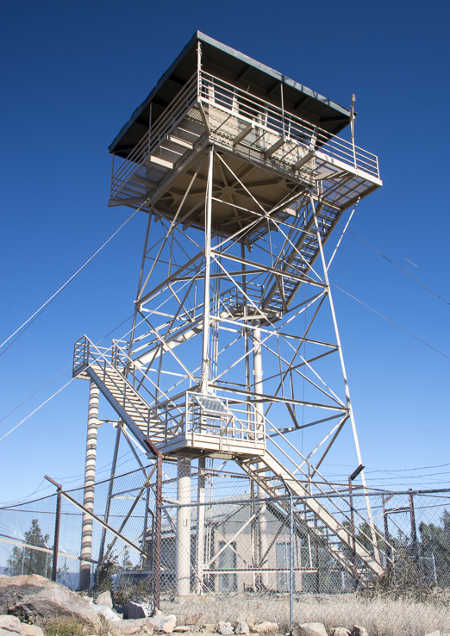
The Mount Konocti fire lookout in Kelseyville, Calif. Courtesy photo. KELSEYVILLE, Calif. – Cal Fire is soon to reopen the lookout tower on Mount Konocti for the season, again staffed by local volunteers.
The devastating wildfires in Lake, Sonoma and Mendocino counties make the fire lookout of great importance.
A tower training day is soon to be scheduled for new volunteers and as a refresher for those from previous years.
Once under way, volunteers will be able to schedule online for either eight- or five-hour shifts. They drive their own vehicle to the tower to begin their shift.
If smoke from fire is observed, a report is made via radio contact directly to Cal Fire dispatch.
Determining and communicating the location of the fire is a skill that comes from training and experience.
Those interested in volunteering to serve at least one day a month are encouraged to call tower leader Ric Abrams, 707-245-4171, or Chairman Jim Adams, 707-245-3771.
Chuck Sturges is a Mount Konocti fire lookout volunteer.
LAKE COUNTY, Calif. – The Sonoma-Lake-Napa Unit fire crews from Konocti Conservation Camp and Delta Conservation Camp will hold their annual Fire Crew Readiness Exercises in Lake County on April 30 and May 1. . The California Department of Forestry and Fire Protection, or Cal Fire, in conjunction with the California Department of Corrections and Rehabilitation operates 39 conservation camps with approximately 200 fire crews throughout California.
This partnership of state agencies provides a large force of trained crews for all types of emergency incident mitigation and resource conservation projects.
The Fire Crew Readiness Exercises provide an opportunity for the nine fire crews from the two conservation camps to be evaluated on their physical conditioning, firefighting knowledge, fire safety and personal protective equipment.
The exercise is an important part of preparing for fires in California. The crew members are educated and trained to work under extreme fire conditions, many times in triple-digit heat.
Under competitive pressure, the fire crews will construct fire lines utilizing chainsaws and hand tools, hike a set distance with varying terrain into a pre-designated site, deploy fire shelters, as well as expand their knowledge in fire, bulldozer and helicopter safety.
Proctors will remind them of the importance of communication, their personal protective gear and proper hydration.
It is an outstanding opportunity to put the year’s training to the test and to gear-up both physically and mentally for the ensuing fire season.
Personnel from Cal Fire and the CDCR will participate throughout all elements of the exercises.
 How to resolve AdBlock issue?