How to resolve AdBlock issue?
News
To help minimize unwanted bear foraging behavior, the California Department of Fish and Wildlife is reminding those living in or visiting bear country to store food and dispose of garbage properly.
Black bears typically prefer remote mountainous areas. However, as more people frequent or live in natural bear habitat, the abundance of food and garbage associated with human activities is a temptation hungry bears find hard to resist.
"Over the years, we have seen bear behavior change significantly in areas where more people live and recreate in bear habitat," said Vicky Monroe, CDFW's Conflict Programs coordinator. "Beginning with spring and into late fall, we receive a steady stream of calls from the public reporting anything from bears breaking into cabins and tents to bears stealing food off picnic tables."
Black bears, like other bear species, have a highly specialized sense of smell, which can sometimes lead them to towns and recreation areas where they may quickly find an overflowing garbage can or someone's leftover hamburger and French fries.
The public can help bears stay out of human settlements and stick to their natural diet by properly disposing of leftover food and garbage. Additional suggestions include:
– Residents and vacationers should remove any food attractants from around their home or rental. Pet food, barbecue grills and bird feeders are also attractants. Store trash in bear-resistant storage sheds until trash pickup day.
– Use sensory deterrents (such as ammonia), electric mats and bear-resistant fencing to exclude hungry and curious bears from gaining access to attractants.
– Visitors to towns and tourist areas should not pile trash in a trash can or bin that is already overflowing - take trash to a proper receptacle or another location if necessary.
– Keep campsites and other recreation areas clean. Use bear-resistant coolers and store all food in bear lockers.
– Never feed wildlife.
Additional information can be found on CDFW's Web site, including tips on how to keep California black bears wild, information about bear proof containers and information about black bear biology.

As devastating images of the 2019 Midwest floods fade from view, an insidious and longer-term problem is emerging across its vast plains: The loss of topsoil that much of the nation’s food supply relies on.
Today, Midwest farmers are facing millions of bushels of damaged crops such as soybean and corn. This spring’s heavy rains have already caused record flooding, which could continue into May and June, and some government officials have said it could take farmers years to recover.
Long after the rains stop, floodwaters continue to impact soil’s physical, chemical and biological properties that all plants rely on for proper growth. Just as very wet soils would prevent a homeowner from tending his or her garden, large amounts of rainfall prevent farmers from entering a wet field with machinery. Flooding can also drain nutrients out of the soil that are necessary for plant growth as well as reduce oxygen needed for plant roots to breathe, and gather water and nutrients.
As scientists who have a combined 80 years of experience studying soil processes, we see clearly that many long-term problems farmers face from floodwaters are steeped in the soil. This leads us to conclude that farmers may need to take far more active measures to manage soil health in the future as weather changes occur more drastically due to climate change and other factors.
Here are some of the perils with flooded farmland that can affect the nation’s food supply.
Suffocating soil
When soil is saturated by excessive flooding, soil pores are completely filled with water and have little to no oxygen present. Much like humans, plants need oxygen to survive, with the gas taken into plants via leaves and roots. Also identical to humans, plants – such as farm crops – can’t breathe underwater.
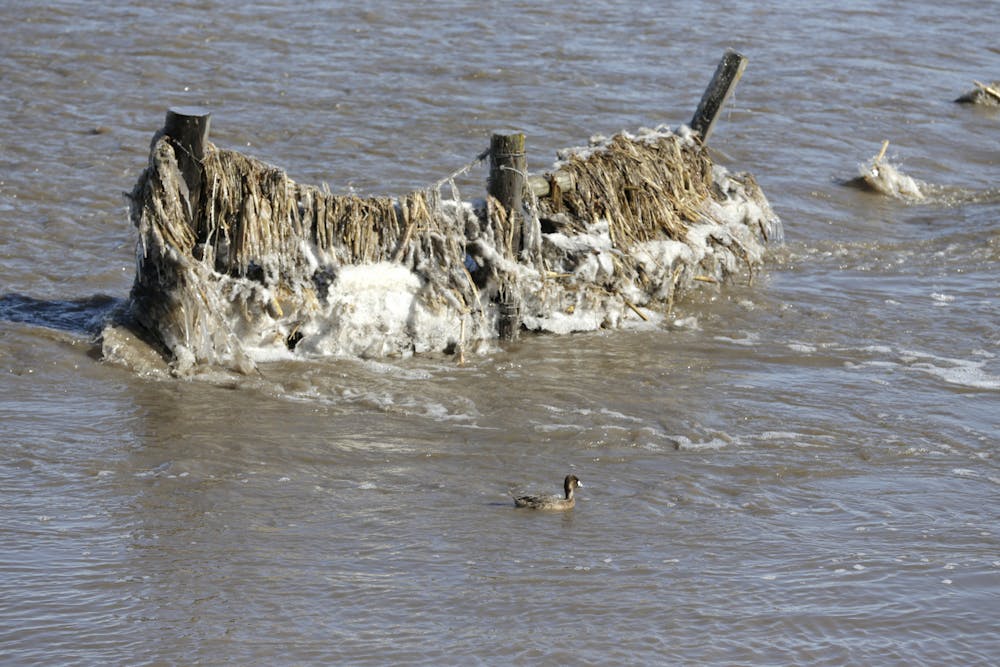
Essentially, excess and prolonged flooding kills plant roots because they can’t breathe. Dead plant roots in turn lead to death of aboveground plant, or crop, growth.
Another impact of flooding is compacted soil. This often occurs when heavy machinery is run over wet or saturated farmland. When soils become compacted, future root growth and oxygen supply are limited. Thus, severe flooding can delay or even prevent planting for the entire growing season, causing significant financial loss to farmers.
Loss of soil nutrients
When flooding events occur, such as overwatering your garden or as with the 2019 Midwest flooding, excess water can flush nutrients out of the soil. This happens by water running offsite, leaching into and draining through the ground, or even through the conversion of nutrients from a form that plants can utilize to a gaseous form that is lost from the soil to the atmosphere.
Regardless of whether you are a backyard gardener or large-scale farmer, these conditions can lead to delays in crop planting, reduced crop yields, lower nutritive value in crops and increased costs in terms of extra fertilizers used. There is also the increased stress within the farming community – or for you, the backyard gardener who couldn’t plant over the weekend due to excess rainfall. This ultimately increases the risk of not producing ample food over time.
Small microbial changes have big effects
Flooding on grand scales causes soils to become water-saturated for longer than normal periods of time. This, in turn, affects soil microorganisms that are beneficial for nutrient cycling.
Flooded soils may encounter problems caused by the loss of a specific soil microorganism, arbuscular mycorrhizae fungi. These fungi colonize root systems in about 90% to 95% of all plants on Earth in a mutually beneficial relationship.
The fungi receive energy in the form of carbon from the plant. As the fungi extend thread-like tendrils into the soil to scavenge for nutrients, they create a zone where nutrients can be taken up more easily by the plant. This, in turn, benefits nutrient uptake and nutritive value of crops.
When microbial activity is interrupted, nutrients don’t ebb and flow within soils in the way that is needed for proper crop growth. Crops grown in previously flooded fields may be affected due to the absence of a microbial community that is essential for maintaining proper plant growth.
The current Midwest flooding has far-reaching effects on soil health that may last many years. Recovering from these types of extreme events will likely require active management of soil to counteract the negative long-term effects of flooding. This may include the adoption of conservation systems that include the use of cover crops, no-till or reduced-till systems, and the use of perennials grasses, to name few. These types of systems may allow for better soil drainage and thus lessen flooding severity in soils.
Farmers have the ability to perform these management practices, but only if they can afford to convert over to these new systems; not all farmers are that fortunate. Until improvements in management practices are resolved, future flooding will likely continue to leave large numbers of Midwest fields vulnerable to producing lower crop yields or no crop at all.
Jim Ippolito, Associate Professor of Environmental Soil Quality/Health, Colorado State University and Mahdi Al-Kaisi, Professor of Soil Management and Environment, Iowa State University
This article is republished from The Conversation under a Creative Commons license. Read the original article.
BERKELEY, Calif. – Some of the peculiar aspects of our solar system – an enveloping cloud of comets, dwarf planets in weird orbits and, if it truly exists, a possible Planet Nine far from the sun – have been linked to the close approach of another star in our system’s infancy flung things helter-skelter.
But are stellar flybys really capable of knocking planets, comets and asteroids askew, reshaping entire planetary systems?
UC Berkeley and Stanford University astronomers think they have now found a smoking gun.
A planet orbiting a young binary star may have been perturbed by another pair of stars that skated too close to the system between 2 and 3 million years ago, soon after the planet formed from a swirling disk of dust and gas.
If confirmed, this bolsters arguments that close stellar misses help sculpt planetary systems and may determine whether or not they harbor planets with stable orbits.
“One of the mysteries arising from the study of exoplanets is that we see systems where the planets are misaligned, even though they are born in a flat, circular disk,” said Paul Kalas, a UC Berkeley adjunct professor of astronomy. “Maybe a cosmic tsunami hit these systems and rearranged everything about them, but we haven't had proof. Our paper gives rare observational evidence for one of these flybys gently influencing one of the planetary systems in the galaxy.”
Astronomers are already searching for a stellar flyby in our solar system’s past, but since that likely happened 4.6 billion years ago, most of the evidence has gone cold.
The star system that the astronomers studied, identified only by the number HD 106906 and located about 300 light years from Earth in the direction of the constellation Crux, is very young, only about 15 million years old.
Kalas and Robert De Rosa, a former UC Berkeley postdoc who is now a research scientist at Stanford’s Kavli Institute for Particle Astrophysics and Cosmology, describe their findings in a paper accepted for publication in the Astronomical Journal and now available online.
Rogue stars
Kalas, who studies young, newly formed planetary systems to try to understand what happened in the early years of our own solar system, first focused on HD 106906 in 2015 after it was found to have a massive planet in a highly unusual orbit.
The planet, dubbed HD 106906 b, has a mass of about 11 Jupiters, and it orbits HD 106906 — recently revealed to be a binary star – in an orbit tipped about 21 degrees from the plane of the disk that contains all the other material around the star.
Its current location is at least 738 times farther from its star than Earth is from the sun, or about 18 times farther from its star than Pluto is from the sun.
Kalas used both the Gemini Planet Imager on the Gemini Telescope in the Chilean Andes and the Hubble Space Telescope to look more closely at HD 106906 and discovered that the star has a lopsided comet belt, as well.
The planet’s strange orbit and the fact that the dust disk itself is asymmetrical indicated that something had disrupted the young system.
Kalas and his colleagues, including De Rosa, proposed that the planet had been kicked out of its solar system by interactions with another as-yet-unseen planet in the system or by a passing star.
Kalas and De Rosa now believe that both happened: The planet was kicked into an eccentric orbit when it came dangerously close to the central binary star, a scenario proposed in 2017 by theorist Laetitia Rodet and her collaborators from the Grenoble Observatory in France.
Repeated gravitational kicks from the binary would have quickly ejected the planet into interstellar space, but the passing stars rescued the planet by nudging its orbit to a safer distance from the binary.
The Gaia space observatory gave them the data they needed to test their hypothesis. Gaia, launched in 2012 by the European Space Agency, collects precise measurements of distance, position and motion for 1.3 billion stars in the Milky Way Galaxy, a catalog 10,000 times larger than Gaia’s predecessor, Hipparcos.
Kalas and De Rosa gathered Gaia information on 461 stars in the same cluster as HD 106906 and calculated their positions backward in time—reversed the cosmic clock, so to speak—and discovered that another binary star system may have approached close enough 3 million years ago to alter the planetary system.
“What we have done here is actually find the stars that could have given HD 106906 b the extra gravitational kick, a second kick so that it became long-lived, just like a hypothetical Planet Nine would be in our solar system,” Kalas said.
They also found also that the binary star came in on a trajectory that was within about 5 degrees of the system’s disk, making it even more likely that the encounter had a strong and lasting impact on HD 106906.
Such double kicks may be important to stabilizing planets, asteroids and comets around stars, Kalas said.
“Studying the HD 106906 planetary system is like going back in time to watch the Oort cloud of comets forming around our young sun,” he said. “Our own giant planets gravitationally kicked countless comets outward to large distances. Many were ejected completely, becoming interstellar objects like ʻOumuamua, but others were influenced by passing stars. That second kick by a stellar flyby can detach a comet’s orbit from any further encounters with the planets, saving it from the prospect of ejection. This chain of events preserved the most primitive solar system material in a deep freeze far from the sun for billions of years.”
Kalas hopes that future observations, such as an updated catalog of Gaia measurements, will clarify the significance of the flyby on HD 106906.
“We started with 461 suspects and discovered two that were at the scene of the crime,” he said. “Their exact role will be revealed as we gather more evidence.”
The work was supported by the National Science Foundation (AST-1518332), National Aeronautics and Space Administration (NNX15AC89G) and Nexus for Exoplanet System Science (NExSS), a research coordination network sponsored by NASA’s Science Mission Directorate (NNX15AD95G).
Robert Sanders writes for the UC Berkeley News Center.
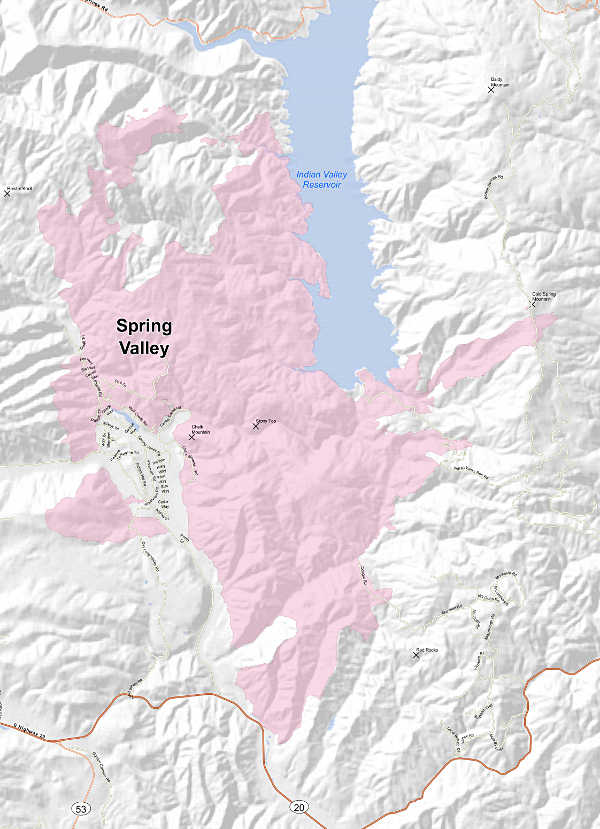
LAKE COUNTY, Calif. – Following a 10-month investigation, Cal Fire has concluded that target shooting was the cause of the 2018 Pawnee fire, which burned thousands of acres and destroyed nearly two dozen structures near Clearlake Oaks.
Cal Fire said Friday that its law enforcement officers who conducted the investigation reached the conclusion on the Pawnee fire’s cause and origin.
The fire, which began on June 23 on Pawnee and New Long Valley roads in the Spring Valley Lakes subdivision northeast of Clearlake Oaks, burned 15,185 acres and destroyed 22 structures. It was fully contained on July 8.
It led to a local emergency proclamation by Lake County Sheriff Brian Martin, which the Board of Supervisors most recently voted to continue on Tuesday.
Then-Gov. Jerry Brown followed up on Sheriff Martin’s original proclamation last year by declaring a state of emergency in Lake County because of the Pawnee fire.
Cal Fire said its investigators were dispatched as part of the initial fire response and immediately began working to determine the blaze’s origin and cause.
The ensuing investigation uncovered evidence that target shooting sparked the fire, Cal Fire said.
Cal Fire was assisted during the course of the investigation by the Lake County Sheriff's Office, Lake County District Attorney's Office, Sonoma County Sheriff's Department and Rohnert Park Department of Public Safety.
Email Elizabeth Larson at
CLEARLAKE, Calif. – The Clearlake City Council on Thursday approved a list of road projects to submit to the state for funding and got an update from Public Works staff on the plans for road maintenance projects in the coming months.
The discussion on roads begins in the video above at the 3:23:20 mark.
Public Works Superintendent Michael Baker presented to the council the list of road projects staff proposed submitting to the California Transportation Commission for funding under Senate Bill 1, the Road Repair and Accountability Act of 2017.
The list, in no particular order, includes:
– Meadowbrook area pavement rehabilitation project: $1.1 million.
– Pearl Avenue/Emory Avenue pavement rehabilitation project: $1.3 million.
– Highlands Park frontage improvement project: $516,000.
– Airport Road regional connector improvements: $1.2 million.
– Modoc/Second Street pavement rehabilitation project: $550,000.
– San Joaquin drainage improvements and pavement rehabilitation: $1.4 million.
– Dam Road roundabout: $4.6 million.
He said adopting the resolution containing the list of projects didn’t obligate the city to spend funds on the project.
City Manager Alan Flora said the list is supposed to include projects that would be completed in the next year. Work on Lakeshore Drive isn’t on the list because that project isn’t far enough along.
“This is an extremely optimistic project list,” said Flora, noting there is no penalty for adding extra projects. He said they were erring on the side of adding extra projects in, in hopes of getting the money.
Flora also noted during the discussion that the city is only eligible for funding for projects included on the list, which has to be submitted by May 1.
Councilman Russell Cremer asked if the projects were designed already. Flora said they were in various stages, with the city’s consulting engineer, Dave Swartz, adding that Meadowbrook is the farthest along.
Councilman Phil Harris was concerned about the city not being able to complete all of the projects within the coming year.
Later in the discussion, Harris said, “These proposed completion dates make me giddy,” and that he didn’t want to get let down.
Harris added that the city has a history of not doing things by certain dates, and he preferred to under promise and over deliver.
Swartz said that, realistically, they will see work on Emory, Pearl, Highlands Harbor and Highlands Park in the coming year.
“In the next 12 months, we’re going to tear up some ground,” Swartz said.
The council approved the resolution unanimously.
Baker also presented to the council the city’s road maintenance plan for this year.
The city’s road work is largely funded by its Measure V road tax.
He said his staff will start grading in the Avenues on May 6. They’re starting in that area due to the number of complaints and service requests as a result of heavy rains and lack of drainage.
“Some of those spots are pretty bad,” he said, and they need to be addressed quickly as they are creating issues for elderly residents with medical conditions.
He said his department is now working to hire more workers, with Public Works staff to be split into two crews: One crew of four to six people will do pothole repair, crack sealing and miscellaneous work, while the grading crew will include six to nine personnel.
Baker said the crews will work 10-hour days, Monday through Friday, and alternating Saturdays.
He said they are required by law to call DigAlert before starting grading work so that the utilities are marked. It usually takes about 48 hours for that process. In the meantime, crews will go out and trim trees and clean the right-of-way so equipment won’t be damaged.
Baker said they will build up the road base as part of the grading.
Pothole patching will start on Lakeshore Drive, move up Olympic Drive and come down Old Highway 53, Baker said.
In addition to their work plan, Baker said crews will respond to service requests.
Flora showed a map – which he said the city plans to post a map on its Web site – illustrating where the crews will be working.
He said grading work is expected to take place from 18th to 30th avenues.
Baker also let the council know that, in case of emergencies, the grading crew could be called off its work to assist elsewhere.
Cremer asked if the first phase of work will take the entire summer. Baker said no. Cremer followed up by asking about phase two.
Flora said the plan is to give the council and public a monthly update on progress and next phases. He said the city is changing its technique a little this year as it tries to accomplish more road work than it did last year.
He said they want to see how much ground they can cover. “Having the two crews is really going to help.”
Cremer asked how long Baker expected it to take to complete pothole repair. Baker said the city is still waiting for delivery of its new asphalt hot box, which is being built. He reported that the manufacturer said they should hear something by next week.
As soon as the city gets that piece of equipment, Baker said the city repair crew will get to work.
“They’re going to be working hard, they’re going to be working 10-hour days, five to six days a week,” Baker said.
Email Elizabeth Larson at
042519 Clearlake City Counc... by on Scribd

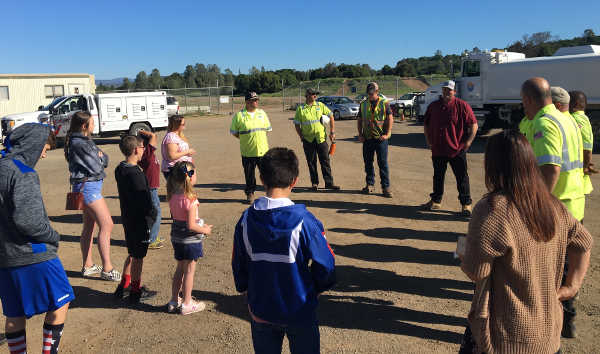
CLEARLAKE, Calif. – On Thursday, in conjunction with more than 3.5 million public and private sector employers across the nation, the city of Clearlake participated in “Take Our Sons and Daughters to Work Day.”
Employees from all divisions, including the Clearlake Police Department, Public Works, Code Enforcement and administration, brought their children to work to show them the value of their education and help them discover the power and possibilities associated with a balanced work and family life.
The children spent a half day with the Public Works Department, learning proper equipment techniques and how roads are built.

They were then given a tour of the police department, where Det. Leonardo Flores taught them fingerprinting techniques and showed them to use the sirens and loud speakers in the vehicles.
They ended their day with a meeting with Councilmember Phil Harris, who taught them about the history of Clearlake and discussed the roles their parents play within the city of Clearlake.