LAKE COUNTY, Calif. – Lake County Animal Care and Control has several new dogs up for adoption this week.
Dogs available for adoption this week include mixes of boxer, Chihuahua, dachshund, German Shepherd, Labrador Retriever and pit bull.
Dogs that are adopted from Lake County Animal Care and Control are either neutered or spayed, microchipped and, if old enough, given a rabies shot and county license before being released to their new owner. License fees do not apply to residents of the cities of Lakeport or Clearlake.
If you're looking for a new companion, visit the shelter. There are many great pets hoping you'll choose them.
The following dogs at the Lake County Animal Care and Control shelter have been cleared for adoption (additional dogs on the animal control Web site not listed are still “on hold”).
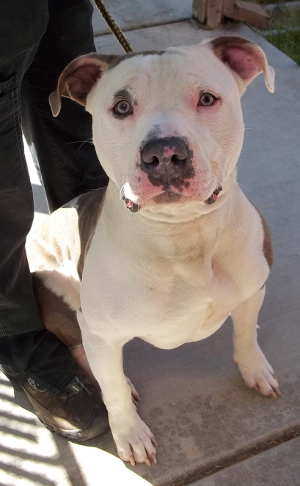
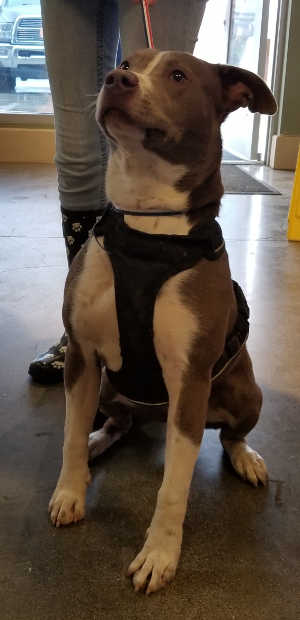
This male pit bull terrier is in kennel No. 13, ID No. 12043. Photo courtesy of Lake County Animal Care and Control. Male pit bull terrier
This male pit bull terrier has a short brown and white coat.
He’s in kennel No. 13, ID No. 12043.
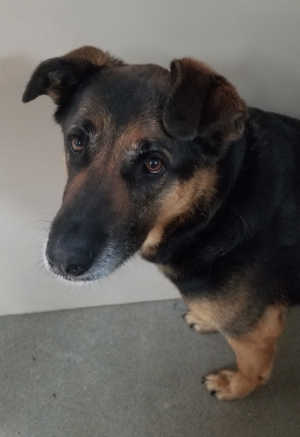
“Soy” is a male German Shepherd in kennel No. 15, ID No. 12107. Photo courtesy of Lake County Animal Care and Control. ‘Soy’
“Soy” is a male German Shepherd with a medium-length black and brown coat.
He already has been neutered.
He’s in kennel No. 15, ID No. 12107.
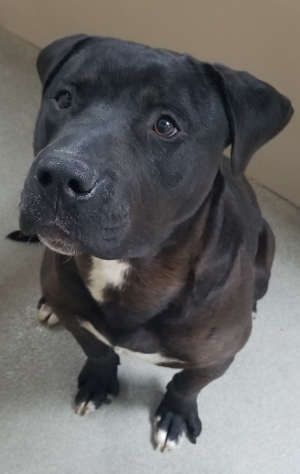
This male pit bull terrier is in kennel No. 20, ID No. 11958. Photo courtesy of Lake County Animal Care and Control. Male pit bull terrier
This male pit bull terrier has a short black coat.
He’s in kennel No. 20, ID No. 11958.
“Dollar Bill” is a male dachshund in kennel No. 23, ID No. 12115. Photo courtesy of Lake County Animal Care and Control. ‘Dollar Bill’
“Dollar Bill” is a male dachshund with a short tan and white coat.
He’s in kennel No. 23, ID No. 12115.
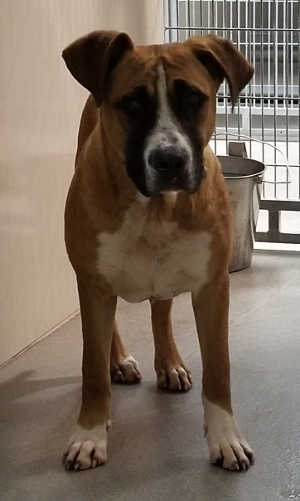
This male boxer is in kennel No. 24, ID No. 12123. Photo courtesy of Lake County Animal Care and Control. Male boxer
This male boxer has a short tricolor coat.
He’s in kennel No. 24, ID No. 12123.
This female pit bull is in kennel No. 28, ID No. 11950. Photo courtesy of Lake County Animal Care and Control. Female pit bull
This female pit bull has a short brown and white coat.
She’s in kennel No. 28, ID No. 11950.
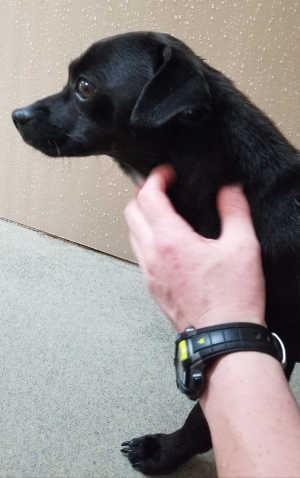
This male Chihuahua-terrier mix is in kennel No. 29a, ID No. 12112. Photo courtesy of Lake County Animal Care and Control. Chihuahua-terrier mix
This male Chihuahua-terrier mix has a short black coat.
He’s in kennel No. 29a, ID No. 12112.
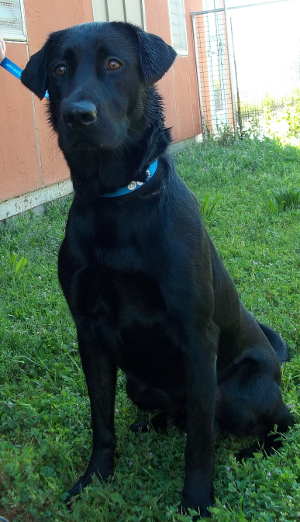
“Bear” is a male Labrador Retriever in kennel No. 34, ID No. 11986. Photo courtesy of Lake County Animal Care and Control. ‘Bear’
“Bear” is a male Labrador Retriever with a short black coat.
He’s already been neutered.
He’s in kennel No. 34, ID No. 11986.
Lake County Animal Care and Control is located at 4949 Helbush in Lakeport, next to the Hill Road Correctional Facility.
Office hours are Monday through Friday, 11 a.m. to 5 p.m., and 11 a.m. to 3 p.m., Saturday. The shelter is open from 11 a.m. to 4 p.m. Monday through Friday and on Saturday from 11 a.m. to 3 p.m.
For more information call Lake County Animal Care and Control at 707-263-0278.
Email Elizabeth Larson at This email address is being protected from spambots. You need JavaScript enabled to view it.. Follow her on Twitter, @ERLarson, or Lake County News, @LakeCoNews.
Astronomers have put together the largest and most comprehensive "history book" of galaxies into one single image, using 16 years' worth of observations from NASA's Hubble Space Telescope.
The deep-sky mosaic, created from nearly 7,500 individual exposures, provides a wide portrait of the distant universe, containing 265,000 galaxies that stretch back through 13.3 billion years of time to just 500 million years after the big bang.
The faintest and farthest galaxies are just one ten-billionth the brightness of what the human eye can see.
The universe's evolutionary history is also chronicled in this one sweeping view. The portrait shows how galaxies change over time, building themselves up to become the giant galaxies seen in the nearby universe.
This ambitious endeavor, called the Hubble Legacy Field, also combines observations taken by several Hubble deep-field surveys, including the eXtreme Deep Field, or XDF, the deepest view of the universe. The wavelength range stretches from ultraviolet to near-infrared light, capturing the key features of galaxy assembly over time.
"Now that we have gone wider than in previous surveys, we are harvesting many more distant galaxies in the largest such dataset ever produced by Hubble," said Garth Illingworth of the University of California, Santa Cruz, leader of the team that assembled the image. "This one image contains the full history of the growth of galaxies in the universe, from their time as 'infants' to when they grew into fully fledged 'adults.'"
No image will surpass this one until future space telescopes are launched. "We've put together this mosaic as a tool to be used by us and by other astronomers," Illingworth added. "The expectation is that this survey will lead to an even more coherent, in-depth and greater understanding of the universe's evolution in the coming years."
The image yields a huge catalog of distant galaxies. "Such exquisite high-resolution measurements of the numerous galaxies in this catalog enable a wide swath of extragalactic study," said catalog lead researcher Katherine Whitaker of the University of Connecticut, in Storrs. "Often, these kinds of surveys have yielded unanticipated discoveries which have had the greatest impact on our understanding of galaxy evolution."
The video begins with a view of the thousands of galaxies in the Hubble Ultra Deep Field and slowly zooms out to reveal the larger Hubble Legacy Field, containing 265,000 galaxies. Credits: NASA, ESA, G. Illingworth (University of California, Santa Cruz) and G. Bacon (STScI) Galaxies are the "markers of space," as astronomer Edwin Hubble once described them a century ago. Galaxies allow astronomers to trace the expansion of the universe, offer clues to the underlying physics of the cosmos, show when the chemical elements originated, and enable the conditions that eventually led to the appearance of our solar system and life.
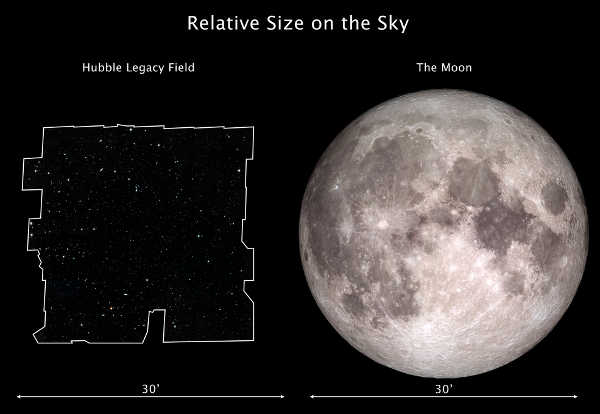
This wider view contains about 30 times as many galaxies as in the previous deep fields. The new portrait, a mosaic of multiple snapshots, covers almost the width of the full Moon. The XDF, which penetrated deeper into space than this wider view, lies in this region, but it covers less than one-tenth of the full Moon's diameter. The Legacy Field also uncovers a zoo of unusual objects. Many of them are the remnants of galactic "train wrecks," a time in the early universe when small, young galaxies collided and merged with other galaxies.
Assembling all of the observations was an immense task. The image comprises the collective work of 31 Hubble programs by different teams of astronomers. Hubble has spent more time on this tiny area than on any other region of the sky, totaling more than 250 days, representing nearly three-quarters of a year.
"Our goal was to assemble all 16 years of exposures into a legacy image," explained Dan Magee, of the University of California, Santa Cruz, the team's data processing lead. "Previously, most of these exposures had not been put together in a consistent way that can be used by any researcher. Astronomers can select the data in the Legacy Field they want and work with it immediately, as opposed to having to perform a huge amount of data reduction before conducting scientific analysis."
The image, along with the individual exposures that make up the new view, is available to the worldwide astronomical community through the Mikulski Archive for Space Telescopes (MAST). MAST, an online database of astronomical data from Hubble and other NASA missions, is located at the Space Telescope Science Institute in Baltimore, Maryland.\
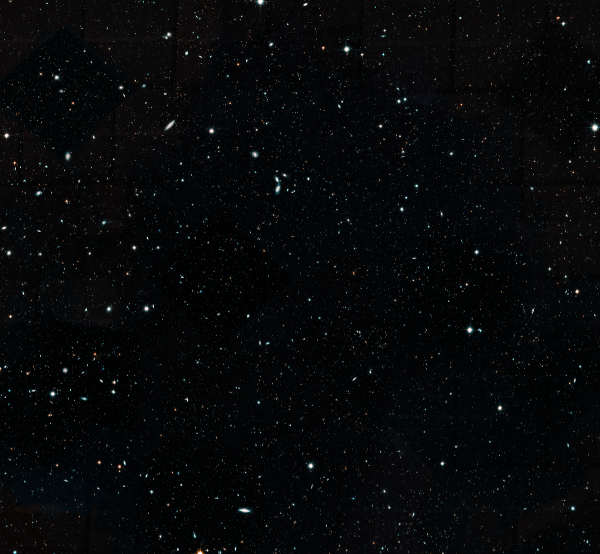
This Hubble Space Telescope image represents a portion of the Hubble Legacy Field, one of the widest views of the universe ever made. The image, a combination of thousands of snapshots, represents 16 years' worth of observations. The Hubble Legacy Field includes observations taken by several Hubble deep-field surveys, including the eXtreme Deep Field (XDF), the deepest view of the universe. The wavelength range stretches from ultraviolet to near-infrared light, capturing all the features of galaxy assembly over time. This cropped image mosaic presents a wide portrait of the distant universe and contains roughly 200,000 galaxies. They stretch back through 13.3 billion years of time to just 500 million years after the universe's birth in the big bang. Credits: NASA, ESA, G. Illingworth and D. Magee (University of California, Santa Cruz), K. Whitaker (University of Connecticut), R. Bouwens (Leiden University), P. Oesch (University of Geneva) and the Hubble Legacy Field team.
The Hubble Space Telescope has come a long way in taking ever deeper "core samples" of the distant universe.
After Hubble's launch in 1990, astronomers debated if it was worth spending a chunk of the telescope's time to go on a "fishing expedition" to take a very long exposure of a small, seemingly blank piece of sky.
The resulting Hubble Deep Field image in 1995 captured several thousand unseen galaxies in one pointing. The bold effort was a landmark demonstration and a defining proof-of-concept that set the stage for future deep field images.
In 2002, Hubble's Advanced Camera for Surveys went even deeper to uncover 10,000 galaxies in a single snapshot. Astronomers used exposures taken by Hubble's Wide Field Camera 3, or WFC3, installed in 2009, to assemble the eXtreme Deep Field snapshot in 2012.
Unlike previous Hubble cameras, the telescope's WFC3 covers a broader wavelength range, from ultraviolet to near-infrared.
This new image mosaic is the first in a series of Hubble Legacy Field images. The team is working on a second set of images, totaling more than 5,200 Hubble exposures, in another area of the sky. In the future, astronomers hope to broaden the multiwavelength range in the legacy images to include longer-wavelength infrared data and high-energy X-ray observations from two other NASA Great Observatories, the Spitzer Space Telescope and Chandra X-ray Observatory.
The vast number of galaxies in the Legacy Field image are also prime targets for future telescopes. "This will really set the stage for NASA's planned Wide Field Infrared Survey Telescope (WFIRST)," Illingworth said. "The Legacy Field is a pathfinder for WFIRST, which will capture an image that is 100 times larger than a typical Hubble photo. In just three weeks' worth of observations by WFIRST, astronomers will be able to assemble a field that is much deeper and more than twice as large as the Hubble Legacy Field."
In addition, NASA's upcoming James Webb Space Telescope will allow astronomers to push much deeper into the legacy field to reveal how the infant galaxies actually grew. Webb's infrared coverage will go beyond the limits of Hubble and Spitzer to help astronomers identify the first galaxies in the universe.
The Hubble Space Telescope is a project of international cooperation between NASA and European Space Agency. NASA's Goddard Space Flight Center in Greenbelt, Maryland, manages the telescope.
The Space Telescope Science Institute, or STScI, in Baltimore, Maryland, conducts Hubble science operations. STScI is operated for NASA by the Association of Universities for Research in Astronomy in Washington, D.C.
This graphic compares the dimensions of the Hubble Legacy Field on the sky with the angular size of the Moon. The Hubble Legacy Field is one of the widest views ever taken of the universe with Hubble. The new portrait, a mosaic of nearly 7,500 exposures, covers almost the width of the full Moon. The Moon and the Legacy Field each subtend about an angle of one-half a degree on the sky (or half the width of your forefinger held at arm's length). Credits: Hubble Legacy Field Image: NASA, ESA, and G. Illingworth and D. Magee (University of California, Santa Cruz); Moon Image: NASA, Goddard Space Flight Center and Arizona State University.
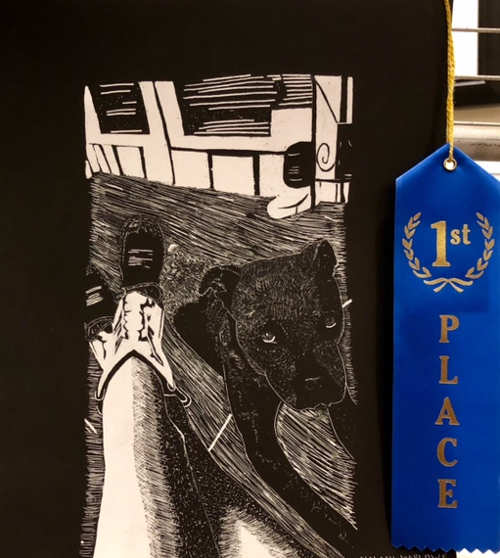
“A Day in the Life” by Nalani Marlowe. Courtesy photo. LAKE COUNTY, Calif. – Rep. Mike Thompson (CA-05) announced that local judges have selected Nalani Marlowe from Kelseyville High School in Lake County as the 2019 Fifth Congressional District Art Competition grand prize winner.
Her art piece, “A Day in the Life,” will hang in the halls of the United States Capitol for one year and she will be honored at a ceremony in Washington, D.C. next month.
“Proud to announce that Nalani Marlowe is this year’s Grand Prize winner for the Fifth Congressional District Art Competition,” said Thompson. “She displayed great skill and talent with the use of scratchboard in the final piece she produced. ‘A Day in the Life’ will be an excellent representation from our district to everyone who walks the halls of the Capitol and I look forward to seeing it each time I walk to vote. Congratulations, Nalani!”
“A Day in the Life” was created using scratchboard and represents Nalani with her dog relaxing on her front porch – a glimpse into her everyday life.
Marlowe and a guest will receive plane tickets to Washington for a ceremony honoring winners from across the nation next month.
Thompson represents California’s Fifth Congressional District, which includes all or part of Contra Costa, Lake, Napa, Solano and Sonoma counties.
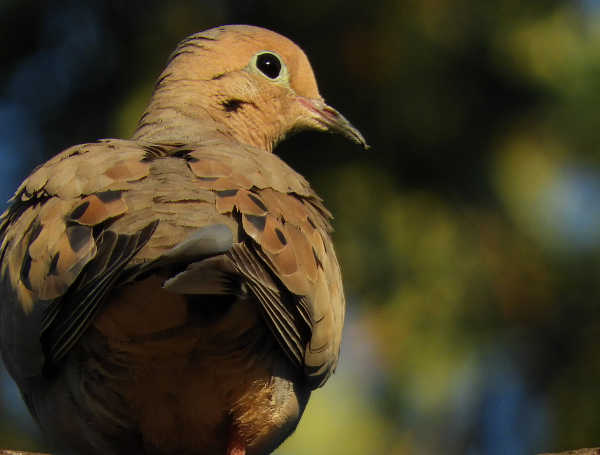
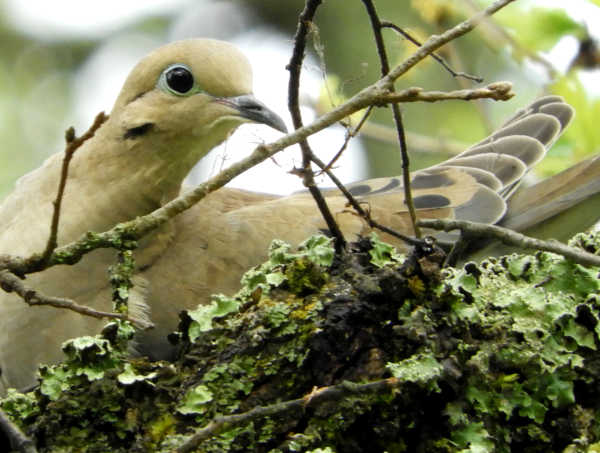
Mourning doves are one of the most common and abundant species of bird in the country and this is due in part to the fact that the birds are highly adaptable and can have up to six broods in a single year. Photo by Mary K. Hanson.
Coo-hoo-woo-woo-woo. It’s an easily recognizable sound.
The gentle cooing of the Mourning Dove (Zenaida marginella) is most often performed by the male of the species when he’s courting a female or reestablishing a bond with a mate. The doves are generally monogamous, especially if they don’t participate in any form of migration.
Some individuals migrate, others do not. (Some have actually shown up in Canada and Great Britain!) It’s very often the availability of food sources that determine their migration status.
So, keeping platform-type bird feeders available to them in your yard or garden year-round will encourage them to stay. Bear in mind that the doves eat most often from the ground, so if you have feeders around, keep your cats indoors.
The mourning doves will on rare occasions eat garden snails, but otherwise their diet consists exclusively of different kinds of seeds.
Usually, they’ll gobble up as many seeds as they can in a single seating and store them in their crop, a muscular pouch-like expansion of the esophagus. Once the crop is full, the dove will fly off to a secure area to rest and continue with the digestion process.
The exception to the 99-percent-seed diet applies to the doves’ young, called “squabs.” The newborns cannot digest seeds, so for the first few days of their lives, the parents feed them “crop milk,” a special gooey secretion the parents regurgitate for them.
The cottage-cheese-looking milk is high in protein and fat, but it lacks carbohydrates or calcium. Both the males and the females, who co-parent the young, can produce the milk which along with nutrition, provides the baby birds with the immune-building antibodies they need to survive and grow.
What’s additionally fascinating about the milk is that it appears in the adults a day or two before the eggs hatch, so it’s ready for the squabs as soon as they need it.
When the squabs are old enough to eat seeds, the parents’ milk gradually shuts itself off. Doves aren’t the only birds that produce the crop milk; some species of pigeons and flamingos do, too, as do male emperor penguins.
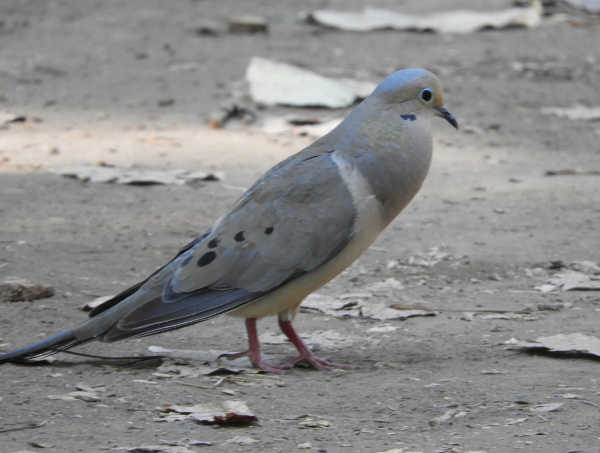
The mourning dove’s recognizable coo is most often performed by the male of the species when he’s courting a female or reestablishing a bond with a mate. The bird’s throat expands with an intake of air just before the coo is emitted. In this photo you can see the blue coloration on the top of the male’s head. Photo by Mary K. Hanson. Not only do both mourning dove parents feed their young, both parents also incubate the eggs, so often you’ll find the male sitting on the nest.
Like many birds, male mourning doves have coloring the females do not, but much of their extra color is somewhat subtle. The males’ breast and neck have a somewhat pink hue to them, and the top of the head bears a grayish blue cap. Otherwise, the sexes look very much the same.
Mourning doves are one of the most common and abundant species of bird in the country, even though they are hunted regularly, and this is due in part to the fact that the birds are highly adaptable and can have up to six broods in a single year.
Egg-laying can last from mid-February to early October; more than any other bird. Usually, each brood consists of two eggs which are laid in a nest that often looks too thin and flimsy to contain them.
The doves aren’t the greatest architects when it comes to nest construction. Males usually scout out nesting sites – usually a branch with foliage around it or some flat surface that has some form of protection on at least one side – and then he escorts the female around to the sites until she chooses one she likes.
While the female sits on the spot she like best, the male will go in search of fine twigs and grasses and carry them to her to arrange as she pleases.
At each landing and takeoff, you’ll hear a bright whooshing-whistling sound emanating from the dove. This isn’t made by the bird’s vocal equipment; it’s made by the air rushing through the doves’ feathers. Mourning doves are actually strong flyers and can reach speeds up to 55 mile per hour.
You can help the doves with nesting sites by providing them with simple wire- or twig-mesh nesting cones in the trees around your house or property.
The construction of these cones is simple enough for children to produce, and detailed instructions including the optimal places to secure the cones can be found online at Nest Watch.
Mary K. Hanson is a Certified California Naturalist, author and nature photographer, living with terminal cancer. She developed and helps to teach the naturalist program at Tuleyome, a 501(c)(3) nonprofit conservation organization based in Woodland. For more information, see their website at http://tuleyome.org/.
Here you’re seeing a female mourning dove sitting on a spot she’s chosen for her nesting site. Once she’s chosen a site, the male will go in search of fine twigs and grasses and carry them to her to arrange as she pleases. Photo by Mary K. Hanson.
The California Office of Traffic Safety is asking everyone participating in Cinco de Mayo festivities this weekend to celebrate responsibly by planning ahead for how to get home safely.
Cinco de Mayo is on a Sunday this year, and law enforcement agencies across the state will have additional officers on patrol looking for drivers suspected of driving under the influence of alcohol and/or drugs.
“Unfortunately, Cinco de Mayo has become a deadly holiday for impaired driving, which is why it is important for everyone to celebrate with caution and make smart decisions about how they get home,” OTS Director Rhonda Craft said.
“Designate a sober driver before the party, whether it is ride-share, a friend or taxi.”
Although alcohol consumption is more of an issue during the Cinco de Mayo holiday, the number of drug-impaired driving crashes continues to rise.
The OTS wants to remind drivers that a “DUI Doesn’t Just Mean Booze.” Prescription drugs, over-the-counter medications and marijuana can all be impairing, especially in combination with alcohol or other drugs, and can lead to a DUI.
Many people will be hosting or attending Cinco de Mayo parties, and the OTS offers a few tips to make sure everyone has a fun, safe time:
• Playing party host? Offer nonalcoholic drinks. Monitor who is drinking and ask how they are getting home.
• If you plan to drink, choose a sober way to get around. Use ride-share, a designated sober driver, taxi, or public transportation to get home.
• If you are hosting a party and someone who is clearly impaired tries to leave, offer them a sober ride home or have them stay the night.
“Any level of impairment while driving puts everyone around you, and yourself, at risk,” Director Craft said. “Being sober is the safest bet behind the wheel.”
Whether by car, motorcycle, bike, scooter or walking, the OTS wants everyone to “go safely.” To learn more about ways to stay safe on the go, visit www.gosafelyca.org.
The OTS administers funding for traffic safety programs statewide with the goal of reducing deaths, injuries, and economic losses. The OTS is a department under the California State Transportation Agency.
Dennis Fordham. Courtesy photo. Must special assets – such as businesses, farms and ranches – held in trust always be sold when there are multiple trust beneficiaries?
Disagreement and litigation amongst trust beneficiaries can arise over a special asset that some want preserved and others want sold and distributed as cash.
The answer depends both on the trust and how it is administered.
In Trolan v. Trolan (2019), 31 CA5th 939, the 6th District Court of Appeals, recently addressed this question.
In Trolan, the settlors established a trust with income producing assets for the benefit of their six children. Each child was entitled to receive full distribution once the child turned age thirty. Five of the six children wanted to continue to hold the income producing assets in trust but one wanted the assets sold and the net proceeds distributed.
The Sixth District Court of Appeal ruled that the Trolan Trust unambiguously required distribution but that it did not require liquidation (sale) of the assets.
Thus, while the trust had to be terminated, the distribution in satisfaction of the beneficiaries’ shares could either be made in cash or in-kind to the beneficiaries. In-kind distributions involve distributing either a partial or complete ownership interest in an asset.
Disagreements over whether to continue to own or to sell assets often involve a going business, a farm, a ranch, or a residence, such as the family home or vacation home. How can an owner of such assets ensure that these assets are not sold?
One approach is to hold the asset in further trust, after the owner’s death, for a period of time, up to ninety-years in California; at which time the asset is either distributed to the beneficiaries or is sold.
For example, a family home can be held in house trust that provides for the sharing of the enjoyment and expense amongst the beneficiaries and their families. If the house were instead distributed outright to multiple beneficiaries – as tenants-in-common – then any one or more beneficiaries, or their judgment creditors, could compel the sale of the property.
Another approach is to make offsetting gifts of money, or other assets, to those beneficiaries who do not want an on-going interest in the subject asset.
If it is not possible to make such an offsetting gift then it may be possible for the Trustee to make a loan – at the trustee level – that is secured against the asset and is later paid-off in installments funded by the income generated from the asset or by another beneficiary (who may secure their own financing).
With a family business that the owner wants to see go to their next generation, there will be those children who are interested in being part of the business and other children who want out.
The parents will need to consider whether they want to equalize out the children’s inheritances with other assets in their estate (including life insurance) or make the children who receive the business as a going concern purchase out the other children’s interests over a period of years using the business income.
When a business is concerned years of advance planning is often necessary to achieve a desired outcome.
Estate planning with special assets, therefore, is more complicated because the owner may not want the trustee to simply sell the assets and distribute the net proceeds amongst the beneficiaries.
The owner may have to balance the competing goals of treating beneficiaries fairly whom they love equally versus ensuring the special asset continues intact into the next generation.
This balancing may require subjective reconsideration as to whether all beneficiaries – e.g., one’s children – should receive an equal share of the estate when doing so may or may not be feasible.
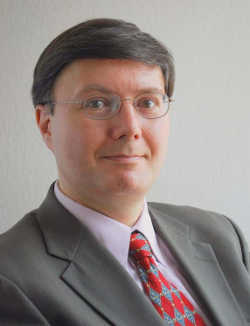
Dennis A. Fordham, attorney, is a State Bar-Certified Specialist in estate planning, probate and trust law. His office is at 870 S. Main St., Lakeport, Calif. He can be reached at This email address is being protected from spambots. You need JavaScript enabled to view it. and 707-263-3235.
 How to resolve AdBlock issue?