 How to resolve AdBlock issue?
News
The open house will take place from 3 to 7 p.m. at the Lucerne Alpine Senior Center, 3985 Country Club Drive.
The planning team will have information about the North Shore Restoration Project for review and be available to answer questions and receive comments at the open house.
The team is asking the community to provide input from the very beginning about what they would like to see done on their National Forest.
Personnel from the Forest Service, Cal Fire and Natural Resources Conservation Service also will be available for private landowners to discuss post-fire restoration on private lands and opportunities to combine treatments across boundaries to increase chances in acquiring outside funding.
The project area is within the 2018 Ranch fire perimeter and is in the wildland urban interface of the communities on the north and east shores of Clear Lake.
Information about the area, purpose and need and proposed action can be found on the forest Web site at https://www.fs.usda.gov/project/?project=55716.
The Mendocino National Forest is preparing an environmental assessment for the project in collaboration with FireScape Mendocino, the Forest Service Regional Ecology program and the Pacific Northwest Research Station.
For more information, contact Planning Team Leader Gary Urdahl at 707-275-1417 or by email at
The urgency ordinance does the following:
⦁ Establishes a procedure for submitting an application for a wireless communication facility permit.
⦁ Establishes required content for a wireless communication facility permit.
⦁ Establishes required findings for approval of a permit for a wireless communication facility.
⦁ Establishes general standards for wireless communication facilities.
⦁ Establishes conditions of approval for wireless communication facility permits
⦁ Establishes regulations that specifically apply to small wireless communication facilities.
⦁ Establishes a review and appeals process for wireless communication facility permits.
⦁ Establishes maintenance and removal requirements for wireless communication facility permits.
⦁ Establishes enforcement provisions for violations of the ordinance.
Following the conclusion of the community workshop the Planning Commission will provide direction to staff on the need to prepare any amendments or changes in order to adopt a permanent wireless communication facilities ordinance.
The public is encouraged to attend and participate.
An electronic version of the urgency ordinance (Ordinance 921 (2019)) and other meeting materials can be viewed on the city of Lakeport’s Web site at https://www.cityoflakeport.com/news_detail_T14_R16.php.
If you have any questions feel free to contact the Community Development Department at 707-263-5615, Extension 201, or email Kevin Ingram at
Gov. Gavin Newsom declared May 5 to 11 “Wildfire Preparedness Week” to urge homeowners that California Wildfires Have Changed, Together We Must Adapt.
Already this year, Cal Fire has responded to more than 470 wildfires that have burned more than 1,180 acres.
Californian’s need to accept fire as part of our natural landscape, understand the fire risk and take action before a wildfire starts.
Fire officials encourage residents to help safeguard their homes by using fire-safe construction materials, and to look for points of entry where embers could intrude into the home during a fire.
Home and property safety preparation should include creating a defensible space by clearing vegetation 100 feet or more away from your home, and using fire resistant landscaping to help stop the spread of wildfire.
“Our firefighters have been preparing non-stop for the inevitable fires that will happen this year. However, preparation involves all levels of the community, from first responders to the general public,” said Chief Thom Porter, Cal Fire director.
“As was unfortunately witnessed with tremendous force this past year, wind-driven embers can destroy homes or neighborhoods far from the actual flame front of a wildfire,” Porter said. “Taking the initiative to prepare your home and your community will be key in preventing the unfathomable damage that these intense wildfires can cause. It is up to us, the agencies that respond to the wildfires, and you, the homeowner, to create the strong network needed to endure through these devastating events.”
Persistent drought like conditions, warmer temperatures and continued severe winds have created conditions that will lead to more frequent and catastrophic fires.
To meet this challenge, California must adopt an all-of-the-above approach in protecting the public and maintaining the health of our forests.
Gov. Newsom has directed Cal Fire to recommend immediate, medium and long-term actions to help prevent destructive wildfires.
Cal Fire identified 35 priority fuel reduction projects that collectively cover 90,000 acres, and when complete will help protect over 200 of the state’s most wildfire-vulnerable communities.
Cal Fire’s “Ready for Wildfire” app is the perfect tool to use in year-round preparation. Checklists found on the Cal Fire app help homeowners prepare and maintain defensible space, harden homes with ignition-resistant building materials, and create family evacuation plans and kits.
The app features customizable alerts to electronic devices when Cal Fire responds to a wildfire of 10 acres or more.
To download the free ready-for-wildfire app and to learn how to create defensible space around your home and more, visit www.ReadyForWildfire.org.

"We live on the leash of our senses." – Diane Ackerman
LAKE COUNTY, Calif. – Gliding down the silky waters of Cache Creek, its banks are alive with a rich, new-tide scent.
The creek banks sport spring's shrubby growth below, and evidence of a boisterous heron rookery above.
The landscape here is untamed enough to support crawdads, fish of all description, frogs, raccoons, mink and more.
It's a given that no two hikes, bike rides or kayak trips are alike here in our wild county. There is always something new to observe, whether it's a new bloom, a bird or a larger critter, like a river otter.
River otters can be spotted frolicking on the shores of Clear Lake, or on the banks of our county's many creeks, such as Cache Creek.
According to wildlife biologists, river otters are making a comeback in the Bay Area due to conservation and restoration projects, but here on Clear Lake and its environs, where fish are plentiful, otters are, too.
Prior to the 1960s otters were hunted in California for their fur, but thankfully, that sport has ceased to exist.
River otters eat more than other mammals of comparable size – around 12 percent of their 20-pound body weight. They consume crawdads, frogs, birds and shellfish, but they prefer fish.
Crafty and streamlined creatures, otters are adept at fishing and can chase or even ambush their prey. Once otters track a fish, they may remain submerged for around four minutes.
River otters seem to dine on small fish near the surface of the water, and eat larger catches on the shore.
River otters employ scent-marking as a means of communication. They are adept at marking their territory with urine, scat or musk scent, with the musk being secreted when agitated.
Another form of communication is the otter's hiss or growl, which they can emit if disturbed or distressed.
Springtime is when they find a den to give birth to their kits.
The den, or holt, as the home is called, is actually an unused home of another animal. The protective den will be enhanced with moss, hair or leaves for the nest-chamber.
The female otter can produce up to five, but most often between one and three young.
When the pups or kits are born they only weigh about 5 ounces and already sport fur, but are born blind.
After a month, the kits can see and they gain their sense of play not much later, at 5 or 6 weeks, when they tumble around with their siblings.
When they are nearly 2 months old, mama otter takes them to the water where they are natural swimmers.
One more reason to love Lake County – playful and cute otters!
Be sure to watch for them sliding down the wet banks of waterways with their agile and flexible brown-furred bodies, or as they dine on a fresh catch on someone's pier.
Kathleen Scavone is a writer and retired teacher. She lives in Middletown, Calif.

KELSEYVILLE, Calif. – Get your favorite denim and bling ready and come out to support the community.
The annual Denim and Diamonds benefit dinner kicks off at Boatique Winery in scenic Red Hills on Saturday, June 22, at 5:30 p.m.
Sponsored by the Rotary Club of Kelseyville Sunrise, the evening will feature dinner, dancing and both a silent and live auction.
The Saw Shop Gallery Bistro will be serving a menu that is sure to delight your taste buds. A vegetarian option is available on request.
The Fargo Brothers will keep you on your feet dancing the night away with all of your favorite dance tunes to make the evening fun.
The club has gathered an array of items for the silent auction. Live auction items will include a cruise on Clear Lake in one of Boatique’s fabulous antique boats with lunch and wine for four, a Farm to Fork dinner a century-old Lake County pear orchard, and a few more surprises.
Money raised at Denim and Diamonds will enable the Club to continue to fund projects in the community and beyond. This includes dictionaries for third graders, elementary school reading books, sponsorship of the Interact Club at Kelseyville High School and scholarships to graduating seniors.
The Rotary Club of Kelseyville has also completed projects to help refurbish the Kelseyville Senior Center, roadside clean-up, the Adopt a Fifth Grader program, and other projects with funds raised by the Denim & Diamonds event.
A huge thank you to our generous sponsors that have committed for this year’s event including presenting sponsor Lake County Tribal Health, Diamond sponsor Calpine Corporation, and Denim sponsors Adventist Health Clearlake, Bella Vista Farming Co, LLC, Boatique Winery, California Exterminators, Lake County Waste Solutions, Lakeview Health Center, Saw Shop Gallery Bistro & UCC Rentals, Shields Construction, Sutter Lakeside Hospital and The Travel Centers.
Tickets for this fun evening are $75 per person or tables of eight are available for $600.
Tickets are available from members of the Rotary Club of Kelseyville Sunrise, from the Saw Shop Gallery Bistro in Kelseyville or on Eventbrite.
There are also additional sponsorship opportunities for $1,000 and $2,500.
For more information and tickets, call Terry Dereniuk at 707-337-2871 or Kim Baldwin at 707-349-7913.
Can’t make the event, but want to help – send your tax-deductible donation to LARCA, Rotary District 5130, and P.O. Box 2921, Clearlake, CA 95422. Please specify Denim and Diamonds on your check. Lake Area Rotary Club Association (LARCA) is a 501©3 organization, tax ID number 46-1149482.
The Rotary Club of Kelseyville Sunrise chapter is made up of local business, professional, and civic leaders. Members meet regularly, get to know each other, form friendships, and through that, get things done in the community.
For membership and other information about the Rotary Club of Kelseyville Sunrise, visit http://www.kelseyvillesunriserotary.org.

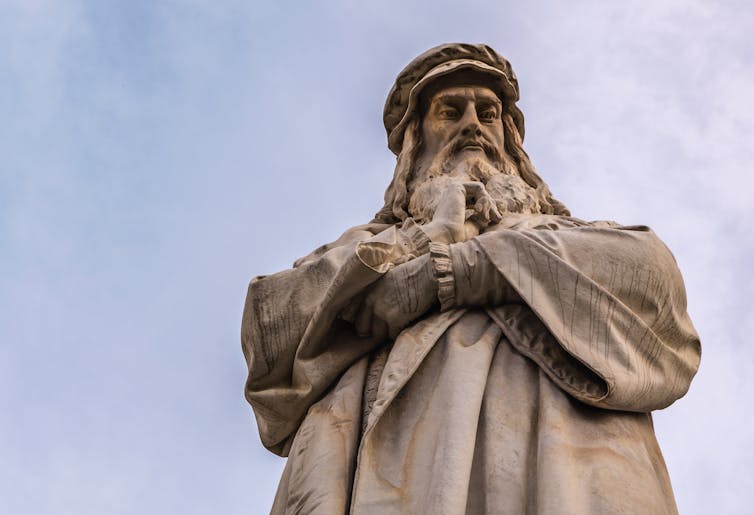
This year marks the 500th anniversary of Leonardo da Vinci’s death. Widely considered one of the greatest polymaths in human history, Leonardo was an inventor, artist, musician, architect, engineer, anatomist, botanist, geologist, historian and cartographer.
Though his artistic output was small, Leonardo’s impact was great, reflecting his deep knowledge of the body, his extensive studies of light and the human face, and his sfumato (Italian for “smoky”) technique, which allowed for incredibly lifelike images. Leonardo regarded artists as divine apprentices, writing “We, by our arts, may be called the grandsons of God.”
Twenty-first-century scholars at MIT ranked him the sixth most influential person who ever lived. Like Rembrandt and Michelangelo, he is so renowned that he is known by only his first name. Yet despite his fame, there are things about Leonardo that many people today find surprising.
Shady parentage
Leonardo was born out of wedlock on April 15, 1452. His father, Piero, was a wealthy notary, and his mother, Caterina, was a local peasant girl. Although the circumstances of his birth would place Leonardo at a disadvantage in terms of education and inheritance, biographer Walter Isaacson regards it as a terrific stroke of luck. Rather than being expected to become a notary like his father, Leonardo was instead free to develop the full range of his genius. People surmise that it also imbued him with a special sense of urgency to establish his own identity and prove himself.
Physical beauty
Leonardo created some of the world’s most beautiful works of art, including the “Last Supper” and the “Mona Lisa.” In his own day, he was known as an exceptionally attractive person. One of Leonardo’s biographers describes him as a person of “outstanding physical beauty who displayed infinite grace in everything he did.” A contemporary described him as a “well proportioned, graceful, and good-looking man” who “wore a rose-pink tunic” and had “beautiful curling hair, carefully styled, which came down to the middle of his chest.” Leonardo is thought to have entered into long-term and possibly sexual relationships with two of his pupils, both artists in their own right.
From scraps to notebooks
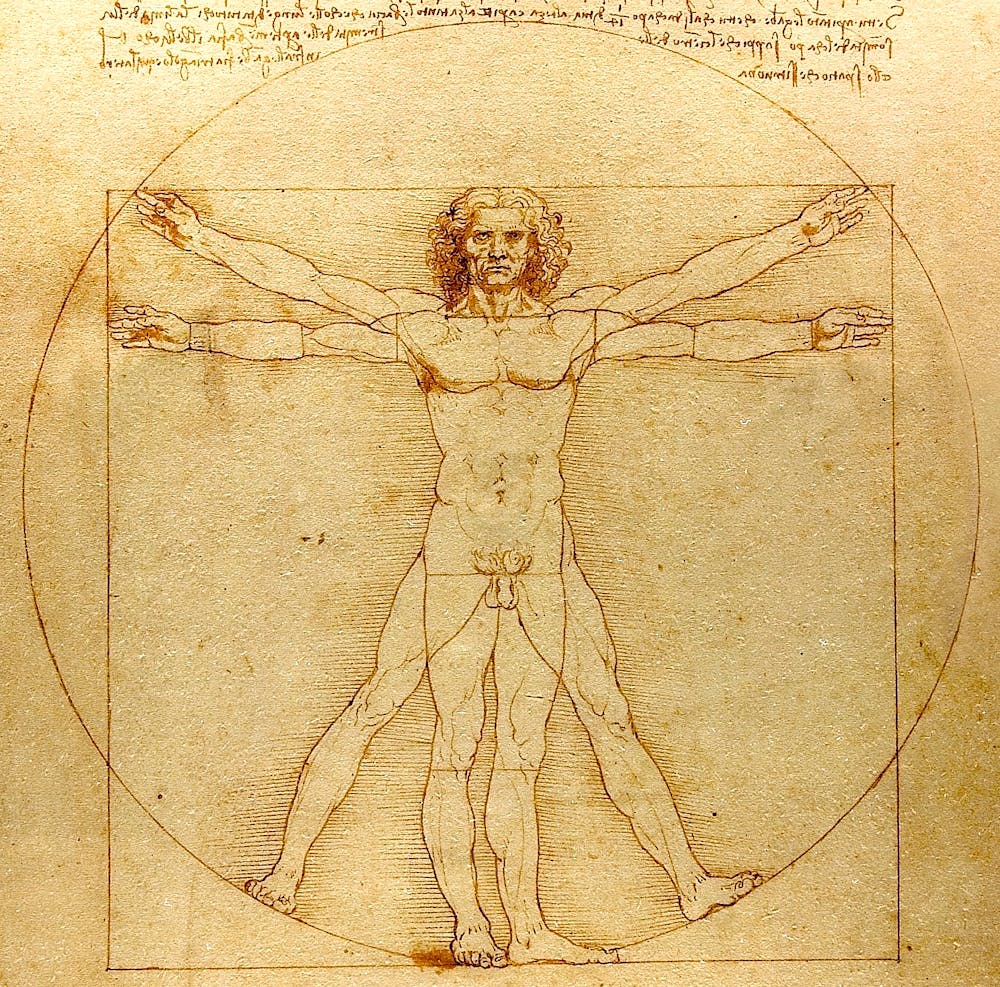

The paintings generally attributed to Leonardo number fewer than 20, while his notebooks contain over 7,000 pages. They’re the best source of knowledge about Leonardo, housed today in locations such as Windsor Castle, the Louvre and the Spanish National Library in Madrid. Their diverse content ranges across drawings – most famously, Vitruvian Man – notes of things he wanted to investigate, scientific and technical diagrams and shopping lists. They comprise perhaps the most remarkable monument to human curiosity and creativity ever produced by a single person. Yet when Leonardo penned them, they were just loose pieces of paper of different types and sizes. His friends bound them into “notebooks” only after his death.
Outsider’s education
As a result of his illegitimacy, Leonardo received a rather rudimentary formal education consisting primarily of business arithmetic. He never attended university and sometimes referred to himself as an “unlettered man.” Yet his lack of formal schooling also freed him from the constraints of tradition, helping to instill in him a determination to question authority and place greater reliance on his own experience than opinions expressed in books. As a result, he became a firsthand observer and experimenter, uninterested in serving as a mouthpiece for the classics.
Prolific procrastinator
Although Leonardo’s mind was extraordinarily fertile, he was also an inveterate procrastinator and even quitter. He frequently took months or years to begin work on commissions, sometimes keeping patrons at bay with lofty pronouncements regarding his creative process. A giant equestrian statue for the duke of Milan, requiring 70 tons of bronze to cast, might have been his grandest work – if it had ever been completed. Yet a decade after the 1482 commission, Leonardo had produced only a clay model which was subsequently destroyed when invading French soldiers used it for target practice.
Rivalrous motivations
Leonardo’s life overlapped those of two other Renaissance giants – Michelangelo and Raphael – but it was Michelangelo who stoked an intense rivalry. The contrast between the two men could hardly have been sharper. Leonardo was elegant and evinced little interest in matters religious, while Michelangelo was deeply pious yet neglectful of his appearance and hygiene. Michelangelo created some of the greatest paintings in history, including the ceiling of the Sistine Chapel, and many considered his “David” the greatest sculpture ever produced, a triumph he lorded over his older rival.

Royal admirer
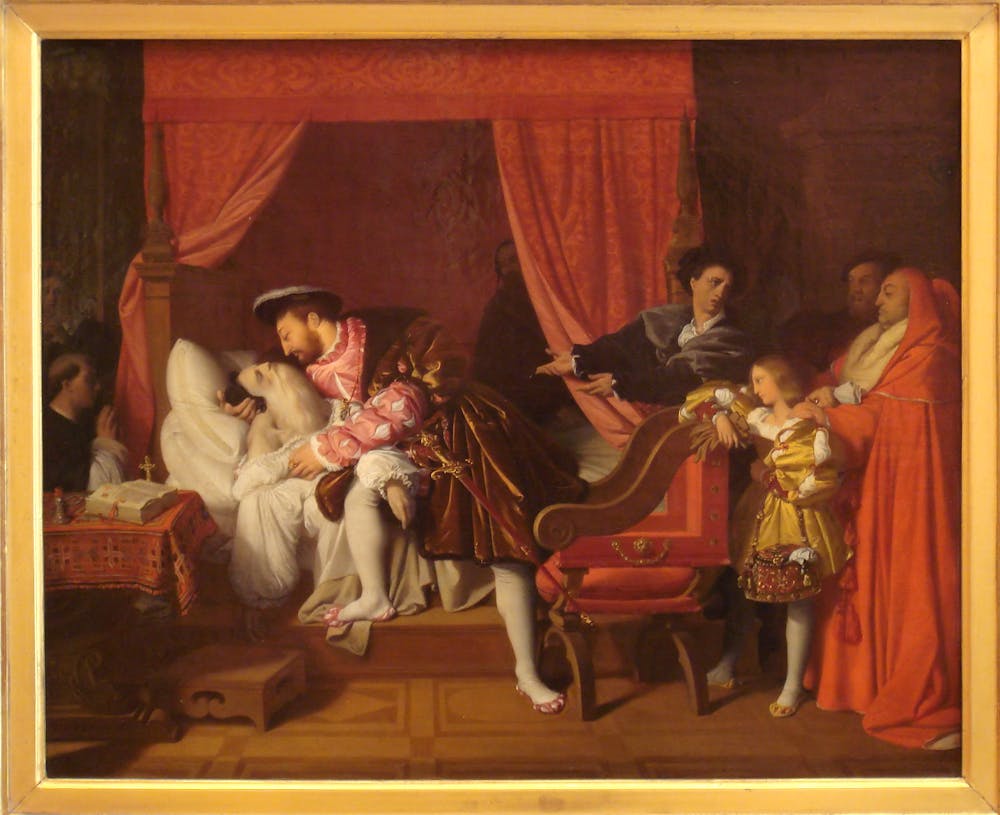
Soon after King Francis I of France captured Milan in 1516, Leonardo entered his service, spending the last years of his life in a house near the royal residence. When death came to Leonardo on May 2, 1519 at the age of 67, it is said that the king, who loved to listen to Leonardo talk so much that he was hardly ever apart from him, cradled his head as he breathed his last. Years later, reflecting on his friendship with the great man, King Francis said, “No man possessed such a knowledge of painting, sculpture, or architecture as Leonardo, but the same goes for philosophy. He was a great philosopher.”
Skyrocketing value
_Salvator_Mundi_circa_1500.jpg)
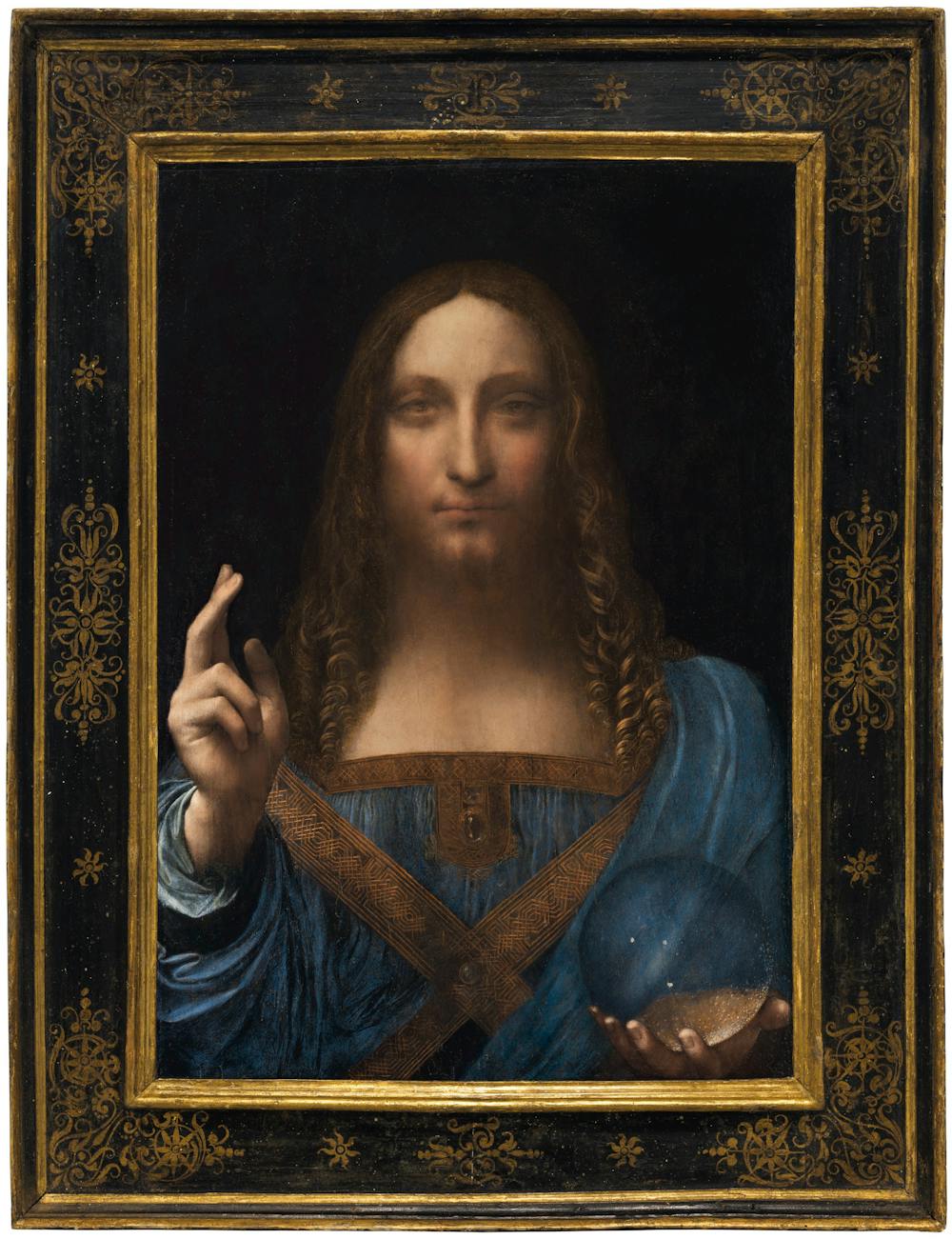
In November 2017, one of the paintings attributed to Leonardo, “Salvator Mundi” (“Savior of the World”), set the record for the most expensive painting ever sold, fetching US$450 million. Painted in oil on walnut in about 1500, it depicts Jesus offering a benediction with his right hand while holding a crystalline orb that appears to represent the cosmos in his left. The painting had suffered from neglect and poor restorations and was long assumed to be the work of one of Leonardo’s students, selling as recently as 2005 as part of the estate of a Baton Rouge businessman for less than $10,000. Its current whereabouts are unknown.
One of a kind, admired then and now
Just a half-century after Leonardo’s death, the biographer Vasari beautifully summed up his enduring significance:
“In the normal course of events many men and women are born with remarkable talents; but occasionally, in a way that transcends nature, a single person is marvelously endowed by heaven with beauty, grace, and talent in such abundance that he leaves other men far behind, all his actions seem inspired, and indeed everything he does clearly comes from God rather than from human skill.”
Five hundred years after Leonardo’s death, these words still ring true.
Richard Gunderman, Chancellor's Professor of Medicine, Liberal Arts, and Philanthropy, Indiana University
This article is republished from The Conversation under a Creative Commons license. Read the original article.