How to resolve AdBlock issue?
News
CLEARLAKE, Calif. – The Clearlake City Council will hold a special meeting on Monday to discuss the process for filling the vacancy resulting from Mayor Nick Bennett’s resignation.
The council will meet beginning at 3:30 p.m. Monday, May 13, in the council chambers at Clearlake City Hall, 14050 Olympic Drive.
On Thursday night, Bennett – who has served on the council since May 2016 – announced he was resigning due to health issues and moving to South Dakota, as Lake County News has reported.
“I would like to thank my fellow council members and city staff. It has been truly an honor to serve our community,” Bennett said.
On Monday, the council will discuss what City Manager Alan Flora said are the two available options – appointing a successor, as the council has done over the past several years, or put the vacancy up for special election.
“We are saddened to see Mayor Bennett step down from the council. He served the public for decades as a member of law enforcement and, in his retirement, chose to continue service to his community as a member of the city council. We wish him well as he takes the next journey in his life,” Flora said.
The council also will consider appointing a new mayor and, if needed, a vice mayor if the current vice mayor, Russ Cremer, moves up in leadership.
The council also will hold a closed session to discuss the city’s litigation against Pacific Gas and Electric Co.
Email Elizabeth Larson atThis email address is being protected from spambots. You need JavaScript enabled to view it. . Follow her on Twitter, @ERLarson, or Lake County News, @LakeCoNew.
The council will meet beginning at 3:30 p.m. Monday, May 13, in the council chambers at Clearlake City Hall, 14050 Olympic Drive.
On Thursday night, Bennett – who has served on the council since May 2016 – announced he was resigning due to health issues and moving to South Dakota, as Lake County News has reported.
“I would like to thank my fellow council members and city staff. It has been truly an honor to serve our community,” Bennett said.
On Monday, the council will discuss what City Manager Alan Flora said are the two available options – appointing a successor, as the council has done over the past several years, or put the vacancy up for special election.
“We are saddened to see Mayor Bennett step down from the council. He served the public for decades as a member of law enforcement and, in his retirement, chose to continue service to his community as a member of the city council. We wish him well as he takes the next journey in his life,” Flora said.
The council also will consider appointing a new mayor and, if needed, a vice mayor if the current vice mayor, Russ Cremer, moves up in leadership.
The council also will hold a closed session to discuss the city’s litigation against Pacific Gas and Electric Co.
Email Elizabeth Larson at
LAKE COUNTY, Calif. – The Lake County/City Area Planning Council is conducting two meetings next week on two local traffic corridors in Lakeport and on the Northshore.
The meetings will take place on Tuesday, May 14, in Lakeport and Thursday, May 16, in Lucerne.
The Lakeport workshop takes place from 6 to 8 p.m. May 14 in the council chambers at Lakeport City Hall, 225 Park St., and is co-hosted by the Lake County/City Area Planning Council and the city of Lakeport.
It will focus on the 11th Street Corridor Multi-Modal Engineered Feasibility Study, and will offer the public an opportunity to help improve access and safety for walking, bicycling, and transit users on 11th Street and the surrounding area.
Project team members will be available after 7 p.m. to discuss community members’ needs and interests.
The Lucerne meeting will take place from 6 to 7 p.m. May 16 at the Lucerne Alpine Senior Center, 3985 Country Club Drive.
The workshop will look at improved access and safety for walking, bicycling and transit users along Highway 20 in the communities of Nice, Lucerne, Glenhaven and Clearlake Oaks.
At 7 p.m., the Lucerne Area Town Hall Meeting will begin, and a presentation about the project will be given during the town hall meeting.
Families and children are welcome at the meetings. Snacks and refreshments will be provided.
Funding for the studies is paid for by a grant from the California Department of Transportation.
For more information contact Cayla McDonell,This email address is being protected from spambots. You need JavaScript enabled to view it. or 916-448-1198, Extension 324.
The meetings will take place on Tuesday, May 14, in Lakeport and Thursday, May 16, in Lucerne.
The Lakeport workshop takes place from 6 to 8 p.m. May 14 in the council chambers at Lakeport City Hall, 225 Park St., and is co-hosted by the Lake County/City Area Planning Council and the city of Lakeport.
It will focus on the 11th Street Corridor Multi-Modal Engineered Feasibility Study, and will offer the public an opportunity to help improve access and safety for walking, bicycling, and transit users on 11th Street and the surrounding area.
Project team members will be available after 7 p.m. to discuss community members’ needs and interests.
The Lucerne meeting will take place from 6 to 7 p.m. May 16 at the Lucerne Alpine Senior Center, 3985 Country Club Drive.
The workshop will look at improved access and safety for walking, bicycling and transit users along Highway 20 in the communities of Nice, Lucerne, Glenhaven and Clearlake Oaks.
At 7 p.m., the Lucerne Area Town Hall Meeting will begin, and a presentation about the project will be given during the town hall meeting.
Families and children are welcome at the meetings. Snacks and refreshments will be provided.
Funding for the studies is paid for by a grant from the California Department of Transportation.
For more information contact Cayla McDonell,
LAKEPORT, Calif. – The Lake County Registrar of Voters Office released an update on the ballots remaining to be counted in the Lakeport Fire Protection District’s Measure M parcel tax.
The all-mail special election was held on Tuesday, with preliminary results released that night that showed the measure appears headed for victory with more than the required supermajority of 66.7 percent.
However, the election results are not final. More ballots remain to be counted, as the Registrar of Voters Office continued to receive ballots postmarked by May 7 through Friday.
On Friday, the Registrar of Voters Office said 69 ballots were dropped off at the polls on election day.
The elections office also received by Friday 320 ballots mailed and postmarked on or before May 7.
There are 48 ballots that require further review for various reasons and one provisional ballot, officials said. Provisional ballots and ballots requiring further review may be entirely counted, partially counted or not counted.
Altogether, approximately 438 ballots remain to be counted during the 30-day official canvass period, according to the elections office.
Those will be added to the nearly 1,900 ballots counted and reported by Tuesday evening.
Officials said approximately 5,982 ballots were mailed out for the election.
The Registrar of Voters Office said there are many checks and balances when certifying election results.
The process of certifying election results, also known as the official canvass, is mandated by state law to make sure the public can have confidence in the integrity of the final results.
Lake County has not historically updated results between the unofficial election night results and the final certified results of the election. Instead, the county prioritizes the careful steps required to complete the canvass.
Officials said interim unofficial results have no bearing on the final outcome of Measure M. Only final certified results will determine whether Measure M receives at least 66.7 percent to pass and become effective, or less than 66.7 percent to not pass.
The all-mail special election was held on Tuesday, with preliminary results released that night that showed the measure appears headed for victory with more than the required supermajority of 66.7 percent.
However, the election results are not final. More ballots remain to be counted, as the Registrar of Voters Office continued to receive ballots postmarked by May 7 through Friday.
On Friday, the Registrar of Voters Office said 69 ballots were dropped off at the polls on election day.
The elections office also received by Friday 320 ballots mailed and postmarked on or before May 7.
There are 48 ballots that require further review for various reasons and one provisional ballot, officials said. Provisional ballots and ballots requiring further review may be entirely counted, partially counted or not counted.
Altogether, approximately 438 ballots remain to be counted during the 30-day official canvass period, according to the elections office.
Those will be added to the nearly 1,900 ballots counted and reported by Tuesday evening.
Officials said approximately 5,982 ballots were mailed out for the election.
The Registrar of Voters Office said there are many checks and balances when certifying election results.
The process of certifying election results, also known as the official canvass, is mandated by state law to make sure the public can have confidence in the integrity of the final results.
Lake County has not historically updated results between the unofficial election night results and the final certified results of the election. Instead, the county prioritizes the careful steps required to complete the canvass.
Officials said interim unofficial results have no bearing on the final outcome of Measure M. Only final certified results will determine whether Measure M receives at least 66.7 percent to pass and become effective, or less than 66.7 percent to not pass.
Imagine being in a life-threatening emergency, picking up your phone to call 911, and having no service or dial tone. Imagine being fast asleep and never receiving an emergency alert to let you know flames were closing in and about to engulf your home.
This is the situation millions of Californians have faced over the last several years as mega-fires have raged in or near their community.
Currently, when telecommunications services go down – affecting 911 service or the ability for emergency officials to send alerts – telecommunication companies are not required to report real-time information about the location of the outage, how many individuals are affected, and what the estimated time of repair is. This means the public is in the dark and are put in harm’s way.
“Californians cannot afford to be without the most up-to-date information during times of disaster,” said State Sen. Mike McGuire, who represents the North Coast, including Lake County. “That’s why we have introduced SB 670, which would require telecommunications carriers to report outages to the State Office of Emergency Services when outages affect 911 service and emergency notification systems. Failure to report outages affecting 911 service or emergency alerting capabilities can wreak havoc on communities and puts the public’s safety at risk.”
SB 670 is a simple step to mitigate the risks during times of total crisis and phone outages by requiring telecommunications providers to report 911 service outages or outages affecting emergency alert and warning technologies to the California Office of Emergency Services in real time. This seems like it should already be happening – but it’s not.
This common-sense approach will ensure coordination between state and local emergency officials and telecommunication companies. SB 670 will provide emergency officials with real time data and the crucial information they need to keep our communities safe.
“The night of Oct. 8, 2017, changed the lives of tens of thousands of Californians forever. Whether you were one of the nearly 100,000 evacuated, one of the 6,000 who lost their home, one of the thousands who fled in the middle of the night through the flames or one of the dozens who lost a loved one due to the fire – your loss should not go in vain,” McGuire said. “We have a new normal in California. It’s clear there are significant shortcomings in our emergency alerting system and residents deserve warnings. We moved forward on emergency alert legislation last year, and now it’s time to tackle another massive challenge facing this state: Mandating reporting when 911 goes dark and emergency alerts go silent.”
While the California Public Utilities Commission and FCC have a shared responsibility to oversee all components of 911 services, outage reporting to the PUC is provided hours, and sometimes days, after the outage occurs and not in real time to the State Office of Emergency Services or local emergency managers.
For example, during the Camp fire in Paradise, which began around 6:33 a.m. on Nov. 8, 2018, the CPUC received their notification of the outage from the FCC over 5 hours later at 12:01 pm after thousands of homes had been destroyed.
The Tubbs fire in Santa Rosa began at approximately 9:43 p.m. on Oct. 8, 2017, and the CPUC received their notification from the FCC over six hours later at 4:12 a.m. the next morning – thousands of homes were destroyed in that timeframe. By that time, the Tubbs Fire had burned into central Santa Rosa.
The California Office of Emergency Services never received formal notification which means local governments never received formal notification either. This is simply unacceptable.
SB 670 would require providers of telecommunication services to provide notification to CalOES whenever there is a 911 service outage or any outage affecting emergency warning capabilities within 60 minutes of the outage starting.
CalOES would then be responsible for notifying the affected local county OES. This would ensure all of the necessary emergency officials are getting the information they need to keep residents safe.
SB 670 passed with unanimous, bipartisan support from both the Senate Governmental Organization Committee (16-0) and the Senate Energy, Utilities and Communications Committee (13-0).
The bill is currently in Senate Appropriations before going to the full Senate for a vote.
This is the situation millions of Californians have faced over the last several years as mega-fires have raged in or near their community.
Currently, when telecommunications services go down – affecting 911 service or the ability for emergency officials to send alerts – telecommunication companies are not required to report real-time information about the location of the outage, how many individuals are affected, and what the estimated time of repair is. This means the public is in the dark and are put in harm’s way.
“Californians cannot afford to be without the most up-to-date information during times of disaster,” said State Sen. Mike McGuire, who represents the North Coast, including Lake County. “That’s why we have introduced SB 670, which would require telecommunications carriers to report outages to the State Office of Emergency Services when outages affect 911 service and emergency notification systems. Failure to report outages affecting 911 service or emergency alerting capabilities can wreak havoc on communities and puts the public’s safety at risk.”
SB 670 is a simple step to mitigate the risks during times of total crisis and phone outages by requiring telecommunications providers to report 911 service outages or outages affecting emergency alert and warning technologies to the California Office of Emergency Services in real time. This seems like it should already be happening – but it’s not.
This common-sense approach will ensure coordination between state and local emergency officials and telecommunication companies. SB 670 will provide emergency officials with real time data and the crucial information they need to keep our communities safe.
“The night of Oct. 8, 2017, changed the lives of tens of thousands of Californians forever. Whether you were one of the nearly 100,000 evacuated, one of the 6,000 who lost their home, one of the thousands who fled in the middle of the night through the flames or one of the dozens who lost a loved one due to the fire – your loss should not go in vain,” McGuire said. “We have a new normal in California. It’s clear there are significant shortcomings in our emergency alerting system and residents deserve warnings. We moved forward on emergency alert legislation last year, and now it’s time to tackle another massive challenge facing this state: Mandating reporting when 911 goes dark and emergency alerts go silent.”
While the California Public Utilities Commission and FCC have a shared responsibility to oversee all components of 911 services, outage reporting to the PUC is provided hours, and sometimes days, after the outage occurs and not in real time to the State Office of Emergency Services or local emergency managers.
For example, during the Camp fire in Paradise, which began around 6:33 a.m. on Nov. 8, 2018, the CPUC received their notification of the outage from the FCC over 5 hours later at 12:01 pm after thousands of homes had been destroyed.
The Tubbs fire in Santa Rosa began at approximately 9:43 p.m. on Oct. 8, 2017, and the CPUC received their notification from the FCC over six hours later at 4:12 a.m. the next morning – thousands of homes were destroyed in that timeframe. By that time, the Tubbs Fire had burned into central Santa Rosa.
The California Office of Emergency Services never received formal notification which means local governments never received formal notification either. This is simply unacceptable.
SB 670 would require providers of telecommunication services to provide notification to CalOES whenever there is a 911 service outage or any outage affecting emergency warning capabilities within 60 minutes of the outage starting.
CalOES would then be responsible for notifying the affected local county OES. This would ensure all of the necessary emergency officials are getting the information they need to keep residents safe.
SB 670 passed with unanimous, bipartisan support from both the Senate Governmental Organization Committee (16-0) and the Senate Energy, Utilities and Communications Committee (13-0).
The bill is currently in Senate Appropriations before going to the full Senate for a vote.

Dust is not just a household nuisance; it’s a planetary one, particularly on Mars. Before astronauts visit the Red Planet, we need to understand how the dust particles that often fill the atmosphere could impact them and their equipment.
The global Martian dust storm of summer 2018 – the one that blotted out sunlight for weeks and put NASA’s beloved Opportunity rover out of business – offered an unprecedented learning opportunity.
For the first time, humans had eight spacecraft orbiting Mars or roving its surface – the largest cadre of robotic explorers ever to watch a global dust storm unfold.
Global dust storm advancing
Scientists around the globe are still analyzing reams of data, but preliminary reports include insights on how massive dust storms could have affected ancient Martian water, winds, and climate, and how they could affect future weather and solar power.
Martian dust storms are common, especially during southern hemisphere spring and summer. They tend to last a couple of days and can cover regions of the planet the size of the United States.
But planet-encircling ones are unpredictable, sometimes lingering for months. Why?
“We still don’t know what drives the variability, but the 2018 storm gives another data point,” said Scott Guzewich, an atmospheric scientist at NASA’s Goddard Space Flight Center in Greenbelt, Maryland, who’s a lead in NASA’s dust storm investigation.
NASA first saw a global dust storm up close in 1971 when our Mariner 9 spacecraft — the first to orbit another planet — arrived at a dust-engulfed Red Planet. Since then, we’ve seen global storms in 1977 (twice), 1982, 1994, 2001, 2007 and 2018.
Here are a few things we saw from space and from the ground during the recent global dust storm that helped address some open questions and exposed new ones:
Could global dust storms have blown away the planet’s water?
Scientists have found loads of evidence that Mars had rivers, lakes and maybe even oceans of water billions of years ago. Dry riverbeds, ancient shorelines, and salty surface chemistry are all clues. But why did much of the water disappear? And how?
“The global dust storm may give us an explanation,” said Geronimo Villanueva, a Martian water expert at NASA Goddard.
Villanueva worked with colleagues at the ESA (European Space Agency) and Russia’s Roscosmos space agency to confirm that powerful, global dust storms appear to loft water vapor from its typical altitude of 12 miles (20 kilometers) above the Martian surface to much higher elevations of at least 50 miles (80 kilometers). NASA's Mars Reconnaissance Orbiter observed a similar phenomenon in 2007.
By thrusting water into the upper atmosphere, global dust storms may interfere with the planet’s water cycle, preventing H2O from condensing and falling back down to the surface. On Earth, H2O falls back down as rain or snow. The same process could have existed on Mars billions of years ago.
At higher altitudes, where the Martian atmosphere is especially tenuous, solar radiation can easily penetrate to break up the water molecules and blow their component elements into space, Villanueva and his colleagues speculate.
“When you bring water to higher parts of the atmosphere, it gets blown away so much easier,” said Villanueva, who has spent his career piecing together the history of water on Mars.
Villanueva and his colleagues reported on April 10 in the journal Nature that they found evidence of receding water vapor by using the ExoMars Trace Gas Orbiter at Mars, a spacecraft managed by ESA and Roscosmos.
The orbiter measured water molecules at different altitudes before and after the 2018 storm. Scientists saw for the first time that all types of water molecules (there are lighter and heavier ones) reached the “escape region” of the upper atmosphere, which was an important insight into how water may be disappearing from Mars.
Now, said Villanueva, scientists will have to take this new information into account in their predictions about how much water flowed on ancient Mars and how long it took for it to disappear.
Global dust storms don’t seem to significantly reshape Martian sand dunes
For scientists who track sand dunes shift inches across the surface, the global dust storm offered critical evidence in their investigation of wind patterns on the Red Planet. Only the forceful winds during a global dust storm would be able to move the planet’s extensive dunes, scientists once thought, given that Mars’ super thin atmosphere makes 100-mile-per-hour wind feel like a breeze.
Yet images from orbiters and landers throughout the decades have revealed that Martian sand moves all the time, implying that it doesn’t need strong gusts to do so. This was a surprise to researchers.
Now that scientists finally got to watch a global dust storm from the ground through the eyes of NASA’s Curiosity rover, they noticed another surprising characteristic of Martian wind: strong gusts don’t appear to move sand more than normal.
“This has added to the overall mystery of how wind behaves on Mars,” said Mariah Baker, a Ph.D. student at Johns Hopkins University in Baltimore, Maryland, who helps track changes in Martian sand ripples
Ongoing analysis of the entire Martian globe will reveal whether Gale Crater, where Curiosity is roving, was unique.
The heart of the storm was over Opportunity, after all, which was roving on the other side of the globe from Curiosity. Plus, wind may behave differently inside Gale Crater, scientists note.
“Were we being sheltered?” Guzewich asked. “That’s possible.”
If it turns out sand dunes didn’t shift much anywhere on Mars during the storm, there could be a good reason, Baker said: “Winds swirling dust around in the atmosphere might not be the same thing as winds on the surface.”
Some scientists think that when dust gets lifted into the atmosphere during a global storm, blocking sunlight from reaching the surface, it shuts down the wind-generating process close to the ground that, under normal conditions, is induced by temperature fluctuations between the air and surface.
Whatever the reason turns out to be, understanding the behavior of sand dunes today helps us reveal Mars’s ancient climate, said Baker: “We can look at wind-shaped sandstones on the surface and look at dunes that are moving now, and say, ‘OK, what does that say about the conditions that were here billions of years ago when these dunes were moving and now are cemented into the rock record?’”
Dust devils, which are rotating columns of air and dust, are common on Mars. They form when hot air from the surface rises, creating a current of air that forms a whirlwind. These devils are useful for cleaning off dust from the panels of solar-powered spacecraft, like InSight, as they pass over them. Thus, it’s important to understand how often they occur.
Curiosity is powered by a nuclear battery, which allowed it to collect data while Opportunity hibernated, with minimal sunlight reaching its solar panels.
Through Curiosity, we learned that dust devils disappear during a dust storm, right when we need them most, and for months afterwards. This happens because of an interruption in the same wind-generating process that might affect the movement of sand dunes.
Guzewich said that understanding a global storm’s impact on dust devils is important in planning how to power equipment during future Mars missions: “You need to be prepared to go a while before your next dust devil passes over and cleans you off.”
Lonnie Shekhtman works for the NASA's Goddard Space Flight Center in Greenbelt, Maryland.
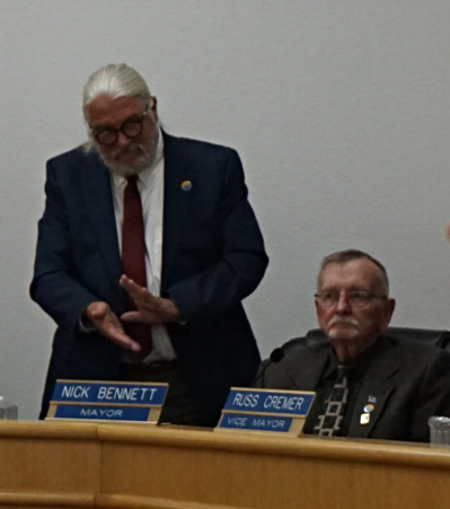
CLEARLAKE, Calif. – Clearlake’s mayor said Thursday that he is stepping down as he prepares for a move out of state that is necessitated by health issues.
Mayor Nick Bennett’s announcement came at the end of the Clearlake City Council’s Thursday night meeting, during which he and his fellow council members continued fine-tuning commercial cannabis rules and considered equipment needs for the Public Works Department, which is doing more road work thanks to the Measure V sales tax.
He said Thursday’s meeting will be his last, as he and his family are preparing to leave Lake County this Sunday.
“I'm stepping down due to some health reasons I need to have addressed,” he said, adding that the issues are “physical, not mental.”
Bennett, who has served on the council since 2016, thanked his fellow council members, past and present, along with city staff, saying that it’s been an honor to serve.
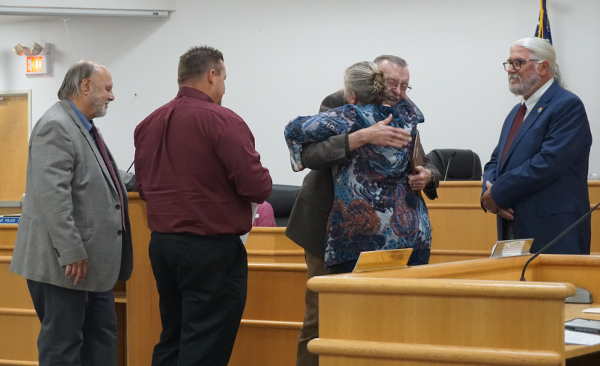
Bennett received a standing ovation from the council and city officials.
His vice mayor, Russ Cremer, joined with other council members in presenting Bennett with a plaque honoring his service.
Cremer said it had been a genuine pleasure working with Bennett, whose quiet wisdom he appreciated and who had taught him a lot.
Bennett exchanged handshakes and hugs with council colleagues Cremer, Phil Harris, Joyce Overton and Dirk Slooten before adjourning the meeting.
Bennett told Lake County News he and his family are moving to Hot Springs, South Dakota, where they have owned a home for some time.
Hot Springs is the county seat of Fall River County. It’s in southwestern South Dakota and is called the “Southern Gateway of the Black Hills,” with Mount Rushmore about an hour’s drive away.
It’s a big move for Bennett, who has roots in Lake County and was raised in Middletown.
He served honorably in the United States Army before beginning his law enforcement career in the 1960s. He worked at Bay Area agencies including the police departments in South San Francisco and East Palo Alto. In 1996 he returned to Lake County, working as a sergeant at the Clearlake Police Department until his retirement in 2015.
In addition to thanking his council colleagues and staff, Bennett, in a followup Facebook post late Thursday night, thanked his supporters “and even detractors who kept me on the straight and narrow and most of all my family who has always stood beside me.”
Next, the council must decide how to fill the vacancy resulting from Bennett’s departure.
City Manager Alan Flora said a special council meeting is planned at 3:30 p.m. Monday to discuss filling the seat.
Flora said there are two options: Fill the seat by appointment within 60 days or put it on the ballot during the next election, which would be in March.
Based on the practice within the last several years, it’s likely that the council will opt for appointment.
That’s how Bennett himself initially joined the council. He was appointed in May 2016 to fill the vacancy resulting when Denise Loustalot resigned. Later that year, he ran for the seat and was elected.
The council also chose to appoint a new member when Councilman Russell Perdock resigned in February 2018, selecting Cremer the following month. Cremer won his first election in November.
In addition to deciding how to address the vacancy, the council will need to determine its leadership for the rest of the year.
While Cremer is vice mayor, City Clerk Melissa Swanson said that when the mayor’s seat becomes vacant, the vice mayor doesn’t automatically become mayor.
Editor’s note: The article has been updated with a new time for the Monday meeting.
Email Elizabeth Larson at