 How to resolve AdBlock issue?
News
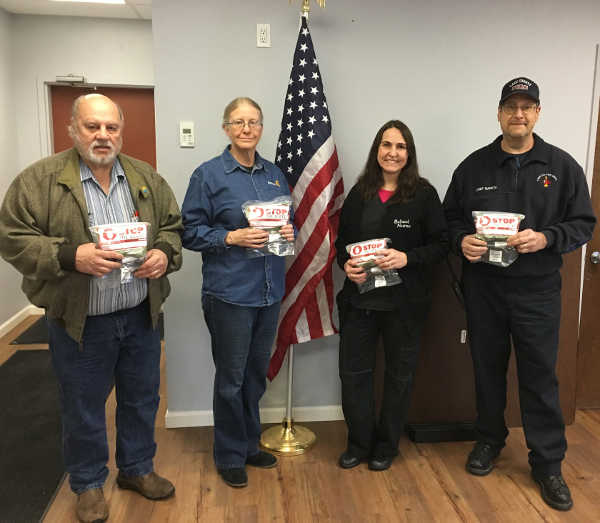
CLEARLAKE, Calif. – A partnership between first responders, Rotary, health care providers and the Konocti Unified School District has resulted in the placement of hundreds of lifesaving medical kits in district classrooms.
Over the past few years, with the growing number of mass casualty shootings and violence in schools and the workplace, the Lake County Fire Protection District felt the need to better prepare educational facilities and initiated a Stop the Bleed program, according to Fire Chief Willie Sapeta.
He said the program is designed to stop the bleeding on shooting victims and is a national campaign.
Additional information was sought from about “Jacob’s Kit,” which Sapeta said addresses training individuals to place a tourniquet and pack wounds to save a life from bleeding. The training includes the use of pressure dressings, tourniquets, packing wounds and placing sealing bandages on torso injuries with the average class lasting approximately 1.5 hours.
Sapeta said that, more than a year ago, the district began to seek donations and grants to fund this project, which was estimated to cost $16,000. The goal was to place one Stop the Bleed response kit in 230 Konocti Unified School District classrooms, with Lake County Fire providing training to the entire faculty and staff at each school.
The kits run approximately $70 per kit, plus $1,100 for the simulated training props, which are utilized for the hands-on training component of the training, according to Sapeta.
With approval and support from the Konocti Unified nurse, the district agreed to support placing these kits in their facilities and allow the fire district to instruct their staff, Sapeta said.
“Once we received approval we met with the Rotary Club of Clear Lake to continue our pursuit for funding,” Sapeta said. “We received immediate support from our local Rotary Club and other various entities we were able to secure the funding and received the 230 kits.”
He said district personnel began training Konocti Unified staff in early January with the support of medical students from the Konocti Education Center, who serve as assistant instructors and to date have instructed more than 250 Konocti Unified staff members.
Sapeta said the funding came from the Rotary Club of Clear Lake, Lake County Fire, Adventist Health Clear Lake and Sutter Lakeside Hospital in the pass through of Maddy funds, which is a state grant funds for pediatric trauma.
On Feb. 25, Konocti Unified took possession of the kits and began placing them into existing emergency response bags in every district classroom, Sapeta said.
The sustainability of the program, which Sapeta said includes annual training and replacement of perishable items in the kits, will be coordinated by the Konocti Unified nurse with the instructional support from the Konocti Education Center and Lake County Fire.
Sapeta invites any agency interested in the program to contact him at 707-994-2170, cell 707-489-0966 or via email
NORTHERN CALIFORNIA – Glenn County authorities said the body of a missing Orland man was found on the Colusa County side of the Walker Ridge area in a case that is now being handled as a homicide investigation.
The body of 26-year-old Brandon Bryce Dawson was located with the help of cadaver dogs, according to a Friday report from the Glenn County Sheriff’s Office.
The agency said Dawson disappeared under suspicious circumstances from a residence in the rural Orland area in the early morning hours of March 8.
Dawson’s mother, Kelly Skidmore, and his girlfriend, Ashley Heitland, reported Dawson’s disappearance to Glenn County Sheriff’s deputies on March 10.
Glenn County Sheriff’s deputies checked the immediate area and were unable to locate Dawson, and the investigation was turned over to detectives from the Glenn Investigative Task Force, authorities said.
The Glenn County Sheriff’s Office said detectives received tips from several sources, including Dawson’s family members.
The agency said the tips alleged that Dawson was in a dispute with several subjects regarding illegal drugs, that he was murdered sometime on or after March 8, and that his body was dumped in a wilderness area in Colusa County.
Glenn County detectives contacted the California Office of Emergency Services to request mutual aid, according to the Friday report.
The Glenn County Sheriff’s Office said cadaver dogs and handlers from various areas in Northern California, along with members the Colusa County Sheriff’s Office, and Glenn and Colusa County Search and Rescue teams, assisted the Glenn County Sheriff’s Office with a search in the wilderness area near Colusa and Lake County.
During the search, cadaver dogs located human remains in the area of Walker Ridge in Colusa County, authorities said.
Glenn County officials said the remains were identified as Dawson. Dawson’s family was notified and the investigation is ongoing.
The Glenn County Sheriff’s Office said it will release more information as it becomes available.
The body of 26-year-old Brandon Bryce Dawson was located with the help of cadaver dogs, according to a Friday report from the Glenn County Sheriff’s Office.
The agency said Dawson disappeared under suspicious circumstances from a residence in the rural Orland area in the early morning hours of March 8.
Dawson’s mother, Kelly Skidmore, and his girlfriend, Ashley Heitland, reported Dawson’s disappearance to Glenn County Sheriff’s deputies on March 10.
Glenn County Sheriff’s deputies checked the immediate area and were unable to locate Dawson, and the investigation was turned over to detectives from the Glenn Investigative Task Force, authorities said.
The Glenn County Sheriff’s Office said detectives received tips from several sources, including Dawson’s family members.
The agency said the tips alleged that Dawson was in a dispute with several subjects regarding illegal drugs, that he was murdered sometime on or after March 8, and that his body was dumped in a wilderness area in Colusa County.
Glenn County detectives contacted the California Office of Emergency Services to request mutual aid, according to the Friday report.
The Glenn County Sheriff’s Office said cadaver dogs and handlers from various areas in Northern California, along with members the Colusa County Sheriff’s Office, and Glenn and Colusa County Search and Rescue teams, assisted the Glenn County Sheriff’s Office with a search in the wilderness area near Colusa and Lake County.
During the search, cadaver dogs located human remains in the area of Walker Ridge in Colusa County, authorities said.
Glenn County officials said the remains were identified as Dawson. Dawson’s family was notified and the investigation is ongoing.
The Glenn County Sheriff’s Office said it will release more information as it becomes available.
Assignments, disclaimers and powers of appointment can alter the distribution of a decedent’s estate.
First what is and who can make an assignment? A person who has a vested – legally enforceable – interest in a decedent’s estate can “assign,” i.e., transfer, part or all of their interest to another.
Generally, an inheritance vests upon the decedent’s death. An assignment is a gift by the assignor making the assignment to the assignee receiving the assigned interest. Assignments create tax issues for both the assignor and assignee.
For example, consider an unmarried father who dies intestate – without a will or trust – and is survived by a son and a daughter, his heirs.
Prior to settling dad’s estate, the son decides to give his one-half share to his sister and signs and notarizes an assignment of inheritance rights.
The assignment is then filed with the court. Dad’s estate, less expenses and debts, is distributed entirely to the daughter.
If an interest in real property inherited from a parent is assigned then the parent child exclusion from reassessment – for local real property taxes – only applies to the interest(s) belonging to the child(ren) who do not assign their interest(s). There is no reassessment exclusion for any transfers between siblings.
Assignments, however, almost never apply to a beneficiary’s interests in a trust. Usually, a trust prohibits beneficiaries from assigning their interest in the trust before distribution. The anti-assignment provision protects undistributed trust assets from claims by a beneficiary’s creditors.
Next, disclaimers are used when a beneficiary, or heir, refuses to accept a gift or inheritance. You cannot force someone to receive a gift or an inheritance.
To be valid disclaimers must satisfy the following requirements: be unconditional, be in writing, and be timely (i.e., generally, within nine months of the transfer), and, when real property is involved, also be filed with the county recorder where the real property lies.
Unlike assignments, the person disclaiming their interest cannot say who receives the disclaimed interest. A disclaimer is not a gift by the person disclaiming.
Lastly, one cannot have accepted any benefits from the property being disclaimed, such as the income from an income producing asset.
The person disclaiming their gift or inheritance is treated as if they had predeceased the person who made the gift. We see who is then entitled to inherit.
For example, a decedent’s trust leaves a share of the decedent’s trust estate to a named beneficiary and otherwise, if he does not survive to inherit, to the beneficiary’s descendants by right of representation. The beneficiary survives and timely disclaims. The beneficiary’s living descendants would then inherit by right of representation.
Unlike assignments and disclaimers, powers of appointment are created within a person’s estate planning, e.g., a trust or will, for future use. A power of appointment allows the power holder to say who receives a gift/distribution from a trust or an estate.
The power of appointment is either a limited power that allows gifting to certain persons or is a general power that allows gifting to anyone at all, including the power holder, the power holder’s estate and the power holder’s creditors. Powers of appointment are used for a variety of estate planning reasons.
For example, a husband’s and wife’s joint estate planning may give the spouse who survives a limited power of appointment over the deceased spouse’s separate trust estate.
The limited power of appointment might allow the deceased spouse’s estate to be divided equally or unequally amongst the deceased spouse’s children as the surviving spouse sees fit after the deceased spouse’s death.
Anyone who wants to proceed with making an assignment, a disclaimer or exercise of a power of appointment should consult a qualified attorney.
There are tax and other issues to discuss and drafting requirements to these legal instruments that benefit from the expertise of a qualified attorney.
Dennis A. Fordham, attorney, is a State Bar-Certified Specialist in estate planning, probate and trust law. His office is at 870 S. Main St., Lakeport, Calif. He can be reached at

NASA is working right now to send American astronauts to the surface of the moon in five years, and the agency has its sights set on a place no humans have ever gone before: the lunar south pole.
Water is a critical resource for long-term exploration, and that’s one of the main reasons NASA will send astronauts to the moon’s south pole by 2024.
Water is a necessity for furthering human exploration because it could potentially be used for drinking, cooling equipment, breathing and making rocket fuel for missions farther into the solar system.
The experience NASA gains on the moon, including using lunar natural resources, will be used to help prepare the agency to send astronauts to Mars.
“We know the south pole region contains ice and may be rich in other resources based on our observations from orbit, but, otherwise, it’s a completely unexplored world,” said Steven Clarke, deputy associate administrator of the Science Mission Directorate at NASA Headquarters in Washington. “The south pole is far from the Apollo landing sites clustered around the equator, so it will offer us a new challenge and a new environment to explore as we build our capabilities to travel farther into space.”
The south pole is also a good target for a future human landing because robotically, it’s the most thoroughly investigated region on the moon.
The elliptical, polar orbit of NASA’s Lunar Reconnaissance Orbiter, or LRO, is closest to the moon during its pass over the south pole region.
Through its thousands of orbits in the last decade, LRO has collected the most precise information about the south pole region than any other, offering scientists precise details about its topography, temperature and locations of likely frozen water.
“We’ve mapped every square meter, even areas of permanent shadow,” said Noah Petro, an LRO project scientist based at NASA’s Goddard Space Flight Center in Greenbelt, Maryland.
There’s still so much to learn about Earth’s nearest neighbor.
Ahead of a human return, NASA is planning many to send new science instruments and technology demonstration payloads to the Moon using commercial landers through Commercial Lunar Payload Services, or CLPS.
These robotic precursors will further investigate regions of interest to human explorers, including the south pole, and will provide information to the engineers designing modern lunar surface systems.
Water on the moon
The floors of polar craters reach frigid temperatures because they’re permanently in shadow as a result of the low angle at which sunlight strikes the moon’s surface in the polar regions (and also because the moon has no atmosphere to help warm up its surface). This angle is based on the 1.54-degree tilt of the Moon’s axis (Earth’s is 23.5 degrees).
If an astronaut was standing near the south pole, the sun would always appear on the horizon, illuminating the surface sideways, and, thus, skimming primarily the rims of deep craters, and leaving their deep interiors in shadow.
These permanently shadowed craters feature some of the lowest temperatures in the solar system — down to -414 degrees Fahrenheit (-248 Celsius). Water ice is stable at these temperatures and it is believed that some of these craters harbor significant ice deposits.
The south pole’s frozen water may date back billions of years and has been untainted by the sun’s radiation or the geological processes that otherwise constantly churn and renew planetary surfaces (think of wind and erosion on Earth), offering us a window into the early solar system.
“That record of water collection is a record that can help us understand how water and other volatiles have been moving around the solar system, so we’re very interested in getting to these locations and sampling the material there,” said John W. Keller, a lunar scientist at NASA’s Goddard Space Flight Center in Greenbelt, Maryland.
Studying samples of ice from polar regions of Earth, for example, has revealed how our planet's climate and atmosphere have evolved over thousands of years.
Constant light and power
Other extremes at the moon’s south pole are not so dark and cold — there are also areas, near Shackleton crater for instance, that are bathed in sunlight for extended periods of time, over 200 Earth days of constant illumination.
This happens also because of the moon’s tilt and is a phenomenon that we experience at our own polar regions on Earth.
Unrelenting sunlight is a boon to moon missions, allowing explorers to harvest sunlight in order to light up a lunar base and power its equipment.
The president’s direction from Space Policy Directive-1 galvanizes NASA’s return to the moon and builds on progress on the Space Launch System rocket and Orion spacecraft, collaborations with U.S industry and international partners, and knowledge gained from current robotic assets at the moon and Mars.
CLEARLAKE, Calif. – Double-digit drops in violent crimes and property crimes was just one of several pieces of good news included in the Clearlake Police Department’s annual report to the Clearlake City Council.
Chief Andrew White gave the report on the police department’s accomplishments and challenges for 2018 to the council last week. The presentation begins at the 47-minute mark in the video above.
White explained that it’s important to remember the department’s mission, which is “to enhance public safety by providing professional, trustworthy service in partnership with the community.”
“This mission is really what guides everything that we do and it’s something that we incorporate into our hiring process,” he said, explaining that it’s been used to help identify candidates that can help them achieve and fulfill the mission.
The year 2018 was a busy year “for a variety of different reasons,” said White, who arrived just as the Mendocino Complex was bearing down on Lakeport in July.
He said Clearlake Police provided mutual aid during the summer fires. That included assistance to the city of Lakeport; on his first day on the job, White was in Lakeport’s emergency operations center, working alongside that city’s leadership as it dealt with a full evacuation.
He said recruitment and retention has been a focus, and they’ve been able to add new employees and promote current ones.
The police department, which also oversees animal control, has a new fleet of vehicles and carried out extensive renovations at its headquarters, which White said is almost like brand new.
They’ve also made significant investments in new technology, including automating the animal control management process, increasing accessibility by the public for finding lost and found dogs and adoptable pets, online dog licensing, in-house scheduling for police officers, and are working to become a 911 public safety answering point, he said.
White said they’ve also implemented a new information system for the vehicles of both police and animal control officers, focused on service delivery, increased the investment in staff training, increased community engagement and their online presence, specifically through social media like Facebook.
Regarding crime statistics, White said the department had an 8-percent increase in incidents, or 2,300 more in 2018.
There was a 25-percent increase – totaling 2,485 more – in officer-initiated activities, which he called the “bread and butter of police work.”
White said there were 692 more arrests, a 35-percent increase, which he attributed to the increased officer-initiated activities.
A recent report found Lake County has the highest per capita arrest rate in the state, which White said he believed is due to arresting the same individuals repeatedly. He said police can’t solve that, and it will take a community and legislative effort.
White said in 2018 there was a 22-percent increase in reports, or 748 more than 2018, again likely due to officer-involved activity.
Traffic enforcement was up by 21 percent, or 580 more calls. White said that in September the department focused on traffic and had 580 more calls in that month alone. At the same time, there was a 12-percent drop in injury collisions, which traffic enforcement impacts.
He said officers have been doing enforcement activities focusing on city parks and shopping areas, enforcing city ordinance violations in an effort to deter activity that makes law abiding citizens uncomfortable.
The big news: Clearlake has seen a 16-percent drop in violent crime and a 14-percent drop in property crime, he said.
He said from the administrative standpoint, they’re happy with single-digit drops, but in a city like Clearlake that is disproportionately affected by crime, especially violent crime, “This is a massive accomplishment.”
White said it’s directly attributable to a number of things, including working with community members who have helped them solve crimes, as well as patrol activities.
Crime on the national spectrum has been declining while California has been showing an increase, “so I think it’s important that we continue to watch this area,” he said.
The categories don’t account for every crime the city deals with, White said, but they’re the most significant. “This is really good news, I think, for the city,” White said.
He said a few weeks ago the department recognized its outstanding employees during an annual meeting. Officer Mark Harden was officer of the year, and Nicki Burrell received the award for nonsworn personnel. Richard Moore was volunteer of the year.
Officer Steve Hobb and Officer Daniel Eagle received the lifesaving medal for saving the life of a child whose father killed the child’s siblings before killing himself.
Officer Michael Perreault and Officer Chris Keller received the productivity award.
The agency has had staff shortages, and White said the willingness of staff to work extra shifts has helped them deal with those staffing issues.
Going forward, White said the Clearlake Police Department’s goal is to focus on key areas, including: personnel – retention, recruitment and training, with caring employees a key to getting crime to drop; community engagement, which White said is “absolutely critical,” with police needing to share their story with residents; accountability to the public, which includes measuring what they are doing and conducting fair and impartial investigations; and excellence.
White said it’s a unique time in Clearlake, with the city having done a lot of positive things and police also making a change in the community. He said the community needs to work together.
“We aren’t sitting and holding all the solutions and just waiting for somebody to open the door, the solutions exist with all of us working together,” he said.
White said the department also has done a lot of training and development, including recent active shooter training locally, with officers also sent for education out of county. They’re additionally planning internal trainings.
He said officers have the ability to go into situations, talk to people and resolve them. As an example, he said they recently had a call regarding a potential “suicide by cop.” The officers were able to diffuse the situation, talk to him and help him.
They’re also making advances in handling animal control and code enforcement. He said they have met with the city engineer to draw up plans for modular kennels.
White said that in 2018 they department opened 405 code enforcement cases, of which 398 were closed; there were 65 red tags opened and 25 were closed. There were 393 vehicles tagged for abatement and got compliance on 208, while the city abated 194 vehicles before it had abandoned vehicle abatement funds during the first half of the year.
He said there also were 125 code enforcement cases involving marijuana, 173 cases for overgrown weeds, with a total caseload of 1,000 code enforcement cases.
White said the department also is participating in community events, CalRecycle-funded building demolitions, Coffee with A Cop and other happenings in the city.
Mayor Nick Bennett, a retired Clearlake Police sergeant, commended White and his staff on the accomplishments.
“I’m very, very proud of our department,” he said.
Email Elizabeth Larson at
KELSEYVILLE, Calif. – The Kelseyville Unified School District Board of Trustees on Tuesday voted to donate the historic Kelsey Creek Schoolhouse to a nonprofit organization in a process that is still to be determined.
The schoolhouse, built in 1871, originally sat in a location near Quercus Ranch before being moved to its current location on Finley Road East in 1882.
The building hasn’t been used in many years, with the district raising issues about safety and liability.
Nearly two years ago the board had a discussion about possibly giving the building to the Lake County Historical Society, which wants to move it from the place it has sat for 137 years to the Ely Stage Stop, several miles away. At that time, the matter went no further than a discussion.
Board President Rick Winer said Tuesday that the board wanted to begin by talking about whether or not they wanted to dispose of the building, adding that he didn’t like using the word “dispose.” He said they also wanted to discuss how that process will go.
Board member Gary Olson said he wanted to donate it to a charitable organization that will rehabilitate it and do for it what needs to be done.
Marilyn Holdenried, president of the Lake County Historical Society, was in the audience with a number of other society members. She said they wanted to hear the board’s parameters and timeframe. “We realize this will be a step-by-step project.”
She said the organization also realized it needed to go before the Board of Supervisors to get approval for moving the building to the Ely Stage Stop, as it is a county-owned property.
Winer said they want to see the schoolhouse come back to life, adding that he wanted somebody to tell them how they are going to preserve the building and to move it, how they would raise the funds and what their timeframe would be.
Referring to late Board member Peter Quartarolo, he said had Quartarolo been there, he would have wanted assurances that the interested party won’t take a piece of history and blow it up on the road.
Winer said they would have an application form and a timeline, adding that the board realizes the process isn’t going to be quick.
“We want to do it step by step,” he said, adding, “You don't get to make a mistake on this one.”
Board member Taja Odom said they wanted to make sure that whoever is interested has a plan for action.
Winer said he would like to see the building become a public attraction, and that it needs to remain within the school district boundaries.
If a plan came forward to keep the building on its current site and lease it from the district, Winer said the board could entertain that.
“We're open to any good plans,” he said.
Olson said he agreed with Winer, but added, “I don't think the building serves its best purpose in its current location.”
He referred to a letter submitted to the district several years ago – which he was a signatory on along with Holdenried and a variety of others, including others linked to the historical society – from a group calling itself the Friends of the Kelsey Creek Schoolhouse.
The group promoted the idea of moving the building from its current location. They looked at other areas and concluded it should go to the historical society’s Ely Stage Stop. It was not made clear in their letter if the group ever considered working to preserve and use the building in its current location.
“We've gone round and round with this whole prospect over the years,” said Olson, who has in the past repeatedly had the matter put back on the board agenda, as he did in previous discussions in 2016 and 2017. He added that he thinks it’s time for the board to take action and decide to donate it once they determine the parameters.
The board then took a 4-0 vote to move forward with a donation. Based on the agenda item, that included determining that the property “is of insufficient value to defray the cost of arranging a sale.” Board member Allison Panella was absent from the meeting.
Superintendent Dave McQueen said he can work on getting together the process and the board can talk about what they want to do at the May 21 meeting.
Holdenried pressed them on when they can put in a proposal, saying her group is ready to sit down and talk.
McQueen said they need to develop what the process will be and how to put it out to the public, referring to a request for proposals, or RFP, process.
Winer said he anticipated it being on the agenda for the next two meetings, in May and June.
Holdenried responded that she doesn’t want it to keep “dragging on.” Olson said it won’t.
Lake County News asked for more details about what the board envisioned the process looking like. Winer said they will come back with an RFP process, but he said it actually would be more like an application.
McQueen will synthesize the board’s ideas, look at how to handle the issues with giving away school property and return with a discussion item next month.
Email Elizabeth Larson atThis email address is being protected from spambots. You need JavaScript enabled to view it. . Follow her on Twitter, @ERLarson, or Lake County News, @LakeCoNews.
The schoolhouse, built in 1871, originally sat in a location near Quercus Ranch before being moved to its current location on Finley Road East in 1882.
The building hasn’t been used in many years, with the district raising issues about safety and liability.
Nearly two years ago the board had a discussion about possibly giving the building to the Lake County Historical Society, which wants to move it from the place it has sat for 137 years to the Ely Stage Stop, several miles away. At that time, the matter went no further than a discussion.
Board President Rick Winer said Tuesday that the board wanted to begin by talking about whether or not they wanted to dispose of the building, adding that he didn’t like using the word “dispose.” He said they also wanted to discuss how that process will go.
Board member Gary Olson said he wanted to donate it to a charitable organization that will rehabilitate it and do for it what needs to be done.
Marilyn Holdenried, president of the Lake County Historical Society, was in the audience with a number of other society members. She said they wanted to hear the board’s parameters and timeframe. “We realize this will be a step-by-step project.”
She said the organization also realized it needed to go before the Board of Supervisors to get approval for moving the building to the Ely Stage Stop, as it is a county-owned property.
Winer said they want to see the schoolhouse come back to life, adding that he wanted somebody to tell them how they are going to preserve the building and to move it, how they would raise the funds and what their timeframe would be.
Referring to late Board member Peter Quartarolo, he said had Quartarolo been there, he would have wanted assurances that the interested party won’t take a piece of history and blow it up on the road.
Winer said they would have an application form and a timeline, adding that the board realizes the process isn’t going to be quick.
“We want to do it step by step,” he said, adding, “You don't get to make a mistake on this one.”
Board member Taja Odom said they wanted to make sure that whoever is interested has a plan for action.
Winer said he would like to see the building become a public attraction, and that it needs to remain within the school district boundaries.
If a plan came forward to keep the building on its current site and lease it from the district, Winer said the board could entertain that.
“We're open to any good plans,” he said.
Olson said he agreed with Winer, but added, “I don't think the building serves its best purpose in its current location.”
He referred to a letter submitted to the district several years ago – which he was a signatory on along with Holdenried and a variety of others, including others linked to the historical society – from a group calling itself the Friends of the Kelsey Creek Schoolhouse.
The group promoted the idea of moving the building from its current location. They looked at other areas and concluded it should go to the historical society’s Ely Stage Stop. It was not made clear in their letter if the group ever considered working to preserve and use the building in its current location.
“We've gone round and round with this whole prospect over the years,” said Olson, who has in the past repeatedly had the matter put back on the board agenda, as he did in previous discussions in 2016 and 2017. He added that he thinks it’s time for the board to take action and decide to donate it once they determine the parameters.
The board then took a 4-0 vote to move forward with a donation. Based on the agenda item, that included determining that the property “is of insufficient value to defray the cost of arranging a sale.” Board member Allison Panella was absent from the meeting.
Superintendent Dave McQueen said he can work on getting together the process and the board can talk about what they want to do at the May 21 meeting.
Holdenried pressed them on when they can put in a proposal, saying her group is ready to sit down and talk.
McQueen said they need to develop what the process will be and how to put it out to the public, referring to a request for proposals, or RFP, process.
Winer said he anticipated it being on the agenda for the next two meetings, in May and June.
Holdenried responded that she doesn’t want it to keep “dragging on.” Olson said it won’t.
Lake County News asked for more details about what the board envisioned the process looking like. Winer said they will come back with an RFP process, but he said it actually would be more like an application.
McQueen will synthesize the board’s ideas, look at how to handle the issues with giving away school property and return with a discussion item next month.
Email Elizabeth Larson at