 How to resolve AdBlock issue?
News
Dogs available for adoption this week include mixes of Australian Shepherd, bluetick coonhound, boxer, Chihuahua, dachshund, German Shepherd, Great Pyrenees, heeler, Jack Russell Terrier, Labrador Retriever, pit bull, redbone coonhound, Rhodesian Ridgeback, shepherd, Shih Tzu, Siberian Husky, and Staffordshire bull terrier.
Dogs that are adopted from Lake County Animal Care and Control are either neutered or spayed, microchipped and, if old enough, given a rabies shot and county license before being released to their new owner. License fees do not apply to residents of the cities of Lakeport or Clearlake.
If you're looking for a new companion, visit the shelter. There are many great pets hoping you'll choose them.
The following dogs at the Lake County Animal Care and Control shelter have been cleared for adoption (additional dogs on the animal control Web site not listed are still “on hold”).

‘Plia’
“Plia” is a female husky with a medium-length white coat and blue eyes.
She already has been spayed.
Her ID No. is 9256.

Male Jack Russell Terrier
This male Jack Russell Terrier has a shaved white and buff coat.
He’s in kennel No. 3, ID No. 12033.

‘Moe’
“Moe” is a male Shih Tzu mix with a short black coat.
He already has been neutered.
He’s in kennel No. 4, ID No. 11939.

Boxer-pit bull mix
This male boxer-pit bull mix has a short black and white coat.
He’s in kennel No. 5, ID No. 12037.

‘Sadie’
“Sadie” is a female Australian Shepherd with a short tricolor coat.
She’s in kennel No. 6, ID No. 12022.

Male pit bull
This male pit bull terrier has a short blue and gray coat.
He’s in kennel No. 7, ID No. 11970.

‘Bubbles’
“Bubbles” is a male Chihuahua-dachshund mix with a medium-length black coat.
He already has been neutered.
He’s in kennel No. 8a, ID No. 11990.

‘Gucci’
“Gucci” is a female Chihuahua with a short brown and brindle coat.
She already has been spayed.
She’s in kennel No. 8b, ID No. 11911.

Pit bull terrier
This male pit bull terrier has a short red coat.
He already has been neutered.
He’s in kennel No. 9, ID No. 12031.

‘Rio’
“Rio” is a male bluetick coonhound-shepherd mix with a short tricolor coat.
He already has been neutered.
He’s in kennel No. 11, ID No. 11947.

‘Baylee’
“Baylee” is a female pit bull terrier has a short brindle and white coat.
Shelter staff said she is good with other dogs, has lived with cats and chickens, and was raised with children.
She already has been spayed.
She’s in kennel No. 14, ID No. 11892.

‘Maebelle’
“Maebelle” is a female pit bull terrier with a short brindle and white coat.
Shelter staff said she is good with other dogs, has lived with cats and chickens, and was raised with a small child.
She’s in kennel No. 15, ID No. 11893.

‘Pork Chop’
“Pork Chop” is a male husky with a medium-length red and white coat.
He’s in kennel No. 19, ID No. 9255.

Male pit bull terrier
This male pit bull terrier has a short black coat.
He’s in kennel No. 20, ID No. 11958.

‘Bobby Socks’
“Bobby Socks” is a female Staffordshire bull terrier-Rhodesian Ridgeback.
She has a short red coat and has already been spayed.
She’s in kennel No. 21, ID No. 11911.

‘Abby’
“Abby” is a female German Shepherd with a medium-length black and tan coat.
She already has been spayed.
She’s in kennel No. 22, ID No. 9707.

‘Bing’
“Bing” is a female pit bull terrier with a short brown and white coat.
She already has been spayed.
She’s in kennel No. 23, ID No. 12012.

‘Tina’
“Tina” is a female Labrador Retriever-pit bull terrier with a short yellow coat.
She already has been spayed.
She’s in kennel No. 24, ID No. 11978.

Male redbone coonhound
This male redbone coonhound has a short red coat.
He’s in kennel No. 25, ID No. 11960.

‘Taya’
“Taya” is a female pit bull terrier who a short tricolor coat.
He’s in kennel No. 26, ID No. 12005.

‘Little Foot’
“Little Foot” is a white male Great Pyrenees with a long white coat and gold eyes.
Shelter staff said the right home for him will not have cats, small dogs or livestock.
He’s in kennel No. 27, ID No. 11854.

‘Shi’
“Shi” is a female terrier with a short brindle and white coat.
She’s in kennel No. 28, ID No. 12020.

Siberian husky
This Siberian husky of undetermined gender has a medium-length tricolor coat with blue eyes.
The dog is in kennel No. 29, ID No. 12023.

Chihuahua-dachshund
This male Chihuahua-dachshund has a short black and brown coat.
He’s in kennel No. 30, ID No. 12007.
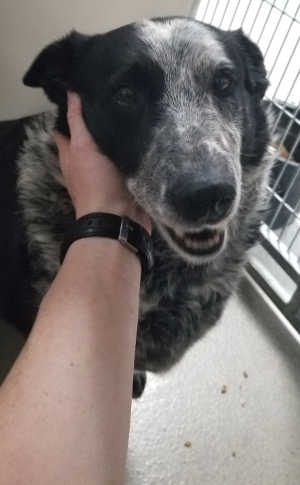
Female heeler
This female heeler has a medium-length black and white coat.
She’s in kennel No. 31, ID No. 11962.

Female pit bull terrier
This female pit bull terrier has a short brown and white coat.
She’s in kennel No. 33, ID No. 11950.

‘Bear’
“Bear” is a male Labrador Retriever with an all-black coat.
He already has been neutered.
He’s in kennel No. 34, ID No. 11986.
Lake County Animal Care and Control is located at 4949 Helbush in Lakeport, next to the Hill Road Correctional Facility.
Office hours are Monday through Friday, 11 a.m. to 5 p.m., and 11 a.m. to 3 p.m., Saturday. The shelter is open from 11 a.m. to 4 p.m. Monday through Friday and on Saturday from 11 a.m. to 3 p.m.
Visit the shelter online at http://www.co.lake.ca.us/Government/Directory/Animal_Care_And_Control.htm.
For more information call Lake County Animal Care and Control at 707-263-0278.
Email Elizabeth Larson at

The measles outbreaks continue to spread, with New York City declaring a public health emergency and requiring people in four ZIP codes to have their children vaccinated or face penalties, including a fine of US$1,000 and or imprisonment.
Since September 2018, 285 measles cases have been reported in Brooklyn and Queens, mainly in neighborhoods where ultra-Orthodox Jews have chosen to not have their children vaccinated.
The Centers for Disease Control and Prevention, said that from Jan. 1 to April 4, 2019, 465 individual cases of measles have been confirmed in 19 states. This is the second-highest number of cases since the CDC declared measles eliminated in 2000; in 2014, 667 cases occurred.
Cases have still been occurring each year, often brought into the United States from international travelers. Officials believe that to be the cause of the outbreak in Rockland County, New York, where 168 cases were reported as of April 8, 2019.
Rockland public health officials issued a ban that would keep unvaccinated children out of public places, but a judge overruled that on April 5. On April 9, county officials said they would appeal.
But there are limits to what health care providers, public health officials and legislators can do. It is crucial to consider both the power – and the limits – of potential solutions that will provide education, medical care and protection for the public while still upholding principles of informed consent, parental decision-making and sustaining public trust.
As a professor who researches and teaches health law, public health law and medical ethics, I think it’s worth clarifying what states can or cannot legally do when responding to cases of communicable disease.
A right to refuse medical care
The law recognizes the right of an individual to refuse medical interventions. Health law has a strong history of recognizing bodily integrity: Adults can choose whether to accept or reject a proposed medical intervention, even in instances where public health authorities conclude a vaccine would benefit both the individual and society. The Supreme Court has recognized parents’ ability to direct the care and control of their children, including consenting or forgoing medical treatment for their child except in very specific circumstances.
In the 1905 Jacobson v. Massachusetts case, the Supreme Court upheld a state law delegating power to local health officials mandating that adults receive one smallpox vaccine in the midst of an epidemic or pay a fine (about $130 today). Under the concept of police power, states have a duty to enact laws that promote the health, safety and welfare of its residents. Public health authorities may offer vaccines as a method of prevention, but medical professionals, public health authorities and even courts may not legally compel a person to submit to a vaccine.
The Jacobson decision also set forth limits on police power, yet subsequent cases addressing vaccine mandates discarded these requirements, extending multiple vaccine mandates to school attendance for disease not in circulation and in the absence of an epidemic.
Deferring to respected scientific consensus as a means to justify forced medical interventions in the name of individual benefit and the public good has historically resulted in some of the most egregious constitutional and human rights atrocities in the U.S. The mass forcible sterilization during the eugenics movement is but one example.
The history of science and medicine further demonstrates the fallibility of commonly accepted medical knowledge, such as when Bayer introduced heroin as a safe, non-addictive substitute for morphine, or physicians prescribed Bendectin and thalidomide to relieve nausea, only to find these medications resulted in babies born with severe birth defects.
Public good, personal rights
The law is also quite clear that public health authorities and law enforcement may place restrictions on a person’s individual liberty – including religious liberty – in situations where a person’s actions pose a direct, immediate and compelling harm to others, such as using venomous snakes in religious worship or asserting a nonexistent “right” to use an illegal substance such as marijuana when operating a motor vehicle.
In public health law relating to communicable disease, this constitutes a very specific standard: A person must have a present disease, and this person’s actions must pose a direct threat to others.
For example, health officials may seek a quarantine order or civil commitment for a person with active tuberculosis who continues to frequent highly populated public spaces until the person is no longer contagious.
Even in such a case, health authorities can offer treatment and limit a person’s movement to prevent infecting others, but the law does not permit forcibly medicating a competent person against his will.
Accordingly, legal precedent does not support quarantining vast geographic areas of healthy persons who have not been exposed to the communicable illness, but would support tailored voluntary isolation and quarantine of persons who have been exposed to, or currently have, the illness.
What health officials can do to protect children

The CDC classifies vaccines as one of the top 10 public health achievements. The vast majority (about 98%) of parents across the U.S. as a whole comply with the state law mandated schedule of vaccines for their children.
Vaccines, like any other FDA-approved product such as a prescription drug or medical device, carry a set of risks and benefits. These calculations vary depending on the vaccine, its efficacy, safety, potential side effects, the severity of the illness the vaccine aims to protect against, and the individual to whom it is administered.
Vaccine science and practice similarly evolved with historical mistakes (the Cutter incident) and ongoing disputes about risks and benefits for individual vaccines like flu and anthrax.
To promote vaccination for children, health officials may offer educational campaigns and set up free clinics for parents to bring their children. State laws may also mandate vaccines as a condition for school attendance, or require excluding unvaccinated children during an active outbreak at their school.
However, if states offer a religious or nonmedical exemption, courts have been clear that health officials and school officials do not have discretion to require the child’s parent to identify with an organized religion or reject the sincerity of the parent’s beliefs because this violates the First Amendment.
Harm to community
Public health professionals worry that parents who forgo vaccination are placing their child and the community at risk. Some have advocated that the state should step in with coercive measures such as eliminating any nonmedical exemptions for all children or intervene by force, such as classifying parents’ decision as child neglect or seeking a court order to vaccinate the child.
In my opinion, these strategies rely on a distortion of legal precedent, dismiss longstanding authority of parents to make decisions for their children, and threaten to undermine an already fractured public trust.
Cases that uphold state intervention to protect a child by compelling medical treatment generally require that the child has an illness, the illness is severe and life-threatening, and the risks and benefits of intervening are assessed.
This requires medical professionals and health officials to maintain precision in distinguishing whether the parents are deciding to forgo recommended vaccines, or whether they are refusing medical care for a critically ill child. Indeed, a recent case in Chandler, Arizona, demonstrated how a climate of coercion and force may result in parental fear and refusal to constructively engage with state officials for even an ill child.
State public health officials have the duty to protect residents from illness and communicable disease, but these strategies must fall within appropriate legal parameters. Dismissing these legal boundaries or justifying unnecessary force not only undermines fundamental liberties, but in my view fuels parental and community distrust of health officials and sets back the ultimate goals of protecting the public.
Katherine Drabiak, Assistant Professor, University of South Florida
This article is republished from The Conversation under a Creative Commons license. Read the original article.

"There is something infinitely healing in the repeated refrain of nature – the assurance that dawn comes after night, and spring after the winter." – Rachel Carson
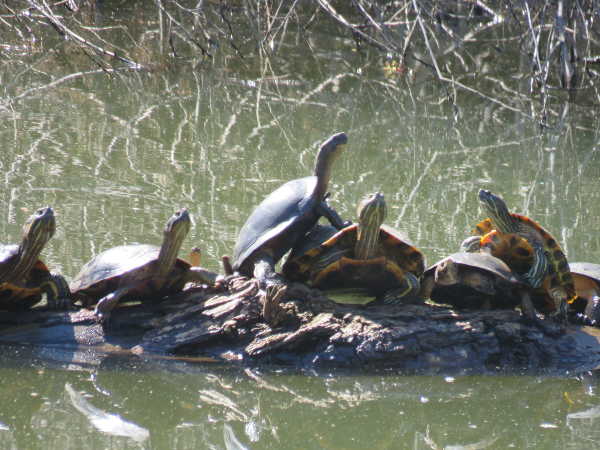
LAKE COUNTY, Calif. – All along the lazy Lake County shorelines of creeks, ponds and lakes you may be able to sneak up on Western pond turtles to observe their slow-motion antics.
Since they favor locations with logs or boulders on which to laze, that is where to look first. As an example, while on a walk on the bucolic boardwalk at Clear Lake State Park I spied several Western pond turtles within a short amount of time.
Anderson Marsh State Historic Park's Cache Creek walk allows for a variety of critters to study, including Western pond turtles.
Besides watery places of residence, however, they require a terrestrial habitat to thrive. For instance, if the turtles' resident pond or marsh dries up seasonally or in a drought, they might end up living outside of their aquatic environment for two-thirds of a year. Many turtles build nests out of the water as well.
Herpetologists – those who study reptiles, or biologists and naturalists specializing in the Western pond turtle tell us that these critters once flourished in abundance in and amongst California's streams, ponds and lakes.
It was popular in the 1800s to hunt turtles, especially during the Gold Rush when turtles were pursued almost to extinction. Today, the turtles are still in peril due to climate and weather changes, along with disappearing wildlife habitat.
Another problem Western pond turtles face is the abundance of non-native species like the turtle called the Red-eared slider. The red-eared slider is native to the mid- and southern United States, and is often purchased as a pet, then released into the Western pond turtles' habitat, where it overtakes the native's food and nesting territory.
Western pond turtles have been studied extensively by Sonoma State University's biology professor Nick Geist since 2008, in collaboration with San Francisco and Oakland Zoos to rear and relocate turtles to their native habitat.
Working with grad students, special transmitters are attached to the backs of some turtles, and this gives them data for one ot two years on their progress.
The turtles are tracked via radio telemetry along with visual surveys in their native habitat at Lake County's Boggs Lake Ecological Reserve.
These special turtles are endemic, or unique to the geographical region of the United States' western coasts from Washington to Mexico. They once thrived in Canada, but have been locally extinct, or extirpated there since 2002.
The reptiles are listed as a species of concern here in California, by the California Department of Fish and Wildlife.
With the Western pond turtle's hard shell, which is dull brown to olive in coloration, the adults are quite often safe from predators.
But their soft eggs and diminutive young hatchlings are preyed upon by many mammals such as otter, osprey, raccoon, coyotes and of course, humans who contaminate or deplete the turtle's habitat. When all is right in the turtles' world, they can live 50 years or more in nature.
Western pond turtle fun-facts: To determine the sex of the Western pond turtle you have only to look at its throat- males wear a pastel yellow throat.
The diet of the Western pond turtle is wide in scope, including crawdads, bugs, frogs and fish. Being omnivorous, they might choose, instead, to dine on tule, algae or cattail roots.
Turtles have played their part in the Pomo Indians' past, through some of their mythology. According to anthropologist and linguist S.A. Barrett who studied American Indian peoples in the 1800s the Pomo Indians depicted turtle as the protagonist in many of their myths.
In a story called, "Coyote Steals the Morning Sack, Containing the Sun, Moon and Pleiades," turtle, along with black lizard and coyote are in search of light.
Coyote was adept at changing himself into many forms, so to trick the boys who were making use of the village sweathouse Coyote changed into an old man so as to gain the boys' sympathy to enable him access.
After much dancing – and with turtle as the guard of the doorway, Coyote was able to gain access to the bag which contained the morning light. When the People learned of the trick, they launched Fog and Dove after them.
While turtle continued guarding the doorway, the villagers shot at him with their swift arrows, and that is how turtle gained the markings on his shell.
Kathleen Scavone, M.A., is a retired educator, potter, freelance writer and author of “Anderson Marsh State Historic Park: A Walking History, Prehistory, Flora, and Fauna Tour of a California State Park”, a local historical novella "People of the Water", and “Native Americans of Lake County.” She wrote for NASA and JPL as one of their “Solar System Ambassadors.” for nearly 20 years.
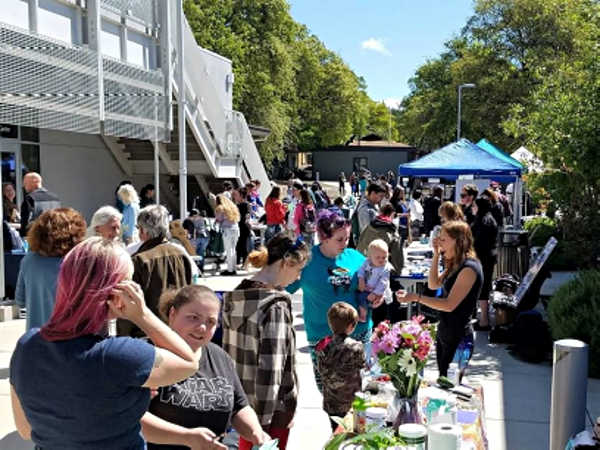
CLEARLAKE, Calif. – The Lake County Campus of Woodland Community College will host Earth Day 2019 on Tuesday, April 16, from 11 a.m. to 1 p.m.
Enjoy live music, guest speakers, workshops, poetry and prizes at the free festival.
Experience booths and activities by Citizens Caring 4 Clearlake, NCO Gardens Project, Sierra Club, Anderson Marsh, the Middletown Art Center and more.
Explore local environmental resources, green practices and outdoor living. Crafts and flower planting is available for preschoolers.
Retired District 3 Supervisor Jim Steele will present interpretive satellite images of nutrient loading in Clear Lake from noon to 1 p.m. in room 715. Steele worked 30 years with the state as a scientist and fresh water ecologist.
Food is available for purchase by Aromas Restaurant. Prizes are given away throughout the event.
Come enjoy a day of fun and learn how to better care for your health, community and planet. Please call 707-995-7900 for more information.
The Lake County Campus is located at 15880 Dam Road Extension, Clearlake.
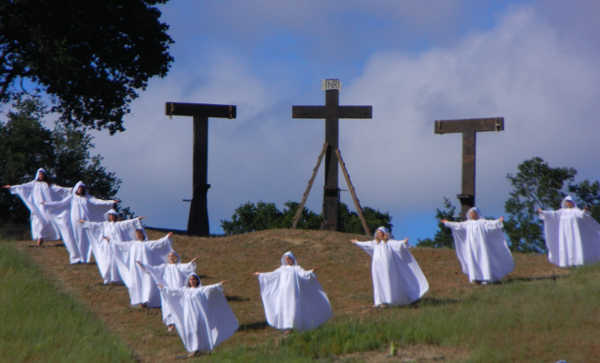
LAKEPORT, Calif. – The Lake County Outdoor Passion Play, one of the largest of such events in the country, will stage its 39th consecutive presentation at 4 p.m. on May 18 and 19.
The drama involves about 150 performers portraying the last days of Christ’s life on earth on a massive 85-acre outdoor setting on the shores of Clear Lake.
Rev. Philip J. Ryan and his then-fellow priest, Paul Moran, started the play on what was, in 1981, a private ranch owned by the Beltramo family.
The Lake County Passion Play formally incorporated in 1990. A few years after the deaths of Mr. and Mrs. Red Beltramo in the late 1990s, the 85-acre ranch was purchased by the organization. All cast and crew members are volunteers as are the Lake County Passion Play Board of Directors.
“This year’s performance will be offered not only as a witness of the cast and crew’s faith in Him crucified, but also out of remembrance for all our loved ones who have past – especially our late producer, Father Philip J. Ryan whose death was in December 2017,” said Rob Haun who has been the director of the Play for over 10 years.
As Father Ryan has said in the past, “The ground level, where the audience sits, is the perfect setting. It is all flat, so people can see.”
The performances take place on various stages and hillsides accompanied by an outdoor sound system. Attendees should bring their own outdoor chairs.
In keeping with the tradition of the first passion plays started in the 13th century, the Lake County Passion Play also instructs all faithful Christians about the key aspect of our faith: God so loved his creation that He sent us only Son to suffer and die for the remission of sin. The play is presented as a prayer and an act of love by the cast and crew.
Some have compared the Lake County Passion Play to others such as at Oberammergau in Germany; Spearfish, South Dakota; and Eureka Springs, Arkansas. Their response has been that the Lake County Play is by far the best.
The hills and the rocks of Lake County are very similar to that of the Holy Land. The handmade costumes are simple, yet colorful. The cast and crew work hard every year to capture the essence of life as it was when Jesus walked the Earth.
Smoking, food, drinks and pets are prohibited. The penitential nature of the performance is not for eating. Local spring water is available as are bathroom facilities.
There are only two performances – in English – lasting about two hours each. Admission continues to be free, as requested by the Beltramo family, but helpful donations are accepted.
As part of their conviction, and after Ryan’s example, the cast and crew members continue the work of maintaining the Passion Play grounds throughout the year.
The many wildfires in Lake County over the past four years have not broken the spirit of the people determined to continue presenting the play.
Organizers say it is only by the grace of God, and the wonderful support of local firefighters that the grounds were not completely burned after an accident last year that started a small grass fire on the grounds.
In the words of St. Teresa of Calcutta, “Come and see,” – and organizers invite community members “to allow the Holy Spirit to work by watching how Jesus suffered and died for each one of us.”
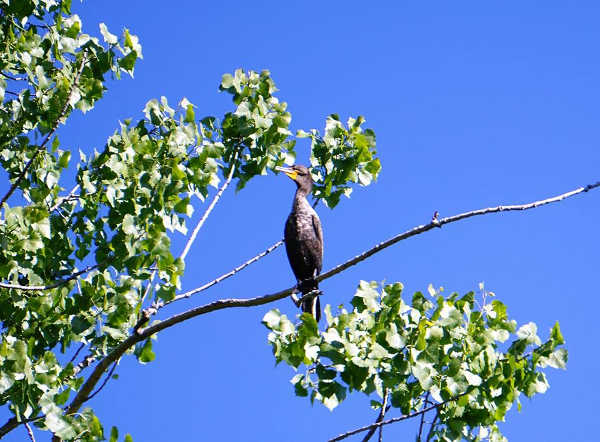
LAKE COUNTY, Calif. – Redbud Audubon Society’s popular annual Heron Days event is filling up slots on its upcoming tours.
The event takes place over two weekends at two different locations: Lakeside County Park on Saturday, April 27, and Sunday, April 28, and at Clear Lake Campground on Cache Creek in Clearlake on May 4 and 5.
This event features pontoon boat tours to view birds and other wildlife on Clear Lake.
Tickets are going fast for this year’s tours at both locations. Many tours for April 27 (leaving from Lakeside County Park) are sold and the April 28 tours from the same location are filling up fast as well.
The May 4 and 5 tours into Anderson Marsh from the Clear Lake Campground are also filling fast. Three tours are already sold out but May 5 from Clear Lake Campground still has plenty of openings.
Check out www.redbudaudubon.org to see what is still available, register for a boat ride and pay online.
If you can’t pay via the website for some reason, call the Audubon phone number: 707- 263-8030 and leave a message but please note reserving by phone makes extra work for volunteers.
The 90 minute tours will leave between the hours of 8 a.m. and 11 a.m. The tour fee is $30.
Tours from Lakeside County Park follow the shoreline where numerous grebes, cormorants and other wildlife can be viewed as well as an active Great-blue Heron rookery, or nesting site.
The trip from Clear Lake Campground travels into Anderson Marsh and along Cache Creek, which is the location of another heron rookery and may be hosting nesting and mating Western and Clarks Grebes.