How to resolve AdBlock issue?
News

On April 21, Christians will be celebrating Easter, the day on which the resurrection of Jesus is said to have taken place. The date of celebration changes from year to year.
The reason for this variation is that Easter always falls on the first Sunday after the first full moon following the spring equinox. So, in 2020, Easter will be celebrated on April 12, and on April 4 in 2021.
I am a religious studies scholar specializing in early Christianity, and my research shows that this dating of Easter goes back to the complicated origins of this holiday and how it has evolved over the centuries.
Easter is quite similar to other major holidays like Christmas and Halloween, which have evolved over the last 200 years or so. In all of these holidays, Christian and non-Christian (pagan) elements have continued to blend together.
Easter as a rite of spring
Most major holidays have some connection to the changing of seasons. This is especially obvious in the case of Christmas. The New Testament gives no information about what time of year Jesus was born. Many scholars believe, however, that the main reason Jesus’ birth came to be celebrated on December 25 is because that was the date of the winter solstice according to the Roman calendar.
Since the days following the winter solstice gradually become longer and less dark, it was ideal symbolism for the birth of “the light of the world” as stated in the New Testament’s Gospel of John.
Similar was the case with Easter, which falls in close proximity to another key point in the solar year: the vernal equinox (around March 20), when there are equal periods of light and darkness. For those in northern latitudes, the coming of spring is often met with excitement, as it means an end to the cold days of winter.
Spring also means the coming back to life of plants and trees that have been dormant for winter, as well as the birth of new life in the animal world. Given the symbolism of new life and rebirth, it was only natural to celebrate the resurrection of Jesus at this time of the year.
The naming of the celebration as “Easter” seems to go back to the name of a pre-Christian goddess in England, Eostre, who was celebrated at beginning of spring. The only reference to this goddess comes from the writings of the Venerable Bede, a British monk who lived in the late seventh and early eighth century. As religious studies scholar Bruce Forbes summarizes:
“Bede wrote that the month in which English Christians were celebrating the resurrection of Jesus had been called Eosturmonath in Old English, referring to a goddess named Eostre. And even though Christians had begun affirming the Christian meaning of the celebration, they continued to use the name of the goddess to designate the season.”
Bede was so influential for later Christians that the name stuck, and hence Easter remains the name by which the English, Germans and Americans refer to the festival of Jesus’ resurrection.
The connection with Jewish Passover
It is important to point out that while the name “Easter” is used in the English-speaking world, many more cultures refer to it by terms best translated as “Passover” (for instance, “Pascha” in Greek) – a reference, indeed, to the Jewish festival of Passover.
In the Hebrew Bible, Passover is a festival that commemorates the liberation of the Jewish people from slavery in Egypt, as narrated in the Book of Exodus. It was and continues to be the most important Jewish seasonal festival, celebrated on the first full moon after the vernal equinox.
At the time of Jesus, Passover had special significance, as the Jewish people were again under the dominance of foreign powers (namely, the Romans). Jewish pilgrims streamed into Jerusalem every year in the hope that God’s chosen people (as they believed themselves to be) would soon be liberated once more.
On one Passover, Jesus traveled to Jerusalem with his disciples to celebrate the festival. He entered Jerusalem in a triumphal procession and created a disturbance in the Jerusalem Temple. It seems that both of these actions attracted the attention of the Romans, and that as a result Jesus was executed around the year A.D. 30.
Some of Jesus’ followers, however, believed that they saw him alive after his death, experiences that gave birth to the Christian religion. As Jesus died during the Passover festival and his followers believed he was resurrected from the dead three days later, it was logical to commemorate these events in close proximity.

Some early Christians chose to celebrate the resurrection of Christ on the same date as the Jewish Passover, which fell around day 14 of the month of Nisan, in March or April. These Christians were known as Quartodecimans (the name means “Fourteeners”).
By choosing this date, they put the focus on when Jesus died and also emphasized continuity with the Judaism out of which Christianity emerged. Some others instead preferred to hold the festival on a Sunday, since that was when Jesus’ tomb was believed to have been found.
In A.D. 325, the Emperor Constantine, who favored Christianity, convened a meeting of Christian leaders to resolve important disputes at the Council of Nicaea. The most fateful of its decisions was about the status of Christ, whom the council recognized as “fully human and fully divine.” This council also resolved that Easter should be fixed on a Sunday, not on day 14 of Nisan. As a result, Easter is now celebrated on the first Sunday after the first full moon of the vernal equinox.
The Easter bunny and Easter eggs
In early America, the Easter festival was far more popular among Catholics than Protestants. For instance, the New England Puritans regarded both Easter and Christmas as too tainted by non-Christian influences to be appropriate to celebrate. Such festivals also tended to be opportunities for heavy drinking and merrymaking.
The fortunes of both holidays changed in the 19th century, when they became occasions to be spent with one’s family. This was done partly out of a desire to make the celebration of these holidays less rowdy.

But Easter and Christmas also became reshaped as domestic holidays because understandings of children were changing. Prior to the 17th century, children were rarely the center of attention. As historian Stephen Nissenbaum writes,
“…children were lumped together with other members of the lower orders in general, especially servants and apprentices – who, not coincidentally, were generally young people themselves.”
From the 17th century onward, there was an increasing recognition of childhood as as time of life that should be joyous, not simply as preparatory for adulthood. This “discovery of childhood” and the doting upon children had profound effects on how Easter was celebrated.
It is at this point in the holiday’s development that Easter eggs and the Easter bunny become especially important. Decorated eggs had been part of the Easter festival at least since medieval times, given the obvious symbolism of new life. A vast amount of folklore surrounds Easter eggs, and in a number of Eastern European countries, the process of decorating them is extremely elaborate. Several Eastern European legends describe eggs turning red (a favorite color for Easter eggs) in connection with the events surrounding Jesus’ death and resurrection.
Yet it was only in the 17th century that a German tradition of an “Easter hare” bringing eggs to good children came to be known. Hares and rabbits had a long association with spring seasonal rituals because of their amazing powers of fertility.
When German immigrants settled in Pennsylvania in the 18th and 19th centuries, they brought this tradition with them. The wild hare also became supplanted by the more docile and domestic rabbit, in another indication of how the focus moved toward children.
As Christians celebrate the festival this spring in commemoration of Jesus’ resurrection, the familiar sights of the Easter bunny and Easter eggs serve as a reminder of the holiday’s very ancient origins outside of the Christian tradition.
This is an updated version of a piece published on March 21, 2018.
Brent Landau, Lecturer in Religious Studies, University of Texas at Austin
This article is republished from The Conversation under a Creative Commons license. Read the original article.
When NASA's Curiosity Mars rover landed in 2012, it brought along eclipse glasses. The solar filters on its Mast Camera, or Mastcam, allow it to stare directly at the Sun.
Over the past few weeks, Curiosity has been putting them to good use by sending back some spectacular imagery of solar eclipses caused by Phobos and Deimos, Mars' two moons.
Phobos, which is as wide as 16 miles (26 kilometers) across, was imaged on March 26, 2019 (the 2,359th sol, or Martian day, of Curiosity’s mission); Deimos, which is as wide as 10 miles (16 kilometers) across, was photographed on March 17, 2019 (Sol 2350). Phobos doesn't completely cover the Sun, so it would be considered an annular eclipse. Because Deimos is so small compared to the disk of the Sun, scientists would say it's transiting the Sun.
In addition to capturing each moon crossing in front of the Sun, one of Curiosity's Navigation Cameras (Navcams) observed the shadow of Phobos on March 25, 2019 (Sol 2358). As the moon's shadow passed over the rover during sunset, it momentarily darkened the light.
Solar eclipses have been seen many times by Curiosity and other rovers in the past. Besides being cool — who doesn't love an eclipse? — these events also serve a scientific purpose, helping researchers fine-tune their understanding of each moon's orbit around Mars.
Before the Spirit and Opportunity rovers landed in 2004, there was much higher uncertainty in the orbit of each moon, said Mark Lemmon of Texas A&M University, College Station, a co-investigator with Curiosity's Mastcam. The first time one of the rovers tried to image Deimos eclipsing the Sun, they found the moon was 25 miles (40 kilometers) away from where they expected.
"More observations over time help pin down the details of each orbit," Lemmon said. "Those orbits change all the time in response to the gravitational pull of Mars, Jupiter or even each Martian moon pulling on the other."
These events also help make Mars relatable, Lemmon said: "Eclipses, sunrises and sunsets and weather phenomena all make Mars real to people, as a world both like and unlike what they see outside, not just a subject in a book."
To date, there have been eight observations of Deimos eclipsing the Sun from either Spirit, Opportunity or Curiosity; there have been about 40 observations of Phobos.
There's still a margin of uncertainty in the orbits of both Martian moons, but that shrinks with every eclipse that's viewed from the Red Planet's surface.
More information about Curiosity is at http://mars.jpl.nasa.gov/msl/. For more information about Mars visit https://mars.nasa.gov.

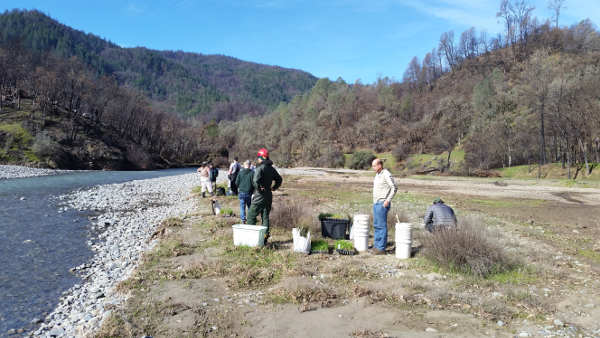
UPPER LAKE, Calif. – The Mendocino National Forest and the Habematolel Pomo of Upper Lake are teaming up on a project to reestablish native riparian vegetation along Middle Creek on the Upper Lake Ranger District.
The Middle Creek restoration project involves planting traditional native plants and protecting them with fencing in order to stabilize the stream bank and enhance aquatic habitat.
In March, forest and tribal staff planted a variety of native plants including juncus and sedge along the creek.
The riparian restoration work will reduce soil erosion, provide better water quality for the Clear Lake Hitch to spawn – a very important food source historically for the Pomo of the Clear Lake basin – and reintroduce a variety of traditional native plants used by the Habematolel Pomo for basketry and other purposes.
Officials said this collaboration is intended to be an ongoing effort which will require future plantings and maintenance of those plants started.
“This project is bringing the Forest Service and local tribes together with a common purpose,” said Mendocino National ForestHeritage Program Manager Mike Dugas. “Working side by side, we strengthen relationships and discover new ways to reach our shared goals.”
Jerry L. Thorpe, 47, of Nice sustained major injuries in the solo-vehicle crash, which occurred at 4:40 a.m. Friday, according to the California Highway Patrol’s Clear Lake Area office.
The CHP said Thorpe was driving a red 1994 Acura Integra westbound on Highway 20, east of Bender Drive in Lucerne, when he lost control of the car, which then traveled off the roadway to the north before hitting a tree.
Thorpe was flown by the REACH 7 air ambulance to Santa Rosa Memorial Hospital for treatment, the CHP said.
The CHP said investigators determined that Thorpe’s vehicle was previously reported stolen out of Santa Rosa, and he also was arrested on suspicion of DUI for drugs.
Authorities released Thorpe to the hospital for treatment of his injuries, the CHP said.
Email Elizabeth Larson at

KELSEYVILLE, Calif. – Three Bay Area residents were taken into custody this week after a Lake County Sheriff’s deputy conducted a vehicle stop and found a cache of firearms and marijuana.
Richard Leslie Styles, 51, of San Bruno; Mandeep Singh Deol, 43, of Union City; and Bleu Mariah Debardeleben, 39, of Hayward, were arrested following a Tuesday vehicle stop, according to Lt. Corey Paulich of the Lake County Sheriff’s Office.
At 6:10 a.m. Tuesday a Lake County Sheriff’s Office deputy was patrolling in the area of Bottle Rock Road and Sulphur Creek Road, Kelseyville when he observed a gray Volvo with a brake light out and conducted an enforcement stop for the violation, Paulich said.
Paulich said the deputy contacted the driver who was identified as Styles, along with his passengers Deol and Debardeleben.
The deputy smelled an overwhelming odor of marijuana coming from the vehicle. Paulich said the deputy also observed that the entire passenger compartment of the Volvo was filled with Home Depot moving boxes. Styles told the deputy that each box contained 2 to 3 pounds of marijuana.
During a search of the vehicle, the deputy located a glass pipe and small plastic bag containing suspected methamphetamine. Paulich said the deputy also located 14 firearms in the trunk that were wrapped in a sleeping bag, bolt cutters and a sock containing $77 in quarters.

Paulich said the deputy questioned all three occupants regarding the items that had been located, but they refused to provide any additional information.
Styles and Debardeleben were both prohibited from possessing firearms as they had previously been convicted of a felony, Paulich said.
All three subjects were placed under arrest and transported to the Lake County Jail where they were booked into custody, according to Paulich.
Styles was booked on charges of being a felon in possession of a firearm and possession and transportation of marijuana for sale. He remains in custody with bail set at $150,000.
Deol was booked on charges of possession and transportation of marijuana for sale, possession of drug paraphernalia and drug addict in possession of a firearm. He remains in custody with bail set at $50,000.
Debardeleben was charged with felon in possession of a firearm, possession and transportation of marijuana for sale, possession of a controlled substance while armed, and false ID to a peace officer. She remains in custody with bail set at $90,000.

NORTHERN CALIFORNIA – The largest raptor poaching case in known California history has ended in a conviction in Lassen County, the California Department of Fish and Wildlife announced.
Richard Parker, 68, of Standish pleaded guilty to crimes associated with poaching in excess of 150 raptors and other wildlife on his rural Lassen County property.
He was sentenced to 90 days in jail and given a $75,000 fine and five years of probation.
Probation terms include full search authority, prohibitions on possessing firearms, hunting and fishing, and a requirement to obey all laws.
The two firearms used during the commission of the crimes were ordered destroyed by the court.
In March 2018, wildlife officers assigned to Lassen County received an anonymous tip from someone who reportedly witnessed a man killing a hawk near the town of Standish.
The wildlife officer conducted covert surveillance of the suspect, then visited the private property and discovered nine dead raptors.
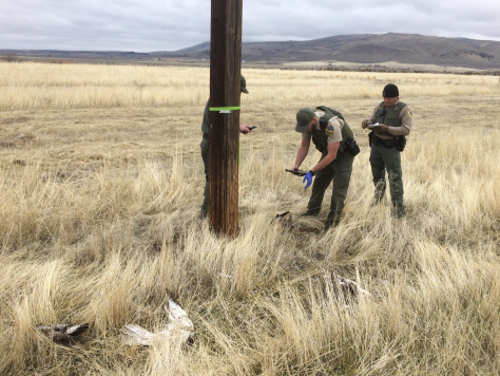
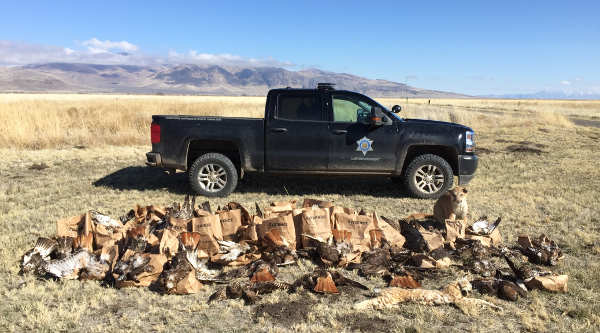
The entire local Lassen/Plumas County wildlife officer squad later returned to the property with a search warrant. A search of the home and 80-acre property turned up more than 150 carcasses of protected birds and other wildlife in various states of decay, along with spent rifle casings.
Most of the birds were red-tailed hawks, but several other species of hawks, other nongame birds and an owl were found. Four of the birds were migratory ferruginous hawks, which are uncommon in the area.
Officers also located two dead bobcats and one taxidermied mountain lion, all of which were suspected to be unlawfully taken.
A CDFW wildlife veterinarian and avian specialist analyzed the first nine carcasses collected. However, investigators sent the majority of the carcasses to the U.S. Fish and Wildlife Service Forensics Laboratory in Ashland, Ore., where wildlife forensic scientists meticulously necropsied 159 samples to determine cause of death.
The 400-page necropsy report significantly contributed to the Deputy Attorney General's ability to effectively prosecute the case.
"We are pleased to work with the California Attorney General's Office, as well as CDFW's Office of General Counsel, to put this egregious poacher out of business," said David Bess, CDFW deputy director and chief of the Law Enforcement Division. "The case came together as a result of collaboration of our local wildlife officers and laboratory and wildlife biology staff from the state and federal governments."
"Poaching is not a game, it's a serious crime," said Attorney General Xavier Becerra. "Richard Parker willfully and egregiously disregarded California law to kill protected wildlife, including hawks. To anyone who breaks our laws for illegal sport, know that we will prosecute and hold you accountable."
CDFW also expresses appreciation to Lassen County District Attorney Melyssah Rios for her contribution to the monumental effort put forth to bring this case to closure.
The case developed from a tip originating with a member of the public who saw something amiss.
Anyone who believes they are witness to unlawful poaching or pollution activity is encouraged to call CalTIP, CDFW's confidential secret witness program, at 888-334-2258 or send a text with the tip411 app.
Both methods allow the public to provide wildlife officers with factual information to assist with investigations.
Callers may remain anonymous, if desired, and a reward can result from successful capture and prosecution.