 How to resolve AdBlock issue?
News
It may be hard to resist scooping up a young wild animal that looks vulnerable and alone but human intervention may cause more harm than good.
Young animals removed from their natural environment typically do not survive or may not develop the appropriate survival skills needed to be released back into the wild.
“It is a common mistake to believe a young animal has been abandoned when it is found alone, even if the mother has not been observed in the area for a long period of time,” said Nicole Carion, CDFW’s statewide wildlife rehabilitation coordinator. “Chances are the mother is off foraging, or is nearby, waiting for you to leave.”
Adult female deer often stash their fawns in tall grass or brush for many hours while they are out foraging for food. A female mountain lion may spend as much as 50 percent of her time away from her kittens.
After leaving the nest, fledgling birds spend significant time on the ground while learning to fly with their parents somewhere nearby.
If a young animal is in distress, or you are unsure, contact a wildlife rehabilitation facility and speak to personnel to determine the best course of action.
For an injured, orphaned or sick bear, elk, deer, bighorn sheep, pronghorn antelope, wild pig or mountain lion, contact CDFW directly, as most wildlife rehabilitators are only allowed to possess small mammals and birds.
Although some wildlife rehabilitators are allowed to accept fawns, injured or sick adult deer should be reported directly to CDFW for public safety reasons.
Anyone who removes a young animal from the wild is required to notify CDFW or take the animal to a state and federally permitted wildlife rehabilitator within 48 hours.
These animals may need specialized care and feeding that is best done by trained wildlife care specialists.
It is important to note that wild animals – even young ones – can cause serious injury with their sharp claws, hooves and teeth, especially when injured and scared. They may also carry ticks, fleas and lice, and can transmit diseases to humans, including rabies and tularemia.
To learn more about how to live and recreate responsibly where wildlife is near, please visit CDFW’s Keep Me Wild website at www.keepmewild.org.
The board will meet beginning at 9 a.m. Tuesday, April 9, in the board chambers on the first floor of the Lake County Courthouse, 255 N. Forbes St., Lakeport.
The meeting can be watched live on Channel 8 and online at https://countyoflake.legistar.com/Calendar.aspx. Accompanying board documents, the agenda and archived board meeting videos also are available at that link.
At 9:45 a.m., the board will consider a report from a committee that it appointed to negotiate with the city of Lakeport regarding the South Main Street annexation area and consider a response to the city’s request for review of its planned annexation application to the Local Agency Formation Commission, or LAFCo.
The annexation of the 123-acre South Main Street area, which has been in the city’s sphere of influence for decades, has long been a point of contention between the city and county, primarily because it is reported to be the most lucrative commercial corridor in the unincorporated county.
The city and county have attempted to negotiate a revenue sharing agreement for property tax as part of a solution that would allow the annexation to go forward.
However, negotiations between the city and county reportedly broke down last year, according to statements at a February Lakeport City Council meeting, during which the council approved a budget adjustment to pay for a fiscal analysis that’s a key part of the annexation process, as Lake County News has reported.
Both city and county officials have pointed at each other as the cause of the breakdown in both relations and negotiations over the annexation, the heart of which appears to revolve around its monetary value, the county’s unwillingness – and stated inability, due to its fiscal constraints – to relinquish it and the city’s continued pursuit of the matter.
With the city moving forward with its plans to pursue adding that area to its limits, it will submit an application to LAFCo.
On Tuesday, the board will be asked to consider a draft letter to the city, dated April 9, which can be seen below.
In it, a number of issues are addressed, but the key matter relates to water.
The city plans to construct a water main on South Main Street in conjunction with the upcoming South Main Street and Soda Bay Widening and Bike Lanes Project; it says the water main is necessary to create a closed loop in its system to increase reliability and reduce maintenance costs, and allow property owners to hook into the system.
In response to that purpose, the county letter notes: “At the end of the last round of talks last year, the County advised the City of its intention to reinvigorate its own plans for providing water to the area and thus, retaining South Main Street in the County. Lake County Special Districts has since obtained an updated Project Design Report and has had preliminary discussions with USDA about possible grant funding for a water system there. For many years, the County has carried forward a partial funding set aside for completion of a water system for South Main Street/Soda Bay Road area, intended to support the development of the area. The District Supervisor has proposed the concept to his constituents, for connecting South Main Street/Soda Bay Road to Kelseyville/Finley, and the response has been favorable. Adding the South Main Street/Soda Bay Road area to the County water system will require only a very small portion of system capacity.”
The letter also states that the city’s proposed annexation area “will leave a small and vulnerable section of properties without any services,” which the county says its plans address in its alternative proposal.
“Although the proposed annexation may be of benefit to the City, in terms of looping its system, it would not benefit all property owners in the South Main Street/Soda Bay Road area. To include a few and exclude the rest, would be an extreme disservice to the business owners that have struggled to survive in the area. The County desires to bring water service to the annexation area and beyond,” the letter states.
Another key city purpose is offering annexed properties city services.
“As we are all aware, the concept of annexation is not new,” the letter states. “In fact, some years ago, such plans were met with considerable opposition from those who live in and/or operate businesses in the area. Given the past history, the County proposes the preparation of a new survey, to be developed collaboratively, to assess the will of the business owners and residents of South Main Street. Survey results should be a powerful indicator as to the future of annexation.”
The letter ends by noting that “the County negotiating committee would welcome the opportunity to meet again with the City’s team.”
In other timed items for Tuesday, at 9:10 a.m. the board will present proclamations designating the week of April 7 to 13 as National Crime Victims' Rights Week, and April 2019 as Child Abuse Prevention Month and Sexual Assault Awareness Month in Lake County.
At 9:30 a.m., the board will consider responses to the Bureau of Indian Affairs’ invitation to provide comment on the Big Valley Band of Pomo Indians’ land acquisition applications, which could impact property tax revenues, and result in potential land use conflicts, among other issues.
County Administrative Officer Carol Huchingson’s report to the board notes that the tribe is seeking the BIA’s approval of moving 21 parcels into trust. The county received notice of these applications on two dates – March 4 for the first seven parcels and March 20 for the other 14 parcels.
As staff was researching the applications for the initial seven parcels, they learned that the tribe recently had opened a cannabis dispensary and was expanding cultivation and manufacturing programs. When they began to review the second application, they found there were additional plans regarding another casino, Huchingson reported.
“During staff’s continued research, it became clear that beyond the expansion of the Tribe’s cannabis industries, there are other potential inconsistencies in land use, both present and possibly future,” Huchingson said. “For example, there are plans for a potential commercial center and casino on Soda Bay Road. Generally, the area in and around the Big Valley Rancheria has zoning reflecting Agricultural and Residential uses. Some of the ongoing and potential uses typically would not have been previously contemplated by County staff so the opportunity for further study would be valuable.”
Huchingson said the county has asked for a 30-day extension to study the applications.
“Due to these recent developments, these proposed comments clarify for the Bureau that staff is unable to fully and informatively respond to the Bureau’s requests for information on these short timelines,” Huchingson said. “Staff has highlighted the areas of concern and noted that further time would be necessary to investigate the proper tax valuations and evaluate the infrastructure of the surrounding area and what steps and costs might be necessary to accommodate potential development by the Tribe. The proposed comments give greater background detail and suggest the Bureau provide County staff the opportunity to identify topics requiring attention and work with the Tribe and other local partners to gather the necessary information.”
In untimed items, the board will continue its discussion and consideration of county regulation of industrial hemp and will approve acceptance of a $10,000 donation from an anonymous donor to the Middletown Library.
The full agenda follows.
CONSENT AGENDA
5.1: Approve minutes of the Board of Supervisors meetings held Dec. 11, 2018, and March 26, 2019.
5.2: Approve agreement between the county of Lake and Visit Lake County California authorizing the county of Lake to collect and remit tourism improvement district assessments.
5.3: Approve leave of absence request for Melinda Daunis, client support assistant from Feb. 1, through April 1, 2019, and authorize the chair to sign.
5.4: Approve waiver of the 900 hour limitation for Animal Care and Control employees Deonne Collins, Amanda Williamson and Andrew York and approve the extension of hours to 999 hours each.
5.5: (a) Waive the formal bidding process, pursuant to Lake County Code Section 38.2, as it is not in the public interest due to the unique nature of goods or services (b) approve agreement between the county of Lake and Kofile for the preservation of historical documents required for business in the amount of $34,762.56 and authorize assessor-recorder to sign agreement.
5.6: Adopt the resolution authorizing Amendment A01 to the standard agreement for the multi-year contract between the county of Lake and the Department of Health Care Services for substance use disorder services between July 1, 2017, through June 30, 2020 and authorizing the Behavioral Health Services administrator to sign the amendment.
5.7: (a) Waive the formal bidding process, pursuant to Lake County Code Section 38.2, as it is not in the public interest due to the unique nature of goods or services; and (b) approve the agreement between the county of Lake and BHC Heritage Oaks Hospital for the Fiscal Year 2018-19 for a contract maximum of $35,244 and authorize the board chair to sign the agreement.
5.8: Approve Amendment 1 to the agreement between the county of Lake and Remi Vista Inc. for specialty mental health services for Fiscal Year 2018-19 in the amount of $40,000 and authorize the board chair to sign the amendment.
5.9: Adopt proclamation designating the week of April 7-13, 2019 as National Crime Victims' Rights Week in Lake County.
5.10: Approve acceptance of $10,000 donation for the Middletown Library.
5.11: Adopt proclamation designating the month of April 2019 as Child Abuse Prevention Month in Lake County.
5.12: Adopt proclamation designating the Month of April 2019 as Sexual Assault Awareness Month in Lake County .
5.13: Approve the waiver of the 900 hour limit for certain facility maintenance positions within the Department of Social Services.
5.14: Approve the waiver of the 900 hour limit for certain janitor positions within the Department of Social Services.
5.15: Authorize the advanced step hiring of Daniel Curtis as an electrical-mechanical technician II, Step 5.
TIMED ITEMS
6.2, 9:10 a.m.: (a) Presentation of proclamation designating the week of April 7-13, 2019, as National Crime Victims' Rights Week in Lake County; (b) presentation of proclamation designating the month of April 2019 as Child Abuse Prevention Month in Lake County; and (c) presentation of proclamation designating the month of April 2019 as Sexual Assault Awareness Month in Lake County.
6.3, 9:30 a.m.: Consideration of responses to the Bureau of Indian Affairs invitation to provide comment on the Big Valley Band of Pomo Indians’ land acquisition applications.
6.4, 9:45 a.m.: (a) Consideration of report from the committee appointed by the board to negotiate with the city of Lakeport regarding the South Main area; and (b) consideration of response to city of Lakeport’s request for review of its planned application to the Local Agency Formation Commission, or LAFCO, for the annexation of the South Main area.
UNTIMED ITEMS
7.2: Consideration of the following appointments: Maternal Child Adolescent Health Advisory Board and Child Care Planning and Development.
7.3: Discussion and consideration of county regulation of industrial hemp.
7.4: Consideration of appointments to the Geothermal Advisory Committee.
CLOSED SESSION
8.1: Conference with legal counsel: Significant exposure to litigation pursuant to Gov. Code sec. 54956.9 (d)2, (e)3 – Claim of Dodson.
Email Elizabeth Larson at
South Main Annexation Application County Response 040919 by LakeCoNews on Scribd
In July 2018, a spark near the Mendocino National Forest ignited California’s largest wildfire on record.
As the fire spread rapidly, officials declared mandatory evacuations in several areas and counties. But where did people go, when did they leave, and when did they return?
Researchers have turned to a new data source to observe population movements during a crisis: social media.
“We wanted to analyze evacuation patterns and factors that can influence the speed of evacuations during a crisis,” said Shenyue Jia, a remote sensing specialist at Chapman University.
Analyzing evacuation and recovery patterns could help researchers understand how humans behave in the face of a disaster, which could inform emergency response efforts. Jia said nobody was able to provide population movements during a disaster, especially at a high temporal and spatial resolution – until Facebook.
Almost 2.5 billion people per month actively use Facebook. When a disaster strikes, many of those users log on during an evacuation.
Facebook’s disasters map initiative uses aggregated, anonymized Facebook data in disaster areas to estimate population densities, movements between neighborhoods, and where people mark themselves as “safe” during a crisis.
The company also works with mobile phone carriers to observe the number of connections to surrounding cell phone towers.
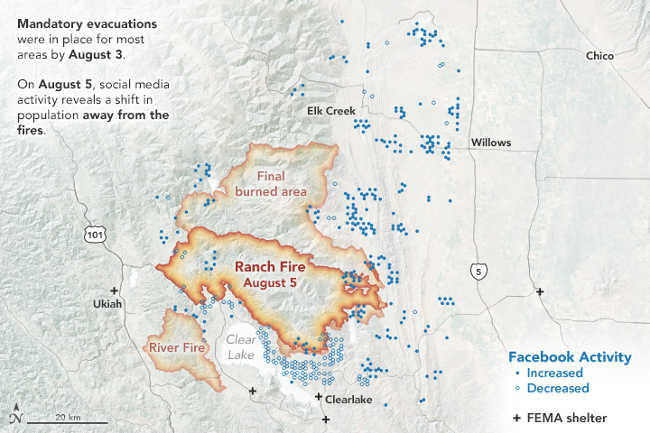
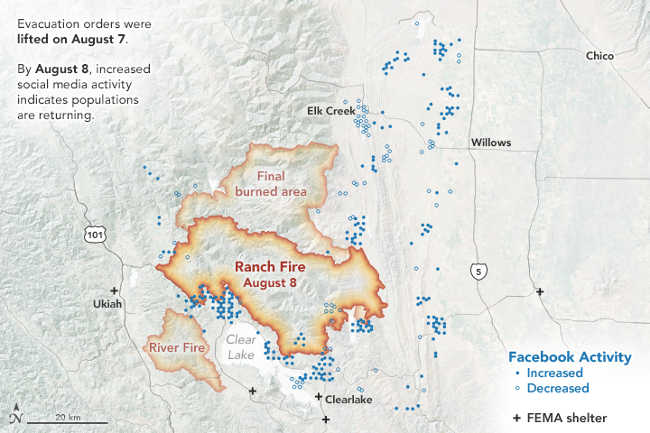
The images on this page show the population data during the Mendocino Complex Fire in Northern California for 10,000 people, as provided by the Facebook disaster map dataset.
The first map above shows the area on Aug. 5, 2018, two days after mandatory evacuations were in place. The second map below shows the area on Aug. 8, one day after the evacuation orders were lifted.
During the Mendocino Complex fire, most people fled the fire perimeter when an evacuation was in place, which was not surprising. But what surprised Jia was where people were headed – or not headed.
“Originally, I thought this data could be nice to track which places people decide to go, but the information didn't show any significant pattern for this fire,” said Jia, whose research was funded by NASA. “I was expecting a very simple trend, but evacuations are more complicated to understand.”
Jia thinks that perhaps people had more shelter options to flee to (FEMA shelters, neighboring towns, etc.), so the evacuation patterns were dispersed.
However, when the evacuations were lifted, the data showed a much clearer trend of where people were headed: most were returning back to their homes and hometowns. Jia said that how the population bounces back post-disaster is an important indicator of whether the evacuated areas may be safe for residing. In the Mendocino Complex fire, most areas saw people returning.
But that’s not always the case. Jia also analyzed population data from Facebook for the Camp fire that occurred in November 2018. The data showed a large portion of the evacuated area did not see a sustainable population return since many of those areas were destroyed.
“This research demonstrates that social-network data can be a valuable tool to monitor human behaviors in response to disasters, such as wildfires in areas that have been exacerbated by urbanization,” said Son Nghiem, remote sensing expert at NASA’s Jet Propulsion Laboratory, who oversaw this research.
According to Nghiem, this frequently updated social media data can add another dimension to satellite remote sensing data from NASA and other international agencies used to monitor land cover and land use change.
“With remote sensing data, we don’t know the immediate socioeconomic and demographic impacts,” said Nghiem. “This innovative use of demographic data opens up new possibilities to advance research on how humans respond to abrupt physical changes in disaster situations.”
Kasha Patel is a science journalist at NASA’s Goddard Space Flight Center in Greenbelt, Maryland.
Although most native snakes are harmless, the California Department of Fish and Wildlife recommends giving the venomous rattlesnake a wide berth and knowing what to do in the rare event of a bite.
“Snakes really get an unfair bad rap, when they actually play an important role in California’s ecosystems,” said CDFW’s Keep Me Wild program coordinator Lesa Johnston. “Like most wild animals, snakes prefer to keep to themselves and are not naturally aggressive. Taking the time to learn about safety precautions before going outdoors can make all the difference.”
Rattlesnakes are widespread in California and are found in a variety of habitat throughout the state from coastal to desert. They may also turn up around homes and yards in brushy areas and under wood piles.
Generally not aggressive, rattlesnakes will likely retreat if given room and not provoked or threatened. Most bites occur when a rattlesnake is handled or accidentally brushed against by someone walking or climbing.
On occasion, rattlesnake bites have caused severe injury – even death. However, the potential of encountering a rattlesnake should not deter anyone from venturing outdoors.
The California Poison Control System notes that the chances of being bitten are small compared to the risk of other environmental injuries.
Most bites occur between the months of April and October when snakes and humans are most active outdoors.
CDFW provides tips for safely living in snake country on its website, as well as tips for keeping snakes out of your yard and what do to do (and not do) in the event of a snake bite.
Additional resources can be found on the www.CaliforniaHerps.com Living with Rattlesnakes Web page.

Climate change is a chronic challenge – it is here now, and will be with us throughout this century and beyond. As the U.S. government’s National Climate Assessment report made clear, it’s already affecting people throughout the United States and around the world.
Warmer temperatures are making heat waves more intense, with harmful effects on human health. More intense rainfall and higher sea levels are leading to more frequent and intense flooding, with ensuing damages to property, infrastructure, business activity and health. Higher temperatures and strained water supplies are requiring new agricultural approaches, while fisheries are shifting and in some cases shrinking; in some cases, stressed food systems are contributing to national instability.
This reality means society needs to think about climate change in different ways than the past, by focusing on reducing the risk of negative effects. And speaking as a climate scientist, I recognize that climate science research, too, has to change.
Historically, climate science has been primarily curiosity-driven – scientists seeking fundamental understanding of the way our planet works because of the inherent interest in the problem.
Now it’s time for the climate science research enterprise to adopt an expanded approach, one that focuses heavily on integrating fundamental science inquiry with risk management.
Flexible infrastructure design
Climate risk management strategies need to be broad, ranging from efforts to reduce greenhouse gas emissions, to designing new infrastructure hardened against more frequent extreme weather, to policies that encourage development to shift to less exposed areas.
And these strategies must be flexible. In some cases, decisions made today affect people’s vulnerability for the rest of this century, even though there is much that remains to be learned about how climate change will unfold over the decades to come.
Consider the risks associated with sea-level rise.
The new rail tunnel under the Hudson River – if it is built – will likely still be in use in the next century. And yet, the scientific understanding of how much sea level will rise by the end of the century is quite imprecise. That’s because of uncertainty in how much greenhouse gases humans will emit and the immature scientific understanding of the ice-sheet physics.
It is possible – if emissions are high, and ice-sheet physics unstable – that the world could see 6 feet or more of global average sea-level rise over the course of this century, with substantially more in some regions. It is also possible – if emissions are low, or ice-sheet physics fairly stable – that it could be just 2 feet.

If we as a society are making decisions that affect the world a century from now, we cannot blindly ignore either of these possibilities. If we treat 6 feet as a certainty, we could end up making unnecessary expenditures that come at the cost of other important priorities; if we treat 2 feet as a certainty, we may be putting lives and property at substantial risk.
So the best is an iterative approach. Communities can identify the resources and features that they value. Engineers and planners can identify key benchmarks – for example, critical levels of sea-level rise – that would require strategic changes to protect these values resources and features. And scientists can figure out what observations and theoretical insights would allow us to learn about those benchmarks as quickly as possible.
When the scientists discover that a benchmark is going to be hit – for example, when ice-sheet observations and modeling make clear whether we are on course for 2 feet or 6 feet of sea-level rise in this century – the engineers, planners and policymakers can adjust accordingly.
Getting out of the ivory tower
This long-term, iterative process is a break with current practices. It requires sustained relationships that are not a good fit for much of the academic scientific enterprise, which is driven by curious individuals and funded by short-term grants.
There are signs, though, that climate scientists are getting out of the ivory tower and taking a different approach to research.
Transdisciplinary research recognizes stakeholders outside of academia as critical partners throughout the research process – from problem identification to solution deployment. People like Stanford’s Pam Matson and Harvard’s Bill Clark have been pioneers in this area, which they describe in the book “Pursuing Sustainability.” Matson, for example, has spent decades conducting interdisciplinary work with farming communities in Sonora, Mexico, that has led to both new insights into nitrogen cycling in the ocean and more sustainable agricultural practices.
True transdisciplinarity is hard – it requires a considerable investment on the part of researchers or their institutions in maintaining strong, working, trusting relationships with stakeholders, whether they be city planners, farmers, businesses, or members of vulnerable communities. And building such relationships is slow – if it must be done from scratch, it does not sit well with the time pressures faced by scientists who are not yet tenured faculty.
The land-grant university model
Fortunately, there is an example in the United States of institutions successfully maintaining long-term relationships between academic researchers and decision-makers in their communities.
In 1862, amidst the bloodshed of the Civil War, Congress established a network of land-grant universities, devoted to training the next generation of farmers and engineers, conducting research to advance agriculture, and engaging with farmers to disseminate the fruits of this research.

Many land-grant universities have extended the extension concept beyond agriculture. For example, at Rutgers where I teach, our extension service runs programs designed to help coastal communities increase their resilience to storm and sea-level rise. Rutgers staff have built partnerships, like the New Jersey Climate Change Alliance, that link communities, NGOs and businesses to climate science expertise. And the Rutgers Coastal Climate Risk and Resilience initiative trains graduate students to engage across disciplines and with stakeholders to address coastal challenges.
Elsewhere, the University of Arizona has built a Center for Climate Adaptation Science and Solution, the University of Washington is building an EarthLab, and the University of California, San Diego has a new Center for Climate Change Impacts and Adaptation. The recently established University Climate Change Coalition and Science for Climate Action Network are aiming to catalyze similar efforts.
But unlike the core agricultural work of cooperative extension, these climate risk-focused partnerships often lack institutional stability; most are the products of a small number of visionary individuals and many are funded one small grant at a time. And yet stability is critical for science that is intended to support decades of chronic risk management.
That’s why I believe it is worth considering a national investment in our universities that is analogous to that of cooperative extension but applied to scientific climate risk management.
These are not easy or cheap changes to make. But they are both easy and inexpensive when compared to the costs of climate change and the costs of the climate risk management decisions they will help inform.
Editor’s note: This article expands upon testimony delivered to the U.S. House of Representatives Committee on Science, Space, and Technology.
Robert Kopp, Professor, Department of Earth & Planetary Sciences, and Director, Rutgers Institute of Earth, Ocean, and Atmospheric Sciences, Rutgers University
This article is republished from The Conversation under a Creative Commons license. Read the original article.
KELSEYVILLE, Calif. – Lake County has long been known for pears, winegrapes and walnuts, but it may soon be known for another unique and ancient commodity – saffron.
Saffron is a spice that’s been used for thousands of years. Its origins appear to come from the Middle East, where it’s still grown, as it is in the Mediterranean. Today, major producers include Iran, Italy, Morocco and Spain, with minor producers including China, France, Great Britain, Greece, India, Tajikistan and the United States.
It’s also one of the most expensive spices – its nickname is “red gold” – due to the labor-intensive quality of its production, which has to be done by hand in a short timeframe in the fall. Saffron prices vary, but for the highest quality the spice is reported to cost several thousand dollars for a pound. It’s estimated that it takes 4,000 flowers to create one ounce of dried saffron, according to a University of Vermont report.
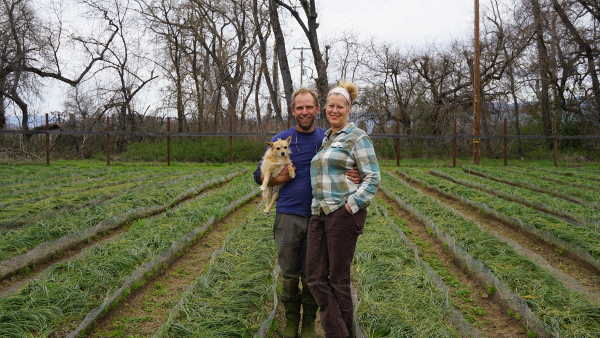
Bringing the crop to Lake County are Melinda Price and Simon Avery, who have spent the last two years joining the local farming community and creating Peace and Plenty Farm.
They said they are the only farm growing certified organic saffron on a commercial scale in California; they may actually be the largest producer in the United States, where saffron is uncommon outside of a burgeoning growing industry in New England.
Avery and Price purchased the seven-acre Old Gaddy Ranch at 4550 Soda Bay Road in Kelseyville in 2017. The couple said they had been looking to get a place in the country and become farmers.
“Both of us had had a similar dream of farming for years before we met,” said Price. “We knew that we wanted to farm.”
At that time, Price – who grew up in Stockton – had been living in the Bay Area and raising her daughter. However, her daughter recently had left home, and as an empty nester, she took the opportunity to look for a change.
Avery is a British-born ornithologist, hailing from north of London, who formerly worked as a field biologist with the Nature Conservancy. He’s managed land reserves of up to 40,000 acres, with experience not just in land management but in ecology, so he was equipped for farming.
Searching for the perfect crop and a farm
In envisioning their future farm, Price said they loved the idea of doing a full-on market garden, but the effort involved to sustain it would probably not go beyond 10 years.
While both Avery and Price are youthful 50-somethings, they wanted a crop that they would be able to physically handle for at least a few decades to come.
So they looked at high value crops – besides cannabis – that fit the bill. She said they looked at everything – hops, vanilla, mushrooms, wasabi – and did a lot of research.
Then one day as Avery was in his car listening to the radio, he heard a program about the University of Vermont working with farmers to add value by growing saffron.
“That was an ‘aha’ moment for sure,” Price said.
Based on their research, they felt saffron growing in California was a far better fit than for the colder climate of Vermont.
Price went to a conference in Vermont to learn more about saffron and then placed an order for more than 11,000 corms – the part of the saffron plant that goes into the grown, similar to a bulb or tuber.
Their plans were moving ahead quickly, but one part was missing. “We didn’t have property yet,” said Price, which meant they had thousands of corms coming in the spring of 2017 but no place to put them.
Simultaneously, Avery and Price had been looking at properties, primarily in Sonoma County. “We soon realized that to get what we wanted, we weren’t going to afford it there,” Price said.
In addition to price, there was the issue of not being able to find the appropriate soil, as well as concerns about water, she said. So they opened up the area they were searching for properties and the first place they found in an online search was the Old Gaddy Shack Ranch.
Once they found the ranch, that part of the process went quickly, too. They looked at the ranch the following weekend, arriving with shovels in hand to take soil samples.
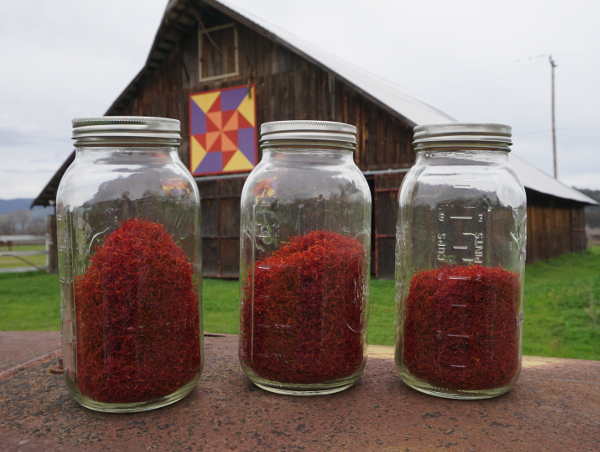
They had a cursory look at the ranch’s 1850s farmhouse and the newer buildings, as well as the old barn, which has the “Peace and Plenty” quilt block which is part of the Lake County Quilt Trail. Price said the quilt block’s colors are all the colors of saffron.
“We kind of felt like we found the perfect place,” Price said.
Two days later they made an offer, which was accepted. “We didn’t look at any other farms up here. This was the only place we looked at,” Price said.
A fast first harvest
The couple purchased the farm in June 2017 and immediately set to work, including cutting weeds and preparing for their farming enterprise.
By September 2017 Price had made the move to the farm, and that same month they planted the saffron. In October 2017, they had their first harvest.
“It’s a quick one,” she said of that first growing season.
She said that saffron flowers once a year, in the fall. That first year was both quick and meager – the harvest yielded only about 25 grams of dried saffron. Still, that was enough to give them hope, and it showed them that the plants were healthy and responding.
In the summer of 2018, they had to dig out all of the corms due to rodent issues, after they lost several thousand plants to gophers, Price said.
“Lake County gophers love the taste of saffron. They’re quite gourmet, the gophers here,” said Price.
At the same time, the Mendocino Complex fires were burning, prompting tens of thousands of county residents to evacuate, including Kelseyville residents.
Price said all of their saffron was in boxes in a cool room at that point, so when they evacuated, they took the saffron, their 10 chickens, Ruby the dog and Kitty the cat.
The ranch, which is surrounded by pear orchards and winegrapes, was unscathed, said Price, and when they got back, they replanted the corms in slightly raised beds to help keep out the gophers.
The fall 2018 harvest, their second, was far better, with a yield of 325 grams of dried saffron, Price said.
“Harvest was really, really exciting,” she said.
Also, it was again a rather sudden process, with Price explaining that there were 8,000 flowers blooming in one day, blanketing the field in purple.
Harvesting is intense work. “It’s all done by hand,” she said, explaining that’s why the price is high.
She said they have to harvest very early in the morning, before the flowers open, as the longer the flower’s stigmas – which receive pollen – hang out in the sun and air, the less potent they are.
They can pick the field bare and new flowers will come up very quickly. Price said it was three to four weeks of picking saffron all day, every day.
Then, once the picking was done, they had to sit and hand-separate the stigmas from the rest of the flowers and dry them. Price said that process should happen the same day as they’re picked to maintain freshness and to the intensity of the taste.
She said they now have more than 55,000 corms in the ground due to the natural multiplying of the “mothers” and “daughters,” and those are expected to triple by October. They also will plant another 20,000 corms this summer.
Walking around the farm now, the saffron plants are still green. They’ll stay that way until June, when they will wither away and die back, to later regenerate and grow, Avery said. When they go dormant they don’t need water, and the ground will appear bare for several months, until September. Then the plants will start coming back, blooming and leafing in brilliant blue in October.
The farm’s sandy loam soil is great for saffron, said Avery.
An excellent crop and future plans
In six years the corms will need to be dug up, broken up and then placed in virgin soil, Price said.
The plants are doing better now thanks to the raised beds, which offer a measure of protection against gophers.
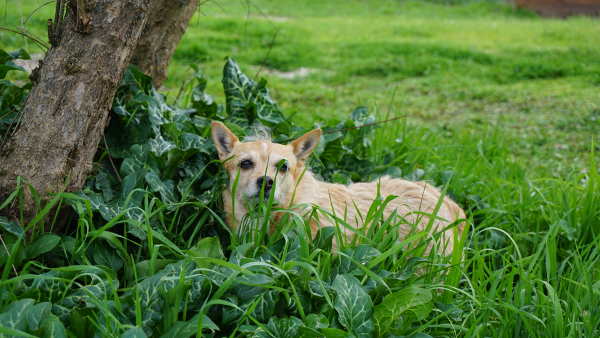
Also helping attack the gopher population is the couple’s little farm dog, Ruby. A mix of Chihuahua and terrier, during a walkabout of the farm Ruby did a full-on terrier vault into some high grass, looking for what her owners thought was a mole, another of her favorite snacks.
She eats more than her fair share of gophers – she scarfs up more of them than the 15-year-old farm cat Kitty, who has caught a few – and the couple jokes that she looks rather like a saffron plant herself, thanks to the white wispy hairs sticking out of the top of her head. Ruby seems pretty pleased with life on the farm, and she’s also featured in the farm’s Instagram feed.
Price said people have asked how their saffron compares to that grown in Iran and Spain. They recently had it tested by a Quebec firm.
Avery said their fingers were crossed that it was going to come out good, and they received an excellent quality rating.
The smell of it is deep, rich and fruity, with somewhat of a tomatoey tang. It’s unique, and since California saffron is a rather new crop, Peace and Plenty’s produce is setting expectations for fresh saffron.
Saffron that comes from overseas can be as old as two years before it arrives here. While it can keep indefinitely, Price said it’s best to use it in the first eight months after harvest.
Their saffron sells on their Web site for $25 for a tin that weighs a third of a gram.
Their operation is certified organic, a process that was helped when Suzanne Blavet, who sold them the property, assisted them with historic information on how the land was used and filling out the necessary paperwork. That helped them bypass the three-year waiting period for certification, Price said.
Price said they’ve sold their saffron to local chefs – including those who own Fresh n Bangin and Dancing Poly – and in the San Francisco Bay Area, to the Tartine Manufactory and to a chef from Chez Panisse for her personal use.
They also are growing organic, dry-farmed walnuts from 15 old but very prolific walnut trees that are the remnant of an orchard. They’ve had great success selling them, and have used the nuts for small batch cold-pressed oil.
They have many plans going forward, including selling their products at food fairs and having a small market garden and farm stand on site. Price said they are doing direct sales right now because wholesale selling won’t be viable until they have a much larger saffron crop. But she anticipates this year’s harvest will top a kilo and each year the crop is expected to triple in volume.
Other plans including planting a few dozen pear trees this year, as a homage to the county’s pear growing history.
Avery notes that the ecosystem around them is very important to their crop, and they are keeping some areas wild. They’re also planting as many nectar and pollen rich plants as they can.
This May they will be planting a field of 870 lavender plants, and they’re also gearing up to offering fresh seasonal produce. They want to eventually open a wedding venue and currently they have an AirBNB rental on site that is regularly booked.
Price said they’ve fallen in love with Lake County, have met many good people and already have made many great new friends. Besides that, they have friends from outside the area who now want to move to Lake County and farm.
They love the farm, and for Avery, as an ornithologist, hearing so much birdsong is a special treat.
“We feel so fortunate to be here. It’s just perfect in so many ways,” Price said.
Visit Peace and Plenty Farm’s Web site or Facebook page, or follow them on Instagram.
Email Elizabeth Larson at