How to resolve AdBlock issue?
Refresh this page
How to resolve AdBlock issue?
Refresh this page
Lake County News,California
  • Home
    • Registration Form
  • News
    • Education
    • Veterans
    • Community
      • Obituaries
      • Letters
      • Commentary
    • Police Logs
    • Business
    • Recreation
    • Health
    • Religion
    • Legals
    • Arts & Life
    • Regional
  • Calendar
  • Contact us
    • FAQs
    • Phones, E-Mail
    • Subscribe
  • Advertise Here
  • Login
How to resolve AdBlock issue?
Refresh this page

News

Rising electricity prices and an aging grid challenge the nation as data centers demand more power

Details
Written by: Barbara Kates-Garnick, Tufts University
Published: 18 December 2025
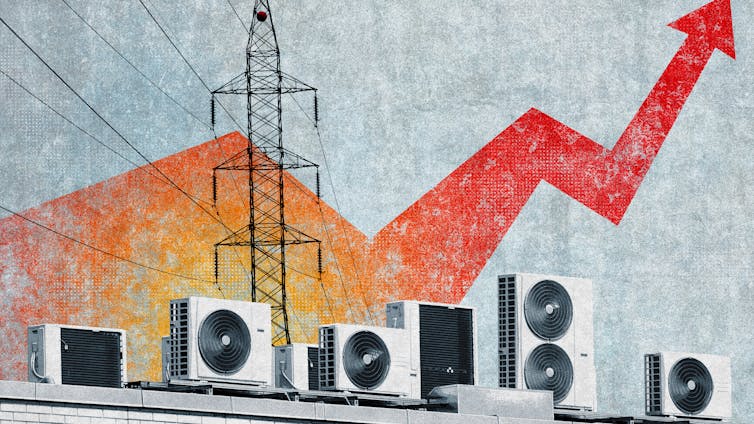
Energy prices are going up – still. zpagistock/Moment via Getty Images

Everyone – politicians and the public – is talking about energy costs. In particular, they’re talking about data centers that drive artificial intelligence systems and their increasing energy demand, electricity costs and strain on the nation’s already overloaded energy grid.

As a former state energy official and utility executive, I know that many of the underlying questions involving energy affordability are very complex and have been festering for decades, in part because of how many groups are involved. Energy projects are expensive and take a long time to build. Where to build them is often also a difficult, even controversial, question. Consumers, regulators, utilities and developers all value energy reliability but have different interests, cost sensitivities and time frames in mind.

The problem of high energy prices is not new, but it is urgent. And it comes at a time when the U.S. is deeply divided on its approaches to energy policy and the politics of solving collective problems.

A person in an elevated bucket works with tools and wires.
To stay reliable, the electricity grid needs long-term investment, not just repairs after storms. Miguel J. Rodriguez Carrillo/Getty Images

Rising costs

From September 2024 to September 2025, average U.S. residential electricity prices have risen 7.4%, from 16.8 to 18 cents per kilowatt-hour. Government analysts expect prices will continue to rise and outpace inflation in 2026.

With household earnings basically flat when adjusted for inflation, these increases hit consumers hard. They take up higher percentages of household expenses – especially for lower-income households. Electricity prices have effects throughout the economy, both directly on consumers’ budgets and indirectly by raising operating costs for business and industry, which pass them along to customers by raising prices for goods and services.

The problem

By 2030, energy analysts expect U.S. electricity demand to rise about 25%, and McKinsey estimates that data centers’ energy use could nearly triple from current levels by that year, using as much as 11.7% of all electricity in the U.S. – more than double their current share.

The nation’s current electricity grid is not ready to supply all that energy. And even if the electricity could be generated, transmission lines are aging and not up to carrying all that power. Their capacity would need to be expanded by about 60% by 2050.

Orders of key generating equipment often face multiyear delays. And construction of new and expanded transmission lines has been very slow.

A Brattle Group analysis estimates all that new and upgraded equipment could cost between US$760 billion and $1.4 trillion in the next 25 years.

The reasons

The enormous scale of the work needed is a result of a lack of investment over time and delays in the investments that have been made.

For instance, since at least 2011 there has been an effort to bring Canadian hydropower to the New England electricity grid. Political opposition to cutting a path for a transmission line through forestland meant the project was subjected to a statewide referendum in Maine – and then a court case that overturned the referendum results. During those delays, inflation raised the estimated price of the project by half, from $1 billion to $1.5 billion – an added cost that will be paid by Massachusetts electricity customers.

That multiyear effort is just one example of how the vast web of companies that generate power, transmit it from power plants to communities, and distribute it to homes and businesses complicates attempts to make changes to the power grid.

State and federal government agencies have roles in these processes. States’ public utilities commissions oversee the utility companies that distribute power to customers. The Federal Energy Regulatory Commission oversees connections of power generators to the grid and the transmission lines that move electricity across state lines.

Often, those efforts aren’t aligned with each other, leading to delays over jurisdiction and decision-making.

For instance, as new generators prepare to operate, whether they are solar farms or gas-fired power plants, they need permission from FERC to connect to the transmission grid. The commission typically requests technical engineering studies to determine how the project would affect the existing system. Delays in this process increase the timeline and cost of development and postpone adding new capacity to the grid.

The costs

A key question for regulators and consumers alike is who should pay for adding more electricity to the grid and making the system more reliable.

Utilities traditionally charge customers for the costs of generating and delivering power. And it’s not clear how much power the data centers will ultimately require.

Some large data centers have taken to paying to build their own on-site power plants, though often they can supply energy to the grid as well.

In some states, efforts have begun to address public concern about electricity bills. In November 2025, two utility commissioners in Georgia, who had consistently approved electricity rate hikes over the previous two years, were voted out of office in a landslide.

New Jersey’s Gov.-elect Mikie Sherrill has pledged to declare a utility-price emergency and freeze costs for a year.

In New York, Gov. Kathy Hochul has paused implementation of state law, driven by environmental concerns, requiring that all new buildings over seven stories tall only use electricity and not natural gas or other energy sources. Hochul has said that requirement would increase electricity demand too much, raising prices and making the grid less stable.

In Massachusetts, Gov. Maura Healey has filed legislation seeking to provide energy affordability, including eliminating some charges from utility bills, capping bill increases and barring utility companies from charging customers for advertisement costs.

A wind turbine stands near a large group of block-shaped buildings.
Generating more power – from wind, nuclear or other sources – is only part of the potential solution. Scott Olson/Getty Images

The solutions

Clearly, there are no quick fixes or easy solutions to this complex situation.

However, innovation in regulation, combined with new technologies and even AI itself, may enable creative regulatory and technical solutions. For instance, devices that can be programmed to use energy efficiently, time-sensitive pricing and demand monitoring to smooth out peaks and valleys in electricity use can potentially ease both grid load and customers’ bills. But those solutions will work only if all the players are willing to cooperate.

There are a lot of ideas about how to lower the public’s burden of paying for data centers’ power. New ideas like this need careful scrutiny and possible revisions to ensure they are effective at lowering costs and increasing reliability.

As the country grapples with the effort to upgrade the grid, perform long-deferred maintenance and build new power plants, consumers’ costs are likely to continue to rise, further increasing pressure on Americans. Existing regulations and government oversight may no longer lower electricity costs immediately or help people plan for the rising costs over the long term.The Conversation

Barbara Kates-Garnick, Professor of Practice in Energy Policy, The Fletcher School, Tufts University

This article is republished from The Conversation under a Creative Commons license. Read the original article.


Feimer appointed as Lake County’s new chief public defender

Details
Written by: Elizabeth Larson
Published: 17 December 2025

LAKE COUNTY, Calif. — The Board of Supervisors on Tuesday appointed an attorney experienced in criminal defense to be the county’s next chief public defender.

The board emerged from a closed session on Tuesday to announce the hire of Thomas Feimer to fill the position, created in 2023.

He succeeds Raymond Buenaventura, who served in the position from October 2023 until this past November, when he left to accept the chief public defender’s job in Monterey County, as Lake County News has reported.

Since Buenaventura’s departure, Senior Deputy County Counsel Carlos Torrez has filled the chief public defender’s position on an interim basis.

In its announcement of Feimer’s hire, the county said he “brings a distinguished record of service, leadership, and commitment to justice, and extensive experience across Northern California’s legal landscape.”

The county also said Feimer has “a strong background in public service and legal advocacy, with experience supporting access to quality legal representation for communities throughout the region. His career reflects a consistent commitment to fairness, integrity, and public service.”

“I look forward to working collaboratively with the community, the courts, and county leadership to ensure every resident receives quality legal representation,” Feimer said in the statement issued by the county.

He holds a Bachelor of Arts degree from the University of California, Irvine, and earned a Juris Doctor from Golden Gate University School of Law, where he focused on public interest and criminal defense. In December 2009, he was admitted to the State Bar of California. 

From 2016 to 2024, he worked as a criminal defense attorney in Lake County. His notable cases included defending Mavrick Fisher, a young deaf man accused of killing another deaf man, Grant David Whitaker, in a 2019 incident which occurred in Humboldt County but was tried in Lake County after Whitaker’s body was found here.

During his first eight years in Lake County, Feimer worked for the county’s indigent defense contractors, first Lake Legal Defense Services and, later, for its successor, Lake Indigent Defense, for which Feimer was one of its partners and administrators. 

When the Board of Supervisors was looking to hire its first chief public defender, Feimer was among the five initial candidates.

Feimer left the contract in the spring of 2024 to take a job with the Mendocino County Public Defender’s Office. 

“I am extremely honored and excited to return to Lake County,” Feimer told Lake County News in a Tuesday email. “I have aspired to this position ever since the County established the Public Defender's office. I look forward to reconnecting with colleagues and friends, meeting new members of the office, and leading a team the community can be proud of — one that delivers strong, ethical defense and earns public trust through outstanding work.”

Feimer said he’s grateful to everyone who encouraged him to apply and supported his application. “It really means a lot.”

Email Elizabeth Larson at This email address is being protected from spambots. You need JavaScript enabled to view it.. Follow her on Twitter, @ERLarson, and on Bluesky, @erlarson.bsky.social. Find Lake County News on the following platforms: Facebook, @LakeCoNews; X, @LakeCoNews; Threads, @lakeconews, and on Bluesky, @lakeconews.bsky.social. 

Redbud Audubon Society to host Christmas Bird Count Dec. 20

Details
Written by: LAKE COUNTY NEWS REPORTS
Published: 17 December 2025
This bald eagle was photographed at Clear Lake State Park. Photo courtesy of Redbud Audubon Society. 

LAKE COUNTY, Calif. — Redbud Audubon Society will carry out its annual Christmas Bird Count on Saturday, Dec. 20.

The Christmas Bird Count, or CBC, is a traditional project of Audubon societies around the country. 

Former participants have been sent information about meeting times and places by the count organizers, Brad and Kathy Barnwell. The public is also welcome to participate and can do so by emailing Redbud Audubon at This email address is being protected from spambots. You need JavaScript enabled to view it. for more information about where you can meet with the different birding groups.

On Sunday, Dec. 21, participants will meet at noon at Kelseyville Pizza for fellowship and to report the final tallies. This event is hosted by Redbud Audubon.

Before the bird count, on Thursday, Dec. 18, starting at 7 p.m. Donna Mackiewicz will host a Zoom Bird Identification program. This will be an extensive slide show featuring birds that are often seen on the annual count and birds that are common to Lake County. 

The program emphasizes the field characteristics of the common and some not-so-common birds here. 

Great egrets will most likely be seen on the Christmas Bird Count. Photo courtesy of Redbud Audubon Society. 


To register for this program, go to www.redbudaudubon.org and click on the registration link on the home page. The link to join will be sent on Thursday before the program.

National Audubon has been holding a Christmas Bird Count for 124 years. The official count period usually starts around the middle of December and ends the first week of January. Local Audubon Societies can decide what day they conduct their counts within this time frame. 

Every individual bird and species encountered during the day is recorded. Each count group has a designated circle of 15 miles in diameter and tries to cover as much ground as possible within a certain period of time.

Newcomers are encouraged to join in on the bird count. You don’t have to be an expert birder to participate. Besides emailing Redbud Audubon, feel free to call Brad or Kathy Barnwell at 707-263-1283 for more information.

Western bluebirds are numerous in parts of the bird count area. Photo courtesy of Redbud Audubon Society. 

Clearlake City Council to select mayor, vice mayor for 2026

Details
Written by: Elizabeth Larson
Published: 17 December 2025

LAKE COUNTY, Calif. — The Clearlake City Council will select its leadership for 2026 when it holds its last regular meeting of the year.

The council will meet at 6 p.m. Thursday, Dec. 18, in the council chambers at Clearlake City Hall, 14050 Olympic Drive.

The agenda can be found here.

The meeting will be broadcast live on the city's YouTube channel or the Lake County PEGTV YouTube Channel. 

Community members also can participate via Zoom. The pass code is 657700. One tap mobile is available at +16694449171,,82771053751#, or join by phone at 669-444-9171 or 646-931-3860.
 
The public will not be allowed to provide verbal comment during the meeting if attending via Zoom. The public can submit comments in writing for City Council consideration by commenting via the Q&A function in the Zoom platform or by sending comments to the Administrative Services Director/City Clerk at This email address is being protected from spambots. You need JavaScript enabled to view it.. To give the City Council adequate time to review your comments, you must submit your written emailed comments prior to 4 p.m. on the day of the meeting.

Thursday’s meeting will begin with the presentation of December’s adoptable dogs along with certificates of appreciation to Winter Fest sponsors and participants.

On the agenda is a public hearing to consider the first reading of an ordinance adopting the 2025 California Building Standards Code update.

The meeting will culminate with presentations thanking Mayor Russ Cremer and Vice Mayor Dirk Slooten for their service this year.

That will be followed by the appointment of the 2026 mayor and vice mayor.

On the meeting’s consent agenda — items that are considered routine in nature and usually adopted on a single vote — includes warrants; minutes of the Oct. 8 Lake County Vector Control Board meeting; the second reading of an ordinance Amending Section 13-3 of the Clearlake Municipal Code regarding fire hydrant inspection, testing and maintenance; and council minutes.

The council also will hold a closed session to discuss a liability claim filed against the city by Rick Edward Evans.

Email Elizabeth Larson at This email address is being protected from spambots. You need JavaScript enabled to view it.. Follow her on Twitter, @ERLarson, and on Bluesky, @erlarson.bsky.social. Find Lake County News on the following platforms: Facebook, @LakeCoNews; X, @LakeCoNews; Threads, @lakeconews, and on Bluesky, @lakeconews.bsky.social. 

  1. My prescription costs what?! Pharmacists offer tips that could reduce your out-of-pocket drug costs
  2. Lakeport Unified engages students in school redesign process
  3. Former CDC director and chief medical officer hired to consult, join California for launch of Public Health Network Innovation Exchange
  • 62
  • 63
  • 64
  • 65
  • 66
  • 67
  • 68
  • 69
  • 70
  • 71
How to resolve AdBlock issue?
Refresh this page