How to resolve AdBlock issue?
Refresh this page
How to resolve AdBlock issue?
Refresh this page
Lake County News,California
  • Home
    • Registration Form
  • News
    • Education
    • Veterans
    • Community
      • Obituaries
      • Letters
      • Commentary
    • Police Logs
    • Business
    • Recreation
    • Health
    • Religion
    • Legals
    • Arts & Life
    • Regional
  • Calendar
  • Contact us
    • FAQs
    • Phones, E-Mail
    • Subscribe
  • Advertise Here
  • Login
How to resolve AdBlock issue?
Refresh this page

News

Agencies, organizations partner to bring Christmas to child victims of crime

Details
Written by: LAKE COUNTY NEWS REPORTS
Published: 20 December 2025

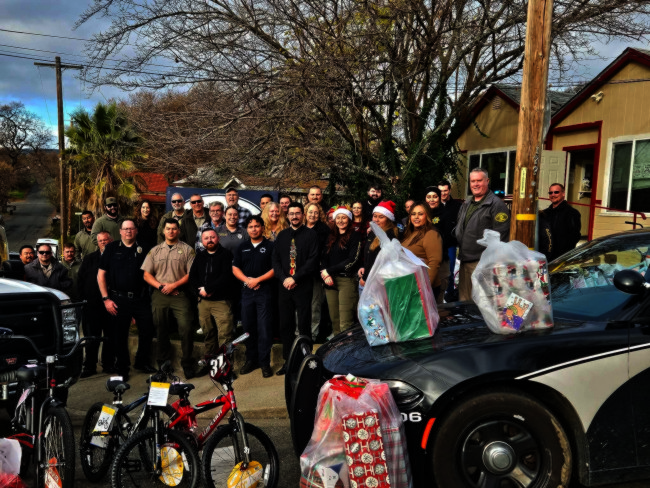
The Lake County District Attorney’s Office Victim/Witness Division and its partners gathered to bring Christmas to children who have suffered trauma. Courtesy photo.


LAKE COUNTY, Calif. — This Christmas, several county agencies have once again partnered with churches, schools and other organizations to bring Christmas to children in need.

Every year, the Lake County District Attorney’s Office Victim/Witness Division assists over 1,000 people through their traumatic experiences, and many of them are
children.

It has been a long-standing tradition during Christmas, where the Victim/Witness Division teams up with local organizations and law enforcement agencies around the lake to spread holiday cheer.

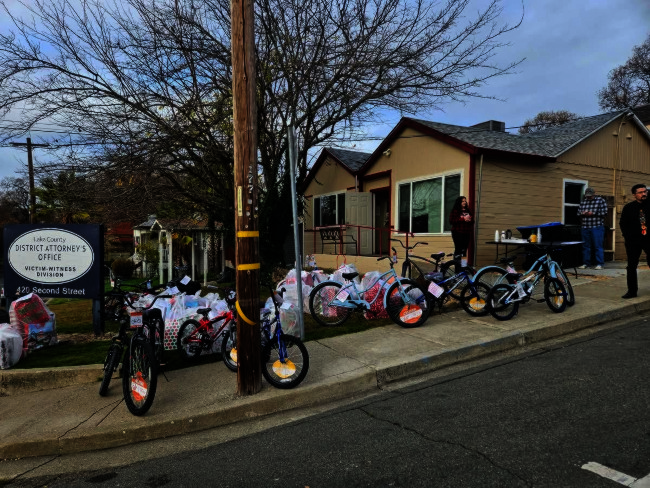
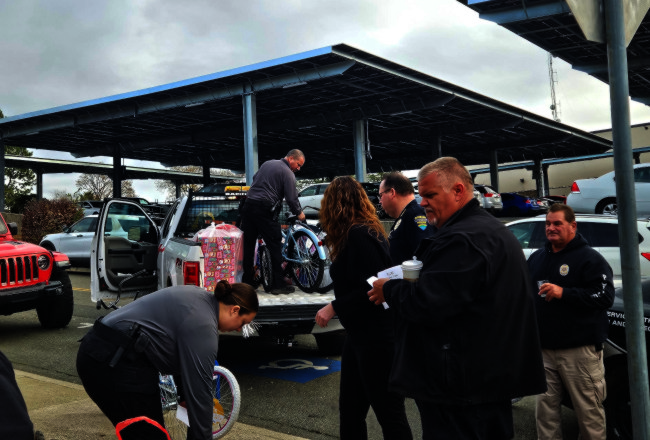
The local organizations supply all the gifts, and the law enforcement agencies deliver the gifts to bring a brighter Christmas to the children that have experienced trauma. 

The agencies and organizations collected Christmas gifts, including bicycles. Courtesy photo.


This year, they delivered presents to 92 children in our community, and they said they could not have done it without the assistance and generosity of several people and organizations.

Those who assisted the effort include the Guy Fieri Foundation, Pastor Rick Barnes, Pastor David Moon-Wainwright, Lake County Bible Fellowship, United Christian Parish, Rotary Club of Lakeport, Galilee Lutheran Church, Konocti Christian Academy, Lake County Auditor’s Office and the Lake County Assessor-Recorder’s Office.

The Victim/Witness Division offered huge thanks to the law enforcement partners who every year assist them in delivering all the gifts.

Those partners include the Clearlake Police Department, Lake County Sheriff’s Office, Lakeport Police Department and Lake County Probation.

Law enforcement agencies delivered the gifts to the families. Courtesy photo.

Continuing atmospheric river storm forecast leads to flood watch for Lake County            

Details
Written by: Elizabeth Larson
Published: 20 December 2025

LAKE COUNTY, Calif. — After a Friday of steady rain and with an atmospheric river storm incoming, Lake County is set to go under a flood watch through the weekend.

The National Weather Service has issued a flood watch that will be in effect from 4 p.m. Saturday through 4 p.m. Monday.

The forecast says a Pacific storm track is bringing an atmospheric river that will move into Mendocino and Lake counties starting Saturday afternoon and continuing into Monday.

That storm track could potentially bring more heavy rainfall and strong southerly winds through much of next week, the National Weather Service reported.

The National Weather Service’s Eureka office said 3 to 5 inches of rain could fall during the duration of the flood watch.

That raises concerns for rising creeks and drainages, as well as rock and mudslides along roads and highways.

Besides heavy rain, the flood watch said there is the possibility that by early next week, snow levels could fall to as low as 3,500 to 4,500 feet.

The Lake County forecast expects rain through next Friday, with no break for Christmas.

Temperatures over the coming week are forecast to be in the low 50s during the day and the low 40s at night. 

Winds with gusts of more than 20 miles per hour are also in the forecast through the weekend.

Email Elizabeth Larson at This email address is being protected from spambots. You need JavaScript enabled to view it.. Follow her on Twitter, @ERLarson, and on Bluesky, @erlarson.bsky.social. Find Lake County News on the following platforms: Facebook, @LakeCoNews; X, @LakeCoNews; Threads, @lakeconews, and on Bluesky, @lakeconews.bsky.social. 

Where the wild things thrive: Finding and protecting nature’s climate change safe havens

Details
Written by: Toni Lyn Morelli, UMass Amherst; U.S. Geological Survey and Diana Stralberg, University of Alberta
Published: 20 December 2025

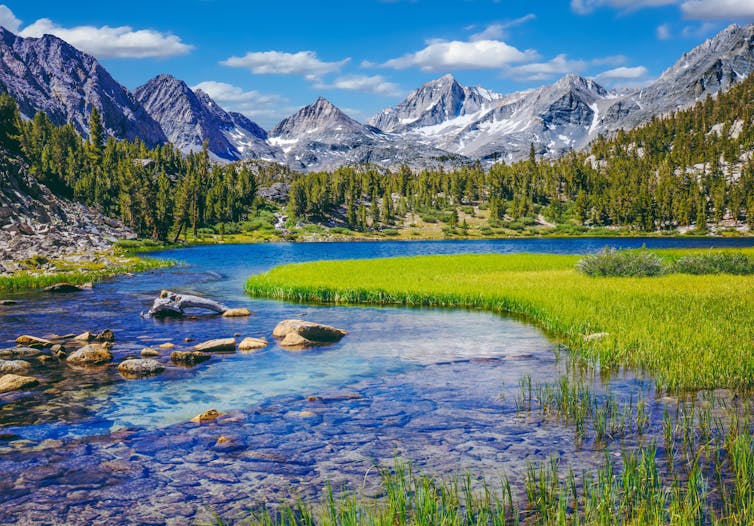
Much wildlife relies on cool streams and lush meadows in the Sierra Nevada. Ron and Patty Thomas/E+ via Getty Images

The idea began in California’s Sierra Nevada, a towering spine of rock and ice where rising temperatures and the decline of snowpack are transforming ecosystems, sometimes with catastrophic consequences for wildlife.

The prairie-doglike Belding’s ground squirrel (Urocitellus beldingi) had been struggling there as the mountain meadows it relies on dry out in years with less snowmelt and more unpredictable weather. At lower elevations, the foothill yellow-legged frog (Rana boylii) was also being hit hard by rising temperatures, because it needs cool, shaded streams to breed and survive.

A ground squirrel with a skinny tail sits up on its back legs.
A Belding’s ground squirrel in the Sierra Nevada. Toni Lyn Morelli

As we studied these and other species in the Sierra Nevada, we discovered a ray of hope: The effects of warming weren’t uniform.

We were able to locate meadows that are less vulnerable to climate change, where the squirrels would have a better chance of thriving. We also identified streams that would stay cool for the frogs even as the climate heats up. Some are shaded by tree canopy. Others are in valleys with cool air or near deep lakes or springs.

These special areas are what we call climate change refugia.

Identifying these pockets of resilient habitat – a field of research that was inspired by our work with natural resource managers in the Sierra Nevada – is now helping national parks and other public and private land managers to take action to protect these refugia from other threats, including fighting invasive species and pollution and connecting landscapes, giving threatened species their best chance for survival in a changing climate.

An illustration shows protected lakes and glaciers and shaded streams
Examples of climate change refugia. Toni Lyn Morelli, et al., 2016, PLoS ONE, CC BY

Across the world, from the increasingly fire-prone landscapes of Australia to the glacial ecosystems at the southern tip of Chile, researchers, managers and local communities are working together to find and protect similar climate change refugia that can provide pockets of stability for local species as the planet warms.

A new collection of scientific papers examines some of the most promising examples of climate change refugia conservation. In that collection, over 100 scientists from four continents explain how frogs, trees, ducks and lions stand to benefit when refugia in their habitats are identified and safeguarded.

People walk along a mountain ridge with a glacier in the background.
Chile has been rapidly losing its glaciers as global temperatures rise. Humans and wildlife depend on them for water. Joaquin Fernandez

Saving songbirds in New England

The study of climate change refugia – places that are buffered from the worst effects of global warming – has grown rapidly in recent years.

In New England, managers at national parks and other protected areas were worried about how species are being affected by changes in climate and habitat. For example, the grasshopper sparrow (Ammodramus savannarum), a little grassland songbird that nests in the open fields in the eastern U.S. and southern Canada, appears to be in trouble.

We studied its habitats and projected that less than 6% of its summer northeastern U.S. range will have the right temperature and precipitation conditions by 2080.

The grasshopper sparrow. American Bird Conservancy

The loss of songbirds is not only a loss of beauty and music. These birds eat insects and are important to the balance of the ecosystem.

The sand plain grasslands that the grasshopper sparrow relies on in the northeastern U.S. are under threat not only from changes in climate but also changes in how people use the land. Public land managers in Montague, Massachusetts, have used burning and mowing to maintain habitat for nesting grasshopper sparrows. That effort also brought back the rare frosted elfin butterfly for the first time in decades.

Protecting Canada’s vast forest ecosystems

In Canada, the climate is warming at about twice the global average, posing a threat to its vast forested landscapes, which face intensifying drought, insect outbreaks and destructive wildfires.

We have been actively mapping refugia in British Columbia, looking for shadier, wetter or more sheltered places that naturally resist the worst effects of climate change.

A young moose and an adult moose run through a meadow.
Forests and wetlands used by moose and other wildlife are becoming more vulnerable to climate change as temperatures rise. Alexej Sirén, Northeast Wildlife Monitoring Network

The mapping project will help to identify important habitat for wildlife such as moose and caribou. Knowing where these climate change refugia are allows land-use planners and Indigenous communities to protect the most promising habitats from development, resource extraction and other stressors.

British Columbia is undertaking major changes to forest landscape planning in partnership with First Nations and communities.

Lions, giraffes and elephants (oh, my!)

On the sweeping vistas of East Africa, dozens of species interact in hot spots of global biodiversity. Unfortunately, rising temperatures, prolonged drought and shifting seasons are threatening their very existence.

In Tanzania, working with government agencies and conservation groups through past USAID funding, we mapped potential refugia for iconic savanna species including lions, giraffes and elephants. These areas include places that will hold water in drought and remain cooler during heat waves. The iconic Serengeti National Park, home to some of the world’s most famous wildlife, emerged as a key location for climate change refugia.

Giraffe wander among trees with a mountain in the distance.
In East Africa, climate change refugia remain cooler and hold water during droughts. Protecting them can help protect the region’s iconic wildlife. Toni Lyn Morelli

Combining local knowledge with spatial analysis is helping prioritize areas where big cats, antelope, elephants and the other great beasts of the Serengeti ecosystem can continue to thrive – provided other, nonclimate threats such as habitat loss and overharvesting are kept at bay.

The Tanzanian government has already been working with U.S.-funded partners to identify corridors that can help connect biodiversity hot spots.

Hope for the future

By identifying and protecting the places where species can survive the longest, we can buy crucial decades for ecosystems while conservation efforts are underway and the world takes steps to slow climate change.

Across continents and climates, the message is the same: Amid our rapidly warming world, pockets of resilience remain for now. With careful science and strong partnerships, we can find climate change refugia, protect them and help the wild things continue to thrive.The Conversation

Toni Lyn Morelli, Adjunct Full Professor of Environmental Conservation, UMass Amherst; U.S. Geological Survey and Diana Stralberg, Adjunct professor, Department of Renewable Resources, University of Alberta

This article is republished from The Conversation under a Creative Commons license. Read the original article.

Rains lead to wet weather trail closure on Mendocino National Forest’s Upper Lake District

Details
Written by: Elizabeth Larson
Published: 20 December 2025

MENDOCINO NATIONAL FOREST, Calif. — Mendocino National Forest officials have issued a wet weather trail closure on the Upper Lake Ranger District's off-highway vehicle, or OHV, trails, effective at 8 a.m. on Saturday, Dec. 20.

Temporary trail closures go into effect when 2 inches of rainfall occur within a 24-hour period or when soils are saturated.

Wet weather trail closures restrict the use of motor vehicles on National Forest System trails when conditions are too wet to sustain use without causing soil loss, impacting water quality, damaging trail tread and putting public safety at risk.

Updates on wet weather closures will be posted on the forest's website under alerts and on the forest's social media. Forest alerts can be found at https://www.fs.usda.gov/r05/mendocino/alerts. 

Users can also subscribe to receive email updates from the forest at https://www.fs.usda.gov/r05/mendocino/keep-in-touch. 

In accordance with the administration’s presidential action, Forest Service offices will be closed Dec. 24 to 26 in observance of the federal holiday. National forests and grasslands will remain open for your enjoyment.

  1. Space News: The next frontier in space is closer than you think – welcome to the world of very low Earth orbit satellites
  2. Lake County Public Works interim director lays out five-year plan for road pavement
  3. Clearlake Animal Control: ‘Sammy’ and the dogs
  • 59
  • 60
  • 61
  • 62
  • 63
  • 64
  • 65
  • 66
  • 67
  • 68
How to resolve AdBlock issue?
Refresh this page