How to resolve AdBlock issue?
Refresh this page
How to resolve AdBlock issue?
Refresh this page
Lake County News,California
  • Home
    • Registration Form
  • News
    • Education
    • Veterans
    • Community
      • Obituaries
      • Letters
      • Commentary
    • Police Logs
    • Business
    • Recreation
    • Health
    • Religion
    • Legals
    • Arts & Life
    • Regional
  • Calendar
  • Contact us
    • FAQs
    • Phones, E-Mail
    • Subscribe
  • Advertise Here
  • Login
How to resolve AdBlock issue?
Refresh this page

News

My prescription costs what?! Pharmacists offer tips that could reduce your out-of-pocket drug costs

Details
Written by: Sujith Ramachandran, University of Mississippi and Adam Pate, University of Mississippi
Published: 17 December 2025

Out-of-pocket costs to fill prescriptions can vary widely. Malte Mueller/fStop via Getty Images

Even when Americans have health insurance, they can have a hard time affording the drugs they’ve been prescribed.

About 1 in 5 U.S. adults skip filling a prescription due to its cost at least once a year, according to KFF, a health research organization. And 1 in 3 take steps to cut their prescription drug costs, such as splitting pills when it’s not medically necessary or switching to an over-the-counter drug instead of the one that their medical provider prescribed.

As pharmacy professors who research prescription drug access, we think it’s important for Americans to know that it is possible to get prescriptions filled more affordably, as long as you know how before you go to the pharmacy.

Cost of copays ranges widely

When you have health insurance and have to pay for a prescription drug at the pharmacy, you’re usually covering the cost of your copay. This is the amount patients or their caregivers are expected to pay after insurance covers the rest of the tab.

If you get your health insurance through Medicaid, the government program that covers low-income Americans and people with disabilities, you should not have to pay anything at all to obtain prescription drugs. If there is a copay, it should be low – probably less than US$5.

And if you’re insured through Medicare, the government program that mainly covers people who are 65 and older, or get your coverage through a private health insurance company, it’s important to understand what to expect when you visit a pharmacy.

Most private insurance companies charge US$5 to $50 for prescription drug copays. The copays are tiered based on what the drug costs. Brand-name and specialty medications have higher copays; older generics have lower copays.

Some generic drugs and vaccines may even require no copay at all. While a copay is a flat fee, it can change over the course of the year based on whether or not you have met your deductible. The deductible is the amount of money you have to pay out of pocket before your insurance starts covering your prescriptions. Before your deductible is fully paid, you may be responsible for the full cost of your medications. After you’ve met your deductible for the year, you will only be required to pay the copay.

As newer, more expensive drugs enter the market, cost-sharing at the pharmacy has increasingly shifted from a copay to coinsurance.

In contrast with a flat copay, coinsurance means your insurance company will cover a certain percentage of the drug’s cost, and you’ll pay the rest. Since the patient’s share is based on a percentage of the medication’s price, coinsurance often results in higher out-of-pocket costs than copays do.

New help for patients with Medicare coverage

Two new government programs could help make prescription drugs more affordable for millions of older Americans.

Starting in 2026, people who are insured through Medicare will pay no more than $2,100 out of pocket on prescription drugs over the year. That cap may be much lower than $2,100 due to a quirk in Medicare’s rules. Prescriptions filled after someone has paid the maximum allowable amount will cost them nothing at all.

In addition, the government launched the Medicare Prescription Payment Plan in 2025. This program, which is available to people over 65, helps spread what patients spend out of pocket on prescription drugs throughout the year, making that expense more predictable and easier to budget for.

Early data indicates that very few Americans are enrolled in the Medicare Prescription Payment Plan. Patients insured through private companies do not have similar opportunities.

Consumers should find out if they qualify for state or federal programs on their medications.

Coupons and discount cards

What if you can’t afford a copay for your prescription drug?

Before giving up on ever getting it, ask the pharmacist about your options.

It may be worth trying to use a free online tool, such as RxAssist, sponsored by the Robert Wood Johnson Foundation, or a discount card from GoodRx, which is a publicly traded company.

GoodRx cards are free. They help people compare local pharmacy prices and to locate coupons that make prescriptions more affordable.

GoodRx works by searching for the lowest available price for the prescription at various pharmacies. Other copay coupons provided by the drug manufacturer may also work similarly by lowering the cost of the medication. On some occasions, the cash price at the pharmacy may actually be cheaper than the copay, and the pharmacist should be able to help you navigate these options.

Here’s what you should know before giving GoodRx a try:

  1. GoodRx collects individual data on patients, raising significant privacy concerns.

  2. Some pharmacies do not accept GoodRx. You may have to visit more than one pharmacy to be able to activate its discounts.

  3. These cards may make the most sense for uninsured or underinsured patients, but do not always help those who have insurance because you might not get a better price. What’s more, if you use a discount card, the amount you pay may not count toward your insurance deductible for the year.

You should weigh the caveats closely depending on your circumstance.

A male pharmacist scanning a pharmacy product for his customer.
Your pharmacist can help you navigate the various discount offerings. CG Tan/E+ via Getty Images

Prescription assistance programs

Prescription assistance programs provide another cost-saving tool for Americans.

Drugmakers, nonprofits and government agencies sponsor those programs, which help patients who are uninsured or underinsured – even if they are on Medicare – fill prescriptions either at a discount or for free.

These programs include manufacturer-specific programs as well as charitable pharmacies like Dispensary of Hope, NOVA Scripts Central and the Patient Advocate Foundation. Qualifying criteria vary for these programs, but typically you must have a low income and be a citizen or a legal U.S. resident.

The Patient Access Network Foundation and RxAssist, two nonprofits that help Americans pay their medical bills, also offer helpful tools to identify programs that could work for you.

Assistance from these programs could cut your copay or even provide a prescription drug at no cost.

Separately, the Trump administration announced in November 2025 that a new White House prescription drug pricing program will soon begin to connect consumers to companies that have agreed to sell certain prescription drugs at a big discount.

Many experts don’t expect the program, known as TrumpRx, to help people who have health insurance. Instead, it could be most likely to help those with no insurance at all. The new government program is slated to begin to roll out in 2026.

Direct-to-consumer models

Beyond coupons and assistance programs, a more radical shift is in the works: direct-to-consumer platforms and cash-payment models.

In 2025, several manufacturers offered to sell medications directly to patients on websites and patient portals at cash prices. For example, the drug manufacturer Eli Lilly is offering its popular weight-loss medication, Zepbound, on its website.

These websites have out-of-pocket costs that can run upward of $300 a month, making them too high for many, if not most, Americans to afford. And insurance companies have so far refused to cover them.

To be sure, the systems underlying these programs are still being built. We believe that the Trump administration would need to make a bigger effort to make it easier for millions of Americans to be able to afford filling their prescriptions.The Conversation

Sujith Ramachandran, Associate Professor of Pharmacy Administration, University of Mississippi and Adam Pate, Clinical Professor of Pharmacy Practice, University of Mississippi

This article is republished from The Conversation under a Creative Commons license. Read the original article.

Lakeport Unified engages students in school redesign process

Details
Written by: LAKE COUNTY NEWS REPORTS
Published: 16 December 2025
Lakeport Unified School District Superintendent Dr. Matt Bullard hearing feedback from a student during the School Redesign Process that occurred on Monday, Dec. 8, 2025. Courtesy photo.

 
LAKEPORT, Calif. — Students in grades fifth through 12th across Lakeport Unified School District participated in school redesign input sessions last week, offering insight into what they want their future school experience to include.

Officials said this is an essential step in shaping the future of teaching and learning in the district. 

These sessions asked students to share what they want their school experience to look and feel like, ensuring that the learner voice is central in the district’s long-term improvement work.

Students shared that they are looking for expanded career technical education, or CTE, and job-based learning opportunities, more diverse food options, and learning environments that reflect why they come to school.

“Listening to our students’ input truly grounds this work in what matters most,” said Superintendent Dr. Matt Bullard. “Their feedback affirms that they want rigorous learning connected to the real world, caring relationships, and a school experience that prepares them for life beyond graduation.”

The student engagement sessions are part of Phase II of the school redesign process. Phase I established the district’s core values, guiding principles, and a portrait of a graduate.

With the data from the students, Lakeport Unified will identify priority design areas over the next several months. Recommendations will go to the board in spring 2026 to support a fall 2026 launch of pilot redesign efforts.

Lakeport Unified’s redesign work is grounded in the belief that every learner must have opportunities to thrive personally, academically and socially. While the district maintains high graduation rates, it recognizes the urgency of improving literacy and numeracy outcomes and reimagining learning experiences.

The district said its core values — accountability, community, creativity, equity, growth/improvement, integrity, service and well-being — form the foundation for decision-making and daily practice. These values are operationalized through five guiding principles, including building belonging and trust, understanding each learner, connecting learning to real-world purpose, learning from the past and maintaining high expectations with responsive supports.

By summer 2026, Lakeport Unified will synthesize its learning into a “Bridge to 2026” strategic plan and begin preparing design teams for implementation. Pilot redesign initiatives will launch in fall 2026, beginning with small, measurable tests of change before scaling districtwide.

Lakeport Unified said it is committed to designing schools with students, not just for them.

Officials said last week’s student input sessions reaffirm the district’s dedication to listening to learners, elevating community voice, and shaping a future where every student experiences meaningful, engaging and equitable learning.

Former CDC director and chief medical officer hired to consult, join California for launch of Public Health Network Innovation Exchange

Details
Written by: LAKE COUNTY NEWS REPORTS
Published: 16 December 2025

On Monday, Gov. Gavin Newsom announced the launch of the Public Health Network Innovation Exchange, or PHNIX, a new California-led initiative to modernize public health infrastructure and maintain trust in science-driven decision-making. 

To lead this work, the state is engaging some of the nation’s most respected public health voices to consult on this initiative, including Dr. Susan Monarez, former director of the Centers for Disease Control and Prevention; Dr. Debra Houry, former CDC chief medical officer; and Dr. Katelyn Jetelina, founder and CEO of Your Local Epidemiologist.

These national leaders will work alongside the governor and the California Department of Public Health, or CDPH, to drive public health innovation, strengthen collaboration across states and institutions, and improve how critical health information is communicated — filling the vacuum left by what Newsom’s office called the Trump administration’s systematic retreat from science and evidence-based public health. 

PHNX will serve as a hub for advancing modern tools, best-in-class science, and coordinated responses to emerging health threats. 

“The Public Health Network Innovation Exchange is expected to bring together the best science, the best tools, and the best minds to advance public health. By bringing on expert scientific leaders to partner in this launch, we’re strengthening collaboration and laying the groundwork for a modern public health infrastructure that will offer trust and stability in scientific data not just across California, but nationally and globally,” Newsom said.

“Dramatic and unfounded changes in federal policy, funding, and scientific practice have created uncertainty and instability in public health and health care,” said Dr. Erica Pan, CDPH director and state Public Health officer. “I am thrilled to work with these advisors to catalyze our efforts to lead a sustainable future for public health. California is stepping up to coordinate and build the scaffolding we need to navigate this moment.”

Public Health Network Innovation Exchange

California remains committed to science-driven decision-making, nurturing healthy communities, and protecting individuals’ freedom to make evidence-based health choices. 

PHNIX is a direct response to the federal dismantling of national disease prevention, protection, and tracking programs, the termination of life-saving health programs and erosion of evidence and science-based policies, and the withdrawal from the global public health community. 

With PHNIX, California is taking action to build coalitions across the nation that will work to lead in innovation, collaboration, and communication in public health.

National expertise and support

Dr. Monarez, a globally recognized leader in health innovation, biomedical technology, and global health security, is the most recent CDC director — appointed by President Trump and confirmed by the U.S. Senate — and will serve as a strategic health technology and funding advisor for PHNIX.

In that role, she will lead the development of relationships and collaborations with private sector, technology, and academic partners. These partnerships will advance technological innovations that can be explored in California and potentially scaled nationally to improve public health data integration within the health care system, allowing for more timely and efficient disease monitoring and response. Innovation in technology and funding will promote sustainability of public health amidst the changing landscape for federal support and systems.

Dr. Houry, a physician, public health executive, and recent CDC chief medical officer under the Trump administration, will serve as a senior regional and global public health medical advisor for PHNIX. Dr. Houry will engage existing public health alliances and organizations to develop a larger and more sustainable public health network across the local to global spectrum. This collaboration is critical at a time when our public health community needs to coordinate our response to evolving gaps in federal leadership.

Dr. Katelyn Jetelina, an epidemiologist and one of the nation’s leading scientific communicators, will advise CDPH on the critical need to maintain public confidence in the institutions that keep Californians safe. 

CDPH is the launch partner for “Project Stethoscope,” a program of Your Local Epidemiologist led by Dr. Jetelina that helps rebuild connections between communities and public health institutions by leveraging expert informed social media monitoring, community-driven insights, and targeted research to understand the health questions and needs of Californians.

“I am deeply excited to bring my experience in health technology and innovation to support PHNIX,” said Dr. Monarez. “California has an extraordinary concentration of talent, technology, and investment, and this effort is about putting those strengths to work for the public good — modernizing how public health operates, accelerating innovation, and building a healthier, more resilient future for all Californians.”

“I am excited to bring my experience in regional, national, and global public-health partnerships and programs to support this work,” said Dr. Houry. “California will advance practical, scalable solutions that strengthen public health within the state and across states — showing how states can modernize data, share capacity, and work together more efficiently, while remaining focused on protecting people and communities.”

“We’re living in a chaotic health information environment, and too often people are left to sort it out on their own," said Dr. Jetelina. "It’s time to step up and transform systems to put people first, starting with California. This means listening to questions and confusion on the ground, partnering with voices communities already trust, and empowering people with the information they need to make evidence-informed decisions for themselves and their families.” 

Additional information on PHNIX

PHNIX will focus on innovation, developing advanced technology, and funding frameworks to secure a sustainable future for public health preparedness and response.

Information infrastructure: Improve systems to detect trends, investigate issues, and protect privacy.

Technology development: Focus on artificial intelligence, information infrastructure, and design for multi-state and global health partnerships with private and academic sectors

Funding frameworks: Propose design for multi-state and global health partnerships with private and academic sectors to secure sustainable funding and tools for public health California will continue to build on its collaboration and leadership in evolving regional and global partnerships to develop this larger consortium, including: 

• The West Coast Health Alliance, a group of state and public health officials from California, Washington, Oregon, and Hawaii.
• The Governors Public Health Alliance, a 15-state nonpartisan alliance to coordinate and sustain global situational awareness. 
• California was the first state in the United States to join the World Health Organization Global Outbreak Alert Response Network.
• Other existing or evolving public health organizations and partners across the nation.

California will work with partners to improve communication reach and effectiveness to empower communities to make healthy choices.

CDPH is the launch partner for “Project Stethoscope" with Your Local Epidemiologist led by Dr. Jetelina, a program to re-think how public health departments can communicate and engage directly with communities and stakeholders to empower people to make healthy decisions. 

Project Stethoscope will use social media monitoring, community-driven insights, and targeted research to better inform the department on the health concerns and needs of Californians.

In partnership with Covered California and UC San Francisco’s California Collaborative for Public Health Research, CDPH has launched the Public Health for All Californians Together Coalition, a network of public health and medical professionals, health system leaders, researchers, and community health advocates, working to build trust and strengthen community well-being by sharing timely, evidence-based guidelines and culturally appropriate health messaging to promote a Healthy California for All.

2025’s extreme weather had the jet stream’s fingerprints all over it, from flash floods to hurricanes

Details
Written by: Shuang-Ye Wu, University of Dayton
Published: 16 December 2025


The summer of 2025 brought unprecedented flash flooding across the U.S., with the central and eastern regions hit particularly hard. These storms claimed hundreds of lives across Texas, Kentucky and several other states and caused widespread destruction.

At the same time, every hurricane that formed, including the three powerful Category 5 storms, steered clear of the U.S. mainland.

Both scenarios were unusual – and they were largely directed by the polar jet stream.

What is a jet stream?

Jet streams are narrow bands of high-speed winds in the upper troposphere, around four to eight miles (seven to 13 kilometers) above the surface of the Earth, flowing west to east around the entire planet. They form where strong temperature contrasts exist.

Each hemisphere hosts two primary jet streams:

a globe showing the polar and subtropical jet streams in both the Northern and Southern Hemispheres.
The polar and subtropical jet streams in positions similar to much of summer 2025. NOAA

The polar jet stream is typically found near 50 to 60 degrees latitude, across Canada in the Northern Hemisphere, where cold polar air meets warmer midlatitude air. It plays a major role in modulating weather systems in the midlatitudes, including the continental U.S. With winds up to 200 mph, it’s also the usual steering force that brings those bitter cold storms down from Canada.

The subtropical jet stream is typically closer to 30 degrees latitude, which in the Northern Hemisphere crosses Florida. It follows the boundary between tropical air masses and subtropical air masses. It’s generally the weaker and steadier of the two jet streams.

Illustration shows earth an air circulation cells above it.
A cross section of atmospheric circulations shows where the jet streams exist between large cells of rising and falling air, movements largely driven by solar heating in the tropics. NOAA

These jet streams act like atmospheric conveyor belts, steering storm systems across continents.

Stronger (faster) jet streams can intensify storm systems, whereas weaker (slower) jet streams can stall storm systems, leading to prolonged rainfall and flooding.

2025’s intense summer of flooding

Most summers, the polar jet stream retreats northward into Canada and weakens considerably, leaving the continental U.S. with calmer weather. When rainstorms pop up, they’re typically caused by localized convection due to uneven heating of the land – picture afternoon pop-up thunderstorms.

During the summer of 2025, however, the polar jet stream shifted unusually far south and steered larger storm systems into the midlatitudes of the U.S. At the same time, the jet stream weakened, with two critical consequences.

First, instead of moving storms quickly eastward, the sluggish jet stream stalled storm systems in place, causing prolonged downpours and flash flooding.

Second, a weak jet stream tends to meander more dramatically. Its broad north-south swings in summer 2025 funneled humid air from the Gulf of Mexico deep into the interior, supplying storm systems with abundant moisture and intensifying rainfall.

Three people in a small boat on a river with a building behind them. The wall is torn off and debris is on the river banks.
Search-and-rescue crews look for survivors in Texas Hill Country after a devastating July 4, 2025, flash flood on the Guadalupe River swept through a girls’ camp, tearing walls off buildings. Ronaldo Schemidt/AFP via Getty Images

This moisture surge was amplified by unusually warm conditions over the Atlantic and Gulf regions. A warmer ocean evaporates more water, and warmer air holds a greater amount of moisture. As a result, extraordinary levels of atmospheric moisture were directed into storm systems, fueling stronger convection and heavier precipitation.

Finally, the wavy jet stream became locked in place by persistent high-pressure systems, anchoring storm tracks over the same regions. This led to repeated episodes of heavy rainfall and catastrophic flooding across much of the continental U.S. The same behavior can leave other regions facing days of unrelenting heat waves.

The jet stream buffered US in hurricane season

The jet stream also played a role in the 2025 hurricane season.

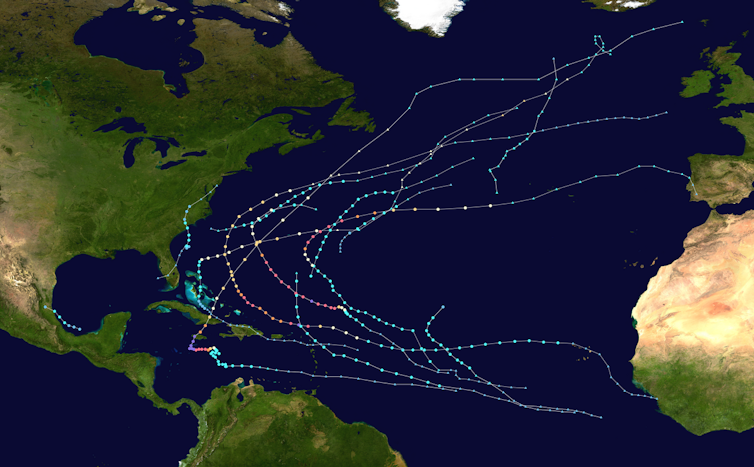
Given its west-to-east wind direction, the southward dip of the jet stream – along with a weak high pressure system over the Atlantic – helped steer all five hurricanes away from the U.S. mainland.

The 2025 Atlantic hurricane season’s storm tracks show how most of the storms steered clear of the U.S. mainland and veered off into the Atlantic. Sandy14156/Wikimedia Commons

Most of the year’s 13 tropical storms and hurricanes veered off into the Atlantic before even reaching the Caribbean.

An animation shows the direction of steering winds over four days
Charts of high-level steering currents over five days, Oct. 23-27, 2025, show the influences that kept Hurricane Melissa (red dot) in place for several days. The strong curving winds in red are the jet stream, which would help steer Melissa northeastward toward the open Atlantic. Cooperative Institute for Meteorological Satellite Studies/University of Wisconsin-Madison, CC BY-ND

Climate change plays a role in these shifts

So, how does climate change influence the jet stream?

The strength of jet streams is controlled by the temperature contrast between the equatorial and polar regions.

A higher temperature contrast leads to stronger jet streams. As the planet warms, the Arctic is heating up at more than twice the global average rate, and that is reducing the equator-to-pole temperature difference. As that temperature gradient weakens, jet streams lose their strength and become more prone to stalling.

A chart shows rising temperatures in the Arctic
The Arctic has been warming two times faster than the planetary average. NOAA Arctic Report Card 2024

This increases the risk of persistent extreme rainfall events.

Weaker jet streams also meander more, producing larger waves and more erratic behavior. This increases the likelihood of unusual shifts, such as the southward swing of the jet stream in the summer of 2025.

A recent study found that amplified planetary waves in the jet streams, which can cause weather systems to stay in place for days or weeks, are occurring three times more frequently than in the 1950s.

What’s ahead?

As the global climate continues to warm, extreme weather events driven by erratic behavior of jet streams are expected to become more common. Combined with additional moisture that warmer oceans and air masses supply, these events will intensify, producing storms that are more frequent and more destructive to societies and ecosystems.

In the short term, the polar jet stream will be shaping the winter ahead. It is most powerful in winter, when it dips southward into the central and even southern U.S., driving frequent storm systems, blizzards and cold air outbreaks.The Conversation

Shuang-Ye Wu, Professor of Geology and Environmental Geosciences, University of Dayton

This article is republished from The Conversation under a Creative Commons license. Read the original article.

  1. Attorney General Bonta blocks Trump Administration from penalizing California for its own erroneous guidance on SNAP eligibility
  2. Board of Supervisors to consider biochar project appeal, discuss further revising contract for Cobb road work
  3. Lakeport City Council to election leadership, discuss park trail development licensing agreement
  • 63
  • 64
  • 65
  • 66
  • 67
  • 68
  • 69
  • 70
  • 71
  • 72
How to resolve AdBlock issue?
Refresh this page