How to resolve AdBlock issue?
Refresh this page
How to resolve AdBlock issue?
Refresh this page
Lake County News,California
  • Home
    • Registration Form
  • News
    • Education
    • Veterans
    • Community
      • Obituaries
      • Letters
      • Commentary
    • Police Logs
    • Business
    • Recreation
    • Health
    • Religion
    • Legals
    • Arts & Life
    • Regional
  • Calendar
  • Contact us
    • FAQs
    • Phones, E-Mail
    • Subscribe
  • Advertise Here
  • Login
How to resolve AdBlock issue?
Refresh this page

News

Space News: Lower-cost space missions like NASA’s ESCAPADE are starting to deliver exciting science – but at a price in risk and trade‑offs

Details
Written by: Ari Koeppel, Dartmouth College
Published: 13 December 2025

This artist’s rendering shows the ESCAPADE probes near Mars. NASA

After a yearslong series of setbacks, NASA’s Escape and Plasma Acceleration and Dynamics Explorers, or ESCAPADE, mission has finally begun its roundabout journey to Mars.

Launched on Nov. 13, 2025, aboard Blue Origin’s New Glenn rocket, ESCAPADE’s twin probes will map the planet’s magnetic field and study how the solar wind – the stream of charged particles released from the Sun – has stripped away the Martian atmosphere over billions of years.

When I was a doctoral student, I helped develop the VISIONS camera systems onboard each of ESCAPADE’s spacecraft, so I was especially excited to see the successful launch.

But this low-cost mission is still only getting started, and it’s taking bigger risks than typical big-ticket NASA missions.

ESCAPADE is part of NASA’s Small Innovative Missions for Planetary Exploration, or SIMPLEx, program that funds low‑cost, higher‑risk projects. Of the five SIMPLEx missions selected so far, three have failed after launch due to equipment problems that might have been caught in more traditional, tightly managed programs. A fourth sits in indefinite storage.

ESCAPADE will not begin returning science data for about 30 months, and the program’s history suggests the odds are not entirely in its favor. Nonetheless, the calculus goes that if enough of these missions are successful, NASA can achieve valuable science at a reduced cost – even with some losses along the way.

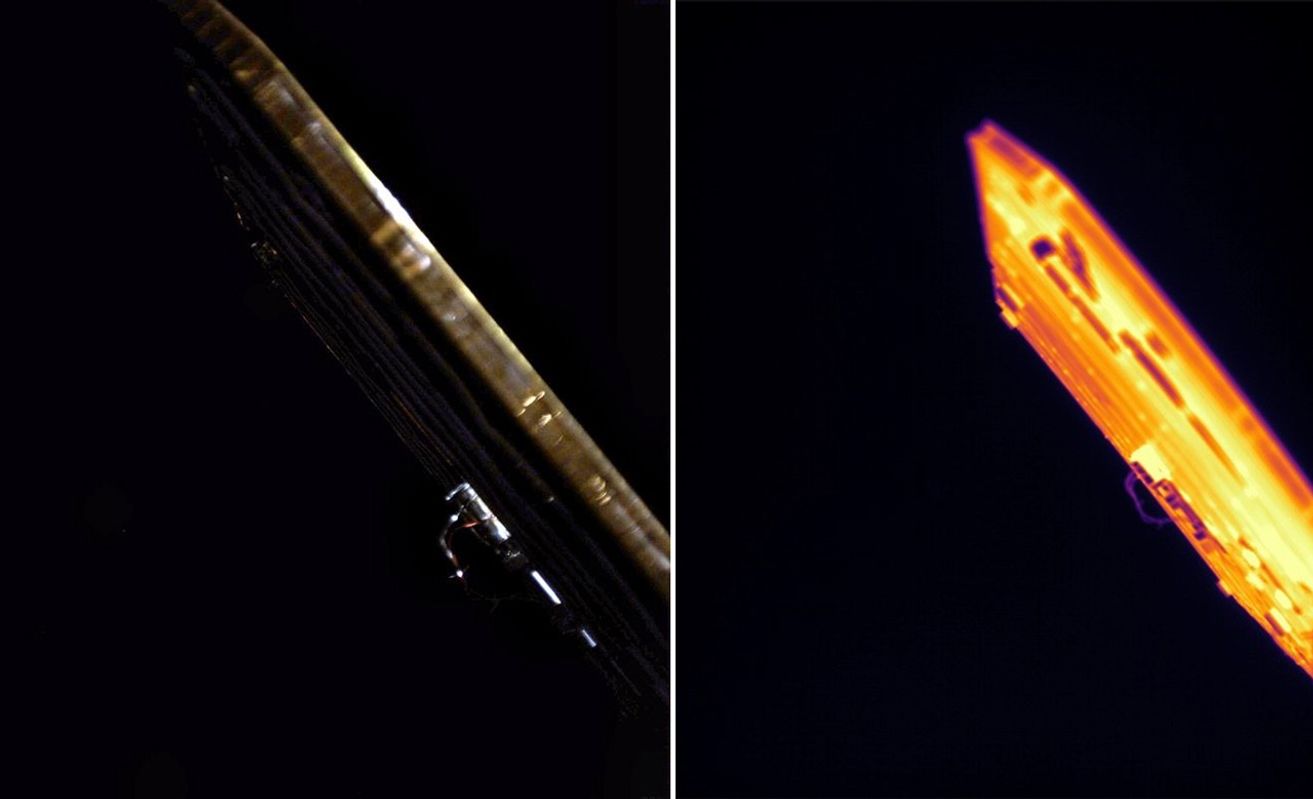
Two images showing the side of a solar panel. The left shows the image in visible light – it looks dark brown in color. The right shows the image lit up in bright yellow and orange light, in the infrared.
First light taken Nov. 21, 2025, from the VISIONS camera aboard Gold, one of NASA’s ESCAPADE spacecraft, showing the side of a solar panel. The left image is the visible-light camera, sensitive enough to image Mars’ green aurora. The right image is from an infrared camera and shows temperature differences, from warmer (yellow and orange) to cooler (purple and black), that can distinguish geologic features on Mars. NASA/UCB-SSL/RL/NAU-Radiant/Lucint

Lower cost, higher risk

NASA classifies payloads on a four‑tier risk scale, from A to D.

Class A missions are the most expensive and highest priority, like the James Webb Space Telescope, Europa Clipper and the Nancy Grace Roman Space Telescope. They use thoroughly proven hardware and undergo exhaustive testing.

ESCAPADE is at the other end. It’s a class D mission, defined as having “high risk tolerance” and “medium to low complexity.”

Of the 21 class D missions that have launched since the designation was first applied in 2009, NASA has not had a single class D mission launch on schedule. Only four remained under budget. Four were canceled outright prior to launch.

ESCAPADE, which will have cost an estimated US$94.2 million by the end of its science operations in 2029, has stayed under the $100 million mark through a series of cost‑saving choices. It has a small set of key instruments, a low spacecraft mass to reduce launch costs, and extensively uses generic commercial components instead of custom hardware.

NASA also outsourced to private companies: Much of the spacecraft development went to Rocket Lab and the trajectory design to Advanced Space LLC, with tight contract limits to make sure the contractors didn’t go over budget.

Additional savings came from creative arrangements, including the university‑funded VISIONS camera package and a discounted ride on New Glenn, which Blue Origin wanted to fly anyway for its own testing objectives.

Commercial space

ESCAPADE launched at a moment of transition in space science.

NASA and other science agencies are facing the steepest budget pressures in more than 60 years, with political winds shifting funding toward human spaceflight. At the same time, the commercial space sector is booming, with long-imagined technologies that enable cheap space travel finally entering service.

That boom has, in part, led to a resurgence in NASA’s “faster, better, cheaper” push that originated in the 1980s and ‘90s – and which largely faded after the 2003 Columbia disaster.

In theory, leaner NASA oversight, greater use of off‑the‑shelf hardware and narrower science goals can cut costs while launching more missions and increasing the total science return. If ESCAPADE succeeds in delivering important science, it will be held up as evidence that this more commercial, risk-tolerant template can deliver.

The trade-offs

A concept put forward by Jared Isaacman, the Trump administration’s nominee to lead NASA, is that 10 $100 million missions would be better than one $1 billion flagship – or top-tier – mission. This approach could encourage faster mission development and would diversify the types of missions heading out into the solar system.

But that reorganization comes with trade-offs. For example, low‑cost missions rarely match flagship missions in scope, and they typically do less to advance the technology necessary for doing innovative science.

With a narrow scope, missions like ESCAPADE are unlikely to produce the most transformative discoveries about, for instance, the origins of life or the nature of dark matter, or the first chemical analyses of oceans on a new world. Instead, they focus on more specific questions.

Early in ESCAPADE’s development, my role was to help create a planning document for the VISIONS cameras called the Science Traceability Matrix, which defines an instrument’s scientific goals and translates them into concrete measurement requirements.

My colleagues and I systematically asked: What do we want to learn? What observations prove it? And, critically, how precisely does the instrument need to work to be “good enough,” given the budget? Loftier goals usually demand more complex instruments and operations, which drive up costs.

ESCAPADE’s broader goals are to create a clearer picture of Mars’ magnetic field, how the solar wind interacts with it, and figure out what that process does to Mars’ atmosphere. That is valuable science. But it is more modest than the $583 million predecessor mission MAVEN’s more extensive scope and richer suite of instruments. It was MAVEN that determined how and when Mars lost its once-dense atmosphere in the first place.

Both ESCAPADE and MAVEN are dwarfed again by the open‑ended potential of an operation like the James Webb Space Telescope, which observes a limitless slate of astronomical objects in the infrared light spectrum with a higher resolution than any combination of prior smaller telescopes.

Flagship missions like the James Webb Space Telescope push the state of the art in new technologies and materials. These innovations then filter into both future missions and everyday life. For example, the Webb telescope advanced the medical tools used in eye exams. Smaller missions rely more heavily on existing, mature technologies.

And when systems are built by private companies rather than NASA, those companies keep tight control over the patents rather than openly spreading the technology across the scientific community.

A tense road to launch

ESCAPADE’s principal investigator, Rob Lillis, has joked that it is the mission with 11 lives, having survived 11 near‑cancellations. Problems ranged from being late in reaching the technology readiness levels that helped ensure the probes wouldn’t malfunction after launch, to the loss of its original free ride, with NASA’s Psyche mission.

In 2024, ESCAPADE received support from NASA to ride on New Glenn’s maiden flight, only to face delays as Blue Origin worked through technical hurdles. At last, in October 2025, ESCAPADE reached the launchpad.

I traveled to Cape Canaveral for the launch and felt the tension firsthand. The first window was scrubbed by bad weather and issues with ground equipment. Then a strong solar storm — ironically, a key driver of the very processes ESCAPADE will study — shut down the second window.

Concurrently, the Federal Aviation Administration imposed new launch restrictions due to the government shutdown that would have postponed the launch further if not for a last-minute exemption.

Finally, on Nov. 13, after repeated setbacks, New Glenn lifted off to cheers around the country. ESCAPADE reached orbit, and after a nervous few hours of receiver misalignment, mission controllers established communication with the spacecraft.

What’s next

While in Florida, I also watched another milestone in commercial spaceflight: the record-breaking 94th launch from Cape Canaveral in 2025, marking the most launches from Florida in a single year. It was a SpaceX Falcon 9 carrying Starlink satellites.

Like New Glenn, SpaceX’s Falcon 9 saves money by landing and reusing rockets. If multiple providers like SpaceX and Blue Origin compete to keep launch prices low, the economics of small science missions will only improve.

A bright light arching through a dark sky.
On Nov. 10, SpaceX launched a Falcon 9 rocket from Cape Canaveral, the record-breaking 94th launch of 2025. SpaceX

If ESCAPADE’s twin spacecraft reach Mars and deliver new insights as planned, they will demonstrate how minimalist, commercial-forward approaches can expand the planetary knowledge base.

But even then, a string of future SIMPLEx successes would likely not be a substitute for the uniquely capable, technology‑advancing flagship missions that answer the most far‑reaching questions. ESCAPADE can instead help test whether a broader mix of small missions – leaning on commercial partners and a few big, ambitious flagships – can together sustain planetary science in an era of tight budgets.

For now, that balance remains an open experiment, and only time will tell whether ESCAPADE is a lone bright spot or the start of a real shift.The Conversation

Ari Koeppel, Earth Sciences Postdoctoral Scientist and Adjunct Associate, Dartmouth College

This article is republished from The Conversation under a Creative Commons license. Read the original article.
Rain forecast for next week; forecasters say November rainfall well above average

Details
Written by: Elizabeth Larson
Published: 13 December 2025

LAKE COUNTY, Calif. — The early December dry spell is expected to end next week, when a series of weather systems move over the region.

The National Weather Service’s Eureka office said wetter weather will finally return starting on Monday.

The forecast calls for light to moderate rain and wind along the North Coast early next week.

Forecasters said they expect weather systems that will bring rain will pass through the region on Monday and Tuesday, with a break on Wednesday, followed by another incoming weather system on either Thursday or Friday.

The specific Lake County forecast calls for rain beginning on Monday night and continuing throughout the week. 

Daytime temperatures next week will range into the low 60s, with nighttime temperatures in the low 40s.

While December has so far been dry in Lake County, the National Weather Service’s Eureka office said overall temperatures and rainfall for November were above normal.

It offered the following November rainfall numbers for Lake County:

• Clearlake, 4.9 inches, 170% of normal.
• Clearlake Oaks, 3.29 inches, 125% of normal. 
• Lakeport, 3.78 inches, 144% of normal.
• Upper Lake, 6.25 inches, 147% of normal.

Email Elizabeth Larson at This email address is being protected from spambots. You need JavaScript enabled to view it.. Follow her on Twitter, @ERLarson, and on Bluesky, @erlarson.bsky.social. Find Lake County News on the following platforms: Facebook, @LakeCoNews; X, @LakeCoNews; Threads, @lakeconews, and on Bluesky, @lakeconews.bsky.social. 

Tariffs 101: What they are, who pays them, and why they matter now

Details
Written by: Kent Jones, Babson College
Published: 13 December 2025

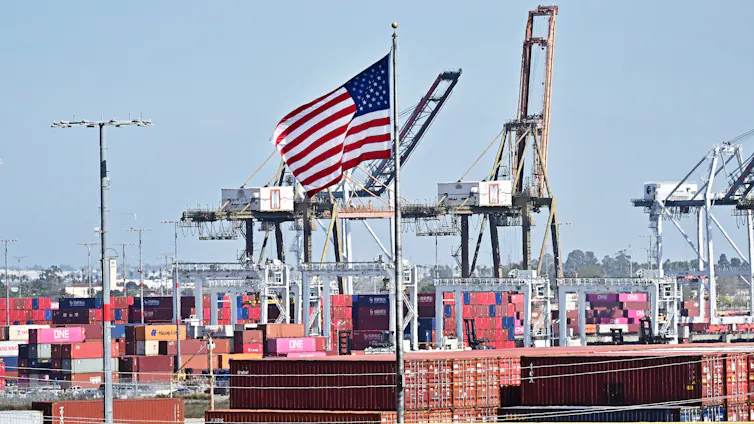
The Port of Long Beach is a key entry point for tariffed goods. Frederick J. Brown/AFP/Getty Images
The U.S. Supreme Court is currently reviewing a case to determine whether President Donald Trump’s global tariffs are legal.

Until recently, tariffs rarely made headlines. Yet today, they play a major role in U.S. economic policy, affecting the prices of everything from groceries to autos to holiday gifts, as well as the outlook for unemployment, inflation and even recession.

I’m an economist who studies trade policy, and I’ve found that many people have questions about tariffs. This primer explains what they are, what effects they have, and why governments impose them.

What are tariffs, and who pays them?

Tariffs are taxes on imports of goods, usually for purposes of protecting particular domestic industries from import competition. When an American business imports goods, U.S. Customs and Border Protection sends it a tariff bill that the company must pay before the merchandise can enter the country.

Because tariffs raise costs for U.S. importers, those companies usually pass the expense on to their customers by raising prices. Sometimes, importers choose to absorb part of the tariff’s cost so consumers don’t switch to more affordable competing products. However, firms with low profit margins may risk going out of business if they do that for very long. In general, the longer tariffs are in place, the more likely companies are to pass the costs on to customers.

Importers can also ask foreign suppliers to absorb some of the tariff cost by lowering their export price. But exporters don’t have an incentive to do that if they can sell to other countries at a higher price.

Studies of Trump’s 2025 tariffs suggest that U.S. consumers and importers are already paying the price, with little evidence that foreign suppliers have borne any of the burden. After six months of the tariffs, importers are absorbing as much as 80% of the cost, which suggests that they believe the tariffs will be temporary. If the Supreme Court allows the Trump tariffs to continue, the burden on consumers will likely increase.

While tariffs apply only to imports, they tend to indirectly boost the prices of domestically produced goods, too. That’s because tariffs reduce demand for imports, which in turn increases the demand for substitutes. This allows domestic producers to raise their prices as well.

A brief history of tariffs

The U.S. Constitution assigns all tariff- and tax-making power to Congress. Early in U.S. history, tariffs were used to finance the federal government. Especially after the Civil War, when U.S. manufacturing was growing rapidly, tariffs were used to shield U.S. industries from foreign competition.

The introduction of the individual income tax in 1913 displaced tariffs as the main source of U.S. tax revenue. The last major U.S. tariff law was the Smoot-Hawley Tariff Act of 1930, which established an average tariff rate of 20% on all imports by 1933.

Those tariffs sparked foreign retaliation and a global trade war during the Great Depression. After World War II, the U.S. led the formation of the General Agreement on Tariffs and Trade, or GATT, which promoted tariff reduction policies as the key to economic stability and growth. As a result, global average tariff rates dropped from around 40% in 1947 to 3.5% in 2024. The U.S. average tariff rate fell to 2.5% that year, while about 60% of all U.S. imports entered duty-free.

While Congress is officially responsible for tariffs, it can delegate emergency tariff power to the president for quick action as long as constitutional boundaries are followed. The current Supreme Court case involves Trump’s use of the International Emergency Economic Powers Act, or IEEPA, to unilaterally change all U.S. general tariff rates and duration, country by country, by executive order. The controversy stems from the claim that Trump has overstepped his constitutional authority granted by that act, which does not mention tariffs or specifically authorize the president to impose them.

The pros and cons of tariffs

In my view, though, the bigger question is whether tariffs are good or bad policy. The disastrous experience of the tariff war during the Great Depression led to a broad global consensus favoring freer trade and lower tariffs. Research in economics and political science tends to back up this view, although tariffs have never disappeared as a policy tool, particularly for developing countries with limited sources of tax revenue and the desire to protect their fledgling industries from imports.

Yet Trump has resurrected tariffs not only as a protectionist device, but also as a source of government revenue for the world’s largest economy. In fact, Trump insists that tariffs can replace individual income taxes, a view contested by most economists.

Most of Trump’s tariffs have a protectionist purpose: to favor domestic industries by raising import prices and shifting demand to domestically produced goods. The aim is to increase domestic output and employment in tariff-protected industries, whose success is presumably more valuable to the economy than the open market allows. The success of this approach depends on labor, capital and long-term investment flowing into protected sectors in ways that improve their efficiency, growth and employment.

Critics argue that tariffs come with trade-offs: Favoring one set of industries necessarily disfavors others, and it raises prices for consumers. Manipulating prices and demand results in market inefficiency, as the U.S. economy produces more goods that are less efficiently made and fewer that are more efficiently made. In addition, U.S. tariffs have already resulted in foreign retaliatory trade actions, damaging U.S. exporters.

Trump’s tariffs also carry an uncertainty cost because he is constantly threatening, changing, canceling and reinstating them. Companies and financiers tend to invest in protected industries only if tariff levels are predictable. But Trump’s negotiating strategy has involved numerous reversals and new threats, making it difficult for investors to calculate the value of those commitments. One study estimates that such uncertainty has actually reduced U.S. investment by 4.4% in 2025.

A major, if underappreciated, cost of Trump’s tariffs is that they have violated U.S. global trade agreements and GATT rules on nondiscrimination and tariff-binding. This has made the U.S. a less reliable trading partner. The U.S. had previously championed this system, which brought stability and cooperation to global trade relations. Now that the U.S. is conducting trade policy through unilateral tariff hikes and antagonistic rhetoric, its trading partners are already beginning to look for new, more stable and growing trade relationships.

So what’s next? Trump has vowed to use other emergency tariff measures if the Supreme Court strikes down his IEEPA tariffs. So as long as Congress is unwilling to step in, it’s likely that an aggressive U.S. tariff regime will continue, regardless of the court’s judgment. That means public awareness of tariffs ⁠– and of who pays them and what they change ⁠– will remain crucial for understanding the direction of the U.S. economy.The Conversation

Kent Jones, Professor Emeritus, Economics, Babson College

This article is republished from The Conversation under a Creative Commons license. Read the original article.

State attorney general sues over Trump Administration’s new $100,000 H-1B Visa fee

Details
Written by: LAKE COUNTY NEWS REPORTS
Published: 12 December 2025

California Attorney General Rob Bonta on Friday led a coalition of 19 attorneys general in announcing a lawsuit challenging the Trump Administration over its unlawful policy imposing a $100,000 fee on new H-1B visa petitions.

H-1B visas allow U.S. employers to hire highly skilled foreign national workers in roles that require specialized skills, including as physicians, researchers, nurses and other vital workers, to alleviate nationwide labor shortages. 

The new fee would create a costly barrier for employers, especially public sector and government employers, trying to fill these positions.

In the lawsuit, Attorney General Bonta and the coalition allege that the policy, which has been implemented by the Department of Homeland Security, or DHS, is a clear violation of the law because it imposes a massive fee outside of the bounds of what is authorized by Congress and contrary to Congress’s intent in establishing the H-1B program, bypasses required rulemaking procedures, and exceeds the authority granted to the executive branch under the Administrative Procedure Act, or APA. 

“As the world’s fourth largest economy, California knows that when skilled talent from around the world joins our workforce, it drives our state forward. President Trump’s illegal $100,000 H-1B visa fee creates unnecessary — and illegal — financial burdens on California public employers and other providers of vital services, exacerbating labor shortages in key sectors,” said Bonta. “The Trump Administration thinks it can raise costs on a whim, but the law says otherwise. We are going to court to defend California’s residents and their access to the world-class universities, schools and hospitals that make Californians proud to call this state home.” 

The H-1B visa program allows employers to petition for high-skilled foreign workers to temporarily fill positions in specialty occupations that require at least a bachelor’s degree. 

In petitioning for an H-1B worker, the employer must submit an application, certified by the U.S. Department of Labor, that employment of the H-1B worker will not negatively affect the wages and working conditions of similarly employed U.S. workers. 

Congress limits the number of H-1B visas available each year for most private employers, with the current cap set at 65,000, with an exemption of 20,000 for individuals with a master’s degree or higher.

Since its inception, the H-1B visa program has been continually tailored by Congress to carry out its purpose of meeting employers’ labor needs, while protecting the interests of American workers to ensure that they are not wrongfully displaced. 

Congress has repeatedly enhanced enforcement, increased penalties and legislated on fees for H-1B petitions to prevent misuse of the program. 

Congress has also adapted the program to ensure that it is especially beneficial to many government and non-profit organizations in fulfilling their public service missions, exempting them from the 65,000-person cap.

On Sept. 19, President Trump issued a proclamation ordering an unprecedented $100,000 fee for new H-1B visa petitions, undermining the very purpose of the H-1B visa by making it harder to address severe labor shortages in critical fields such as education and healthcare and ultimately worsening the staffing crisis. 

As implemented by DHS through a series of written documents, the policy affects any application filed after Sept. 21, and grants the Secretary of Homeland Security broad discretion to determine which petitions are subject to the fee or for an exemption, raising concerns that the enforcement could be applied selectively against employers disfavored by the Trump Administration.  

The $100,000 visa fee is devastating for all states, including California, and threatens the quality of education, health care , and other core services available to residents, Bonta’s office said.

For example, the United States faces a nationwide teacher shortage and in the 2024-2025 school year, 74% of school districts in the U.S. reported having trouble filling open positions, particularly in special education, physical sciences, ESL or bilingual education, and foreign languages. 

Educators are the third-largest occupation for H-1B visa holders, with nearly 30,000 educators on the visas, and nearly a thousand colleges and universities employ hundreds of H-1B personnel to support their research and education missions. 

Because K-12 schools, colleges and universities are generally government or non-profit entities, they are incapable of absorbing an additional $100,000 for each H-1B hire. 

Hospitals and other healthcare centers also rely on the H-1B visa program to hire physicians, surgeons and nurses, oftentimes in low-income and working-class neighborhoods. Nearly 17,000 H-1B visas went to workers in medicine and health occupations in the 2024 fiscal year, and half of those were physicians and surgeons. 

Without foreign-trained physicians, the United States is projecting a shortfall of 86,000 physicians by 2036. There will not be enough doctors to care for older adults, many of whom suffer increased rates of chronic disease and have other complex medical needs. 

In California, access to specialists and primary care providers in rural areas is already extremely limited and is projected to worsen as physicians retire and these communities struggle to attract new doctors. As a result of the fee, these institutions will be forced to operate with inadequate staffing or divert funding away from other important programs to cover expenses. 

In Friday’s lawsuit, Bonta and the coalition allege that the Trump Administration’s H-1B visa fee violates the APA and the U.S. Constitution. Fees associated with H-1B visas have long been established by DHS following the APA’s notice-and-comment process pursuant to congressional authority, which limits fees to the amount necessary to sustain the agency’s work. 

Typically, an employer filing an initial H-1B petition would expect to pay between $960 to $7,595 in regulatory and statutory fees. The Trump Administration’s $100,000 fee far exceeds the actual cost of processing H-1B petitions. 

By imposing this fee, the administration is exceeding the fee-setting authority granted by Congress, which requires that fees be set based on the agency’s costs, rather than arbitrarily. 

Additionally, the Trump Administration issued the fee without going through the notice-and-comment process required by the APA and without considering the full range of impacts — especially on the provision of the critical services by government and nonprofit entities.

Attorney General Bonta and Massachusetts Attorney General Andrea Joy Campbell are leading the attorneys general of Arizona, Colorado, Connecticut, Delaware, Hawaii, Illinois, Maryland, Michigan, Minnesota, North Carolina, New Jersey, New York, Oregon, Rhode Island, Vermont, Washington, and Wisconsin in filing the lawsuit. 

  1. Space News: What’s up for December 2025 
  2. Impasse declared in negotiations between Upper Lake school district, teachers union
  3. State controller publishes 2024 salary and benefits data for public school districts, charter schools, county offices of education
  • 66
  • 67
  • 68
  • 69
  • 70
  • 71
  • 72
  • 73
  • 74
  • 75
How to resolve AdBlock issue?
Refresh this page