How to resolve AdBlock issue?
Refresh this page
How to resolve AdBlock issue?
Refresh this page
Lake County News,California
  • Home
    • Registration Form
  • News
    • Education
    • Veterans
    • Community
      • Obituaries
      • Letters
      • Commentary
    • Police Logs
    • Business
    • Recreation
    • Health
    • Religion
    • Legals
    • Arts & Life
    • Regional
  • Calendar
  • Contact us
    • FAQs
    • Phones, E-Mail
    • Subscribe
  • Advertise Here
  • Login
How to resolve AdBlock issue?
Refresh this page

News

Space News: The next frontier in space is closer than you think – welcome to the world of very low Earth orbit satellites

Details
Written by: Sven Bilén, Penn State
Published: 20 December 2025

The closer a satellite − like this telecommunications one − orbits to Earth, the more atmospheric drag it faces. janiecbros/iStock via Getty Images Plus

There are about 15,000 satellites orbiting the Earth. Most of them, like the International Space Station and the Hubble Telescope, reside in low Earth orbit, or LEO, which tops out at about 1,200 miles (2,000 kilometers) above the Earth’s surface.

But as more and more satellites are launched into LEO – SpaceX’s Starlink internet constellation alone will eventually send many thousands more there – the region’s getting a bit crowded.

Which is why it’s fortunate there’s another orbit, even closer to Earth, that promises to help alleviate the crowding. It’s called VLEO, or very low Earth orbit, and is only 60 to 250 miles (100 to 400 kilometers) above the Earth’s surface.

As an engineer and professor who is developing technologies to extend the human presence beyond Earth, I can tell you that satellites in very low Earth orbit, or VLEO, offer advantages over higher altitude satellites. Among other benefits, VLEO satellites can provide higher-resolution images, faster communications and better atmospheric science. Full disclosure: I’m also a co-founder and co-owner of Victoria Defense, which seeks to commercialize VLEO and other space directed-energy technologies.

Advantages of VLEO

The images from very low Earth orbit satellites are sharper because they simply see Earth more clearly than satellites that are higher up, sort of like how getting closer to a painting helps you see it better. This translates to higher resolution pictures for agriculture, climate science, disaster response and military surveillance purposes.

End-to-end communication is faster, which is ideal for real-time communications, like phone and internet service. Although the signals still travel the same speed, they don’t have as far to go, so latency decreases and conversations happen more smoothly.

Much weather forecasting relies on images of clouds above the Earth, so taking those pictures closer means higher resolution and more data to forecast with.

Because of these benefits, government agencies and industry are working to develop very low Earth orbit satellites.

The holdup: Atmospheric drag

You may be wondering why this region of space, so far, has been avoided for sustained satellite operations. It’s for one major reason: atmospheric drag.

Space is often thought of as a vacuum. So where exactly does space actually start? Although about 62 miles up (100 kilometers) – known as the the von Kármán line – is widely considered the starting point, there’s no hard transition where space suddenly begins. Instead, as you move away from Earth, the atmosphere thins out.

Where space begins is relatively arbitrary, but most consider it to be about 62 miles (100 kilometers) high.

In and below very low Earth orbit, the Earth’s atmosphere is still thick enough to slow down satellites, causing those at the lowest altitudes to deorbit in weeks or even days, essentially burning up as they fall back to Earth. To counteract this atmospheric drag and to stay in orbit, the satellite must constantly propel itself forward – like how riding a bike into the wind requires continuous pedaling.

For in-space propulsion, satellites use various types of thrusters, which provide the push needed to keep from slowing down. But in VLEO, thrusters need to be on all, or nearly all, of the time. As such, conventional thrusters would quickly run out of fuel.

Fortunately, the Earth’s atmosphere in VLEO is still thick enough that atmosphere itself can be used as a fuel.

Innovative thruster technologies

That’s where my research comes in. At Penn State, in collaboration with Georgia Tech and funded by the U.S. Department of Defense, our team is developing a new propulsion system designed to work at 43 to 55 miles up (70 to 90 kilometers). Technically, these altitudes are even below very low Earth orbit – making the challenge to overcome drag even more difficult.

Our approach collects the atmosphere using a scoop, like opening your mouth wide as you pedal a bike, then uses high-power microwaves to heat the collected atmosphere. The heated gas is then expelled through a nozzle, which pushes the satellite forward. Our team calls this concept the air-breathing microwave plasma thruster. We’ve been able to demonstrate a prototype thruster in the lab inside a vacuum chamber that simulates the atmospheric pressure found at 50 miles (80 km) high.

This approach is relatively simple, but it holds potential, especially at lower altitudes where the atmosphere is thicker. Higher up, where the atmosphere is thinner, spacecraft could use different types of VLEO thrusters that others are developing to cover large altitude ranges.

Our team isn’t the only one working on thruster technology. Just one example: The U.S. Department of Defense has partnered with defense contractor Red Wire to develop Otter, a VLEO satellite with its version of atmosphere-breathing thruster technology.

Another option to keep a satellite in VLEO, which leverages a technology I’ve worked on throughout my career, is to tie a lower-orbiting satellite to a higher-orbiting satellite with a long tether. Although NASA has never flown such a system, the proposed follow-on mission to the tether satellite system missions flown in the 1990s was to drop a satellite into much lower orbit from the space shuttle, connected with a very long tether. We are currently revisiting that system to see whether it could work for VLEO in a modified form.

Other complications

Overcoming drag, though the most difficult, is not the only challenge. Very low Earth orbit satellites are exposed to very high levels of atomic oxygen, which is a highly reactive form of oxygen that quickly corrodes most substances, even plastics.

The satellite’s materials also must withstand extremely high temperatures, above 2,732 degrees Fahrenheit (1,500 degrees Celsius), because friction heats it up as it moves through the atmosphere, a phenomenon that occurs when all spacecraft reenter the atmosphere from orbit.

The potential of these satellites is driving research and investment, and proposed missions have become reality. Juniper research estimates that $220 billion will be invested in just the next three years. Soon, your internet, weather forecasts and security could be even better, fed by VLEO satellites.The Conversation

Sven Bilén, Professor of Engineering Design, Electrical Engineering and Aerospace Engineering, Penn State

This article is republished from The Conversation under a Creative Commons license. Read the original article.
Lake County Public Works interim director lays out five-year plan for road pavement

Details
Written by: Lingzi Chen
Published: 19 December 2025


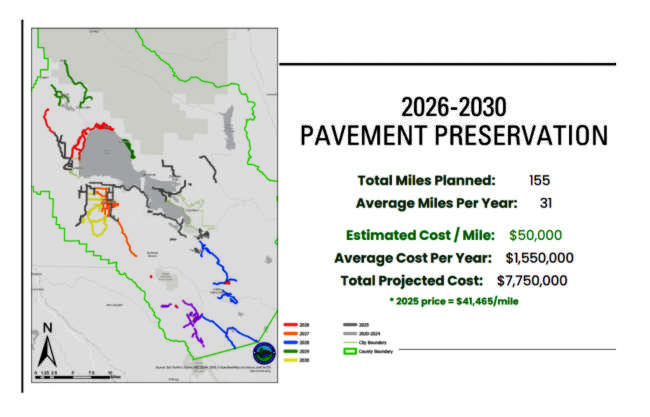
LAKE COUNTY, Calif — The county’s Public Works Department interim director on Tuesday presented a five-year plan to pave county roads, projecting a nearly $8 million investment from 2026 through 2030 — a fraction of the proposals in 2022 and 2023, which officials now say were unrealistic.

Over the next five years, the department plans to pave 155 miles out of the county’s 612 miles of roads, or about 31 miles per year, at an estimated cost of $50,000 per mile. 

Total cost is estimated to be $7.75 million, or about $1.55 million annually, Public Works Interim Director Lars Ewing told the Board of Supervisors.

“I’m calling it a realistic and financially constrained plan,” Ewing said. “It is a financially viable plan.” 

The work is projected to improve the county’s overall Pavement Condition Index, or PCI — a scale from zero to 100 that rates road conditions — from the current 34 to 48, moving county roads from “poor” to “marginal” by 2030, Ewing said.  

While roads across the county need attention, Ewing emphasized prioritizing paving roads by county crews over rebuilding new roads through outside contractors as the most cost-effective approach under a constrained budget.

In 2025 alone, Public Works crews completed pavement preservation on 38.5 miles of county roads at a cost of $1,597,616, or $41,465 per mile. The department averaged 17 miles per year from 2020 through 2024.

County road finances

Each year, road work receives about $8.1 million in total funding, with roughly 70% going to the department’s routine operations and administration, according to Ewing. 

That portion covers salaries, services and supplies for the county’s 28-member road crew, which handles tasks such as repairs, dura patching and sign striping. 

“So this is the bulk of where the work really hits, where those 28 crew members, day in and day out, are handling it,” Ewing said. 

Funding sources for these routine operations include property taxes, the state’s Highway Users Tax Account, federal gas tax allocations, and other grants and miscellaneous programs.

Of the remaining 30% of funds, 12% is allocated to capital improvement projects and 18% to pavement preservation, all funded through California Senate Bill 1, or SB 1, the Road Repair and Accountability Act enacted in 2017. 

SB 1 allocates a portion of fuel taxes and vehicle registration fees to road maintenance, repairs, and transportation infrastructure improvements.

Ewing said the plan in his presentation focused solely on the county’s in-house road work carried out by the crew, which centers on pavement preservation, and did not include capital improvement projects, which are typically contracted to outside construction firms.

“We get more bang for our buck with our crew, and that's where I'd like to maximize it,” Ewing said. “That's where we want to spend our money, preserving our infrastructure, rather than — I’d say — building new.”

Cost of contracted work

Indeed, contractors cost more. 

Immediately following the presentation of the five-year plan, the board considered a separate Public Works agenda item requesting an additional $311,850 for a contract change order on the 2024 Pavement Rehabilitation Project in Cobb, which covers 16 miles of county roads.    

In 2024, the county awarded a $5.1 million construction contract to Argonaut Constructors for the project, scheduled to be carried out in summer 2025. 

However, Cobb residents soon reported quality issues with newly paved roads, prompting Ewing and county officials to order the project paused. 

During a board discussion in September, officials determined that the “double chip seal” used on the roads was not durable. Supervisors directed staff to redo the roads using a two-inch asphalt overlay, resulting in a change order that increased the contract cost to more than $6.1 million.   

At the time, Supervisor Bruno Sabatier criticized the county’s oversight of the project. 

“We failed,” Sabatier said. “We had plans made available to us. We approved these plans. Two directors have gone through these plans and continued to push forward with these plans, and now we’re saying something went wrong.”

Coming back with the request for additional money, “Just due to adjustments in the road, there were imperfections in the road, more asphalt was needed to complete the remaining four roads,” Ewing told supervisors on Tuesday. 

The Board of Supervisors approved the request unanimously in four minutes, with no questions asked. 

Sabatier wanted it to proceed even faster. 

“We need to figure out a future process to allow you to finish a project and maybe give you a 10% wiggle room,” he said. “Because the weather is changing, and so I'm just thinking about the timeline here. Other than that, we have to finish the project, so there's no question to it.”

The contract now sits at $6,453,941.38 for 16 miles of Cobb roads, averaging just above $400,000 per mile.

Supervisors question district rotation in road plan

At the end of the September discussion on the Cobb project, District 3 Supervisor Eddie Crandell, whose district has the lowest PCI, reminded the board that road challenges extend beyond Cobb.

“I'm not trying to go against this project; I support it. I just want to emphasize that I just want these to get done, so my district can get a higher PCI code,” he said. “I only say that just to kind of stand on a soapbox, not trying to go against this.”

A similar discussion surfaced at the Tuesday meeting.

Looking at the color-coded map that lays out the next five years’ plan in pavement preservation work, District 1 Supervisor Helen Owen questioned why after “two years worth of money spent in Jessica’s district — District 5,” it is coming back to the district again in 2027, before going to District 1 in 2028. 

Owen said that Crandell and she “both need some attention in our districts early on.”

Ewing said that the schedule for the road work is “not based on any preference or priority for one district or another; this is looked at from a network perspective.”

Road Superintendent Jim Hale responded that in 2025, “we did 22 miles in District 1.” 

In 2024, Hale said, the crew did not chip seal. “We were in preparation for this chip seal and the preparation work for Cobb,” he added. 

In 2026, some roads in District 3 and 4 are going to “get chip seal done as well,” Hale said. “So that was just the rotation.”

He later also mentioned that the Lucerne area — also under District 3 — will be covered later in 2029. 

“I just had to remind that my district is like the lowest [in PCI] — not saying it takes precedence,” Crandell said, suggesting that there are specific roads that really need attention and the plan shouldn’t focus on just one area.

District 5 Supervisor Jessica Pyska asked about the criteria used to determine which roads to work on. 

“This was more of a boots-on-the-ground,” rather than having a formula and a computer to spit out the answer, Ewing said. 

“There is a cost to road work that we need to put away our differences as district supervisors and really just look at it from a county perspective,” said Bruno, whose district does not have any work plan on the map. 

“Where can we make a difference and focus on those roads to do a chip seal that will give us seven to 10 years of lifespan without having a pothole every day or throughout the whole winter?” Hale said of the considerations in planning out the map. 

Ewing calls prior road plans unrealistic

At the beginning of his presentation, Ewing referenced past pavement preservation plans that he said “may have been either misrepresented or misinterpreted.” 

Later as he responded to questions related to previous plans, he criticized them more explicitly. 

In 2022, then–Public Works Director Scott De Leon proposed spending $84 million over five years — more than 10 times the current plan. 

At that time, the Board of Supervisors did not question the feasibility of the proposal. Instead, they reached a consensus to ask De Leon to formalize the plan with a resolution. 

Under direction from the board to present a 10-year plan in 2023, De Leon returned with a proposal to spend $102 million over the next decade, accompanied by maps outlining the work, Ewing recalled.

“Those maps were a hope and a dream — I’m being perfectly blunt,” Ewing said. “So my plan today was realistic.”

Still, supervisors raised concerns about whether existing funding sources could hold up over time, even for Ewing’s scaled-back plan. 

They also pointed to a consensus reached in May to pursue a preliminary feasibility study on a potential special sales tax to fund road improvements.

At the time, Glen March, then director of the department, was given six months to work on the task. However, he was soon terminated in June, after just a year on the job. 

March was hired in June 2024, following De Leon’s retirement. 

Ewing said he was not aware that the special sales tax study was “a point of emphasis” as he took the role as the interim director, noting the department has been in transition.

“It's not going to happen for next upcoming year,” Sabatier said. “It's way too late in the game to get something on the ballot, but we still need to have that conversation.”

“​​I knew that we missed the date on bringing that back,” Owen said. “But that's something we really should be looking at too to be able to handle the finances of what our roads are needing.”

“If that's the board's direction, then that's what staff will do,” Ewing said.

At the end of the discussion, all supervisors commended the road crew’s work, especially as winter approaches. 

“Keep up the hard work,” Sabatier said. “The more we do in-house — and I say this, and I know it sounds kind of bad — the ‘cheaper’ it is than paying for a contract.”

“Economical,” Crandell interjected, suggesting a good replacement.  

Email staff reporter Lingzi Chen at This email address is being protected from spambots. You need JavaScript enabled to view it.. 

Clearlake Animal Control: ‘Sammy’ and the dogs

Details
Written by: Elizabeth Larson
Published: 19 December 2025
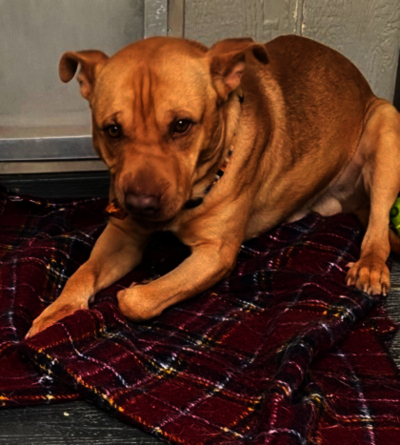
“Sammy.” Photo courtesy of Clearlake Animal Control.


CLEARLAKE, Calif. — Clearlake Animal Control has many dogs available to new homes for the holidays.

The shelter has 60 adoptable dogs listed on its website.

This week’s dogs include “Sammy,” a 2-year-old male American pit bull terrier mix with a tan coat.

The shelter is located at 6820 Old Highway 53. It’s open from 9 a.m. to 6 p.m. Tuesday through Saturday. 

For more information, call the shelter at 707-762-6227, email This email address is being protected from spambots. You need JavaScript enabled to view it. or visit Clearlake’s adoptable dogs here.

This week’s adoptable dogs are featured below.

Email Elizabeth Larson at This email address is being protected from spambots. You need JavaScript enabled to view it.. Follow her on Twitter, @ERLarson, and on Bluesky, @erlarson.bsky.social. Find Lake County News on the following platforms: Facebook, @LakeCoNews; X, @LakeCoNews; Threads, @lakeconews, and on Bluesky, @lakeconews.bsky.social. 

Begin 2026 on the right foot with California State Parks’ First Day Hikes

Details
Written by: LAKE COUNTY NEWS REPORTS
Published: 19 December 2025

LAKE COUNTY, Calif. — Step into 2026 on the right foot and on the right trail.

California State Parks is inviting outdoor enthusiasts to bring their family and friends to the annual First Day Hikes on Thursday, Jan. 1, to embrace a healthy start and breathe in fresh air. 

As the Golden State continues to celebrate its 175th anniversary of statehood, State Parks is offering over 80 guided hikes at more than 60 of California’s more diverse and iconic parks in the nation.

Whether you're a seasoned hiker or trying out something new, First Day Hikes offer something for everyone, encouraging a healthy, active lifestyle and an appreciation for nature. 

Participants can expect scenic views and make new connections as they hike in the mountains or take a stroll through an urban park. The hikes offer varying trail options to accommodate all fitness levels, from leisurely walks to more challenging treks, ensuring everyone can participate.

A perfect start for nature lovers

The First Day Hikes interactive webpage lets you easily search for hikes by park name, region or by clicking directly on the map. Be sure to check the website for any additional hikes or cancellations. The webpage provides information on new hiking opportunities around New Year’s Day. 

Featured hikes and more around the North Coast on Jan. 1:

Anderson Marsh State Historic Park: The park in Lower Lake will host two hikes beginning at noon on New Year’s Day.

Mendocino Headlands SP: Join one of State Parks’ lifeguards for this guided hike that begins at the Ford house to learn a short history of Mendocino's logging industry. Then, head out to see historic artifacts and learn about the Mendocino headlands and the Pacific Ocean.

Sugarloaf Ridge SP: This 5.25- to 6.5-mile trek to Bald Mountain includes a climb of over 1,500 feet and features fantastic 360-degree views of Sonoma and Napa valleys, and San Francisco.

The First Day Hikes is a national-led effort by America’s State Parks that encourages individuals and families to experience, with a seasoned guide, the beautiful natural and cultural resources found in the outdoors and inspire them to take advantage of these treasures all year long. America’s State Parks will also ring in the nation's 250th anniversary with 1,000-plus First Day Hikes across the country.

Plan ahead for your New Year escape

A parking fee is required at most parks for the hike. However, if participants have checked out the California State Library Parks Pass or have qualified for the Golden Bear Pass, they can enter for free at participating parks. 

Parents of fourth graders are invited to download the California State Park Adventure Pass that allows free entrance at 54 participating parks, like Millerton Lake State Recreation Area. Learn more about these free passes at parks.ca.gov/OutdoorsForAll.

As with any outing, it is important for all participants to recreate responsibly. Below are helpful tips to stay safe during First Day Hikes and all year long in the outdoors:

Know before you go: Prior to leaving home, check the status of the park you want to visit to find out what restrictions and guidelines are in place. Have a backup plan in case your destination is crowded. Check the weather before heading out and stay home if you are sick.

Play it safe: Find out what precautions you should take when exploring the outdoors, especially if this is your first time visiting the State Park System. For example, make sure to dress in layers, bring plenty of snacks and water, and wear appropriate hiking shoes.

Leave no trace: Leave areas better than how you found them by staying on designated trails and packing out all trash. Do not disturb wildlife or plants.

For more safety tips, please visit parks.ca.gov/SafetyTips.  

Share your adventure

Experience a safer outdoor adventure with the OuterSpatial app — your ultimate guide to California’s state parks. Navigate through a user-friendly interactive map, receive accurate directions, and stay updated in real-time for secure park exploration. Connect with fellow enthusiasts, monitor your visits, share photos and earn badges via challenges like the Passport to Your California State Parks.

For those who can’t make it to a guided hike, California offers 280 state parks to visit to start 2026 in a positive way with family and friends. Find a park near you: parks.ca.gov/Find-a-Park. 

Participants are encouraged to share their experiences on social media using the hashtags: #HikeInto2026, #FirstDayHikes, #HikeWithCAStateParks and #CAStateParks.

  1. Unpaid caregiving work can feel small and personal, but that doesn’t take away its ethical value
  2. Holiday storm inbound to Northern California
  3. Longtime Kelseyville Unified School Board member resigns; district seeks provisional board member 
  • 60
  • 61
  • 62
  • 63
  • 64
  • 65
  • 66
  • 67
  • 68
  • 69
How to resolve AdBlock issue?
Refresh this page