 How to resolve AdBlock issue?
Recreation
- Details
- Written by: California Department of Fish and Wildlife
CDFW worked closely with recreational stakeholders to develop the following changes, effective Jan. 1, 2021. See CDFW’s summary of recreational groundfish regulations for Management Area boundary definitions.
– Elimination of sub-bag limits for black rockfish, canary rockfish and cabezon within the 10-fish Rockfish, Cabezon, Greenling, or RCG, complex daily bag limit.
– A new sub-bag limit of five vermilion rockfish within the 10-fish RCG complex daily bag limit.
– The Rockfish Conservation Area, or RCA, boundary will increase to 30 fathoms (180 feet) in the Mendocino Management Area during the regular open season (May 1-Oct. 31).
– The RCA boundary will increase to 50 fathoms (300 feet) in the San Francisco Management Area during the open season (April 1-Dec. 31).
– The RCA boundary will increase to 100 fathoms (600 feet) in the Southern Management Area during the open season (March 1-Dec. 31).
– For consistency with federal regulations, the legal method of take for California scorpionfish has been updated such that no more than two hooks and one line may be used when angling for this species.
– The “All Depth” fishery in the Northern and Mendocino Management Areas will continue each November and December, unless modified by an in-season action.
The new regulations were adopted by the California Fish and Game Commission in mid-October and the Pacific Fishery Management Council in July.
Anglers should check CDFW’s website for the current regulations before fishing for groundfish and are advised that regulations printed in the 2020-21 ocean regulations book will be out of date starting Jan. 1, 2021.
The 30, 50 and 100 fathom depth contours are defined by straight lines connecting the waypoints as adopted in the Code of Federal Regulations, Title 50, Part 660, Subpart C.
Many of these changes were made in response to the outcomes of recent stock assessment science. Populations of yelloweye rockfish and cowcod, which were declared overfished in 2002 and 2000 respectively, are increasing faster than anticipated and the cowcod population was declared rebuilt based on the 2019 stock assessment.
“The good news for 2021 is groundfish populations are rebounding,” said CDFW Senior Environmental Scientist Caroline McKnight. “Of the eight stocks that were declared overfished in the early 2000s, all but one, yelloweye rockfish, has been declared rebuilt today. The improved status of these species allows fishery managers to recommend management measures that provide additional fishing opportunity, including access to deeper depths that have been off limits to anglers for more than a decade.”
The implementation of a new five-fish sub-bag limit for vermilion rockfish within the 10-fish RCG complex daily bag limit may come as a surprise to some anglers. Recreational catch of vermilion rockfish has increased significantly in recent years, but stock status information is dated. While a new stock assessment for vermilion rockfish is planned for 2021, the results won’t be available for use in management until 2023. In the interim, the new five-fish vermilion rockfish sub-bag limit has been implemented as a precautionary measure to slow catches.
Take and possession of bronzespotted rockfish, cowcod and yelloweye rockfish remain prohibited statewide.
For more detailed information on the new 2021 recreational groundfish regulations and to stay informed of in-season changes, please call the Recreational Groundfish Hotline at (831) 649-2801 or visit CDFW’s summary of recreational groundfish fishing regulations for 2021. For background information on groundfish science and management, please visit CDFW’s Marine Region Groundfish webpage.
- Details
- Written by: CALIFORNIA DEPARTMENT OF FISH AND WILDLIFE
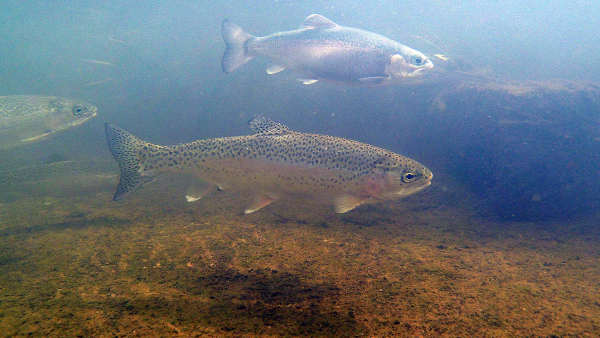
How do I find information on the backcountry stocking of trout?
Question: I have read in different places that CDFW at times stocks trout in the Sierra mountains and elsewhere in high country lakes – sometimes by airplane, horses and humans. Is there a web page on your site that discusses when and where this takes place? Is there a record showing when and where previous stockings took place? I have found the Fish Planting Schedule on your website but never see backcountry or high-elevation lakes included. (Ryan)
Answer: Great questions, Ryan. Let’s start with the Fish Planting Schedule on the California Department of Fish and Wildlife’s (CDFW) website. That schedule shows “catchable trout” – about 12 inches and larger – planted for recreational fishing. Those fish are planted to be caught more or less immediately by anglers, and the Fish Planting Schedule can help direct anglers to the fish.
Trout stocked in backcountry waters, by contrast, are typically planted as “sub-catchables” or “fingerlings” which are typically 7 inches and smaller. Those trout plants don’t appear on the Fish Planting Schedule. Their smaller size makes the fish easier to transport to remote waters. They aren’t planted to be caught immediately – but rather the intention is that they grow and acclimate for a season or two and become much like wild fish by the time an angler encounters them.
There are a couple, better online resources for you. On CDFW’s Fish Planting Schedule web page there is a link to the Annual Provisional Stocking Document, which is the statewide overview of CDFW’s trout and inland salmon stocking plans for the fiscal year. These plants aren’t guaranteed – weather, fires, forest closures, hatchery problems and disease are among the factors that can alter or derail these plans. But it’s a comprehensive look at all the waters CDFW intends to stock along with detailed information on the species stocked and the size of the stocked fish. This document can be very helpful to those planning a backcountry fishing trip.
Another helpful resource is CDFW’s online Fishing Guide. Here you can search an area or specific body of water to see its fish planting history – including those trout stocked as fingerlings and sub-catchables. CDFW’s online Fishing Guide can also tell you what backcountry waters have trout in them and what species of trout you’ll likely find.
Some of the most enjoyable backcountry waters to fish are those that were planted long ago and now support wild, self-sustaining trout populations as a result. Backcountry trout are not stocked indiscriminately, but only after an environmental assessment is conducted to ensure the water is not home to any endangered frogs or other species that could be threatened by introduced trout. In some cases, non-native trout are removed from backcountry waters where they jeopardize native amphibian populations or inhibit recovery.
Each CDFW region is responsible for the stocking of its backcountry waters. Some rely on hatchery staff, volunteers on mules and horseback, aerial stocking or some combination of these methods. You are welcome to reach out to the appropriate CDFW regional office and speak with the local fisheries biologists about their backcountry trout stocking efforts.
Those CDFW regions most popular with trout anglers often have additional resources to share. CDFW’s Inland Deserts Region, for example, home to renowned trout fishing destinations in Inyo and Mono counties, has developed an “Eastern Sierra Back Country Fishing Guide” with a detailed account of the distribution of various trout species within its high elevation lakes. We wish you good luck in your backcountry fishing adventures. See CDFW’s Places to Visit page to see what activities are allowed on each department property.
Using maps to plan a hunt
Question: This is my first year hunting. I downloaded the X map. It tells me where the Bureau of Land Management (BLM) properties and private properties are, and I see the Fish and Wildlife properties. Can I hunt there? (Damian)
Answer: Assuming you’re talking about deer hunting, it sounds like you’re referring to onX maps, a GPS mapping program that offers information on property ownership. This is a well done (and not free) program that can be of great use to hunters, but it’s not necessary that you buy a map or mapping program for this information. You can check the websites of each agency to find properties where hunting is allowed.
For CDFW, you’ll find information on zones, regulations, licenses and much more on our website. Some of our CDFW-managed lands allow hunting and some don’t. There are different rules for hunting different game species. You’re expected to have a good understanding of where you can legally hunt before heading out.
Also consider reviewing CDFW’s regulation booklet for Waterfowl, Upland Game, Public Use of Department Lands. The section titled “Hunting and Other Public Uses on State and Federal Lands” addresses all types of authorized public uses. In particular, Section 551(e), “Types of Wildlife Areas,” provides guidance on which species are legal to hunt on each type of wildlife area. Section 551(e) will also alert you to which regulations to check for any exceptions to the general rules.
If you have a question for the California Department of Fish and Wildlife, email
- Details
- Written by: Elizabeth Larson
Offices are closed to the public and all services are offered online.
Maps, passes and recreation permits are available here: https://store.usgs.gov/.
If you previously obtained a Christmas tree permit or personal free-use firewood permit, please remember that Christmas tree permit holders can cut their tree any day of the week through Thursday, Dec. 24, 2020, and firewood permits expire Thursday, Dec. 31, 2020.
August Complex and Ranch Fire Forest Order 08-20-15 and signs are posted at all the campgrounds, information kiosks, affected recreation sites, trailheads and the forest website.
This order lists campgrounds and trails that are closed due to fire impacts. Remember that there are many hazards present within the Ranch Fire and August Complex fire areas, such as fire weakened trees, burned stump holes, rolling debris and potential landslides and flooding.
Dispersed camping and recreation sites not listed in the closure order remain open to the public. More information about dispersed camping is https://www.fs.usda.gov/activity/mendocino/recreation/campingcabins/?recid=25120&actid=34.
Until snow prevents travel across the forest, roads are open as designated on the Motor Vehicle Use Map: https://www.fs.usda.gov/detail/mendocino/mapspubs/?cid=FSBDEV3_004435.
Whether heading out to the forest to cut a Christmas tree, gather firewood or enjoy some snow play, please check the forecast and be prepared for changing weather and road conditions. Carry emergency equipment in vehicles and remember there may be no cell phone coverage.
Please call 530-934-3316 for more information.
- Details
- Written by: California Department of Public Health
The guidance applies to all organized youth and adult sports, including school and community-sponsored programs, and privately-organized clubs and leagues.
CDPH’s guidance is aimed at giving communities guidelines on how to safely remain physically active while reducing transmission in their communities, especially at a time when cases are at an all-time high and ICU capacity is stretched near capacity.
These guidelines were developed in consultation with a wide range of stakeholders, including the California Interscholastic Federation, or CIF, and the California Association of Recreation and Park Districts, or CARPD.
“Despite how hard it has been to do this for so many months, it’s imperative now more than ever that we all follow public health guidance by staying home and not mixing with other households,” said Dr. Erica Pan, acting State Public Health officer. “I know as a parent and athlete myself, how important exercise is to maintain physical and mental health, and we encourage members of the same household to do physical activities together and outdoors until the current and alarming surge passes. We need everyone to take seriously their responsibility to protect their entire community, and in the meantime, we all can look forward to these activities we can resume in 2021.”
Outdoor physical conditioning, practice, skill-building and training that can be done maintaining 6 feet of physical distance is permitted in all counties, including those under the regional stay at home order. The public is strongly encouraged to limit these outdoor activities to a single household while a county is under the regional stay at home order.
For counties not under the regional stay at home order, the Blueprint for a Safer Economy has been updated to allow sports to resume in tiers corresponding to the sport’s level of contact and transmission risk, and the level of community spread in the associated tier.
Competition will not be allowed in California until January 25, 2021, at the earliest. Competitions are not permitted as they increase the probability of transmission due to mixing of households, traveling, and unavoidable physical contact. Competitions between different teams have been associated with multiple outbreaks in California and across the country. This date will be reassessed by January 4, 2021, based on California disease transmission trends and is subject to change at any time given the level of COVID-19 and ICU capacity in California.
Youth and adult sports include varied activities that have different levels of risk for transmission of COVID-19 depending on the physical contact between players.
Outdoor activities that allow for consistent wearing of face coverings and physical distancing are at lower risk than indoor activities that involve close contact between participants and high exertion that increases spread of exhaled particles.
Youth and adult sports are classified below by their level of contact and transmission risk. This classification applies to competition training/practice with others. It does not apply to individual conditioning or exercise.
The following chart explains which category of sports are allowed in each tier:
WIDESPREAD TIER
Outdoor low-contact sports
• Archery
• Badminton
• Biking
• Bocce
• Corn hole
• Cross country
• Dance (no contact)
• Disc golf
• Golf
• Ice and roller skating (no contact)
• Lawn bowling
• Martial arts (no contact)
• Physical training programs (e.g., yoga, Zumba, Tai chi)
• Pickleball (singles)
• Rowing/crew (with one person)
• Running
• Shuffleboard
• Skeet shooting
• Skiing and snowboarding
• Snowshoeing
• Swimming and diving
• Tennis
• Track and field
• Walking and hiking
SUBSTANTIAL TIER
Outdoor moderate-contact sports
• Baseball
• Cheerleading
• Dodgeball
• Field hockey
• Gymnastics
• Kickball
• Lacrosse (girls/women)
• Pickleball (doubles)
• Softball
MODERATE TIER
Outdoor high-contact sports
• Basketball
• Football
• Ice hockey
• Lacrosse (boys/men)
• Rugby
• Rowing/crew (with two or more people)
• Soccer
• Volleyball
• Water polo
Indoor low-contact sports
• Badminton
• Curling
• Dance (no contact)
• Gymnastics
• Ice skating (individual)
• Physical training
• Pickleball (singles)
• Swimming and diving
• Tennis
• Track and field
• Volleyball
MINIMAL TIER
Indoor moderate-contact sports
• Cheerleading
• Dance (intermittent contact)
• Dodgeball
• Kickball
• Pickleball (doubles)
• Racquetball
• Squash
Indoor high-contact sports
• Basketball
• Boxing
• Ice hockey
• Ice skating (pairs)
• Martial arts
• Roller derby
• Soccer
• Water polo
• Wrestling
Participants in youth and adult sports, coaches and support staff must follow steps outlined in the guidance to reduce risk of COVID-19 transmission.
Local health officers may implement more stringent rules tailored to local conditions and should be consulted to confirm if there are any local stricter variations.
For more information and resources on what individuals can do to prevent the spread of COVID-19, visit www.covid19.ca.gov.