 How to resolve AdBlock issue?
Recreation
- Details
- Written by: Nadine Strauss
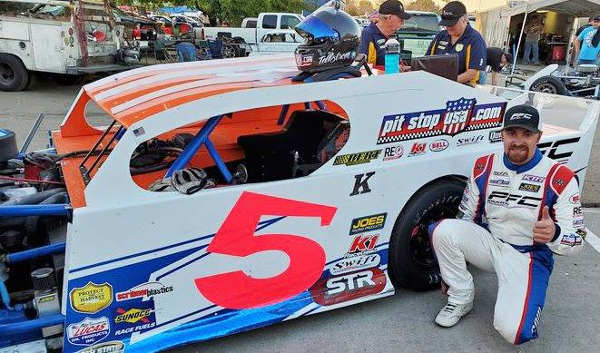
LUCERNE, Calif. – North State Modified Series, or NSMS, presented by Protect the Harvest, concluded its COVID-shortened 2020 season with no spectators in the stands, but the participation was as competitive as ever with full fields of cars at each venue.
It was a close battle all season long, but at the end it was Kyle Tellstrom of Ukiah who came out on top and will reign as the 2020 North State Modified Series champion.
It was Tellstrom’s first full year with NSMS, and he started out by setting fast time at Lakeport Speedway in July and then went on to win the “O’Reilly Auto Parts 60” that same night.
He backed that up in September with another fast time at the “Napa Lake Parts Fall Special” at Lakeport and finished second to Charlie Collins of Upper Lake in the feature.
Tellstrom was quickest again at Redwood Acres Raceway in Eureka later that month, but was only able to bag a sixth place finish in the “McMurray & Sons Roofing 60.” It was Santa Rosa’s Cameron Austin who was victorious that night.
Tellstrom was the defending champion of the 2019 “Lloyd Burton Against the Wind Challenge”, and although he clocked in second quickest, he piloted his way to the front to win the prestigious event again in 2020 at Shasta Speedway in Anderson.
The season finale’ at Stockton 99 Speedway saw Tellstrom come from the back to finish third behind Austin and Darrin Sullivan in the inaugural “Bob Lehman Classic.”
Finishing second in points is 2019 NSMS champion Scott Winters of Tracy. Winters had the fastest car at the final two NSMS events this year, and placed in the top five three times, including a second at Shasta, and a third and fourth at the two Lakeport shows.
Third in overall points is Darrin Sullivan of Kelseyville. Sullivan was the 2016 NSMS Rookie of the Year. The following season he won the 2017 Memorial Day race At Redwood Acres Raceway as well as the Lloyd Burton Challenge at Shasta. Sullivan only finished out of the top five one time in 2020.
2020 Lakeport Speedway modified champion Mike Sullivan of Kelseyville also ran every race with North State this season to earn a fourth place in the standings. It was Mike Sullivan’s first year running in the series, earning him the 2020 North State Modified Series Rookie of the Year title.
The North State Modified Series is presented by: Protect the Harvest, Lucas Oil, Hoosier Tire West, Sunoco Race Fuels, Naake Suspension, Five Star Bodies, Racer Bling, Mark & Sharon Baldwin, Scribner Plastics, O’Reilly Auto Parts, Economy Heating and Air, GASCO and Mort Houston.
- Details
- Written by: Nadine Strauss
STOCKTON, Calif. – The 2020 grand finale for the North State Modified Series, presented by Protect the Harvest, was held at Stockton 99 Speedway Saturday with 21 cars and drivers on hand to compete in the inaugural Bob Lehman Classic.
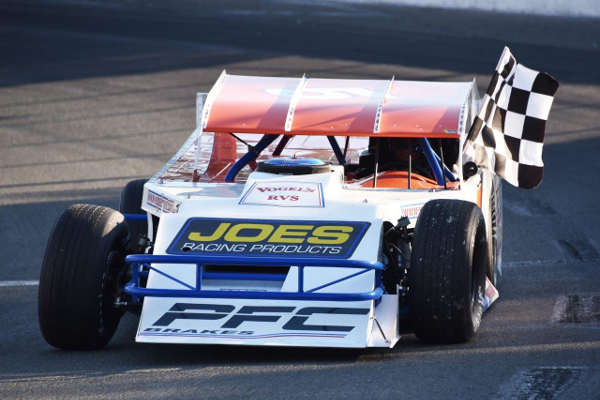
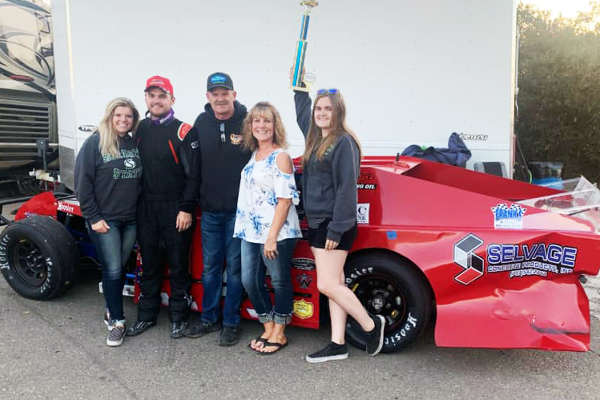
The event saw five lead changes in 60 laps, but it was Cameron Austin of Santa Rosa who led the final 20 to win the event and collect the $3,200 first-place prize.
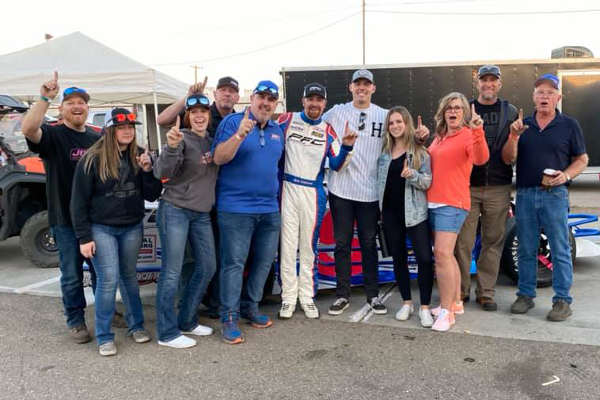
Darrin Sullivan of Kelseyville, who led the most laps – 29 – finished second. And Kyle Tellstrom of Ukiah clinched the 2020 NSMS championship by finishing third.
No time trials were scheduled for this event so the 60 lap feature lineup was based on the fastest laps turned in two pre-race practice sessions.
Defending champion Scott Winters of Tracy turned the quickest lap of the day (14.125) and drew the number 10 pill for the inversion.
Nick Lyons was 10th quick and would have started on the pole, but his brakes failed in hot laps and he drove hard into the turn four concrete wall and was unable to make the show.
So Jarred Hess and Rich Lindgren shared the front row with Cody Braund and Mike Sullivan in row two, Darrin Sullivan and Ian Elliott in row three, Darrin Knight and Austin in row four, and Tellstrom and Winters in row five.
Lindgren powered into the lead at the drop of the green flag with Hess settling into second. Both Darrin Sullivan and Knight made the inside groove work and snuck under Hess on lap five. Darrin Sullivan continued his inside challenge and took the lead away from Lindgren on the tenth circuit. Knight drove by Lindgren the following round and the two leaders pulled away from the pack.
Five laps later Braund’s car started to smoke. When his oil filter blew off it spilled oil all around the track, and when Elliott spun in the oil, the red flag came out.
After a lengthy clean-up, the race restarted with Knight and Darrin Sullivan in a heated side-by-side battle for the lead. The two make contact but kept going, and at the same time Chris Lyon and Robert Schmidt crashed together ending their runs.
When racing resumed Darrin Sullivan continued to lead with Knight second. Austin passed Lindgren as both Tellstrom and Winters were using the low side to gain ground. Austin caught Knight and took a look under, but could not make the pass stick.
Meanwhile, Tellstrom and Winters were rubbing fenders and when the two cars came together on the backstretch on lap 25, Winters spun to bring out the next caution. Both Winters and Tellstrom had to restart at the back of the field.
Two more yellows were thrown when Mike Sullivan spun in turn four, and Lindgren and Elliott made contact on the back-stretch.
Once again Darrin Sullivan shot out in front on the restart, but this time Austin drove under Knight into second. At the halfway mark it was Darrin Sullivan, Austin, Knight, Winters, Keith Bloom, Lindgren, Tellstrom, Dustin DeRosier, Chris Salmina, and Hess.
The leaders continued to battle with Austin peeking under Sullivan while Winters was challenging Knight. Winters assumed the third spot on lap 33 and continued his forward charge. Meanwhile, Tellstrom drove by Bloom and set his sights on the leaders.
Austin moved under Darrin Sullivan on lap 37 and the pair drove side-by-side for four laps before Austin took control. Winters followed Austin’s line into second and the challenge was on. Winters tagged Austin’s car, moving Austin up the track and he drove by to take the lead. But then Winter’s car slowed down and he lost 3 laps when he pitted for a tire change.
In the closing laps Sal Lopez spun to slow the action, Rick Avila dropped out and Lindgren spun in turn two. With only five laps to go Knight’s car overheated ending his run. Austin drove the final rounds to capture his second NSMS race of 2020.
Darrin Sullivan had his season-best finish with second place, and Tellstrom finished third. Keith Bloom was fourth with Mike Sullivan rebounding to finish fifth. Rounding out the top ten were Brian Collins, Lindgren, DeRosier, Salmina and Winters.
Economy Heating and Air, along with Timm Williams, sponsored the increased winner’s purse. The Great American Seed Company added to positions second through 20th.
Bloom won $100 in the Lucas Oil Dash for Cash and Salmina finished a $50 second. Austin was named the Naake Suspension Hard Charger. The top 15 in points received the Lucas Oil Tow Money.
The North State Modified Series is presented by: Protect the Harvest, Lucas Oil, Hoosier Tire West, Sunoco Race Fuels, Naake Suspension, Five Star Bodies, Racer Bling, Mark & Sharon Baldwin, Scribner Plastics, O’Reilly Auto Parts, Economy Heating and Air, GASCO and Mort Houston.
LUCAS OIL DASH FOR CASH: Keith Bloom, Chris Salmina, Jarred Hess, Robert Schmidt
BOB LEHMAN CLASSIC : Cameron Austin, Darrin Sullivan, Kyle Tellstrom, Keith Bloom, Mike Sullivan, Brian Collins, Rich Lindgren, Dustin DeRosier, Chris Salmina, Scott Winters, Darrin Knight, Rick Avila, Sal Lopez, Ian Elliott, Cody Braund, Chris Lyon, Robert Schmidt, Jarred Hess, Rick Allen, John Baker
- Details
- Written by: CALIFORNIA DEPARTMENT OF FISH AND WILDLIFE

Where are the Carrizo Plains Pronghorn?
Question: For years, I would see pronghorn antelope along Highway 58 in the Carrizo Plains. After the solar farms went in, I saw less and less. In the last few years, I’ve not seen a single one. What is the current status of the pronghorn antelopes in the Carrizo Plains? (Lee)
Answer: The population of pronghorn on the Carrizo Plains has been declining for many years due to changes in land use. The California Department of Fish and Wildlife is actively working to retain a viable pronghorn population there.
CDFW manages the Carrizo Plains Ecological Reserve and the North Carrizo Ecological Reserve. On those lands, we are improving pronghorn habitat connectivity by modifying and removing fencing. We are also improving water availability by managing the number of troughs available. Additionally, we are actively working to improve habitat with other agencies and non-profit groups that manage land on the Carrizo, including the Bureau of Land Management, Carrizo Plain Conservancy and Sequoia Riverlands Trust.
Solar projects, which are beneficial in that they help California reach lofty renewable energy goals, have displaced a portion of the pronghorn’s core habitat which has made the herds more difficult to see from Highway 58. However, the population occupies habitat in areas outside the solar panel arrays as well, such as along Soda Lake Road and areas to the south. The Carrizo is a unique area as it is one of the only places in the state where the public can view populations of both pronghorn and tule elk. CDFW and its partner agencies will continue working to improve habitat suitability there.
Changes to fishing regulations?
Question: There is a lot of talk about making fishing regulations less complicated and word is that CDFW has made some changes. What was changed and what is the status? (Pete W.)
Answer: To answer the status part of the question first, yes, there has been recent progress with changes going into effect on March 1, 2021, assuming the changes are approved by the Office of Administrative Law (OAL). It is both the California Fish and Game Commission (FGC) and CDFW that have spearheaded those changes, with input from anglers across the state. For many years, anglers have expressed frustration with the complexity of freshwater sport fishing regulations. Some people say they are dissuaded from fishing due to actual or perceived difficulty in complying with the regulations. To address the concerns FGC and CDFW have heard over the years, CDFW held a series of community meetings in 2018 and 2019 at locations across the state to publicly introduce and discuss proposed changes to simplify statewide inland sport fishing regulations.
CDFW proposals and recommendations from the public were then vetted at this year’s January and March Wildlife Resources Committee meetings, and FGC adopted the changes just last week.
The goals of the proposed changes are to increase regulatory consistency statewide, reduce the complexity of inland sport fishing regulations and remove regulations that are no longer biologically justifiable. The major proposed regulatory changes:
• Separate the regulations for inland trout (non-anadromous waters) from those for steelhead and salmon (anadromous waters) to help provide greater clarity for anglers;
• Replace the district regulations with statewide regulations separated for trout; and
• Standardize and consolidate the “special fishing” regulations.
Technically, there are hundreds of small changes and adjustments, far too many to list here. However, if you are interested in the gritty detail, please see the regulations as they were submitted to OAL here.
When does a one-day fishing license become valid?
Question: When you purchase a one-day fishing license, when does the one day begin? Is it 24 hours from the time of purchase or at the beginning on the next day (i.e.,12:01 a.m.)? (G.)
Answer: Whether you’re purchasing a one-day, two-day or 10-day license, you’ll choose your own validity date at the time of purchase. One-day sport fishing licenses will be valid for use only on the validity date. Two-day sport fishing licenses will be valid for use for two consecutive days beginning on the date you specify at the time of purchase. Lastly, 10-day sport fishing licenses are only available to nonresident anglers and will be valid for 10 consecutive days beginning on the date you specify at the time of purchase.
If you were to buy a one-day fishing license at 2 p.m. and you wanted to go fishing that afternoon, you would specify that day’s date, print out your license at home and be on your way. The license would be good until midnight. If you specify a future date for the one-day fishing license, it will be valid at 12:01 a.m. on the date specified and will be valid until midnight of that day.
If you have a question for the California Department of Fish and Wildlife, email
- Details
- Written by: California Department of Fish and Wildlife
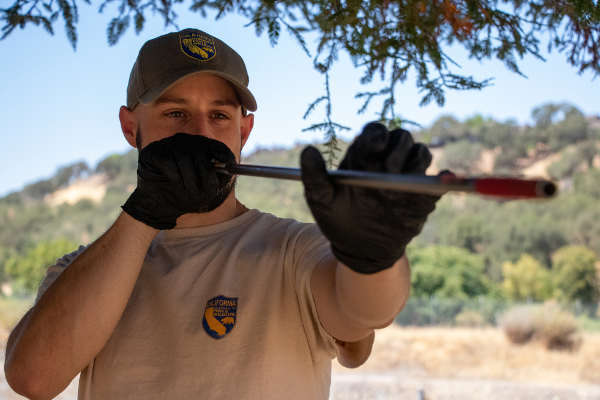
Hunting with a blowgun?
Question: I know someone who works at a zoo and they sometimes use blowguns when they need to tranquilize their animals. I am wondering if I can use a blowgun to hunt big game. Not to tranquilize, but to actually hunt. (Robert)
Answer: No, a person may not use a blowgun to hunt big game, nor is it legal to possess a blowgun at all.
The mechanisms by which a person may hunt or "take" a big game mammal are specifically defined by the California Code of Regulations, Title 14, section 353. The section is lengthy because the methods authorized for take are as permissive as they can be and may be quite different for different types of game. Blowguns are not authorized anywhere in that section.
Also, blowguns are specifically prohibited by California Penal Code section 20010 - not just for hunting, but for any purpose. This code section states: "Any person who knowingly manufactures, sells, offers for sale, possesses, or uses a blowgun or blowgun ammunition in this state is guilty of a misdemeanor."
The one exception in the Penal Code for possession of a blowgun is for those professionals who work with wild, domestic or zoo animals. The exception is defined in Penal Code section 20015, which states: "Nothing in this division shall prohibit the sale to, purchase by, possession of, or use of any blowgun or blowgun ammunition by zookeepers, animal control officers, Department of Fish and Game personnel, humane officers, or veterinarians in the course and scope of their business in order to administer medicine to animals."
Blowguns are an important tool for California Department of Fish and Wildlife personnel when tranquilizing (also known as chemically immobilizing) an animal in a confined or restricted space. Blowguns are quieter than standard tranquilizing guns, which makes them less startling to the animal.
Blow darts also hit with less force, typically use smaller needles and inject drug with less pressure which can provide a very safe and humane option for biologists, veterinarians or wildlife officers, when used appropriately.
However, their range is limited so one must get very close to the animal to be accurate and ensure an adequate injection.
Don't eat the fish
Question: Why is there a sign saying do not consume bass or striper caught in the river at the Rio Vista Pier? (Donn)
Answer: That sign was based on an advisory developed by the California Office of Environmental Health Hazard Assessment, or OEHHA, the agency responsible for issuing consumption advice for recreationally caught fish.
On May 20, 2020, OEHHA updated this advisory to include advice for 18 fish species in the Sacramento River and northern Delta, based on mercury and other chemical contaminants in the water.
OEHHA provides separate safe eating advice for members of the public who are likely to be sensitive to contaminants (women 18-49 years and children 1-17 years) and the general population (women over 50 years and men over 18 years).
The advice for striped bass remains the same, although the age range for the sensitive population has changed: women 18-49 and children 1-17 should not eat striped bass and women 50 years and older and men 18 years and older can eat up to 2 servings per week of striped bass.
The advisory covers the Sacramento River from just below Shasta Lake to where it joins the San Joaquin River in Pittsburg, and also applies to creeks, sloughs and other water bodies in the northern Delta that are north of Highway 12. The area includes portions of Butte, Colusa, Glenn, Shasta, Sacramento, Solano, Sutter, Tehama and Yolo counties.
You can find more details about that advisory (including two posters) on OEHHA's website.
Saltwater fishing license
Question: Why does CDFW charge for a saltwater fishing license? Do you stock the Pacific Ocean?
Answer: California Fish and Game Code (FGC) section 7145(a) requires that "every person 16 years of age or older who takes any fish, reptile, or amphibian for any purpose other than profit shall first obtain a valid license for that purpose." One of CDFW's primary roles is to manage California's fish and wildlife resources for use by the public. Saltwater fishing license fees help support law enforcement and scientific research and management of marine resources. In addition, CDFW does operate some hatchery and stocking programs for marine fish, such as ocean salmon and white seabass.
If you have a question for the California Department of Fish and Wildlife, email