 How to resolve AdBlock issue?
Recreation
- Details
- Written by: California Department of Fish and Wildlife
These new flyers will be available in anticipation of the upcoming recreational boat-based groundfish fishery openers that will occur as follows:
– March 1 in the Southern Management Area (Point Conception to U.S./Mexico border);
– April 1 in the Central Management Area (Point Arena to Point Conception);
– April 1 in the San Francisco Management Area (Pigeon Point to Point Arena);
– May 1 in the Mendocino Area (Point Arena to near Cape Mendocino);
– May 1 in the Northern Management Area (Near Cape Mendocino to California/Oregon state line).
RCAs are used in each of the state’s five Groundfish Management Areas (and the Cowcod Conservation Areas) to minimize contact with deeper-dwelling species of rockfish needing protection from fishing.
RCAs are defined by straight lines connecting the waypoints in the order listed in the Code of Federal Regulations, Title 50, Part 660, Subpart C.
Recreational take of those groundfish species subject to RCA restrictions is prohibited seaward of these lines regardless of depth.
However, they may be possessed aboard a vessel in transit through these closed areas with no fishing gear deployed in the water.
Anglers fishing for groundfish and non-groundfish species on the same trip are encouraged to review rules on take and possession inside and outside of RCAs.
The new flyers will include an overview cover map, and a series of 38 regional maps detailing the entire California coastline, including offshore islands and banks.
The maps feature the RCA waypoint coordinates and boundary lines as well as the Groundfish Management Area lines. Also included are California’s network of Marine Protected Areas, which may be closed to some or all recreational fishing.
The RCA maps are overlaid on National Ocean Service nautical charts to help anglers compare them to their desired fishing location; however, they should not be used for navigation.
CDFW will also update the online Ocean Sport Fishing Interactive Web Map with the new RCA lines. The web map, when used with a smart phone, will show your current position in relation to the RCA lines and marine protected area boundaries.
Locations can be clicked or tapped to show the current fishing regulations. New features will also include the ability to live-track your position and different selections for the background to better understand the boundaries.
For 2021, the new map products are especially important as changes have been made to waypoints and RCA lines in three of the Groundfish Management Areas – Southern, San Francisco and Mendocino. The changes in each area offer anglers access to deeper depths, meaning more open fishing area when the groundfish season is open.
In the Southern Management Area, the RCA for 2021 increases to 100 fathoms, allowing access to reefs and areas that have not been open to fishing in two decades. Subsequent openers for the San Francisco Management Area at 50 fathoms and the Mendocino Management Area at 30 fathoms are also new opportunities for anglers to venture into deeper depths to access shelf rockfish and deeper nearshore rockfish species.
In the Northern Management Area the RCA depth remains at 30 fathoms, and in the Central Management Area at 50 fathoms.
In addition to the RCA changes and the new map products, anglers should also take note of the sub-daily bag limit of five vermilion rockfish, which is also new in 2021. For more information on this change, please see the FAQ.
Take and possession of bronzespotted rockfish, cowcod and yelloweye rockfish remain prohibited statewide.
Anglers should check CDFW’s website for the current regulations before fishing for groundfish.
For more detailed information on the new 2021 recreational groundfish regulations and to stay informed of in-season changes, please call the Recreational Groundfish Hotline at 831- 649-2801 or visit CDFW’s summary of recreational groundfish fishing regulations for 2021.
For background information on groundfish science and management, please visit CDFW’s Marine Region Groundfish webpage.
- Details
- Written by: California Department of Fish and Wildlife
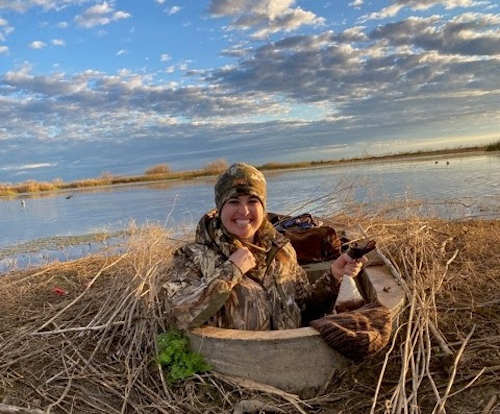
The California Department of Fish and Wildlife conducted its first Veterans and Active Military Personnel Waterfowl Hunting Days Feb.13 to 14, providing more than 650 veterans and active duty military the opportunity to hunt on state and federal managed public hunting areas.
Gray Lodge Wildlife Area near Gridley and the Wister Unit of the Imperial Valley Wildlife Area near the Salton Sea hosted the most hunters over the two days.
Gray Lodge hunters averaged 5.1 waterfowl on Saturday while the Wister Unit hunters averaged 3.5.
Hunting results for all CDFW managed hunting areas are posted at www.wildlife.ca.gov/Hunting/Waterfowl#877772-hunt-results.
“Each of us at CDFW express our appreciation for the work and sacrifice many of our veterans made and continue to make,” said Stafford Lehr, deputy director of CDFW’s Wildlife and Fisheries Division. “Opening our wildlife areas and providing veterans and active duty personnel a special waterfowl hunting opportunity was not only a pleasure, but a chance to give something back for their exceptional service to our country.”
Once the Veterans and Active Military Personnel Waterfowl Hunting Days dates were set, a coordinated effort took place among state and federal agencies, private organizations and duck clubs to provide veterans and military personnel with hunting opportunities.
CDFW opened more than a dozen of its most popular waterfowl areas for these special hunt days. California Waterfowl opened its Grizzly Island Ranch, Butte Creek Ranch and other properties. CWA reached out to members and cooperating partners to provide places for 60 veterans to hunt.
Duck clubs like The Members Duck Club near the Salton Sea and Mound Farms in the Yolo Bypass welcomed veterans for the Veterans and Active Military Personnel Waterfowl Hunting Days.
Club members accompanied veterans out to the blinds, helped them find their blind in the dark and set out decoys.
CWA Volunteer Veterans Hunt Coordinator Mike Peeters said, “There is tremendous community outreach among landowners to connect with veterans, to give back and provide hunting opportunity.”
Only veterans and active military personnel could apply for a hunt reservation through the CDFW waterfowl reservation drawing system for the weekend. This made it possible for many to draw their first reservation of the 2020-21 waterfowl hunting season.
A reservation is extremely important to hunters since it guarantees a place to hunt. Drawing a reservation is hard. In 2020-21, a record 1.23 million hunt reservation applications were submitted.
At Little Dry Creek Unit within the Upper Butte Basin Wildlife Area, one of the most sought-after hunting areas, a record 141,160 applications were submitted. Overall, the odds of drawing a reservation for the 2020-21 season on a CDFW managed waterfowl hunting area averaged 4.05 percent.
Veterans and active duty personnel experiencing the hunt came away with several positives. First and foremost, they enjoyed a special weekend of waterfowl hunting. Those new to waterfowl hunting got a chance to experience a hunt with minimal hunter competition. Many also were able to share the experience with friends and family.
- Details
- Written by: Elizabeth Larson

NORTHERN CALIFORNIA – The Mendocino National Forest began a vegetation management project at the Red Bluff Recreation Area, or RBRA, on Monday.
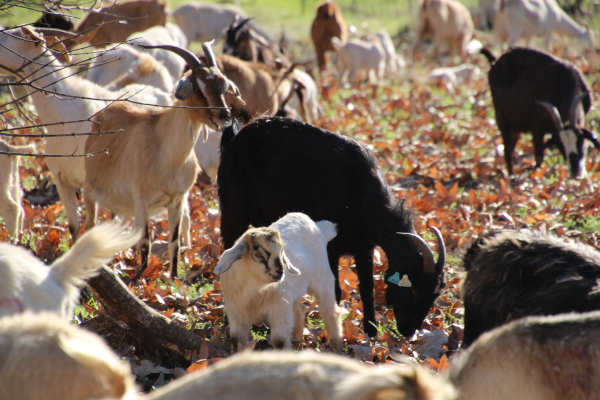
Blue Tent Farms delivered approximately 1,200 Kiko-Savanna-cross goats to reduce vegetation in areas in the undeveloped portions of the RBRA.
The objective of the project is to reduce fire fuels in a sustainable manner.
The vegetation management project will reduce the risk of a large wildfire and help improve public safety and visitor experience at the RBRA. There will be 600 does and 600 kids at the RBRA through the spring.
The project will not affect the campgrounds, picnic areas, the boat ramp or the Sacramento River Discovery Center. At no time will the goats have access to the Sacramento River, East Sand Slough or other wetlands.
The goats will be moved around within the fenced areas with a temporary movable fence. The temporary electric fencing will keep the goats in and the people out as well as help protect water quality for fish and elderberry tree habitat.
There will be shepherds and guard dogs on location.
Please take photos and watch the goats from a distance; do not approach the goats or dogs.
- Details
- Written by: Elizabeth Larson
Booklets will no longer be printed and shipped to license agents or customers but electronic versions of the booklets will continue to be available online.
“Not only is this shift best for the environment because of the reduction of many thousands of short-term paper booklets being produced, the cost to print and ship the booklets is significant,” said CDFW Wildlife and Fisheries Division Deputy Director Stafford Lehr. “Another benefit is that the money saved by going paperless will be redirected to fish and wildlife conservation.”
The transition to paperless regulations booklets follows a two-year effort to reduce the number of hard copy booklets printed and shipped to license agents and is consistent with the governor’s directive to reduce paper usage.
As in previous years, digital booklets are available at www.wildlife.ca.gov/Regulations and can be downloaded as PDFs to your computer, cellular phone or another electronic device.
Hunters and anglers are encouraged to download the digital booklets to their mobile devices and familiarize themselves with the digital format prior to hunting and/or fishing trips.