 How to resolve AdBlock issue?
News
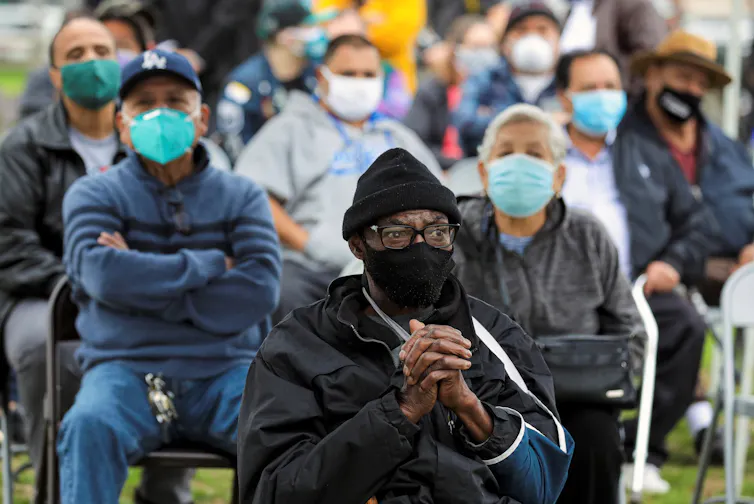
If you’ve tried to get a COVID-19 vaccine appointment, you know how frustrating the process can be. People are spending hours obsessively refreshing websites, hoping an appointment will open up somewhere. They scan Facebook groups for tips and insider information. One writer compared it to Soviet-style queues for cabbage.
The competition for slots will only worsen when the COVID-19 vaccination priority list opens to the broader public.
It doesn’t have to be this way. Much of this misery comes from poorly designed vaccine sign-up websites, but the problem is more fundamental.
As an expert in health care operations and vaccine supply chains, I have closely followed the difficulties in connecting COVID-19 vaccine doses with people. I believe the best solution to vaccine appointment scheduling lies in building a trustworthy one-stop preregistration system.
The U.S. has now surpassed half a million deaths from COVID-19, and new fast-spreading variants of the coronavirus are adding to the urgency. As states scramble to speed up vaccinations and try to prevent their limited doses going to waste, a handful of them are testing this approach.
Why did the traditional model go so wrong?
The traditional vaccine sign-up model does not work when the demand for vaccines far exceeds supply.
Under that model, the only way to get vaccinated is to reserve an appointment slot. Naturally, the fear of being left out drives people to attempt to sign up as soon as appointment slots become available. This leads to a rush of people endlessly refreshing the same websites for the few appointments available.
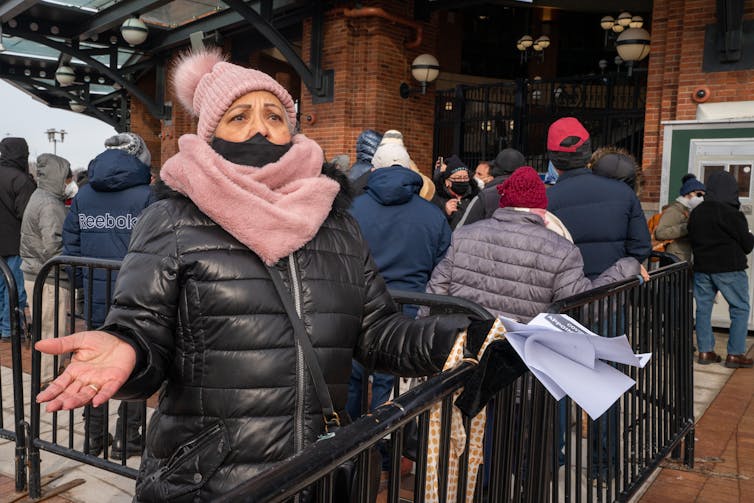
Even if all states had one-stop appointment websites that did not crash under high volume, the limited vaccine supply would mean most appointment slots would quickly be taken. That could make it even harder for people who aren’t tech-savvy to get the vaccine.
To fix the broken vaccine scheduling system, we need to break this cycle.
What preregistration can solve
Most people have fairly realistic expectations about when they will be vaccinated. Their anxiety comes from the fear of being left out. To address this anxiety, the system must be designed to reassure people that they will receive vaccines within a reasonable time frame.
In Israel, which leads the world in COVID-19 vaccination, citizens do not need to actively sign up for vaccine appointments. Rather, they are notified when they become eligible via text messages and can then make an appointment.
States can echo this “push” system by creating a one-stop preregistration portal where everyone registers once and is notified to schedule appointments when their turn arrives. The preregistration step helps avoid waves of people trying to get appointments at the same time, which can crash computer systems, as Massachusetts experienced on Feb. 18.
A good system will make it easy for people to check their position in the vaccine queue at any time, provide an estimated time to vaccination based on frequently updated supply information and then send notifications when their date is getting close. Underlying the system, vaccine doses can be allocated among eligible users on the registry using a lottery system.
A well-designed preregistration system can also help avoid vaccine doses going to waste because of no-shows. With an active waitlist, vaccine planners can match supply with demand in an agile manner and offer appointments to people a few days in advance rather than scheduling appointments weeks out when the supply isn’t certain. Research in appointment scheduling has shown that no-shows are more likely under long lead times.
West Virginia sets an example
West Virginia uses a statewide preregistration system and has so far been more successful at vaccinating its population than almost every other state. It controls the process from preregistration to appointment. To get the vaccine, almost all residents, with a few exceptions, are required to use the state system, with options to register either online or by phone.
Minnesota just launched a similar system. “We still have a frustratingly limited vaccine supply from the federal government, but every Minnesotan should know their chance to get a vaccine will come. Today, we are connecting them directly to that process,” Minnesota Gov. Tim Walz said in announcing the preregistration system on Feb. 18.
More states should follow their lead as more of the general population becomes eligible for the vaccine in the coming months.
[Deep knowledge, daily. Sign up for The Conversation’s newsletter.]
In Massachusetts, where a vaccine sign-up website crashed shortly after launching, nearly every member of the state’s congressional delegation has urged Gov. Charlie Baker to launch a preregistration system. A few other states already have limited preregistration systems that could be expanded.
It still takes coordination
Preregistration can still create confusion if the process isn’t coordinated and users don’t know what to expect.
In Virginia, for example, counties created their own preregistration systems, but when the pharmacy chain CVS announced it was taking appointments, users didn’t know what to do. Most Virginia counties are now shifting to a statewide preregistration system. In Santa Cruz County, California, residents have struggled with a preregistration portal that doesn’t provide confirmation or an estimated time to vaccination.
“Efficiency-equity trade-off” has become a buzzword in discussing COVID-19 vaccination. With limited vaccine supply, the traditional sign-up model has proven to be both inefficient and inequitable. Moving away from that model and establishing one-stop preregistration systems is one key to resolving the painful vaccine scheduling process.
Tinglong Dai, Associate Professor of Operations Management & Business Analytics, Johns Hopkins Carey Business School, Johns Hopkins University School of Nursing
This article is republished from The Conversation under a Creative Commons license. Read the original article.
Dr. Giovanni Annous told Lake County News that the situation shouldn’t warrant any anxiety from the community, as the Upper Lake Elementary School staffer who tested positive for the virus doesn’t work directly with students.
Annous and Upper Lake Elementary School principal Stephanie Wayment released a statement to staff and the community on Sunday explaining that at 6:30 a.m. on Thursday the staffer reported to Wayment that they were not feeling well.
The staff member was immediately sent home and directed to schedule a COVID-19 test. On Sunday, the test results were received confirming the employee has having COVID-19, the statement explained.
“Thanks to diligent safety protocols, we feel confident in the safety of students and staff,” Annous and Wayment said in the statement.
Over the next few days, district officials said they will be working with the Lake County Department of Public Health to conduct contact tracing and help identify and contact possible close contacts as quickly as possible. People identified as close contacts will be notified through Public Health.
The district said a close contact in terms of contact tracing means a person who has been within 6 feet of the infected person for 15 minutes or more within a period of 24 hours without wearing a mask. A person who has been identified as a close contact should be quarantined for 14 days after the last exposure.
Annous and Wayment told parents it’s important to stay home if they or their children feel ill, to contact their doctor as soon as possible and continue to communicate with their school.
Annous told Lake County News on Sunday evening that this is the first instance of a district staff member testing positive for COVID-19 during instructional time since returning to school on Aug. 12.
He said one staffer also had tested positive in June and over the Christmas break one or two district employees may also have tested positive but the district wasn’t formally notified of it.
The Upper Lake Unified School District and the Lucerne Elementary School District both started school in August in a “hybrid” model that allowed for having students back on campuses.
After Christmas break, Annous said the district agreed to a request from Public Health to delay in-person instruction for several weeks because of the county’s high case rate, so they began with distance learning and had students back on campus on Jan. 25.
Annous said 72 percent of the district’s elementary students are now on campus five days a week and 55 percent of students in the middle and high school grades attend classes in person.
He credited the district’s 99 staff members with their diligence in maintaining safety protocols each day for the fact the district has not had more cases.
In addition to hospital-style air purifiers that the district uses – and that were brought in before COVID-19 in order to deal with wildland fire smoke – Annous said every staffer gets a new K95 mask every day.
The schools also have been using partitions, foggers and hand sanitizer, among other measures.
“We’re always managing risk,” Annous said.
Two-thirds of the district’s staff also has been vaccinated against COVID-19. Annous said he was the last district staffer to receive the second dose on Friday.
Annous said the safety of students, teachers, staff and the community is paramount.
At the same time, he said they want to make sure they provide an atmosphere offering academic, social and emotional support for students.
“Our kids deserve the best,” he said.
Email Elizabeth Larson at
The meeting will begin at 9 a.m. Tuesday, March 2, and will be available to the public virtually only.
The meeting can be watched live on Channel 8, online at https://countyoflake.legistar.com/Calendar.aspx and on the county’s Facebook page. Accompanying board documents, the agenda and archived board meeting videos also are available at that link.
To participate in real-time, join the Zoom meeting by clicking this link at 9 a.m. The meeting ID is 947 9043 3802, password 156886. The meeting also can be accessed via on tap mobile at +16699006833,,94790433802#,,,,*156886#.
All interested members of the public that do not have internet access or a Mediacom cable subscription are encouraged to call 669-900-6833, and enter the Zoom meeting ID and passcode information above.
Chromebook devices are also available at the Lakeport and Clearlake Library branches, which will open early on Tuesday. Chromebooks can be checked out for three hours for use on the library premises and contactless pickup is available. The Lakeport Library Branch can be reached at 707-263-8817, and Clearlake at 707-994-5115.
WiFi is accessible in the parking lot of each County Library Branch, so residents can park at these locations to use WiFi on borrowed or personal devices, by connecting to the “Lake County Library” network (no password) anytime from 7 a.m. to 8 p.m.
While the board chambers remain closed, outdoor viewing and participation are also available during each meeting on the Third Street side of the courthouse building.
To submit a written comment on any agenda item please visit https://countyoflake.legistar.com/Calendar.aspx and click on the eComment feature linked to the meeting date. If a comment is submitted after the meeting begins, it may not be read during the meeting but will become a part of the record.
In an untimed item, the board will consider a resolution directing another sale of tax-defaulted properties, to take place in June.
The proposed resolution includes a list of 490 properties.
At 9:45 a.m., the board will discuss the formation of an ad hoc committee promoting tolerance, respect, equity and inclusion.
The report to the board from Board Chair Bruno Sabatier explains that on Feb. 23 the supervisors adopted the proclamation promoting tolerance, respect, equity and inclusion in Lake County.
“As an important next step, I am recommending our Board now form an ad hoc committee to plan for the community visioning forum to develop recommendation for meaningful actions and activities that build bridges where there may be walls; fostering tolerance, respect, understanding, equity and inclusion; promoting non-violence and non-violent conflict resolution; focusing resources on underlying causes and conditions that lead to inequitable resource and justice distribution; and, relevant solutions for social injustices, as they may come to light,” wrote Sabatier.
Sabatier recommends that the ad hoc committee have seven seats, including two board members – Supervisors Tina Scott and EJ Crandell – along with one representative of law enforcement and four members from the community.
In other business on Tuesday, in an item timed for 9:06 a.m., Public Health Officer Dr. Gary Pace will give an update on COVID-19.
At 10:30 a.m., the board will get a report from the Clear Lake Environmental Research Center.
In an untimed item, the board will consider giving notification to increase concealed carried weapon class fees.
The full agenda follows.
CONSENT AGENDA
5.1: Adopt resolution amending Resolution 2021-133 and approving the Classification, Compensation Recruitment and Retention Committee findings and recommendations.
5.2: Approve minutes of the Board of Supervisors meetings on May 19, 2020, and Feb. 23, 2021.
5.3: Approve COVID-19 Prevention Program.
5.4: Approve memorandum of understanding between the Department of Social Services and Behavioral Health Services for the provision of Lanterman-Petris-Short conservatorships in the amount of $102,780 per fiscal year, and authorize the chair to sign.
5.5: Approve contract between the county of Lake and Lindsey & Company Inc., an MRI Software LLC Co. in the amount of $104,252 from Jan. 1, 2021, to Sept. 30, 2026, and authorize the chair to sign.
TIMED ITEMS
6.2, 9:06 a.m.: Consideration of Update on COVID-19.
6.3, 9:45 a.m.: Consideration of an ad hoc committee promoting tolerance, respect, equity and inclusion.
6.4, 10 a.m.: Consideration of early activation changes; (a) amendment to cannabis cultivation ordinance; (b) resolution for those were early activated in 2020; and (c) efficiency processes, direction to staff.
6.5, 10:30 a.m.: Consideration of report from the Clearlake Environmental Research Center.
UNTIMED ITEMS
7.2: Consideration of the following advisory board appointments: Agriculture Advisory Committee, Scotts Valley Community Advisory Council and Fish & Wildlife Advisory Committee.
7.3: Consideration to approve advance step hiring of Ms. Eileen Harmon in the position of Public Health Nurse, Senior, at Step 5, due to candidates extraordinary qualifications.
7.4: Consideration of notification of increase in concealed carried weapon class fees.
7.5: Consideration of resolution authorizing the chairman of the board to approve and direct the tax collector to sell, by public auction via internet, tax-defaulted property which is subject to the power to sell in accordance with Chapter 7 of part 6 of Division 1, of the California Revenue and Taxation Code and approving sales below minimum price in specified cases.
CLOSED SESSION
8.1: Conference with legal counsel: Existing litigation pursuant to Gov Code sec 54956.9(d)(1) City of Clearlake v. County of Lake, et al.
8.2: Employee disciplinary appeal (Gov Code sec 54957): Appeal No. 2021- 01.
Correction: The article previously stated there were 471 properties to be offered for tax sale. There are in fact 490.
Email Elizabeth Larson at
The council will meet at 6 p.m. Tuesday, March 2.
The meeting will be by teleconference only. The city council chambers will not be open to the public.
The agenda can be found here.
To speak on an agenda item, access the meeting remotely here or join by phone by calling toll-free 669-900-9128 or 346-248-7799. The webinar ID is 973 6820 1787, access code is 477973; the audio pin will be shown after joining the webinar. Those phoning in without using the web link will be in “listen mode” only and will not be able to participate or comment.
Comments can be submitted by email to
Indicate in the email subject line "for public comment" and list the item number of the agenda item that is the topic of the comment. Comments that read to the council will be subject to the three minute time limitation (approximately 350 words). Written comments that are only to be provided to the council and not read at the meeting will be distributed to the council prior to the meeting.
The council on Tuesday will meet new Lakeport Police Department intern Pualani Kiao Erickson.
Under council business, Administrative Services Director Kelly Buendia will present a resolution to approve joining the Employment Risk Management Authority Joint Powers Agreement for employment practices liability coverage.
Community Development Director Jenni Byers will take to the council a proposed professional service agreement with Mintier Harnish for the completion of objective design and development standards for the city’s zoning ordinance and updates to its accessory dwelling unit rules.
In other business, the council will consider adopting a resolution approving an allocation of funding and the execution of a grant agreement and any amendments thereto from the Community Development Block Grant – Disaster Relief Program, or CDBG-DR.
Byers’ report to the council explains, “Due to the 2018 Mendocino Complex Fire, which threatened the City Lakeport for over a week and resulted in the mandatory evacuation of all City businesses and residents, several allocations of Disaster Recovery funds have been allocated through the CDBG program. The City of Lakeport is eligible for $2,433,284 as part of the Multi-Family Housing Program. This funding must be used to develop multifamily housing. The program is administered through the state department of Housing and Community Development.”
She added, “While the process is frustratingly slow, it is moving forward, but in order to proceed in the process, the City needs to submit its due diligence package, which includes a Council resolution. While there is still time to decide which final project would be the best use of the funds, the City has several developers interested in proposing housing projects for these funds. The City does not need to determine the use of the funds at this time, but the funds must be spent within the City of Lakeport.”
Also on Tuesday, Finance Director Nick Walker will present the comprehensive annual financial report for the year ended June 30, 2020, and the council will consider adopting a proposed resolution to reaffirm the necessity of AB 1600 development impact fees.
In an informational item, Public Works Director Doug Grider will provide a basic overview of city roads and the methods used to manage them.
At the end of the meeting, the council will hear a presentation by NHA Advisors on the Unfunded Accrued Liability Pension Program.
On the consent agenda – items considered noncontroversial and usually accepted as a slate on one vote – are ordinances, minutes of the regular council meeting on Feb. 16 and confirmation of the continuing existence of a local emergency for the COVID-19 public health emergency.
Email Elizabeth Larson at
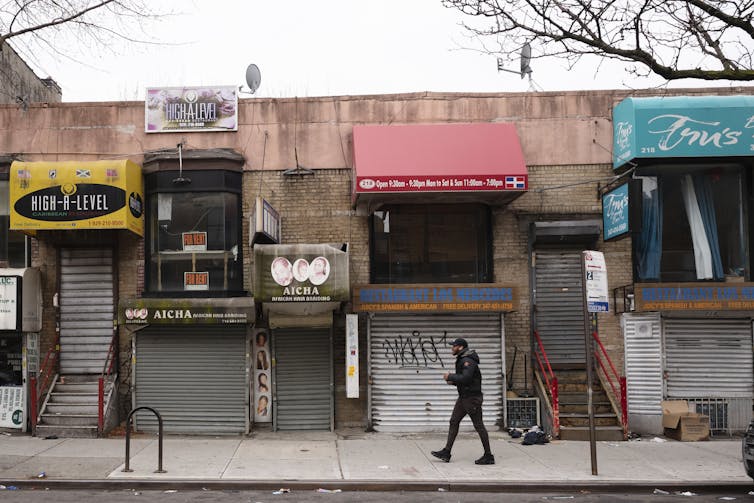
The pandemic has taken a heavy toll on Main Street, with small businesses across the U.S. closing by the thousands.
But as bad as the overall scene is, for minority-owned businesses the picture is even bleaker. A survey released on Jan. 27 by advocacy group Small Business Majority found that almost 1 in 5 Black and Hispanic entrepreneurs expected to permanently close their business over the course of the next three months – a rate higher than for white business owners. It comes on the back of a report by the Federal Reserve of Cleveland that suggested that the impact of the coronavirus could be over two times larger for Black- and Hispanic-owned businesses than for white-owned enterprises.
As scholars who research racial inequities and entrepreneurship, we know that even before the pandemic, Black- and Hispanic-owned businesses were more vulnerable to economic downturns. Minority-owned businesses tend to have lower levels of capital – the amount of equity relative to debt – than white-owned businesses, making it harder for them to safeguard against unexpected economic downturns. In addition, Black- and Hispanic-owned businesses tend to concentrate in areas and industries that have been especially heavily affected by the pandemic, such as retail and the restaurant business.
Lower income, less capital
The gap in capital available to Black and Hispanic business owners is in large part a result of long-standing disparities in homeownership rates.
Lower levels of homeownership among Black and Hispanic Americans compromises their ability to use home equity to start or maintain businesses. Even for those who are homeowners, higher mortgage rates, mortgage insurance premiums and property taxes mean they are likely to have less home wealth at their disposition to keep businesses afloat in tough times.
Data from the 2019 Survey of Consumer Finances shows that white business owners had almost five times the amount of home equity as their Black and Hispanic counterparts. At the same time, minority-owned companies generated 10 times less income than white-owned ones.
In short, this means white-owned businesses typically have more liquidity to weather a sharp decline in revenues, such as has been experienced during the pandemic.
Our analysis of data shows that Black and Hispanic entrepreneurs are 25 percentage points less likely to have emergency savings than white business owners, and similarly hold far fewer stocks or other liquid assets.
As a result, minority business owners are more often forced to rely on nonbusiness income, such as other family members’ income earnings and debt to fund their operations. But making interest payments on higher levels of debt drains cash at a time when entrepreneurs may need it the most.
Decline in business
Compounding the problem is the impact the pandemic has had on clients and customers of small businesses.
A large number of minority-owned businesses operate in neighborhoods with high minority populations – the very communities that have been disproportionately affected by the pandemic, through job loss and illness.
This in turn affects demand for products and services provided by minority small businesses, especially as recessions tend to hit Black and Hispanic communities in the U.S. harder and earlier.
Data from analytics website SafeGraph shows that foot traffic for businesses in minority neighborhoods has declined more sharply than those in white neighborhoods. Small businesses in all-white neighborhoods experienced nearly no decline in foot traffic during the pandemic. In contrast, small businesses in neighborhoods with a 20% minority composition saw a decline in foot traffic of almost 40%.
The sectors that Black- and Hispanic-owned enterprises tend to concentrate in also contribute to the racial disparity in closures. Figures from American Community Survey show that sectors that have been particularly vulnerable in the pandemic, such as retail and restaurant, comprise a larger share of minority ownership. As such, it is no surprise that job losses at the onset of the recession were larger in industries with the highest share of minority business owners.
[Get the best of The Conversation, every weekend. Sign up for our weekly newsletter.]
Targeted assistance
Minority-owned businesses in need are also less likely to benefit when the government offers aid in a crisis.
And that’s what appears to be happening during the pandemic. The federal government created the Paycheck Protection Program last April to provide assistance to small businesses hurt by the coronavirus lockdowns.
Administered in two rounds, it offered more than US$500 billion worth of loans that could be forgiven if funds were used to cover payroll. These loans have provided a lifeline to many small businesses.
But research found that the first round of the stimulus package was inequitably distributed, with the bulk of the funds given to businesses in neighborhoods with low shares of Black and Hispanic residents. The delay in federal help to minority business owners may have been critical, given the large fraction of business closures that took place in the early months of the pandemic.
To mitigate the disproportionate effects of this downturn on minority-owned businesses, we believe it is crucial that the Biden administration begin to target more of its small business aid to Black and Hispanic enterprises and to the worst-hit communities. The consequence of not ensuring that aid is more equitably delivered is further suffering in the Black and Hispanic business community.
Carlos Avenancio-Leon, Assistant Professor of Finance, Indiana University and Isaac Hacamo, Assistant Professor of Finance Department: Finance Campus: Bloomington, Indiana University
This article is republished from The Conversation under a Creative Commons license. Read the original article.
The following cats at the shelter have been cleared for adoption.
Call Lake County Animal Care and Control at 707-263-0278 or visit the shelter online at http://www.co.lake.ca.us/Government/Directory/Animal_Care_And_Control.htm for information on visiting or adopting.

Male tuxedo cat
This male tuxedo cat has a short black and white coat and green eyes.
He is in cat room kennel No. 39, ID No. 14359.

‘Dumplin’
“Dumplin” is a female torbie with a short coat and green eyes.
She has been spayed.
She’s in kennel No. 88, ID No. 14385.

‘Buddy’
“Buddy” is a male domestic short hair cat with a flame point and white coat and blue eyes.
He has been neutered.
He’s in cat room kennel No. 100, ID No. 14384.

‘Trouble’
“Trouble” is a young female domestic medium hair cat with a seal point coat and blue eyes.
She’s in cat room kennel No. 132, ID No. 14378.

Male domestic short hair
This male domestic short hair has a tuxedo coat and green eyes.
He has been neutered.
He’s in cat room kennel No. 142, ID No. 14386.
Email Elizabeth Larson at