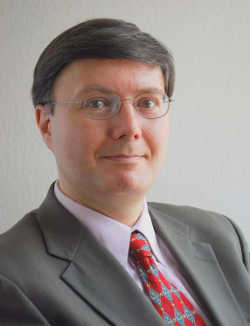
Dennis Fordham. Courtesy photo. A decedent’s will or a trust may require that the beneficiary satisfy certain conditions in order to inherit.
California, like other states, enforces many conditions imposed on inheritances but not those that either violate the law or public policy.
Section 708 of California Civil Code provides that, “[c]onditions are precedent or subsequent. The former fix the beginning, the latter the ending, of the right.”
Conditions precedent must be satisfied to receive a gift. Examples include: the beneficiary must survive me; the beneficiary must be age 21. Section 709 of the California Civil Codes provides, “If a condition precedent requires the performance of an act wrong of itself, the instrument containing it is so far void, and the right cannot exist. If it requires the performance of an act not wrong of itself, but otherwise unlawful, the instrument takes effect and the condition is void.”
A “No Contest” clause is a conditional gift clause requiring the beneficiary to accept the terms of the will or trust in order to inherit. A no-contest clause can be used to reinforce conditional gifts.
Conditions subsequent are conditions that if they occur result in a forfeiture (loss) of the gift. While California disfavors conditions subsequent a court will give effect if the testator’s intent is clear and there is no violation of law or public policy. In re Kitchen, 192 Cal. 834 (1923).
Let us consider conditions subsequent related to marriage. In California, “[c]onditions imposing restraints upon marriage, except upon the marriage of a minor, are void; but this does not affect limitations where the intent was not to forbid marriage, but only to give the use until marriage.” (Section 710, Civil Code.)
In Estate of Earl Guidotti (2001), 90 Cal.App.4th 1403, Earl’s trust provided that, “"[i]n the event [my wife] should remarry, or, live with a man as though they were husband and wife, even though not married, all income payments to her shall immediately stop ...."
The court looked to whether Earl intended to support his widow while she was unmarried – which would be permissible – or intended to restrict her from remarrying – which would be void. Thus it is important to show that the decedent’s intentions were good and not prohibited.
Let us consider conditions subsequent related to behavior. Sometimes a decedent’s estate requires the benefits to be suspended or terminated if the beneficiary behaves inappropriately, such as, by getting poor grades in college (resulting in no more college funding); by failing to look after the decedent’s pets (no more free rent); or by using illegal drugs (no more distributions). None of these conditions subsequent are either illegal or against public policy.
To be enforceable conditions must be properly drafted. The condition would have to be worded in a way that showed the consequence if the condition was not satisfied and provided for an alternative disposition. The intention behind the condition should also be clear. For example, if the beneficiary uses illegal drugs all distributions are suspended until the beneficiary has tested clean.
Sometimes failure to satisfy a condition is forgiven, such as when it is impossible to satisfy the condition, the condition requires the beneficiary to violate the law or public policy. In Schwan v Permann (2018), 28 CA5th 678, the decedent’s trust provided that three named employees of the decedent would each receive a percentage of the trust if are "employed by Control Master Products, Inc. at the death of Trustor and his spouse and if not, this gift shall lapse and augment the share of the remaining beneficiaries under this paragraph."
The decedent sold his company prior to his death but two of the three named employees remained employed right up until the company was sold. The court concluded that, “the two employees who had remained employed till the end had ‘complied with the terms of the trust so far as was possible.’ Impossibility, due to the decedent’s unilateral decision to sell the company, excused any further performance.”
The foregoing brief discussion of a complex and broad subject is not legal advice. Anyone confronting such issues should consult with a qualified attorney.
Dennis A. Fordham, attorney, is a State Bar-Certified Specialist in estate planning, probate and trust law. His office is at 870 S. Main St., Lakeport, Calif. He can be reached at This email address is being protected from spambots. You need JavaScript enabled to view it. and 707-263-3235.
To investigate humans’ impact on freshwater resources, scientists have now conducted the first global accounting of fluctuating water levels in Earth’s lakes and reservoirs – including ones previously too small to measure from space.
The research, published March 3 in the journal Nature, relied on NASA’s Ice, Cloud and land Elevation Satellite 2, or ICESat-2, launched in September 2018.
ICESat-2 sends 10,000 laser light pulses every second down to Earth. When reflected back to the satellite, those pulses deliver high-precision surface height measurements every 28 inches along the satellite’s orbit. With these trillions of data points, scientists can distinguish more features of Earth’s surface, like small lakes and ponds, and track them over time.
Scientists used these height measurements to study 227,386 water bodies over 22 months and discovered that, from season to season, the water level in Earth’s lakes and ponds fluctuates on average by about 8.6 inches. At the same time, the water level of human-managed reservoirs fluctuate on average by nearly quadruple that amount – about 34 inches.
While natural lakes and ponds outnumber human-managed reservoirs by more than 24 to 1 in their study, scientists calculated that reservoirs made up 57 percent of the total global variability of water storage.
“Understanding that variability and finding patterns in water management really shows how much we are altering the global hydrological cycle,” said Sarah Cooley, a remote sensing hydrologist at Stanford University in California, who led the research. “The impact of humans on water storage is much higher than we were anticipating.”
In natural lakes and ponds, water levels typically vary with the seasons, filling up during rainy periods and draining when it’s hot and dry. In reservoirs, however, managers influence that variation – often storing more water during rainy seasons and diverting it when it’s dry, which can exaggerate the natural seasonal variation, Cooley said.
Cooley and her colleagues found regional patterns as well – reservoirs vary the most in the Middle East, southern Africa, and the western United States, while the natural variation in lakes and ponds is more pronounced in tropical areas.
The results set the stage for future investigations into how the relationship between human activity and climate alters the availability of freshwater.
As growing populations place more demands on freshwater, and climate change alters the way water moves through the hydrological cycle, studies like this can illuminate how water is being managed, Cooley said.
“This kind of dataset will be so valuable for seeing how human management of water is changing in the future, and what areas are experiencing the greatest change, or experiencing threats to their water storage,” Cooley said. “This study provides us with a really valuable baseline of how humans are modulating the water cycle at the global scale.”
The researchers’ methods relied on a second satellite mission, as well – Landsat, the decades-long mission jointly overseen by NASA and the U.S. Geological Survey.
The team used Landsat-derived, two-dimensional maps of bodies of water and their sizes, providing them with a comprehensive database of the world’s lakes, ponds, and reservoirs. Then, ICESat-2 added the third dimension – height of the water level, with an uncertainty of roughly 4 inches (10 cm). When those measurements are averaged over thousands of lakes and reservoirs, the uncertainty drops even more.
Although ICESat-2’s mission focuses on the frozen water of Earth’s cryosphere, creating data products of non-frozen water heights was also part of the original plan, according to Tom Neumann, ICESat-2 project scientist at NASA’s Goddard Space Flight Center in Greenbelt, Maryland.
Now, with the satellite in orbit, scientists are detecting more smaller lakes and reservoirs than previously anticipated – in this study they detected ponds half the size of the Lincoln Memorial Reflecting Pool.
“We’re now able to measure all of these lakes and reservoirs with the same ‘ruler,’ over and over again,” Neumann said. “It’s a great example of another science application that these height measurements enable. It’s incredibly exciting to see what questions people are able to investigate with these datasets.”
LAKE COUNTY, Calif. – The governor on Thursday offered additional information about the plan to devote 40 percent of California’s COVID-19 vaccine supply to the communities where he says the pandemic’s impact has hit the hardest.
The new vaccine equity plan will focus 40 percent of the vaccine supply on more than 400 zip codes across the state where an estimated eight million people live.
Those areas were identified through the California Healthy Places Index. In that index, those areas are in the lowest of four quartiles.
Newsom said the lowest quartile is most impacted with the disease burden, thus the new focus, which is how he said progress will be made toward dropping case rates and reopening the state.
In offering an example of the inequities the new vaccine plan is attempting to address, Newsom said households making less than $40,000 have had an infection rate more than twice that of households making $120,000 or more a year.
At the same time, those higher-income households have a vaccination rate nearly twice of that of their lower-income counterparts, the governor said.
Officials said the state is committed to doing better when it comes to dealing with those inequities.
On Thursday, the California Department of Public Health released to Lake County News a list of the state’s 1,678 zip codes, of which 446 are ranked in the lowest quartile of the Healthy Places Index.
Among those 446 targeted zip codes are six in Lake County: Clearlake, Clearlake Oaks, Finley, Lucerne, Nice and Upper Lake.
Once two million vaccines are administered in California’s lowest-quartile communities and case rates stabilize, Newsom said it will allow for a “modest loosening” of the tiers in the state’s Blueprint for a Safer Economy.
As of Thursday, Newsom said the state was at the 1.6 million vaccination threshold for those communities and expects to reach the two million mark within the next few weeks.
Officials had said on Wednesday that by the time they reach four million vaccinations in that vaccine equity quartile, the blueprint would be updated again.
The state said that in the coming weeks, the MyTurn app and the California COVID-19 Hotline at 833-422-4255 will reserve appointment slots in the lowest-quartile communities for child-care workers, low-income Californians over the age of 65, agricultural workers, regional center and independent living center consumers (serving first HPI quartile zip codes).
In related news, nearly 10 million COVID-19 vaccine doses have been administered statewide, with Lake County up to 14,596 doses administered, the California Department of Public Health reported Thursday.
California’s seven-day positivity rate dropped to 2.2 percent and the 14-day rate was at 2.6 percent, the California Department of Public Health said.
Newsom also reported that California is updating its guidance on masking and encouraging people to “double down” by asking that those who wear cloth masks use two masks rather than just one.
The new masking guidance also addresses how to choose masks and get the most out of their use.
Newsom said the goal is to get to the day when the blueprint is no longer necessary. “As more people are vaccinated and more vaccines are available, especially in our most impacted communities, we can envision a day when California can enter the ‘green tier’ – in which strict public health measures will no longer be needed.”
Email Elizabeth Larson at This email address is being protected from spambots. You need JavaScript enabled to view it.. Follow her on Twitter, @ERLarson, or Lake County News, @LakeCoNews.
LAKE COUNTY, Calif. – The Board of Supervisors has voted to create an 11-member ad hoc committee that will be tasked with addressing equity and inclusion and will include the county, municipal and tribal governments.
The creation of the committee follows the board’s Feb. 23 presentation of a proclamation that promoted “tolerance, respect, equity and inclusion in Lake County.”
That proclamation, brought forward by board members EJ Crandell and Tina Scott, committed to holding a visioning session to develop recommendations for, among other things, “meaningful actions and activities that will build bridges where there may be walls,” fostering tolerance, promoting nonviolence, focusing resources on underlying causes and conditions that lead to inequitable resource and justice distribution, and relevant solutions for social injustices.
For Tuesday’s meeting, Board Chair Bruno Sabatier had the matter agendized, recommending in his written report to the board that “as an important next step,” the board form a seven-member ad hoc committee to plan for the community visioning forum.
He told fellow supervisors members on Tuesday that he was recommending Crandell and Scott represent the board on the committee, which also was to have one representative of law enforcement and four community members.
However, as the discussion progressed, the board supported expanding the recommended membership to include more voices, in particular, the local city and tribal governments.
County Administrative Officer Carol Huchingson said that since the proclamation’s reading last week, the county had been contacted by several people who have a strong interest in serving on the committee.
Sabatier said he was messaged during the Tuesday meeting about offering two seats representing the cities of Clearlake and Lakeport.
“I would love to see the cities involved in this and not take up the four seats of the community members,” said Scott, adding that the committee needed to include the entire county, not just the unincorporated areas.
Sabatier suggested adding the two seats for the city, bringing the total number of seats to nine.
Supervisor Moke Simon, who is in tribal leadership for Middletown Rancheria, said it’s good to include all local governments, which he said includes the county’s seven tribal nations.
Sabatier said he appreciated Simon’s comments and asked him for his thoughts on correctly adding tribal membership.
“Obviously, that’s the question,” said Simon, noting each tribe has its own government. He suggested having at least one or two tribals seats, noting he hadn’t talked to all of the local tribal leaders. He added that they wouldn’t want the committee to be overly burdensome.
Crandell, who also is a local tribal member, suggested letting each of the tribes choose how they would like to be represented on the committee.
Scott said she was open to adding seats for all seven local tribes. While having too many members may make it hard to come to a conclusion, “I definitely don’t want to limit seats at the table,” she said.
Sabatier suggested starting with the updated size of nine members and then come back with a plan on how to implement tribal membership.
Huchingson told the board that “11 is a workable number” and suggested approving that number of seats, which would include tribal representatives, and see how it works. “You’ll be further along if you go with that.”
Supervisor Jessica Pyska asked if they would need a facilitator. With the committee size growing, she said she thought someone would need to keep it on track, be in charge of agendas and minutes, and facilitate meetings. Sabatier said he would leave it up to Scott and Crandell to work through how the committee would operate.
Scott said she didn’t want to move forward without having seats representing the native community.
“Everybody will be welcome to come to this meeting,” she said, noting it will be interesting to see who shows up.
Scott moved to approve an 11-member ad hoc committee and agreed that she and Crandell would reach out to the local tribes to find out how they would like to be represented.
Simon seconded the motion and the board approved it 5-0.
Sabatier thanked everyone for the conversation and said he’s looking forward to what the group will look like.
Email Elizabeth Larson at This email address is being protected from spambots. You need JavaScript enabled to view it.. Follow her on Twitter, @ERLarson, or Lake County News, @LakeCoNews.
Most of the nation’s small businesses do not require employees to get COVID-19 vaccines or tests to return to work, according to the first results of Phase 4 of the U.S. Census Bureau’s Small Business Pulse Survey, or SBPS, released last week.
SBPS was launched Feb. 15, to measure the effect of changing business conditions during the coronavirus pandemic on our nation's small businesses.
Many prior survey questions have evolved and additional questions such as those related to coronavirus vaccinations and tests have been added.
The recent data make it increasingly clear that SBPS is sufficiently resilient and current to measure the economic impact of the coronavirus pandemic as well as other natural disasters such as the recent storms that hit the southern United States.
The value of this experimental data product is far-reaching, providing decision makers and the public with near real-time insight into the impact of events, from the pandemic to natural disasters, on the small-business economy.
Following are the survey’s new questions about the vaccine and initial data results:
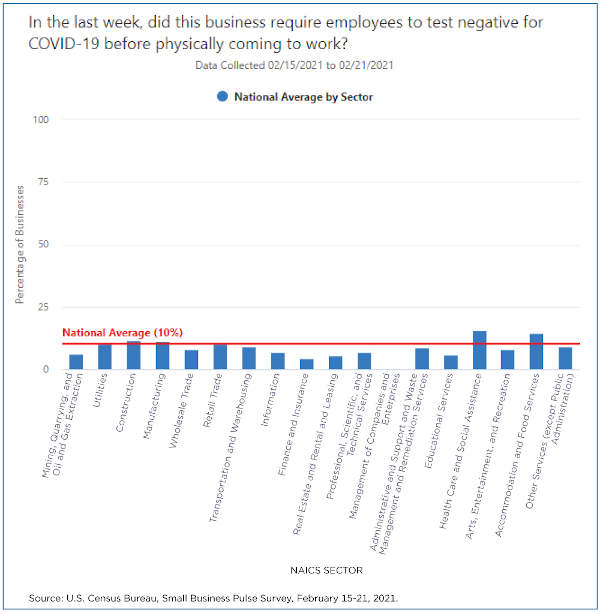
Question: In the last week, did this business require employees to test negative for COVID-19 before physically coming to work? Respondents may select only one of the following check boxes: “yes,” “no” or “not applicable, this business did not have employees physically coming to work in the last week.”
Responses: 10.0% said yes; 70.1% said no; and 19.9% said not applicable or n/a. Responses in two specific sectors outpaced the national average: 15.5% of health care and 14.3% of accommodation/food service businesses for requiring a negative test.
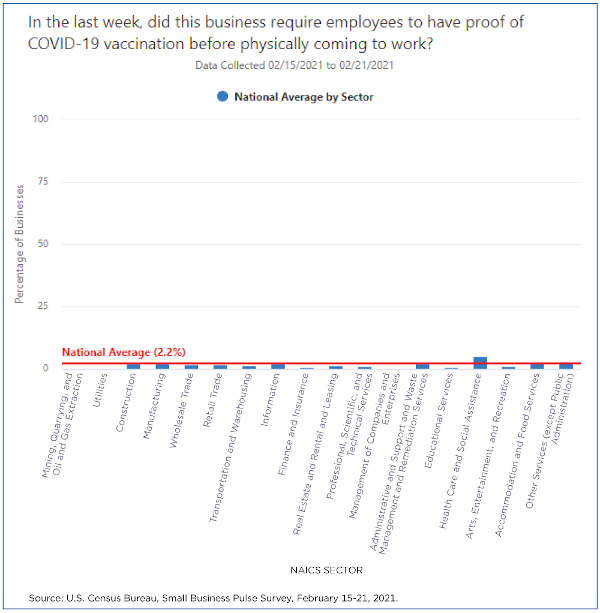
Question: In the last week, did this business require employees to have proof of COVID-19 vaccination before physically coming to work? Respondents may select only one: “yes,” “no” or “not applicable, this business did not have employees physically coming to work in the last week.”
Responses: 2.2% said yes; 78.4% said no; and 19.4% said not applicable. Health care was by far the largest sector requiring a vaccine with 62% of its respondents checking that box.
A finger on the pulse of small business
SBPS complements existing Census Bureau data collections by providing high-frequency, detailed information on the challenges that small businesses (those with 1-499 employees) are facing during the pandemic.
The survey also includes information on small business operations, requests and receipt of assistance, capital expenditures and expectations for recovery. SBPS has been conducted in 9-week phases: Phase 1 started in late April 2020; Phase 2 began in August; and Phase 3 started in November.
In the first week of Phase 4, the survey was sent to approximately 100,000 businesses and about 25,000 responded.
Data are available by sector, state and for the 50 most populous Metropolitan Statistical Areas or MSAs, in addition to Puerto Rico, as well as sub-sector, state by sector and by employee size class.
Survey results provide local, state and federal officials essential up-to-date data to help them make informed policy decisions. The information also aids businesses in making economic decisions and assists researchers studying the economic effects of the pandemic.
Other content changes in Phase 4 include the addition of new questions on leased space, planned capital expenditures and business travel:
Question: The White House declared a national emergency because of the coronavirus pandemic on March 13, 2020. Since March 13, 2020, did this business change the amount of square footage leased/rented for operations? Respondents may select only one of the following responses: “yes, increased,” “yes, decreased,” “no change” or “not applicable, this business does not lease/rent space.”
Responses: 2.6% said yes, increased; 6.1% said yes, decreased; 76.3% said no change; and 15.1% said not applicable. The decrease in leased space outpaced the increase, but both are dwarfed by no change.
Question: Since March 13, 2020, what changes did this business make to its planned capital expenditures for 2020? Respondents may select all of the following answers that apply: “canceled planned capital expenditures,” “postponed planned capital expenditures,” “decreased planned capital expenditures,” “increased planned capital expenditures,” “introduced new unplanned capital expenditures,” “this business had no changes to planned capital expenditures for 2020” and “this business had no planned capital expenditures for 2020.”
Responses: 12.8% canceled planned capital expenditures; 22% postponed planned capital expenditures; 15.6% decreased planned capital expenditures; 2.9% increased planned capital expenditures; 7.5% introduced new unplanned capital expenditures; 21.3% said this business had no changes to planned capital expenditures for 2020 and 33% said this business had no planned capital expenditures for 2020.
Question: In the next 6 months, do you think this business will have business travel expenditures for air, rail, car rental, or lodging? Respondents may select only one of the following: “yes,” “no” and “not applicable, this business does not usually have business travel expenditures.”
Responses: 26.5% said yes, 42.7% said no and 30.8% said not applicable. Far fewer small businesses anticipated travel expenses in the next six months.
Phase 4 excluded earlier questions about rehiring employees, working from home, cash flow, loan defaults, other payment defaults and online platforms. (Question on product service offerings and mode of product delivery have not been included since Phase 1.) Phase 4 also includes updates to answer options for questions on financial assistance, factors that affect capacity and future needs.
Jane Callen is senior writer/editor in the Census Bureau's Communications Directorate.
CLEARLAKE, Calif. – Clearlake Animal Control has three new dogs joining the canines available to be adopted this week.
The following dogs are ready for adoption or foster.
“Dorito.” Photo courtesy of Clearlake Animal Control. ‘Dorito’
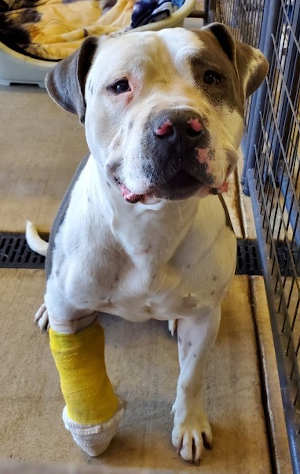
“Dorito” is a male American Staffordshire Terrier mix with a short white and gray coat.
He has been neutered.
He is dog No. 4576.
“Hector.” Photo courtesy of Clearlake Animal Control. ‘Hector’
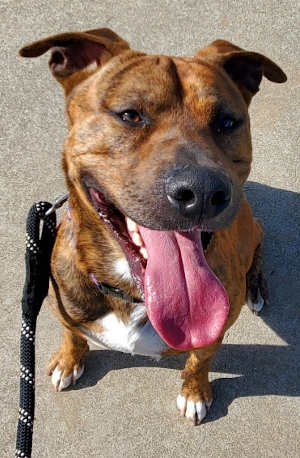
“Hector” is a male American Pit Bull Terrier mix with a short brindle coat.
He is dog No. 4697.
“Inky.” Photo courtesy of Clearlake Animal Control. ‘Inky’
“Inky” is a male German Shepherd mix with a long black coat.
He has been neutered.
He is dog No. 4324.
“Jerry.” Photo courtesy of Clearlake Animal Control. Jerry
“Jerry” is a male pit bull terrier mix with a short brindle coat.
He has been neutered.
He is dog No. 4455.
“Ranger.” Photo courtesy of Clearlake Animal Control. ‘Ranger’
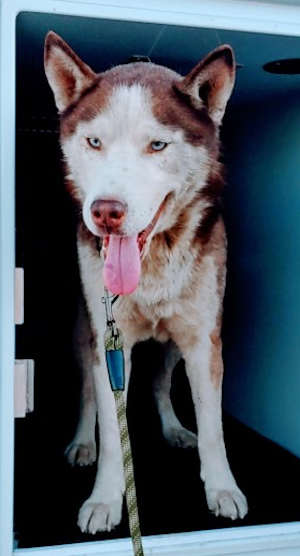
“Ranger” is a male husky mix with a long red and white coat.
He has been neutered.
Ranger is dog No. 4443.
“Sarah.” Photo courtesy of Clearlake Animal Control. ‘Sarah’
“Sarah” is a female terrier mix with a short tan coat.
She is dog No. 4712.
“Tia.” Photo courtesy of Clearlake Animal Control. ‘Tia’
“Tia” is a female American Bully with a short black with white markings.
She is dog No. 4602.
“Toby.” Photo courtesy of Clearlake Animal Control. ‘Toby’
“Toby” is a friendly senior male boxer mix.
He has a short tan and white coat.
He is dog No. 4389.
Call the Clearlake Animal Control shelter at 707-273-9440, or email This email address is being protected from spambots. You need JavaScript enabled to view it. to inquire about adoptions and schedule a visit to the shelter.
Email Elizabeth Larson at This email address is being protected from spambots. You need JavaScript enabled to view it.. Follow her on Twitter, @ERLarson, or Lake County News, @LakeCoNews.
 How to resolve AdBlock issue?