 How to resolve AdBlock issue?
News
LAKE COUNTY, Calif. — A fast-moving vegetation fire in Clearlake is prompting evacuations as state and local firefighters attempt to stop it.
The fire in the area of Wilkinson and Dam Road was first reported shortly after 5 p.m. Monday.
Radio traffic indicated the fire began with a passenger car fire spreading into vegetation.
Dispatch reported receiving calls about multiple explosions in the area as well as downed power lines.
Initial reports from the scene put the fire’s size at about half an acre.
Incident command called for evacuations on Wilkinson from Dam Road to Eighth Avenue, with that area expanding as the incident has progressed.
The Clearlake Police Department reported that Dam Road at Lake Street has been closed because of the fire.
At 5:25 p.m., Cal Fire air attack reported the fire was two to three acres with a rapid rate of spread.
Other air resources, including tankers and a helicopter, are reported to be working at the scene.
Two nearby mobile home parks are being told to shelter in place.
Clearlake Police have requested an ambulance respond to Wilkinson and Dam Road to transport one patient.
Shortly before 6 p.m., incident command reported that the fire was seven to eight acres with a southwest wind on it, and is moving into the Avenues in the city with structures and vehicles actively threatened and the evacuation zone expanding.
There is short-range spotting and the high-tension power lines from the Kugelman to Highland substations are threatened, incident command said.
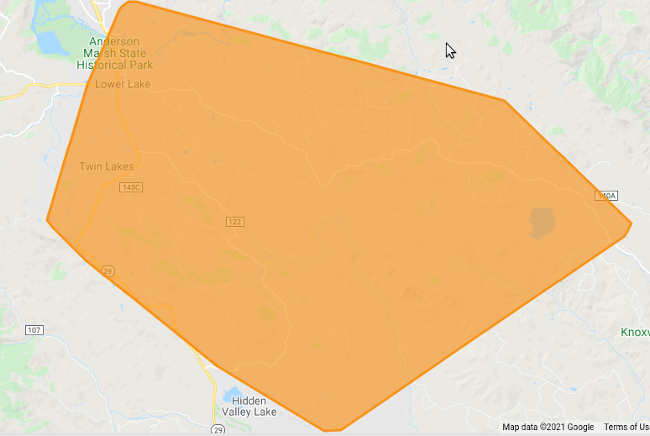
As of 6:03 p.m., power was reported to be out to 2,584 customers in an area stretching from Clearlake to Hidden Valley Lake. As of that time, Pacific Gas and Electric Co. had not confirmed that the outage was a direct result of the fire.
However, Sheriff Brian Martin later confirmed to Lake County News that PG&E had deenergized the lines due to the fire threat, with the fire just under the lines.
Just before 6:45 p.m., incident command reported the fire to be 15 acres, with multiple spot fires continuing.
At 7:16 p.m., the Lake County Sheriff’s Office sent out a Nixle alert reporting an evacuation advisory for the area north of 18th Avenue, east of Phillips Avenue, south of 32nd Avenue and west of the Clearlake city limits.
The sheriff’s office said an evacuation shelter has been set up at Kelseyville High School.
Incident command reported shortly after 8 p.m. that the fire was at 20 acres and 75-percent contained, with the spot fires mitigated and the winds reducing. Overall, incident command said things were going well and they were looking at beginning to release engines soon.
Sheriff Martin told Lake County News at 8:15 p.m. residents in the area were still evacuated and that his agency was working with the Clearlake Police Department on starting to get everyone home safely.
No one appeared to have been seriously injured during the incident, he said.
Martin said PG&E is anticipating getting power back on to all but about 20 customers by about 10 p.m.
About 15 minutes later, a Nixle alert was issued advising community members that the evacuation advisory for the following areas had been lifted as of 8:17 p.m.: north of 18th Avenue, east of Phillips Avenue, south of 32nd Avenue and west of the Clearlake city limits.
Radio traffic shortly after 10 p.m. indicated fire crews would remain on the scene through the night.
Additional information will be posted as it becomes available.
Email Elizabeth Larson at
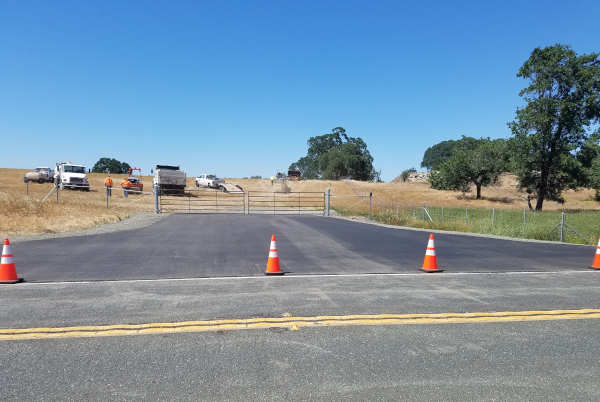
LAKEPORT, Calif. — The Westside Community Park Committee reported it’s making progress on its future horse park.
The committee recently completed the encroachment from State Highway 175 along with the entrance into the eight-acre site where the horse park will be located.
It is on the north side of the state highway just west of the intersection with Mathews Road outside of Lakeport.
Chair Dennis Rollins said this project was a collaborative effort.
Mike Lucchetti of Lucchetti Excavating approached the Westside Community Park Committee with an offer to provide labor and equipment for this project. Rollins said the committee eagerly accepted his very generous offer.
“This community has been supportive of our business and we would like to do this to help the community,” Lucchetti said.
The city of Lakeport Public Works Department under the leadership of Public Works Director Doug Grider and Foreman Jim Kennedy, provided additional labor and equipment when needed.
Bob Peters, owner of RB Peters in Lakeport, offered to haul asphalt to the site.
Granite Construction sold the asphalt at a significant discount to further assist with the completion of the horse park entrance.
Members of the Westside Community Park Committee volunteered to provide traffic control on the day of the paving.
“Even with the donations of labor and equipment as well as the discount on materials, this project still cost nearly $15,000,” said Rollins.
He added, “The committee raised these funds from its annual Grillin’ on the Green BBQ Cook Off and other donations from a generous community.”
Rollins said the Westside Community Park Committee is currently working on a grant application to fund the design and construction of the horse park.
Public support is always needed and appreciated. Donations can be mailed to Westside Community Park Committee, 1350 Berry St., Lakeport, CA 95453.
The board will meet beginning at 9 a.m. Tuesday, June 22, in the board chambers on the first floor of the Lake County Courthouse, 255 N. Forbes St., Lakeport.
The meeting can be watched live on Channel 8, online at https://countyoflake.legistar.com/Calendar.aspx and on the county’s Facebook page. Accompanying board documents, the agenda and archived board meeting videos also are available at that link.
To participate in real-time, join the Zoom meeting by clicking this link.
The meeting ID is 987 2645 5306, pass code 519842. The meeting also can be accessed via one tap mobile at +16699006833,,98726455306#,,,,*519842#.
All interested members of the public that do not have internet access or a Mediacom cable subscription are encouraged to call 669-900-6833, and enter the Zoom meeting ID and pass code information above.
To submit a written comment on any agenda item visit https://countyoflake.legistar.com/Calendar.aspx and click on the eComment feature linked to the meeting date. If a comment is submitted after the meeting begins, it may not be read during the meeting but will become a part of the record.
In an untimed item, the board will consider amending the Lake COVID-19 Public Health Emergency Worksite Protocol to come in line with updated Cal/OSHA regulations adopted on Thursday.
Last week, county administrative staff and the supervisors discussed the challenge the county was having due to conflicting guidance between federal and state health agencies and Cal/OSHA, as Lake County News has reported.
The board voted to allow staff to keep the county’s current protocols in place and allow an exception if the Cal/OSHA board updated its regulations ahead of the supervisors coming back to adopt and updated protocol document on Tuesday.
Cal/OSHA did, indeed, update its regulations to come into line with Centers for Disease Control and Prevention and California Department of Public Health guidance on Thursday, with Gov. Gavin Newsom signing an executive order to allow the new regulations to go into place immediately, without the 10-day review period.
Deputy County Administrative Officer Matthew Rothstein told Lake County News in a Friday email that on Thursday evening, the county’s Human Resources Division distributed notice to all county employees of the changes, offering a self-certification process, through which employees can attest to being fully vaccinated.
“Fully vaccinated employees that have submitted the self-certification form to HR have the option of not wearing a mask, pursuant to CalOSHA’s rules,” said Rothstein.
He said the Tuesday discussion “will undoubtedly touch upon the self-certification process.”
“Administration and Human Resources recognize some fully vaccinated employees and members of the public may still choose to wear a mask, and we celebrate people continuing to take common sense precautions, particularly in light of the fact COVID-19 is still present in Lake County communities,” Rothstein said.
He also encouraged community members in this new phase to treat each other with dignity and respect, regardless of any perception surrounding vaccination status.
“We also must individually make choices that consider the safety of ourselves, our families and our broader communities,” he said, adding that Lake County is stronger when everyone works for the healthiest possible outcomes for all residents.
“The Health Services Department will continue to provide resources and support,” he added.
In other business, at 9:06 a.m., the board will present a proclamation commending Dave Deakins for his 33 years of service to the residents of Lake County.
At 9:07 a.m., the supervisors will honor Jeff Rein for his 30 years of service to the county of Lake. He currently works as risk manager in the County Counsel’s Office and is retiring at the close of the fiscal year.
At 9:10 a.m., the board will consider a hiring incentive policy and updated employee referral program.
The full agenda follows.
CONSENT AGENDA
5.1: Adopt proclamation commending Jeff Rein for his 30 years of service to the county of Lake.
5.2: Adopt proclamation commending Dave Deakins for his 33 years of service to the residents of Lake County.
5.3: Approve revised committee appointments for Emergency Medicare Care Committee .
5.4: Approve leave of absence request for Behavioral Health employee Judith Krings from Sept. 6, 2021, through Nov. 17, 2021, and authorize the chair to sign.
5.5: Approve memorandum of understanding between the Golden State Finance Authority and the county of Lake regarding the development/update of a broadband strategic plan and authorize chair to sign.
5.6: Approve the first amendment to 2019 agreement between the city of Clearlake, city of Lakeport and the county of Lake relative to operation of a local public, educational, governmental (PEG) cable television channel, extending the term through June 30, 2023.
5.7: Adopt resolution approving unanticipated revenue to fund Aquatic Weed Control Program.
5.8: Approve agreement with California Department of Food Agriculture for Certified Farmer’s Market Program investigation and enforcement in the amount of $1,425 Agreement No. 21-0163-000-SA.
5.9: Approve Agreement No. 21-0037-000-SA with the state of California, Department of Food and Agriculture and authorize the execution of the Fuels, Lubricants, and Automotive Products Program agreement for periods July 1, 2021, through June 30, 2022, in the amount of $2,475.
5.10: Adopt resolution establishing 2021-2022 appropriations limit for the county of Lake and Special Districts governed by the Board of Supervisors.
5.1: Adopt resolution authorizing cancellation of audit settlement reserve designations in the amount of $835,000 to provide required funds for the support and care of persons and for profession and specialize accounts.
5.12: Adopt resolution defining Lake County Behavioral Health Services position on Laura’s Law implementation.
5.13: Approve minutes of the Board of Supervisors meeting on May 25, 2021.
5.14: Approve amendment to contracts for abandoned vehicle towing and disposal services with Jones Towing and Kelseyville Auto Salvage.
5.15: Approve the continuation of a local health emergency related to the 2019 Coronavirus (COVID-19) as proclaimed by the Lake County Public Health officer.
5.16: Approve the continuation of a local health emergency and order prohibiting the endangerment of the community through the unsafe removal, transport, and disposal of fire debris for the LNU Complex wildfire.
5.17: Approve the continuation of a local emergency due to the Mendocino Complex fire incident (River and Ranch fires).
5.18: Approve the continuation of a local emergency due to COVID-19.
5.19: Approve the continuation of a local emergency due to the Pawnee fire incident.
5.20: Approve the continuation of an emergency declaration for drought conditions.
5.21: Approve the continuation of a local emergency In Lake County in response to the LNU Lightning Complex wildfire event.
5.22: Adopt resolution authorizing cancellation of capital improvement reserve designations in the amount of $11,000 to pay off the loan acquired for the Lampson Field Runway Pavement Rehabilitation Project.
5.23: Adopt resolution to establish a list of projects proposed to be funded in FY 2021/2022 pursuant to the Road Repair and Accountability Act of 2017 (SB1).
5.24: Adopt resolution establishing county maintained mileage for 2020.
5.25: Adopt Resolution authorizing the acceptance of the 2021/22 Boating Safety and Enforcement financial aid funding from the state of California, Department of Parks and Recreation, Division of Boating and Waterways in the amount of $315,312.
5.26: Approve Addendum 2 to Trinity Food Services agreement between Trinity Services Group and Lake County for the implementation of a meal take out program and authorize the chairman to sign.
5.27: Approve background investigations contract with Christopher Eggers in an amount not to exceed $25,000 and authorize the chairman to sign.
5.28: Authorize the sheriff to enter into an agreement with the Office of Education for reimbursement of three deputy sheriffs to participate as school resource officers to be assigned to various school districts.
5.29: Approve lease agreement with the US Forest Service for placement of a repeater vault on Goat Mountain and authorize the chairman of the board to sign.
5.30: Approve Amendment No. 2 of inmate telephone and video visitation service agreement with Inmate Calling Solutions LLC and authorize the chairman to sign.
5.31: Waive 900-hour limit for extra-help field worker Austin Pratt.
5.32: Sitting as the board of directors for the Lake County Watershed Protection District, approve the purchase agreement with Francisco Ortega and Angela Ortega for property within the Middle Creek Flood Damage Reduction and Ecosystem Restoration Project in the amount of $170,000 and authorize the chair of the board of directors to sign the agreement.
5.33: Sitting as the board of directors of the Watershed Protection District, approve Amendment No. 1 for the Big Valley Groundwater Sustainability Agency charter document.
TIMED ITEMS
6.2, 9:06 a.m.: Presentation of proclamation commending Dave Deakins for his 33 years of service to the residents of Lake County.
6.3, 9:07 a.m.: presentation of proclamation commending Jeff Rein for his 30 years of service to the county of Lake.
6.4, 9:10 a.m.: Consideration of hiring incentive policy and updated employee referral program.
UNTIMED ITEMS
7.2: Consideration of agreement for investment advisory and management services.
7.3: Consideration of amendment to the county of Lake COVID-19 Public Health Emergency Worksite Protocol.
7.4: (a) Consideration to Waive the formal bidding process, pursuant to Lake County Code Section 38.2, as it is not in the public interest due to the unique nature of goods or services; and (b) consideration of Amendment 1 to the agreement between the county of Lake and Redwood Community Services Inc. for the Family Stabilization Program provided at The Nest during Fiscal Year 2021-22 for an increase in the contract maximum to $280,632.08 and authorize the board chair to sign the amendment.
7.5: (a) Consideration to Waive the formal bidding process, pursuant to Lake County Code Section 38.2, as it is not in the public interest due to the unique nature of goods or services; and (b) consideration to approve Amendment 1 to the agreement between the county of Lake and Redwood Community Services Inc. for the MHSA Transitional Age Youth Drop-In Center for Fiscal Year 2021-22 for an increase in the contract maximum up to $261,000.00 and authorize the board chair to sign the amendment.
7.6: Consideration of the following advisory board appointments: Emergency Medical Care Committee, First 5 Lake Commission and Community Visioning Forum Planning Committee.
CLOSED SESSION
8.1: Conference with legal counsel: Existing litigation pursuant to Gov. Code section 54956.9(d)(1) — Center for Biological Diversity v. County of Lake, et al.
8.2: Conference with legal counsel: Existing litigation pursuant to Gov. Code section 54956.9(d)(1) – California Native Plant Society v. County of Lake, et al.
8.3: Conference with legal counsel: Significant exposure to Litigation pursuant to Gov. Code section 54956.9 (d)(2), (e)(1) – One potential case.
8.4: Conference with legal counsel: Existing litigation pursuant to Government Code section 54956.9(d)(1) – City of Clearlake v. County of Lake, et al.
8.5: Sitting as the board of directors of the Lake County IHSS Public Authority: Conference with (a) Chief Negotiator M. Long and County Negotiator C. Markytan; and (b) employee organization: California United Homecare Workers Union Local 4034.
Email Elizabeth Larson at

Lawmakers in the nation’s capital have an opportunity to fix a longstanding problem with the landmark legislation to prevent domestic violence: its failure to protect Indigenous women.
The 1994 Violence Against Women Act, or what is commonly called “VAWA,” was the first federal law criminalizing domestic violence. VAWA aimed to protect women by making battering a federal crime, allocating federal funding for both sexual assault and domestic violence prevention and services, and requiring states to enforce all legal orders of protection.
But VAWA’s provisions have not adequately shielded Indigenous women, who experience higher rates of sexual assault, domestic violence, intimate partner violence and stalking compared to women of other racial and ethnic identities. They also suffer injuries at the hands of their rapists that require medical care more than non-Indigenous women.
Indigenous women were not specifically named in VAWA until its 2005 reauthorization. The 2005 reauthorization included funding for tribal governments to serve victims of violence and provided access to national criminal justice data for tribal law enforcement agencies. It also mandated that research on violence against Indigenous women be undertaken.
Even after VAWA 2005, tribes were unable to prosecute most cases of violence against Indigenous women on Indian reservations – and few of those cases were prosecuted by the federal government. It wasn’t until the 2013 VAWA reauthorization that restrictions on tribal authority to prosecute some violence against Indigenous women on Indian reservations were repealed, though some of these restrictions still exist today.
Now, the U.S. Senate is about to consider another reauthorization of VAWA, HR 1620, which has already been passed by the House of Representatives. Lawmakers have the opportunity to address this longstanding inequity.

Colonization bred violence
According to U.S. Census estimates, the majority of people living on Indian reservations are not American Indian or Alaska Native. Further, most violence perpetrated against Indigenous women is committed by non-Indigenous men.
Violence against Indigenous women can be largely attributed to the longstanding effects of colonization – the elimination and destruction of a society, including their beliefs, values, culture, norms and traditions – by European settlers.
Indigenous legal scholar Sarah Deer explains that violence, and specifically rape, was used by colonizers to conquer and control Indigenous women and disconnect them from their land and bodies.
Indigenous social work scholar Hilary Weaver further describes how colonization also bred stereotypes regarding Indigenous people, insinuating that they are less than human and savages, and that Indigenous women specifically do not deserve protection from violence.
Taking away power to protect
Over the past 150 years, the federal government has drastically reduced tribal sovereignty and the power of tribal courts to prosecute crimes that happen on Indian reservations.
In 1885, Congress passed The Major Crimes Act, imposing the federal criminal justice system on tribal nations. With this legislation, the U.S. federal government asserted jurisdiction over “major crimes” such as rape and homicide occurring on the approximately 56.2 million square miles of Indian reservations in the U.S.
Then, in 1978, the Supreme Court ruling in Oliphant v. Suquamish further limited the sovereignty of tribal nations. The U.S. government, the court ruled, would have jurisdiction over all offenses committed by non-Indigenous perpetrators on Indian reservations, including cases where the victim is Indigenous.
Criminal jurisdiction on Indian reservations is also complicated by Public Law 280 from 1953, which returned jurisdiction of crimes committed on Indian reservations in six states, not to the tribes, but to the state where the Indian reservation is located.
Thus, in those six states – Alaska, California, Minnesota, Nebraska, Oregon and Wisconsin – the state has jurisdiction over crimes committed on the Indian reservation. Sarah Deer notes that the federal government did not provide those states with any additional funding to expand their criminal justice authority to Indian reservations.
Low likelihood of prosecution
The complexities of these federal policies create what some scholars call a “jurisdictional maze” for Indigenous women who are victimized on Indian reservations.
Depending on where the crime happened, who the victim is, who the perpetrator is or what type of crime occurred, a different law enforcement agency assumes jurisdiction – whether tribal, local, state or federal law enforcement.
For Indigenous women who manage to navigate this maze and report a crime, the likelihood that the perpetrator will be prosecuted by the federal government is low. U.S. federal prosecutors consistently decline to prosecute much of the crime reported on Indian reservations.
In 2018, U.S. attorneys prosecuted 80% of all criminal matters referred for prosecution. In comparison, U.S. attorneys prosecuted about 60% of crimes reported on Indian reservations; 65% of the cases declined for prosecution related to physical assaults or sexual violence.
Closing the gaps
The 2013 reauthorization of VAWA recognized some of these gaps in protection for Indigenous women and attempted to increase protections by strengthening tribal sovereignty.
VAWA 2013 created Special Domestic Violence Criminal Jurisdictions, or what are known as “SDVCJ,” for tribes. The SDVCJ return to tribes the power to prosecute dating violence, domestic violence and violations of protection orders, even in incidents when the perpetrator is not Indigenous.
In order to assert the powers provided by SDVCJ, tribes must meet extensive requirements set by the federal government. Tribes must have adequate facilities to house non-Indigenous defendants and provide defense counsel for poor defendants among other requirements.
As described by criminologist Jennifer Hartman, depending on the changes necessary, the process may require significant time or financial investment by the tribe. By February 2021, less than 5% of the federally recognized tribes, only 27 of 574 tribes, had exercised the SDVCJ. The National Congress of American Indians has reported that implementing the SDVCJ is just too expensive for some tribes.
The 2013 VAWA did not extend authority to tribes to prosecute sexual assault and stalking, of which Indigenous women experience disproportionate rates.
Thus, on Indian reservations, Indigenous victims of physical violence by acquaintances or strangers, and all victims of sexual assault and stalking, have little recourse other than to rely on a federal criminal justice system that has consistently failed to prosecute their attackers.
[Get the best of The Conversation, every weekend. Sign up for our weekly newsletter.]
One way to remedy this longstanding problem is for the reauthorization of VAWA to expand tribal jurisdiction to cover all crimes of violence against women committed on Indian reservations, irrespective of the race or the relationship of the victim and perpetrator.
To be effective, the federal government would also need to work directly with tribes to ensure that tribes have the resources they need to assert this jurisdiction.
This change would close a significant public safety gap in the Violence Against Women Act and move VAWA closer to its aim of protecting all women from violence.
Sheena L. Gilbert, Graduate Assistant, University of Nebraska Omaha; Emily Wright, Professor of Criminology and Criminal Justice, University of Nebraska Omaha, and Tara N. Richards, Associate Professor of Criminology and Criminal Justice, University of Nebraska Omaha
This article is republished from The Conversation under a Creative Commons license. Read the original article.
On Thursday, the Cal/OSHA Board voted to modify the current emergency temporary standards to allow fully vaccinated employees to go without a face covering in the workplace. Gov. Gavin Newsom has signed an executive order to make the modified emergency temporary standards effective immediately, as Lake County News has reported.
On June 9, the California Department of Public Health released similar guidance for members of the public, which, in part, require unvaccinated persons to wear a face covering for indoor public events.
In accordance with the current public health directives, the Lake County Superior Court presiding judge’s general order on the requirement of wearing face coverings and maintaining physical distancing, dated June 4, 2020, will be modified, officials reported.
Effective June 21, the revised general order will eliminate the physical distancing requirements for the public and will end the face covering requirements for fully vaccinated individuals.
As a result, beginning Monday, June 21, those persons who are fully vaccinated will no longer be required to wear a face covering when attending court proceedings or to conduct business with the court.
The order will continue to require that all individuals who are not fully vaccinated continue to properly wear an appropriate face covering at all times while physically present at the court unless determined to be subject to an exemption under the public health directives.
Effective June 21, and continuing until further order, the court will implement compliance verification of vaccine status by permitting vaccinated persons to self-attest that they are fully vaccinated upon entry into the court.
In addition, the physical presence of a person while at the court and not wearing a face covering will be considered to self-attest that the person is fully vaccinated.
A violation of the order requiring face covering for unvaccinated persons may result in a person to be unable to physically enter the court facility and to potential sanctions.
The order will apply to persons appearing for jury service (and to trial jurors) and will require unvaccinated persons to wear a proper face covering at all times physically present at court including jury selection.
As a result of the Cal/OSHA emergency temporary standards, the court will implement a compliance verification process whereby the court will verify and document vaccination status of prospective jurors at the time of reporting for jury service.
Pending further order, the court will continue to conduct jury selection at the fairgrounds facility and will continue to implement physical distancing for juror seating.
In accordance with the Cal/OSHA emergency temporary standards, the employees and staff of the court who are fully vaccinated are no longer required to wear a proper face covering while present at the court.
The court said anyone may choose to wear a face covering while attending court. The fact that an individual is wearing a face covering should not be interpreted to conclude that the individual is unvaccinated.
The court will undertake appropriate action, including contempt, against abusive, harassing or other inappropriate behavior toward employees, parties, attorneys or others, while present at the court, related to the wearing of face coverings, as an interference with the process of the court.
As set forth in the public notice of June 11, in many instances, the court continues to permit appearance and participation in court by video-conference and telephone in lieu of in-person attendance. The option is available to the public regardless of vaccination status.
For updates from the court visit www.lake.courts.ca.gov.
The following cats at the shelter have been cleared for adoption.
Call Lake County Animal Care and Control at 707-263-0278 or visit the shelter online at http://www.co.lake.ca.us/Government/Directory/Animal_Care_And_Control.htm for information on visiting or adopting.
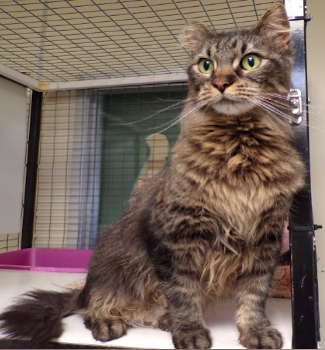
‘Cozette’
“Cozette” is a female domestic longhair with a brown tabby coat.
She is estimated to be 6 years old.
She is in cat room kennel No. 6, ID No. LCAC-A-969.

Female Siamese mix
This female Siamese mix has a short coat and blue eyes.
She is 2 years old.
She is in cat room kennel No. 68, ID No. LCAC-A-963.

Male domestic shorthair kitten
This male yellow tabby kitten has a short coat.
He is in cat room kennel No. 70b, ID No. LCAC-A-987.
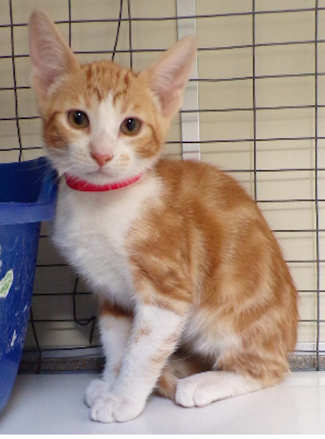
Male domestic shorthair kitten
This male yellow tabby kitten has a short coat.
He is in cat room kennel No. 70d, ID No. LCAC-A-989.
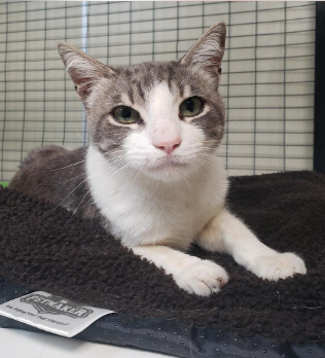
Male domestic shorthair
This male domestic shorthair has a gray and white coat.
He is 1-year-old and weighs nearly 6 pounds.
He is in cat room kennel No. 120, ID No. LCAC-A-874.
Email Elizabeth Larson at