 How to resolve AdBlock issue?
News
The United States has a new federal holiday.
On Thursday, President Joe Biden signed the Juneteenth National Independence Day Act into law at a Washington ceremony as Vice President Kamala Harris, civil rights activist Opal Lee — who Biden called the “grandmother of the movement to make Juneteenth a federal holiday” — and other supporters looked on.
Juneteenth, also known as Jubilee Day or Emancipation Day, commemorates the emancipation of enslaved Black Americans in the United States.
The Civil War came to an end on April 9, 1865, with the surrender of the Confederacy in Appomattox County, Virginia.
Two months later and 1,200 miles away, on June 19, 1865, Union General Gordon Granger issued an order in Galveston, Texas, proclaiming the end of slavery in Texas.
That was in accordance with the Emancipation Proclamation, issued by President Abraham Lincoln in September 1862. The proclamation, which went into effect on Jan. 1, 1863, outlawed slavery in states such as Texas that had seceded from the Union but hadn’t yet been taken back under Northern control.
Slavery in the United States would be finally and officially abolished on Dec. 18, 1865, when the 13th Amendment to the U.S. The Constitution was adopted.
“Juneteenth marks both the long, hard night of slavery and subjugation, and a promise of a brighter morning to come,” said Biden at the signing ceremony, calling it a day of “profound weight and profound power.”
Many states have observed Juneteenth for some time, including Texas, which has marked the day since 1980, and California, which has formally celebrated Juneteenth since 2003.
The Juneteenth National Independence Day Act was introduced by a group that included Senators Sen. Edward Markey (D-Mass.), Tina Smith (D-Minn.), Cory Booker (D-N.J.), John Cornyn (R-Texas) and Raphael Warnock (D-Ga.), and Rep. Sheila Jackson Lee (TX-18).
It passed the U.S. Senate with unanimous consent on Tuesday, with the House of Representatives passing it on Wednesday.
Lake County’s members of Congress, Rep. John Garamendi (CA-03) and Rep. Mike Thompson (CA-05), both voted for the bill.
Then, on Thursday, the bill went to President Biden, who signed it into law and made it effective immediately.
Biden thanked the members of Congress — in particular, the Congressional Black Caucus — who worked to make a Juneteenth federal holiday.
“I’m especially pleased that we showed the nation that we can come together as Democrats and Republicans to commemorate this day with the overwhelming bipartisan support of the Congress. I hope this is the beginning of a change in the way we deal with one another,” said Biden.
The new holiday already is being rolled out for federal agencies.
Paul Meznarich of the Mendocino National Forest said they got the word on Thursday that the forest’s offices would be closed on Friday in observance of the new holiday.
Email Elizabeth Larson atThis email address is being protected from spambots. You need JavaScript enabled to view it. . Follow her on Twitter, @ERLarson, or Lake County News, @LakeCoNews.
On Thursday, President Joe Biden signed the Juneteenth National Independence Day Act into law at a Washington ceremony as Vice President Kamala Harris, civil rights activist Opal Lee — who Biden called the “grandmother of the movement to make Juneteenth a federal holiday” — and other supporters looked on.
Juneteenth, also known as Jubilee Day or Emancipation Day, commemorates the emancipation of enslaved Black Americans in the United States.
The Civil War came to an end on April 9, 1865, with the surrender of the Confederacy in Appomattox County, Virginia.
Two months later and 1,200 miles away, on June 19, 1865, Union General Gordon Granger issued an order in Galveston, Texas, proclaiming the end of slavery in Texas.
That was in accordance with the Emancipation Proclamation, issued by President Abraham Lincoln in September 1862. The proclamation, which went into effect on Jan. 1, 1863, outlawed slavery in states such as Texas that had seceded from the Union but hadn’t yet been taken back under Northern control.
Slavery in the United States would be finally and officially abolished on Dec. 18, 1865, when the 13th Amendment to the U.S. The Constitution was adopted.
“Juneteenth marks both the long, hard night of slavery and subjugation, and a promise of a brighter morning to come,” said Biden at the signing ceremony, calling it a day of “profound weight and profound power.”
Many states have observed Juneteenth for some time, including Texas, which has marked the day since 1980, and California, which has formally celebrated Juneteenth since 2003.
The Juneteenth National Independence Day Act was introduced by a group that included Senators Sen. Edward Markey (D-Mass.), Tina Smith (D-Minn.), Cory Booker (D-N.J.), John Cornyn (R-Texas) and Raphael Warnock (D-Ga.), and Rep. Sheila Jackson Lee (TX-18).
It passed the U.S. Senate with unanimous consent on Tuesday, with the House of Representatives passing it on Wednesday.
Lake County’s members of Congress, Rep. John Garamendi (CA-03) and Rep. Mike Thompson (CA-05), both voted for the bill.
Then, on Thursday, the bill went to President Biden, who signed it into law and made it effective immediately.
Biden thanked the members of Congress — in particular, the Congressional Black Caucus — who worked to make a Juneteenth federal holiday.
“I’m especially pleased that we showed the nation that we can come together as Democrats and Republicans to commemorate this day with the overwhelming bipartisan support of the Congress. I hope this is the beginning of a change in the way we deal with one another,” said Biden.
The new holiday already is being rolled out for federal agencies.
Paul Meznarich of the Mendocino National Forest said they got the word on Thursday that the forest’s offices would be closed on Friday in observance of the new holiday.
Email Elizabeth Larson at
Following the Thursday vote by the Occupational Safety and Health Standards Board to adopt revised COVID-19 Prevention Emergency Temporary Standards that reflect the state’s latest COVID-19 public health order, Gov. Gavin Newsom signed an executive order enabling the revisions to take effect immediately.
The updated revisions are meant to offer clarity and consistency for employers and employees as California fully reopens its economy.
While the state began its reopening on Tuesday, Cal/OSHA’s regulations hadn’t yet come into line with guidance from the other state and federal agencies, which had created issues for employers such as the county of Lake, as Lake County News has reported.
As of Thursday’s action, Cal/OSHA’s revisions align with the latest guidance from the California Department of Public Health — based on guidelines issued by the Centers for Disease Control and Prevention — on face coverings and eliminate physical distancing requirements, except for certain employees during outbreaks.
Unless they show symptoms, fully vaccinated employees do not need to be offered testing or be excluded from work after close contact with a COVID-19-positive person.
Ensuring workplaces throughout the state have consistent guidance as California officially moves Beyond the Blueprint, the governor’s order waives the 10-day review process by the Office of Administrative Law.
The emergency regulations will take effect upon their filing with the Secretary of State’s Office.
With over 40 million vaccines administered and among the lowest case rates and transmission rates in the nation, the state fully reopened on June 15, eliminating pandemic-related restrictions that have been in place over the past year.
Initially implemented last November, the state said Cal/OSHA’s COVID-19 Emergency Temporary Standards remain an important component of the state’s ongoing response, providing balanced worker protections that support California’s continued progress in recovering from the pandemic.
The full text of today’s executive order can be seen below.
More information on the revised COVID-19 Prevention Emergency Temporary Standards can be found here.
The updated revisions are meant to offer clarity and consistency for employers and employees as California fully reopens its economy.
While the state began its reopening on Tuesday, Cal/OSHA’s regulations hadn’t yet come into line with guidance from the other state and federal agencies, which had created issues for employers such as the county of Lake, as Lake County News has reported.
As of Thursday’s action, Cal/OSHA’s revisions align with the latest guidance from the California Department of Public Health — based on guidelines issued by the Centers for Disease Control and Prevention — on face coverings and eliminate physical distancing requirements, except for certain employees during outbreaks.
Unless they show symptoms, fully vaccinated employees do not need to be offered testing or be excluded from work after close contact with a COVID-19-positive person.
Ensuring workplaces throughout the state have consistent guidance as California officially moves Beyond the Blueprint, the governor’s order waives the 10-day review process by the Office of Administrative Law.
The emergency regulations will take effect upon their filing with the Secretary of State’s Office.
With over 40 million vaccines administered and among the lowest case rates and transmission rates in the nation, the state fully reopened on June 15, eliminating pandemic-related restrictions that have been in place over the past year.
Initially implemented last November, the state said Cal/OSHA’s COVID-19 Emergency Temporary Standards remain an important component of the state’s ongoing response, providing balanced worker protections that support California’s continued progress in recovering from the pandemic.
The full text of today’s executive order can be seen below.
More information on the revised COVID-19 Prevention Emergency Temporary Standards can be found here.
6.17.21-ETS-EO-N-09-21 by LakeCoNews on Scribd
The California Independent System Operator has extended its Flex Alert a second day to Friday, asking consumers to again conserve electricity during the evening as California and states across the country work to relieve stress on electric grids due to extreme heat.
Consumers are asked to conserve energy by:
— Setting thermostats to 78 degrees or higher, if health permits;
— Avoiding using major appliances;
— Turning off all unnecessary lights.
Consumers are also encouraged to use fans for cooling and to unplug unused electrical items.
Additional tips can be found at the website, www.flexalert.org, where people can also sign up to receive Flex Alert notifications.
To be as comfortable as possible during the Flex Alert hours, consumers can take these steps earlier in the day:
— Precool your home by lowering the thermostat;
— Use major appliances, like your dishwasher, and clothes washer and dryer;
— Close window coverings to keep your home or apartment cool;
— Charge electronic devices;
— Charge electric vehicles.
The Independent System Operator is continuing to monitor weather and grid conditions and will have additional announcements as information becomes available.
Consumers are asked to conserve energy by:
— Setting thermostats to 78 degrees or higher, if health permits;
— Avoiding using major appliances;
— Turning off all unnecessary lights.
Consumers are also encouraged to use fans for cooling and to unplug unused electrical items.
Additional tips can be found at the website, www.flexalert.org, where people can also sign up to receive Flex Alert notifications.
To be as comfortable as possible during the Flex Alert hours, consumers can take these steps earlier in the day:
— Precool your home by lowering the thermostat;
— Use major appliances, like your dishwasher, and clothes washer and dryer;
— Close window coverings to keep your home or apartment cool;
— Charge electronic devices;
— Charge electric vehicles.
The Independent System Operator is continuing to monitor weather and grid conditions and will have additional announcements as information becomes available.
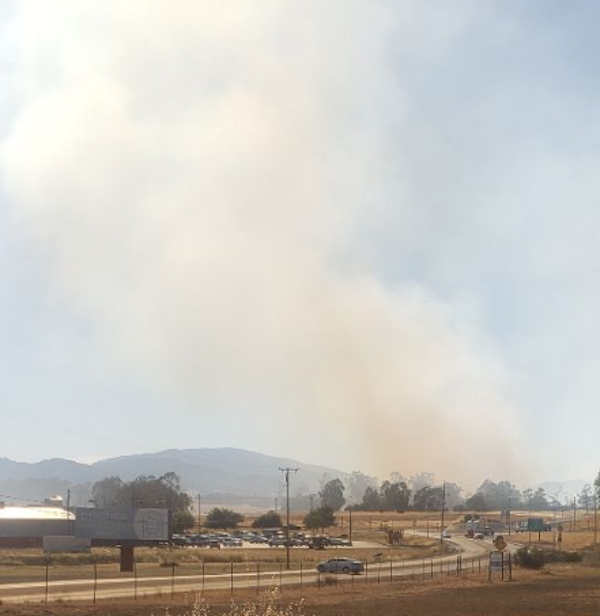
This story is being updated with new information.
LAKE COUNTY, Calif. — Firefighters are at the scene of a fast-moving grass fire near Nice that has prompted evacuations.
The Pomo fire was first reported just after 4:45 p.m. Thursday at Highway 20 at the Pomo Pumps gas station near Reclamation Cutoff.
Reports from the scene indicated it began as a passenger car fire that spread into the vegetation.
The fire quickly jumped in size as the wind hit it, according to scanner reports.
The initial reports stated it was half an acre, then an acre, spotting 50 to 100 yards ahead of the main fire as it moved across a mowed field toward structures. Incident command reported having law enforcement on scene start evacuations of some nearby residences.
A full wildland fire dispatch of local and state fire agencies was issued over the radio, with a request shortly afterward for an engine from the US Forest Service. Air resources also were dispatched.
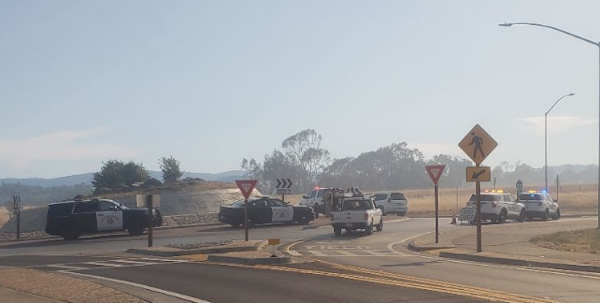
Just after 5 p.m., radio reports indicated a portion of Highway 20 was being closed.
In a video posted from the scene of the fire around 5:15 p.m., Sheriff Brian Martin said Highway 20 is closed at the Nice-Lucerne Cutoff to westbound traffic, as well as at Reclamation Road for eastbound traffic. He said it will be closed for awhile as the firefighting effort continues.
Also around 5:15 p.m., Cal Fire air attack reported the fire was about 15 acres in size.
Fire officials reported shortly after 5:30 p.m. that there was an evacuation order for Red Hill Lane and evacuation warnings for side roads beyond that area.
As of 5:48 p.m., a report over the radio from incident command said the fire was up to 25 acres with active spotting outside the fire line.
At 6:08 p.m., the fire remained at 25 acres, with the risk to structures mitigated and forward progress stopped.
Highway 20 was opened shortly before 7 p.m., according to the California Highway Patrol.
The CHP said closures remain in effect on Reclamation Road.
Additional information will be published as it becomes available.
Email Elizabeth Larson at
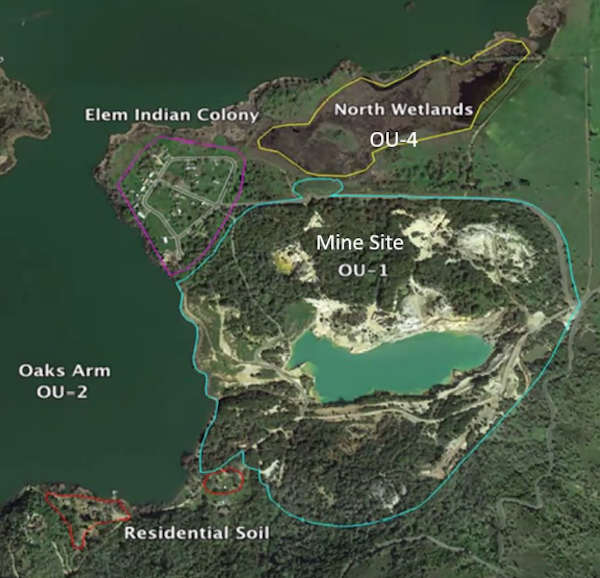
LAKE COUNTY, Calif. — U.S. Environmental Protection Agency staff held an online meeting with community members on Wednesday to report on the decades long effort to plan and carry out the cleanup of the Sulphur Bank Superfund site in Clearlake Oaks.
The 160-acre site, mined for sulfur and mercury between 1865 and 1957, has two million cubic yards of contaminated mine waste along with the Herman impoundment, a flooded open pit mine that’s filled with water contaminated by mine waste that’s impacting Clear Lake.
The mine site has been on the Superfund list since 1990.
While the process has been a slow one, officials estimated they are now within four years of beginning the main cleanup project, with the proposed plan for the cleanup expected to be released this fall.
Officials said the two-hour online meeting — which included descriptions of work and planning, and a chance to discuss the site in breakout rooms — was the result of a March planning group meeting. The goal was to update the community on the status of the project and its lengthy planning process.
Rusty Harris-Bishop, the EPA California Cleanup Sites Section manager, said they recognized how the site and its contamination have impacted livelihoods, the way of life and use of the lake, and prosperity of the community, and they wanted to hear input as they move the cleanup forward.
“Superfund is a very process heavy effort,” he said.
“It takes a long time and we recognize that,” he added.
Harris-Bishop said the agency has heard from people who want to see what EPA is doing as well as more action. “Things are going on as we’re doing this engagement.”
The situation at the site
Carter Jessop, the site project manager, said the material mined out of the Herman pit is significantly higher in mercury, arsenic and other metals.
Those materials originally were contained in bedrock and not exposed to air and water. Once the materials were exposed, Jessop said they leach out acidity and metals that get into the environment and impact community health.
Next to the Herman pit is a waste rock dam, which Jessop said isn’t an engineered dam but a pile of waste rock that creates a barrier between the pit and Clear Lake. The dam causes the pit’s water level to be above that of Clear Lake.
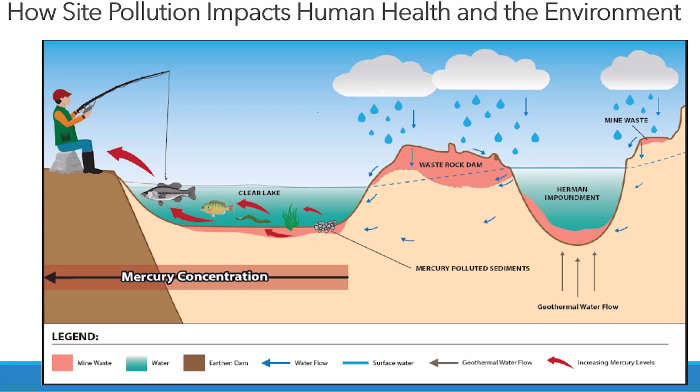
He showed a conceptual site model that illustrated how the water from the Herman pit can flow as groundwater through waste rock and into Clear Lake.
The water from the pit itself isn’t the problem, said Jessop. Rather, it’s the waste rock the water flows through, causing it to pick up more contaminants. That’s an ongoing problem for Clear Lake.
He said the mercury carried from the mine site binds to the sediments on the bottom of the lake. It’s then transformed into another form of mercury and moves up the food chain, becoming more concentrated.
Predator fish can have high levels of mercury. Because of that high concentration of mercury in fish, the state of California has issued a fish advisory for Clear Lake that outlines how much of the fish people can safely eat, Jessop said.
Jessop said the consumption of fish from Clear Lake is the greatest source of risk from mercury.
Unauthorized entry on the mine site offers risk of arsenic contamination, said Jessop, adding that there also is substantial naturally occurring risk due to arsenic and mercury.
The proposed plan
The EPA’s work is expected to result this fall in the publication of its proposed plan for the mine site, which will have a separate public process. Jessop said the document is now going through the EPA’s internal review process.
Jessop said the plan is fairly brief; it’s about 25 pages and is meant to summarize EPA’s preferred cleanup approach.
The cleanup, as proposed, will be broken into two phases, consolidation and capping, Jessop said.
Consolidation will include moving smaller waste piles onto larger waste piles to shrink the footprint of the area that requires major remediation, he explained.
They will then place a cap — a barrier layer like heavy plastic — over the site then cover that with clean soil so vegetation can grow, Jessop said.
Jessop said the plan aims to block the mine waste’s interaction with air and water, and stormwater management will be important.
There will be additional signs and fences, work with the local community and a period of monitoring after the project is completed.
Once the plan is released in the fall, there will be a public meeting followed by a 60-day comment period, Jessop said.
He said formal decision making and final design will follow the proposed plan, which must be approved by the EPA headquarters and administrator in Washington, DC.
Jessop said the EPA has a really robust record of documents and a very strong understanding of the site, which are benefits of the lengthy process.
He said construction could begin as soon as 2025.
Because the mine doesn’t have a “responsible party,” the entire cleanup is being covered by taxpayer funds, EPA staff said.
The site also isn’t owned by the agency so it will not manage the mine site long-term. Harris-Bishop said once the cleanup is completed, the property will be the responsibility of someone else.
Staff did not specify who will be responsible, but a 2012 settlement the EPA reached with the U.S. Department of the Interior, the U.S. Forest Service, the Bradley Mining Co., the Worthen Bradley Family Trust and the Elem Indian Colony of Pomo Indians called for the Bradley Mining Co. and Bradley Trust to transfer nearly all of their land holdings at the Sulphur Bank Mercury Mine to a new trust created to retain the lands pending EPA cleanup.
EPA also is constrained to clean up the site to what it would have been under natural conditions, it was explained during the meeting.
Next steps
As far as what’s next, EPA staff, it's the proposed plan’s release in the fall.
For those who want to follow the process, sign up for the email list here or contact community involvement coordinator Gavin Pauley at
The administrative record, which includes the documents and studies completed so far, will be online at the EPA website, and a physical copy will be available at the Redbud Library in Clearlake.
A summary of the meeting is expected to be posted on the EPA website by the end of June.
Email Elizabeth Larson at
Congressman Mike Thompson (CA-05) on Wednesday joined in voting to pass S. 475, Juneteenth National Independence Day, a bill to designate June 19 as a federal holiday.
The new holiday commemorates the arrival in Galveston, Texas, of Union troops led by General Gordon Granger, who on June 19, 1865, proclaimed there the end of the Civil War — nearly two months after the surrender of the Confederacy — and the end of slavery in Texas.
With the war came the end of slavery for Black Americans in the Condederate states, many of whom didn’t know they had been set free until that June day in 1865.
Most states recognize the date, with California having celebrated it since 2003.
“On June 19, our nation joins to mark Juneteenth, the end to slavery in the United States. It’s the day when the last enslaved people were freed after federal troops arrived in Texas, a full two years after President Abraham Lincoln issued the Emancipation Proclamation. Freedom was delayed for thousands because they had not heard the news and were kept where they were,” said Thompson.
“Designating Juneteenth as a federal holiday is an important recognition of that delayed freedom and a reminder of our responsibility to continue working to achieving full equality and justice for all. I was proud to vote to pass this legislation today and will continue my work to ensure Congress provides equal opportunity for everyone across our nation.”
You can click here to read more about this bill.
The bill is now on its way to President Joe Biden’s desk for his signature.
Thompson represents California’s Fifth Congressional District, which includes all or part of Contra Costa, Lake, Napa, Solano and Sonoma counties.
The new holiday commemorates the arrival in Galveston, Texas, of Union troops led by General Gordon Granger, who on June 19, 1865, proclaimed there the end of the Civil War — nearly two months after the surrender of the Confederacy — and the end of slavery in Texas.
With the war came the end of slavery for Black Americans in the Condederate states, many of whom didn’t know they had been set free until that June day in 1865.
Most states recognize the date, with California having celebrated it since 2003.
“On June 19, our nation joins to mark Juneteenth, the end to slavery in the United States. It’s the day when the last enslaved people were freed after federal troops arrived in Texas, a full two years after President Abraham Lincoln issued the Emancipation Proclamation. Freedom was delayed for thousands because they had not heard the news and were kept where they were,” said Thompson.
“Designating Juneteenth as a federal holiday is an important recognition of that delayed freedom and a reminder of our responsibility to continue working to achieving full equality and justice for all. I was proud to vote to pass this legislation today and will continue my work to ensure Congress provides equal opportunity for everyone across our nation.”
You can click here to read more about this bill.
The bill is now on its way to President Joe Biden’s desk for his signature.
Thompson represents California’s Fifth Congressional District, which includes all or part of Contra Costa, Lake, Napa, Solano and Sonoma counties.