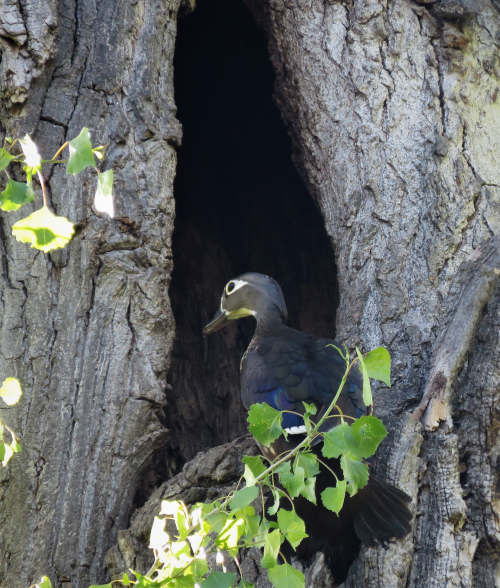
A female wood duck photographed by Laurie Scheibner on April 14, 2021, in the Kelsey Creek Campground at Clear Lake State Park in Kelseyville, California, won the Clear Lake State Park Interpretive Association’s spring photo contest in the adult division. LAKE COUNTY, Calif. — The Clear Lake State Park Interpretive Association has announced the winners of its spring photo contest and is launching its next contest for summer.
The group thanked everyone who participated in the spring, noting they had excellent submissions which captured the beautiful park in spring.
The winners are:
Adult division: Laurie Scheibner, female wood duck taken in a nest cavity on April 14 in Kelsey Creek Campground.
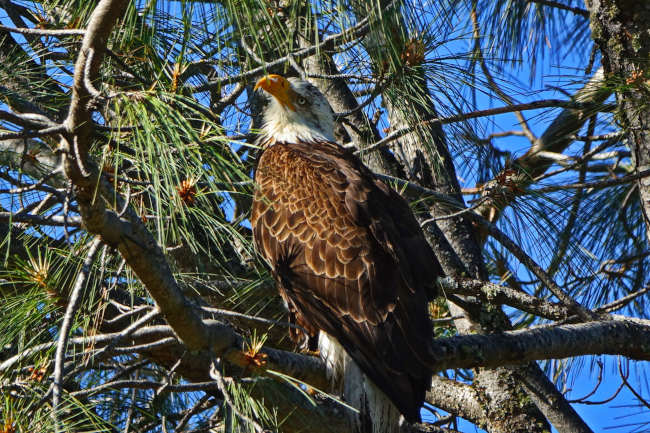
Senior division: Herman Strik, bald eagle taken May 11, 8:46 a.m. in a gray pine in Lower Bayview Campground.
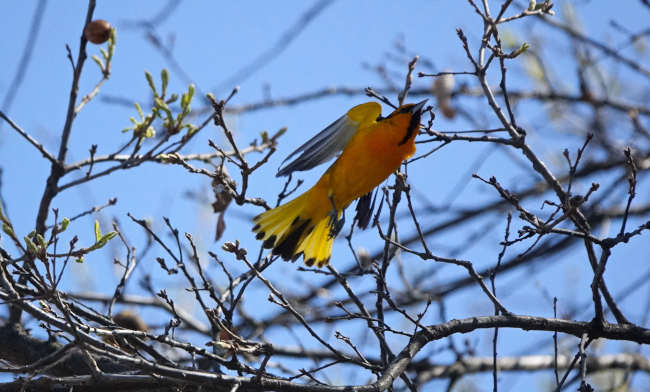
Most Facebook likes: Herman Strik, Bullock’s Oriole in flight taken April 9 at 10:46 a.m.
Herman Strik won the senior division in the Clear Lake State Park Interpretive Association’s spring photo contest for this photo of a bald eagle taken on May 11, 2021, in the Lower Bayview Campground at Clear Lake State Park in Kelseyville, California. The association is continuing its seasonal photo contests, and invites all park visitors to participate in the summer photo contest, which begins July 1 and continues until Sept. 1.
The contest is for all ages and all photographic submissions must be digital and posted on the CLSPIA Facebook Page. All rules for the contest can be found on this Facebook page.
You must be an amateur photographer and may use any type of digital camera.
Photographs must be taken inside Clear Lake State Park during the period of the contest. You may only post five photos during the period of the contest, but you may delete a photo and replace it with another. If you choose to substitute in a new photo, you will lose the likes on the deleted photo.
Judging will be in two stages: the five photos in each age group with the most Facebook likes will be honored and will move up to the panel judging.
The panel of judges will be selected by the CLSPIA Board and will judge the top five most liked photos and award a top winner in each age group.
Herman Strik won the most Facebook likes in the Clear Lake State Park Interpretive Association’s spring photo contest for this photo of a Bullock’s Oriole taken on April 9, 2021, in Clear Lake State Park in Kelseyville, California.
CLEARLAKE, Calif. — Clearlake Animal Control has a big new group of dogs waiting for homes.
The following dogs are ready for adoption or foster. The newest dog is listed at the beginning of the list.
“Bear.” Photo courtesy of Clearlake Animal Control. ‘Bear’
“Bear” is a male American Staffordshire terrier mix with a short brown coat.
He has been neutered.
He is dog No. 3476.
“Cleo.” Photo courtesy of Clearlake Animal Control. ‘Cleo’
“Cleo” is a female Doberman pinscher mix with a short gray coat who is new to the shelter.
She has been spayed.
She is dog No. 4865.
“Dusty.” Photo courtesy of Clearlake Animal Control. ‘Dusty’
“Dusty” is a male American Pit Bull Terrier with a tan and white coat.
He is dog No. 4750.
“Frankie.” Photo courtesy of Clearlake Animal Control. ‘Frankie’
“Frankie” is a male Labrador Retriever mix with a short yellow coat.
He is dog No. 4911.
“Gizmo.” Photo courtesy of Clearlake Animal Control. ‘Gizmo’
“Gizmo” is a senior male Chihuahua mix with a short tan and white coat.
He is dog No. 4902.
“Lucky.” Photo courtesy of Clearlake Animal Control. ‘Lucky’
“Lucky” is a male Labrador Retriever mix with a short yellow coat.
He is dog No. 4908.
“Mitzy.” Photo courtesy of Clearlake Animal Control. ‘Mitzy’
“Mitzy” is a female shepherd mix with a medium-length black and white coat.
She is dog No. 4648.
“Mojo.” Photo courtesy of Clearlake Animal Control. ‘Mojo’
“Mojo” is a male Chihuahua mix with a short black and tan coat.
He has been neutered.
He is dog No. 4881.
“Patches.” Photo courtesy of Clearlake Animal Control. ‘Patches’
“Patches” is a male Chihuahua mix with a short tricolor coat.
He is dog No. 4903.
“Princess.” Photo courtesy of Clearlake Animal Control. ‘Princess’
“Princess” is a female American pit bull terrier mix with a short fawn and white coat.
She is dog No. 4840.
“Sassy.” Photo courtesy of Clearlake Animal Control. ‘Sassy’
“Sassy” is a female Labrador retriever and pit bull mix with a short black with white markings.
She is house-trained.
She is dog No. 4602.
“Tanisha.” Photo courtesy of Clearlake Animal Control. ‘Tanisha’
“Tanisha” is a female shepherd mix with a short orange and white coat.
She is dog No. 4647.
“Terry.” Photo courtesy of Clearlake Animal Control. ‘Terry’
“Terry” is a male Dutch shepherd mix with a smooth brindle coat.
He is dog No. 4880.
“Toby.” Photo courtesy of Clearlake Animal Control. ‘Toby’
“Toby” is a friendly senior male boxer mix.
He has a short tan and white coat.
Toby is house trained and neutered.
He is dog No. 4389.
Call the Clearlake Animal Control shelter at 707-273-9440, or email This email address is being protected from spambots. You need JavaScript enabled to view it. to inquire about adoptions and schedule a visit to the shelter.
Visit Clearlake Animal Control on Facebook or on the city’s website.
California Attorney General Rob Bonta on Friday formally launched new regional Human Trafficking and Sexual Predator Apprehension Teams, or HT/SPAT, within the California Department of Justice and is encouraging law enforcement partners in the state to reach out to the new program.
Progressively stepping up their efforts since last year, the teams — one covering Northern California and another covering Southern California — are now nearly fully staffed and have already taken action across the state to support law enforcement partners in disrupting and dismantling human trafficking and the criminal exploitation of children.
Attorney General Bonta on Friday also issued an information bulletin to local authorities to provide guidance on key techniques meant to help reduce harm in law enforcement interactions with sexually exploited youth.
In addition, the attorney general highlighted new funds included in the proposed state budget aimed at combatting the effects of the pandemic on human trafficking and directly supporting survivors across California through $30 million in new grants over the next three years.
The new proposed funds are in addition to $10 million per year in grants already included in the budget.
“Plain and simple: Human trafficking is a modern-day form of slavery. Whether it’s forced labor or commercial sexual exploitation of children, there is no place for these kinds of crimes in California or anywhere,” said Attorney General Bonta. “Unfortunately, the pandemic has only served to exacerbate many of the underlying risks that lead to human trafficking in our state. We all have to work together across every level of government and society to help bring human trafficking to an end.”
Bonta said he was proud to formally launch our human trafficking teams at the California Department of Justice.
“I urge our partners across the state to reach out whenever they are in need of assistance. No one agency can do it all alone — and we need more than arrests to have a real, lasting impact on survivors, particularly children,” he said. “That's what makes these new grants in the proposed budget and our law enforcement bulletin so important. It will take hard work, patience, and understanding to secure justice and, ultimately, to bring healing. I’m confident that with the tools being shared today, together we can help make a difference for our people and for our state.”
“It has been more than 150 years since slavery was abolished and yet modern-day slavery still exists in our backyard,” said Assemblymember Miguel Santiago. “It’s our responsibility to do everything in our power to abolish this horrid crime and help survivors recover. A historic state investment of $60 million over the next three years coupled with the Attorney General’s statewide efforts will provide survivors much needed services such as housing, food, legal representation, and emergency response that could prove life-saving. This is only the start and it will take a village to eradicate one of the biggest human rights challenges of our time.”
Fighting a modern-day form of slavery
Human trafficking is a modern-day form of slavery where perpetrators profit from the control and exploitation of men, women, and children for sex or labor through force, fraud or coercion.
According to the National Human Trafficking Hotline, there were more than 1,500 human trafficking cases reported in California in 2019 — more than any other state in the nation.
In California, human trafficking has been most prevalent in urban areas and, according to the Federal Bureau of Investigation, three of the top child prostitution regions nationwide are in the Los Angeles, San Diego and San Francisco metropolitan areas.
Among other industries, victims of human trafficking can also be found among migrant and seasonal agricultural workers, providers of residential care, and in California’s garment sector.
Despite these ongoing concerns, California has historically lacked a statewide, collaborative approach to human trafficking enforcement.
However, as a result of a new infusion of funds to the California Department of Justice starting in fiscal year 2019-20, HT/SPAT has begun to directly step up engagement with federal, state and local law enforcement partners in efforts to help address the epidemic of human trafficking in California through a more comprehensive and collaborative statewide response.
The new regional teams are in addition to the California Department of Justice’s existing work as a lead agency in the San Diego Human Trafficking Task Force.
The HT/SPAT program is committed to using a victim-centered approach to aggressively investigate and identify forced labor and sexual exploitation for profit or gain by human traffickers and sexual predators.
The program also works to monitor and ensure compliance with California’s laws among registered sex offenders, largely focusing on those who have been identified as “Well Above Average Risk Offenders” in the California Sex Offender Registry. These individuals generally have a higher predicted rate of recidivism within the first five years of release from custody.
Overall, there are 13 special agents and two crime analysts in the HT/SPAT program, all are new positions dedicated to directly tackling and assisting in efforts to eradicate human trafficking in the state.
Law enforcement agencies urged to contact teams
The attorney general encourages law enforcement partners across the state to reach out to the new HT/SPAT program for assistance on human trafficking matters, particularly those that may be complex or impact multiple jurisdictions.
To date, many agencies have already done so and HT/SPAT has taken action in nearly all phases of enforcement efforts, including through:
— Nearly 300 on-the-ground address checks of potential suspects and high-risk sex offenders; – The development of dozens of investigative leads, conducting suspect and survivor interviews in conjunction with law enforcement partners; – The execution of nearly two dozen search warrants; – Outreach to nonprofit organizations that provide services to survivors; and – Assisting in and directly securing arrests related to human trafficking and other violations of California’s laws.
Protecting exploited children from harm
In addition to the California Department of Justice’s ongoing efforts to directly combat human trafficking in the state, Attorney General Bonta issued guidance to help law enforcement protect commercially sexually exploited children from further harm.
Commercial sexual exploitation of youth is defined as a commercial sex act where anything of value is given, including the provision of food, shelter, or payment, in exchange for the performance of a sexual act. Both girls and boys can be impacted and are subject to many of the same risk factors.
Over the past decade, there has been a growing awareness and shift in understanding regarding sexually exploited youth in California and around the country.
As a result, the California Legislature has enacted a number of state laws that aim to ensure youth are not criminalized as a result of being commercially sexually exploited.
For instance, Senate Bill 1322 of 2016 made laws that criminalize soliciting or engaging in prostitution inapplicable to anyone under 18 years of age, fundamentally changing aspects of the relationship between youth and law enforcement.
However, legislation alone does not ensure youth in such circumstances are able to meaningfully engage with law enforcement to extricate themselves from abusive situations or assist in the investigation and prosecution of exploiters.
Ultimately, more restorative-focused actions often depend on building trust and long-term relationships, Bonta’s office said.
While a number of law enforcement agencies may have significant experience and expertise in working with commercially sexually exploited youth in such a manner, this is not always the case for law enforcement agencies across the state and a harm reduction approach ultimately requires patience, consistency, and a recognition that lasting change will take time.
In Friday’s bulletin, drawing on the expertise of the Department's Bureau of Children's Justice, the attorney general urges law enforcement agencies to use a harm reduction framework and offers a wide-range of specific key strategies and approaches to help protect sexually exploited youth, including, among other things, to:
— Remember that trauma impacts the ability of youth to recall information, creating the potential for there to be gaps in their stories or have details presented in a non-linear fashion; — Allow time for youth engaging with law enforcement to decompress, giving them space to clear their heads or use the restroom; — Clearly establish the purpose of the interaction, reminding youth that they are not in trouble or under arrest; — Review and update as needed a safety plan for youth regarding what to do should they feel in danger or receive threats; — Take steps to remain engaged and stay in contact with youth if possible, even if they go missing from foster care or other placements; — Maintain communication with the youth’s support systems, including social workers or caregivers; — Determine the best and safest way to maintain contact, particularly if texts or phone calls make the youth feel unsafe; and — Take steps to protect youth from being required to publicly provide testimony due to the sensitive nature of their cases and their juvenile status.
New grants proposed
Lastly, pending approval by the governor, the proposed budget contains a major new investment in direct services for survivors of human trafficking in the form of grants to be administered by the California Governor's Office of Emergency Services.
These new grants are sorely needed as a result of the pandemic's impacts on many of the underlying risk factors that lead to human trafficking in California, including job loss among vulnerable populations, reported increases in online grooming, and limitations on the ability of victims to seek assistance in person.
During COVID-19, service organizations across California have reported significant upticks in calls to their hotlines and in demand for assistance.
Bonta’s office said he is a fierce champion for making these kinds of grants available and supported calls by advocates to ratchet up investments into direct services for survivors.
The grants included in the current proposed budget will help local entities support survivors through $30 million in new funding over the next three years. If approved, these funds will be part of the state's multi-tiered strategy to help protect and support Californians impacted by human trafficking.
Separately, the California Department of Justice also provides and maintains on its website human trafficking notices that certain businesses are required to post by law in order to inform the public and help ensure potential victims of trafficking are aware of resources available to them in California.
These notices are available for use to all members of the public. Up-to-date digital copies of the notices are available for free in two dozen languages on the Attorney General’s website here: https://oag.ca.gov/human-trafficking/model-notice.
General information about the HT/SPAT program is available on the Attorney General’s website here: https://oag.ca.gov/bi/htspat .
In this artist’s rendering, two gaseous planets orbit the bright star HD 152843. These planets were discovered through the citizen science project Planet Hunters TESS, in collaboration with professional scientists. Credit: NASA/Scott Wiessinger. At night, 7-year-old Miguel likes talking to his father Cesar Rubio about planets and stars.
“I try to nurture that,” said Cesar Rubio, a machinist in Pomona, California, who makes parts for mining and power generation equipment.
Now, the boy can claim his father helped discover planets, too. Cesar Rubio is one of thousands of volunteers participating in Planet Hunters TESS, a NASA-funded citizen science project that looks for evidence of planets beyond our solar system, or exoplanets.
Citizen science is a way for members of the public to collaborate with scientists. More than 29,000 people worldwide have joined the Planet Hunters TESS effort to help scientists find exoplanets.
Planet Hunters TESS has now announced the discovery of two exoplanets in a study published online in Monthly Notices of the Royal Astronomical Society, listing Rubio and more than a dozen other citizen scientists as co-authors.
Cesar Rubio and his son Miguel enjoy talking about space together. Credit: Cesar Rubio. These exotic worlds orbit a star called HD 152843, located about 352 light-years away. This star is about the same mass as the Sun, but almost 1.5 times bigger and slightly brighter.
Planet b, about the size of Neptune, is about 3.4 times bigger than Earth, and completes an orbit around its star in about 12 days.
Planet c, the outer planet, is about 5.8 times bigger than Earth, making it a “sub-Saturn,” and its orbital period is somewhere between 19 and 35 days. In our own solar system, both of these planets would be well within the orbit of Mercury, which is about 88 days.
“Studying them together, both of them at the same time, is really interesting to constrain theories of how planets both form and evolve over time,” said Nora Eisner, a doctoral student in astrophysics at the University of Oxford in the United Kingdom and lead author of the study.
TESS stands for Transiting Exoplanet Survey Satellite, a NASA spacecraft that launched in April 2018. The TESS team has used data from the observatory to identify more than 100 exoplanets and over 2,600 candidates that await confirmation.
Planet Hunters TESS, operated through the Zooniverse website, began in December 2018, shortly after the first TESS data became publicly available. Volunteers look at graphs showing the brightness of different stars over time.
They note which of those plots show a brief dip in the star’s brightness and then an upward swing to the original level. This can happen when a planet crosses the face of its star, blocking out a tiny bit of light — an event called a “transit.”
Elisabeth Baeten has been part of more than a dozen published scientific studies through Zooniverse projects. Credit: Elisabeth Baeten. The Planet Hunters project shares each brightness plot, called a “light curve,” with 15 volunteers. In the background of the website, an algorithm collects all of the volunteers’ submissions and picks out light curves that multiple volunteers have flagged.
Eisner and colleagues then look at the highest-ranked light curves and determine which ones would be good for scientific follow-up.
Even in an era of sophisticated computing techniques like machine learning, having a large group of volunteers looking through telescope data is a big help to researchers.
Since researchers can’t perfectly train computers to identify the signatures of potential planets, the human eye is still valuable.
“That’s why a lot of exoplanet candidates are missed, and why citizen science is great,” Eisner said.
In the case of HD 152843, citizen scientists looked at a plot showing its brightness during one month of TESS observations. The light curve showed three distinct dips, meaning at least one planet could be orbiting the star.
All 15 citizen scientists who looked at this light curve flagged at least two transits, and some flagged the light curve on the Planet Hunters TESS online discussion forum.
Then, scientists took a closer look. By comparing the data to their models, they estimated that two transits came from the inner planet and the other came from a second, outer planet.
To make sure the transit signals came from planets and not some other source, such as stars that eclipse each other, passing asteroids, or the movements of TESS itself, scientists needed to look at the star with a different method.
They used an instrument called the High Accuracy Radial velocity Planet Searcher for the Northern hemisphere, or HARPS-N, at the Telescopio Nazionale Galileo in La Palma, Spain, as well as the Extreme Precision Spectrometer, or EXPRES, an instrument at Lowell Observatory in Flagstaff, Arizona.
Both HARPS and EXPRES look for the presence of planets by examining whether starlight is “wobbling” due to planets orbiting their star. This technique, called the radial velocity method, allows scientists to estimate the mass of a distant planet, too.
While scientists could not get a signal clear enough to pinpoint the planets’ masses, they got enough radial velocity data to make mass estimates — about 12 times the mass of Earth for planet b and about 28 times the mass of Earth for planet c.
Their measurements validate that signals that indicate the presence of planets; more data is needed for confirmation of their masses. Scientists continue to observe the planetary system with HARPS-N and hope to have more information about the planets soon.
Researchers may soon have high-tech tools to see if these planets have atmospheres and what gases are present in them. NASA’s James Webb Space Telescope, launching later this year, will be able to look at what kinds of molecules make up the atmospheres of planets like those in this system, especially the larger outer planet.
The HD 152843 planets are far too hot and gaseous to support life as we know it, but they are valuable to study as scientists learn about the range of possible planets in our galaxy.
Alexander Hubert is studying to become a math and Latin teacher but enjoys astronomy citizen science projects. Credit: Alexander Hubert. “We're taking baby steps towards the direction of finding an Earthlike planet and studying its atmosphere, and continue to push the boundaries of what we can see,” Eisner said.
The citizen scientists who classified the HD 152843 light curve as a possible source of transiting planets, in addition to three Planet Hunters discussion forum moderators, were invited to have their names listed as co-authors on the study announcing the discovery of these planets.
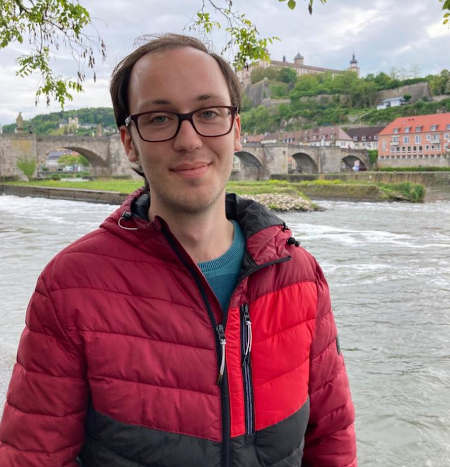
One of these citizen scientists is Alexander Hubert, a college student concentrating in mathematics and Latin in Würzburg, Germany, with plans to become a secondary school teacher. So far, he has classified more than 10,000 light curves through Planet Hunters TESS.
“I regret sometimes that in our times, we have to constrain ourselves to one, maybe two subjects, like for me, Latin and mathematics,” Hubert said. “I’m really grateful that I have the opportunity on Zooniverse to participate in something different.”
Elisabeth Baeten of Leuven, Belgium, another co-author, works in the administration of reinsurance, and says classifying light curves on Planet Hunters TESS is “relaxing.”
Interested in astronomy since childhood, she was one of the original volunteers of Galaxy Zoo, an astronomy citizen science project that started in 2007. Galaxy Zoo invited participants to classify the shapes of distant galaxies.
While Baeten has been part of more than a dozen published studies through Zooniverse projects, the new study is Rubio’s first scientific publication. Astronomy has been a lifelong interest, and something he can now share with his son. The two sometimes look at the Planet Hunters TESS website together.
“I feel that I’m contributing, even if it’s only like a small part,” Rubio said. “Especially scientific research, it’s satisfying for me.”
NASA has a wide variety of citizen science collaborations across topics ranging from Earth science to the Sun to the wider universe. Anyone in the world can participate. Check out the latest opportunities at www.science.nasa.gov/citizenscience.
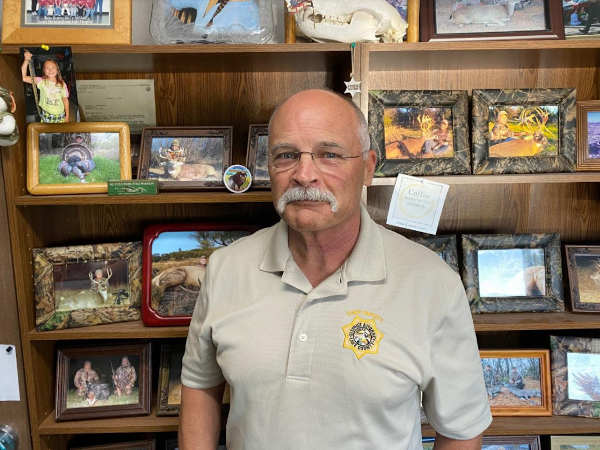
Lake County Chief Deputy District Attorney Richard Hinchcliff has been named the 2020 Wildlife Prosecutor of the Year by the California Fish and Game Commission. Courtesy photo. LAKE COUNTY, Calif. — At its June meeting on Thursday, the California Fish and Game Commission along with the California Department of Fish and Wildlife announced Lake County Chief Deputy District Attorney Richard Hinchcliff as the commission’s 2020 Wildlife Prosecutor of the Year.
“We are immensely grateful for Richard Hinchcliff’s years of dedicated service to Lake County’s fish and wildlife, and its citizens,” said Commission President Pete Silva. “This award acknowledges our appreciation of his many years of extraordinary work and we hope that other prosecutors in the state recognize and follow his example.”
Hinchcliff told Lake County News that he is very honored to receive the award from the California Fish and Game Commission.
“I am especially honored to have the local wardens who personally know me and work with me nominate me for the award. I have spent a lot of time in the last 20 years working on fish and wildlife poaching cases, much of it in the evenings and weekends, trying to protect our local fish and wildlife resources,” he said.
Having been an angler and hunter since the age of 6, Hinchcliff has always considered the illegal take of fish and wildlife to be a form of theft from the public and a violation of ethical and responsible behavior.
Throughout his lifetime spent in the field, his time with the District Attorney’s Office and his participation in the Lake County Environmental Crimes Task Force, Hinchcliff is doing his part to counteract the damaging effects of poaching and pollution on the ecosystem.
Since September 2000, Hinchcliff has prosecuted approximately 550 wildlife and environmental cases in Lake County. He has a conviction rate exceeding 95% for all fish and wildlife cases referred to the Lake County District Attorney’s Office in the last 21 years.
During that time, Hinchcliff has successfully obtained orders from the court to have poachers pay fines in the amount of $429,742, he has had 65 firearms ordered forfeited, and had 116 hunting licenses and 57 fishing licenses revoked from convicted poachers for one to three years.
Hinchcliff was the very first prosecutor to use the “trophy enhancement” for a deer poaching conviction, which increased penalties associated with poaching trophy class game mammals and wild turkey.
He said all of the hard working game wardens investigating and putting fish and wildlife poaching cases together in Lake County have made his work — and, ultimately, this award — possible.
“I have probably worked with a couple dozen wardens in this county over the last 20 years, and they have all been dedicated hard working people. The award belongs to all of those wardens as much as it does me,” Hinchcliff said.
There was another group Hinchcliff also credited with making his work possible.
“Fortunately, over the last 20 years, we have had some good judges in Lake County that realize the importance of protecting fish and wildlife from illegal hunting and fishing activities, that have generally supported the dispositions and sentences recommended by the District Attorney’s Office,” he said.
Hinchcliff has mentored many Lake County wildlife officers, rookie and veteran alike, even during the pandemic.
He is always available to answer questions about environmental violations, case law updates, search warrant evaluations or to provide sound advice whenever officers are seeking guidance.
His assistance and availability have led to solid convictions in cases which involve serious wildlife or environmental offenses.
“California wildlife officers and the residents of California are indebted to Richard Hinchcliff’s relentless pursuit of justice and his tireless prosecution of those who would bring harm to the wildlife we care so much about,” said David Bess, CDFW deputy director and chief of the Law Enforcement Division.
Hinchcliff is also a sitting board member on the Lake County Fish and Wildlife Advisory Committee, having served continuously since 1986.
He is active in many local and statewide charitable groups, including the Mendocino Blacktail Deer Association, California Deer Association, A-Z Foundation, Rocky Mountain Elk Foundation, California Waterfowl Association and the Lake County Peace Officers Association.
The Fish and Game Commission annually honors a courtroom champion of California’s fish, wildlife and natural resources, a person who tirelessly prosecutes fish, wildlife, natural resource and environmental crimes in California courts.
The Wildlife Prosecutor of the Year Award goes to a prosecuting attorney who exhibits:
— Exceptional skill and an outstanding commitment to protecting California’s fish, wildlife and natural resources;
— Superior performance in prosecuting wildlife, natural resource and environmental crimes;
— Relentless pursuit of justice for the most egregious violators and keen ability to prosecute complex, controversial or landmark cases, and/or;
— Exemplary work promoting and maintaining a collaborative working relationship with wildlife officers in pursuit of conserving our natural resources.
LAKE COUNTY, Calif. — A Northshore man died Wednesday following a head-on wreck on Highway 20 near Nice.
The Lake County Sheriff’s Office identified the man as Harold Leslie Learned Jr., 73, of Nice.
The California Highway Patrol’s Clear Lake Area office said the wreck occurred at 3:17 p.m. Wednesday on Highway 20 east of Pomo Way.
Learned was driving his 1991 Chevrolet Silverado pickup westbound at an unknown speed, as Tod Syper, a 55-year-old resident of Nice, was driving his 2001 Dodge Ram pickup eastbound at approximately 55 miles per hour, the CHP said.
For reasons the CHP said are yet to be determined, Learned crossed over solid double yellow lines, directly into the path of Syper’s vehicle, resulting in a head-on collision.
Both vehicles came to rest blocking the eastbound lane of Highway 20, front of the Pomo Pumps gas station, the CHP said.
The CHP said traffic control was in effect for a short time, with the assistance of Caltrans.
Following the collision, Learned was transported to Sutter Lakeside Hospital in Lakeport where he was later pronounced deceased, the CHP reported.
Syper was treated for minor injuries at the scene and declined medical transportation, the CHP said.
Learned’s cause of death is under investigation. The CHP said it is unknown if drugs or alcohol were contributing factors in the collision.
The CHP asks anyone who may have witnessed the collision or observed either vehicle immediately before the collision to contact Officer Ryan Erickson at 707-279-0103.
 How to resolve AdBlock issue?