 How to resolve AdBlock issue?
News
Census Bureau data shows steady increase in funding of green programs by state and local governments
Environmentalists have long been pushing the government, consumers and corporations to protect our planet, promoting everything from tougher environmental standards to paperless communications and environmentally friendly products like reusable shopping sacks.
Government is stepping up. The United States just hosted a global climate change summit coinciding with Earth Day and committed to reducing greenhouse gas emissions by 50%-52% below its 2005 emissions levels by 2030.
And state and local governments are spending more on preserving natural resources.
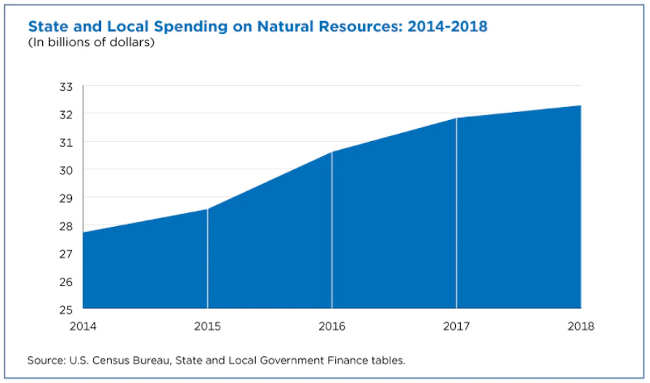
According to the U.S. Census Bureau’s Annual Survey of State and Local Government Finances, public spending to protect the nation’s natural resources jumped from $27.7 billion in 2014 to $32.3 billion in 2018.
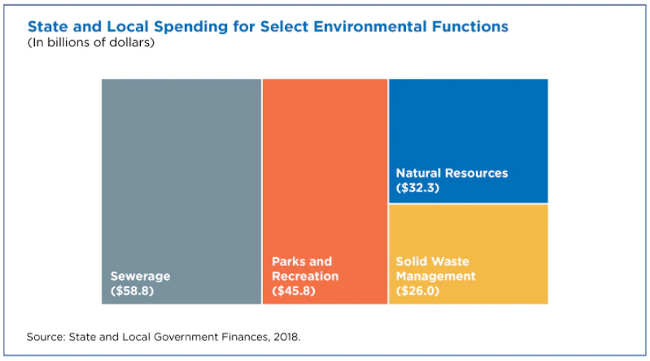
The survey includes a broad range of statistics on public expenditures on natural resources. It provides data on how much our governments spend on conservation and management of resources, such as fish and game, forestry, soil, water, and electric energy resources.
Some specific preservation programs include protection of soil and water resources, including controlling beach erosion, managing dams to prevent floods, educating the public about conservation and generating hydroelectric energy.
The survey also details government expenditures on caring for the environment, including maintaining parks and managing waste.
Employment in natural resources remain largely unchanged
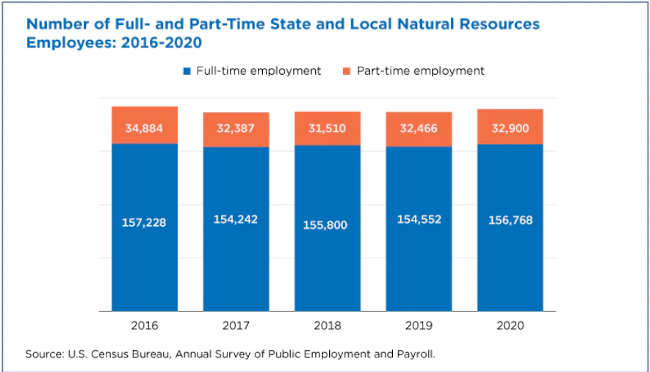
According to the Census Bureau’s Annual Survey of Public Employment & Payroll, in March 2020 there were 189,668 employees in the natural resources functions of state and local governments: 83% (156,768) were full-time and 17% (32,900) part-time.
While expenditures rose, a five-year comparison (from 2016 to 2020) showed a 5.7% decline in part-time employment and a 0.3% dip in full-time employment.
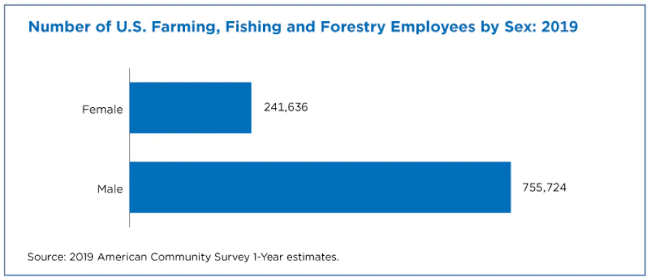
According to the American Community Survey, which shows employment data by sex, women held approximately 24% of the nation’s farming, fishing, and forestry sector jobs in 2019.
Alternative sources of energy
Part of preserving natural resources and the environment is increasing reliance on alternative power sources.
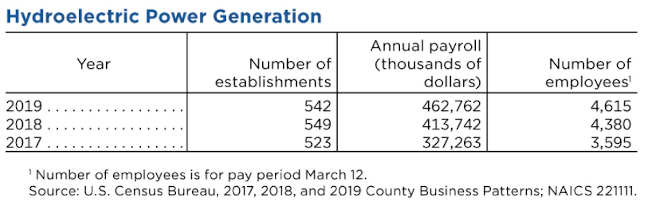
The private sector has seen increases in the number of businesses and employment in industries that generate power from non-fossil fuel sources, according to County Business Patterns data.
For example, there was about a 5% increase in the number of hydroelectric power generation establishments and a 22% rise in the number of people employed in the industry from 2017 to 2018. The 2019 data show fewer establishments with an increase in the number of employees in the sector.
It looks like reduce, reuse and recycle are here to stay and the Census Bureau is tracking all data relating to conservation.
The Census Bureau’s State and Local Governments Snapshot tool provides quick and easy access.
Lynda Lee is a supervisory statistician in the Census Bureau’s Economic Management Division.
Lake County’s testing positivity and case rates continue to trend in the minimal-moderate range.
On Tuesday, June 15, the state of California will move Beyond the Blueprint for a Safer Economy), and most sector-specific business restrictions will be lifted as a result.
Some high-risk settings will still require all participants to take precautions. “Mega Events” (5,000 people indoors, or 10,000 outdoors) are one example.
“Please remember, while Lake County’s Case Rate is significantly lower than it was during our winter peak, COVID-19 is still present in our communities,” said Evan Bloom, MD, MPH, Lake County’s acting Public Health officer.
“Nearly half of eligible Lake County residents [46.8%] have not received even one dose of vaccine. We are well short of the 70% rate required for herd immunity. Some areas of the State have seen recent upticks in new cases, even as restrictions are about to loosen. Getting vaccinated and continuing to take common sense precautions are essential, as we enter this next phase,” Bloom said.
The county of Lake has no immediate intention to add restrictions beyond those required by the State Public Health officer’s order of June 11, 2021, which takes effect on Tuesday.
New guidance for the use of face coverings
Starting Tuesday, fully vaccinated Individuals will no longer be required to wear masks, except in settings where they are required for all people: public transit; indoors in K-12 schools, childcare and other youth settings; health care settings, including long-term care facilities; state and local correctional facilities and detention centers; and homeless shelters, emergency shelters and cooling centers.
Unvaccinated and partially vaccinated individuals will still be required to wear masks in most indoor public settings and businesses, including retail, restaurants, family entertainment centers, meetings, state and local government offices.
People are considered fully vaccinated for COVID-19 two weeks after they receive the second dose in a 2-dose series (Pfizer-BioNTech or Moderna), or two weeks after they have received a single-dose vaccine (Johnson and Johnson/Janssen).”
The California Department of Public Health’s complete guidance document can be found here.
Health services partnering with local school districts to vaccinate students and families
The Health Services Department, Lake County Office of Education and school districts are also partnering to make safe, effective COVID-19 vaccines available to students and their families on a rotating basis. Anyone under the age of 18 getting vaccinated will need parent/guardian consent for vaccination.
Appointments can be made at https://myturn.ca.gov/ and walk-ins will also be welcomed.
Two events are scheduled so far, follow the Lake County Office of Education Facebook page to make sure you don’t miss the event in your district.
— Tuesday, June 15, 2 to 7:30 p.m.: Upper Lake High School Cafeteria, 675 Clover Valley Road.
— Thursday, June 17, noon to 4 p.m.: Lakeport Elementary School Cafeteria, 150 Lange St.
Community members urged to get vaccinated
Appointments at a variety of locations throughout the county can be scheduled at https://myturn.ca.gov/ or by calling 833-422-4255. Lake County-focused information and resources are also available at http://health.co.lake.ca.us/Coronavirus/Vaccines.htm.
“To those who have already received their COVID-19 vaccinations: a heartfelt thank you,” said Dr. Bloom. “For the half of the county who are not yet vaccinated: please help us all breathe easier! Increasing our vaccination rate to 70% is still our goal, and further vaccination is key to a sustained return to normalcy.”
He added, “If you remain unsure, you are not alone. Please get your questions answered. Online resources, like https://yourvaccinationguide.org/, can be a great help.”
If you have reviewed online resources and still have questions, or are ready to be vaccinated, and need assistance overcoming barriers, call the Public Health’s MHOAC line, at 707-263-8174.
“Especially as things further open up, and people are mixing more, please take care of each other,” emphasizes Bloom. “If you are unvaccinated, and not feeling 100%, it is still best to stay home. Precautions that were mandates during the peak of the pandemic can help you stay healthier, and help protect your families and communities, even as we move Beyond the Blueprint. Stay safe and well.”
The following are state-produced resources on the reopening.
https://www.cdph.ca.gov/Programs/CID/DCDC/CDPH%20Document%20Library/COVID-19/What-Will-June-15-Look-Like.pdf
https://www.cdph.ca.gov/Programs/CID/DCDC/Pages/COVID-19/Beyond-Blueprint-Framework.aspx
https://www.cdph.ca.gov/Programs/CID/DCDC/Pages/COVID-19/Beyond-Blueprint-QA.aspx
Q&As and other resources are available at https://covid19.ca.gov/.
Actualización de COVID-19: Avanzando Más allá del Plan
Los distritos escolares locales ofrecerán vacunas de forma rotatoria en asociación con los Servicios de Salud https://www.facebook.com/LakeCountyOfficeofEducation/
Condado de Lake, CA (14 de junio de 2021)— Las tasas de casos y positividad de las pruebas del condado de Lake continúan con una tendencia en el rango mínimo-moderado. El martes 15 de junio, el estado de California se moverá "Más allá del plan (para una economía más segura)" y, como resultado, la mayoría de las restricciones comerciales específicas del sector se levantarán. Algunos entornos de alto riesgo aún requerirán que todos los participantes tomen precauciones. Los “mega-eventos” (5,000 personas en interiores o 10,000 al aire libre) son un ejemplo.
"Recuerde, mientras la tasa de casos del condado de Lake es significativamente más baja que durante nuestro pico de invierno, el COVID-19 todavía está presente en nuestras comunidades", urge Evan Bloom, MD, MPH, Funcionario Interino de Salud Pública del Condado de Lake. “Casi la mitad de los residentes elegibles del condado de Lake [46,8%] no han recibido ni una sola dosis de la vacuna. Estamos muy por debajo de la tasa del 70% requerida para la inmunidad colectiva. Algunas áreas del estado han visto repuntes recientes en nuevos casos, incluso cuando las restricciones están a punto de aflojarse. Vacunarse y seguir tomando precauciones de sentido común es esencial, ya que ingresamos a la siguiente fase”.
Nueva orden de salud estatal emitida el viernes 11 de junio a partir del 15 de junio: Reemplaza todos los pedidos anteriores
El Condado de Lake no tiene la intención inmediata de agregar restricciones más allá de las requeridas por la Orden del Oficial de Salud Pública del Estado del 11 de junio de 2021, que entrará en vigencia mañana, 15 de junio.
Puede encontrar esa Orden aquí: https://www.cdph.ca.gov/Programs/CID/DCDC/Pages/COVID-19/Order-of-the-State-Public-Health-Officer-Beyond-Blueprint.aspx
Preguntas y respuestas y otros recursos están disponibles en https://covid19.ca.gov/es/ .
Nueva orientación para el uso de cubiertas faciales
A partir de mañana, 15 de junio, ya no se requerirá que las personas totalmente vacunadas usen máscaras, excepto en los lugares donde se requieren para todas las personas: transporte público; en el interior de las escuelas K-12, cuidado de niños y otros entornos para jóvenes; entornos de atención médica, incluidas las instalaciones de atención a largo plazo; Instalaciones correccionales y centros de detención estatales y locales; y refugios para personas sin hogar, refugios de emergencia y centros de enfriamiento.
Se requerirá que las personas no vacunadas y parcialmente vacunadas usen máscaras en la mayoría de los entornos públicos y negocios interiores, que incluyen: venta minorista; restaurantes; centros de entretenimiento familiar; reuniones; oficinas gubernamentales estatales y locales.
Se considera que las personas están completamente vacunadas contra COVID-19 dos semanas después de recibir la segunda dosis de una serie de 2 dosis (Pfizer-BioNTech o Moderna), o dos semanas después de haber recibido una vacuna de dosis única (Johnson y Johnson / Janssen ). Fuente: https://covid19.ca.gov/vaccines/
El documento de orientación completo del Departamento de Salud Pública de California se puede encontrar aquí:
https://www.cdph.ca.gov/Programs/CID/DCDC/Pages/COVID-19/guidance-for-face-coverings.aspx#June15guidance
Servicios de Salud asociados con distritos escolares locales, LCOE para vacunar a estudiantes y familias locales
El Departamento de Servicios de Salud, la Oficina de Educación del Condado de Lake y los distritos escolares locales también se están asociando para hacer que las vacunas COVID-19 seguras y efectivas estén disponibles para los estudiantes y sus familias * de forma rotatoria. Las citas se pueden hacer en https://myturn.ca.gov/ , y también serán bienvenidas las personas sin cita previa.
Hasta ahora hay dos eventos programados, siga la página de Facebook de la Oficina de Educación del Condado de Lake para asegurarse de no perderse el evento en su distrito (https://www.facebook.com/LakeCountyOfficeofEducation/ ):
• Mañana (martes), 6/15, 2-7: 30pm - Cafetería de Upper Lake High School, 675 Clover Valley Rd, Upper Lake
• Jueves, 6/17, 12-4pm - Cafetería de la Escuela Primaria de Lakeport, 150 Lange St., Lakeport
* Tenga en cuenta: cualquier persona menor de 18 años que se vacune necesitará el consentimiento del padre / tutor
Vacúnese: sigue siendo clave para un retorno sostenido a la normalidad
Las citas en una variedad de ubicaciones en todo el condado se pueden programar en https://myturn.ca.gov/ o llamando al 833-422-4255. La información y los recursos centrados en el condado de Lake también están disponibles en http://health.co.lake.ca.us/Coronavirus/Vaccines.htm.
“Para aquellos que ya han recibido sus vacunas COVID-19: un sincero agradecimiento,” comparte el Dr. Bloom. “Para la mitad del condado que aún no está vacunada: ¡ayúdenos a respirar mejor! Aumentar nuestra tasa de vacunación al 70% sigue siendo nuestro objetivo, y una mayor vacunación es clave para un retorno sostenido a la normalidad.”
"Si no está seguro, no está solo,” continúa Bloom. “Por favor, obtenga respuestas a sus preguntas. Los recursos en línea, como ,https://yourvaccinationguide.org/ , pueden ser de gran ayuda.”
Si ha revisado los recursos en línea y aún tiene preguntas, o está listo para vacunarse y necesita ayuda para superar las barreras, llame a la línea MHOAC de Salud Pública al 707-263-8174.
“Especialmente a medida que las cosas se abren más y la gente se mezcla más, por favor cuídense unos a otros,” enfatiza Bloom. “Si no está vacunado y no se siente al 100%, es mejor quedarse en casa. Las precauciones que fueron obligatorias durante el pico de la pandemia pueden ayudarlo a mantenerse más saludable y ayudar a proteger a sus familias y comunidades, incluso mientras avanzamos Más allá del Plan. Mantente sano y salvo.”
Aquí hay algunos recursos producidos por el estado que muchos pueden encontrar útiles:
https://www.cdph.ca.gov/Programhttps://www.inyocounty.us/sites/default/files/2021-06/CA-Inyo_What-Will-June-15-Look-Like%28spanish%29.pdfs/CID/DCDC/CDPH%20Document%20Library/COVID-19/What-Will-June-15-Look-Like.pdf
https://www.cdph.ca.gov/Programs/CID/DCDC/Pages/COVID-19/Beyond-Blueprint-Framework.aspx
https://www.cdph.ca.gov/Programs/CID/DCDC/Pages/COVID-19/Beyond-Blueprint-QA.aspx
When the commission begins drawing maps using census data, they will need to follow this set of criteria, in this order, as outlined in the California Constitution:
— Districts must be of nearly equal population to comply with the U.S. Constitution.
— Districts must comply with the Voting Rights Act to ensure that minorities have a fair opportunity to elect representatives of their choice.
— Districts must be drawn contiguously, so that all parts of the district are connected to each other.
— Districts must minimize the division of counties, cities, neighborhoods and communities of interest to the extent possible.
— Districts should be geographically compact such that nearby areas of population are not bypassed for more distant populations.
— Where practicable, each Senate District should consist of two complete and adjacent Assembly Districts, and Board of Equalization districts should consist of 10 complete and adjacent State Senate districts. This is known as “nesting.”
The commission can obtain city and county information from those jurisdictions, but it needs the neighborhood and communities of interest information from Californians directly.
“Although we have been accepting communities of interest submissions online since March, these virtual input sessions are yet another opportunity for communities to share with the commission about their communities of interest,” said Commission Chair Isra Ahmad.
During these input meetings, participants will be asked to describe their community and will be encouraged to consider highlighting the following:
— Begin with your county or city.
— Mention the street names and significant locations in your neighborhood to help the commission identify the parameters of your community.
— What are your shared interests?
— What brings you together?
— What is important to your community?
— Are there nearby areas you want to be in a district with?
— Nearby areas you don't want to be in a district with? Why or why not?
— Has your community come together to advocate for important services, better schools, roads or health centers in your neighborhood?
Registration is not required to participate in these public input meetings. The call-in number for public input on the day of each event will be 877-853-5247.
To view a full list of upcoming meetings, visit https://www.wedrawthelinesca.org/meetings.
Additionally, Californians can skip the line and provide their input online by visiting https://drawmycacommunity.org/.
The online COI tool is 14 in fourteen languages and includes tutorials.
Every 10 years, after the federal government publishes updated census information, California must redraw the boundaries of its electoral districts so that the state’s population is evenly allocated among the new districts.
In 2008, California voters passed the Voters First Act, authorizing the creation of the independent California Citizens Redistricting Commission to draw new State Senate, State Assembly and State Board of Equalization district lines.
In 2010, the Voters First Act for Congress gave the Commission the responsibility of drawing new Congressional districts following every census.
For more information, visit www.WeDrawTheLinesCA.org.
The proposal, which will be put out for public comment, will be on the CPUC’s July 15 voting meeting agenda.
As a condition of approving PG&E’s plan for exiting bankruptcy in May 2020, the CPUC determined it necessary that an independent safety monitor succeed the federal monitor that was appointed as part of PG&E’s probation in criminal court.
The federal monitor’s work ends in 2022.
By creating an independent safety monitor, the CPUC is enhancing its oversight of PG&E to ensure the utility focuses on long-term outcomes that promote safety and reliability.
The independent safety monitor will be selected by and report to the CPUC.
In March, PG&E’s proposal with recommended oversight responsibilities for the independent safety monitor was issued for public comment.
The proposal issued by the CPUC incorporates feedback received and proposes a scope of work, budget and length of term.
Under the proposal, the term of the independent safety monitor will begin before the federal monitor completes its term and will continue for five years. The term can be extended based on PG&E’s performance.
The proposal sets the annual operating budget at $5 million and proposes these costs be paid by PG&E shareholders.
The CPUC’s oversight of PG&E includes exercising its broad investigation and enforcement authority, examining of rates and costs, pressing for progress on the utility’s efforts to reduce the risk of wildfire ignited by its equipment, ensuring safe execution of public safety power shut-offs, regulating the safety of the utility’s natural gas system and ensuring PG&E is progressing toward modernizing its electric grid.
Under the CPUC proposal, the independent safety monitor will support the CPUC in ensuring PG&E prioritizes and executes the highest level of risk reduction across all levels of the company, from senior officials to field personnel, and will assess PG&E’s risk management activities in the field.
The independent safety monitor will support the CPUC’s efforts to ensure PG&E has in place a risk assessment process that identifies where its operations and infrastructure create the greatest risk to public safety.
The independent safety monitor also will monitor PG&E’s safety-related record keeping and record management systems to ensure modernization efforts are informed by prior failures and support safe system construction, operation, and maintenance in PG&E’s electric and natural gas lines of business.
The proposal is available at www.cpuc.ca.gov/pgechapter11.
Public comment on the proposal may be sent to

Midlife was once considered a time to enjoy the fruits of one’s years of work and parenting. That is no longer true in the U.S.
Deaths of despair and chronic pain among middle-aged adults have been increasing for the past decade. Today’s middle-aged adults – ages 40 to 65 – report more daily stress and poorer physical health and psychological well-being, compared to middle-aged adults during the 1990s. These trends are most pronounced for people who attained fewer years of education.
Although these trends preclude the COVID-19 pandemic, COVID-19’s imprint promises to further exacerbate the suffering. Historical declines in the health and well-being of U.S. middle-aged adults raises two important questions: To what extent is this confined to the U.S., and will COVID-19 impact future trends?
My colleagues and I recently published a cross-national study, which is currently in press, that provides insights into how U.S. middle-aged adults are currently faring in relation to their counterparts in other nations, and what future generations can expect in the post-COVID-19 world. Our study examined cohort differences in the health, well-being and memory of U.S. middle-aged adults and whether they differed from middle-aged adults in Australia, Germany, South Korea and Mexico.
US is an outlier among rich nations
We compared people who were born in the 1930s through the 1960s in terms of their health and well-being – such as depressive symptoms and life satisfaction – and memory in midlife.
Differences between nations were stark. For the U.S., we found a general pattern of decline. Americans born in the 1950s and 1960s experienced overall declines in well-being and memory in middle age compared to those born in the 1930s and 1940s. A similar pattern was found for Australian middle-aged adults.
In contrast, each successive cohort in Germany, South Korea and Mexico reported improvements in well-being and memory. Improvements were observed in health for each nation across cohorts, but were slowed for Americans born in the 1950s and 1960s, suggesting they improved less rapidly than their counterparts in the countries examined.
Our study finds that middle-aged Americans are experiencing overall declines in key outcomes, whereas other nations are showing general improvements. Our cross-national approach points to policies that could could help alleviate the long-term effects arising from the COVID-19 pandemic.
Will COVID-19 exacerbate troubling trends?
Initial research on the short-term effects of COVID-19 is telling.
The COVID-19 pandemic has laid bare the fragility of life. Seismic shifts have been experienced in every sphere of existence. In the U.S., job loss and instability rose, household financial fragility and lack of emergency savings have been spotlighted, and children fell behind in school.
At the start of the pandemic the focus was rightly on the safety of older adults. Older adults were most vulnerable to the risks posed by COVID-19, which included mortality, social isolation and loneliness. Indeed, older adults were at higher risk, but an overlooked component has been how the mental health risks and long-haul effects will likely differ across age groups.
Yet, young adults and middle-aged adults are showing the most vulnerabilities in their well-being. Studies are documenting that they are currently reporting more psychological distress and stressors and poorer well-being, compared to older adults. COVID-19 has been exacerbating inequalities across race, gender and socioeconomic status. Women are more likely to leave the workforce, which could further strain their well-being.

Changing views and experiences of midlife
The very nature and expectations surrounding midlife are shifting. U.S. middle-aged adults are confronting more parenting pressures than ever before, in the form of engagement in extracurricular activities and pressures for their children to succeed in school. Record numbers of young adults are moving back home with their middle-aged parents due to student loan debt and a historically challenging labor and housing market.
A direct effect of gains in life expectancy is that middle-aged adults are needing to take on more caregiving-related duties for their aging parents and other relatives, while continuing with full-time work and taking care of school-aged children. This is complicated by the fact that there is no federally mandated program for paid family leave that could cover instances of caregiving, or the birth or adoption of a child. A recent AARP report estimated that in 2020, there were 53 million caregivers whose unpaid labor was valued at US$470 billion.
The restructuring of corporate America has led to less investment in employee development and destabilization of unions. Employees now have less power and input than ever before. Although health care coverage has risen since the Affordable Care Act was enacted, notable gaps exist. High numbers of people are underinsured, which leads to more out-of-pocket expenses that eat up monthly budgets and financially strain households. President Biden’s executive order for providing a special enrollment period of the health care marketplace exchange until Aug. 15, 2021 promises to bring some relief to those in need.
Promoting a prosperous midlife
Our cross-national approach provides ample opportunities to explore ways to reverse the U.S. disadvantage and promote resilience for middle-aged adults.
The nations we studied vastly differ in their family and work policies. Paid parental leave and subsidized child care help relieve the stress and financial strain of parenting in countries such as Germany, Denmark and Sweden. Research documents how well-being is higher in both parents and nonparents in nations with more generous family leave policies.
Countries with ample paid sick and vacation days ensure that employees can take time off to care for an ailing family member. Stronger safety nets protect laid-off employees by ensuring that they have the resources available to stay on their feet.
In the U.S., health insurance is typically tied to one’s employment. Early on in the COVID-19 pandemic over 5 million people in the U.S. lost their health insurance when they lost their jobs.
During the pandemic, the U.S. government passed policy measures to aid people and businesses. The U.S. approved measures to stimulate the economy through stimulus checks, payroll protection for small businesses, expansion of unemployment benefits and health care enrollment, child tax credits, and individuals’ ability to claim forbearance for various forms of debt and housing payments. Some of these measures have been beneficial, with recent findings showing that material hardship declined and well-being improved during periods when the stimulus checks were distributed.
I believe these programs are a good start, but they need to be expanded if there is any hope of reversing these troubling trends and promoting resilience in middle-aged Americans. A recent report from the Robert Wood Johnson Foundation concluded that paid family leave has a wide range of benefits, including, but not limited to, addressing health, racial and gender inequities; helping women stay in the workforce; and assisting businesses in recruiting skilled workers. Research from Germany and the United Kingdom shows how expansions in family leave policies have lasting effects on well-being, particularly for women.
Middle-aged adults form the backbone of society. They constitute large segments of the workforce while having to simultaneously bridge younger and older generations through caregiving-related duties. Ensuring their success, productivity, health and well-being through these various programs promises to have cascading effects on their families and society as a whole.
[Get the best of The Conversation, every weekend. Sign up for our weekly newsletter.]
Frank J. Infurna, Associate Professor of Psychology, Arizona State University
This article is republished from The Conversation under a Creative Commons license. Read the original article.
The meeting will be held on Wednesday, June 16, from 5:30 to 7:30 p.m. via Zoom.
To join by computer, click: https://zoom.us/j/93002989951. To join by a tablet or smartphone via the Zoom app, use meeting ID 930-0298-9951.
To join by phone (audio only), call one tap audio for cell phones at +16699009128, 93002989951# or 669-900-9128 for land lines, using meeting ID 930-0298-9951.
The Sulphur Bank Mercury Mine is an abandoned open pit mercury mine located on the shoreline of Clear Lake in Clearlake Oaks.
The EPA’s website said the 160-acre site was mined intermittently for sulfur and mercury between 1865 and 1957.
The EPA added the mine to its Superfund site program in 1990.
Today, approximately two million cubic yards of mine waste are located on the property. It also includes the Herman impoundment, which the EPA said is a flooded open pit mine filled with water contaminated by mine waste and naturally occurring geothermal groundwater that covers 23 acres, is 90 feet deep and is located 750 feet from Clear Lake.
During the meeting, EPA staff will give an update on the site cleanup, including this year’s project schedule and an overview of concerns heard from recent outreach, and discuss how the site has affected the community’s use of Clear Lake.
There also will be time scheduled for a discussion of community concerns and remedies, and the best ways for EPA to share site updates.
The meeting will be broken up into “rooms” where participants will discuss different topics, including:
— trust and communication with the EPA, access to site documents and administration changes and priorities;
— lake quality effects on the community, including fish consumption, the site’s economic effects and reuse of the site;
— technical understanding and site document interpretation, including arsenic and mercury risks, algae, and mine cleanup and site documents.
For more information on the superfund site and what has been done to date, visit the EPA website.
An updated fact sheet may be found here.
Email Elizabeth Larson at