 How to resolve AdBlock issue?
News
Lifetime gifting of property is an approach to estate planning that has its place under the right circumstances.
Lifetime gifting can either be outright or subject to a retained interest by the donor. An owner of real property, who owns their property free and clear, can deed (gift) their real property to another and still reserve (retain) a life estate for their lifetime. A deed with a life estate approach has its pluses and minuses.
A life tenant — i.e, the person with the life estate — has the use, rents and enjoyment of the real property until the life tenant either dies or relinquishes (gives up) their life estate. Thus, the life tenant can live there and/or collect any rent on the real property.
At the end of the life estate, ownership of the real property automatically passes to the holder(s) of the remainder interest named on the deed. No probate or trust administration is required. All that is required to transfer title is that an affidavit of death of life tenant or surrender of life estate, as relevant, be recorded with the county recorder’s office.
During the period of the life estate, the life tenant has all the obligations of ownership, including paying the real property taxes and insurance.
However, the life tenant alone can neither sell the property nor take out a reverse mortgage because the life tenant does not own a fee simple absolute (complete title).
To sell the property, the life tenant and the owner(s) of the remainder interest would all have to join together. The proceeds of the sale would be allocated (divided) based on the appraised value of the life estate at the time of sale factoring in the life expectancy of the life tenant.
Avoiding an administration at death may be viewed as particularly beneficial in some family circumstances. By transferring the property during the owner’s lifetime with a reserved life estate, no notice is required at the owner’s death to the owner’s heirs, as is required with either probate or trust administration.
This means that the heirs do not have an opportunity to contest the trust or will that might otherwise have been used as the owner’s estate planning tool.
Another use of the life estate applies when the owner wants to allow someone else the right to live in the property during their lifetime but wants the property to pass to a different person when the life tenant dies.
This is frequently seen in second marriages where the real property is owned by one spouse who wants to ensure that his or her children ultimately inherit the real property when the surviving spouse dies.
As life tenant, the surviving spouse can live at the residence but cannot prevent the deceased spouse’s own intended beneficiaries (usually the deceased spouse’s own children) from inheriting full ownership at the surviving spouse’s death.
However, in the foregoing situation it is more common for the owner to use a trust — and not a deed with a life estate — that allows their surviving spouse the right to live in the residence and gives the property to the owner’s children at the surviving spouse’s death.
The terms of the life estate are inside the trust. Using a trust to provide the life estate can allow the residence to be sold and a replacement residence to be purchased by the trust while the surviving spouse is alive. That way the surviving spouse can move or downsize their home.
The foregoing is a simplified discussion and not legal advice. Anyone considering or dealing with a life estate should consult an attorney.
Dennis A. Fordham, attorney, is a State Bar-Certified Specialist in estate planning, probate and trust law. His office is at 870 S. Main St., Lakeport, California. He can be reached at
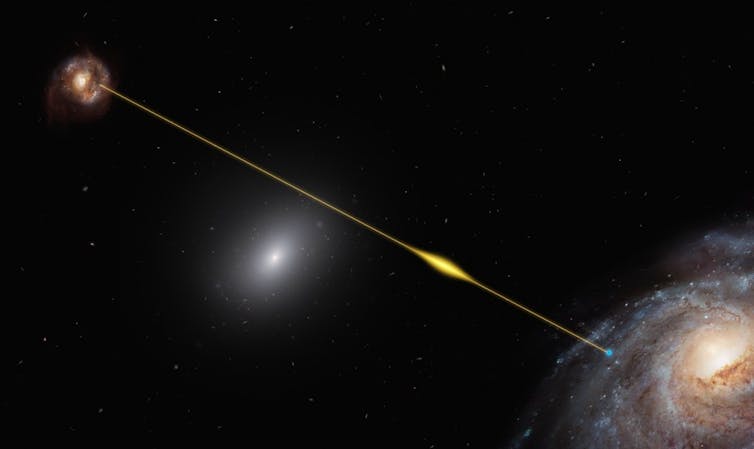 Mysterious blasts of radio waves from across the universe called fast radio bursts are getting more attention from astronomers. ESO/M. Kornmesser, CC BY-SA
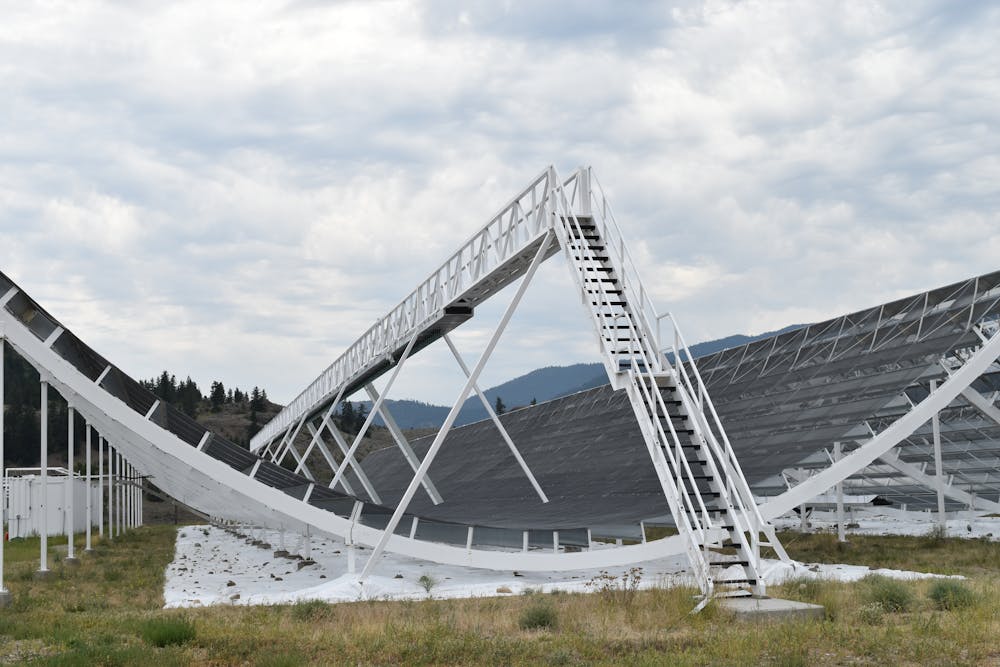
On June 9, 2021, my colleagues and I announced the discovery of 535 fast radio bursts that we detected using the Canadian Hydrogen Intensity Mapping Experiment telescope (CHIME). Detected in 2018 and 2019, these bursts of radio waves last only milliseconds, come from far across the universe, and are enormously powerful – a typical event releases as much energy in a millisecond as the Sun does over many days.
Fast radio bursts are the subject of a young and emerging field in astrophysics, with only around 150 having been found before the release of our new catalog. A lot of work has been done to understand these events, but these cosmic radio bursts remain as mysterious as when they were first discovered in 2007. Simply put: No one knows what exactly produces them.
Every newly captured event is allowing astrophysicists like me to learn more about these weird cosmic phenomena. And, as this is happening, some astronomers have begun to use fast radio bursts as incredibly powerful tools to study the universe itself.

What is a fast radio burst?
The name “fast radio burst” is pretty on the nose. These signals are bursts of radiation in radio frequencies that last for mere milliseconds. A defining property of these bursts is their dispersion: The bursts produce a spectrum of radio waves, and as the waves travel through matter, they spread out – or disperse – with bursts at higher radio frequencies arriving at telescopes earlier than those at lower frequencies.
This dispersion allows researchers to learn about two important things. First, telescopes like CHIME can measure this dispersion to learn about the stuff that radio bursts pass through as they travel toward Earth. For example, some of my colleagues were able to solve a long-standing mystery of missing matter that was scattered across the universe.
Second, by measuring dispersion, astronomers can indirectly determine one of the most important pieces of information in all of astronomy: how far apart things are. The larger the dispersion measure, the more material the signal encountered. So, presumably, passing through more stuff means the burst traveled farther across the universe.
The dispersion measures for fast radio bursts are so large that astronomers know the signals must be coming from outside of the Milky Way galaxy, but these estimates can be inaccurate because of the uneven distribution of matter in the universe. We therefore needed another way of finding distances to the sources of fast radio bursts to avoid assumptions on how matter is distributed and thus unlock a large amount of information and opportunities.
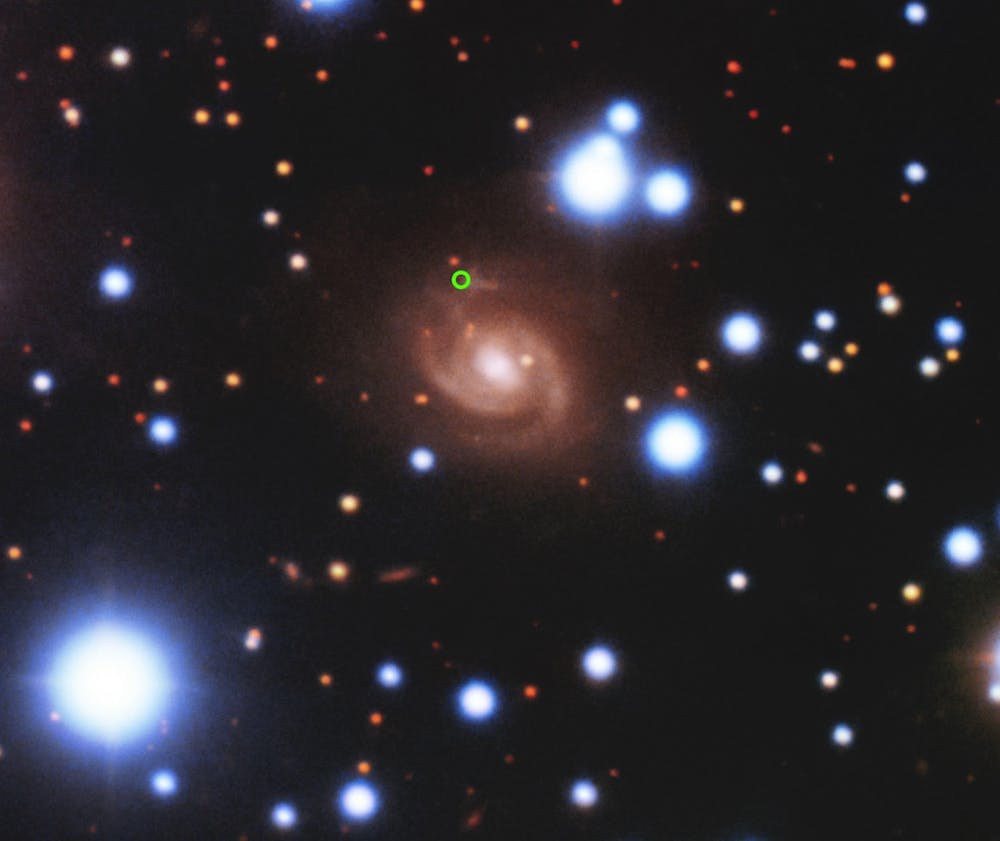
A striking solution to this problem came in 2017, when colleagues of mine were able to pinpoint the exact location of the source of a repeating fast radio burst in the sky. By taking images of repeating bursts on the sky, they found the specific galaxy that the bursts were coming from. Then, using optical telescopes, they determined the distance to this galaxy – approximately 3 billion light-years away from Earth.
Repeating fast radio bursts make it much easier to pinpoint the host galaxies of their sources by giving researchers multiple chances to catch them. While astronomers work to answer important questions about fast radio bursts – What are they? Are repeating bursts different from single bursts? Are they all caused by the same things? – these lingering mysteries don’t stop us from putting them to good use in the meantime.

Using fast radio bursts to study the cosmos
The unique properties of fast radio bursts and their host galaxies – combined with recent technological advancements like the CHIME telescope – have given researchers hope that these phenomena can be used to answer some long-standing questions about the universe.
For example, some theorists have proposed that fast radio bursts can be used to study the three–dimensional structure of matter in the universe. Others have shown that the most distant bursts could be used to learn about poorly understood early moments in the evolution of the universe. But to answer these and other questions, astronomers need a large number of fast radio bursts and their dispersion measures, strengths and locations in the sky.
And this is where our new catalog from CHIME comes in. By releasing information about 535 new fast radio bursts – including 61 bursts coming from 18 repeating sources – our team is more than quadrupling the total number of known events and pushing the field into an era of big data. With a large and growing number of measurements, all sorts of questions can finally start being addressed.
Recently, student members of the CHIME collaboration began releasing studies using this catalog. One study showed that the fast radio bursts detected by CHIME come equally from all directions – a fact that had previously been under debate. Another team studied the shapes and sizes of bursts in the catalog and confirmed that repeating events behave differently from single bursts, pointing to multiple causes of fast radio bursts. And a third team for the first time confirmed that fast radio bursts are strongly associated with known galaxies. This means astronomers can use events to map out the structure of the universe.
An adventurous future lies ahead
CHIME and other telescopes are detecting more fast radio bursts every day, but researchers are just scratching the surface of what can be learned about – and done with – these mysterious and powerful cosmic events.
Colleagues of mine recently argued that attributing thousands of events to their individual host galaxies is “the most urgent observational priority for [fast radio burst] science.” Finding host galaxies is very challenging, though – only 14 galaxies that host fast radio bursts have been found so far. But other telescopes, like the Australian Square Kilometre Array Pathfinder, have successfully detected and pinpointed a small number of nonrepeating bursts to their host galaxies. Next-generation telescopes are being designed to combine the high-detection capability of CHIME with the high-resolution imaging of the Australian telescope.
The field of fast radio burst astronomy is still in its infancy, and it is hard to predict what discoveries will be made next. But I expect the future of the field to be just like these profound cosmic events: bright and fast.
[Understand new developments in science, health and technology, each week. Subscribe to The Conversation’s science newsletter.]
Emmanuel Fonseca, Assistant Professor of Astronomy, West Virginia University
This article is republished from The Conversation under a Creative Commons license. Read the original article.
The fatal wreck occurred at 12:50 p.m. Friday on Highway 20 east of Rosemont Drive, the California Highway Patrol’s Clear Lake Area office reported.
The name of the 70-year-old man who died is not being released pending the notification of next of kin, the CHP said.
The CHP’s Friday evening report on the wreck said the Vacaville man was riding a 2009 Harley-Davidson westbound on Highway 20 east of Rosemont Drive.
Driving eastbound was Ryan Hicks, 50, of Stockton in a 2020 International truck-tractor and trailer combination, the CHP said.
Both vehicles were approaching each other within their respective lanes when, for reasons the CHP said are still under investigation, the motorcyclist entered the opposing lane of traffic and collided with Hick’s truck and trailer.
The CHP said a Northshore Fire Protection District ambulance transported the motorcyclist to Sutter Lakeside Hospital, where he died of his injuries.
Hicks was not injured. The CHP said both men were using their safety equipment.
Neither alcohol nor drugs are believed to be factors in the crash, the CHP said.
Email Elizabeth Larson at
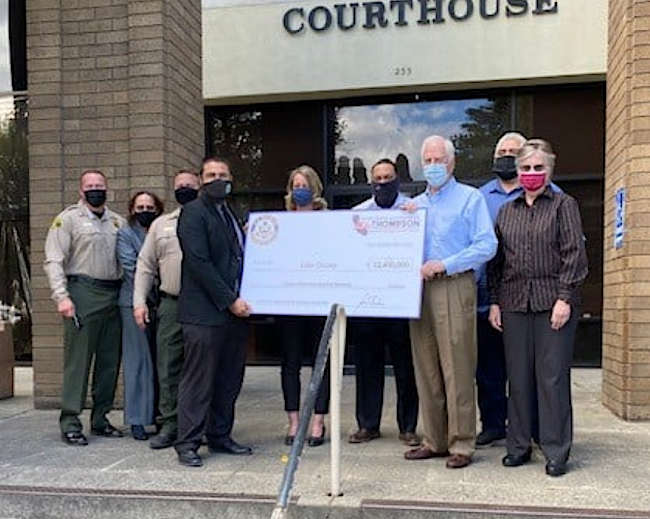
LAKE COUNTY, Calif. — The American Rescue Plan Act is sending millions of dollars to Lake County to help communities that continue to recover from the COVID-19 pandemic.
The $1.9 trillion economic stimulus legislation was signed into law by President Joe Biden in March.
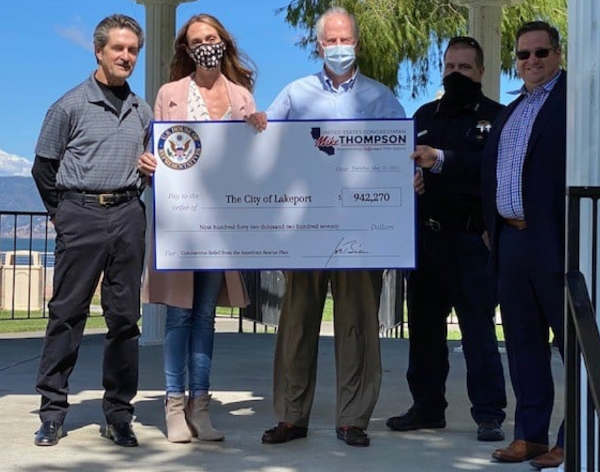
On Wednesday, Congressman Mike Thompson, whose Fifth Congressional District includes half of Lake County, including Lakeport, was in town to present ceremonial checks to city and county officials.
Lake County’s total allocation under the act, also known as ARPA, is $12,506,226, said Deputy County Administrative Officer Matthew Rothstein.
“The Board of Supervisors and county leaders are very grateful to Congressman Thompson for his strong advocacy on behalf of our county, and very much appreciate the congressman and his staff making a point to present our ceremonial check in person, yesterday,” Rothstein said Thursday.
The city of Lakeport will receive $1.2 million, said City Manager Kevin Ingram.
Ingram said the city hasn’t gotten any of the money yet.
“As a nonentitlement community we will be receiving our money in two tranches,” said Ingram.
“Tranche” is the term the federal government has used for the allocations.
He said the first installment should be allocated to the city by the end of this month.
Ingram said that on Thursday the city submitted its paperwork to the state to receive the allocations.
The city of Clearlake, which is in Congressman John Garamendi’s Third District, will receive an allocation of $3,652,191, said City Manager Alan Flora.
“It sounds like we will get the first 50% of the money in early July and the remaining 50% next June,” Flora said.
Flora didn’t report what the city plans to do with the funds.
As for Lakeport, Ingram said they are waiting for the final rules from the U.S. Treasury on how the money can be used. Those rules are expected to be issued on Aug. 15.
He said a plan will be brought to the Lakeport City Council for public input and approval in September.
Referencing comments made by County Administrative Officer Carol Huchingson and Auditor-Controller/County Clerk Cathy Saderlund at the county’s Wednesday budget hearings, Rothstein said the planning process is underway for the county’s ARPA spending plan, and a plan is expected to be finalized soon.
Saderlund also reported Wednesday that the county has received its first installment of the ARPA funds, with the second installment of more than $6 million expected in May of 2022.
“Our full complement of federal and state representatives have been important and invaluable partners, as we have navigated challenges and new demands brought by the pandemic,” Rothstein said.
Email Elizabeth Larson at
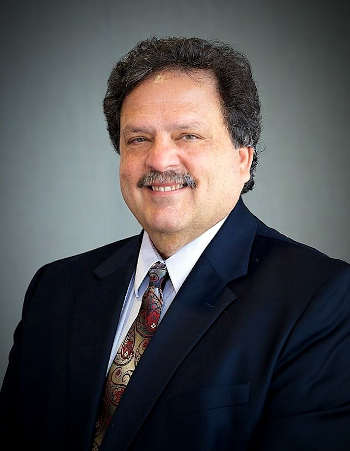
NORTHERN CALIFORNIA — On Thursday, the Yuba Community College District Governing Board appointed an interim chancellor after the departure of Dr. Douglas B. Houston.
After a nationwide search, the governing board appointed Dr. James L.J. Houpis to serve as interim chancellor beginning July 1, and continuing through June 30, 2022, as the recruitment for a permanent chancellor is conducted through the academic year.
“We are thrilled to welcome Dr. Houpis to our Yuba Community College family,” said Board President Susan Alves, “Dr. Houpis brings a wealth of experience in student-centered leadership, innovation, and equity, that will best serve our faculty, staff, administration, and especially students. Dr. Houpis’ guidance and focus on clear communication, community building, and transparency will be instrumental as we move forward in our selection of a permanent chancellor.”
“I am excited about returning to the North State and joining such an outstanding community college district, and developing relationships and working with committed colleagues, faculty, staff, students and community members toward common goals,” said Dr. Houpis. “I am looking forward to returning to the North State and serving the community in reaching their educational goals.”
Dr. Houpis received his bachelor’s degree in environmental sciences and his doctorate in forest science from University of California Berkeley, his master’s degree in biology from San Diego State University.
He was an environmental scientist and project leader in the Health and Ecological Sciences Division for Lawrence Livermore National Laboratory conducting and publishing research in the areas of climate change and air pollution.
Dr. Houpis also served as the dean of Natural Science at California State University, Chico from 2001 to 2010 where he launched the Gateway Science Museum, initiated reform in general education science courses, and doubled the number of science majors.
Dr. Houpis served as the provost and vice president of academic affairs, and professor of earth and environmental sciences at California State University East Bay from 2010 to 2015.
Under his leadership, CSU East Bay’s enrollment expanded to record highs, primarily drawing on students from underrepresented populations.
The campus also instituted expanded peer mentoring, established, and expanded advising in all colleges, developed, and initiated cultural and cohort-based programs, expanded community engagement (from 70,000 hours to 300,000 hours), and expanded co-curriculum and high impact programs across all levels of instruction. As a result, CSU East Bay’s first-year retention increased annually, and the second-year retention was at a 10-year high.
Dr. Houpis served as the president of Modesto Junior College from 2019 to 2021. As president, he established the College’s Online Campus, the Institute for Applied Creativity, and Community Transformation (for college-wide professional development), began MIT’s invention education program in partnership with local high schools, and expanded a zero-textbook cost program.
Throughout his career, Dr. Houpis has been a strong advocate of sustainability, social justice and diversity, and their connections. He has also been dedicated to serving and advancing the needs of students from underrepresented populations receiving several awards for his continued efforts on behalf of Latino students and exemplary service to students through modeling shared governance.
Yuba Community College District spans eight counties. Yuba College and Woodland Community College, offer degrees, certificates, and transfer curricula at college campuses in Marysville and Woodland, educational centers in Clearlake and Yuba City, and through outreach operations in Williams.
The two colleges in Yolo County and Yuba County and the campuses in Clearlake, and Colusa and Sutter counties, serve 13,000 students across the northern Sacramento Valley.
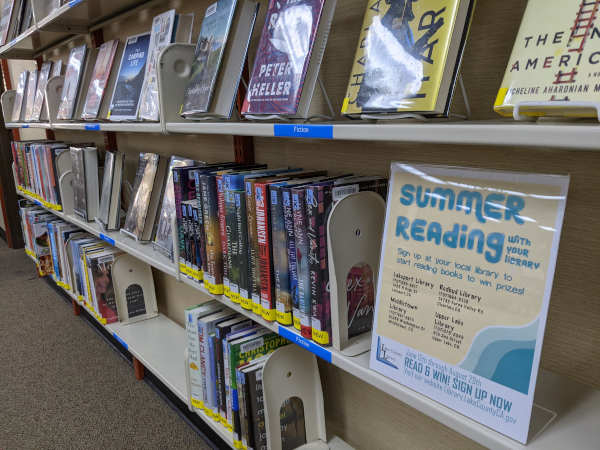
LAKE COUNTY, Calif. — The Lake County Library's annual Summer Reading Challenge begins Saturday, June 12.
By signing up for summer reading with the library, children, teens and adults will have the opportunity to win various prizes, including stickers, small toys, a Samsung tablet or gift cards to local businesses.
Participating in the library program is a fun way for residents to challenge themselves to read more over the summer.
For students, reading over summer break can prevent summer learning loss and help them start the next school year out on the right page.
The library has programs for pre-K, kids, teens and adults. Children who can't quite read on their own can still sign up and parents can record the books that they read together.
Once sign-ups start on June 12 residents can register on the Library's summer reading website. Registration is open at any time until summer reading ends on Aug. 29.
Anyone who wants to sign up can head to the library website at http://library.lakecountyca.gov and click “Summer Reading”.
Residents don't have to go online. They can also register and take part by visiting their local branch. All library branches have been open to the public since late March.
Once registered, participants can start reading books and get points by logging their reading, either online or by visiting the library. All reading counts, including eBooks, print books, audiobooks, comics, or whatever participants like to check out from the library and read.
Reading is its own reward, but the library offers prizes to make summer reading more fun. There will be prize drawings throughout the summer. The more points participants earn the greater chance they have to win. The Friends of the Lake County Library, a community nonprofit membership organization, provides all the prizes.
Once participants read enough to earn 1,000 points the Friends of the Lake County Library will donate a book to the library in their name. The book will have their name inside commemorating their reading achievement and they will be the first person to check it out.
Visit the Lake County Library Website at http://library.lakecountyca.gov.