 How to resolve AdBlock issue?
News
On Tuesday, the Lakeport Police Department said it received a report from two farmers' market vendors of receipt of counterfeit $100 bills.
The individuals who passed the bills were described as an adult male with a medium complexion in his 30s, wearing a gray tank top and gray sweatpants, with two lines tattooed under his right eye; and adult female with a light complexion, with one or more missing front teeth and an A-line hairstyle wearing a white and blue sundress.
The counterfeit bills collected were made to look like the new series $100 bills.
The community is asked to report any similar activity to the Lakeport Police Department or the nearest law enforcement jurisdiction.
Speeding violations will be the target of law enforcement in California, Arizona, Colorado, Idaho, Montana, North Dakota, Nevada, Oregon, South Dakota, Utah, Washington and Wyoming from Friday, June 25, through Sunday, June 27.
“Excessive speed and unsafe driving are a threat to everyone on the roadway,” said CHP Commissioner Amanda Ray. “The CHP and our allied state partners will be out in force this weekend with the common goal of saving lives through speed enforcement.”
The speed enforcement campaign follows a significant increase in speed-related incidents and traffic fatalities in 2020.
In California last year, more than 500 people were killed and more than 57,000 others were injured in crashes caused by unsafe speed.
Also last year, CHP officers issued more than 28,000 speeding citations to motorists driving in excess of 100 miles per hour — and 9,300 more during the first four months of 2021.
“Keep yourself and those on the road around you safe. Slow down and drive at a legal, safe speed,” added Commissioner Ray.
In addition to speed, officers will be looking for seat belt and child safety seat violations, evidence of distracted driving, and driving under the influence.
The CHP and the officers and troopers of its allied law enforcement agencies remind you to drive safely and report any emergencies or dangerous drivers by calling 911.
“It is the largest budget in the city’s history, primarily due to a lot of investment in capital projects,” said City Manager Alan Flora during an hour and a half long budget workshop that took place before the regular Thursday evening meeting, during which the council and staff looked over the final budget numbers.
“This is an historic budget,” Mayor Dirk Slooten said during the council meeting that followed.
The 2021-22 fiscal year budget includes $57.4 million in expenditures, $53.6 million in revenue and a general fund of just under $8 million.
Much of that influx of revenue — nearly three times the $18 million the city had budgeted for 2020-21 — is the result of grants and settlements that are flowing into the city’s coffers, Flora said in his report.
One of the key areas of focus for spending in the coming fiscal year will be infrastructure — including 15 miles of road work — which Slooten said is badly needed.
The 2021-22 budget calls for capital projects totaling $36 million. The funds to cover that spending include $14 million in settlement proceeds from litigation and nearly $14 million in Community Development Block Grant Disaster Recovery money for two large road rehabilitation projects in and around the Sulphur Fire area.
During the budget workshop, staff noted highlights including more than $1 million going into the city’s general fund reserves, which will now total $1.625 million.
Flora said it’s a long way from five or six years ago, when the city’s reserves were zero. He said the Government Finance Officers Association recommends having reserves of 5% to 15%; Clearlake’s reserves are now just over 20% of general fund reserves.
Those reserves are an important piece of the city’s fiscal stability, Flora said.
Flora said a lot of the story about this budget is about infrastructure — which is something he acknowledged that the city hasn't done a good job of building over the years.
The coming year’s infrastructure improvements are going to have what Flora called “a dramatic impact” on the city’s ongoing discretionary revenue streams because of things like the commercial development set to take place at the city’s former Pearce Field airport site, where the infrastructure improvements are expected to break ground in the spring. Such developments bring in key revenue such as sales tax.
But preparing for those projects requires the city to be financially prepared, Flora explained
“We have to make sure that we're on a strong fiscal foundation and that reserve adjustment’s a big piece of that,” Flora said.
He also noted that he’s very optimistic about the city’s position with its developments, with retail consultants telling them the biggest problem is that the city needs more land to develop.
“Right now the retail interest is hot and we need to take advantage of it,” said Flora.
Capital project investments in the budget include more than $7 million for the airport project and $4.1 for Lakeshore Drive, Flora said.
Most of the city wasn’t developed properly in the beginning. “We’re trying to create a real city after the fact,” with amenities people expect, Flora said.
During the workshop, the council heard from Clearlake Police Chief Andrew White, who has been doing double duty as both chief and the city’s finance director, who said the police department’s greatest challenge remains recruitment and retention.
It’s not just an issue for officers; White said they are struggling to get applicants for dispatcher jobs.
They’ve also lost one of their two animal control officers and are about to lose the second, so they are considering contracting with an outside organization for services as they have no interim coverage lined up, White said.
Another challenge for the city this year is a growth in insurance premiums.
City Clerk/Administrative Services Director Melissa Swanson said the general liability market is having instability.
That’s resulted in increases across the board, with lowered coverage and increased deductibles across many insurance pools, Swanson said.
She said the city is seeing premiums increase for general liability at a rate they haven’t seen since the 1980s, and they’re expecting more such increases in the 2022-23 fiscal year.
After having the extensive discussion of the budget during the workshop, the council item to approve the budgeting during the meeting that followed was brief.
Councilman Russ Cremer moved to approve the budget, with Councilman David Claffey seconding and the council voting 4-0. Councilman Russ Perdock was absent.
Slooten offered his thanks to staff for their work on the new budget.
Email Elizabeth Larson at
A total of $50,000 in cash prizes will be awarded to five local small businesses that compete in this year’s competition with prizes ranging from $4,000 to $20,000. Startups and small businesses are encouraged to apply.
This is the second year the nonprofit, 1Team 1Dream, has featured the project to support local entrepreneurs and small business owners. The goal of the nonprofit is to improve the struggling Lake County economy, one small business at a time.
The idea for the competition is the brainchild of Maryann Schmid, a local business woman who knows what it is to work hard to achieve success. Peter and Maryann Schmid own and operate the now thriving “Lodge At Blue Lakes,” in Upper Lake.
“It wasn’t always this way and it didn’t happen overnight, the place was in a sad state of disrepair when we discovered it,” said Maryann Schmid. “We had a dream — a vision and a plan to get there. It took two years of very hard physical labor and sleepless nights filled with the next day's work list before we could open for business, but we never gave up. We worked our plan, made adjustments along the way and today, we are living the dream.”
That spirit, along with a commitment to a plan for success is, in large part, what the judges will be evaluating in the competition.
“We’re also looking for the business model that takes into account the ups and downs of a sometimes fragile and unpredictable market,” said Laurie Dohring, one of last year's judges. “It sounds complicated, but it really isn’t because the businesses selected to proceed will get help.”
Preparing for the competition begins with a one-day workshop. Selected applicants participate in this training and a “mini” competition from which the finalists are selected.
Finalists will receive personalized coaching and training to prepare their “pitch” to business leaders who will judge the competition and make the final decisions.
“It’s what sets this business competition apart from others — the investment in the applicants. Win or lose, the idea is to learn the basics of creating a strong, sustainable business model,” said Dohring.
This year’s business competition is possible through the support of several donors who see the value of investing in local small businesses.
“We are thankful to our major sponsors who will present the cash awards at the final competition and gala on Dec. 12, including the city of Clearlake, The Lodge At Blue Lakes, Foods, Etc., the city of Lakeport and Lake County Tribal Health,” said co-founder Olga Steele.
"Last year we distributed $28,250 to six small businesses with prizes ranging from $15,000 to $1,000. Despite the challenge of a pandemic, our first business competition was a smashing success,” said Steele.
This year the stakes are higher with prizes of $20,000, $12,000, $8,000, $6,000 and $4,000, Steele said.
Any local startup or small business is eligible to apply, including last year's applicants, except the 2020 winners.
The online application can be found at https://1team1dream.net/. Questions can be submitted via the contact section on the site or by calling Steele at 916-849-8170.
The commission will meet virtually beginning at 6 p.m. Tuesday, June 22.
The agenda can be found here.
Submit comments and questions in writing for commission consideration by sending them to
Community members also can participate via Zoom.
To give the planning commission adequate time to review your questions and comments, please submit written comments prior to 6 p.m. Tuesday, June 22.
The meeting will be broadcast live on the Youtube channels for the city of Clearlake or Lake County PEG TV.
On Tuesday, the commission will be asked to consider the appeal of Jamie Fielden, who is seeking an administrative use permit to exceed the total allowed square footage for an accessory structure on property located at 3006 Old Highway 53 and a finding that it’s exempt from environmental review.
Fielden is proposing to install a 3,000-square-foot prefabricated garage for personal storage purposes only.
The staff report explained that a public hearing was held on April 26 and, “based on significant concerns from neighboring property owners and lack of corresponding participation from the applicant – the application was denied.”
An appeal was filed on May 13, six days after the deadline for submission, staff reported.
In her appeal, Fielden said she did not receive the notice because it was sent to an incorrect address.
She said the garage will be used to store personal vehicles.
The commission’s members are Chair Kathryn Davis, Vice Chair Robert Coker and commissioners Lisa Wilson, Erin McCarrick and Fawn Williams.
Email Elizabeth Larson at
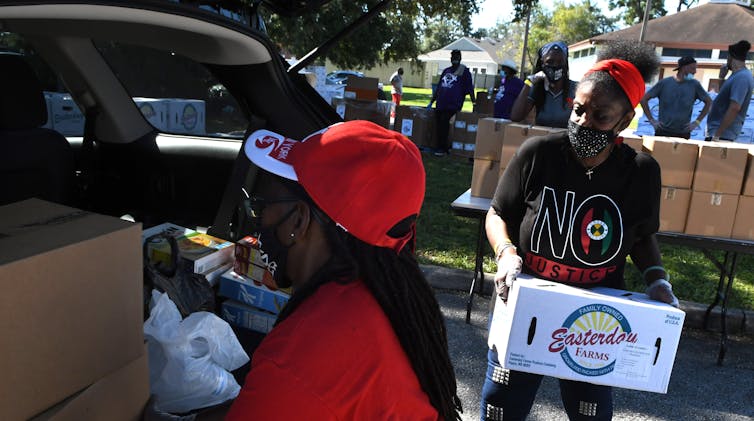
A flood of donations to support COVID-19 relief and racial justice efforts, coupled with stock market gains, led Americans to give a record US$471 billion to charity in 2020.
The total donated to charity rose 3.8% from the prior year in inflation-adjusted terms, according to the latest annual Giving USA report from the Giving USA Foundation, released in partnership with the Indiana University Lilly Family School of Philanthropy at IUPUI. In contrast, total charitable giving only grew 2.8% in 2019 – a year of economic expansion and stock gains, we have found.
As two of the lead researchers who produced this report, we observed that giving bucked historical trends in three ways. The total increased despite a recession; foundations’ giving surged; and gifts to a variety of nonprofits providing social services, supporting people in need and protecting civil rights grew the most.
1. A good year for giving during a recession
Typically, giving declines or stays flat during recessions.
One reason why giving rose in 2020, even though the economy contracted, was that stocks notched gains by the end of the year.
Economists have found that donors give more to charity when the stock market fares well. But stocks usually decline during recessions.
2. Foundations and individuals stepped up
Soon after the COVID-19 pandemic began, many foundations pledged to increase their grantmaking. Based on our findings, it looks like they kept their word: Foundation giving rose 15.6% to a record $88.55 billion in 2020, after adjusting for the effects of inflation.
Strong stocks also bolstered giving by foundations, which support a wide array of charitable activities by making grants. They are required by law to annually give away 5% of the average value of their assets, often held in endowments. As their stocks and other holdings grow, that 5% gets larger too.
Stock gains may have also boosted giving by American households, the source of about two-thirds of all charitable dollars, which grew 1% to set another inflation-adjusted record of $324 billion.
In particular, America’s billionaires became an estimated $1.2 trillion richer in 2020.
While giving by the wealthiest Americans – especially novelist and philanthropist MacKenzie Scott – often dominated the headlines, giving by individuals wasn’t limited to large-scale gifts. One report found that the total raised from gifts under $250 grew more than larger donations. Another study found that one-time online gifts to organizations that provided COVID-19 relief grew by 41%.
At the same time, corporate philanthropy, which our colleagues in the past have found to be closely linked to economic performance and the profits companies earn, actually fell 7.3%. While certain industries, such as technology, grew in 2020, many others, including travel, hospitality and transportation, experienced losses.
3. Uneven experiences for different kinds of nonprofits
In addition to addressing the coronavirus pandemic and the unemployment spike it caused, American individuals and foundations responded to calls regarding racial justice.
Food banks, homeless shelters, youth programs and other organizations that meet basic needs, collectively known as human services groups, received an outpouring of support in 2020. Those donations grew 8.4%, in inflation-adjusted dollars, to $65 billion. This additional giving responded to the COVID-19 pandemic and the economic troubles it brought about, as well as broad calls for racial justice.
Giving to public-society benefit organizations grew the most, a 14.3% increase to $48 billion. This broad category includes the United Way and its local branches, which pool donations raised in workplaces, from corporations and other sources. It also includes donor-advised funds, accounts through which donors can direct gifts to charities, and community development financial institutions, private-sector financial operations that boost local borrowers. Civil rights and voting rights groups also fall into this category.
However, organizations that rely on in-person events and services – such as operas and museums, as well as charity walks, runs and other peer-to-peer fundraising events that raise money to fight diseases – overall fared worse in 2020 compared to 2019. That could help explain the 8.6% decline in giving to the arts, culture and humanities sector as well as why giving to health-related organizations fell by 4.2% amid the pandemic.
In addition, some large gifts that funded COVID-19 research, such as the W.M. Keck Foundation’s $6 million in donations to the University of Southern California, count as giving to education, not giving to health.
What’s more, all nine categories that we track received gifts slated for COVID-19 relief and racial justice causes.
We also feel it’s important to observe that more than half of all Americans responded to the upheaval of 2020 with an outpouring of generosity, which they expressed in many ways besides donating money to charities.
When physical distancing became essential, Americans went out of their way to buy meals-to-go to support local restaurants, paid their hairdressers when their salons were closed and volunteered either formally or by simply helping their neighbors out. In addition, many Americans gave directly to others through crowdfunding platforms and other apps, which are particularly popular for younger people and people of color. While our research focuses on giving to charities, these new habits may indicate a broader move toward generosity on the horizon.
Together with our colleagues, we will continue to investigate whether these new patterns will continue in 2021 and beyond.
[You’re smart and curious about the world. So are The Conversation’s authors and editors. You can read us daily by subscribing to our newsletter.]
Anna Pruitt, Researcher and Managing Editor, Giving USA, IUPUI and Jon Bergdoll, Applied Statistician of Philanthropy, IUPUI
This article is republished from The Conversation under a Creative Commons license. Read the original article.