 How to resolve AdBlock issue?
News

Early in the pandemic, it was expected that satellite imagery around the world would show cleaner air as a result of COVID-19 lockdowns.
But not all pollutants were taken out of circulation. For tiny airborne-particle pollution, known as PM 2.5, researchers using NASA data found that variability from meteorology obscured the lockdown signals when observed from space.
“Intuitively you would think if there is a major lockdown situation, that we would see dramatic changes, but we didn't,” said Melanie Hammer, a visiting research associate at Washington University in St. Louis who led the study. "It was kind of a surprise that the effects on PM 2.5 were modest.”
PM 2.5 describes the mass of nose-level particles, often produced anthropogenically, that are smaller than 2.5 micrometers, or roughly 30 times smaller than the width of a human hair. PM 2.5 is small enough to linger in the atmosphere, and, when inhaled, is associated with increased risk of heart attack, cancer and a host of other implications for human health.
By combining NASA spacecraft data with ground-based monitoring and an innovative computer modeling system, the scientists mapped PM 2.5 levels across China, Europe and North America during the early months of the pandemic.
The researchers found seasonal differences in PM 2.5 between recent years were driven primarily by the natural variability of the meteorology, not by pandemic lockdowns.
Published June 23 in the journal Science Advances, the new research integrates data from NASA’s Terra and Aqua satellites, as well as meteorological modeling input from the NASA Global Modeling and Assimilation Office.
The meteorological effects analyzed in the study include changes in the sources of mineral dust, the way pollutants react to sunlight in the atmosphere, mixing and heat transfer, as well as the removal of pollutants from the atmosphere by precipitation.
PM 2.5 is among the most complicated pollutants to study because its particle size, composition and toxicity vary greatly depending on its source and environmental conditions.
A gas pollutant known as nitrogen dioxide, or NO2, did see dramatic declines during the lockdowns. A major byproduct of fuel burning by trucks, cars and other vehicles, the decline of nitrogen dioxide was visible from space and from the ground. Images of clear, blue skies where heavy smog had been the norm flooded popular news and social media, suggesting COVID-19 has drastically decreased all pollution in general.
When nitrogen dioxide is emitted, it can also interact with other chemicals in the atmosphere and form PM 2.5. However, the two pollutants do not have a linear relationship. Half as much nitrogen dioxide in the atmosphere does not necessarily lead to half as much PM 2.5 produced by nitrogen dioxide.
Because PM 2.5 often comes from the same sources as NO2, the researchers also began to question whether the lockdowns resulted in a decline of PM 2.5.
Early pandemic studies of PM 2.5 changes analyzed data from ground monitoring sites, which test the surrounding air. But because those ground sites are few and far between, their data alone are unable to piece together the bigger picture of PM 2.5 concentrations in the air, Hammer said.
“We were most interested in looking at changes in PM 2.5 because PM 2.5 is the leading environmental risk factor for premature mortality globally,” Hammer said. “We decided to look again, using a more complete picture from satellite images.”
The study was co-led by Randall Martin at Washington University in St. Louis, who pioneered research integrating modeling and remote sensing to study atmospheric pollutants such as PM 2.5.
“Many countries in the world have no operational PM 2.5 monitoring at all,” Martin said. “These tools enable insight into ground level PM 2.5 at the global or regional scale.”
To ensure a comprehensive analysis, the team focused on regions with extensive ground monitoring systems in place and compared monthly estimates of PM 2.5 from January to April in 2018, 2019 and 2020.
When the researchers compared PM 2.5 levels over the three years during the months that coincided with each region's lockdown phases, there weren’t many clear signals over North America or Europe. The most significant lockdown-related differences were detected in China.
“We found the most clearly detectable signal was a significant reduction over the North China Plain, where the strictest lockdowns were concentrated,” Hammer said.
To figure out whether the lockdown was responsible for that signal, and several smaller ones dotted around the areas surveyed, the team ran different “sensitivity simulations” using GEOS-Chem, a chemical transport model to which Martin’s team helps lead.
They simulated a scenario where anthropogenic emissions of nitrogen dioxide were held constant and meteorological variability was solely responsible for year over year differences in PM 2.5 during the key lockdown months.
They also ran simulations in which they reduced transportation-related emissions and other anthropogenic sources of nitrogen dioxide, mirroring lockdown, when fewer people were driving and fewer industrial sites were operational.
They found the simulation where both meteorology and transportation effects were included most closely mirrored the real-world situation.
“Tackling PM 2.5 is a very complex issue, and you have to take into account its multiple sources, not just the fact that fewer people are on the road,” Hammer said. “Just decreasing transportation emissions would not be enough to account for the complexity of the problem.”
Most satellites sample the atmosphere through vertical columns spanning the ground to the edge of space. Identifying the concentrations of airborne particles near the surface, where they affect air quality, cannot be determined from these satellites alone.
The satellite data used in this study, referred to as aerosol optical depth, were related to surface PM 2.5 concentrations using GEOS-Chem, which simulates the composition of the atmosphere, the reactions and relationships among its different components, and the way they move horizontally as well as vertically through the air.
The model is a sophisticated tool that helps paint a more complete picture of air quality, said Ralph A. Kahn, senior research scientist at NASA’s Goddard Space Flight Center in Greenbelt, Maryland and adjunct professor at University of Maryland in College Park.
“The bigger story is actually the global characterization of air quality, especially in places where there aren't surface monitors,” said Kahn, who was part of the study. “The satellites provide an important piece of it, the models provide an important piece of it, and the ground-based measurements make an important contribution as well.”
Hammer suspects the change in PM 2.5 levels over the North China Plain was more apparent because of the region’s higher pollution levels during “normal” times.
The new insights also highlight a relevant point that may not at first be intuitive: Average PM 2.5 levels have been dropping steadily in North America and Europe. Pollution concentrations that are already low are more difficult to change, Hammer said.
Brandie Jefferson works for Washington University in St. Louis.

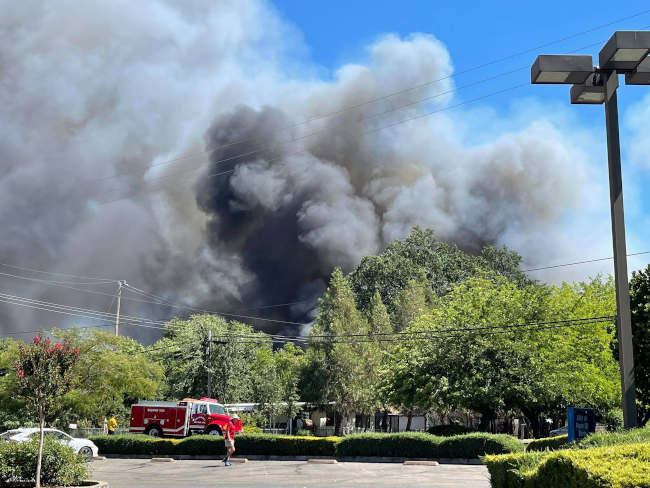
KELSEYVILLE, Calif. — On Saturday evening firefighters were continuing to mop up after a fire that began in the afternoon and burned several structures in downtown Kelseyville.
The Church fire was first dispatched at 3:05 p.m., with forward progress stopped at 4:29 p.m., said Cal Fire Battalion Chief Mike Wink.
It was initially reported on Church at Fifth street, later moving along Third Street, just a block over from Main Street.
Kelseyville Fire Chief Joe Huggins, the incident commander, said the fire destroyed two homes and two outbuildings, one of which was a large garage with two vehicles inside of it.
The structures that burned were next door to Kelseyville Presbyterian Church.
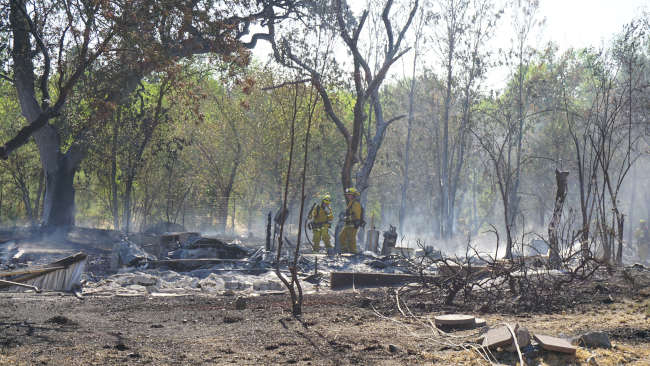
The fire burned in the creekbed behind Kelseyville Presbyterian, where incident command was located, and was within about 50 feet of the manse, the original church building.
Huggins said the fire burned approximately 3.4 acres.
No injuries were reported, Huggins said.
Shortly after the incident was dispatched, arriving firefighters reported multiple structures were on fire and power lines were down, and evacuations were ordered for all of Church Street.
Incident command ordered all of Church Street to be evacuated within 10 minutes of dispatch, and at 3:40 p.m. ordered mandatory evacuations from Main Street to Highway 29, with Live Oak Drive to First Street placed under evacuation advisory.
Huggins said they had been prepared to extend the advisory evacuation zone to all of Kelseyville proper, which didn’t turn out to be necessary as engines rolled in from around the county to control it.
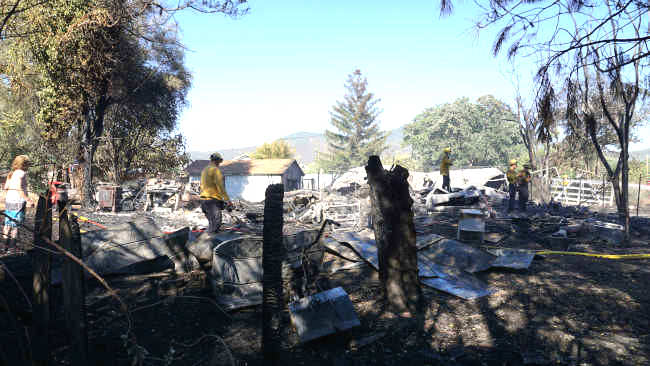
Engines, water tenders and rescue units responded not just from Kelseyville Fire and Cal Fire but from Lake County Fire, Lakeport Fire and Northshore Fire, Huggins said.
Pacific Gas and Electric also responded to the scene due to the reports of downed power lines by arriving firefighters.
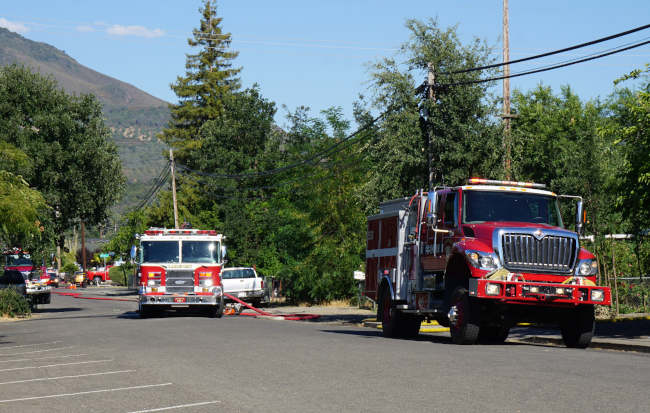
The Lake County Sheriff’s Office and California Highway Patrol were on scene to assist with evacuations and traffic control on Church Street, which was closed off for several hours as fire hoses snaked along the street from hydrants to the fire’s location.
After the fire was controlled, firefighters continued mopping up and putting out hot spots near the creek and around the burnout remains of the destroyed structures.
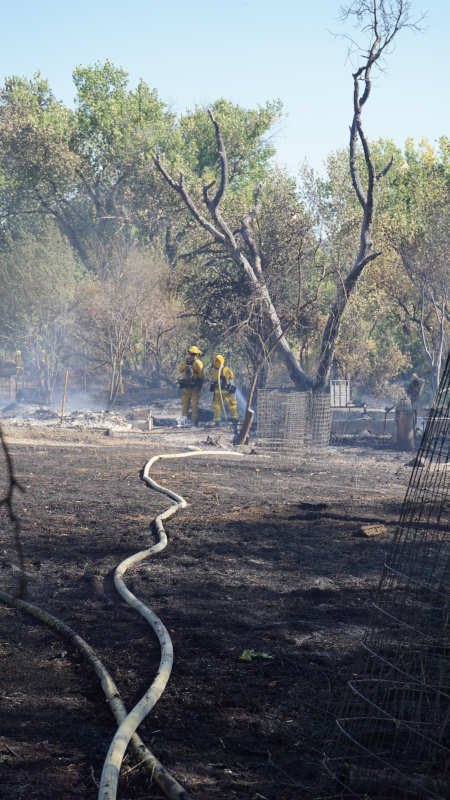
The evacuations were called off just before 6 p.m., Huggins said.
Huggins anticipated mop up and overhaul would continue into Saturday night.
As for the fire’s cause, “We don’t know yet,” said Huggins,
He said investigators had been on scene to try to determine the cause.
Email Elizabeth Larson at
This article is being updated with new information.
LAKE COUNTY, Calif. — A Saturday afternoon structure fire is spreading through Kelseyville, prompting evacuations.
The Church fire was first reported shortly after 3 p.m. in the area of Fifth and Church streets near downtown Kelseyville.
The fire was reported as a structure fire that spread into vegetation, with the first units on scene reporting that a quarter-acre of vegetation and a structure were fully involved, according to radio traffic.
In less than 10 minutes from dispatch, firefighters reported multiple structures were on fire and power lines were down, and evacuations were ordered for all of Church Street.
Shortly after 3:30 p.m., a spot fire was reported to have jumped to the area of Third Street
Just before 3:40 p.m., incident command ordered evacuations from Main Street to Highway 29, with Live Oak to First Street placed under evacuation advisory.
Resources at the scene just before 4 p.m. included six engines and a rescue unit, with another engine and water tender en route. Cal Fire also put out a call to other fire agencies across the county for fire equipment.
Forward progress was reportedly stopped at around 4:30 p.m.
Additional information will be published as it becomes available.
Email Elizabeth Larson at
The warning is in effect from 2 p.m. Saturday to 9 p.m. Tuesday due to dangerously hot conditions that could reach 110 degrees in Northern California.
The National Weather Service’s forecast said an “exceptionally strong dome of high pressure” that’s persisting over much of the Western United States through next week is bringing the very hot temperatures.
The Lake County forecast anticipates daytime temperatures across the county of 103 degrees on Saturday, 102 on Sunday, 100 on Monday, 102 on Tuesday, 103 on Wednesday and 97 degrees on Thursday.
It will be warm at night, with temperatures forecast to hover in the high 50s and low 60s.
The National Weather Service urges people to take special precautions during this coming heat wave, noting that heat is the leading cause of weather-related fatalities over a 30-year average from 1991 to 2020.
Stay hydrated, don’t stay outdoors for long periods of time and remain in air-conditioned rooms.
For a list of some of the places in Lake County to stay cool, click here.
Email Elizabeth Larson at
Lake County’s four Public Library branches are open during their normal business hours and Behavioral Health Services’ peer support centers also are open as a refuge from the heat.
The library branches and peer support centers are not formal cooling centers, and capacity is limited, but they are a valuable community resource when temperatures climb.
At the peer support centers, water and snacks will be offered, and restrooms are available. Referrals to social services will also be made. All are welcome.
While you cool off at the libraries, check out the many new materials and digital services the libraries have to offer.
If you are planning to visit, be advised face coverings are required for people that are not vaccinated. Library visitors self-attest they are fully vaccinated by entering the building with no mask on.
Below is a list of Lake County Library locations and their hours of operation, and the peer support centers.
Lake County libraries
Lakeport Library
1425 N. High St.
707-263-8817
Tuesday, 10 a.m. to 5 p.m.
Wednesday, 10 a.m. to 7 p.m.
Thursday through Saturday, 10 a.m. to 5 p.m.
Redbud Library (Clearlake)
14785 Burns Valley Road
707-994-5115
Tuesday, 10 a.m. to 5 p.m.
Wednesday, 10 a.m. to 7 p.m.
Thursday through Saturday, 10 a.m. to 5 p.m.
Middletown Library
21256 Washington St.
707-987-3674
Tuesday through Saturday, 10 a.m. to 5 p.m.
Upper Lake Library
310 Second St.
707-275-2049
Tuesday through Friday, noon to 5 p.m.
Saturday, 10 a.m. to 3 p.m.
Peer support centers
The Big Oak Peer Support Center
13340 East Highway 20, Suite “O”
Clearlake Oaks
707-998-0310
Monday through Friday, 8:30 a.m. to 4:30 p.m.
Weekends, noon to 4 p.m.
Circle of Native Minds Cultural Center
845 Bevins St.
Lakeport
707-263-4880
Monday through Friday, 8:30 a.m. to 4:30 p.m.
The Harbor on Main
154 South Main St.
Lakeport
707-994-5486
Monday through Friday, 8:30 a.m. to 4:30 p.m.
La Voz de la Esperanza Centro Latino
14092 Lakeshore Drive
Clearlake
707-994-4261
Monday through Friday, 8:30 a.m. to 4:30 p.m.
Weekends, noon to 4 p.m.
Family Support Center
21389 Stewart St., Suite “E”
Middletown
707-987-9601
Monday through Friday, 8:30 a.m. to 4:30 p.m.
The three-party agreement on AB 832 — which extends the current eviction moratorium through Sept. 30, 2021 — will ensure that California quickly uses the more than $5 billion in federal rental assistance to help the state’s tenants and small landlords and protect vulnerable households from eviction.
The agreement widens rental assistance by enhancing current law.
Provisions include increasing reimbursement to 100% for both rent that is past due and prospective payments for both tenants and landlords.
Additionally, the bill ensures rental assistance dollars stay in California by prioritizing cities and counties with unmet needs, and uses the judicial process to ensure tenants and landlords have attempted to obtain rental assistance.
Gov. Newsom said the economic impacts of COVID-19 continue to disproportionately impact so many low-income Californians, tenants and small landlords alike. He said he was thankful for the Legislature’s action and looked forward to signing the bill into law as soon as he received it.
“Our housing situation in California was a crisis before COVID, and the pandemic has only made it worse — this extension is key to making sure that more people don’t lose the safety net helping them keep their home,” said Senate President pro Tempore Toni Atkins (D-San Diego). “While our state may be emerging from the pandemic, in many ways, the lingering financial impact still weighs heavily on California families. People are trying to find jobs and make ends meet and one of the greatest needs is to extend the evictions moratorium — which includes maximizing the federal funds available to help the most tenants and landlords possible — so that they can count on a roof over their heads while their finances rebound.”