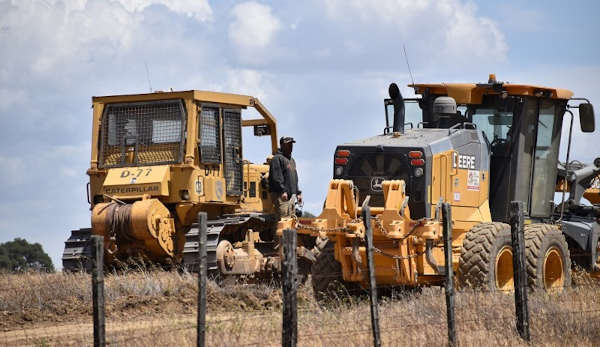
Two huge tractors create a wildfire break along a fence line on California Department of Fish and Wildlife property in Merced County, California. Courtesy photo. The California Department of Fish and Wildlife has undertaken the largest wildfire protection and resiliency effort in its history, working to safeguard nearly all of its wildlife areas, ecological reserves and the surrounding communities from wildfire ahead of peak wildfire season this summer and fall.
Wildfire resiliency work is underway at dozens of CDFW-owned properties statewide. These efforts include creating fire breaks, removing brush and other wildfire fuel, thinning overgrown vegetation, expanding livestock grazing and conducting controlled burns when conditions safely permit.
The unprecedented undertaking is the result of SB 85, the “Wildfire Forest and Resilience Early Action Package,” state legislation signed by Gov. Gavin Newsom in April that authorized $536 million in wildfire protection and resiliency spending in the current fiscal year.
CDFW is budgeted to receive $15 million of those funds to better protect its lands, which total about 1 million acres. Additional wildfire funding is expected in the 2021-22 state budget.
“This is a huge moment for the department, and we’re really striving for smart projects that will benefit wildlife habitats and the communities surrounding department lands,” said Stafford Lehr, CDFW deputy director for Wildlife and Fisheries. “We’ve already identified more than 40 projects, many of which have been started and a few already completed. We’ll be able to hire some new people and buy some new equipment that will not only help protect our own properties but better protect our neighbors as well. In many instances, this wildfire work has the added benefit of improving native plant and wildlife habitat on our properties.”
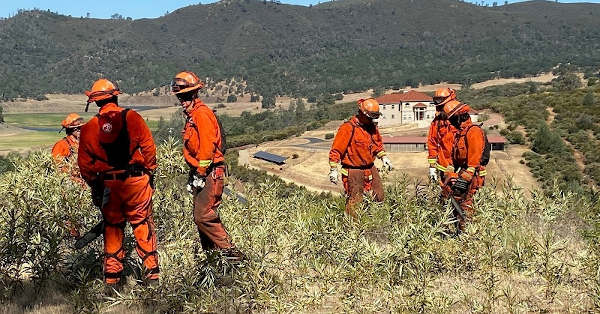
Cal Fire inmate crews work to clear brush at the Pine Hill Ecological Reserve in El Dorado County, California. Courtesy photo. Among the CDFW wildfire resiliency projects planned or currently underway:
— At the Butte Valley Wildlife Area in Siskiyou County, a 30-acre controlled burn was recently completed with another 50 acres of burning planned for upland habitat once temperatures cool. — At the Pine Hill Ecological Reserve in El Dorado County, CAL FIRE crews have begun thinning dense stands of manzanita, creating pathways for botanical surveys and preparing a 100-foot fire break along bordering roadways. Controlled burns are planned for the fall and winter when conditions safely permit. The work is expected to benefit several rare and listed plant species found in the ecological reserve. — At the Cosumnes River Preserve in Sacramento County, CDFW is preparing its properties and working with other landowners such as The Nature Conservancy to accommodate more livestock grazing. CDFW is installing new, wildlife-friendly fencing on its pastureland to accommodate cattle. Cattle will help reduce grassland fire threat and make the pastures more appealing for migrating sandhill cranes and white-fronted geese. Other parcels in more-forested and dense areas of the 55,000-acre preserve are being prepared for the arrival of sheep and goats. — At the Santa Rosa Plain Vernal Pool Ecological Reserve in Sonoma County, CDFW is mowing firebreaks around the ecological reserve border to prevent wildfire spread into adjacent neighborhoods. Sonoma County has experienced devastating wildfires in recent years. — At the Cottonwood Creek Wildlife Area and the San Luis Reservoir Wildlife Area in Merced County, CDFW created a fire break along both sides of Highway 152, which traverses both wildlife areas. In addition to the wildlife areas, the fire break will help protect 6,000 acres of neighboring agricultural land and residential property along with Pacheco State Park. — The Slinkard/Little Antelope Wildlife Area in Mono County suffered extensive wildfire damage in 2020. Approximately, 3,800 acres of the 11,700-acre wildlife area burned, including one building. CDFW will remove the burned-out structure and initiate habitat restoration that will benefit migrating deer among other species. — Mowing has begun at the 6,100-acre Hollenbeck Canyon Wildlife Area in San Diego County to thin excess vegetation and lessen the wildfire threat along the bordering Highway 94. The area has a history of wildfires and mowing will help fire crews better access the property in the event of a future wildfire.
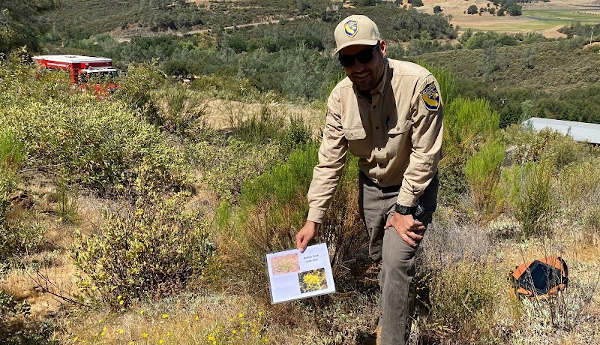
California Department of Fish and Wildlife Environmental Scientist John Watkins holds an image of a rare yellow plant at the Pine Hill Ecological Reserve in El Dorado County next to the actual plant growing in the ground. Courtesy photo.
CLEARLAKE, Calif. — Clearlake Animal Control has many dogs of various breeds waiting for new families.
The following dogs are ready for adoption or foster. The newest dog is listed at the beginning of the list.
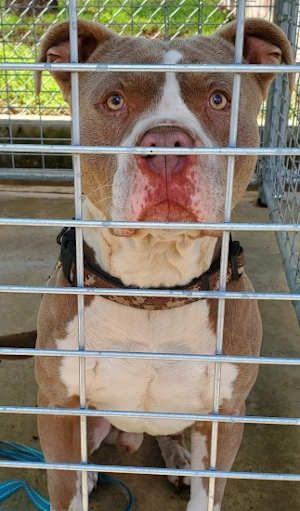
“Bear.” Photo courtesy of Clearlake Animal Control. ‘Bear’
“Bear” is a male American Staffordshire terrier mix with a short brown coat.
He has been neutered.
He is dog No. 3476.
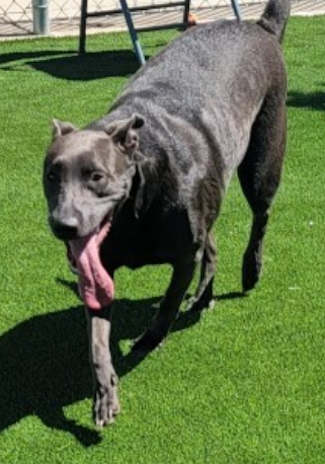
“Cleo.” Photo courtesy of Clearlake Animal Control. ‘Cleo’
“Cleo” is a female Doberman pinscher mix with a short gray coat who is new to the shelter.
She has been spayed.
She is dog No. 4865.
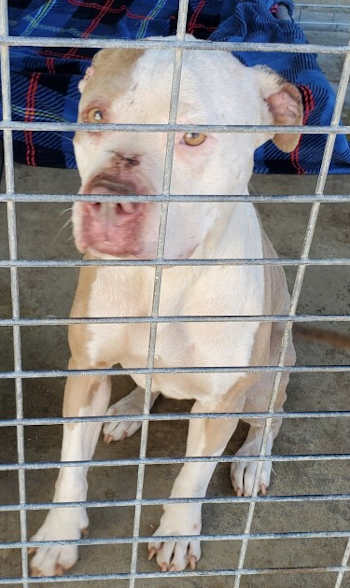
“Dusty.” Photo courtesy of Clearlake Animal Control. ‘Dusty’
“Dusty” is a male American Pit Bull Terrier with a tan and white coat.
He is dog No. 4750.
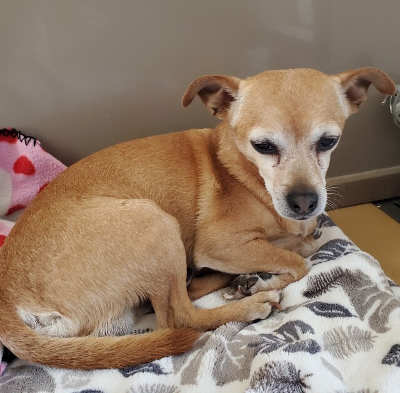
“Girly.” Photo courtesy of Clearlake Animal Control. ‘Girly’
“Girly” is a senior female Chihuahua mix.
She has a short tan coat.
Girly is house-trained.
“Gizmo.” Photo courtesy of Clearlake Animal Control. ‘Gizmo’
“Gizmo” is a senior male Chihuahua mix with a short tan and white coat.
He is dog No. 4902.
“Ike.” Photo courtesy of Clearlake Animal Control. ‘Ike’
“Ike” is a senior male Chihuahua.
He has a short tan coat.
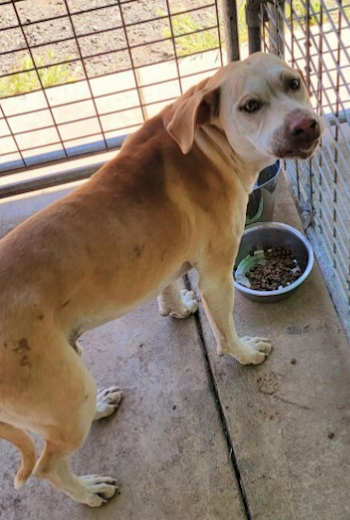
“Lucky.” Photo courtesy of Clearlake Animal Control. ‘Lucky’
“Lucky” is a male Labrador retriever mix with a short yellow coat.
He is dog No. 4908.
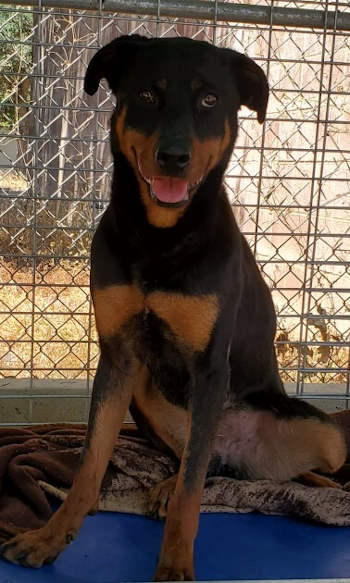
“Mara.” Photo courtesy of Clearlake Animal Control. ‘Mara’
“Mara” is a female Rottweiler mix.
She has a short black and tan coat.
He is house-trained.
“Mary J.” Photo courtesy of Clearlake Animal Control. ‘Mary J’
“Mary J” is a female pit bull terrier mix.
She has a white and tan coat.
She is house-trained.
“Mitzy.” Photo courtesy of Clearlake Animal Control. ‘Mitzy’
“Mitzy” is a female shepherd mix with a medium-length black and white coat.
She is dog No. 4648.
“Mojo.” Photo courtesy of Clearlake Animal Control. ‘Mojo’
“Mojo” is a male Chihuahua mix with a short black and tan coat.
He has been neutered.
He is dog No. 4881.
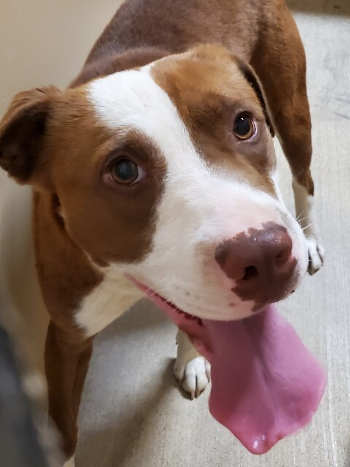
“Oakley.” Photo courtesy of Clearlake Animal Control. ‘Oakley’
“Oakley” is a male pit bull terrier mix.
He has a short red and white coat.
“Patches.” Photo courtesy of Clearlake Animal Control. ‘Patches’
“Patches” is a male Chihuahua mix with a short tricolor coat.
He is dog No. 4903.
“Tanisha.” Photo courtesy of Clearlake Animal Control. ‘Tanisha’
“Tanisha” is a female shepherd mix with a short orange and white coat.
She is dog No. 4647.
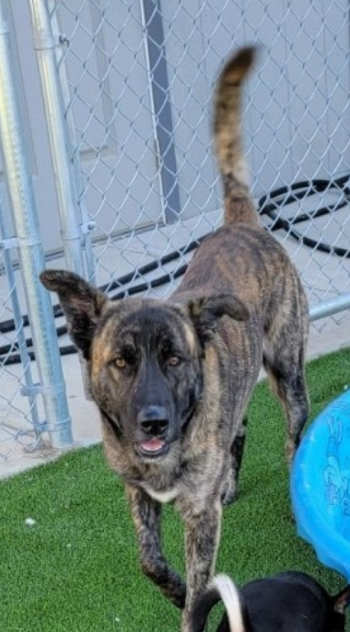
“Terry.” Photo courtesy of Clearlake Animal Control. ‘Terry’
“Terry” is a male Dutch shepherd mix with a smooth brindle coat.
He is dog No. 4880.
Call the Clearlake Animal Control shelter at 707-273-9440, or email This email address is being protected from spambots. You need JavaScript enabled to view it. to inquire about adoptions and schedule a visit to the shelter.
Visit Clearlake Animal Control on Facebook or on the city’s website.
Email Elizabeth Larson at This email address is being protected from spambots. You need JavaScript enabled to view it.. Follow her on Twitter, @ERLarson, or Lake County News, @LakeCoNews.
What's up for July? The “Evening Star” beckons, and in search of the Milky Way.
Sunsets in July come with an added bonus: a brilliant gem low in the western sky, calling to us to come and explore its many mysteries. This is the planet Venus. It's our cosmic next-door neighbor — that is, the planet with the closest orbit to the orbit of Earth.
It's also often thought of as Earth's sister planet, given that it's also a rocky world of the same size, though Venus developed into a hellishly hot world, where Earth became the cool, blue planet we know and love.
Venus is sometimes referred to as “the Morning Star,” or “the Evening Star,” depending on whether it's visible around sunrise or sunset. This month, it's the latter, and you'll find Venus low in the west together with a faint planet Mars beginning about half an hour after sunset.
In fact, you can watch each evening as Venus and Mars get closer, culminating with a close conjunction on July 12, when they'll be only a finger's width apart. Look for them together with a slim, crescent Moon that's only 10% illuminated.
In June, NASA announced that two new space missions would be heading to Venus beginning later in the decade. VERITAS and DAVINCI+ will investigate the planet's surface and atmosphere, returning incredible images, maps, and other data, likely rewriting our understanding of how Earth's sister planet became so inhospitable, along with how it might still be active today.
They'll be joined by the European spacecraft EnVision, for what's sure to be an exciting new chapter in solar system exploration.
July is one of the best times of year to enjoy the magical sight that is the Milky Way. This is our view of our spiral galaxy, seen edge on, from within.
Now, some part of the Milky Way is visible in the night sky any time of year, but the galaxy's bright, complex core is only observable during certain months.
Earlier in the season, you have to wait until the wee hours of the morning for the core to rise in the sky. But in June and July, the core has already risen by the time it's fully dark, and can be seen fairly well til around 2 a.m. when it starts to set.
Now, the Milky Way is faint, and to see it, you'll need to find your way out to fairly dark skies, but as long as you're below about 55 degrees north latitude, you should be able to observe the Milky Way core under dark skies. (Southern Hemisphere observers have it even better, as the core appears much higher overhead there.)
One super important tip is to avoid the full moon and the days close to it, since a bright Moon overwhelms the faint glow of the Milky Way.
The three or four nights around the new moon are best, but the week before and after is also OK — you just have to note when the Moon will be rising or setting.
There are a variety of great apps and websites to help you find dark skies and figure out when and where to look. So here's hoping you get out there and experience one of the most fantastic sights the sky has to offer.
You can catch up on all of NASA's missions to explore the solar system and beyond at www.nasa.gov.
Preston Dyches is with NASA's Jet Propulsion Laboratory.
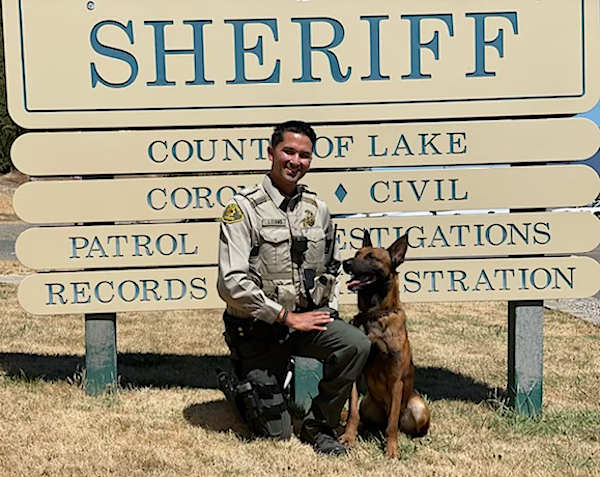
Lake County Sheriff’s Deputy Joe Lyons and his new K-9 partner, Rex, a 2-year-old Belgian Malinois. Photo courtesy of the Lake County Sheriff’s Office. LAKE COUNTY, Calif. — The Lake County Sheriff’s Office has a new K-9.
Rex, a 2-year-old Belgian Malinois, has been assigned to Deputy Joe Lyons, said Lt. Rich Ward.
Ward said Lyons and Rex just completed a six-week-long, 240-hour basic handler course at Adlerhorst International in Jurupa Valley.
Lyons and Rex will be assigned to the Enforcement Division and provide a variety of services to the community, Ward said.
Rex is trained for handler protection, tracking, searching and suspect apprehension, and Ward said Rex and Lyons can provide school and public demonstrations.
Despite the serious nature of his work, Rex is “a sweetheart,” said Ward.
Ward told Lake County News that Rex is now the second K-9 on duty with the sheriff’s office. The other K-9 is a black Labrador retriever named Raider who is used for narcotics detection.
“We just retired one of our narcotics trained yellow labs at the age of 10, but hope to get another protection trained canine as soon as staffing will permit,” hopefully in the early spring of 2022, Ward said.
The Lake County Sheriff’s Office K-9 Unit is funded through a variety of revenue sources which Ward said include asset forfeiture, fundraising events, and donations from citizens and community stakeholders.
Email Elizabeth Larson at This email address is being protected from spambots. You need JavaScript enabled to view it.. Follow her on Twitter, @ERLarson, or Lake County News, @LakeCoNews.
LAKE COUNTY, Calif. — The Lake County Registrar of Voters Office is ready to begin preparations for the recall election against the governor that the state has set for September.
On Thursday, Secretary of State Shirley Weber sent Lt. Gov. Eleni Kounalakis the certification of the petition to recall Gov. Gavin Newsom, with two available dates for the election — Aug. 31 and Sept. 14.
Later in the day, Kounalakis announced Sept. 14 had been selected for the California Gubernatorial Recall Election.
Now, prospective candidates have until July 16 to file their declaration of candidacy, nomination papers and statement of economic interests. Nearly 70 people so far have announced their intention to run.
Newsom is only the second governor, after Gray Davis in 2003, to face a recall election.
Weber reported to Kounalakis that of the 2,161,349 signatures submitted, 1,719,900 were determined to be valid.
The California Department of Finance reported the estimated state and county costs to administer the recall election total $276 million.
The Secretary of State’s Office reported that 3,249 signatures were received in support of the recall from Lake County. Of those, 2,422 were determined valid and 827 invalid.
Statewide, only 43 signatures were withdrawn from the recall petitions during the withdrawal period of April 26 to June 8. None were withdrawn in Lake County, the state reported.
Lake County Registrar of Voters Maria Valadez told Lake County News that her office will be receiving guidance from the Secretary of State’s Office on the recall election, “and I am sure they will address COVID-19.”
“All eligible voters will be mailed a vote-by-mail ballot, but my intention is to follow the same module as that of November and have all 22 polling places available on Election Day. We will continue the use of the ballot drop boxes and we will be adding an additional one in Supervisorial District 5,” Valadez said.
She said as soon as these locations are confirmed she will post a list on her department’s website.
Valadez said the Secretary of State’s Office will have election information on its website as well as a recall election FAQs section.
This isn’t Valadez’s first statewide recall election. She was also in the elections office staff when Davis was recalled in 2003.
The Secretary of State’s Office reported that, since 1913, there have been 179 recall attempts of state officials.
Of those efforts, 55 — the most for any office — focused on the governor.
Only 11 recall efforts have qualified for the ballot and, of those, only six led to the removal of the officials — one governor, three senators and two members of the Assembly.
Email Elizabeth Larson at This email address is being protected from spambots. You need JavaScript enabled to view it.. Follow her on Twitter, @ERLarson, or Lake County News, @LakeCoNews.
LAKE COUNTY, Calif. — Rep. Mike Thompson (CA-05) announced that his request for $320,000 for the Lake County Full Circle Effluent Pipeline preliminary design report update was included in the Fiscal Year 2022 funding package released Thursday by the Appropriations Subcommittee on Interior, Environment and Related Agencies.
This legislation was marked up on Thursday.
“Updated and protected water infrastructure is critical for our district, that’s why I requested $320,000 for the Lake County Full Circle Effluent Pipeline project,” Thompson said. “This funding could increase the use of geothermal power and reduce our dependence on less environmentally friendly power generation, all while making our region more resilient against drought. This is critical for our district and I will work to ensure this funding is included in the final spending package that becomes law.”
“A lack of adequate housing supply is one of the greatest obstacles to Lake County’s long-term recovery and future growth and development. Water and wastewater infrastructure development is critical, as we emerge from seven years of compounding natural disasters,” said Lake County Administrative Officer Carol Huchingson. “Congressman Thompson understands the situation on the ground. His support of the Full Circle Effluent Pipeline project demonstrates that, and we appreciate his working alongside us to build a brighter future for all Lake County residents.”
This project would evaluate which of the existing wastewater treatment facilities in the project area would provide source water for the effluent pipeline the planned project features.
With technological advances made since the completion of the 2004 preliminary design report, this project will review alternatives for the final use of the treated effluent including geothermal energy production and agriculture irrigation.
Thompson’s letter to the committee said the preliminary design report consists of the following:
— Evaluating which of the existing wastewater treatment facilities in the project area would provide source water for the effluent pipeline the planned project features. Evaluation would include general plant design features, treatment schemes, design influent flows and loads, effluent quality, and current plant flows and current waste discharge requirements and permits. — Reviewing existing data from state, regional and local agencies regarding existing population and land use in the project area as well as land use plans and population projections to assess anticipated wastewater flows to be served by the resulting project. — Review the 2004 Preliminary Design Report to reevaluate alternatives considered at that time. In light of new technologies consider additional project alternatives for final use of the treated effluent not limited to; connection to existing Southeast Geysers Effluent Pipeline, agricultural irrigation uses in the Big Valley area, alternative effluent pipeline to different geothermal energy producers, etc. Identify and describe features and requirements of the various components of the Effluent Pipeline and develop alternatives, where appropriate, for those components. — Provide preliminary design for the alternatives. — Identify the preferred alternative and assess design and construction considerations, — Development of Preliminary Design Report.
“This project is a good use of taxpayer funds because it will evaluate options for the Full Circle Effluent Pipeline to increase the production of geothermal power to help offset our reliance on less environmentally friendly forms of power generation,” Thompson said in his request letter. “Another studied potential use for the treated and recycled wastewater would be to supply agriculture needs in the Big Valley groundwater basin, which would lessen the demand on groundwater sources and provide greater resiliency against drought.”
 How to resolve AdBlock issue?