 How to resolve AdBlock issue?
News

As the Biden administration and Republicans negotiate a possible infrastructure spending package, how to pay for it has been a key sticking point.
President Joe Biden and Democrats in Congress want to raise taxes on the rich, while some Republicans have been pushing for an increase in the gas tax – which would be the first in 28 years. A bipartisan group of senators recently crafted a compromise bill that would pay for just under US$1 trillion in spending on rail, roads and bridges over five years in part by indexing the gas tax to inflation. Democrats call this regressive because it would raise taxes on working Americans.
As the director of energy studies at the University of Florida’s Public Utility Research Center, I’ve studied both taxes on energy and how the government spends money on infrastructure.
Throughout the gas tax’s controversial history, leaders have frequently called upon this revenue source when serious infrastructure investment is needed.
The first 40 years
This resilient levy is a major source of U.S. funding for roads and transit today. It originated during the Great Depression as a “temporary” penny-per-gallon gasoline tax. At the time, a gallon cost about 18 cents, or about $2.90 in 2021 dollars.
As he signed the Revenue Act of 1932 into law, President Herbert Hoover lauded “the willingness of our people to accept this added burden in these times in order impregnably to establish the credit of the federal government.”
The original gas tax, an emergency measure intended to bolster the budget and fund national defense spending, not to meet transportation needs, was slated to expire in 1933. Instead, persistent budget deficits throughout the New Deal and World War II kept it in force throughout Franklin D. Roosevelt’s administration over the objections of the oil, automotive and travel industries. It became a permanent 1.5-cent levy in 1941.
Multiple efforts to do away with the gas tax ever since have failed.
For example, Congress again scheduled the tax’s repeal in 1951 when it increased it to 2 cents as a source of revenue related to the Korean War. Instead, lawmakers agreed to keep the tax on the books to help pay for one of President Dwight D. Eisenhower’s top priorities, the national interstate highway system.
In 1956 the levy rose once more, to 3 cents, when Americans were paying about 30 cents for a gallon of gas. At the same time, the government established the Highway Trust Fund to use the gas tax revenue to pay for building and maintaining the new interstates.
The tax rose to 4 cents per gallon in 1959 and froze at that level for more than two decades.
Running on empty
Gas tax revenue stopped keeping up with the expenses it was supposed to cover in the early 1970s following a severe bout of inflation and OPEC’s oil embargo. U.S. gas prices soared from about 36 cents per gallon in 1972 to $1.31 in 1981.
Responding to what members of both major political parties saw as a transportation infrastructure crisis, Congress more than doubled the tax to 9 cents per gallon as part of the Surface Transportation Assistance Act of 1982. The same law split the Highway Trust Fund and its revenue stream into two parts: The first 8 cents would finance roadwork while the other penny would finance mass transit projects.
This hike may have struck drivers as a sharp increase, but public spending on transportation infrastructure would continue to fall as a percentage of all outlays.
In 1984, Congress increased spending on highways by funneling proceeds from fines and other penalties that businesses pay for safety violations, such as failing to label hazardous materials or forcing drivers to work too many hours in a row.
Congress boosted the tax twice more in the 1990s but primarily to reduce the then-ballooning federal deficit. Only half of a 5-cent increase in 1990 went to highways and transit, while a 4.3-cent lift three years later went entirely to lowering the deficit.
By 1997, the government had redirected all gas tax revenue reserved for deficit reduction to the Highway Trust Fund, where it still flows today.
Along the way, other federal fuel taxes arose, including a 24.4-cent-per-gallon diesel tax and taxes on methanol and compressed natural gas. And state fuel taxes, which in most cases began before the federal gas tax, range from as low as 8.95 cents per gallon in Alaska to as high as 57.6 cents per gallon in Pennsylvania.
[Understand key political developments, each week. Subscribe to The Conversation’s politics newsletter.]
Making do
Since 1993, when the federal gas tax was first parked at 18.4 cents, inflation and rising construction costs have eroded its effectiveness as a transportation-related revenue source. In addition, U.S. vehicles have grown more fuel-efficient overall – which means Americans use less fuel for every mile they drive.
As a result, highway and transit spending has significantly outpaced the revenue collected from the gas tax and other sources. Since 2008, the government has transferred over $80 billion to the fund that it had to take from other sources.
But it’s still not enough. The American Society of Civil Engineers, which gives U.S. infrastructure a C-minus, is calling on the government and private sector to increase spending on roads and bridges by at least $2.5 trillion within a decade.
While it’s true the gas tax may be regressive because lower-income people pay the same rate as those who earn higher incomes, there are still advantages to this tax.
For one thing, it follows the “user pays” principle of providing government services. Under this principle, the people using the roads are held responsible for paying for their upkeep. As the number of motorists using electric vehicles increases, however, this may become less true over time.
Further, it would also create an incentive to at least marginally decrease the use of fossil fuels, accomplishing another goal of the administration.
Finally, the government could always subsidize the tax for the poor, perhaps through annual lump-sum payments, making it less regressive.
Clearly, U.S. infrastructure is in dire need of upgrading and investment. At the end of the day, Americans will pay for it one way or another – whether in taxes or through costs of unsafe and inadequate infrastructure, including in lost lives. How the government pays for investment may matter less than that it finally does it.
This is an updated version of an article first published on Feb. 27, 2018.
Theodore J. Kury, Director of Energy Studies, University of Florida
This article is republished from The Conversation under a Creative Commons license. Read the original article.
The following cats at the shelter have been cleared for adoption.
Call Lake County Animal Care and Control at 707-263-0278 or visit the shelter online at http://www.co.lake.ca.us/Government/Directory/Animal_Care_And_Control.htm for information on visiting or adopting.
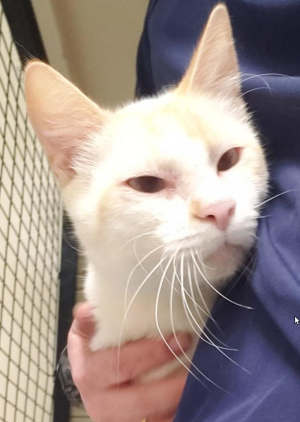
Male Siamese mix
This young male Siamese mix has a short white coat.
He is in kennel No. 15, ID No. LCAC-A-960.
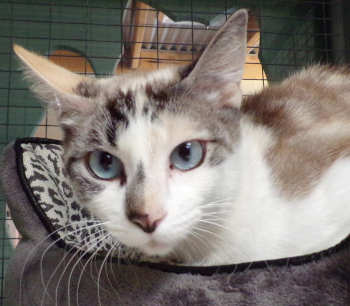
Female Siamese mix
This female Siamese mix has a short coat and blue eyes.
She is 2 years old.
She is in cat room kennel No. 68, ID No. LCAC-A-963.
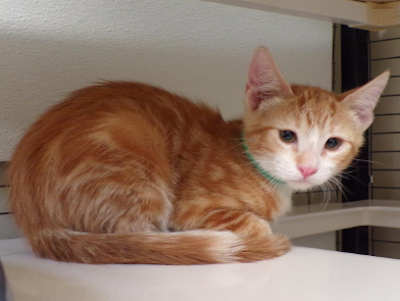
Male domestic shorthair kitten
This male yellow tabby kitten has a short coat.
He is in cat room kennel No. 70b, ID No. LCAC-A-987.
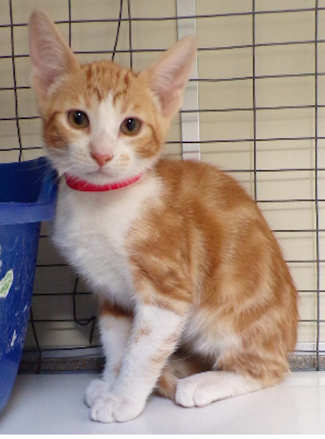
Male domestic shorthair kitten
This male yellow tabby kitten has a short coat.
He is in cat room kennel No. 70d, ID No. LCAC-A-989.
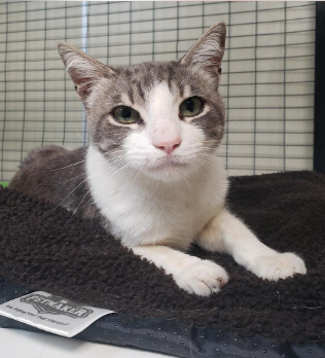
Male domestic shorthair
This male domestic shorthair has a gray and white coat.
He is 1-year-old and weighs nearly 6 pounds.
He is in cat room kennel No. 120, ID No. LCAC-A-874.
Email Elizabeth Larson at
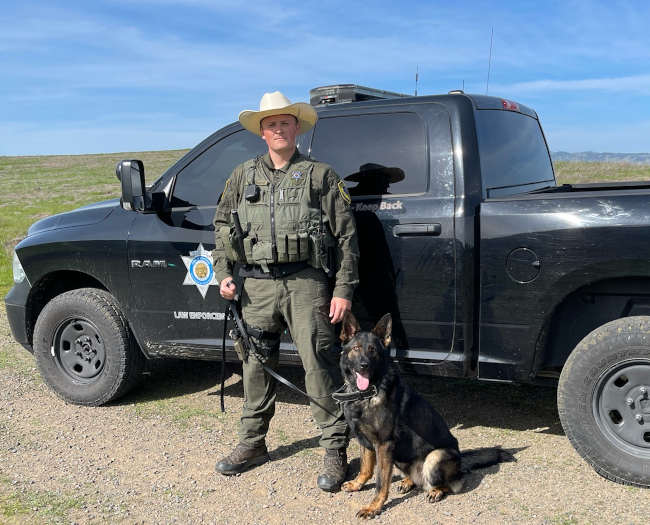
LAKE COUNTY, Calif. — The California Department of Fish and Wildlife has a new K-9 team working to protect Lake County’s natural resources.
The duo of Warden Wyatt Moore with K-9 Vern made their debut earlier this year.
“We’re really proud of our K-9s. They go through a huge amount of training to be a cohesive team so we’re excited about this,” said CDFW spokeswoman Janice Mackey.
Moore has been a warden for just over four years. He’s one of six Fish and Wildlife wardens assigned to Lake County. He is assigned to the Cannabis Enforcement Program while the other five are district wardens.
While Moore also does checks for fishing and hunting compliance, cannabis will be the focus for him and Vern.
“We investigate illegal cannabis cultivation with the associated environmental damage to the watersheds in Lake County,” said Moore.
Mackey added, “Poaching at illegal grows sites is very common.”
Vern, a 2-year-old German shepherd, is the only cannabis dog working in Lake County, Moore said.
Mackey said it’s been some time since the agency had a K-9 working in Lake County.
CDFW put out an interest list for officers interested in working with K-9s and Moore said he had to go through an interview and selection process.
Moore was chosen to be a K-9 handler, and then it was time to look at different dogs.
Vern, with his long sable coat, is a particularly handsome fellow.
“Vern really stood out,” said Moore.
Moore said Vern was imported from a breeder overseas and went through extensive training.
The two of them attended the CDFW K-9 Academy, which lasted a month and a half, in Novato, Moore said. CJ’s Police K-9s conducted the training.
“He’s what’s considered a dual purpose dog,” Moore said of Vern.
Vern is a detection dog who can smell for bear, deer and abalone parts, quagga mussels, and narcotics such as heroin and cocaine.
He also is a protection and apprehension K-9, protecting Moore and other team members.
CDFW said its warden K-9s “must be comfortable in unusual environments such as barriers they don’t expect, the startling noise of running across old file cabinets, old desks that have slippery surfaces, or hunching down and making their way through passages where they can’t stand up straight. Only after passing those skill tests and other tests are they certified for patrol.”
At times during the training, the dogs would be put on a dog-powered treadmill to help deal with their excess energy, CDFW said.
The amount of time a K-9 remains in service will depend on the dog itself, Moore said.
Moore said Vern began his service around the start of March and has been settling in nicely.
“He’s learning the area and he’s liking it,” said Moore.
When not on duty, Vern makes his home with Moore.
In his off time, Moore said Vern likes to play tug with a ball and rope, and loves runs and walks.
“I try to get him out hiking with me, too,” Moore said.
Email Elizabeth Larson at
At the June 15 meeting, Board Chair Bruno Sabatier presented the proclamation, shown below.
The proclamation notes, “LGBTQ+ residents in Lake County represent our families, our friends, our neighbors, our teachers, our employees and our community leaders. Across all religions, races, and communities there are LGBTQ+ people helping our nation to become a more perfect union in reaching our ideals proclaimed in our Declaration of Independence that all ‘people’ are created equal and therefore deserve to be embraced and treated as equals.”
Sabatier said that, based on what he was told by county staff, this is the first time the county of Lake has offered such a proclamation, and he said he hopes it becomes an annual custom.
“I think it’s important to celebrate because of the changes that we’ve had in our country, in our state and in our communities,” he said.
Sabatier said he had a small pride flag to put on the supervisors’ dais for the month of June.
Supervisor Jessica Pyska thanked Sabatier for bringing forward the proclamation, adding she also hopes it’s done annually from now on.
She said she loved the small pride flag. “I think it’s a great gesture.”
However, she said she wanted to get a big pride flag to display on the outside of the courthouse where the board meets for next year.
Sabatier said there are policies on flags and lowering the flag and they should consider those before making any decision on what observances to add.
Pyska said she appreciated that. “We have a year to get that right.”
Supervisor Tina Scott agreed that they needed to look at their rules to see if they can fly the flag next year.
“A lot of progress has been made but more work needs to be done,” Scott said.
Email Elizabeth Larson at
Pride Month Proclamation by LakeCoNews on Scribd
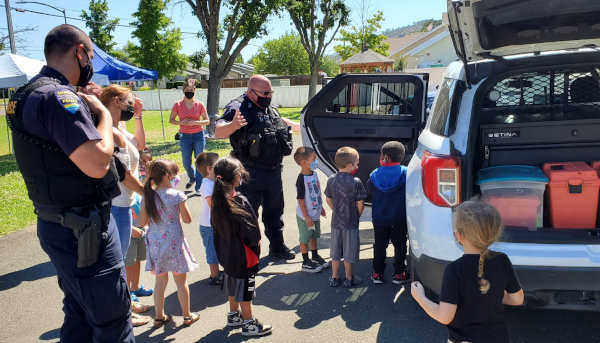
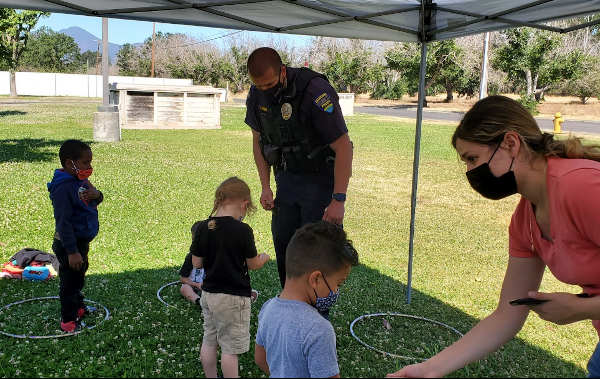
CLEARLAKE, Calif. — The Lake County Library’s Redbud Branch is returning to its weekly story time for children, hosting Clearlake Police officers at its Thursday event.
Sgt. Ryan Peterson, Officer Michael Perreault, Officer Jesus Loera and Officer Nathan Williams attended the Thursday morning story time reading program.
Peterson said the officers were able to participate with the children in the “Hokey Pokey” while the library staff read the associated book.
Officer Perreault also led the children on a tour of his traffic unit patrol vehicle, Peterson said.
The officers thanked the library staff and children for allowing them to participate.
The Lake County Library-Redbud Branch presents a story time every Thursday morning at 10:15 a.m.
The event is open to all children and is currently being held outside with state health guidelines.
The library is located at 14785 Burns Valley Road in Clearake.
For further information, please contact the library in person or by calling 707-995-5115.
Dogs available for adoption this week include mixes of Chihuahua, hound, husky, Labrador retriever, McNab, pit bull, Rottweiler, shepherd and Weimaraner.
Dogs that are adopted from Lake County Animal Care and Control are either neutered or spayed, microchipped and, if old enough, given a rabies shot and county license before being released to their new owner. License fees do not apply to residents of the cities of Lakeport or Clearlake.
The following dogs at the Lake County Animal Care and Control shelter have been cleared for adoption (additional dogs on the animal control website not listed are still “on hold”).
Call Lake County Animal Care and Control at 707-263-0278 or visit the shelter online at http://www.co.lake.ca.us/Government/Directory/Animal_Care_And_Control.htm for information on visiting or adopting.

‘Delilah’
“Delilah” is a 1-year-old female Chihuahua with a short brown coat.
She is in kennel No. 3, ID No. LCAC-A-512.
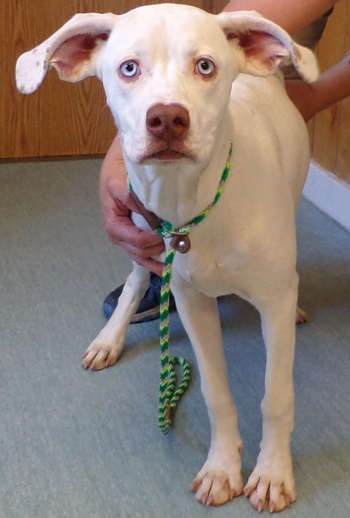
Labrador-Weimaraner mix
This young female Labrador-Weimaraner mix has a short white coat and blue eyes.
She is in kennel No. 6, ID No. LCAC-A-1063.
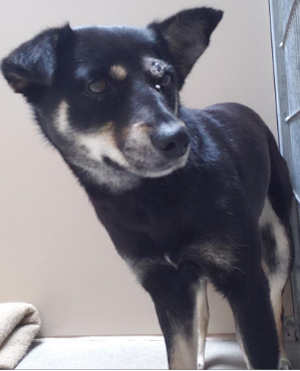
Female Rottweiler-shepherd
This 2-year-old female Rottweiler-shepherd mix has a medium-length black and red coat.
She is in kennel No. 12, ID No. LCAC-A-791.
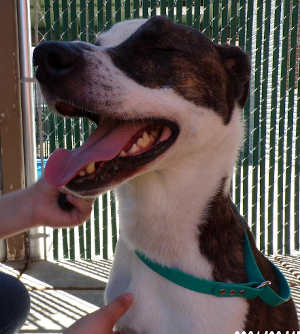
‘Ren’
“Ren” is a 2-year-old male McNab-sheepdog mix with a short brindle and white coat.
He has been neutered.
He is in kennel No. 15, ID No. LCAC-A-785.
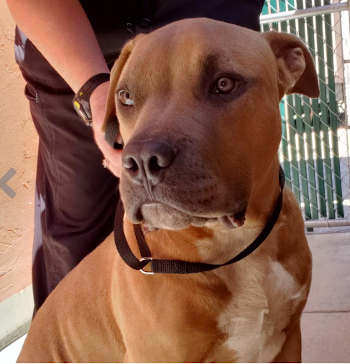
Male pit bull
This young male American pit bull has a short brown coat.
He is in kennel No. 18, ID No. LCAC-A-1028.
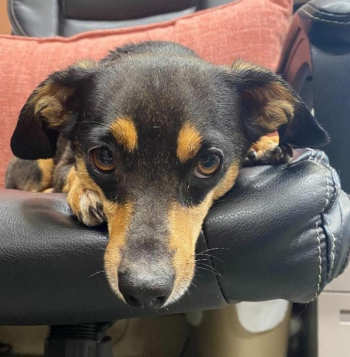
‘Boo’
“Boo” is a 10-year-old male Chihuahua-dachshund mix.
He is in kennel No. 19, ID No. LCAC-A-1039.
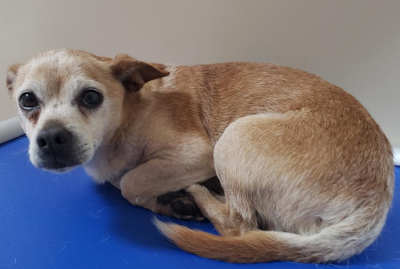
‘Koko’
“Koko” is a 10-year-old male Chihuahua mix with a short tan coat.
He is in kennel No. 24, ID No. LCAC-A-897.
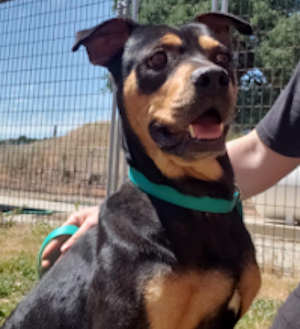
Rottweiler-pit bull mix
This 1-year-old female Rottweiler-pit bull mix has a short black coat.
She has been spayed.
She is in kennel No. 27, ID No. LCAC-A-731.
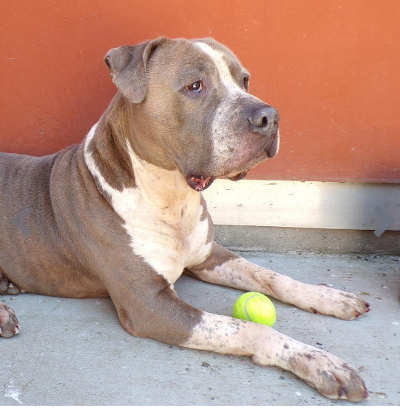
‘Brutus’
“Brutus” is a 5-year-old male pit bull terrier with a short gray and white coat.
He is in kennel No. 28, ID No. LCAC-A-670.
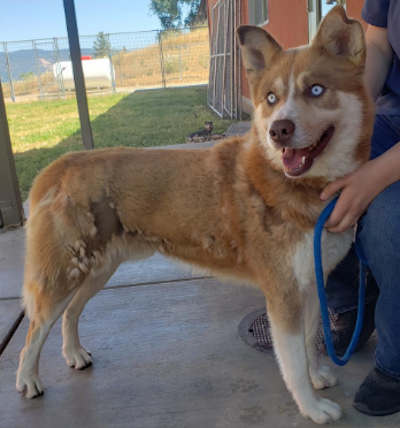
‘Apollo’
“Apollo” is a 2-year-old male husky mix with a medium-length red and white coat and blue eyes.
He is in kennel No. 31, ID No. LCAC-A-783.
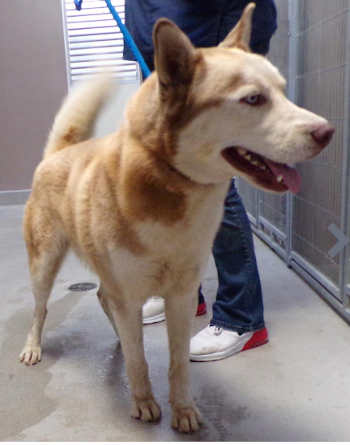
Male husky
This 2-year-old male husky has a medium-length red and white coat.
He is in kennel No. 32, ID No. LCAC-A-1024.
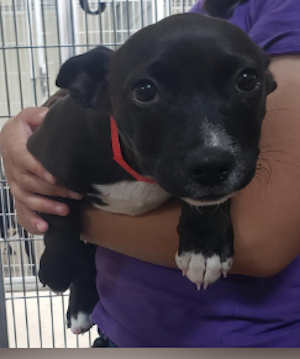
Female pit bull terrier puppy
This female pit bull terrier puppy has a short black coat with white markings.
She is in kennel No. 33b, ID No. LCAC-A-853.

Male pit bull terrier puppy
This male pit bull terrier puppy has a short black coat with white markings.
He is in kennel No. 33d, ID No. LCAC-A-855.
Email Elizabeth Larson at