 How to resolve AdBlock issue?
News
LAKE COUNTY, Calif. — Fire officials are continuing to investigate the causes of wildland fires over the past week, but in some cases it’s already been determined that vehicles or mowing sparked blazes.
Pomo fire: Thursday, June 17
Northshore Fire Chief Mike Ciancio said the Pomo fire on June 17 burned 42 acres.
It burned on Reclamation Road off Highway 20 near Nice.
Initial reports from the scene said it began with a vehicle fire.
However, Ciancio said the fire remains under investigation.
Ciancio said the vehicle in question remained at the site this week, sitting out in a field.
He said he didn’t know if the vehicle had just been abandoned.
“It’s not stolen, we’ve determined that,” he said.
Blue fire: Saturday, June 19
This fire occurred on Saturday afternoon near Blue Lakes.
Ciancio said it burned less than an acre.
That fire began when a homeowner was operating a tractor, causing brush to ignite, Ciancio said.
Hill fire: Sunday, June 20
The Hill fire was first reported at around 7:30 p.m. Sunday along Highway 29 near Hill Road in the north Lakeport area.
Officials said it originally was reported as five small fires along the highway that burned into three fires that totaled about an acre, based on reports from the scene.
Those fires “appear to have been started from a malfunctioning vehicle,” Sheriff Brian Martin told Lake County News.
He said a dark-colored sedan was seen in the area that may have been connected to the fires.
“In any event the Hill Road fire did not appear to be intentionally set,” Martin said.
Wilkinson fire: Monday, June 21
The Wilkinson fire was reported just after 5 p.m. Monday on Wilkinson Avenue and Dam Road in Clearlake.
It burned a total of 25 acres and spurred some mandatory and advisory evacuations in nearby neighborhoods in the Avenues, said Lakeport Fire Chief Willie Sapeta.
Sapeta said 17 engines from local, state and federal fire agencies responded to the fire.
He said the cause is still under investigation.
Sapeta said the fire quickly worked into several debris piles and homeless encampments, causing big columns of black smoke. When firefighters arrived on scene, there were probably half a dozen cars and motor homes involved.
The area also has a lot of brush, he said.
Sapeta said there were no injuries and no missing parties reported.
“We did a thorough area check of those debris piles,” he said, with no findings of any animal or human remains.
Crews are expected to remain on scene for a few more days to patrol, because Sapeta said the fire could go down to the roots of the brush and come out in another location.
Chief asks for people to use caution
Sapeta asked community members to be cognizant of their surroundings during this hot summer.
He said it’s going to be a dry and potentially active fire season if people don’t pay attention and be cautious about mowing.
Sapeta said not to mow after 9 a.m., especially with bladed equipment or metal heads that can hit rocks and spark fires. After that time, fuels are primed and can easily catch fire.
He said another recent fire, which took place on Noble Ranch Road near Lower Lake and burned a quarter of an acre, also was caused by mowing.
Email Elizabeth Larson atThis email address is being protected from spambots. You need JavaScript enabled to view it. . Follow her on Twitter, @ERLarson, or Lake County News, @LakeCoNews.
Pomo fire: Thursday, June 17
Northshore Fire Chief Mike Ciancio said the Pomo fire on June 17 burned 42 acres.
It burned on Reclamation Road off Highway 20 near Nice.
Initial reports from the scene said it began with a vehicle fire.
However, Ciancio said the fire remains under investigation.
Ciancio said the vehicle in question remained at the site this week, sitting out in a field.
He said he didn’t know if the vehicle had just been abandoned.
“It’s not stolen, we’ve determined that,” he said.
Blue fire: Saturday, June 19
This fire occurred on Saturday afternoon near Blue Lakes.
Ciancio said it burned less than an acre.
That fire began when a homeowner was operating a tractor, causing brush to ignite, Ciancio said.
Hill fire: Sunday, June 20
The Hill fire was first reported at around 7:30 p.m. Sunday along Highway 29 near Hill Road in the north Lakeport area.
Officials said it originally was reported as five small fires along the highway that burned into three fires that totaled about an acre, based on reports from the scene.
Those fires “appear to have been started from a malfunctioning vehicle,” Sheriff Brian Martin told Lake County News.
He said a dark-colored sedan was seen in the area that may have been connected to the fires.
“In any event the Hill Road fire did not appear to be intentionally set,” Martin said.
Wilkinson fire: Monday, June 21
The Wilkinson fire was reported just after 5 p.m. Monday on Wilkinson Avenue and Dam Road in Clearlake.
It burned a total of 25 acres and spurred some mandatory and advisory evacuations in nearby neighborhoods in the Avenues, said Lakeport Fire Chief Willie Sapeta.
Sapeta said 17 engines from local, state and federal fire agencies responded to the fire.
He said the cause is still under investigation.
Sapeta said the fire quickly worked into several debris piles and homeless encampments, causing big columns of black smoke. When firefighters arrived on scene, there were probably half a dozen cars and motor homes involved.
The area also has a lot of brush, he said.
Sapeta said there were no injuries and no missing parties reported.
“We did a thorough area check of those debris piles,” he said, with no findings of any animal or human remains.
Crews are expected to remain on scene for a few more days to patrol, because Sapeta said the fire could go down to the roots of the brush and come out in another location.
Chief asks for people to use caution
Sapeta asked community members to be cognizant of their surroundings during this hot summer.
He said it’s going to be a dry and potentially active fire season if people don’t pay attention and be cautious about mowing.
Sapeta said not to mow after 9 a.m., especially with bladed equipment or metal heads that can hit rocks and spark fires. After that time, fuels are primed and can easily catch fire.
He said another recent fire, which took place on Noble Ranch Road near Lower Lake and burned a quarter of an acre, also was caused by mowing.
Email Elizabeth Larson at
CLEARLAKE, Calif. — The Clearlake City Council will hold a special Thursday morning meet to discuss hiring a new finance director.
The council will meet at 10:30 a.m. Thursday, June 24, in the council chambers at Clearlake City Hall, 14050 Olympic Drive.
The public may attend, however, the council chambers will have limited capacity and attendees must adhere to masking and social distancing mandates.
The meeting will be broadcast live on the city's YouTube channel or the Lake County PEGTV YouTube Channel. Community members also can participate via Zoom.
The agenda can be found here and viewed below.
Comments and questions can be submitted in writing for City Council consideration by sending them to Administrative Services Director/City Clerk Melissa Swanson atThis email address is being protected from spambots. You need JavaScript enabled to view it. . You can also visit the city’s town hall site and submit written comments at https://www.opentownhall.com/portals/327/forum_home. Identify the subject you wish to comment on in your email’s subject line or in your town hall submission.
To give the council adequate time to review your questions and comments, please submit your written comments before 10 a.m. Thursday, June 24.
On the agenda is a proposed employment contract with Kelcey Young for the city’s director of finance job.
City Manager Alan Flora said in his report that Young is available to start on July 18 after she moves from Dallas, Texas.
Flora said staff is recommending a base salary at Step E of the salary scale of $118,667.20 annually, relocation assistance, a recruitment incentive of $10,000 and the other standard department head benefits as defined in the management benefit plan.
“We believe Ms. Young’s education and experience are well suited for the position and the City’s needs and welcome her to Clearlake,” Flora said.
Young’s proposed employment contract is in the council packet published below, beginning on page 19.
Young will take over from Andrew White, who over the past year has been doing double duty as city police chief and finance director while recruiting efforts have been underway.
Also under business, the council will consider adopting the first amendment to the agreement between the city of Clearlake, city of Lakeport and county of Lake for operation of a public, educational and governmental, or PEG, cable television channel.
City Clerk/Administrative Services Director Melissa Swanson’s report to the council explains that the amendment continues the PEG station’s current funding mechanisms, including the city’s in-kind contributions of operational facilities at City Hall and the senior and community center, insurance and other operations assistance, in place of an annual monetary contribution of $8,000.
The amendment continues through June 30, 2023.
The council also will hold a closed session for labor negotiations with the Clearlake Municipal Employees Association, Clearlake Police Officers Association and Clearlake Middle Management Association, and to discuss existing litigation, Jane Wang v. City of Clearlake, et al.
Email Elizabeth Larson atThis email address is being protected from spambots. You need JavaScript enabled to view it. . Follow her on Twitter, @ERLarson, or Lake County News, @LakeCoNews.
The council will meet at 10:30 a.m. Thursday, June 24, in the council chambers at Clearlake City Hall, 14050 Olympic Drive.
The public may attend, however, the council chambers will have limited capacity and attendees must adhere to masking and social distancing mandates.
The meeting will be broadcast live on the city's YouTube channel or the Lake County PEGTV YouTube Channel. Community members also can participate via Zoom.
The agenda can be found here and viewed below.
Comments and questions can be submitted in writing for City Council consideration by sending them to Administrative Services Director/City Clerk Melissa Swanson at
To give the council adequate time to review your questions and comments, please submit your written comments before 10 a.m. Thursday, June 24.
On the agenda is a proposed employment contract with Kelcey Young for the city’s director of finance job.
City Manager Alan Flora said in his report that Young is available to start on July 18 after she moves from Dallas, Texas.
Flora said staff is recommending a base salary at Step E of the salary scale of $118,667.20 annually, relocation assistance, a recruitment incentive of $10,000 and the other standard department head benefits as defined in the management benefit plan.
“We believe Ms. Young’s education and experience are well suited for the position and the City’s needs and welcome her to Clearlake,” Flora said.
Young’s proposed employment contract is in the council packet published below, beginning on page 19.
Young will take over from Andrew White, who over the past year has been doing double duty as city police chief and finance director while recruiting efforts have been underway.
Also under business, the council will consider adopting the first amendment to the agreement between the city of Clearlake, city of Lakeport and county of Lake for operation of a public, educational and governmental, or PEG, cable television channel.
City Clerk/Administrative Services Director Melissa Swanson’s report to the council explains that the amendment continues the PEG station’s current funding mechanisms, including the city’s in-kind contributions of operational facilities at City Hall and the senior and community center, insurance and other operations assistance, in place of an annual monetary contribution of $8,000.
The amendment continues through June 30, 2023.
The council also will hold a closed session for labor negotiations with the Clearlake Municipal Employees Association, Clearlake Police Officers Association and Clearlake Middle Management Association, and to discuss existing litigation, Jane Wang v. City of Clearlake, et al.
Email Elizabeth Larson at
LAKE COUNTY, Calif. — The Lake County Museums and Lake County Parks and Recreation is inviting the community to meetings early in July to share ideas on possible improvements to the museum grounds.
The meetings will take place at the Lakeport Courthouse Museum, 255 N. Main St.
The first is scheduled for 11 a.m. to 2 p.m. Thursday, July 1.
The second meeting will take place from 9:30 to 11:30 a.m. on Saturday, July 3.
A conceptual list of improvements and amenities for a competitive state grant funding opportunity will be available for review.
This is an opportunity for community members to tell the Parks and Recreation Department what they would like to see at the museum.
County staff also will be holding an online survey soon to offer more opportunities for community members to have their voices heard.
If you are unable to attend any of the meetings in person please visit any of the following locations in person or online for other ways to share your comments or ask questions:
Historic Courthouse Museum, 255 N. Main St., Lakeport; open Thursday through Saturday, 10 a.m. to 4 p.m.
Historic Schoolhouse Museum, 16435 Main St., Lower Lake; open Thursday through Saturday, 10 a.m. to 4 p.m.
Gibson Museum and Cultural Center at 21267 Calistoga Road, Middletown; open Thursday through Saturday, 10 a.m. to 4 p.m.
Visit the museums online and on Facebook.
The meetings will take place at the Lakeport Courthouse Museum, 255 N. Main St.
The first is scheduled for 11 a.m. to 2 p.m. Thursday, July 1.
The second meeting will take place from 9:30 to 11:30 a.m. on Saturday, July 3.
A conceptual list of improvements and amenities for a competitive state grant funding opportunity will be available for review.
This is an opportunity for community members to tell the Parks and Recreation Department what they would like to see at the museum.
County staff also will be holding an online survey soon to offer more opportunities for community members to have their voices heard.
If you are unable to attend any of the meetings in person please visit any of the following locations in person or online for other ways to share your comments or ask questions:
Historic Courthouse Museum, 255 N. Main St., Lakeport; open Thursday through Saturday, 10 a.m. to 4 p.m.
Historic Schoolhouse Museum, 16435 Main St., Lower Lake; open Thursday through Saturday, 10 a.m. to 4 p.m.
Gibson Museum and Cultural Center at 21267 Calistoga Road, Middletown; open Thursday through Saturday, 10 a.m. to 4 p.m.
Visit the museums online and on Facebook.
The last decade was free of recessions and from the opening bell in January 2010 to the closing bell in December 2019, the Dow Jones Industrial Average and S&P 500 soared 173.60% and 189.35%, respectively.
The Gross Domestic Product increased from $14.992 trillion to $21.433 trillion.
Yet, during that same period, the labor force participation rate actually declined.
So, how could it drop when the economy was booming and labor force participation rates among the working-age population grew in every age category?
The solution to this labor market puzzle: rise in the percentage of the population ages 65 and over.
The oldest baby boomers were 64 in 2010 and 73 in 2019. As they aged, a large segment of the population shifted into 65 and older age groups.
Because older Americans are less likely than younger ones to be in the labor force, this demographic shift reduced the overall labor force participation rate.
Labor force participation includes working-age adults who are either working or looking for work.
This article uses estimates from the 2010 and 2019 American Community Survey, or ACS, 1-year.
Labor force participation by age
The national labor force participation rate for the total population ages 16 and over decreased from 64.4% in 2010 to 63.6% in 2019.
Despite the overall dip, the labor force participation rate went up across all age groups from 2010 to 2019:
— Ages 16 to 19: 37.7% to 39.9%.
— Ages 20 to 64: 77.5% to 78.3%.
— Ages 65 to 74: 24.8% to 26.8%.
— Ages 75 and older: 5.7% to 7.2%.
This apparent discrepancy in the rates can be explained by the sea change in the age distribution of the U.S. population.
Effect of aging on labor force
From 2010-2019, as the U.S. economy improved, the percentage of the population ages 65 and older grew nationally (from 13.1% to 16.5%) and in all 50 states and the District of Columbia.
These increases affected both the national and state labor force characteristics.
The labor force participation rates of people ages 65 to 74 and 75 years and older were lower than for the population ages 16 to 19 and 20 to 64 in 2010 and in 2019.
Even so, older Americans were still more likely to be in the labor force in 2019 than in 2010.
Labor force trends in states
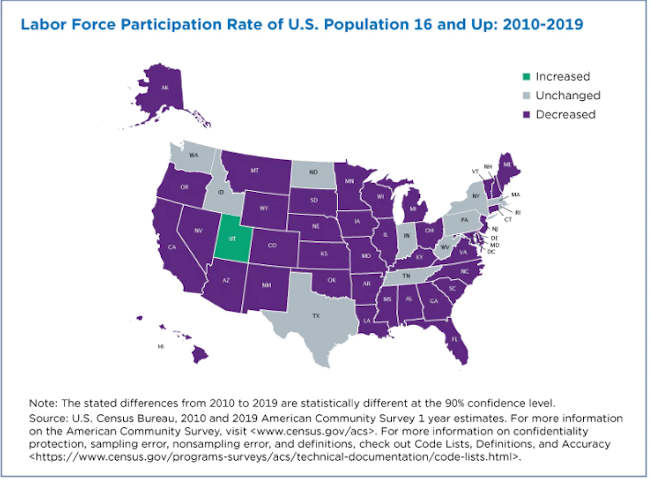
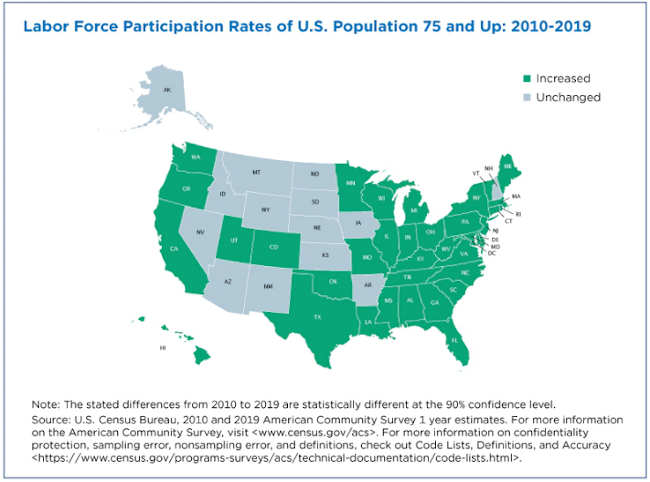
This seemingly contradictory pattern of an overall decline in labor force participation but increases in every age group was evident at the state level as well.
Only one state (Utah) and the District of Columbia experienced increases in their labor force participation rates for the total working-age population ages 16 and older while 38 states experienced decreases.
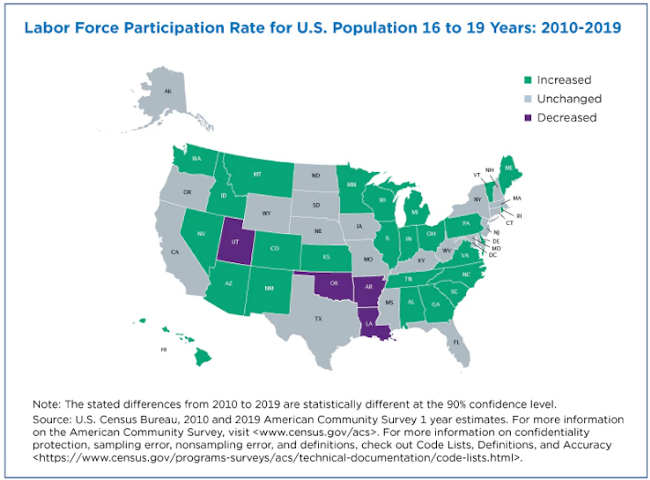
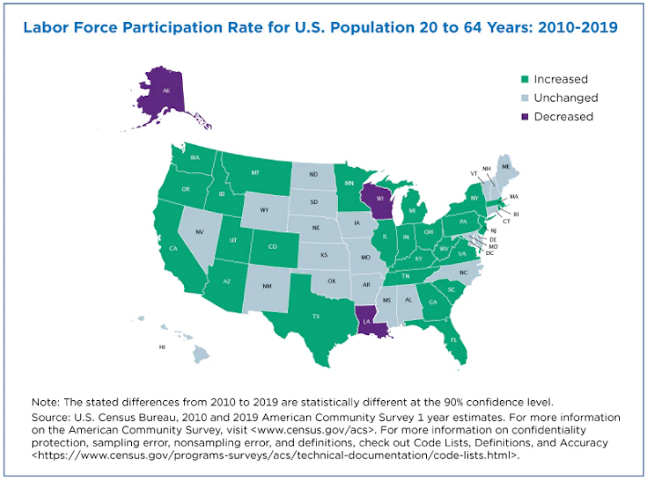
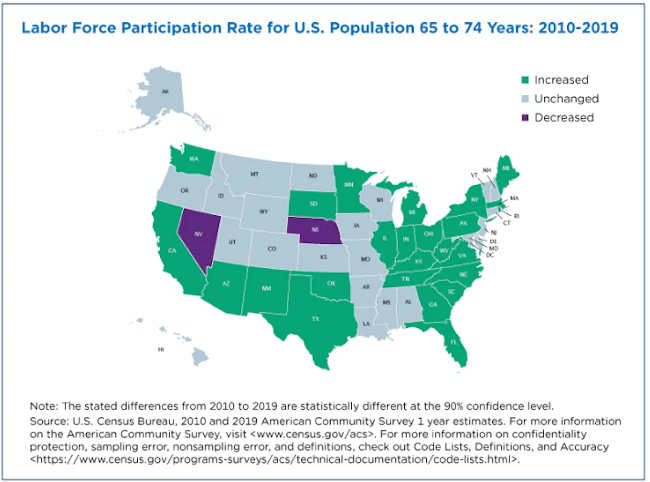
However, just as it played out nationally, labor force participation rates went up in most states in every age group from 2010 to 2019:
— Ages 16 to 19, up in 26 states and D.C., and down in four.
— Ages 20 to 64, up in 26 states and D.C., and down in three.
— Ages 65 to 74, up in 25 states and down in two.
— Ages 75 and older, up in 36 states and down in none.
Aging and unemployment
People without jobs searching and available for work are considered unemployed.
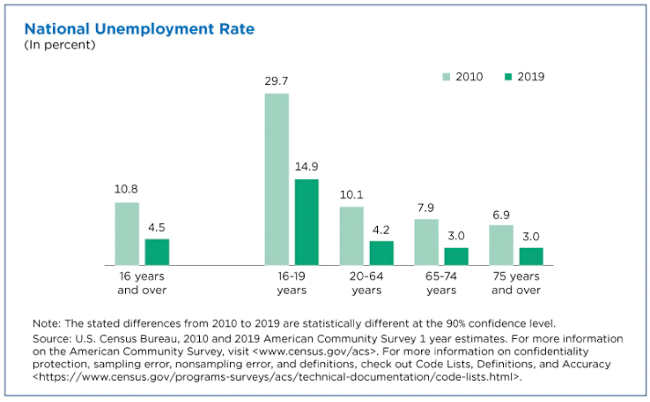
Unemployment rates trended downward overall from 10.8% in 2010 to 4.5% in 2019. They also declined for each age cohort:
— Ages 16 to 19, from 29.7% to 14.9%.
— Ages 20 to 64, 10.1% to 4.2%.
— Ages 65 to 74, 7.9% to 3.0%.
— Ages 75 and older, 6.9% to 3.0%.
The unemployment rates of the population ages 65 to 74 and 75 and older were lower than the unemployment rates of the population ages 16 to 19 and 20 to 64, in both 2010 and 2019.
As the nation and labor force aged, older Americans’ lower unemployment rates and continued presence in the labor force drove down the overall unemployment rate.
This effect was compounded by the improving labor market that reduced unemployment rates for all age groups between 2010 and 2019.
Aging out, not dropping out
These demographic subtleties matter because labor force participation and unemployment rates are key measures of economic health.
Conventional wisdom about falling labor force participation rates is that discouraged workers are dropping out of the labor force. But that conclusion can be misleading, especially when the country is experiencing significant demographic shifts, such as changes in the age distribution of the U.S. population in the last decade.
As a result, demographic changes rather than economic and labor market conditions may be the driving factor behind labor force participation and unemployment rates.
David Howard is a survey statistician in the Census Bureau’s Social, Economic and Housing Statistics Division.
LAKE COUNTY, Calif. — The Board of Supervisors on Tuesday approved updates to the workplace regulations for county employees, changes made possible by state-level action last week.
On Thursday, the Cal/OSHA Board updated its regulations to come into line with guidance from the Centers for Disease Control and Prevention and the California Department of Public Health, as Lake County News has reported.
Until that action was taken, the county of Lake — the largest employer in Lake County, with about 1,000 employees — had been caught between conflicting state and federal rules.
Following Thursday’s action, the county began finalizing the latest updates to county workplace rules and sent out notification about the changes to employees, County Administrative Officer Carol Huchingson told the Board of Supervisors on Tuesday.
Huchingson said Human Resources Director Pam Samac made sure employees were notified of the changes on Thursday night.
Samac told the board that county staff was excited to see Cal/OSHA update its rules to match the CDC’s guidance.
“We’ve got some very happy employees,” she said.
Among the changes to the protocol is a new addendum which is a certification of vaccination status for employees to fill out.
“Per Cal OSHA COVID-19 Prevention Emergency Temporary Standards we are required to collect information about your vaccination status,” the form says.
People can choose to disclose that they are full or partially vaccinated, not vaccinated, or they can decline to answer.
As of Tuesday morning, Samac said the county had received back 400 of those certifications.
Altogether, nine sections of the protocol have been updated, including the sections on facial coverings for vaccinated versus unvaccinated employees, she said.
Cal/OSHA’s “Emergency Temporary Standards” require employers “to provide unvaccinated employees with face coverings or N95 masks and ensure they are worn over the nose and mouth when indoors and when outdoors, and within 6 feet of another,” the county protocol explains.
Fully vaccinated employees are not required to wear face coverings indoors unless they are in certain situations, including being on public transit, in school and health care settings, correctional facilities and detention centers, homeless and emergency shelters, and cooling centers, the document said.
Samac said the county must provide facial coverings to staff who request them. The protocol said fully vaccinated employees can request, and must be provided, face coverings or N95 masks.
The protocol requires unvaccinated employees to wear face masks indoors unless they are alone in a room, using a respirator or respiratory protection, they cannot use a face covering due to a medical or mental condition, if they are hearing impaired or communicating with a hearing-impaired person, when specific work tasks cannot be performed with a face covering or when other measures to protect against COVID-19 infection must be implemented when face coverings cannot be used.
Samac said employees must still keep high touch areas clean and frequently wipe them down as necessary.
Regarding physical distance, there is no longer a need to have physical barriers and social distancing for employees, she said.
However, Samac said the county still needs to keep barriers in place in front-facing customer service areas to protect employees because they don't have 100-percent vaccination among employees at this point.
For vaccinated employees who come into close contact with a person with suspected or confirmed COVID-19, the protocol said they do not need to quarantine or be tested, but unvaccinated employees are to be instructed to quarantine for up to 10 days.
Samac said they also have eliminated an employee travel ban, and still need to offer remote telecommuting to high risk employees, where appropriate.
The board voted unanimously to approve the amended County of Lake COVID-19 Public Health Emergency Worksite Protocol and bring it back for future changes on an as-needed basis.
Email Elizabeth Larson atThis email address is being protected from spambots. You need JavaScript enabled to view it. . Follow her on Twitter, @ERLarson, or Lake County News, @LakeCoNews.
On Thursday, the Cal/OSHA Board updated its regulations to come into line with guidance from the Centers for Disease Control and Prevention and the California Department of Public Health, as Lake County News has reported.
Until that action was taken, the county of Lake — the largest employer in Lake County, with about 1,000 employees — had been caught between conflicting state and federal rules.
Following Thursday’s action, the county began finalizing the latest updates to county workplace rules and sent out notification about the changes to employees, County Administrative Officer Carol Huchingson told the Board of Supervisors on Tuesday.
Huchingson said Human Resources Director Pam Samac made sure employees were notified of the changes on Thursday night.
Samac told the board that county staff was excited to see Cal/OSHA update its rules to match the CDC’s guidance.
“We’ve got some very happy employees,” she said.
Among the changes to the protocol is a new addendum which is a certification of vaccination status for employees to fill out.
“Per Cal OSHA COVID-19 Prevention Emergency Temporary Standards we are required to collect information about your vaccination status,” the form says.
People can choose to disclose that they are full or partially vaccinated, not vaccinated, or they can decline to answer.
As of Tuesday morning, Samac said the county had received back 400 of those certifications.
Altogether, nine sections of the protocol have been updated, including the sections on facial coverings for vaccinated versus unvaccinated employees, she said.
Cal/OSHA’s “Emergency Temporary Standards” require employers “to provide unvaccinated employees with face coverings or N95 masks and ensure they are worn over the nose and mouth when indoors and when outdoors, and within 6 feet of another,” the county protocol explains.
Fully vaccinated employees are not required to wear face coverings indoors unless they are in certain situations, including being on public transit, in school and health care settings, correctional facilities and detention centers, homeless and emergency shelters, and cooling centers, the document said.
Samac said the county must provide facial coverings to staff who request them. The protocol said fully vaccinated employees can request, and must be provided, face coverings or N95 masks.
The protocol requires unvaccinated employees to wear face masks indoors unless they are alone in a room, using a respirator or respiratory protection, they cannot use a face covering due to a medical or mental condition, if they are hearing impaired or communicating with a hearing-impaired person, when specific work tasks cannot be performed with a face covering or when other measures to protect against COVID-19 infection must be implemented when face coverings cannot be used.
Samac said employees must still keep high touch areas clean and frequently wipe them down as necessary.
Regarding physical distance, there is no longer a need to have physical barriers and social distancing for employees, she said.
However, Samac said the county still needs to keep barriers in place in front-facing customer service areas to protect employees because they don't have 100-percent vaccination among employees at this point.
For vaccinated employees who come into close contact with a person with suspected or confirmed COVID-19, the protocol said they do not need to quarantine or be tested, but unvaccinated employees are to be instructed to quarantine for up to 10 days.
Samac said they also have eliminated an employee travel ban, and still need to offer remote telecommuting to high risk employees, where appropriate.
The board voted unanimously to approve the amended County of Lake COVID-19 Public Health Emergency Worksite Protocol and bring it back for future changes on an as-needed basis.
Email Elizabeth Larson at
LAKE COUNTY, Calif. — Congressman John Garamendi (D-CA) is encouraging hardworking families to be on the lookout for advance monthly payments of the Child Tax Credit of up to $300 per month per child beginning July 15 and continuing through December.
Garamendi’s office said 48,600 hardworking households, covering 86% of all children in California’s 3rd Congressional District, could get up to $300 per month per child July to December and even more after filing their taxes next year.
An estimated 11,000 children are expected to be lifted out of poverty in Garamendi’s district.
Nearly all families should get their monthly payments automatically beginning July 15 with no further action required.
Families who did not file a tax return for 2019 or 2020 and who did not use the IRS Non-filers tool last year to sign up for the Economic Impact Payments, should go online and use the IRS Child Tax Credit Non-filer Sign-up Tool to sign up today.
“Child Tax Credit Monthly Payments will help set America’s children up for success and put more money in the pockets of hardworking parents sooner, to pay for child care or put gas in the car so they can go to work and help fuel our economy while building better lives for their families,” said Garamendi.
Major tax relief for nearly all working families:
How much is the Child Tax Credit expansion from the American Rescue Plan?
The American Rescue Plan expanded the Child Tax Credit to up to $3,600 per child for children ages 0 to 5 and $3,000 per child for children ages 6 to 17.
The American Rescue Plan also authorized advance monthly payments of the Child Tax Credit through December 2021. Beginning in July and running through December, qualifying families can get up to:
— $300 a month per child for children ages 0 to 5.
— $250 a month per child for children ages 6 to 17.
Families will get their remaining expanded Child Tax Credit when they file their 2021 tax return.
Who qualifies?
Families will qualify for a full credit if their income is below $75,000 for single filers, $112,000 for people filing as head of household, or $150,000 for people who are married and filing jointly.
How do I get my payment?
Nearly all families should get their monthly payments automatically beginning July 15 with no further action required. If you’ve filed tax returns for 2019 or 2020, or if you signed up to receive a stimulus check from the Internal Revenue Service, you will get this tax relief automatically. You do not need to sign up or take any action.
Families who did not file a tax return for 2019 or 2020 and who did not use the IRS Non-filers tool last year to sign up for the Economic Impact Payments, should go online and use the IRS Child Tax Credit Non-filer Sign-up Tool to sign up today.
Families who got their refunds from the IRS through direct deposit will get these payments in their bank account around the 15th of every month until the end of 2021. People who don’t use direct deposit will receive their payment by mail around the same time.
Families will be able to determine their eligibility, check the status of their payments, and more at IRS.gov/childtaxcredit2021 later this month.
Watch out for scams
According to IRS.gov: “The IRS urges everyone to be on the lookout for scams related to both Advance Child Tax Credit payments and Economic Impact Payments. The IRS emphasized that the only way to get either of these benefits is by either filing a tax return with the IRS or registering online through the Non-filer Sign-up tool, exclusively on IRS.gov. Any other option is a scam.
Watch out for scams using email, phone calls, or texts related to the payments. Be careful and cautious: The IRS never sends unsolicited electronic communications asking anyone to open attachments or visit a nongovernmental website.
Garamendi’s office said 48,600 hardworking households, covering 86% of all children in California’s 3rd Congressional District, could get up to $300 per month per child July to December and even more after filing their taxes next year.
An estimated 11,000 children are expected to be lifted out of poverty in Garamendi’s district.
Nearly all families should get their monthly payments automatically beginning July 15 with no further action required.
Families who did not file a tax return for 2019 or 2020 and who did not use the IRS Non-filers tool last year to sign up for the Economic Impact Payments, should go online and use the IRS Child Tax Credit Non-filer Sign-up Tool to sign up today.
“Child Tax Credit Monthly Payments will help set America’s children up for success and put more money in the pockets of hardworking parents sooner, to pay for child care or put gas in the car so they can go to work and help fuel our economy while building better lives for their families,” said Garamendi.
Major tax relief for nearly all working families:
How much is the Child Tax Credit expansion from the American Rescue Plan?
The American Rescue Plan expanded the Child Tax Credit to up to $3,600 per child for children ages 0 to 5 and $3,000 per child for children ages 6 to 17.
The American Rescue Plan also authorized advance monthly payments of the Child Tax Credit through December 2021. Beginning in July and running through December, qualifying families can get up to:
— $300 a month per child for children ages 0 to 5.
— $250 a month per child for children ages 6 to 17.
Families will get their remaining expanded Child Tax Credit when they file their 2021 tax return.
Who qualifies?
Families will qualify for a full credit if their income is below $75,000 for single filers, $112,000 for people filing as head of household, or $150,000 for people who are married and filing jointly.
How do I get my payment?
Nearly all families should get their monthly payments automatically beginning July 15 with no further action required. If you’ve filed tax returns for 2019 or 2020, or if you signed up to receive a stimulus check from the Internal Revenue Service, you will get this tax relief automatically. You do not need to sign up or take any action.
Families who did not file a tax return for 2019 or 2020 and who did not use the IRS Non-filers tool last year to sign up for the Economic Impact Payments, should go online and use the IRS Child Tax Credit Non-filer Sign-up Tool to sign up today.
Families who got their refunds from the IRS through direct deposit will get these payments in their bank account around the 15th of every month until the end of 2021. People who don’t use direct deposit will receive their payment by mail around the same time.
Families will be able to determine their eligibility, check the status of their payments, and more at IRS.gov/childtaxcredit2021 later this month.
Watch out for scams
According to IRS.gov: “The IRS urges everyone to be on the lookout for scams related to both Advance Child Tax Credit payments and Economic Impact Payments. The IRS emphasized that the only way to get either of these benefits is by either filing a tax return with the IRS or registering online through the Non-filer Sign-up tool, exclusively on IRS.gov. Any other option is a scam.
Watch out for scams using email, phone calls, or texts related to the payments. Be careful and cautious: The IRS never sends unsolicited electronic communications asking anyone to open attachments or visit a nongovernmental website.