 How to resolve AdBlock issue?
News
BERKELEY — The cost of homes is soaring — and so is the cost of the lumber to build them. The price of cars and gas are up sharply, too, as are prices for products ranging from corn to computer chips. Now worries are rising that as the post-pandemic economy comes back to life, a sustained surge of inflation could undermine the recovery.
The U.S. Department of Labor reported earlier this month that the Consumer Price Index rose 5% in May, following a 4.2% jump in April. But at UC Berkeley, high-level economists are offering some calming advice: A measure of inflation is inevitable as the U.S. economy comes back online, but it will likely be modest. And it will almost certainly blow over as the economy stabilizes.
“Alarmists point to past periods of very high inflation, so we imagine inflation of 5%, 6%, maybe higher,” said Berkeley professor Maurice Obstfeld, former chief economist for the International Monetary Fund. “But I don’t think it's very likely that we would get much above 3% after a couple of years.”
“People have this idea that inflation is something we have to be frightened about,” added Berkeley economist Yuriy Gorodnichenko. “When we have some inflation, that means we have a lot of action in the economy, and the economy is recovering. It's good. It's a sign of health. … It doesn’t mean we’ll return to the 1970s.”
The UC Berkeley economics department features some of the nation’s most influential scholars in monetary and economic policy, many of them with experience at high levels of government, international institutions and academic centers. In a series of interviews, they cited a range of challenges as policymakers try to restore some normalcy to the economy — continuing high unemployment, for example, and an economic realignment away from brick-and-mortar retail stores.
Inflation forecasts are inherently uncertain, but they said today’s higher prices are likely to be a blip that lasts a year or two, at most.
The new inflation numbers are roughly double the annual inflation rate of the past decade, but far below inflation that averaged 7.9% annually in the 1970s, before peaking at nearly 14% in 1980.
That inflation caused deep, long-term damage to the U.S. economy. Tens of millions of Americans saw dramatic erosion in the value of their earnings and savings. Businesses faced price increases and broad uncertainty that made it difficult to budget for the costs of supplies and labor. Unemployment rose and stayed high for years.
Without doubt, the 1970s economy left scars that remain painful four decades later — and, the Berkeley scholars say, that likely accounts for some of the alarm in recent weeks.
Waking the economy from an induced coma
For generations, Econ 101 students have learned that inflation is a straightforward process: When an economy is strong, a lot of people are working, and their wages are rising. That means more people with more money are competing to buy apples or pickup trucks or homes. The competition causes price inflation.
But the economic conditions caused by the pandemic have been unlike anything in modern U.S. history. In effect, the lockdown put much of the economy in an induced coma so that, where possible, workers would stay home and be protected from the coronavirus.
The lockdown saved thousands of lives, and government relief programs prevented mass poverty. Still, restaurants, tourism and retail sales took a massive hit. Rental car companies sold off their fleets, rather than let vehicles sit idle. Microchip manufacturers reduced production. Housing starts plunged. Hundreds of thousands of businesses reduced or suspend operations, which meant reduced hours or furloughs for millions of workers. Other businesses closed permanently.
As more Americans get vaccinated and health threats retreat, it would seem simple to flip the switch and turn the economy back on, said Berkeley economist J. Bradford DeLong, who served as deputy assistant Treasury secretary in the administration of President Bill Clinton.
“You give people lots of purchasing power, and you say, ‘Go out and spend it,’” DeLong explained. “And if there are lots of people running around waving money in the air saying, ‘I want to buy things,’ businesses will respond, and you will get back to full employment quite quickly.”
COVID, microchips and the spiraling price of pickup trucks
In reality, however, it’s neither easy nor smooth.
“Right now, we’re coming out of a plague year,” said DeLong. “We’re in some place we’ve never been before.”
“Bottlenecks” are the problems most visible — and most vexing — to many consumers, and Berkeley economists say bottlenecks are driving much of the preoccupation with inflation in politics and the press.
As the economy restarts, demand for new cars and trucks is up sharply. But a shortage of microchips has slowed production. The result: Prices are up sharply.
The pandemic forced the shutdown of many lumber mills, and construction activity slowed dramatically as workers were sent home. Consumers meanwhile stopped eating at restaurants and cancelled vacations; they shifted their priorities to new homes or vacation homes. With similar results: The cost of timber needed for new construction is up 180%, construction has slowed, and home prices are going through the roof.
This signals runaway inflation, right? Probably not
While the price increases are sobering, the Berkeley economists expect inflation arising from the pandemic to be temporary. Timber production will increase, and prices will fall. Chip manufacturers are ramping up production, and new-vehicle inventories will rise. As mills and factories come back online and workers return, the economy will return to a more natural balance.
Still, the experts are cautious about blanket predictions. Why? In part, at least, because inflation isn’t the linear cause-and-effect phenomenon typically described in Econ 101.
Berkeley economist Emi Nakamura, winner of the prestigious John Bates Clark Medal in 2019, last year joined with Berkeley colleague Jón Steinsson and others in research on the “Phillips curve,” an influential model for understanding inflation. In simple terms, the Phillips curve holds that, in a robust economy with low unemployment, workers will seek higher wages, and firms will raise prices.
But in their paradigm-challenging work, Nakamura, Steinsson and their colleagues demonstrated that employment levels had little bearing on the high inflation of the 1970s. Far more important, they found, were the expectations by business owners and consumers that inflation, in the long run, would rise.
In effect, the owners and consumers didn’t trust policymakers to control inflation. But while inflation has been contained for 40 years, the inflation of the 1970s has had long-lasting influence on our expectations, Berkeley economists say. Today many political leaders — predominantly Republicans — are using those fears to attack President Joe Biden and the Democrats’ pandemic recovery and infrastructure investment programs.
Gorodnichenko and others at Berkeley acknowledge that some credible economists see higher risks of inflation. But the political attacks, they say, often are not based on sound economic analysis.
The Federal Reserve Board, which has primary influence in shaping the nation’s policies on inflation, is led by Chairman Jerome Powell and Vice Chairman Richard Clarida — both appointees of former President Donald Trump. “They’re Republicans,” Gorodnichenko said, “and they say inflation is not a problem.”
Strange conditions make an uncertain future
Today, the pandemic has created a range of conditions that suggest long-term inflation is not a risk — but which make the future especially hard to predict.
The economy still has about 8 million fewer jobs than at the start of the pandemic.
“To put this into perspective,” Gorodnichenko said, “the employment-to-population ratio we have today is at the level that we had at the worst period of the Great Recession” that started in 2008.
Obstfeld, a member of California Gov. Gavin Newsom’s Council of Economic Advisers, cites a more technical factor: While the May Consumer Price Index pegged inflation at 5%, a different measure, the “median CPI,” was just 2.1% for both May and April — and economists believe that measure is a more accurate signal of future inflation.
Those numbers suggest that inflationary pressures are modest. Other dynamics, however, are unprecedented, reflecting deeper changes in the economy that may have accelerated with the pandemic.
For example, DeLong asked, how do you get 8 million or 10 million people back to work quickly? Policymakers have to be careful to maintain pandemic financial supports while they’re still needed, but also must end them so they don’t become an incentive to stay unemployed.
At the same time, he said, millions of jobs will have to shift from fading sectors to those that are growing — for example, from conventional retail sales to fields related to online shopping. But if those new jobs don’t pay well, people won’t take them. “That means that the average level of wages is going to go up,” he said, “and there's going to be inflation.”
Debt is another concern, said Obstfeld. Both the government and businesses have had to increase borrowing during the pandemic, and that, too, could contribute to inflationary dynamics.
Obstfeld and others said the Fed will face a critical challenge: allowing prices to rise as the economy comes back to life, but then raising interest rates carefully to cool the economy and slow inflation as the economy gets stronger. Success in that effort also may determine whether Americans come to expect sustained higher inflation, but Nakamura and Obstfeld said it would usually take an extended period of high inflation before consumer expectations began to shift.
Among U.S. economists, there’s a spirited debate over whether the Fed will be able to fine-tune its intervention enough to slow inflation without causing a recession. At Berkeley, economists tend to think it’s possible.
DeLong anticipates that any modest inflation, as the pandemic fades, will be “just a blip followed by stability.”
“But that is something that is going to be decided in the next 18 months or two years,” he said. “That will be the end stage of a very complicated and uncertain and confused process of trying to get the economy reopened and get back to full employment as quickly as possible.”
Edward Lempinen writes for the UC Berkeley News Center.
The U.S. Department of Labor reported earlier this month that the Consumer Price Index rose 5% in May, following a 4.2% jump in April. But at UC Berkeley, high-level economists are offering some calming advice: A measure of inflation is inevitable as the U.S. economy comes back online, but it will likely be modest. And it will almost certainly blow over as the economy stabilizes.
“Alarmists point to past periods of very high inflation, so we imagine inflation of 5%, 6%, maybe higher,” said Berkeley professor Maurice Obstfeld, former chief economist for the International Monetary Fund. “But I don’t think it's very likely that we would get much above 3% after a couple of years.”
“People have this idea that inflation is something we have to be frightened about,” added Berkeley economist Yuriy Gorodnichenko. “When we have some inflation, that means we have a lot of action in the economy, and the economy is recovering. It's good. It's a sign of health. … It doesn’t mean we’ll return to the 1970s.”
The UC Berkeley economics department features some of the nation’s most influential scholars in monetary and economic policy, many of them with experience at high levels of government, international institutions and academic centers. In a series of interviews, they cited a range of challenges as policymakers try to restore some normalcy to the economy — continuing high unemployment, for example, and an economic realignment away from brick-and-mortar retail stores.
Inflation forecasts are inherently uncertain, but they said today’s higher prices are likely to be a blip that lasts a year or two, at most.
The new inflation numbers are roughly double the annual inflation rate of the past decade, but far below inflation that averaged 7.9% annually in the 1970s, before peaking at nearly 14% in 1980.
That inflation caused deep, long-term damage to the U.S. economy. Tens of millions of Americans saw dramatic erosion in the value of their earnings and savings. Businesses faced price increases and broad uncertainty that made it difficult to budget for the costs of supplies and labor. Unemployment rose and stayed high for years.
Without doubt, the 1970s economy left scars that remain painful four decades later — and, the Berkeley scholars say, that likely accounts for some of the alarm in recent weeks.
Waking the economy from an induced coma
For generations, Econ 101 students have learned that inflation is a straightforward process: When an economy is strong, a lot of people are working, and their wages are rising. That means more people with more money are competing to buy apples or pickup trucks or homes. The competition causes price inflation.
But the economic conditions caused by the pandemic have been unlike anything in modern U.S. history. In effect, the lockdown put much of the economy in an induced coma so that, where possible, workers would stay home and be protected from the coronavirus.
The lockdown saved thousands of lives, and government relief programs prevented mass poverty. Still, restaurants, tourism and retail sales took a massive hit. Rental car companies sold off their fleets, rather than let vehicles sit idle. Microchip manufacturers reduced production. Housing starts plunged. Hundreds of thousands of businesses reduced or suspend operations, which meant reduced hours or furloughs for millions of workers. Other businesses closed permanently.
As more Americans get vaccinated and health threats retreat, it would seem simple to flip the switch and turn the economy back on, said Berkeley economist J. Bradford DeLong, who served as deputy assistant Treasury secretary in the administration of President Bill Clinton.
“You give people lots of purchasing power, and you say, ‘Go out and spend it,’” DeLong explained. “And if there are lots of people running around waving money in the air saying, ‘I want to buy things,’ businesses will respond, and you will get back to full employment quite quickly.”
COVID, microchips and the spiraling price of pickup trucks
In reality, however, it’s neither easy nor smooth.
“Right now, we’re coming out of a plague year,” said DeLong. “We’re in some place we’ve never been before.”
“Bottlenecks” are the problems most visible — and most vexing — to many consumers, and Berkeley economists say bottlenecks are driving much of the preoccupation with inflation in politics and the press.
As the economy restarts, demand for new cars and trucks is up sharply. But a shortage of microchips has slowed production. The result: Prices are up sharply.
The pandemic forced the shutdown of many lumber mills, and construction activity slowed dramatically as workers were sent home. Consumers meanwhile stopped eating at restaurants and cancelled vacations; they shifted their priorities to new homes or vacation homes. With similar results: The cost of timber needed for new construction is up 180%, construction has slowed, and home prices are going through the roof.
This signals runaway inflation, right? Probably not
While the price increases are sobering, the Berkeley economists expect inflation arising from the pandemic to be temporary. Timber production will increase, and prices will fall. Chip manufacturers are ramping up production, and new-vehicle inventories will rise. As mills and factories come back online and workers return, the economy will return to a more natural balance.
Still, the experts are cautious about blanket predictions. Why? In part, at least, because inflation isn’t the linear cause-and-effect phenomenon typically described in Econ 101.
Berkeley economist Emi Nakamura, winner of the prestigious John Bates Clark Medal in 2019, last year joined with Berkeley colleague Jón Steinsson and others in research on the “Phillips curve,” an influential model for understanding inflation. In simple terms, the Phillips curve holds that, in a robust economy with low unemployment, workers will seek higher wages, and firms will raise prices.
But in their paradigm-challenging work, Nakamura, Steinsson and their colleagues demonstrated that employment levels had little bearing on the high inflation of the 1970s. Far more important, they found, were the expectations by business owners and consumers that inflation, in the long run, would rise.
In effect, the owners and consumers didn’t trust policymakers to control inflation. But while inflation has been contained for 40 years, the inflation of the 1970s has had long-lasting influence on our expectations, Berkeley economists say. Today many political leaders — predominantly Republicans — are using those fears to attack President Joe Biden and the Democrats’ pandemic recovery and infrastructure investment programs.
Gorodnichenko and others at Berkeley acknowledge that some credible economists see higher risks of inflation. But the political attacks, they say, often are not based on sound economic analysis.
The Federal Reserve Board, which has primary influence in shaping the nation’s policies on inflation, is led by Chairman Jerome Powell and Vice Chairman Richard Clarida — both appointees of former President Donald Trump. “They’re Republicans,” Gorodnichenko said, “and they say inflation is not a problem.”
Strange conditions make an uncertain future
Today, the pandemic has created a range of conditions that suggest long-term inflation is not a risk — but which make the future especially hard to predict.
The economy still has about 8 million fewer jobs than at the start of the pandemic.
“To put this into perspective,” Gorodnichenko said, “the employment-to-population ratio we have today is at the level that we had at the worst period of the Great Recession” that started in 2008.
Obstfeld, a member of California Gov. Gavin Newsom’s Council of Economic Advisers, cites a more technical factor: While the May Consumer Price Index pegged inflation at 5%, a different measure, the “median CPI,” was just 2.1% for both May and April — and economists believe that measure is a more accurate signal of future inflation.
Those numbers suggest that inflationary pressures are modest. Other dynamics, however, are unprecedented, reflecting deeper changes in the economy that may have accelerated with the pandemic.
For example, DeLong asked, how do you get 8 million or 10 million people back to work quickly? Policymakers have to be careful to maintain pandemic financial supports while they’re still needed, but also must end them so they don’t become an incentive to stay unemployed.
At the same time, he said, millions of jobs will have to shift from fading sectors to those that are growing — for example, from conventional retail sales to fields related to online shopping. But if those new jobs don’t pay well, people won’t take them. “That means that the average level of wages is going to go up,” he said, “and there's going to be inflation.”
Debt is another concern, said Obstfeld. Both the government and businesses have had to increase borrowing during the pandemic, and that, too, could contribute to inflationary dynamics.
Obstfeld and others said the Fed will face a critical challenge: allowing prices to rise as the economy comes back to life, but then raising interest rates carefully to cool the economy and slow inflation as the economy gets stronger. Success in that effort also may determine whether Americans come to expect sustained higher inflation, but Nakamura and Obstfeld said it would usually take an extended period of high inflation before consumer expectations began to shift.
Among U.S. economists, there’s a spirited debate over whether the Fed will be able to fine-tune its intervention enough to slow inflation without causing a recession. At Berkeley, economists tend to think it’s possible.
DeLong anticipates that any modest inflation, as the pandemic fades, will be “just a blip followed by stability.”
“But that is something that is going to be decided in the next 18 months or two years,” he said. “That will be the end stage of a very complicated and uncertain and confused process of trying to get the economy reopened and get back to full employment as quickly as possible.”
Edward Lempinen writes for the UC Berkeley News Center.

LAKE COUNTY, Calif. — Cal Fire’s Sonoma-Lake-Napa Unit said a new firefighting helicopter has arrived at the Boggs Mountain Helitack Base.
The new Sikorsky S70i Fire Hawk helicopter will be known as Copter 104.
It will replace the existing Copter 104, a Vietnam-era in-service UH-1H Super Huey that has been in service with Cal Fire since 1990. At that time, it was among a fleet upgrade to replace UH-1F helicopters Cal Fire had purchased from the Air Force in 1981.
While the UH-1H helicopter has been an asset to the unit and to the state for many years, Cal Fire’s Sonoma-Lake-Napa Unit reported that it’s excited to have the new state of the art S70i helicopter available to serve and safeguard people and protect the property and resources of California.
In 2018, Cal Fire received approval from the Governor’s Office to purchase 12 new Sikorsky S70i firefighting helicopters — with enhanced capabilities including flight safety, higher payloads and increased power margins — from United Rotorcraft to replace its aging fleet of 12 Super Huey helicopters.
Cal Fire spokeswoman Christine McMorrow said this year four Fire Hawks will be up and running statewide, including the one at Boggs Mountain.
She said the first Fire Hawk was delivered last year to the helitack at Vina, near Corning.
McMorrow said a decision hadn’t yet been made about what will be done with the older helicopters.
The primary mission for the Fire Hawks is responding to initial attack on wildfires and rescue Missions. Cal Fire said they also can transport internal cargo loads, and conduct reconnaissance, mapping, medical evacuations, crew transports and numerous other types of emergency work not related to fires.
Cal Fire said the Fire Hawks can deliver a helitack crew for ground firefighting operations and then quickly transition to water or foam dropping missions. The crew includes one pilot, two helitack captains, an operations supervisor and up to nine personnel.
The new helicopters can carry up to 1,000 gallons of water or foam, where the UH-1H Super Huey had the maximum capability of up to 324 gallons, Cal Fire reported.
Additionally, Cal Fire said the Fire Hawks are equipped with an external hoist for faster response to rescue missions. This specialized rescue technique requires Cal Fire personnel to undergo many hours of training to become skilled and proficient in the operations.
The Fire Hawks have a twin turbine engine with a cruise speed of 160 miles per hour, are night vision capable and have a 250-mile range.
The new helicopters are part of a larger effort by Cal Fire to strengthen its fleet to protect the state against the increasingly numerous — and larger — wildland fires.
State Sen. Mike McGuire, whose district includes Lake County, said Cal Fire has the largest air attack fleet in the world.
In addition to the Fire Hawks, McGuire said the state has struck a deal to purchase seven older C-130 cargo planes that the Coast Guard is phasing out. Cal Fire will outfit the C-130s to make them the largest air attack planes in the sky and will locate them strategically throughout California.
He said Cal Fire also has gotten new predictive software to help determine how fires move and estimate how many firefighters will be needed to stop them.
As for resources on the ground, in March Gov. Gavin Newsom used emergency fund authorization to approve nearly $81 million to hire 1,399 firefighters for Cal Fire.
McMorrow said that funding allowed Cal Fire to bring on seasonal firefighters earlier in the year in order to be ready to respond to early season wildland fires and do more prevention activities.
Those fire crews will be spread out throughout the state, she said.
Tyree Zander, a Cal Fire spokesman for the Sonoma-Lake-Napa Unit, said the unit has 174 firefighters budgeted for each fire season.
This year, thanks to the additional funding from the governor, they will get 70 additional personnel, for a total of 244 for the 2021 fire season, Zander said.
Zander said four firefighter academies were scheduled for this year, beginning in April.
Email Elizabeth Larson at
LAKEPORT, Calif. — The city of Lakeport is set to move into a new fiscal year that includes dozens of city projects after the pandemic put a hold on many priorities.
The Lakeport City Council approved the 2021-22 budget during a brief discussion at its June 15 meeting.
By that point, Councilman Michael Froio said he thought the council had gone over the budget document “pretty thoroughly.”
In a budget workshop held during the council’s June 1 meeting, city Finance Director Nick Walker gave a detailed update on the budget.
He said the budget process last year had felt less collaborative — another apparent impact of COVID-19 — and that it was good to get back to a more normal process.
Walker said the city is getting back to a focus on project completion with a continued emphasis on operational efficiencies.
The budget for the new fiscal year, which begins July 1, calls for spending that totals $21.5 million and $17.4 million in revenues, Walker said.
That $4.1 million difference in revenue and expenditures, Walker explained, is project related, with the city having received the revenue for the projects in previous years.
Those projects that make up that difference include $1,199,500 for a major water and sewer expansion project now underway and $1,150,000 for the 2017 storm repairs.
There also are projects in various city funds: general fund, $658,644; sewer fund, $547,799; water fund, $468,137; and the storm drain fund, $129,000.
Among the city’s main areas of spending are $7.2 million for capital improvement projects; $6.3 million for operations, which Walker said include materials, supplies and professional services; $6.1 million for personnel; and $1.9 million for debt service.
Regarding planned projects in this new fiscal year, Walker said, “There’s a lot going on.”
The list includes the waterfront promenade, upgrades to City Hall and the Silveira Community Center, the south Lakeport loop water main, new restrooms at First and Third streets, sidewalk improvements, new sewer pump stations, road work, engineering and drainage studies, new police and public works equipment, updating city rules and regulations, and numerous studies for facilities, retention, safety and master plans, among other items.
Walker also shared analysis that indicates the city will continue to have more unfunded accrued liabilities for pensions over the next 30 years due to the California Public Employees’ Retirement System, or CalPERS.
He also presented a forecast showing that over the next 12 years the city expects to see operating expenditures outstripping revenue, which could cause the city’s reserves to plummet.
The economy is doing well but there are certain things about it that “are very scary,” said Walker, noting that the city has sales tax gaps to fill.
This was the first budget process for Kevin Ingram as city manager, who thanked Walker for helping him through it and putting together the budget.
“We're really proud of this document,” and really proud to get back to some more regular budgeting, Ingram said.
Ingram said the year 2020 was definitely strange and caused the city to put a lot of things on hold.
In the case of city finances, “We did not see the worst case scenario play out,” he said.
“We’re going to continue to be very conservative moving forward,” Ingram said, explaining that they are still in unpredictable waters.
He said the city has a good path going forward, and while staff didn’t want to scare people with future projections, he wanted the council to be aware of what staff is looking for on a very regular basis.
If staff sees things are getting out of control they will come back to the council, he said.
Ingram said they’re excited to get back to doing projects, which were put on hold last year, and said the city will continue to be aggressive in pursuing grants.
Email Elizabeth Larson atThis email address is being protected from spambots. You need JavaScript enabled to view it. . Follow her on Twitter, @ERLarson, or Lake County News, @LakeCoNews.
The Lakeport City Council approved the 2021-22 budget during a brief discussion at its June 15 meeting.
By that point, Councilman Michael Froio said he thought the council had gone over the budget document “pretty thoroughly.”
In a budget workshop held during the council’s June 1 meeting, city Finance Director Nick Walker gave a detailed update on the budget.
He said the budget process last year had felt less collaborative — another apparent impact of COVID-19 — and that it was good to get back to a more normal process.
Walker said the city is getting back to a focus on project completion with a continued emphasis on operational efficiencies.
The budget for the new fiscal year, which begins July 1, calls for spending that totals $21.5 million and $17.4 million in revenues, Walker said.
That $4.1 million difference in revenue and expenditures, Walker explained, is project related, with the city having received the revenue for the projects in previous years.
Those projects that make up that difference include $1,199,500 for a major water and sewer expansion project now underway and $1,150,000 for the 2017 storm repairs.
There also are projects in various city funds: general fund, $658,644; sewer fund, $547,799; water fund, $468,137; and the storm drain fund, $129,000.
Among the city’s main areas of spending are $7.2 million for capital improvement projects; $6.3 million for operations, which Walker said include materials, supplies and professional services; $6.1 million for personnel; and $1.9 million for debt service.
Regarding planned projects in this new fiscal year, Walker said, “There’s a lot going on.”
The list includes the waterfront promenade, upgrades to City Hall and the Silveira Community Center, the south Lakeport loop water main, new restrooms at First and Third streets, sidewalk improvements, new sewer pump stations, road work, engineering and drainage studies, new police and public works equipment, updating city rules and regulations, and numerous studies for facilities, retention, safety and master plans, among other items.
Walker also shared analysis that indicates the city will continue to have more unfunded accrued liabilities for pensions over the next 30 years due to the California Public Employees’ Retirement System, or CalPERS.
He also presented a forecast showing that over the next 12 years the city expects to see operating expenditures outstripping revenue, which could cause the city’s reserves to plummet.
The economy is doing well but there are certain things about it that “are very scary,” said Walker, noting that the city has sales tax gaps to fill.
This was the first budget process for Kevin Ingram as city manager, who thanked Walker for helping him through it and putting together the budget.
“We're really proud of this document,” and really proud to get back to some more regular budgeting, Ingram said.
Ingram said the year 2020 was definitely strange and caused the city to put a lot of things on hold.
In the case of city finances, “We did not see the worst case scenario play out,” he said.
“We’re going to continue to be very conservative moving forward,” Ingram said, explaining that they are still in unpredictable waters.
He said the city has a good path going forward, and while staff didn’t want to scare people with future projections, he wanted the council to be aware of what staff is looking for on a very regular basis.
If staff sees things are getting out of control they will come back to the council, he said.
Ingram said they’re excited to get back to doing projects, which were put on hold last year, and said the city will continue to be aggressive in pursuing grants.
Email Elizabeth Larson at

KELSEYVILLE, Calif. — Now in its second year, the Kelseyville Learning Academy is offering students the opportunity to take a more active role in tailoring their education.
Class of 2021 Kelseyville Learning Academy, or KLA, graduate Elena Bloomquist encourages students who want more fun and flexibility in their school curricula to consider the academy.
Bloomquist spent her junior and senior year at the alternative school that offers a hybrid approach to learning, sourcing its educational offerings from both traditional and nontraditional origins.
In her graduation speech, Bloomquist said of KLA, “Students are able to flourish by taking control of their own schooling. We’re given so many opportunities to pursue personal interests on top of the required classes. I’ve been able to delve into astronomy, folk harp, creative writing, and traditional art with the support of my school in ways I could not have alone.”
This fall, Bloomquist will attend Aberystwyth University in Wales where she plans to major in creative writing, film and television studies.
KLA is part of the Kelseyville Unified School District, developed for families who want a tailored schedule and curriculum for their students, one that can be completed online or via a home-classroom environment — or a blend of the two.
The 2019-20 school year was its first year and the response was “overwhelmingly positive,” said district Assistant Superintendent Tim Gill.
The school has been growing ever since, including during the pandemic when KLA was especially well suited to supporting students because of its flexible structure.
Bloomquist praised not only the school’s flexible structure but its veteran teachers who worked with her to create a schedule that enabled her to be accepted to a four-year university while also supporting her desire to explore extracurricular areas of study of personal interest.
She said, “[Teacher] Rena Roush has been a huge support. She has been deeply attentive to my learning needs and flexible with finding the exact programs that work for me. She helped me craft my curriculum to not only work but be enjoyable.”
Bloomquist explained that during her junior year, she did not participate in developing her own curriculum much, instead taking Roush’s recommendations to follow a program that helped her stay on track with her university goals.
However, for her senior year, she was deeply engaged in crafting her own curriculum.
“You get to decide how much effort you want to put in. You can take the lead or not,” said. “And you can change midstream if things aren’t working. I had an economics class during the pandemic that wasn’t a good fit for me, so I worked with my teacher to re-evaluate and was able to enroll in a different economics class that worked better for me,” she said. “I believe that having more learning options works for different learning styles in children. It turns high school into a much more interactive and personalized experience. At the least, it did for me.”
KLA high school students who want to participate in extracurricular activities or select classes at Kelseyville High School are free to do so, including sports, career technical education, and more.
For high school students interested in pursuing a career, KLA offers a hybrid academic/work-study program and an early college program for those who want to begin classes at community colleges such as Mendocino College or Woodland Community College.
“There are many ways to achieve a goal. At Kelseyville Unified, we are committed to making sure that all students have a chance to succeed,” Roush said.
Families who want to enroll their students simply need to call KLA and schedule an enrollment meeting.
If the students live in the Kelseyville Unified School District area but have never enrolled their student in public school, they simply need to bring proof of residency.
Students who live in Lake County or any adjacent county can enroll in KLA, including Mendocino, Sonoma, Napa, Colusa, Yolo and Glenn counties. Those who reside outside the Kelseyville Unified School District simply need to apply for an interdistrict transfer before enrolling.
For more information about KLA, call 707-279-4305.
LAKE COUNTY, Calif. — After a pandemic year of closures and canceled events, this year’s Independence Day celebrations are returning with street fairs, fireworks, a parade, a carnival and other longtime favorites.
The following is a rundown of planned events taking place through Sunday around Lake County.
THURSDAY, JULY 1
CLEARLAKE
Midway of Fun carnival
The Midway of Fun carnival will take place at Austin Park, 14077 Lakeshore Drive.
Hours on Thursday, July 1, will be 4 to 10 p.m.
Presale tickets are available at Tatonka Land Mini Golf. For ticket information call 707-994-1661 or 707-972-8502.
Tickets also are available online through Friday, July 2, at https://brassring.magicmoneyllc.com/MagicMoney_Web/ETicket/EventDetails/31.
FRIDAY, JULY 2
CLEARLAKE
Midway of Fun carnival
The Midway of Fun carnival will take place at Austin Park, 14077 Lakeshore Drive.
Hours on Friday, July 2, will be 4 to 10 p.m.
Presale tickets are available at Tatonka Land Mini Golf. For ticket information call 707-994-1661 or 707-972-8502.
Tickets also are available online through Friday, July 2, at https://brassring.magicmoneyllc.com/MagicMoney_Web/ETicket/EventDetails/31.
SATURDAY, JULY 3
CLEARLAKE
Redbud Parade and Festival
The 64th Redbud Parade and Festival will include a parade, carnival, festival, worm races and fireworks.
The parade, the theme of which is “Stars and Stripes,” begins at 11 a.m. at Redbud Park and travels Lakeshore Drive to Austin Park.
Arts, crafts and food vendors, games and entertainment will be offered during the festival at Austin Park.
This year, the International Worm Races will return.
A concert in the new band shell at Austin Park, hosted by the city of Clearlake, will begin at 5 p.m.
The fireworks display over Clear Lake will begin at dusk, at around 9:15 p.m.
Midway of Fun carnival
The Midway of Fun carnival will take place at Austin Park, 14077 Lakeshore Drive.
Hours on Saturday, July 3, will be noon to midnight.
Presale tickets are available at Tatonka Land Mini Golf. For ticket information call 707-994-1661 or 707-972-8502.
LAKEPORT
Lakeport Speedway racing and fireworks
Lakeport Speedway will have its firework show along with racing on July 3.
July 3 will feature the Vintage Midgets, Bombers, Limited Modifieds, Jammers, Bandoleros and Pro 4 Modifieds. Racing will begin at 5 p.m.
Tickets are $14 for adults, $11 for children ages 6 to 11, and family passes — for two adults and up to three children — are $34.
Tickets are on sale online here and at the gate. People are encouraged to purchase tickets online to help speed up the lines at the racetrack.
The Lakeport Speedway is located at 401 Martin St.
SUNDAY, JULY 4
CLEARLAKE
Midway of Fun carnival
The Midway of Fun carnival will take place at Austin Park, 14077 Lakeshore Drive.
Hours on Sunday, July 4, will be noon to 8 p.m.
Presale tickets are available at Tatonka Land Mini Golf. For ticket information call 707-994-1661 or 707-972-8502.
LAKEPORT
City of Lakeport Independence Day celebration
Fireworks will thunder and boom over Lakeport's Library Park again this July 4.
The annual Independence Day display that was snuffed out last year due to the pandemic returns this year with a bang.
A street fair will be held from 10 a.m. to 10 p.m.
The professional fireworks display over Clear Lake will begin at approximately 9:30 p.m.
While alcohol is prohibited in the parklands this year, the footprint has broadened to include the new Lakefront Park area located at 810 N. Main St., giving more upfront seating than ever.
Please leave your alcohol at home and bring your friends and your chair to enjoy the celebration.
“Safe and sane” fireworks are permitted in Lakeport July 1 to 4. These fireworks are illegal in all other parts of Lake County. Be aware of fire danger, use safely and follow all the laws related to fireworks.
An expanded discharge area for safe and sane fireworks will be featured on Fourth Street at Library Park.
For event information and alerts, please text FIREWORKS to 888777.
Konocti Vista fireworks display
Konocti Vista Casino will hold its annual fireworks display again this year on July 4.
It will take place from 6 to 10 p.m.
Konocti Vista Casino is located at 2755 Mission Rancheria Road, Lakeport.
The following is a rundown of planned events taking place through Sunday around Lake County.
THURSDAY, JULY 1
CLEARLAKE
Midway of Fun carnival
The Midway of Fun carnival will take place at Austin Park, 14077 Lakeshore Drive.
Hours on Thursday, July 1, will be 4 to 10 p.m.
Presale tickets are available at Tatonka Land Mini Golf. For ticket information call 707-994-1661 or 707-972-8502.
Tickets also are available online through Friday, July 2, at https://brassring.magicmoneyllc.com/MagicMoney_Web/ETicket/EventDetails/31.
FRIDAY, JULY 2
CLEARLAKE
Midway of Fun carnival
The Midway of Fun carnival will take place at Austin Park, 14077 Lakeshore Drive.
Hours on Friday, July 2, will be 4 to 10 p.m.
Presale tickets are available at Tatonka Land Mini Golf. For ticket information call 707-994-1661 or 707-972-8502.
Tickets also are available online through Friday, July 2, at https://brassring.magicmoneyllc.com/MagicMoney_Web/ETicket/EventDetails/31.
SATURDAY, JULY 3
CLEARLAKE
Redbud Parade and Festival
The 64th Redbud Parade and Festival will include a parade, carnival, festival, worm races and fireworks.
The parade, the theme of which is “Stars and Stripes,” begins at 11 a.m. at Redbud Park and travels Lakeshore Drive to Austin Park.
Arts, crafts and food vendors, games and entertainment will be offered during the festival at Austin Park.
This year, the International Worm Races will return.
A concert in the new band shell at Austin Park, hosted by the city of Clearlake, will begin at 5 p.m.
The fireworks display over Clear Lake will begin at dusk, at around 9:15 p.m.
Midway of Fun carnival
The Midway of Fun carnival will take place at Austin Park, 14077 Lakeshore Drive.
Hours on Saturday, July 3, will be noon to midnight.
Presale tickets are available at Tatonka Land Mini Golf. For ticket information call 707-994-1661 or 707-972-8502.
LAKEPORT
Lakeport Speedway racing and fireworks
Lakeport Speedway will have its firework show along with racing on July 3.
July 3 will feature the Vintage Midgets, Bombers, Limited Modifieds, Jammers, Bandoleros and Pro 4 Modifieds. Racing will begin at 5 p.m.
Tickets are $14 for adults, $11 for children ages 6 to 11, and family passes — for two adults and up to three children — are $34.
Tickets are on sale online here and at the gate. People are encouraged to purchase tickets online to help speed up the lines at the racetrack.
The Lakeport Speedway is located at 401 Martin St.
SUNDAY, JULY 4
CLEARLAKE
Midway of Fun carnival
The Midway of Fun carnival will take place at Austin Park, 14077 Lakeshore Drive.
Hours on Sunday, July 4, will be noon to 8 p.m.
Presale tickets are available at Tatonka Land Mini Golf. For ticket information call 707-994-1661 or 707-972-8502.
LAKEPORT
City of Lakeport Independence Day celebration
Fireworks will thunder and boom over Lakeport's Library Park again this July 4.
The annual Independence Day display that was snuffed out last year due to the pandemic returns this year with a bang.
A street fair will be held from 10 a.m. to 10 p.m.
The professional fireworks display over Clear Lake will begin at approximately 9:30 p.m.
While alcohol is prohibited in the parklands this year, the footprint has broadened to include the new Lakefront Park area located at 810 N. Main St., giving more upfront seating than ever.
Please leave your alcohol at home and bring your friends and your chair to enjoy the celebration.
“Safe and sane” fireworks are permitted in Lakeport July 1 to 4. These fireworks are illegal in all other parts of Lake County. Be aware of fire danger, use safely and follow all the laws related to fireworks.
An expanded discharge area for safe and sane fireworks will be featured on Fourth Street at Library Park.
For event information and alerts, please text FIREWORKS to 888777.
Konocti Vista fireworks display
Konocti Vista Casino will hold its annual fireworks display again this year on July 4.
It will take place from 6 to 10 p.m.
Konocti Vista Casino is located at 2755 Mission Rancheria Road, Lakeport.
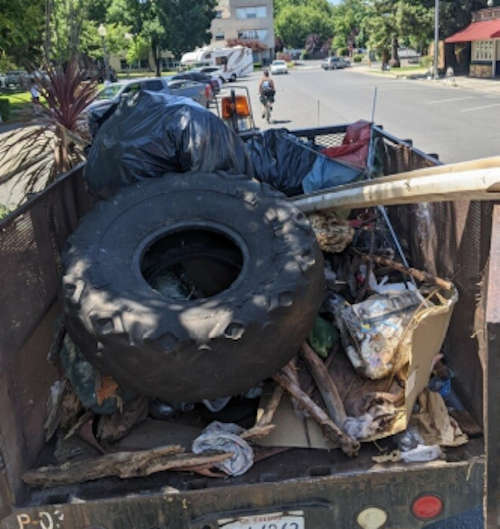
LAKE COUNTY, Calif. — Two dozen volunteers joined local agencies and braved the heat on the morning of June 19 to take part in the Clear Lake Shoreline Clean-Up.
The Lake County Water Resources Department’s AmeriCorps CivicSpark Fellows organized the four-hour event.
The fellows partnered with Lake County Special Districts, the cities of Clearlake and Lakeport, C&S Waste Solutions and Lake County Public Services in carrying out the cleanup.
Cleanup sites were located at Library Park in Lakeport, Redbud Park in Clearlake and Lucerne Harbor Park.
Lake County Water Resources reported that the cleanup resulted in four trailers and 32 bags of trash collected, totaling more than 1,300 pounds of waste.
Over 1,000 pounds were collected at Library Park in Lakeport, 120 pounds were collected at Redbud Park in Clearlake and 224 pounds were collected at Lucerne Harbor Park in Lucerne, according to a report from CivicSpark Fellow Nikol Damato.
Damato said the cleanup was a success, exceeding the goal of having between 15 and 20 volunteers.
In total, 24 community members volunteered, Damato said, with 11 in Lakeport, eight in Clearlake and five in Lucerne.
City Manager Kevin Ingram said in a report on the event that the city of Lakeport was grateful for the volunteers of all ages who worked to clean up the trash and debris from Lakeport’s shoreline.
“Some volunteers focused on the area between Library Park and the site of the new Lakefront Park on North Main Street,” said Ingram.
He added, “Another group led by City Councilmember Michael Froio tackled the shoreline along Lakeshore Boulevard.”
Damato said volunteers served for an average of 1.5 hours each for a total of approximately 36 hours served for the event.
Email Elizabeth Larson at