 How to resolve AdBlock issue?
News
The commission will meet at 5:30 p.m. Wednesday, Nov. 10, in the council chambers at Lakeport City Hall, 225 Park St.
The council chambers will be open to the public for the meeting. In accordance with updated guidelines from the state of California and revised Cal OSHA Emergency Temporary Standards, persons who are not fully vaccinated for COVID-19 are required to wear a face covering at this meeting.
The agenda is available here.
To speak on an agenda item, access the meeting remotely here; the meeting ID is 986 6166 5155. To join by phone, dial 1-669-900-9128.
Comments can be submitted by email to
Please indicate in the email subject line "for public comment" and list the item number of the agenda item that is the topic of the comment. Comments that are read to the council will be subject to the three minute time limitation (approximately 350 words). Written comments that are only to be provided to the council and not read at the meeting will be distributed to the council before the meeting.
On Tuesday, the commission will consider a minute order to amend the Municipal Code for compliance with SB 1383.
City documents explained that SB 1383 requires that jurisdictions adopt an ordinance or other enforceable requirement that requires the recycling and/or salvage or at least 65% of nonhazardous construction and demolition materials for residential and nonresidential projects in accordance with the California Green Building Standards. Cities also must adopt the Model Water Landscape Ordinance.
In other business, the commission will discuss and review possible amendments to the Lakeport Municipal Code in order to reflect state regulations and rulemaking actions by the California Department of Cannabis Control.
Email Elizabeth Larson at
The committee, or LEDAC, will meet via Zoom from 7:30 to 9 a.m. Wednesday, Nov. 10.
The meeting is open to the public.
The meeting will be held via Zoom: Meeting ID, 847 9466 6151; pass code, 619840. Dial by your location, 669-900-6833.
On the agenda is the recruitment of LEDAC members.
Three positions on LEDAC expire at the end of December. The city is accepting applications for two-year terms beginning on Jan. 1, 2022. The application form may be found on the city's website and will be accepted until Nov. 22. For additional information, contact Deputy City Clerk Hilary Britton at 707-263-5615, Extension 102, or by email at
The committee will continue to review and work on updating the Lakeport Economic Development Strategic Plan, with a focus on the third goal, “Strive to enhance the historic downtown and lakefront areas." LEDAC Chair Wilda Shock said City Manager Kevin Ingram will present the Logic Model approach to this element.
Ingram and city Community Development Director Jenni Byers will give updates on city projects and activities, and there also will be member reports and citizens input.
The remaining LEDAC meeting this year will take place from 7:30 to 9 a.m. on Wednesday, Dec. 8.
LEDAC advocates for a strong and positive Lakeport business community and acts as a conduit between the city and the community for communicating the goals, activities and progress of Lakeport’s economic and business programs.
Members are Chair Wilda Shock and Vice Chair Denise Combs, Bonnie Darling, Candy De Los Santos, Monica Flores, Pam Harpster, Andy Lucas, Alicia Russell, Laura Sammel and Marie Schrader, with Bill Eaton as an ex officio member. City staff who are members include City Manager Kevin Ingram and Community Development Director Jenni Byers.
Email Elizabeth Larson at
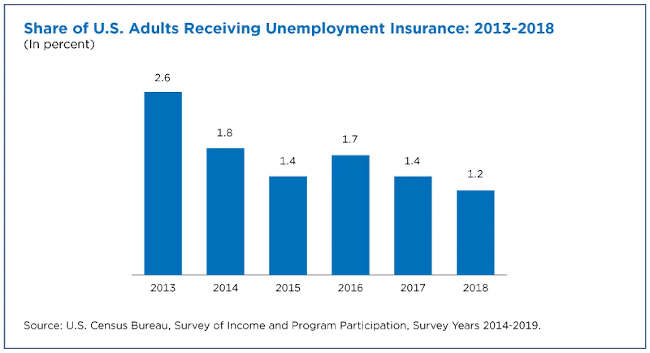
In 2018, the share of adults who received Unemployment Insurance (UI) at some point during the year reached a six-year low as the economy strengthened following the Great Recession.
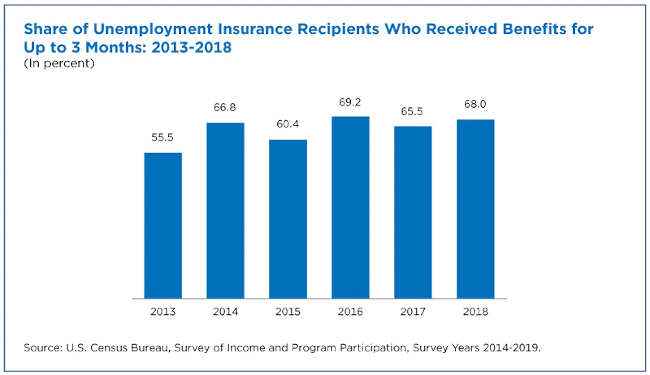
Also, seven in 10 adults who received UI at any point during 2018 received it for three months or fewer.
These findings come from tables recently released by the U.S. Census Bureau, detailing demographic characteristics of recipients of social insurance programs in 2018 captured in the Survey of Income and Program Participation (SIPP).
The newly released tables, combined with data from the U.S. Department of Labor and the Census Bureau’s experimental Household Pulse Survey (HPS), also shed light on how the COVID-19 pandemic reshaped the profile of unemployment insurance recipients.
Unemployment insurance after the Great Recession
The UI program supports millions of workers who lose their jobs through no fault of their own every year. Typically, more adults receive UI during times of economic recession, and fewer adults receive it during times of economic expansion.
Often, Congress extends the number of weeks workers can collect UI during recessions, as it did during the so-called Great Recession from December 2007-June 2009. Emergency Unemployment Compensation (EUC) was available in some form from 2008 through 2013.
The following decade was a time of economic recovery. In fact, 2018 marked the ninth consecutive year of the longest post-WWII expansion, which lasted through February 2020 until the pandemic took hold in the United States.
The Great Recession unemployment rate peaked at 10% in October 2009, but the lingering effects of the recession and the availability of extended benefits under EUC were evident in elevated receipt of UI as late as 2013.
In 2013, 2.6% of adults received UI at some point. However, by 2018, the share of adults that received UI had been cut in half to 1.2%.
As the share of Americans receiving UI fell, more received the benefits for shorter periods except in 2015 (when the share of recipients of up to 3 months of UI was about the same as in 2013).
In 2013, just over half of UI recipients collected the benefits for three or fewer months; by 2018, nearly 70% of recipients collected UI for three or fewer months.
UI transformed during COVID-19
The federal government responded to the challenges of the COVID-19 pandemic by transforming the UI program.
The program underwent several temporary changes under the Coronavirus Aid, Relief, and Economic Security Act (CARES) Act enacted in March 2020. Weekly benefit checks were increased by $600 and the number of weeks of benefits available were extended.
Plus, it created the Pandemic Unemployment Assistance (PUA) program, allowing individuals who were not previously eligible for regular UI — such as workers with shorter work histories, self-employed workers, independent contractors, and gig workers — to receive benefits if their employment was affected by COVID-19.
Administrative UI data from the Department of Labor show the magnitude of disruption and changes to the UI program triggered by the pandemic. In the second quarter of 2019, before the pandemic hit the United States, 2.6 million UI claims were filed. In the second quarter of 2020, 33.7 million claims were filed.
What happens after the pandemic
Will UI follow the same trajectory in post-pandemic recovery as after the Great Recession?
Data from the Census Bureau’s experimental Household Pulse Survey (HPS) show that UI receipt remained high although economic conditions improved by the summer of 2021. By June 2021, 6.8% of adults in households reported receiving UI in the first half of 2021.
SIPP and HPS data also show that the profile of UI recipients changed in the wake of the pandemic-related economic disruption and changes to the UI program.
In 2018, SIPP data show that about 60% of UI recipients were non-Hispanic White adults. HPS data show that in June 2021, about 50% of all those who reported receiving UI since January were non-Hispanic White adults.
In 2018, about 30% of those who received UI had a bachelor's degree or higher, according to the SIPP. In June 2021, the HPS found that only about 20% of adults who reported UI receipt had at least a bachelor’s degree.
The living situation of UI recipients has also changed during the pandemic. The SIPP data from 2018 show that 15.6% of UI recipients lived alone. By June 2021, the HPS shows that only 7.0% of households that reported receiving UI that year were single-person households.
About the data
SIPP is a nationally representative longitudinal survey administered by the U.S. Census Bureau that provides comprehensive information on the dynamics of income, employment, household composition, and government program participation.
For technical documentation and more information about SIPP data quality, please visit the SIPP website's Technical Documentation page.
HPS is designed to provide near real-time data on how the pandemic is affecting American lives. Information on the methodology and reliability of these estimates can be found in the source and accuracy statements for each HPS data release.
Data users interested in state-level sample sizes, the number of respondents, weighted response rates and occupied housing unit coverage ratios can consult the quality measures file available at the same location.
All comparative statements in this report have undergone statistical testing and, unless otherwise noted, all comparisons are statistically significant at the 10% significance level.
The June 2021 data were collected from June 23-July 5, 2021 during week 33 of the survey. The Census Bureau sent invitations to 1,042,285 households and received a total of 66,262 responses, for a weighted response rate of 6.3%.
Daniel J. Perez-Lopez is a survey statistician in the Census Bureau’s Social, Economic, and Housing Statistics Division.

LOWER LAKE, Calif. — Habitat for Humanity Lake County has helped another family achieve its dream of homeownership.
On Saturday, Oct. 2, the Cimina-Jeffers family became the 38th family to be welcomed into their new home as part of Habitat for Humanity’s Homeownership Program.
Staff, volunteers and family gathered to celebrate with Heidi Jeffers, Dave Cimina and their children. The home was made possible by the generous donation of their lot to Habitat for Humanity Lake County by Sharon Bianchi.
As part of the dedication festivities, Grocery Outlet Clearlake donated household supplies, groceries and a gift certificate to help the family transform their new house in Lower Lake into a home.
“Everyone has worked so hard to make this happen; there were times we thought it wouldn’t work out but Habitat’s perseverance and encouragement helped make this real. We’ve struggled for so long. Now we have a home, our children have room to grow, we’re not crowded … it’s an unbelievable relief,” said Jeffers.
“They deserve this,” added Cimina, referring to his family. “We’re so grateful to Habitat for this opportunity. We’re appreciative of everything everyone has done. And we thank Grocery Outlet for the generosity too. It’s a big help.”
If you or someone you know is interested in Habitat’s First Time Homebuyer program, please contact the office at 707-994-1100 or come by at 15312 Lakeshore Drive, Clearlake, for more information.
The commission will meet beginning at 6 p.m. Tuesday, Nov. 9, in the council chambers at Clearlake City Hall, 14050 Olympic Drive.
The agenda can be found here.
Submit comments and questions in writing for commission consideration by sending them to
Administrative Services Director/City Clerk Melissa Swanson at
Community members also can participate via Zoom.
To give the planning commission adequate time to review your questions and comments, please submit written comments before 4 p.m. Tuesday, Nov. 9.
The meeting will be broadcast live on the YouTube channels for the city of Clearlake or Lake County PEG TV.
At the start of the meeting, the commission will swear in the new planning commissioner, Terry Stewart.
The Clearlake City Council selected Stewart from a field of three applicants at its Thursday meeting. He succeeds Kathryn Davis, who resigned her seat in September.
The commission — whose other members are Robert Coker, Lisa Wilson, Erin McCarrick and Fawn Williams — will then appoint its new chair and vice chair.
In an item continued from Oct. 26, the commission will consider conditional use permit applications, including a mitigated negative declaration and development agreement, for a commercial cannabis operation at 2185 Ogulin Canyon Road.
Ogulin Hills Holdings LLC is planning operations including manufacturing, cultivation, distribution and a retail dispensary with delivery only on the 21.25-acre site, according to city documents.
The proposed project includes two 5,000 square foot buildings for manufacturing, and processing; a 3,000 square foot building for distribution, retail delivery only and office space; 10 greenhouses, each measuring 1,875 square feet; five water storage tanks, with size to be determined; and a 225 square foot trash enclosure.
The staff report said the project is anticipated to have up to 10 employees during typical operations and up to 25 employees during harvest season.
Email Elizabeth Larson at

After a lackluster jobs report in September 2021, the latest news on employment gives Americans plenty of cheer about ahead of the holiday season.
In total, 531,000 jobs were added in October – outstripping the already optimistic predictions of economists. This caused the unemployment rate to fall 0.2 percentage points to 4.6%.
Even with those gains, the U.S. is still below pre-pandemic employment levels. But as an economist, I see details in the latest jobs report that suggest the workforce is emerging from 18 months of what has been the “new normal” and getting back to, well, the “normal normal.”
Remote working in the rear-view mirror?
Americans are returning to offices after a year-and-a-half of Zoom meetings and digital water cooler moments. The pandemic had opened the eyes of many potential workers to the possibility that working from home might be preferable to on-site work.
But the jobs report shows that this may be passing. In October, 11.6% of employees worked remotely due to the pandemic, down from 13.2% in the previous month.
Working from home offered flexibility, especially to people who held down two jobs. A lot of people found they could get by with one job, work from home and save money on commuting and child care. The drop in remote working could indicate that some families came to realize that while this worked to cover a shorter-term period during the pandemic, it ate away at household savings, getting to a point where working on site was necessary again.
It also signifies a change of attitude that may explain why employment in the leisure and hospitality sector has bounced back. One possible reason for lower-than-expected job gains in September was that people were hesitant to return to worksites where they would have to mix with people – such as at bars, restaurants and in stores – preferring to spend more time at home.
October’s jobs report – which saw strong gains in leisure and hospitality – suggests that peoples’ ability to delay returning to work may be coming to an end and potentially that they are more open to returning to on-site jobs, perhaps encouraged by vaccination rates and falling case numbers.
Wages up, workers back … time for the Fed to act?
There is some evidence that the “great resignation” – or more accurately, the great “not taking up low-paid jobs” – era was short-lived and winding down.
Many potential workers had seemingly been hesitant to return to lower-paid food service jobs as well as employment in the leisure and hospitality sector due to relative low wages and rigid work schedules.
But the latest report shows evidence of increases in wages and salaries. In October, average hourly earnings increased by 11 cents to US$30.96 – continuing the upward trend of recent months. It means that average earnings are almost 5% higher that they were a year ago.
Wage increases look set to continue for some time. The latest report shows that labor costs increased 8.3% year-on-year in the third quarter as job opening rates remained pretty high, putting further upward pressure on pay.
This is great for workers but does pose a challenge to the Federal Reserve, which must keep inflation in check.
On Nov. 3, the Fed said it would begin scaling down its pandemic-era policy of buying Treasury bonds and other assets, which has the effect of gently reducing the supply of money in the economy. The Fed has also said it might lift interest rates earlier than planned if necessary to tamp down inflation risks.
The stronger-than-expected jobs report and increases in employment costs may prompt it to act more quickly. That said, the Fed may still want to tread cautiously here. Supply chain concerns remain and will need to be worked out before central bankers can conclude that overall inflation is more than a short-term issue.
Not all American workers are seeing the bounce
There is no doubt that the October jobs report was encouraging.
But public sector employment was down, and that is important. This is largely a result of the pandemic. Retail sales were down significantly in 2020 and as a result state budgets are tight - in short, they have suffered from lackluster tax revenue sources.
This might make it harder for public sector jobs – in local government and schools – to bounce back as robustly as the rest of the economy.
[Over 115,000 readers rely on The Conversation’s newsletter to understand the world. Sign up today.]
Christopher Decker, Professor of Economics, University of Nebraska Omaha
This article is republished from The Conversation under a Creative Commons license. Read the original article.