 How to resolve AdBlock issue?
News
LAKE COUNTY, Calif. — After a round of interviews during its Thursday night meeting, the Clearlake City Council chose the city’s newest planning commissioner.
In a unanimous vote, the council appointed Terry Stewart to a term that ends in March 2025.
He will fill the seat vacated in September by Kathryn Davis.
Stewart, who submitted his application on Tuesday, was one of three applicants who sought the position. Also applying were Thomas Burnett and Jim Scholz.
A lifelong Lake County resident, Stewart graduated from Lower Lake High School in 1968. He went on to get his contractor’s license. He owned and operated Floortown from 1980 to 2000, and continues to operate a shades and blinds business and owns a number of rentals.
Stewart was a firefighter with the fire department from 1976 to 1989, a former Clear Lake Chamber president and remains a member of the Clearlake Rotary Club.
Council members asked him a variety of questions; one of the questions was about his view of the city and its future.
He said he’s optimistic about the city’s direction, noting that what’s happened over the last two or three years has been “a marked turnaround.”
Stewart said he was impressed with improvement to the city’s streets thanks to the Measure V sales tax, and also noted he’s very pleased with the development of Austin Park. “It’s fabulous, really.”
He added, “I’m upbeat about the future of the community,” noting he wants to retain the flavor of a small town, but make it nicer and more welcoming.
Councilwoman Joyce Overton thanked all of the applicants, adding that the council doesn’t usually have such a hard choice.
Ultimately, council members favored Stewart for the position, with Councilman Russ Cremer moving to approve his appointment. Councilman David Claffey seconded and the council approved the motion 5-0.
The council also appointed Michael McKeown to the Clearlake Marketing Committee. McKeown, the sole applicant, will succeed Susan Bloomquist, who resigned in August.
In other business during the two-and-a-half-hour-long meeting, council members discussed a local syringe exchange program, Any Positive Change, that had been operating in the city and had begun to distribute glassware for smoking drugs, which state law allows such programs to do in the interest of reducing disease.
The program is no longer in the city after the owner of the property where it had been operating severed the relationship.
On Tuesday, the Board of Supervisors also discussed the program, approving a resolution that continues to authorize the syringe program but enacting a temporary restriction on distributing any glassware.
The council chose to take no action regarding rules for syringe supply programs, instead choosing to wait to respond and set up rules should Any Positive Change apply to the state to operate in the city.
Council members also got an update on the redistricting maps for county, state and federal offices that are now in the draft stages, but chose to offer no additional input on the maps at this time.
Email Elizabeth Larson atThis email address is being protected from spambots. You need JavaScript enabled to view it. . Follow her on Twitter, @ERLarson, or Lake County News, @LakeCoNews.
In a unanimous vote, the council appointed Terry Stewart to a term that ends in March 2025.
He will fill the seat vacated in September by Kathryn Davis.
Stewart, who submitted his application on Tuesday, was one of three applicants who sought the position. Also applying were Thomas Burnett and Jim Scholz.
A lifelong Lake County resident, Stewart graduated from Lower Lake High School in 1968. He went on to get his contractor’s license. He owned and operated Floortown from 1980 to 2000, and continues to operate a shades and blinds business and owns a number of rentals.
Stewart was a firefighter with the fire department from 1976 to 1989, a former Clear Lake Chamber president and remains a member of the Clearlake Rotary Club.
Council members asked him a variety of questions; one of the questions was about his view of the city and its future.
He said he’s optimistic about the city’s direction, noting that what’s happened over the last two or three years has been “a marked turnaround.”
Stewart said he was impressed with improvement to the city’s streets thanks to the Measure V sales tax, and also noted he’s very pleased with the development of Austin Park. “It’s fabulous, really.”
He added, “I’m upbeat about the future of the community,” noting he wants to retain the flavor of a small town, but make it nicer and more welcoming.
Councilwoman Joyce Overton thanked all of the applicants, adding that the council doesn’t usually have such a hard choice.
Ultimately, council members favored Stewart for the position, with Councilman Russ Cremer moving to approve his appointment. Councilman David Claffey seconded and the council approved the motion 5-0.
The council also appointed Michael McKeown to the Clearlake Marketing Committee. McKeown, the sole applicant, will succeed Susan Bloomquist, who resigned in August.
In other business during the two-and-a-half-hour-long meeting, council members discussed a local syringe exchange program, Any Positive Change, that had been operating in the city and had begun to distribute glassware for smoking drugs, which state law allows such programs to do in the interest of reducing disease.
The program is no longer in the city after the owner of the property where it had been operating severed the relationship.
On Tuesday, the Board of Supervisors also discussed the program, approving a resolution that continues to authorize the syringe program but enacting a temporary restriction on distributing any glassware.
The council chose to take no action regarding rules for syringe supply programs, instead choosing to wait to respond and set up rules should Any Positive Change apply to the state to operate in the city.
Council members also got an update on the redistricting maps for county, state and federal offices that are now in the draft stages, but chose to offer no additional input on the maps at this time.
Email Elizabeth Larson at
CLEARLAKE, Calif. — The city of Clearlake is holding a hybrid community engagement meeting to collect public input on the proposed Burns Valley Sports Complex and Recreation Center.
The meeting will take place from 3:30 to 5 p.m.Monday, Nov. 8.
The in-person portion of the meeting will be in council chambers at Clearlake City Hall, located at 14050 Olympic Drive in Clearlake.
Virtual attendance will be via Zoom using meeting ID 846 1886 0779, passcode 436559.
Everyone in the community is invited to share their input on recreation and design preferences. Discussions and activities will be used to propose additional park features and amenities for the City’s application to the Rural Recreation and Tourism, or RRT, Grant Program offered through the California Department of Parks and Recreation and funded by Prop 68.
The RRT grant seeks to create new recreation features that support economic, tourism and health-related goals.
On Wednesday, November 4, the city published an online survey to collect initial thoughts from community members.
Suggestions from the survey will be considered and built upon in the community meeting on Monday.
The survey is available at https://www.surveymonkey.com/r/3TS3CMG.
For more information about the hybrid meeting, visit the city’s Facebook page or email Tina Viramontes atThis email address is being protected from spambots. You need JavaScript enabled to view it. .
The meeting will take place from 3:30 to 5 p.m.Monday, Nov. 8.
The in-person portion of the meeting will be in council chambers at Clearlake City Hall, located at 14050 Olympic Drive in Clearlake.
Virtual attendance will be via Zoom using meeting ID 846 1886 0779, passcode 436559.
Everyone in the community is invited to share their input on recreation and design preferences. Discussions and activities will be used to propose additional park features and amenities for the City’s application to the Rural Recreation and Tourism, or RRT, Grant Program offered through the California Department of Parks and Recreation and funded by Prop 68.
The RRT grant seeks to create new recreation features that support economic, tourism and health-related goals.
On Wednesday, November 4, the city published an online survey to collect initial thoughts from community members.
Suggestions from the survey will be considered and built upon in the community meeting on Monday.
The survey is available at https://www.surveymonkey.com/r/3TS3CMG.
For more information about the hybrid meeting, visit the city’s Facebook page or email Tina Viramontes at
LAKE COUNTY, Calif. — The Lake County Arts Council is inviting local high school students to take part in the annual Poetry Out Loud competition.
The competition takes place at the school and countywide levels.
The National Endowment for the Arts and the Poetry Foundation present Poetry Out Loud in partnership with counties and local partners all across the United States.
This national arts education program encourages the study of great poetry by offering free educational materials and a dynamic recitation competition for high school students across the country.
The Poetry Out Loud program helps students master public speaking skills and build self-confidence, while also learning more about both classic and contemporary poetry.
Any Lake County High School student currently enrolled in grades ninth to 12th are eligible to compete, whether enrolled in a public, private, alternative or home-school.
During fall and winter of 2021, schools are invited to hold classroom and school wide contests, with students advancing to a county competition in early 2022.
Nonschool organizations, such as after school clubs, libraries or nonprofit organizations, may also choose to run Poetry Out Loud. Students may only compete in one stream — either with their school or an organization.
More information is available at www.PoetryOutLoud.org, including guidelines for conducting the competition in-person or virtually.
The county champion will move on to represent our county in the State competition for a chance to advance to the national finals, which are planned to take place in Washington, D.C, April 26 to 27, 2022, and where $50,000 in awards and school stipends will be distributed.
Since the program began in 2005, more than 4.1 million students across the country have participated in Poetry Out Loud.
“All of the student competitors demonstrate their openness to the power of poetry and their commitment to developing skills that allow them to share that power with those around them,” said Michelle T. Boone, Poetry Foundation president.
As part of Poetry Out Loud, the National Endowment for the Arts and Poetry Foundation provide free, standards-based curriculum materials — all available online — which teachers may choose to use in their classrooms.
These include an online poetry anthology containing more than 1,100 classic and contemporary poems, a teacher’s guide, lesson plans, posters, and video and audio on the art of poetry recitation. Schools are welcome to access these resources at www.PoetryOutLoud.org.
High schools and organizations that wish to be part of the official Poetry Out Loud program must contact Georgina Marie Guardado, Lake County Poetry Out Loud coordinator, by Dec. 1 to participate. Guardado and the Lake County Arts Council will work with interested schools and organizations to include them in the official Poetry Out Loud program.
Poetry Out Loud offers school, county, and state level awards and prizes. Each state champion will receive $200 and will advance to the national championship, where $50,000 in awards and school stipends will be distributed, including a $20,000 award for the Poetry Out Loud National Champion.
The state champion’s school will receive a $500 stipend for the purchase of poetry materials. The first runner-up in each state will receive $100, with $200 for his or her school library.
The Poetry Foundation provides and administers all aspects of the monetary prizes awarded and travel arrangements for the Poetry Out Loud National Finals.
For further information on Poetry Out Loud, visit www.lakearts.org.
For questions, additional materials and guidelines, and to confirm participation, contact Guardado atThis email address is being protected from spambots. You need JavaScript enabled to view it. .
The competition takes place at the school and countywide levels.
The National Endowment for the Arts and the Poetry Foundation present Poetry Out Loud in partnership with counties and local partners all across the United States.
This national arts education program encourages the study of great poetry by offering free educational materials and a dynamic recitation competition for high school students across the country.
The Poetry Out Loud program helps students master public speaking skills and build self-confidence, while also learning more about both classic and contemporary poetry.
Any Lake County High School student currently enrolled in grades ninth to 12th are eligible to compete, whether enrolled in a public, private, alternative or home-school.
During fall and winter of 2021, schools are invited to hold classroom and school wide contests, with students advancing to a county competition in early 2022.
Nonschool organizations, such as after school clubs, libraries or nonprofit organizations, may also choose to run Poetry Out Loud. Students may only compete in one stream — either with their school or an organization.
More information is available at www.PoetryOutLoud.org, including guidelines for conducting the competition in-person or virtually.
The county champion will move on to represent our county in the State competition for a chance to advance to the national finals, which are planned to take place in Washington, D.C, April 26 to 27, 2022, and where $50,000 in awards and school stipends will be distributed.
Since the program began in 2005, more than 4.1 million students across the country have participated in Poetry Out Loud.
“All of the student competitors demonstrate their openness to the power of poetry and their commitment to developing skills that allow them to share that power with those around them,” said Michelle T. Boone, Poetry Foundation president.
As part of Poetry Out Loud, the National Endowment for the Arts and Poetry Foundation provide free, standards-based curriculum materials — all available online — which teachers may choose to use in their classrooms.
These include an online poetry anthology containing more than 1,100 classic and contemporary poems, a teacher’s guide, lesson plans, posters, and video and audio on the art of poetry recitation. Schools are welcome to access these resources at www.PoetryOutLoud.org.
High schools and organizations that wish to be part of the official Poetry Out Loud program must contact Georgina Marie Guardado, Lake County Poetry Out Loud coordinator, by Dec. 1 to participate. Guardado and the Lake County Arts Council will work with interested schools and organizations to include them in the official Poetry Out Loud program.
Poetry Out Loud offers school, county, and state level awards and prizes. Each state champion will receive $200 and will advance to the national championship, where $50,000 in awards and school stipends will be distributed, including a $20,000 award for the Poetry Out Loud National Champion.
The state champion’s school will receive a $500 stipend for the purchase of poetry materials. The first runner-up in each state will receive $100, with $200 for his or her school library.
The Poetry Foundation provides and administers all aspects of the monetary prizes awarded and travel arrangements for the Poetry Out Loud National Finals.
For further information on Poetry Out Loud, visit www.lakearts.org.
For questions, additional materials and guidelines, and to confirm participation, contact Guardado at
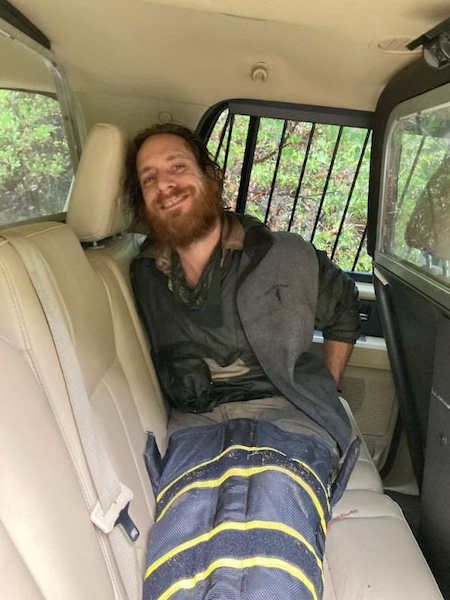
NORTH COAST, Calif. — Authorities on Thursday arrested a man who has been sought for months for his part in a series of Mendocino County burglaries and for shooting at a sheriff’s deputy.
The Mendocino County Sheriff’s Office said its deputies and sheriff’s K-9 took 40-year-old William Allan Evers into custody.
Evers has been the focus of searches in the areas of Elk and Albion since May, when he shot at a deputy responding to a burglary report.
Since then, there has been a continuing series of burglaries in remote areas of Mendocino County as well as sightings of Evers.
The Mendocino County Sheriff’s Office had last received a report of a man believed to be Evers in an Albion resident’s vegetable garden on Aug. 30.
Then, on Wednesday morning, an Albion resident saw a man crouched down beside an outbuilding near their residence. The man, who matched Evers’ description, then ran off into the wooded terrain.
Sheriff's deputies responded and searched the area during the morning and late afternoon hours.
During the late afternoon hours, sheriff's deputies encountered Evers from a distance but he eluded them because of the terrain.
On Thursday morning, three Mendocino County Sheriff’s deputies returned to the wooded area where they encountered Evers the previous day. That area is part of the Salmon Creek Forest near a specific location commonly referred to as the "doughnut shop.”
While searching approximately 300 yards downhill from the doughnut shop, two sheriff's deputies encountered Evers, who exited brushy terrain approximately 8 feet away from them. Evers immediately noticed the presence of the sheriff's deputies and ran back into the brushy terrain from where he had appeared.
The deputies chased after Evers who was approximately 30 feet away and running at a fast pace through the wooded terrain. One of the sheriff's deputies was a sheriff's office K-9 handler and deployed his partner "Takota," who gave chase.
Takota bit onto Evers' backpack and he kicked the dog, which caused the dog to disengage momentarily. Takota was given verbal deployment commands and again gave chase to Evers, eventually knocking him to the ground with a bite to the lower leg.
Sheriff's deputies reached Evers, who was attempting to stand up to resume fleeing and wrestled him back onto the ground and into handcuffs. The foot chase lasted approximately 50 yards until Evers was restrained in handcuffs.
Evers subsequently attempted to stand and flee while sitting on the ground in handcuffs.
Evers was eventually escorted to a nearby patrol vehicle and placed into a wrap leg restraint system due to his history of noncompliance and aggressive behavior.
Officials said Evers was transported to the Sheriff's Office Ukiah Station to meet with Mendocino County District Attorney’s Office investigators, sheriff's office detectives and to be medically cleared before being booked into the Mendocino County Jail.
Evers is being held on $2.5 million bail for a charge of attempted murder, according to jail booking records.
LAKE COUNTY, Calif. — After several failed negotiating attempts over the past four years, the county of Lake has finalized a new contract with the In-Home Supportive Services workers’ union.
Following a brief discussion on Tuesday morning, the Board of Supervisors — sitting as the In-Home Supportive Services Public Authority Board of Directors — unanimously approved the new memorandum of understanding between the authority and SEIU Local 2015 Union.
In-Home Supportive Services — or IHSS — workers will see their base wages rise by $0.65 an hour over minimum wage, effective Jan. 1.
The contract language said the base wage is the state or federal minimum wage, whichever is higher. At this time, California’s is $14 per hour, while the federal minimum wage is $7.25 an hour.
For the rest of 2021, Lake County’s IHSS workers will get $14 an hour. When California’s minimum wage increases to $15 on Jan. 1 — an increase for employers with 25 or more employees — their wages will increase to $15.65.
The agreement went into effect once both parties ratified it. The union approved it on Oct. 15, leaving the board’s action on Tuesday as the final step in the process.
Social Services Director Crystal Markytan said the agreement will be in effect until Dec. 31, 2023.
“These improvements are a huge step toward the $20 wage floor for all long-term care providers,” SEIU Local 2015 President April Verrett said. “The change is a testament to our continued mission behind our Time for $20 campaign. These efforts are propelled by Union members at bargaining tables across the state to raise standards in the industry, including access to health care, professional training, on-the-job safety, and secure retirement.”
The agreement also provides $5,000 annually for a protective personal equipment, or PPE, fund to be managed by the union.
Another $5,000 will be used each year to train IHSS workers. That funding, which also will be managed by SEIU, will include universal precautions, infection control, CPR, basic first aid, proper lifting techniques, symptoms of heart attack, symptoms of stroke, symptoms of diabetic coma, or working with patients who suffer from dementia, Alzheimer’s, mental health issues and autism.
Simone Tatman, a Lake County IHSS provider, said both the PPE and training are important right now.
“The only reason I had masks at the beginning of the COVID outbreak is because the union was able to get us some. But it was still hard to find sanitizer. And for providers who have three or four clients, having fresh PPE gets expensive, so this will really help,” Tatman said.
Until the new contract approval, Lake was among the 12 lowest-paid counties for IHSS workers, with providers getting only minimum wage, according to state data. The highest paid IHSS workers in the state are in San Francisco County, where they earn $18 an hour.
SEIU has announced several other new contracts with other counties over the last few months which are increasing pay rates across the state. Lake County’s new agreement will see local wages fall more into a medium statewide pay range for providers.
A large workforce
IHSS workers provide care to the elderly, those who are blind or have disabilities in their homes as an alternative to recipients having to live in more expensive and less comfortable care facilities.
The California Department of Social Services reported there are more than 520,000 IHSS providers currently serving more than 600,500 recipients across the state.
In Lake County alone, the state said there are 2,165 authorized IHSS recipients, with both the union and county officials reporting there are more than 1,800 providers.
SEIU Local 2015 Executive Vice President Arnulfo De La Cruz said IHSS providers are increasingly in need due to the growing senior population.
He said providers don’t just care for day-to-day needs, but they also are often first responders in emergencies.
The union, which represents 400,000 care workers across California, called the agreement a big win for Lake County’s IHSS workers, the majority of whom are women.
The National Direct Care Workforce Resource Center reports that 81% of direct care workers in California are female and 74% are people of color. Specific breakdowns for Lake County were not available from SEIU Local 2015.
Union officials said it’s the Board of Supervisors that’s responsible for setting wages and benefits for IHSS providers.
However, even though the board has that oversight, county officials told Lake County News that IHSS workers are not considered to be county employees but, rather, are employees of the IHSS program recipients themselves.
IHSS program recipients must be income eligible to the program in order to receive benefits by way of payment to their provider. IHSS recipients retain their exclusive right to hire, fire and supervise their providers. The Public Authority, however, conducts fingerprinting, the county reported.
The California Department of Social Services reported that for September, the most recent month for which data is available, Lake County’s 2,165 authorized IHSS recipients were receiving a total of 253,744 hours, an average of 117 hours per recipient.
The program is paid for by federal and state sources. County officials said the state pays 65% of the program’s total cost, and 35% is paid for by Lake County.
To pay its share of the costs, Lake County draws from sources that include 1991 Realignment funds, the same funding source for other Social Services programs such as Foster Care Assistance Payments, Child Welfare Services, the Adoption Assistance Program, CalWORKs, and administration costs for Foster Care, CalFRESH and CalWORKs.
At Tuesday’s board meeting it was reported that Lake County’s total annual portion for the IHSS program ranges between $6.5 million and $7 million.
Years without a contract
During the past year, a number of IHSS workers who are SEIU members appeared at Board of Supervisors meetings to ask for a wage increase. At one point they also rallied outside of the courthouse with signs.
“We’ve had an expired contract,” De La Cruz said.
De La Cruz said the contract expired eight years ago and IHSS providers had gone seven years without raises, other than minimum wage increases.
The closed-door negotiation process that began this year was the fourth time since 2017 that the county and union had attempted to reach a new contract, the county of Lake reported.
While the three earlier attempts had failed, this time there was progress, and the county and the union reached a tentative agreement on Sept. 17 after what the union said were “months of often emotional negotiations.”
“This contract took four years of bargaining with the county,” said Tatman. “It feels good that we were finally heard. We’ve been through a lot, and the pandemic just made it worse.”
De La Cruz said of the contract, “It’s a real economic generator for the largest workforce.”
He added, “There is a crisis of care in Lake County and we want them to put care first.”
Correction: A previous version of this story had reported, based on statements at the Board of Supervisors meeting on Nov. 2, that Lake County’s IHSS workers would get $14.65 an hour for the rest of the year. However, the union clarified that the increase of $15.65 goes into effect on Jan. 1, 2022, and there is no earlier stepped increase.
Email Elizabeth Larson atThis email address is being protected from spambots. You need JavaScript enabled to view it. . Follow her on Twitter, @ERLarson, or Lake County News, @LakeCoNews.
Following a brief discussion on Tuesday morning, the Board of Supervisors — sitting as the In-Home Supportive Services Public Authority Board of Directors — unanimously approved the new memorandum of understanding between the authority and SEIU Local 2015 Union.
In-Home Supportive Services — or IHSS — workers will see their base wages rise by $0.65 an hour over minimum wage, effective Jan. 1.
The contract language said the base wage is the state or federal minimum wage, whichever is higher. At this time, California’s is $14 per hour, while the federal minimum wage is $7.25 an hour.
For the rest of 2021, Lake County’s IHSS workers will get $14 an hour. When California’s minimum wage increases to $15 on Jan. 1 — an increase for employers with 25 or more employees — their wages will increase to $15.65.
The agreement went into effect once both parties ratified it. The union approved it on Oct. 15, leaving the board’s action on Tuesday as the final step in the process.
Social Services Director Crystal Markytan said the agreement will be in effect until Dec. 31, 2023.
“These improvements are a huge step toward the $20 wage floor for all long-term care providers,” SEIU Local 2015 President April Verrett said. “The change is a testament to our continued mission behind our Time for $20 campaign. These efforts are propelled by Union members at bargaining tables across the state to raise standards in the industry, including access to health care, professional training, on-the-job safety, and secure retirement.”
The agreement also provides $5,000 annually for a protective personal equipment, or PPE, fund to be managed by the union.
Another $5,000 will be used each year to train IHSS workers. That funding, which also will be managed by SEIU, will include universal precautions, infection control, CPR, basic first aid, proper lifting techniques, symptoms of heart attack, symptoms of stroke, symptoms of diabetic coma, or working with patients who suffer from dementia, Alzheimer’s, mental health issues and autism.
Simone Tatman, a Lake County IHSS provider, said both the PPE and training are important right now.
“The only reason I had masks at the beginning of the COVID outbreak is because the union was able to get us some. But it was still hard to find sanitizer. And for providers who have three or four clients, having fresh PPE gets expensive, so this will really help,” Tatman said.
Until the new contract approval, Lake was among the 12 lowest-paid counties for IHSS workers, with providers getting only minimum wage, according to state data. The highest paid IHSS workers in the state are in San Francisco County, where they earn $18 an hour.
SEIU has announced several other new contracts with other counties over the last few months which are increasing pay rates across the state. Lake County’s new agreement will see local wages fall more into a medium statewide pay range for providers.
A large workforce
IHSS workers provide care to the elderly, those who are blind or have disabilities in their homes as an alternative to recipients having to live in more expensive and less comfortable care facilities.
The California Department of Social Services reported there are more than 520,000 IHSS providers currently serving more than 600,500 recipients across the state.
In Lake County alone, the state said there are 2,165 authorized IHSS recipients, with both the union and county officials reporting there are more than 1,800 providers.
SEIU Local 2015 Executive Vice President Arnulfo De La Cruz said IHSS providers are increasingly in need due to the growing senior population.
He said providers don’t just care for day-to-day needs, but they also are often first responders in emergencies.
The union, which represents 400,000 care workers across California, called the agreement a big win for Lake County’s IHSS workers, the majority of whom are women.
The National Direct Care Workforce Resource Center reports that 81% of direct care workers in California are female and 74% are people of color. Specific breakdowns for Lake County were not available from SEIU Local 2015.
Union officials said it’s the Board of Supervisors that’s responsible for setting wages and benefits for IHSS providers.
However, even though the board has that oversight, county officials told Lake County News that IHSS workers are not considered to be county employees but, rather, are employees of the IHSS program recipients themselves.
IHSS program recipients must be income eligible to the program in order to receive benefits by way of payment to their provider. IHSS recipients retain their exclusive right to hire, fire and supervise their providers. The Public Authority, however, conducts fingerprinting, the county reported.
The California Department of Social Services reported that for September, the most recent month for which data is available, Lake County’s 2,165 authorized IHSS recipients were receiving a total of 253,744 hours, an average of 117 hours per recipient.
The program is paid for by federal and state sources. County officials said the state pays 65% of the program’s total cost, and 35% is paid for by Lake County.
To pay its share of the costs, Lake County draws from sources that include 1991 Realignment funds, the same funding source for other Social Services programs such as Foster Care Assistance Payments, Child Welfare Services, the Adoption Assistance Program, CalWORKs, and administration costs for Foster Care, CalFRESH and CalWORKs.
At Tuesday’s board meeting it was reported that Lake County’s total annual portion for the IHSS program ranges between $6.5 million and $7 million.
Years without a contract
During the past year, a number of IHSS workers who are SEIU members appeared at Board of Supervisors meetings to ask for a wage increase. At one point they also rallied outside of the courthouse with signs.
“We’ve had an expired contract,” De La Cruz said.
De La Cruz said the contract expired eight years ago and IHSS providers had gone seven years without raises, other than minimum wage increases.
The closed-door negotiation process that began this year was the fourth time since 2017 that the county and union had attempted to reach a new contract, the county of Lake reported.
While the three earlier attempts had failed, this time there was progress, and the county and the union reached a tentative agreement on Sept. 17 after what the union said were “months of often emotional negotiations.”
“This contract took four years of bargaining with the county,” said Tatman. “It feels good that we were finally heard. We’ve been through a lot, and the pandemic just made it worse.”
De La Cruz said of the contract, “It’s a real economic generator for the largest workforce.”
He added, “There is a crisis of care in Lake County and we want them to put care first.”
Correction: A previous version of this story had reported, based on statements at the Board of Supervisors meeting on Nov. 2, that Lake County’s IHSS workers would get $14.65 an hour for the rest of the year. However, the union clarified that the increase of $15.65 goes into effect on Jan. 1, 2022, and there is no earlier stepped increase.
Email Elizabeth Larson at
MOU Lake County IHSS PublicAuthority SEIU2015 Through 12.31 by LakeCoNews on Scribd
LAKE COUNTY, Calif. — On Wednesday, arguments continued in a case against the county of Lake over the approval last year of the Maha Guenoc Valley resort near Middletown.
The arguments before Lake County Superior Court Judge J. David Markham began on Friday and were held over for continuation and conclusion on Wednesday afternoon.
In nearly two and a half additional hours of arguments, Markham heard the county and its representatives respond to the challenges lodged against the project — whose formal name is the Guenoc Valley Mixed Use Planned Development Project — filed by the Center for Biological Diversity and California Native Plant Society, with support from the California Attorney General’s Office.
Lotusland Investment Holdings Inc. plans to build the resort on a portion of the 16,000-acre Guenoc Ranch. The project will include 1,400 residential estate villas, 400 hotel units and 450 resort residential units at build out.
The petitioners have argued that the environmental impact report that the Board of Supervisors approved in July 2020 failed in its requirements under the California Environmental Quality Act, or CEQA, to fully consider key issues, primary among them, wildland fire risk, impacts on species of concern, water, greenhouse gas emissions and roads.
The case record is enormous, in excess of 85,000 pages, Markham said Tuesday. “I haven’t reviewed every page of the record, probably won't be doing so.”
On Wednesday afternoon, Arthur Coon, an attorney who specializes in CEQA cases, offered responses on behalf of the county.
Coon said the purpose of CEQA is to make sure government decisions are balanced and made with environmental concerns in mind, but it’s not meant to be used as an instrument for delay of development.
He said an environmental impact report, or EIR, “is the heart of CEQA.” It’s the highest form of environmental review and the most extensive CEQA document that can be produced or required.
While the fair argument test puts all presumptions about a project on the side of the challenger, once an EIR is prepared, Coon said the resumption flips in favor of an agency and against the challengers. Therefore, the EIR is presumed adequate and it’s the challengers’ burden to prove otherwise.
Coon said the plaintiffs and the Attorney General’s Office disagree with the EIR’s conclusions. “That’s fine but it’s not up to them to design or dictate the contents of the EIR.”
He addressed an issue he said had been brought up repeatedly by the plaintiffs, a computer model for wildfire behavior that they said should have been used but wasn’t. Coon said CEQA doesn’t say such a test has to be done and the petitioners haven’t explained why it was necessary.
Instead, he pointed to a “robust” chapter in the document addressing wildfire impact, which he said lays out in detail the existing environmental setting and the environmental conditions in Guenoc Valley. He said that document carefully reviewed federal and state regulations relating to fire safety as well as the county’s wildfire protection plan and emergency operations plan. Coon said the plan also offers mitigations.
Coon said the Maha Guenoc Valley resort project isn’t like the typical projects that are discussed in the literature on wildfire risks on low density development in the wildland urban interface.
He said all of those projects in the literature pose dangers, while this project doesn’t. Coon added that Maha Guenoc Valley is a “unique and model project” for the prevention of fires in low density development in a low fire area.
Coon finished his arguments by asking the court to “keep common sense in mind” and pay attention to the findings.
‘Wildfire has not made us stupid’
In her arguments, County Counsel Anita Grant explained that the Board of Supervisors, in its decision to approve the EIR, had to balance environmental concerns with the county’s economic vitality.
She said the project is expected to have 300 year-round permanent jobs in its first phase and at its height 750 construction jobs.
Considering the limitations of Lake County’s population, Grant said the board determined the project also would bring economic vitality to areas outside of the county, and would spur indirect secondary economic development from economic growth, pointing to the need for housing, schools, and regional infrastructure for shopping and stores.
Grant said the Lake County economic plan talks about the need to develop more tourism and the project is consistent with the goals of the Middletown Area Plan.
She said Lotusland representatives first came to Lake County several years ago and almost immediately began making contact with county representatives, fire and water districts, local environmental and communities groups, and the Middletown tribe.
Grant said the case suggests the project was rushed through, but the comment period was probably the longest allowed by CEQA.
“Also there seems to be some indication that there was not enough public outreach,” said Grant, noting numerous public meetings and discussions by local groups, and thoughtful comments offered by community members.
She credited the developer with its approach to working with Lake County. “It is quite often that rural communities are treated as being naive or stupid, unaware of consequences,” said Grant. “Lotusland has treated the county of Lake with respect.”
Regarding the consideration of wildfire risk, “Everybody in California is concerned about wildfire. Wildfire has touched so many of us,” Grant said, noting that identifying and dealing with wildfire risk has been part of the process.
“Lake County residents know better than many exactly what devastation means when it comes to wildfire,” she said. “Nobody has to tell the county of Lake about wildfire.”
That’s why the county can strongly recommend the project, Grant said. “The wildfire mitigations here are tremendous,” she said, adding that it can serve as a model for how other projects can operate in rural areas.
“CEQA raises questions and the answers to those questions are obviously not the same for every project,” Grant said.
Grant said the county hasn’t been shy in telling Lotusland what is required and the company has met those requirements.
Cal Fire and South Lake County Fire, along with other community stakeholders, worked with Lotusland, which designed the resort “to drastically reduce not only the factors which could ignite wildfires but those that feed and propel it forward,” said Grant, noting that fire safety in the south county area will be enhanced.
“This is truly a model for rural communities,” and how to develop responsibly, Grant said, adding it stands as an example of how to design a project without exacerbating wildfire risks.
She said the Center for Biological Diversity doesn’t want any development at all in fire zones. “While that may be their judgment, CEQA does not preclude this development,” but rather it requires certain questions be answered and addressed, said Grant.
Grant suggested the petitioners were trying to legislate more draconian CEQA requirements than are actually required.
“Development can’t simply stop. Rural communities have to be allowed to grow and develop,” Grant said, noting that failing to develop here won't solve the problem of wildfire in Lake County or any area.
Grant said the county also wanted to take note of something that doesn’t get much attention — that the project has taken a giant step forward in consideration of cultural resources. She said Lotusland has worked collaboratively with the Middletown Rancheria.
The value of the project “doesn’t mean the county was blinded to the potential consequence of development.” Rather, Grant said work has been done to make sure it’s responsible development.
She also answered statements about an errata to the EIR that the petitioners suggested had shown that the county knew the document was flawed. Grant said it was an attempt to respond to late comments that had come in.
She noted the delicate task for balancing interests when approving a project, which is left to the discretion of local officials.
“Wildfire has not made us stupid. Wildfire has told us what we need to do,” Grant said, and the county is extremely responsive to those messages.
Not ‘outside nit-pickers’
Peter Broderick of the Center for Biological Diversity, who had made his initial arguments on Friday, offered responses on Wednesday, noting that the petitioners are not “outside nit-pickers’ as he said they were portrayed by Lotusland’s counsel last week. “We’re here on our members’ behalf.”
He said a theme emerged on Friday in the opposing counsels’ remarks that many issues raised now can be brought up later, such as roads, water and grazing.
However, Broderick said it will be too late to raise issues once the EIR is certified, as that is a “point of no return.” CEQA establishes strict requirements for EIR approval and once the document is certified, the developer enjoys safe harbor. At that point, he said it doesn’t matter if the EIR’s findings are dead wrong. “There is no recourse.”
That’s why it’s so important to get it right now, said Broderick. “It’ll be much more expensive to ignore them now and have the community and environment suffer the results later.”
Andrew Contreiras of the California Attorney General’s Office clarified that the petitioners were not requiring any specific method of wildfire risk analysis like a computer model, but that some analysis needed to be presented in the document.
All factors that increase wildfire risk are present in this particular project, said Contreiras, arguing that the analysis the EIR required was omitted.
He said wildfire is a critical issue for the state, with potentially disastrous effects not only on a local community but also the surrounding region, in addition to the smoke impact that causes air quality impacts throughout the state. That’s why the state has required specific types of analysis be done on new individual projects located in high wildfire severity zones and the State Responsibility Area.
Noting that the low density residential project would be built over a 25-square-mile area that’s bigger than the city of Clearlake, Contreiras said it requires a project-specific analysis for wildfire risk.
“The question in this case in our view is simple,” said Contreiras: Does the EIR disclose an analysis of wildfire risk adequate for the purpose of public engagement and policy decision making? And could the public and the Board of Supervisors read that discussion and come away with an understanding of this project’s impact on wildfire risk? Contreiras said the answer is no.
He also faulted the EIR for failing to properly analyze “option C,” which the document said “would result in lesser significant impacts than the Proposed Project with respect to aesthetics, air quality, biological resources, cultural resources, geology and soils, greenhouse gas emissions, and hydrology and water quality.”
Option C called for reducing the overall footprint of the project, increasing open space but keeping the total number or residential units at the same number, with the average lot size reduced from 4.8 acres to 0.8 acres.
Contreiras said the county didn’t find that alternative feasible based on the economics, but he said the EIR didn’t disclose the reasons for that decision as it should.
Broderick offered further comments, raising issue with there being no evidence offered of how the project would reduce wildfire risk, that Lotusland didn’t explain how it would use grazing to mitigate wildfire or offer information on wildfire evacuation exits.
He said the EIR found greenhouse gas emissions would be significant despite mitigations, but mitigations weren’t included until the errata included some feasible measures.
“There are some easy fixes here,” he said.
Broderick said there could be agreements to conditions such as using the water only for wildland fire use, or establishing annual limitations on use.
There's a process for dealing with speculative issues so the public understands up front what is going on. “The EIR didn’t do that here,” he said.
Brian Flynn of the California Native Plant Society also faulted the EIR for not analyzing the impacts on plant life, and for not offering more details about grazing.
He said the document also refused to assess impacts on special status plants.
Following the conclusion of the argument, Judge Markham adjourned the hearing shortly before 4:45 p.m.
An additional brief on wildfire evacuation impacts is due on Nov. 19 and Markham is expected to have a ruling within the coming month.
Email Elizabeth Larson atThis email address is being protected from spambots. You need JavaScript enabled to view it. . Follow her on Twitter, @ERLarson, or Lake County News, @LakeCoNews.
The arguments before Lake County Superior Court Judge J. David Markham began on Friday and were held over for continuation and conclusion on Wednesday afternoon.
In nearly two and a half additional hours of arguments, Markham heard the county and its representatives respond to the challenges lodged against the project — whose formal name is the Guenoc Valley Mixed Use Planned Development Project — filed by the Center for Biological Diversity and California Native Plant Society, with support from the California Attorney General’s Office.
Lotusland Investment Holdings Inc. plans to build the resort on a portion of the 16,000-acre Guenoc Ranch. The project will include 1,400 residential estate villas, 400 hotel units and 450 resort residential units at build out.
The petitioners have argued that the environmental impact report that the Board of Supervisors approved in July 2020 failed in its requirements under the California Environmental Quality Act, or CEQA, to fully consider key issues, primary among them, wildland fire risk, impacts on species of concern, water, greenhouse gas emissions and roads.
The case record is enormous, in excess of 85,000 pages, Markham said Tuesday. “I haven’t reviewed every page of the record, probably won't be doing so.”
On Wednesday afternoon, Arthur Coon, an attorney who specializes in CEQA cases, offered responses on behalf of the county.
Coon said the purpose of CEQA is to make sure government decisions are balanced and made with environmental concerns in mind, but it’s not meant to be used as an instrument for delay of development.
He said an environmental impact report, or EIR, “is the heart of CEQA.” It’s the highest form of environmental review and the most extensive CEQA document that can be produced or required.
While the fair argument test puts all presumptions about a project on the side of the challenger, once an EIR is prepared, Coon said the resumption flips in favor of an agency and against the challengers. Therefore, the EIR is presumed adequate and it’s the challengers’ burden to prove otherwise.
Coon said the plaintiffs and the Attorney General’s Office disagree with the EIR’s conclusions. “That’s fine but it’s not up to them to design or dictate the contents of the EIR.”
He addressed an issue he said had been brought up repeatedly by the plaintiffs, a computer model for wildfire behavior that they said should have been used but wasn’t. Coon said CEQA doesn’t say such a test has to be done and the petitioners haven’t explained why it was necessary.
Instead, he pointed to a “robust” chapter in the document addressing wildfire impact, which he said lays out in detail the existing environmental setting and the environmental conditions in Guenoc Valley. He said that document carefully reviewed federal and state regulations relating to fire safety as well as the county’s wildfire protection plan and emergency operations plan. Coon said the plan also offers mitigations.
Coon said the Maha Guenoc Valley resort project isn’t like the typical projects that are discussed in the literature on wildfire risks on low density development in the wildland urban interface.
He said all of those projects in the literature pose dangers, while this project doesn’t. Coon added that Maha Guenoc Valley is a “unique and model project” for the prevention of fires in low density development in a low fire area.
Coon finished his arguments by asking the court to “keep common sense in mind” and pay attention to the findings.
‘Wildfire has not made us stupid’
In her arguments, County Counsel Anita Grant explained that the Board of Supervisors, in its decision to approve the EIR, had to balance environmental concerns with the county’s economic vitality.
She said the project is expected to have 300 year-round permanent jobs in its first phase and at its height 750 construction jobs.
Considering the limitations of Lake County’s population, Grant said the board determined the project also would bring economic vitality to areas outside of the county, and would spur indirect secondary economic development from economic growth, pointing to the need for housing, schools, and regional infrastructure for shopping and stores.
Grant said the Lake County economic plan talks about the need to develop more tourism and the project is consistent with the goals of the Middletown Area Plan.
She said Lotusland representatives first came to Lake County several years ago and almost immediately began making contact with county representatives, fire and water districts, local environmental and communities groups, and the Middletown tribe.
Grant said the case suggests the project was rushed through, but the comment period was probably the longest allowed by CEQA.
“Also there seems to be some indication that there was not enough public outreach,” said Grant, noting numerous public meetings and discussions by local groups, and thoughtful comments offered by community members.
She credited the developer with its approach to working with Lake County. “It is quite often that rural communities are treated as being naive or stupid, unaware of consequences,” said Grant. “Lotusland has treated the county of Lake with respect.”
Regarding the consideration of wildfire risk, “Everybody in California is concerned about wildfire. Wildfire has touched so many of us,” Grant said, noting that identifying and dealing with wildfire risk has been part of the process.
“Lake County residents know better than many exactly what devastation means when it comes to wildfire,” she said. “Nobody has to tell the county of Lake about wildfire.”
That’s why the county can strongly recommend the project, Grant said. “The wildfire mitigations here are tremendous,” she said, adding that it can serve as a model for how other projects can operate in rural areas.
“CEQA raises questions and the answers to those questions are obviously not the same for every project,” Grant said.
Grant said the county hasn’t been shy in telling Lotusland what is required and the company has met those requirements.
Cal Fire and South Lake County Fire, along with other community stakeholders, worked with Lotusland, which designed the resort “to drastically reduce not only the factors which could ignite wildfires but those that feed and propel it forward,” said Grant, noting that fire safety in the south county area will be enhanced.
“This is truly a model for rural communities,” and how to develop responsibly, Grant said, adding it stands as an example of how to design a project without exacerbating wildfire risks.
She said the Center for Biological Diversity doesn’t want any development at all in fire zones. “While that may be their judgment, CEQA does not preclude this development,” but rather it requires certain questions be answered and addressed, said Grant.
Grant suggested the petitioners were trying to legislate more draconian CEQA requirements than are actually required.
“Development can’t simply stop. Rural communities have to be allowed to grow and develop,” Grant said, noting that failing to develop here won't solve the problem of wildfire in Lake County or any area.
Grant said the county also wanted to take note of something that doesn’t get much attention — that the project has taken a giant step forward in consideration of cultural resources. She said Lotusland has worked collaboratively with the Middletown Rancheria.
The value of the project “doesn’t mean the county was blinded to the potential consequence of development.” Rather, Grant said work has been done to make sure it’s responsible development.
She also answered statements about an errata to the EIR that the petitioners suggested had shown that the county knew the document was flawed. Grant said it was an attempt to respond to late comments that had come in.
She noted the delicate task for balancing interests when approving a project, which is left to the discretion of local officials.
“Wildfire has not made us stupid. Wildfire has told us what we need to do,” Grant said, and the county is extremely responsive to those messages.
Not ‘outside nit-pickers’
Peter Broderick of the Center for Biological Diversity, who had made his initial arguments on Friday, offered responses on Wednesday, noting that the petitioners are not “outside nit-pickers’ as he said they were portrayed by Lotusland’s counsel last week. “We’re here on our members’ behalf.”
He said a theme emerged on Friday in the opposing counsels’ remarks that many issues raised now can be brought up later, such as roads, water and grazing.
However, Broderick said it will be too late to raise issues once the EIR is certified, as that is a “point of no return.” CEQA establishes strict requirements for EIR approval and once the document is certified, the developer enjoys safe harbor. At that point, he said it doesn’t matter if the EIR’s findings are dead wrong. “There is no recourse.”
That’s why it’s so important to get it right now, said Broderick. “It’ll be much more expensive to ignore them now and have the community and environment suffer the results later.”
Andrew Contreiras of the California Attorney General’s Office clarified that the petitioners were not requiring any specific method of wildfire risk analysis like a computer model, but that some analysis needed to be presented in the document.
All factors that increase wildfire risk are present in this particular project, said Contreiras, arguing that the analysis the EIR required was omitted.
He said wildfire is a critical issue for the state, with potentially disastrous effects not only on a local community but also the surrounding region, in addition to the smoke impact that causes air quality impacts throughout the state. That’s why the state has required specific types of analysis be done on new individual projects located in high wildfire severity zones and the State Responsibility Area.
Noting that the low density residential project would be built over a 25-square-mile area that’s bigger than the city of Clearlake, Contreiras said it requires a project-specific analysis for wildfire risk.
“The question in this case in our view is simple,” said Contreiras: Does the EIR disclose an analysis of wildfire risk adequate for the purpose of public engagement and policy decision making? And could the public and the Board of Supervisors read that discussion and come away with an understanding of this project’s impact on wildfire risk? Contreiras said the answer is no.
He also faulted the EIR for failing to properly analyze “option C,” which the document said “would result in lesser significant impacts than the Proposed Project with respect to aesthetics, air quality, biological resources, cultural resources, geology and soils, greenhouse gas emissions, and hydrology and water quality.”
Option C called for reducing the overall footprint of the project, increasing open space but keeping the total number or residential units at the same number, with the average lot size reduced from 4.8 acres to 0.8 acres.
Contreiras said the county didn’t find that alternative feasible based on the economics, but he said the EIR didn’t disclose the reasons for that decision as it should.
Broderick offered further comments, raising issue with there being no evidence offered of how the project would reduce wildfire risk, that Lotusland didn’t explain how it would use grazing to mitigate wildfire or offer information on wildfire evacuation exits.
He said the EIR found greenhouse gas emissions would be significant despite mitigations, but mitigations weren’t included until the errata included some feasible measures.
“There are some easy fixes here,” he said.
Broderick said there could be agreements to conditions such as using the water only for wildland fire use, or establishing annual limitations on use.
There's a process for dealing with speculative issues so the public understands up front what is going on. “The EIR didn’t do that here,” he said.
Brian Flynn of the California Native Plant Society also faulted the EIR for not analyzing the impacts on plant life, and for not offering more details about grazing.
He said the document also refused to assess impacts on special status plants.
Following the conclusion of the argument, Judge Markham adjourned the hearing shortly before 4:45 p.m.
An additional brief on wildfire evacuation impacts is due on Nov. 19 and Markham is expected to have a ruling within the coming month.
Email Elizabeth Larson at