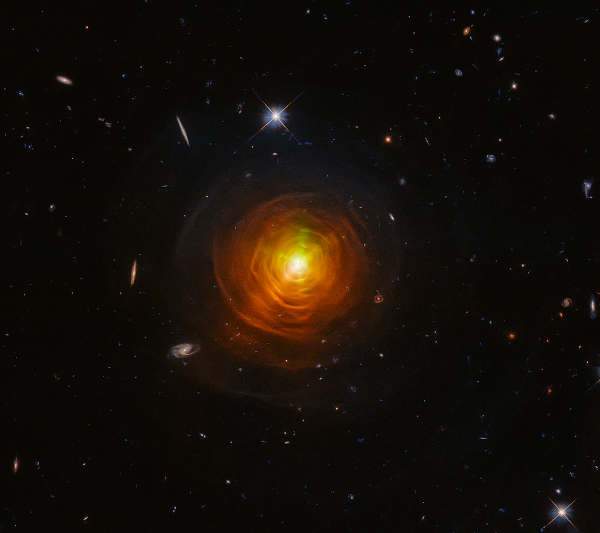
Just in time for Halloween, the red giant star CW Leonis offers us a view of orange-red "cobwebs" that are dusty clouds of sooty carbon engulfing the dying star. Credits: ESA/Hubble, NASA, and Toshiya Ueta (University of Denver), Hyosun Kim (KASI). A hypnotizing vortex? A peek into a witch's caldron? A giant space-spider web?
In reality, it's a look at the red giant star CW Leonis as photographed by NASA's Hubble Space Telescope — just in time for celebrating Halloween with creepy celestial sights.
The orange-red "cobwebs" are dusty clouds of sooty carbon engulfing the dying star. They were created from the outer layers of CW Leonis being thrown out into the inky black void.
The carbon, cooked up through nuclear fusion in the star's interior, gives it a carbon-rich atmosphere. Blasting the carbon back into space provides raw material for the formation of future stars and planets.
All known life on Earth is built around the carbon atom. Complex biological molecules consist of carbon atoms bonded with other common elements in the universe.
At a distance of 400 light-years from Earth, CW Leonis is the closest carbon star. This gives astronomers the chance to understand the interplay between the star and its surrounding, turbulent envelope.
The complex inner structure of shells and arcs may be shaped by the star’s magnetic field. Detailed Hubble observations of CW Leonis taken over the last two decades also show the expansion of threads of ejected material around the star.
The bright beams of light radiating outward from CW Leonis are one of the star's most intriguing features. They've changed in brightness within a 15-year period — an incredibly short timespan in astronomical terms.
Astronomers speculate that gaps in the dust shrouding CW Leonis may allow beams of starlight to pierce through and illuminate dust, like searchlight beacons through a cloudy sky. However, the exact cause of the dramatic changes in their brightness is as yet unexplained.
A star shines when the outward pressure from the fusion furnace at the core balances against the crush of gravity. When the star runs out of hydrogen fuel, the persistent pull of gravity causes the star to start collapsing.
As the core shrinks, the shell of plasma surrounding the core becomes hot enough to begin fusing hydrogen, giving the star a second lease on life. It generates enough heat to dramatically expand the star's outer layers and swell up into a bloated red giant.
CW Leonis has an orange-reddish color due to its relatively low surface temperature of 2,300 degrees Fahrenheit.
The green-tinted beams of light emanating from the star, however, glow at invisible mid-infrared wavelengths. In the absence of natural color, green has been added to the infrared image for better analysis through color-contrast.
The Hubble Space Telescope is a project of international cooperation between NASA and the European Space Agency. NASA's Goddard Space Flight Center in Greenbelt, Maryland, manages the telescope. The Space Telescope Science Institute (STScI) in Baltimore, Maryland, conducts Hubble science operations. STScI is operated for NASA by the Association of Universities for Research in Astronomy, in Washington, D.C.
LAKE COUNTY, Calif. — On Friday, a judge heard arguments during the first day of a hearing in the case filed against the Maha Guenoc Valley resort the Board of Supervisors approved last year.
Lake County Superior Court Judge J. David Markham heard several hours’ worth of arguments in the case filed in September 2020 by the Center for Biological Diversity and the California Native Plant Society against the county of Lake over Lotusland Investment Holdings Inc.’s project.
The California Attorney General’s Office, which raised concerns about what it said is a lack of analysis of how the project might increase wildfire risks and impact wildfire evacuations, also has intervened in the case.
The suit challenges approval of the Guenoc Valley Mixed Use Planned Development Project, also known as the Maha Guenoc Valley, which the board approved in July 2020.
The project is proposed to be built on a portion of the 16,000-acre Guenoc Ranch. It will include nearly 1,400 residential estate villas, 400 hotel units and 450 resort residential units at build out, which is expected to take about a decade.
Peter Broderick, who led the arguments for the Center for Biological Diversity, offered a quote from the meeting during which the board approved the project: “This is the largest land use decision this board will ever make.”
That statement was made by then-Supervisor Rob Brown, the lone dissenter in the vote on the project. Brown raised concerns that the project didn’t specify that an off-site well would be specifically designated as a “secondary” water source and didn’t include triggers that would be necessary before that water could be used instead of the groundwater source at the resort site.
The main thrust of Broderick’s arguments focused on the environmental impact report, or EIR, created for the project, which the supervisors ultimately adopted.
“This is the one chance the public and the county get to consider these issues,” said Broderick, explaining that once the EIR is certified, there is no going back.
Andrew Contreiras of the Attorney General’s Office said the agency intervened due to its belief that the EIR failed in its core function, and didn’t look at how the project would increase wildfire hazards in this region.
He said Guenoc’s 25 square miles already faces serious wildfire risk and the area burns frequently. The Maha Guenoc Valley project would create a new wildland urban interface, introduce low density residential and resort, which Contreiras said is the riskiest kind of development.
In addition to wildfire risk, the petitioners in the case said the EIR didn’t explain calculations for greenhouse gas emissions, and needed more analysis of water impact and the potential impacts on native species.
Information presented on behalf of the California Native Plant Society noted that the ranch’s 16,000 undeveloped acres — which is more than 12,000 football fields — include rare serpentine soils.
There are 107 different special status plant species that occur or are likely to occur on the site, which the group argued will be in immediate jeopardy or will be if the environment changes.
The society faulted the county for releasing an errata for the EIR that included substantive changes to the project, including a general plan amendment, on the Friday evening before the final July 2020 hearing, without the document being recirculated.
Contreiras said the county failed to consider a more compact option, option C, for the resort that would substantially reduce the environmental impacts. He said the EIR provided only a scant, vague description of that alternative.
Attorneys Jonathan Bass and Charmaine Yu argued on behalf of Lotusland during the Friday hearing.
Bass said the county found based on very substantial evidence and analysis that the project would not exacerbate wildfire risk, adding that wide areas of Northern California and Lake County already are subject to wildfires.
He said he’s been litigating California Environmental Quality Act, or CEQA, cases for 40 years and has rarely appeared in court on a case that improves the environment.
Bass said it substantially negates 90% of the argument about wildfire risk and evacuation processes once one acknowledges that CEQA is simply not a tool to be used to advance a wider social or environmental policy.
He questioned what proved the project has a negative impact on the environment in terms of wildfire risk. “The evidence isn’t there.
Bass said the overwhelming quantum of evidence fully justifies the Board of Supervisors’ conclusion to approve the project.
During the arguments, he made the point that it’s not allowed to legislate from the bench.
“We think the board did its job,” Bass said, pointing out that the supervisors live in and know the area.
In response to the issues raised about special plant species, Yu said only nine special status plants have been observed on the site, and all have been mapped. There are mitigations for when a development can’t avoid such plants.
Yu argued that the county of Lake took environmental steps beyond what it needed to do.
She suggested that the idea that anything was rushed was a completely artificial construct, explaining that people in the project area had been commenting on the project for years.
It would be a “step of tremendous significance” to do what the case’s petitioners were seeking, which is to have the EIR recirculated, said Yu, adding that CEQA guidelines set a high bar for recirculation and require there be new information.
Yu said the Board of Supervisors has a right and responsibility to ask if a project fits into its vision for the county. The project is infeasible if it doesn’t.
By the end of the day, arguments had not been completed. As a result, Markham continued the hearing to 2 p.m. Wednesday in order to finish.
He said he’s hoping to have a final decision within two weeks of the end of arguments, although after considering the testimony on Friday, he said that timeline may be optimistic.
Email Elizabeth Larson at This email address is being protected from spambots. You need JavaScript enabled to view it.. Follow her on Twitter, @ERLarson, or Lake County News, @LakeCoNews.
LAKE COUNTY, Calif. — Next week the Board of Supervisors is set to hold the third in a series of hearings as it updates the boundaries of its district maps.
The board will conduct the redistricting hearing at 6 p.m. Tuesday, Nov. 2.
Ahead of the hearing, the county is releasing draft maps showing the five potential sets of supervisorial district boundaries.
The county said the maps were informed by feedback from members of the public and Board of Supervisors during and since the previous redistricting hearing, held Saturday, Oct. 2.
Tuesday’s public hearing will feature a presentation by Margaret Long and Carolyn Walker of Prentice Long, the county’s contractor for redistricting consulting services.
Long and Walker will walk the board and public participants through the pluses and minuses of each of the published draft maps, and provide further information to assist Lake County in settling on the best possible final district boundaries.
Lake County’s geographic information systems specialist will also be present in Zoom during Tuesday’s redistricting hearing, to make live adjustments to the draft maps, as needed.
If you intend to participate in the hearing (e.g.: comment on proposed changes to boundaries; raise a suggestion not previously submitted), please join via Zoom, if you are able by clicking this link.
The meeting ID is 94684965839, pass code is 310792.
Members of the public can also attend the meeting and provide input in person in the Board of Supervisors’ Chambers, at 255 N. Forbes St., Lakeport.
More information on Lake County’s 2021 redistricting process is available here.
Questions or other input can be directed to This email address is being protected from spambots. You need JavaScript enabled to view it. .
Paper applications are also available at the County Administrative Office, 255 N. Forbes St., Lakeport.
Applications will be accepted until the seat is filled.
On June 28, 2011, then-Gov. Jerry Brown, signed ABX1 26, abolishing all California City and county redevelopment agencies, effective Feb. 1, 2012.
This legislation additionally required establishment of local oversight boards. Initially, the county and two cities each established their own distinct oversight boards.
Pursuant to Health and Safety Code Section 34179, as of July 1, 2018, the three boards were consolidated into the seven-member Countywide Redevelopment Successor Agency Oversight Board.
These countywide boards can be staffed by the auditor-controller or certain other entities, as designated by the auditor-controller.
Under state law (as amended by AB 1484 and SB 107), the Oversight Board is responsible to ensure “enforceable obligations” of the historical Lake County and City Redevelopment Successor Agencies are met and to “dispose of assets and properties of the former Redevelopment [Agencies]” or transfer ownership of certain assets, in the interest of “[winding] down the affairs of the [dissolved] Redevelopment Agencies.”
Two Oversight Board members are appointed by the Lake County Board of Supervisors, including a member of the public.
Oversight Board members currently include the following:
· Moke Simon, Lake County Board of Supervisors;
· Brock Falkenberg, Lake County superintendent of schools;
· Dr. Cirilo Cortez, community colleges representative;
· Alan Flora, city selection committee representative;
CLEARLAKE, Calif. — Clearlake Animal Control’s roundup of dogs is waiting to meet new adoptive families.
The City of Clearlake Animal Association also is seeking fosters for the animals waiting to be adopted.
Another way to help is through donations. A wish list has been posted at Amazon and on Chewy. For those who wish to shop local and drop off items, call 707-273-9440 to schedule a delivery or donate at the association’s Facebook page.
Call the Clearlake Animal Control shelter at 707-273-9440, or email This email address is being protected from spambots. You need JavaScript enabled to view it.to inquire about adoptions and schedule a visit to the shelter.
Visit Clearlake Animal Control on Facebook or on the city’s website.
The newest dogs are listed at the top of the following list.
“Terry.” Photo courtesy of Clearlake Animal Control. ‘Terry’
“Terry” is a male Dutch shepherd mix with a smooth brindle coat.
He is dog No. 4880.
“Tanisha.” Photo courtesy of Clearlake Animal Control. ‘Tanisha’
“Tanisha” is a female shepherd mix with a short orange and white coat.
She is dog No. 4647.
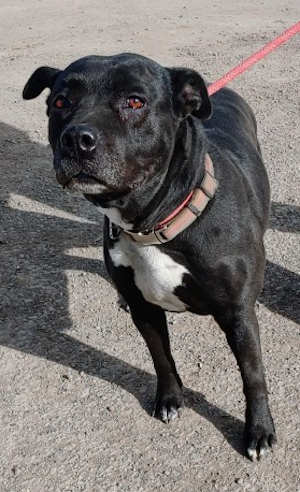
“Sassy.” Photo courtesy of Clearlake Animal Control. ‘Sassy’
“Sassy” is a female American bully mix with a short black coat.
She has been spayed.
She is dog No. 4602.
“Mitzy.” Photo courtesy of Clearlake Animal Control. ‘Mitzy’
“Mitzy” is a female shepherd mix with a medium-length black and white coat.
She is dog No. 4648.
“Luscious.” Photo courtesy of Clearlake Animal Control. ‘Luscious’
“Luscious” is a male Weimaraner with a short gray coat.
He has been neutered.
He is dog No. 5201.
“Edgar.” Photo courtesy of Clearlake Animal Control. ‘Edgar’
“Edgar” is a male American Staffordshire terrier mix with a short black and cream coat.
He is dog No. 5189.
“Charles.” Photo courtesy of Clearlake Animal Control. ‘Charles’
“Charles” is a male American pit bull terrier with a short black coat.
He is dog No. 5190.
“Bella.” Photo courtesy of Clearlake Animal Control. ‘Bella’
“Bella” is a female pit bull mix with a short brindle coat.
She is dog No. 5080.
“Bear.” Photo courtesy of Clearlake Animal Control. ‘Bear’
“Bear” is a male American Staffordshire terrier mix with a short brown coat.
He has been neutered.
He is dog No. 3476.
“Andy.” Photo courtesy of Clearlake Animal Control. ‘Andy’
“Andy” is a male pit bull terrier mix with a short gray and white coat.
He is dog No. 5150.
Email Elizabeth Larson at This email address is being protected from spambots. You need JavaScript enabled to view it.. Follow her on Twitter, @ERLarson, or Lake County News, @LakeCoNews.
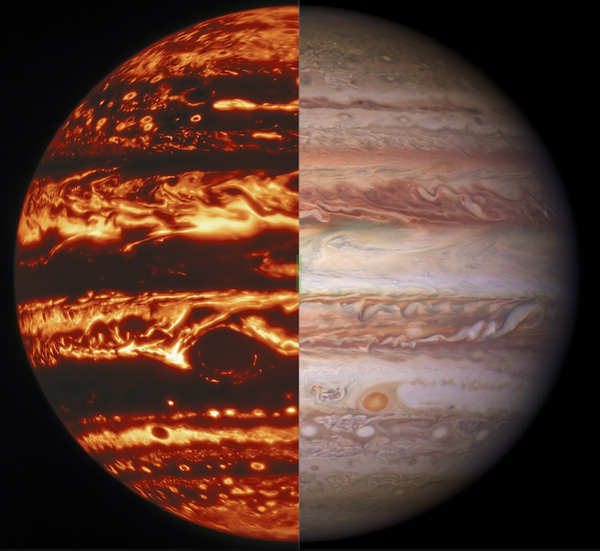
Jupiter’s banded appearance is created by the cloud-forming “weather layer.” This composite image shows views of Jupiter in (left to right) infrared and visible light taken by the Gemini North telescope and NASA’s Hubble Space Telescope, respectively. Credits: International Gemini Observatory/NOIRLab/NSF/AURA/NASA/ESA, M.H. Wong and I. de Pater (UC Berkeley) et al.
New findings from NASA’s Juno probe orbiting Jupiter provide a fuller picture of how the planet’s distinctive and colorful atmospheric features offer clues about the unseen processes below its clouds.
The results highlight the inner workings of the belts and zones of clouds encircling Jupiter, as well as its polar cyclones and even the Great Red Spot.
Researchers published several papers on Juno’s atmospheric discoveries today in the journal Science and the Journal of Geophysical Research: Planets. Additional papers appeared in two recent issues of Geophysical Research Letters.
“These new observations from Juno open up a treasure chest of new information about Jupiter’s enigmatic observable features,” said Lori Glaze, director of NASA’s Planetary Science Division at the agency’s headquarters in Washington. “Each paper sheds light on different aspects of the planet’s atmospheric processes — a wonderful example of how our internationally-diverse science teams strengthen understanding of our solar system.”
Juno entered Jupiter’s orbit in 2016. During each of the spacecraft’s 37 passes of the planet to date, a specialized suite of instruments has peered below its turbulent cloud deck.
“Previously, Juno surprised us with hints that phenomena in Jupiter’s atmosphere went deeper than expected,” said Scott Bolton, principal investigator of Juno from the Southwest Research Institute in San Antonio and lead author of the Journal Science paper on the depth of Jupiter’s vortices. “Now, we’re starting to put all these individual pieces together and getting our first real understanding of how Jupiter’s beautiful and violent atmosphere works — in 3D.”
Juno’s microwave radiometer (MWR) allows mission scientists to peer beneath Jupiter’s cloud tops and probe the structure of its numerous vortex storms. The most famous of these storms is the iconic anticyclone known as the Great Red Spot. Wider than Earth, this crimson vortex has intrigued scientists since its discovery almost two centuries ago.
The new results show that the cyclones are warmer on top, with lower atmospheric densities, while they are colder at the bottom, with higher densities. Anticyclones, which rotate in the opposite direction, are colder at the top but warmer at the bottom.
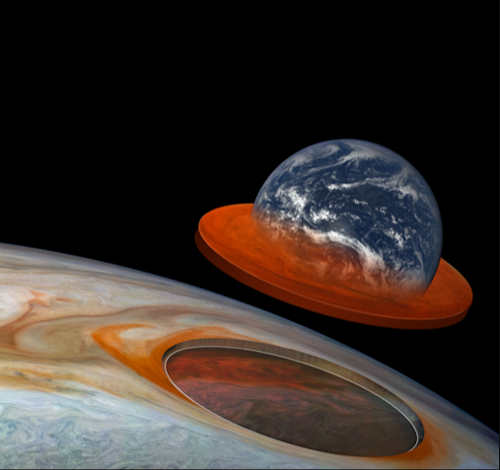
The findings also indicate these storms are far taller than expected, with some extending 60 miles below the cloud tops and others, including the Great Red Spot, extending over 200 miles. This surprise discovery demonstrates that the vortices cover regions beyond those where water condenses and clouds form, below the depth where sunlight warms the atmosphere.
The height and size of the Great Red Spot means the concentration of atmospheric mass within the storm potentially could be detectable by instruments studying Jupiter’s gravity field. Two close Juno flybys over Jupiter’s most famous spot provided the opportunity to search for the storm’s gravity signature and complement the MWR results on its depth.
With Juno traveling low over Jupiter’s cloud deck at about 130,000 mph Juno scientists were able to measure velocity changes as small 0.01 millimeter per second using a NASA’s Deep Space Network tracking antenna, from a distance of more than 400 million miles. This enabled the team to constrain the depth of the Great Red Spot to about 300 miles below the cloud tops.
“The precision required to get the Great Red Spot’s gravity during the July 2019 flyby is staggering,” said Marzia Parisi, a Juno scientist from NASA’s Jet Propulsion Laboratory in Southern California and lead author of a paper in the Journal Science on gravity overflights of the Great Red Spot. “Being able to complement MWR’s finding on the depth gives us great confidence that future gravity experiments at Jupiter will yield equally intriguing results.”
This illustration combines an image of Jupiter from the JunoCam instrument aboard NASA’s Juno spacecraft with a composite image of Earth to depict the size and depth of Jupiter’s Great Red Spot. Credits: JunoCam Image data: NASA/JPL-Caltech/SwRI/MSSS; JunoCam Image processing by Kevin M. Gill (CC BY); Earth Image: NASA. Belts and zones
In addition to cyclones and anticyclones, Jupiter is known for its distinctive belts and zones – white and reddish bands of clouds that wrap around the planet. Strong east-west winds moving in opposite directions separate the bands.
Juno previously discovered that these winds, or jet streams, reach depths of about 2,000 miles. Researchers are still trying to solve the mystery of how the jet streams form. Data collected by Juno’s MWR during multiple passes reveal one possible clue: that the atmosphere’s ammonia gas travels up and down in remarkable alignment with the observed jet streams.
“By following the ammonia, we found circulation cells in both the north and south hemispheres that are similar in nature to ‘Ferrel cells,’ which control much of our climate here on Earth”, said Keren Duer, a graduate student from the Weizmann Institute of Science in Israel and lead author of the Journal Science paper on Ferrel-like cells on Jupiter. “While Earth has one Ferrel cell per hemisphere, Jupiter has eight — each at least 30 times larger.”
Juno’s MWR data also shows that the belts and zones undergo a transition around 40 miles (65 kilometers) beneath Jupiter’s water clouds. At shallow depths, Jupiter’s belts are brighter in microwave light than the neighboring zones. But at deeper levels, below the water clouds, the opposite is true – which reveals a similarity to our oceans.
“We are calling this level the ‘Jovicline’ in analogy to a transitional layer seen in Earth’s oceans, known as the thermocline – where seawater transitions sharply from being relative warm to relative cold,” said Leigh Fletcher, a Juno participating scientist from the University of Leicester in the United Kingdom and lead author of the paper in the Journal of Geophysical Research: Planets highlighting Juno’s microwave observations of Jupiter's temperate belts and zones.
Polar cyclones
Juno previously discovered polygonal arrangements of giant cyclonic storms at both of Jupiter’s poles — eight arranged in an octagonal pattern in the north and five arranged in a pentagonal pattern in the south. Now, five years later, mission scientists using observations by the spacecraft’s Jovian Infrared Auroral Mapper, or JIRAM, have determined these atmospheric phenomena are extremely resilient, remaining in the same location.
“Jupiter’s cyclones affect each other’s motion, causing them to oscillate about an equilibrium position,” said Alessandro Mura, a Juno co-investigator at the National Institute for Astrophysics in Rome and lead author of a recent paper in Geophysical Research Letters on oscillations and stability in Jupiter’s polar cyclones. “The behavior of these slow oscillations suggests that they have deep roots.”
JIRAM data also indicates that, like hurricanes on Earth, these cyclones want to move poleward, but cyclones located at the center of each pole push them back. This balance explains where the cyclones reside and the different numbers at each pole.
Follow the mission on Facebook and Twitter, and get more information about Juno online at https://www.nasa.gov/juno.
 How to resolve AdBlock issue?