 How to resolve AdBlock issue?
News
During the seven-minute meeting, the council voted unanimously to approve a resolution to implement the new increased rates from 2022 to 2026.
In its regular meeting last week, the council held a public hearing that led to two unanimous votes on resolutions for water and sewer rate increases.
However, a 1954 ordinance in city municipal code requires that any resolution to increase water rates must have two readings, rather than one.
That necessitated the council holding the special meeting on Tuesday night.
There was no public comment before the council took its vote and adjourned.
City officials said the new water and sewer rates will go into effect on Nov. 1.
The new rates will support the city’s plans for $7 million in capital utility projects over the coming five years.
Email Elizabeth Larson at
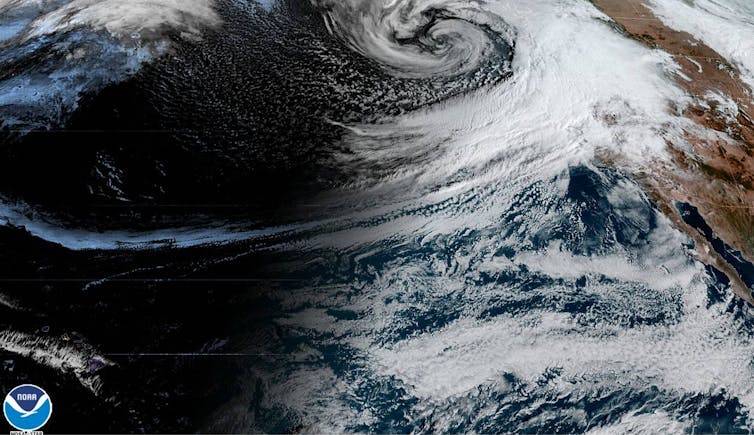
Ask people to name the world’s largest river, and most will probably guess that it’s the Amazon, the Nile or the Mississippi. In fact, some of Earth’s largest rivers are in the sky – and they can produce powerful storms, like the ones now drenching northern California.
Atmospheric rivers are long, narrow bands of moisture in the atmosphere that extend from the tropics to higher latitudes. These rivers in the sky can transport 15 times the volume of the Mississippi River.
When that moisture reaches the coast and moves inland, it rises over the mountains, generating rain and snowfall. Many fire-weary westerners welcome these deluges, but atmospheric rivers can trigger other disasters, such as extreme flooding and debris flows.
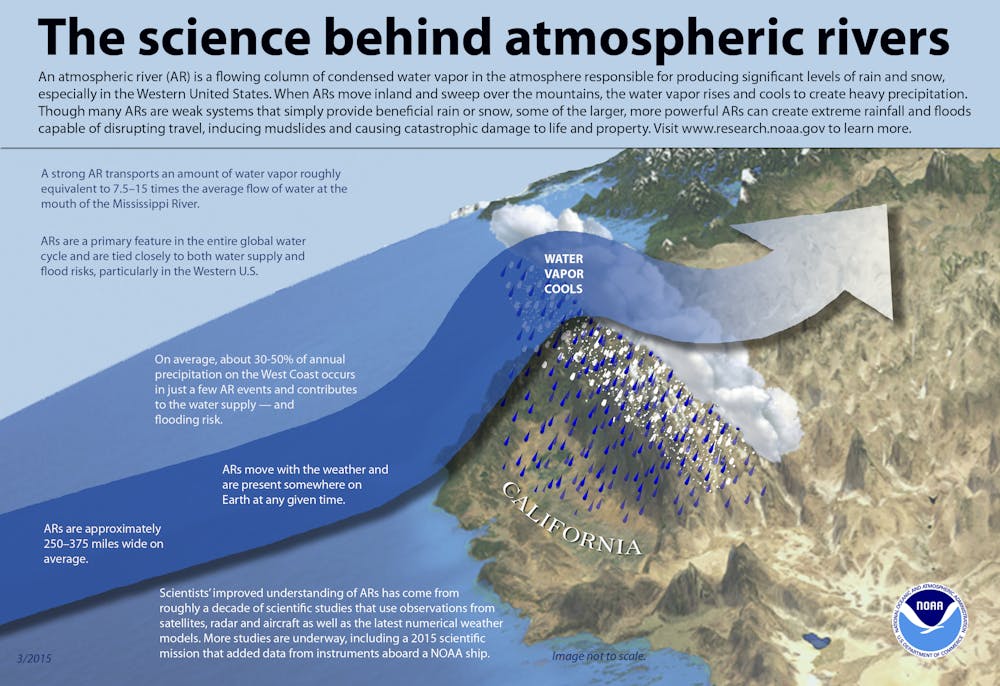

In the past 20 years, as observation networks have improved, scientists have learned more about these important weather phenomena. Atmospheric rivers occur globally, affecting the west coasts of the world’s major land masses, including Portugal, Western Europe, Chile and South Africa. So-called “Pineapple Express” storms that carry moisture from Hawaii to the U.S. West Coast are just one of their many flavors.
My research combines economics and atmospheric science to measure damage from severe weather events. Recently I led a team of researchers from Scripps Institution of Oceanography and the Army Corps of Engineers in the first systematic analysis of damages from atmospheric rivers due to extreme flooding. We found that while many of these events are benign, the largest of them cause most of the flooding damage in the western U.S. And atmospheric rivers are predicted to grow longer, wetter and wider in a warming climate.
Rivers in the sky
On Feb. 27, 2019, an atmospheric river propelled a plume of water vapor 350 miles wide and 1,600 miles long through the sky from the tropical North Pacific Ocean to the coast of Northern California.
Just north of San Francisco Bay, in Sonoma County’s famed wine country, the storm dumped over 21 inches of rain. The Russian River crested at 45.4 feet – 13.4 feet above flood stage.
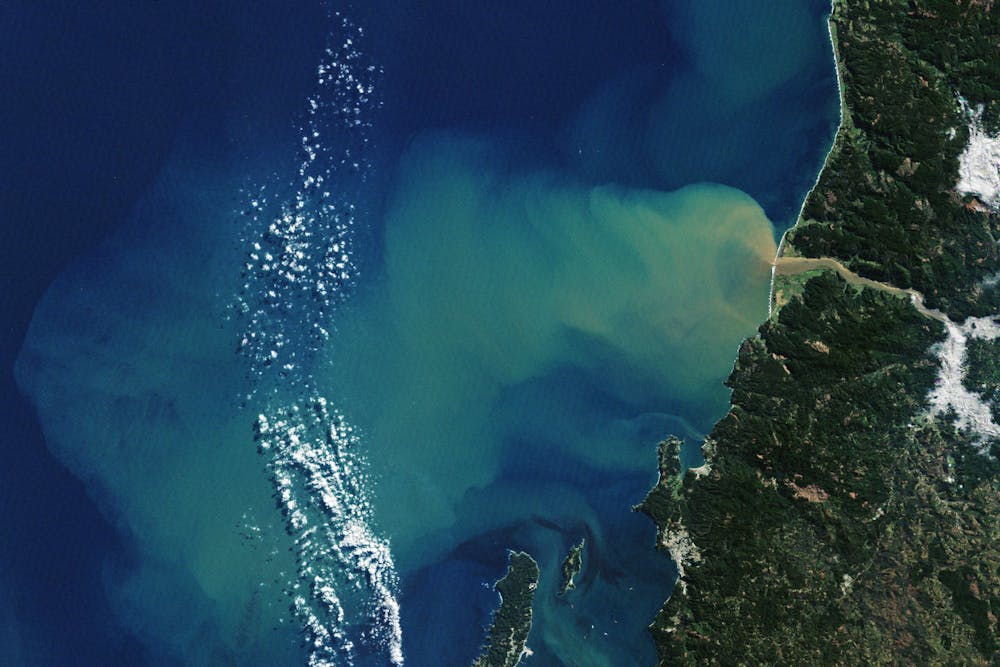
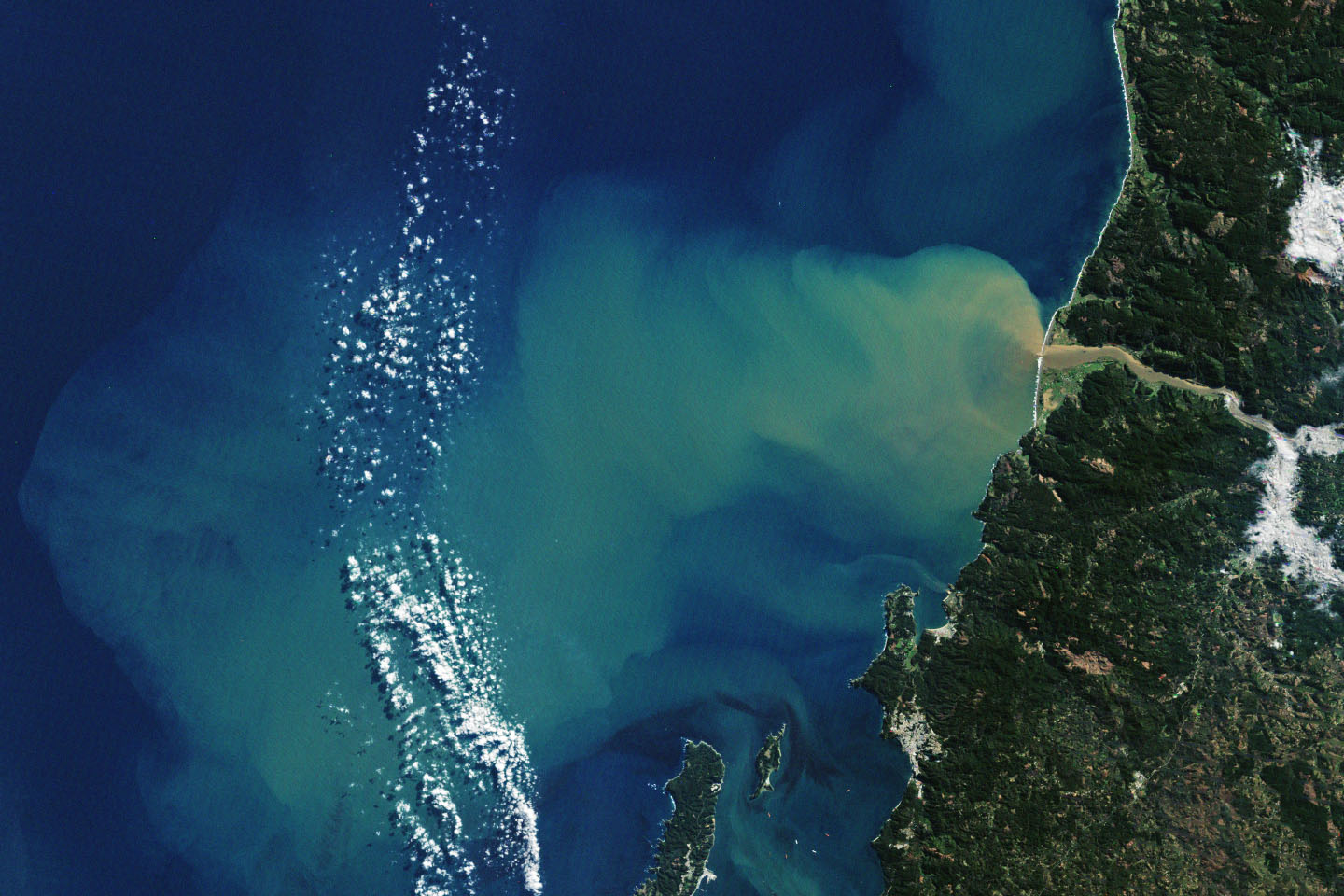
For the fifth time in four decades, the town of Guerneville was submerged under the murky brown floodwaters of the lower Russian River. Damages in Sonoma County alone were estimated at over US$100 million.
Events like these have drawn attention in recent years, but atmospheric rivers are not new. They have meandered through the sky for millions of years, transporting water vapor from the equator toward the poles.
In the 1960s meteorologists coined the phrase “Pineapple Express” to describe storm tracks that originated near Hawaii and carried warm water vapor to the coast of North America. By the late 1990s atmospheric scientists had found that over 90% of the world’s moisture from the tropics and subtropics was transported to higher latitudes by similar systems, which they named “atmospheric rivers.”
In dry conditions, atmospheric rivers can replenish water supplies and quench dangerous wildfires. In wet conditions, they can cause damaging floods and debris flows, wreaking havoc on local economies.
Helpful and harmful
Researchers have known for some time that flooding due to atmospheric rivers could cost a lot of money, but until our study no one had quantified these damages. We used a catalog of atmospheric river events compiled by Scripps Institution of Oceanography’s Center for Western Weather and Water Extremes, and matched it to 40 years of flood insurance records and 20 years of National Weather Service damage estimates.
We found that atmospheric rivers caused an average of $1.1 billion in flood damages yearly in the western U.S. More than 80% of all flooding damages in the West in the years we studied were associated with atmospheric rivers. In some areas, such as coastal northern California, these systems caused over 99% of damages.
Our data showed that in an average year, about 40 atmospheric rivers made landfall along the Pacific coast somewhere between Baja California and British Columbia. Most of these events were benign: About half caused no insured losses, and these storms replenished the region’s water supply.
But there were a number of exceptions. We used a recently developed atmospheric river classification scale that ranks the storms from 1 to 5, similar to systems for categorizing hurricanes and tornadoes. There was a clear link between these categories and observed damages.
Atmospheric River category 1 (AR1) and AR2 storms caused estimated damages under $1 million. AR4 and AR5 storms caused median damages in the 10s and 100s of millions of dollars respectively. The most damaging AR4s and AR5s generated impacts of over $1 billion per storm. These billion-dollar storms occurred every three to four years.
A moister atmosphere means worse storms
Our most significant finding was an exponential relationship between the intensity of atmospheric rivers and the flood damages they caused. Each increase in the scale from 1 to 5 was associated with a 10-fold increase in damages.
Several recent studies have modeled how atmospheric rivers will change in the coming decades. The mechanism is simple: Greenhouse gases trap heat in the atmosphere, warming the planet. This causes more water to evaporate from oceans and lakes, and increased moisture in the air makes storm systems grow stronger.
Like hurricanes, atmospheric rivers are projected to grow longer, wider and wetter in a warming climate. Our finding that damages increase exponentially with intensity suggests that even modest increases in atmospheric river intensity could lead to significantly larger economic impacts.
Better forecasting is critical
I believe that improving atmospheric forecasting systems should be a priority for adapting to a changing climate. Better understanding of atmospheric rivers’ intensity, duration and landfall locations can provide valuable information to residents and emergency responders.
It also is important to discourage new construction in high-risk areas and help people move to safer locations after major disasters, rather than rebuilding in place.
Finally, our study underlines the need to reduce global greenhouse gas emissions. These storms will keep coming, and they’re getting stronger. In my view, stabilizing the global climate system is the only long-term way to minimize economic damage and risk to vulnerable communities.
[Like what you’ve read? Want more? Sign up for The Conversation’s daily newsletter.]
Tom Corringham, Postdoctoral Scholar in Climate, Atmospheric Science and Physical Oceanography, University of California San Diego
This article is republished from The Conversation under a Creative Commons license. Read the original article.
At its Oct. 19 meeting, the Lakeport City Council unanimously approved the new crisis intervention responder program and authorized Police Chief Brad Rasmussen and City Manager Kevin Ingram to enter into a memorandum of understanding with the Lake Family Resource Center.
The program will assign a community crisis intervention specialist, which Lake Family Resource Center will fund, to the Lakeport Police Department.
Rasmussen said the program is the result of a collaboration with Lake Family Resource Center that began over the summer.
City officials and Lake Family Resource Center staff are now in the process of finalizing the memorandum of understanding, with a goal of having the program in place and operating by Nov. 1.
Under the agreement, a community crisis response specialist will work with the Lakeport Police Department and be based out of the agency’s headquarters at 2025 S. Main St.
The Lake Family Resource Center has received grant funding through Dec. 31, 2022, that will enable it to hire and pay for the crisis response specialist’s salary and benefits.
The community crisis response specialist will work primarily with Lakeport Police’s homeless liaison officer.
That team will spend most of its time doing outreach to homeless, but will respond to other calls for service throughout the city while on duty, and will be available to assist with situations where the crisis responder can provide expertise — such as those involving domestic violence and sexual assault.
Rasmussen said there will be minor costs to the police department to implement the program. The council’s approval on Oct. 19 covered an estimated $5,000 financial impact.
The Lakeport Police Department is increasingly getting calls both for homeless individuals as well as people in other types of crisis, including mental health-related issues, who Rasmussen said need the kinds of help and resources that are usually beyond what a police officer can provide.
Due to recent national events involving law enforcement interaction with persons in crisis — including those with disabilities and with substance addictions — Rasmussen said there continues to be a public request for more crisis response specialists on the street handling calls along with the police.
He said his agency has been increasing officer training and efforts to gain more available crisis response over the past several years in order to provide better service to the community.
Seeking solutions for crisis intervention
During a Sept. 9 Lakeport City Council discussion with staff on the city’s challenges in addressing homelessness, Ingram said it was safe to say that a majority of Lakeport Police’s calls involve some combination of individuals who are homeless or need mental health-related services.
“Housing is only one component,” said Ingram, explaining that wraparound services are needed and are just as important.
He said the police department has had an agreement with Lake County Behavioral Health Services for three years in an effort to bring in crisis intervention services.
However, for a variety of reasons — including staffing, COVID-19 and the inability to figure out how to bill out services — Behavioral Health “has never set a foot” in the police station, Ingram said.
Ingram said the city is excited about the potential for working with Lake Family Resource Center to get a full-time intervention specialist.
He said the city gets a lot of calls daily about homeless individuals and those with mental health issues in the city’s parklands and shopping centers.
Rasmussen said of homelessness, “It is a major crisis not only in our community but in our state and our country. It just seems to continue and get worse,” which is why they’ve tried to actively engage with homeless people or those who need mental health services.
It also led to the agency establishing the homeless liaison officer position. Officer Melissa Bedford has been working in that role for more than 18 months, he said.
Even so, Rasmussen said that until the police department gets some kind of social worker or crisis intervention person on the street working with officers, they will have a difficult time making more progress in addressing homelessness.
Rasmussen said the general public expects police to be all things and to make problems go away, and they can’t.
He also touched briefly during that meeting on the city’s work with Lake Family Resource Center to bring that crisis intervention position to his department.
“Unless we have all the services and housing, we’re never going to solve the problem,” he said of homelessness. “It’s going to take all of those components to solve it.”
New agreement offers hope for progress
Rasmussen said his department had been struggling with how to deploy a crisis intervention specialist when, in July, they began talking with the Lake Family Resource Center.
Sheri Young, the center’s victim services program director, said Lisa Morrow, the center’s executive director, had been speaking with Rasmussen about the situation.
Young said center staff began brainstorming about the city’s needs and came up with how grant funding they had in place could be used for a new program to help underserved populations, with a special focus on homeless individuals, those in need of mental health services, victims of domestic violence, sexual assault and human trafficking.
Rasmussen and center staff drew on theories and concepts being used in similar programs in other communities and agencies to create their own program, Young said. “Ours will be unique to our own county.”
In the end, she said it all tied together beautifully and they’re determined to make it happen.
She said center staff have been excited to draft protocols and job descriptions for the full-time position, with interviews of job candidates starting last Friday.
The goal, she said, is to roll out the program on Nov. 1 — whether it’s starting the extensive amount of training the position will require or putting that individual into the field.
Young added that they have a great plan for support and supervision of the crisis intervention specialist and the program as a whole.
Young has a longtime passion both for victim advocacy and law enforcement, and loves to be able to morph those two together. “It’s going to be pretty spectacular.”
From the center’s side, she will oversee the crisis intervention program, along with help from the center’s behavioral health program director, Jennifer Nielson, who brings a background in psychotherapy to the effort.
At the Oct. 19 council meeting, Lakeport City Councilman Michael Green had asked Young about how to sustain the program past the end of the grant funding, which runs out at the end of December 2022.
Since then, she said she’s been thinking about Green’s question.
Both she and Rasmussen believe that, after collecting data over the coming year, it will provide them with the opportunity to find additional funding resources.
If anyone can find the funding and write the grant to get it, it’s Young.
Her talent as a grant writer has brought in significant grants that have allowed Lake Family Resource Center to expand its services in the community, including a growing focus on human trafficking.
“I’m really excited about this,” she said.
Email Elizabeth Larson at
The council will meet at 6 p.m. Tuesday, Oct. 26, in the council chambers at Lakeport City Hall, 225 Park St.
The agenda can be found here.
The council chambers will be open to the public for the meeting. In accordance with updated guidelines from the state of California and revised Cal OSHA Emergency Temporary Standards, persons who are not fully vaccinated for COVID-19 are required to wear a face covering at this meeting.
If you cannot attend in person, and would like to speak on an agenda item, you can access the Zoom meeting remotely at this link or join by phone by calling toll-free 669-900-9128 or 346-248-7799.
The webinar ID is 973 6820 1787, access code is 477973; the audio pin will be shown after joining the webinar. Those phoning in without using the web link will be in “listen mode” only and will not be able to participate or comment.
Comments can be submitted by email to
Indicate in the email subject line "for public comment" and list the item number of the agenda item that is the topic of the comment. Comments that are read to the council will be subject to the three minute time limitation (approximately 350 words). Written comments that are only to be provided to the council and not read at the meeting will be distributed to the council before the meeting.
The meeting’s only item is the discussion and final action on the proposed increase to city water rates.
Last Tuesday, the council unanimously approved resolutions increasing the city’s water and sewer rates, but Lakeport’s municipal code requires a second reading in order to finalize approval of a water rate hike.
Should the council approve the resolution establishing the new water rates, they will go into effect, along with the previously approved sewer rates, on Nov. 1.
Email Elizabeth Larson at
The burn ban will be lifted for 2021 as of 8 a.m. Tuesday, Oct. 26, the Lake County Air Quality Management District reported.
The ban is being lifted now that Cal Fire has determined that wildfire risk has been significantly reduced by the recent rains, the district said.
Lake County’s joint fire agencies and Air Quality Management District’s open burning program has incorporated both fire safety and air quality management since 1987.
In related news, Cal Fire’s Sonoma Lake Napa Unit said it has suspended its burn ban for the season for Colusa, Lake, Napa, Solano, Sonoma and Yolo counties effective on Oct. 26, for areas in the State Responsibility Area.
However, Cal Fire referred residents of that coverage area to their respective air quality management districts to verify it is a permissive burn day according to local regulations.
Burn permits are required for all outdoor burning in the Lake County air basin. Burn permits will be available at your local fire protection district.
The Lake County Air Quality Management District said a smoke management plan is required for multiday burns, overnight burns, standing vegetation burns, whole tree or vine removal, burns over 20 acres, and any other burn where significant smoke impacts may occur or sensitive receptors may be impacted.
A smoke management plan can be obtained at the Lake County Air Quality Management District office; call 707-263-7000 to make an appointment.
Bring a map showing the burn location, burn site coordinates (GPS locations), parcel number or address, acres to be burned, and details of vegetation to be burned. A fee is required for all burn permits, payable at the time the permit is issued.
Smoke management plans, agricultural burn permits and residential burn permits are $29, land development/lot clearing burn permits are $88. Cash or check only (exact change is appreciated).
Only clean dry vegetation that was grown on the property may be burned. Residential burn permits require a one acre or larger lot of record, a burn location that is at least 100 feet from all neighbors, and at least 30 feet from any structure in order to qualify.
Lot clearing/land development burns require special permits available at your local fire protection district. Read your burn permit carefully and follow all the conditions.
Officials ask community members who plan to use burning to please be considerate of their neighbors. A permit does not allow you to create health problems for others. You can be liable for health care costs, fines, and other costs resulting from your burning.
Consider composting or using the vegetative waste pickup provided with your waste collection service as an alternative to burning leaves.
This bipartisan legislation would authorize federal land management agencies to take proven, commonsense measures to prevent the proliferation of invasive species in our nation’s waterways, lakes, reservoirs and aqueducts.
Garamendi is a representative of Lake County, California, which has seen its critically important tourist economy centered around Clear Lake threatened by invasive quagga mussels and other aquatic invasive species exacerbating the lake’s harmful algal blooms.
Garamendi has secured federal resources in recent years to help curb the presence of invasive species in Clear Lake, and the “Stop the Spread of Invasive Mussels Act” can provide key support in this ongoing effort.
“Invasive species crowd out native wildlife and incur billions of dollars in avoidable damage to our nation’s critical water infrastructure, particularly in western states like California,” Rep. Garamendi (D-CA) said. “In my Congressional District, proliferated quagga and zebra mussels clog water pipelines, reduce the capacity of canals, and damage reservoir operations for hydropower, water storage, and flood control.
“The best defense against spreading invasive aquatic species is simple: inspection and decontaminating watercraft so they do not spread aquatic invasive species from one waterbody to another,” Garamendi continued.
“Our bipartisan ‘Stop the Spread of Invasive Mussels Act’ would ensure that federal land management agencies like the Bureau of Land Management and U.S. Forest Service have the legal authority to conduct these inspections on federal land. In addition, our bill would establish a new U.S. Bureau of Reclamation grant program for inspection stations at federally managed reservoirs like those that comprise the Solano and Central Valley Projects,” Garamendi continued.
“Congress can and should take decisive action to limit the spread of aquatic invasive species, and that’s exactly what our bipartisan ‘Stop the Spread of Invasive Muscles Act’ will accomplish. I will continue working with my colleague representing the Nevada side of Lake Tahoe, Congressman Amodei, to ensure this bill becomes law,” Garamendi concluded.
“I am proud to join Congressman Garamendi in introducing the ‘Stop the Spread of Invasive Mussels Act’, which invests critical resources in building and operating additional invasive species inspection stations, while also allowing the Bureau of Reclamation, Bureau of Land Management, and National Park Service to aid in these efforts. This legislation is a commonsense solution to empower our federal agencies to be responsible stewards of our lakes and waterways, which is vital to the preservation of Lake Tahoe," Rep. Amodei (R-NV) said.
According to California’s Department of Fish and Wildlife, invasive quagga mussels were first detected at an intake for the Colorado River Aqueduct in 2007, which supplies water for communities in southern California.
Since then, the State of California has confirmed that all reservoirs, lakes, and watersheds receiving raw Colorado River water have been exposed to quagga mussels.
The first confirmed find of zebra mussels in California was in 2008, at the San Justo Reservoir in San Benito County, California.
The following organizations have endorsed the “Stop the Spread of Invasive Mussels Act” (H. R. 5692): Western Governors' Association, National Wildlife Federation, National Marine Manufacturers Association, American Sportfishing Association, Backcountry Hunters & Anglers, Tahoe Regional Planning Agency, Association of Fish and Wildlife Agencies
The full text of the “Stop the Spread of Invasive Mussels Act” can be viewed here.