 How to resolve AdBlock issue?
News

LAKE COUNTY, Calif. — The Scotts Valley area of Lake County was once awash in hops, so much so that a rise in the earth on 11th Street at Scotts Valley Road was known colloquially as “Brewery Hill.”
Though the days of commercial hops cultivation in Lake County have fallen by the wayside, a Lake County farmer is doing his part to bring back the aromatic glory of that era.
Alex Vollelunga of Valley Long Farms in Lakeport has been growing hops on his property for the last four years. Vollelunga inherited the farm with its organic walnut orchard from his grandfather and has since expanded its offerings to encompass an extensive list of crops, including six varieties of hops.
Hops is integral to brewing beer and is one of the four main ingredients used to produce the quaff. The other three are malt, yeast and, of course, water.
It is the cone-shaped flowers of the hop plant that are used in the brewing process. Hidden inside each cone are tiny yellow pods, sticky glands called lupulin, which produce the resin that provides the characteristic bitterness that lends its aroma and flavor to beer.
This bitterness helps balance the sweetness of the malt. In addition, brewers can selectively use hops to produce a wide range of flavors within their created brews.
Much like wine grapes, each variety of hops has unique characteristics and can contribute wide-ranging flavor profiles such as citrus, pine, mango, resin, melon, and even the herbaceous notes of freshly cut grass.
Vegetal ingredients other than hops can also produce bitterness and flavor, and beer brewed using these rather than hops is known as “gruit.” A wide variety of plants can be used in gruit, including orange rind, spruce tips, juniper, yarrow, and bog myrtle.
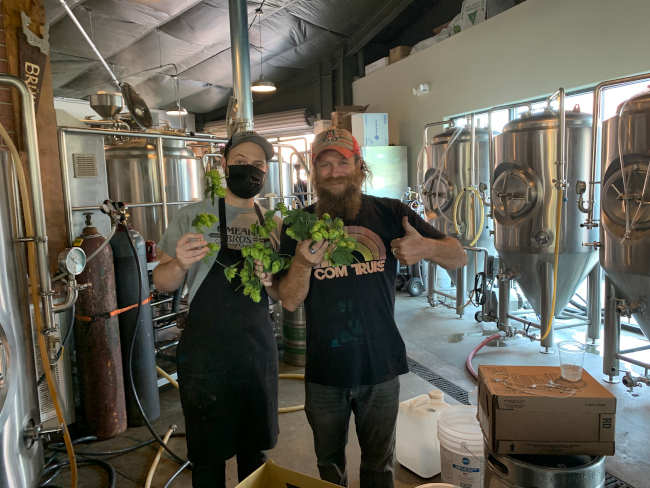
This year Vollelunga’s hop bines (as the long hop stems are called) produced beyond his home brewing needs, so he offered some to Lakeport’s O’Meara Brothers Brewing Co. for use in their beer production.
According to brew master Tim O’Meara, the three varieties from Vollelunga — Cascade, Chinook, and Willamette — were “fantastic, very fresh and aromatic.”
“The beer came out great, with aromas of grapefruit and pineapple, as well as some herbaceous grassy notes. We are very grateful,” said O’Meara.
The beer created by O’Meara using these local hops was dubbed Hydrilla Killa and is a double India pale ale, or DIPA.
When brewed in the fall using fresh hops, beer is considered “wet hopped.” At other times of year when fresh hops aren’t available, brewers use the “dry hopped” method with processed hop pellets.
According to O’Meara, the fresh, whole cone hops were steeped in a large sack during the pre-fermentation wort boil to make a sort of hops tea. The wort boil is done to ensure that any harmful bacteria are eliminated from the brew.
In addition to imparting flavor, hops have inherent preservative qualities, extending the life of beer. The acids within hop resin are naturally antimicrobial, helping to ward off spoiling bacteria during fermentation, as well as keeping it fresher longer once brewed.
Beer brewers in times past understood this. By the late 1700s, British brewers were adding extra hops when beer was being exported to faraway places, averting spoilage on long ocean voyages or overland expeditions.
Another plus is that hops help to retain beer’s head of foam, a key component of its aroma and flavor.
The hop plant, Humulus lupulus, is a hardy climbing perennial in the Cannabinaceae family, which also includes hemp and marijuana. Despite its near relative, smoking or otherwise imbibing hops will not produce a high.
As mentioned above, the long arms of the hop plant are known as bines, rather than vines. Botanically speaking, vines climb using tendrils or suckers, while bines grow in a helix around a support.
Vollelunga has cleverly interplanted hops among his walnut trees so the bines can use the trunks as supportive trellises. His hops are harvested in August and September when the cones have started turning from green to crisp brown, prior to the walnut harvest in October and November.
Vollelunga plans to expand the number of hops bines every year, with the goal of being able to supply Lake County breweries with fresh hops during the “wet hop” brewing season. They currently have more than 20 bines and will plant more next spring.
In addition to crop cultivation, Vollelunga makes oils for culinary and grooming purposes from his farmed walnuts under the name The Bearded Nut. To reach him about hops or any of the Valley Long Farms products, he may be contacted at
There is more to hops than beer.
Hops are utilized in herbal medicine in a similar way to valerian, as a treatment for restlessness, insomnia or anxiety. A pillow filled with hops was a common folk remedy for sleeplessness, and studies with animals have shown hops to have sedative qualities.
And while not a kitchen staple, hops may be incorporated into foods to add a touch of bitterness, such as in a marinade or pesto, or as a sprinkled seasoning.
Depending on the variety, hops will add a floral, earthy, peppery, or citrus flavor to dishes. Without a light hand, however, the bitterness can be overpowering.
The flowers, or cones, of the plant are most widely used in cuisine, but several other parts of the plant are edible, including the young shoots, which can be treated like asparagus.
Salt flavored with hops can be made with either processed pellets or fresh hops cones. Pellets may be ground and combined with salt using a ratio of one teaspoon ground hops to one tablespoon of salt, or a few fresh hops cones may be covered with salt in a closed container to impart a hoppy flavor.
Hops is used in some products because of its inherent aromatherapeutic properties, like lip balm and soap, or in herbal teas.
Today’s recipe for beer bread is reprinted from my March 2020 column on local craft beer breweries and includes several variations. To expand on the theme, try using an exceptionally hops-forward beer in the bread.
I’ll leave you with a “hoppy” (and perhaps happy) poem from Thomas Tusser’s 1557 work, “Five Hundred Points of Good Husbandry.”
"The hop for his profit I thus do exalt,
It strengtheneth drink and it flavoureth malt;
And being well-brewed long kept it will last,
And drawing abide, if ye draw not too fast."
Beer Bread with Rosemary and Olives
3 cups unbleached white flour
3 tablespoons sugar
1 tablespoon baking powder
1 teaspoon salt
2 teaspoons fresh rosemary, minced
½ cup roughly chopped pitted kalamata olives
12 ounces (1 ½ cups) good quality beer
4 tablespoons extra virgin olive oil, divided
Preheat oven to 350 degrees and grease a 13 x 9 x 2 baking dish with one tablespoon of the olive oil.
Stir together the flour, sugar, salt and baking powder in a medium bowl. Stir in the rosemary, then the chopped olives until both are well distributed.
Pour in the beer and stir until just incorporated into the mix. The dough will be sticky and somewhat heavy.
Spoon the dough into the baking pan and spread evenly. Drizzle the remaining olive oil over the top.
Bake for 20 to 25 minutes or until the top is golden brown. Transfer bread to a trivet or cooling rack.
Cut into rectangles and serve warm.
Variations:
Eliminate olives and add ½ cup shredded sharp cheddar cheese.
Diced apple (from one medium peeled apple) can be added along with the cheese.
Go crazy with the olives and add several different types, up to 1 ½ cup total.
Substitute honey for the sugar.
Substitute half the white flour for whole wheat.
Use melted butter instead of olive oil.
Increase or decrease the sugar or honey. (Anywhere from one to four tablespoons will work.)
Increase or decrease rosemary to taste.
Add an equal amount of fresh thyme along with the rosemary.
Add a couple tablespoons chopped scallions or chives to any of the variations or on their own.
Add ¼ cup chopped sun-dried tomatoes to the olives and rosemary.
Esther Oertel is a writer and passionate home cook from a family of chefs. She grew up in a restaurant, where she began creating recipes from a young age. She’s taught culinary classes in a variety of venues in Lake County and previously wrote “The Veggie Girl” column for Lake County News. Most recently she’s taught culinary classes at Sur La Table in Santa Rosa. She lives in Middletown, California.
Lower Lake High’s homecoming festivities typically stretch across two days, including a Friday night football game and a Saturday night dance, said Konocti Unified Superintendent Dr. Becky Salato.
However, Salato said both football teams had to go into modified quarantine due to close contacts with a few staffers and one or two students who had tested positive for COVID-19.
She said the contact tracing process required by the California Department of Public Health included about 85 students and 20 staff members.
“The contact tracing is huge,” said Salato, noting principals have to do it daily.
“We always err on the side of doing more than not to make sure we’re keeping everyone safe,” she said.
Ultimately, about 60 students on the football teams ended up being placed in modified quarantine, Salato said. “It was a big group.”
While on modified quarantine, students can attend school but can’t take part in extracurricular activities, Salato said.
The California Department of Public Health’s latest health guidance for K-12 schools in the 2021-22 school year, updated on Oct. 20, explains that modified quarantine is used for unvaccinated students who are close contacts with COVID-19-positive cases; close contact is defined as more than 15 minutes over a 24-hour period within zero to 6 feet.
Students in modified quarantine may continue to attend school in-person if they have no symptoms; continue to appropriately mask, as required; undergo at least twice weekly testing during quarantine; and continue to quarantine for all extracurricular activities at school, including sports, and activities within the community setting, based on the state requirements.
While the homecoming rally took place on Friday, Salato said the homecoming games scheduled for Friday night, matching the Lower Lake Trojans junior varsity and varsity football teams against the Willits High School Wolverines’ teams, had to be canceled.
With so many students missing out on that event, Salato said the school administration wanted to make some adjustments to ensure everyone had a chance to participate in a homecoming event.
So they moved the homecoming dance, which had been scheduled for Saturday night, to the night of Saturday, Nov. 6, the night after the final football game of the season against Kelseyville High School.
Friday, Nov. 5, also is senior night, and Salato said moving the homecoming dance to the following night fit nicely.
Salato said the intent is to keep the students involved. “We know these extra things are important when they've missed so much in other years,” she said.
While COVID-19 is a key concern for educators, it’s not shut down schools so far this academic year, Salato said.
“Fortunately, we have not had any incidents that are considered outbreaks, where we’ve had to shut down completely,” she said.
There have been a few classes, including a special education classroom with 10 kids, that she said had to be placed on distance learning after a contact with a COVID-19-positive individual, a measure taken out of caution.
Salato said Lake County Public Health has been great, and works with the district’s team daily to address COVID-19 requirements such as contact tracing.
“It’s a difficult time for everybody,” she said.
Email Elizabeth Larson at

COVID-19 has changed the way we work.
Even before the pandemic, the U.S. workforce increasingly relied on remote collaboration technologies like videoconferencing and Slack. The global crisis accelerated the adoption of these work tools and practices in an unprecedented way. By April 2020, about half of companies reported that more than 80% of their employees worked from home because of COVID-19.
That shift was made possible by decades of research into, and then development of, technologies that support remote work, but not everyone uses these technologies with the same ease. As early as 1987, groundbreaking research identified some of the challenges facing women working from home using technology. That included the difficulties of child care, work-home separation and employee growth opportunities.
Since that time, we have learned much more about virtual collaboration. As an associate professor of information systems, I’m interested in what we can expect as we eagerly anticipate a post-pandemic future. One thing stands out: Hybrid work arrangements – that is, employees who do some tasks in the office and others virtually – is clearly going to be a big part of the picture.
One survey from April 2021 shows 99% of human resources leaders expect employees to work in some kind of hybrid arrangement moving forward. Many have already begun. As just one example, Dropbox, the file hosting service, made a permanent shift during the pandemic, allowing employees to work from home and hold team meetings in the office.
The definition of “hybrid” varies in other organizations. Some workers might be in the office a couple days a week or every other day. Other businesses may require only occasional face-to-face time, perhaps meeting in a centralized location once each quarter.
Either way, research does show many companies fail in their implementation of a virtual workforce.

Remote work versus in the office
In-office work promotes structure and transparency, which may increase trust between management and workers. Developing an organizational culture happens naturally. Casual office conversations – a worker walking down the hall for a quick and unscheduled chat with a colleague, for instance – can lead to knowledge-sharing and collaborative problem-solving. That’s difficult to replicate in a virtual environment, which often relies on advance scheduling for online meetings – although that’s still feasible with enough planning and communication.
But if you look at different metrics, in-office work loses out to working from home. My recent research discovered remote workers report more productivity and enjoy working from home because of the flexibility, the ability to wear casual clothes, and the shortened or nonexistent commute time. Remote work also saves money. There is a significant cost savings for office space, one of the largest budget line items for organizations.
Hybrid arrangements attempt to combine the best of both worlds.
It’s not perfect
It’s true that hybrid work faces many of the same obstacles of face-to-face work. Poor planning and communication, ineffective or unnecessary meetings and confusion about task responsibilities happen remotely as well as in-person.
Perhaps the largest issue when working at home: technology and security concerns. Home networks, an easier target for cyberthreats, are typically more vulnerable than office networks. Remote workers are also more likely to share computers with someone else outside of their organization. Hybrid organizations must invest upfront to work through these complicated and often expensive issues.
With hybrid work, managers cannot see the work taking place. That means they must measure employee performance based on outcomes with clear performance metrics rather than the traditional focus on employee behavior.
Another potential pitfall: Fault lines can develop within hybrid teams – that is, misunderstandings or miscommunication between those in the office and those at home. These two groups may start to divide, potentially leading to tension and conflicts between them – an us-versus-them scenario.

Establishing a hybrid environment
Numerous recommendations exist on the best way to develop a hybrid model. Here are a few of the best ideas.
Meeting too often or with little purpose – that is, meeting for the sake of meeting – leads to fatigue and burnout. Not everyone needs to be at every meeting, yet finesse from management is required to make sure no one feels left out. And meeting-free days can help with productivity and allow employees a block of uninterrupted time to focus on complex projects.
[Over 115,000 readers rely on The Conversation’s newsletter to understand the world. Sign up today.]
Listening to employees is critical to making sure the hybrid environment is working. Continually seeking feedback, through one-on-one conversations, focus groups or human resources surveys, is important too. So is recognizing and rewarding employees with in-person or virtual kudos for their achievements. Performance incentives, such as financial rewards or tokens of appreciation including food delivery, help develop a supportive culture that increases employee commitment.
Finally: Both managers and employees must be transparent in their communication and understanding of hybrid plans. Policies must be in place to define what tasks happen in the office and remotely. Access to reliable communications is essential, particularly for remote work. All employees must receive the same information at the same time, and in a timely manner. After all, whether in the office or online, workers don’t want to feel they’re the last to know.
Alanah Mitchell, Associate Professor and Chair of Information Management and Business Analytics, Drake University
This article is republished from The Conversation under a Creative Commons license. Read the original article.
Dogs available for adoption this week include mixes of American bulldog, American Staffordshire terrier, Belgian malinois, Doberman, German shepherd, hound, husky, Labrador retriever, mastiff, pit bull, Rottweiler, schnauzer, shepherd and Yorkshire terrier.
Dogs that are adopted from Lake County Animal Care and Control are either neutered or spayed, microchipped and, if old enough, given a rabies shot and county license before being released to their new owner. License fees do not apply to residents of the cities of Lakeport or Clearlake.
The following dogs at the Lake County Animal Care and Control shelter have been cleared for adoption (additional dogs on the animal control website not listed are still “on hold”).
Call Lake County Animal Care and Control at 707-263-0278 or visit the shelter online at http://www.co.lake.ca.us/Government/Directory/Animal_Care_And_Control.htm for information on visiting or adopting.

‘George’
“George” is a 1-year-old male American bulldog mix with a short gray coat.
He is in kennel No. 4, ID No. LCAC-A-1430.

‘Teddy’
“Teddy” is an 11-year-old Yorkshire terrier-schnauzer mix with a long silver, tan and black coat.
He is in kennel No. 5, ID No. LCAC-A-1896.

Female shepherd-husky
This female shepherd-husky has a short tan coat with black markings and blue eyes.
She is in kennel No. 9, ID No. LCAC-A-1745.
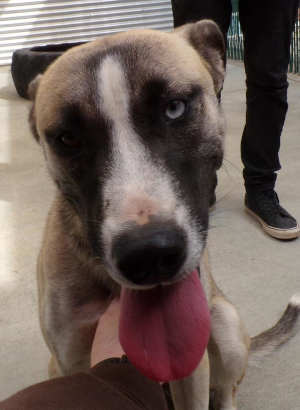
Female shepherd-husky
This 1-year-old female shepherd-husky mix has a short tricolor coat and blue eyes.
She’s in kennel No. 10, ID No. LCAC-A-1746.
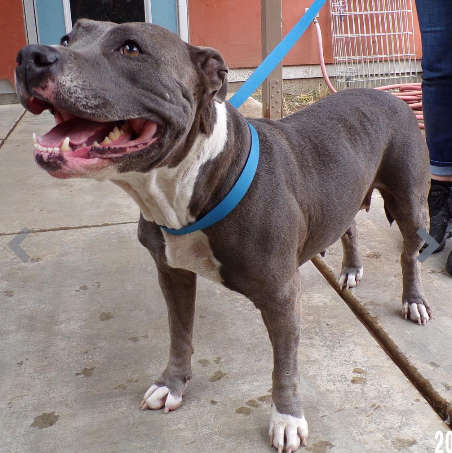
Female American Staffordshire terrier
This 7-year-old female American Staffordshire terrier has a short gray coat and white markings.
She is in kennel No. 11, ID No. LCAC-A-1890.

‘Einstine’
“Einstine” is a young Labrador retriever-pit bull mix with s short black coat with white markings.
He is in kennel No. 12, ID No. LCAC-A-1860.

Labrador-pit bull mix
This 5-year-old female chocolate Labrador retriever-pit bull mix has a short chocolate-colored coat.
She is in kennel No. 13, ID No. LCAC-A-1769.
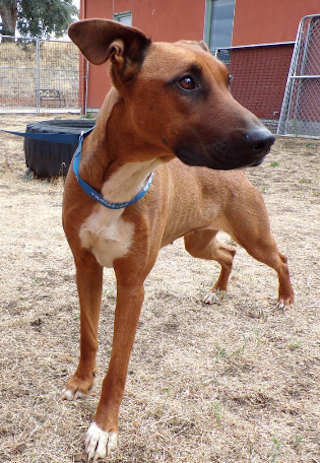
‘Cynthia’
“Cynthia” is a 1-year-old female Doberman pinscher-hound mix.
She is in kennel No. 18, ID No. LCAC-A-1891.

‘Rocky’
“Rocky” is a 1-year-old female German shepherd mix with a short black coat and tan markings.
She is in kennel No. 19, ID No. LCAC-A-1719.

Female Rottweiler
This 5-year-old female Rottweiler has a short black and tan coat.
She is in kennel No. 20, ID No. LCAC-A-1833.

Male mastiff
This 2-year-old male mastiff has a short tan coat.
He is in kennel No. 21, ID No. LCAC-A-1869.
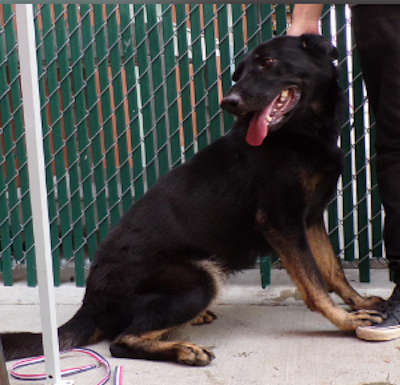
Female German shepherd
This 2-year-old female German shepherd has a short black coat with tan markings.
She is in kennel No. 22, ID No. LCAC-A-1733.
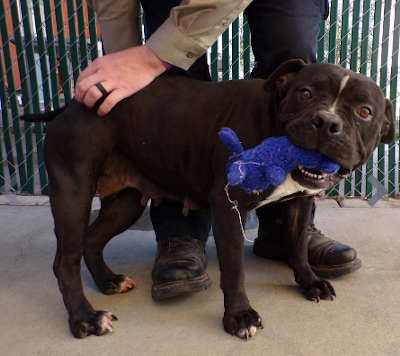
Female American Staffordshire mix
This 3-year-old female American Staffordshire mix has a short black coat with white markings.
She is in kennel No. 23, ID No. LCAC-A-1727.
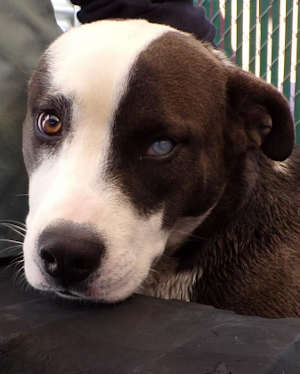
Female husky-pit bull
This 1-year-old female husky-pit bull mix has a short brown coat with white markings.
She is in kennel No. 24, ID No. LCAC-A-1725.

Male husky-pit bull
This 1-year-old male husky-pit bull mix has a short coat.
He is in kennel No. 25, ID No. LCAC-A-1726.

‘LuLu’
“LuLu” is a 1-year-old female Rottweiler with a short black and tan coat.
She is in kennel No. 27, ID No. LCAC-A-1658.
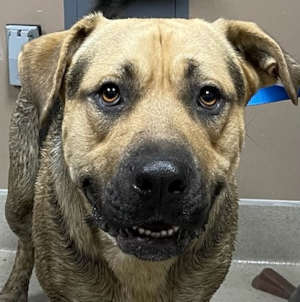
Male shepherd mix
This 2-year-old male shepherd mix has a short black and tan coat.
He is in kennel No. 28, ID No. LCAC-A-1743.

Male pit bull
This young male pit bull has a short black and white coat.
He is in kennel No. 29, ID No. LCAC-A-1699.

Female pit bull
This 1-year-old female pit bull mix has a short gray coat with white markings.
She is in kennel No. 31, ID No. LCAC-A-1683.

‘Dozer’
‘Dozer’ is a 5-year-old American pit bull terrier mix with a short brindle coat.
He is in kennel No. 33, ID No. LCAC-A-1483.

Male Belgian malinois
This 2-year-old male Belgian malinois has a short black and tan coat.
He is in kennel No. 34, ID No. LCAC-A-1779.
Email Elizabeth Larson at
The surface of Venus is completely inhospitable for life: barren, dry, crushed under an atmosphere about 90 times the pressure of Earth’s and roasted by temperatures two times hotter than an oven.
But was it always that way? Could Venus once have been a twin of Earth — a habitable world with liquid water oceans? This is one of the many mysteries associated with our shrouded sister world.
Twenty-seven years have passed since NASA’s Magellan mission last orbited Venus. That was NASA’s most recent mission to Earth’s sister planet, and while we have gained significant knowledge of Venus since then, there are still numerous mysteries about the planet that remain unsolved. NASA’s Deep Atmosphere Venus Investigation of Noble gases, Chemistry, and Imaging, or DAVINCI, mission hopes to change that.
Here are 10 mysteries of Venus that NASA scientists are still grappling with.
1. Did Venus ever host life?
Big questions are often asked when thinking about other planets: Is there life? WAS there ever life? If so, what sort of life? Tiny microbes that that resemble simple life on Earth? Or like nothing we have ever recognized?
Venus is no exception.
“The community has speculated about possible life on Venus, but until we know whether Venus was ever actually habitable in the past, it’s difficult to say much more beyond these speculations,” said Dr. Giada N. Arney, deputy principal investigator for DAVINCI at NASA’s Goddard Space Flight Center, Greenbelt, Maryland. “DAVINCI aims to help us understand whether Venus was ever habitable, which will provide a more concrete grounding on which we can study it as a possible past abode for life … It’s exciting to think there’s a possibility our solar system had two habitable worlds side-by-side for perhaps even billions of years, but we don’t yet know if this was the case.”
To determine whether life was ever possible on Venus, we first need to understand the past environment on Venus. This involves studying the atmosphere, geology and history of the planet.
“We always want to ask the life question, but until we understand the context in which we’re asking it, we won’t know what we’re looking for and may be even more confused or tantalized,” explained Dr. James B. Garvin, principal investigator for DAVINCI at NASA Goddard.
2. How did Venus and Earth come to be so different?
Venus and Earth are similar in size and density, so hypothetically, these planets could be very similar. And yet, they are strikingly different. Air pressure at the surface of Venus is 90 times that of Earth, Venus rotates on its axis backwards compared to the other planets in the solar system, and the surface of Venus is over 900 degrees Fahrenheit (over 482 Celsius), making it the hottest planet in our solar system — hot enough to melt lead.
This extreme heat on the surface of Venus is due to a carbon dioxide atmosphere with thick clouds of sulfuric acid, which could have resulted from a runaway greenhouse phase earlier in Venus’ history that forever changed our sister world.
So, what happened? Was Venus always so inhospitable? “Why are we so good and they so bad?” said Garvin. “That is the central question, because in the long haul, that is going to affect the evolution of our own planet. Maybe Venus is a destiny storyboard that will help us fill in the longer story of our planet.”
The evolution of Venus through time may help us understand processes that govern global-scale changes in a planet’s environment, including evolution of the planet’s habitability, with implications for where we might find habitable planets beyond the solar system.
“Venus represents an important illustration of how planetary environments can evolve over time, and understanding that evolution is critical to our thinking in the search for life beyond Earth,” explained Dr. Stephanie A. Getty, deputy principal investigator for DAVINCI at NASA Goddard.
3. How did Venus form?
Even this seemingly basic question about the origin of Venus is still a mystery. “It’s amazing to me that we don’t know whether Venus formed from the same early solar system materials as did Earth and Mars,” says Getty. “We still don’t know whether Venus was bombarded by comets and asteroids, rich in water, the way Earth was.” These comets and asteroids that bombarded our home planet are considered to have been an important source of water for Earth. Understanding the delivery of water to Venus is important for evaluating its potential to host oceans in the past.
4. What is the atmospheric composition at Venus?
The atmospheric composition of Venus is an important piece of the context we are seeking as we aim to better evaluate Venus’ potential habitability over time.
“We really do not know the important trace chemicals in the Venus atmosphere,” said Garvin. “We don’t understand the chemical cycles that provide clues to how it has evolved and the role of these chemical cycles in Venus’ history — these unknowns are the fingerprints that have been missing for way too long.”
The DAVINCI probe will measure chemistry, pressure, temperature, and dynamics at least every 200 meters (about 656 feet) as it descends through Venus’ atmosphere.
One of the biggest mysteries of Venus’ atmosphere lies in the lowermost or “deep” atmosphere. Typically, planetary atmospheric gases behave like those we study in high-school chemistry — their behavior can be estimated as “ideal gases” and is well understood.
But in Venus’ lower atmosphere (nearest the surface of the planet), carbon dioxide is heated and pressurized to the point where it acts more like a hot liquid than a gas — only about twelve times less dense than liquid water.
“This bizarre behavior is called ‘super-critical,’ and on Venus, the atmosphere that sloshes around the surface landscapes and rocks is supercritical carbon dioxide, which is poorly understood,” said Garvin. “We have to go there and measure what is going on to find out how this works on a planetary scale. That means there’s a whole new frontier on Venus. That’s a new environmental state that we’re not used to.”
5. How were the rocks of Venus formed?
The last spacecraft to successfully descend through the atmosphere and land on Venus was the Soviet VeGa-2 mission in 1985, which survived for 52 minutes on the planet’s inhospitably hot surface on the “night side” of the planet.
At its landing site, it was surrounded by basaltic plains that were formed by volcanism, but some highland regions on Venus are thought to be different. Thus, the surface of Venus remains quite the mystery, especially in regions beyond the volcanic plains.
The DAVINCI spacecraft will be equipped with a suite of four cameras together called Venus Imaging System for Observational Reconnaissance, or VISOR, which will be able to identify rock composition on the planet’s surface.
“Most of the surface of Venus is made of basalt, which is produced by volcanism,” said Arney. “But there are some intriguing mountainous highland regions called ‘tesserae’ (regions of heavily deformed terrain) that suggest hints of having a different composition. They may be made of rocks that form from water-rock interactions and continent-building processes (which could imply Earth-like plate tectonics), and if so, that’s really exciting because it would suggest more hospitable conditions in the Venus past.”
The DAVINCI probe will descend over one of these “tesserae,” called Alpha Regio, and will make measurements with its Venus Descent Imager (VenDI) instrument. “This will help us better understand what this ‘tessera’ is made of,” explained Arney.
6. How much water did Venus have?
Liquid water is essential for life. We cannot assess Venus’ past habitability without knowing how much water Venus may have had — and when and how it lost that water.
Scientists can use the bulk chemical composition of rocks found on Venus to unravel the mystery of water on the planet.
“If we discover ‘granites’ in the mountains of Venus, then we can infer they must have involved large amounts of water in the Venus crust to allow them to form as they do on Earth,” explained Garvin.
Scientists can also use measurements of the atmosphere to understand the history of water at Venus.
The DAVINCI probe’s Venus Mass Spectrometer and Venus Tunable Laser Spectrometer will measure atmospheric composition throughout its entire descent toward the surface of the planet.
The atmospheric signatures measured may provide clues to the story of past water, which may help scientists determine whether the planet previously had an ocean.
“We suspect but do not know whether there were oceans on Venus, and if so, when in Venus’ history the water evaporated,” said Getty.
7. What is the nature of surface activity at Venus?
Scientists are still making discoveries to understand whether Venus ever had Earth-style plate tectonics, and how those mountain-building processes are similar or different from Earth’s. Earth’s crust hosts a network of relatively thin plates jostling around on the planet’s surface in constant horizontal motion.
If similar plate tectonics exist on Venus, now or in the past, the planet’s crust must experience movement of crustal plates over geologic time, mid-ocean-ridge volcanism (volcanic activity present at oceanic boundaries between two plates), and subduction (the movement of one plate sinking underneath another plate).
The history of Venus tectonics is still an active area of research with many open questions. Some scientists believe Venus has retained plate tectonics with laterally moving blocks of crust, while others hypothesize that this period in Venus’ history is long in the past, perhaps when liquid water was either at the surface or abundant within the crust.
At some point, Venus may have had its own form of plate tectonics — possibly different from the plate tectonics here on Earth.
Water and rock measurements obtained from the DAVINCI mission, combined with the Venus global mapping information by NASA’s VERITAS mission, another recently selected mission to Venus that is managed by NASA’s Jet Propulsion Laboratory in Southern California, can be used to decipher how these tectonic patterns may have operated on Venus, and why the planet was unable to sustain them in a fashion similar to Earth.
Venus is an ideal test-case for examining how plate tectonics or some other type of crustal movement persists or disappears on big, rocky planets with atmospheres and a changing (but large) budget of both crustal and surface water.
Another key mystery about the surface of Venus is volcanism. All planets must get rid of their internal heat, and Earth’s method of doing so involves volcanism as an associated process. Scientists are still speculating whether the surface of Venus is currently volcanically active, and to what degree eruptions occur today.
Together, the DAVINCI and VERITAS missions hope to address these questions. DAVINCI can measure gases in the Venus atmosphere that could signal if volcanoes have erupted or are erupting on Venus today, while the VERITAS orbiter will be able to see the deformation of the crust, the chemical signature of recent volcanism, and the thermal signature of major erupting lavas.
8. What do the mountains look like on Venus?
Previous Venus landers (Venera & VeGa) have taken photographs of the Venusian plains after landing on basaltic regions of the surface, but DAVINCI’s cameras will snap the first-ever high-resolution aerial photos of a mountainous tessera surface as the probe descends over the rugged Alpha Regio highlands region.
“Where we’re landing on Venus is in the mountains,” explained Garvin. “No one’s ever gone to the mountains before … When we see them from a mile up, they may look like nothing ever seen by woman or man before, because no one’s ever been there to experience them.”
Such rugged mountain landscapes may hold clues to how erosion on Venus works today. Similarly, they might indicate whether sedimentary rocks were important in the formation of the highlands of Venus as they commonly are on Earth.
9. Are there Venus-like planets beyond our solar system (exoplanets)?
Scientists are excited about the idea of taking what we learn from Venus and applying it to exoplanets — planets outside our solar system.
Venus-like exoplanets are expected to be a common type of planet observed by the upcoming James Webb Space Telescope, and better measurements of Venus may help us to understand these distant worlds.
“We’ll be able to relate what we discover at Venus to what we discover from observations of Venus-like exoplanets observed by the James Webb Space Telescope in the 2020s,” said Arney. “For instance, data from Venus can improve computer models of Venus-like exoplanets that we will use to interpret our future James Webb observations. Also, if Venus was habitable in the past, that means some of these ‘Venus-like’ exoplanets may be habitable too. Understanding the history of Venus may therefore help us to understand and interpret exo-Venus planets observed at varied ages and stages of evolution.”
10. New mysteries we haven’t even thought of yet
“One of the most exciting aspects of planetary exploration is discovering new mysteries that we can’t currently anticipate,” said Arney. “Those new mysteries we can’t yet imagine are what I’m looking forward to the most.”
This is the essence of curiosity-driven exploration, and DAVINCI will offer plenty of opportunities for new mysteries to be identified and even resolved.
What might Venus be hiding? We must go there to find out! “Venus here we come” is the catch-phrase of the DAVINCI team.

Mendocino-Lake Community College District and Yuba Community College District each have seven trustee areas, which must now be adjusted in accordance with the recently released demographic results from the 2020 U.S. Census.
Similarly, the California Citizens Redistricting Commission is leading the work of redrawing congressional, State Senate, State Assembly and State Board of Equalization district lines, and the Board of Supervisors is working to adjust boundaries for its five districts.
California Community College District governing boards are subject to the federal Voting Rights Act and the one person, one vote principle of the Fourteenth Amendment of the U.S. Constitution, Mendocino-Lake Community College District officials reported.
“The Voting Rights Act prohibits electoral systems that deny or abridge the voting rights of protected racial and language minority groups,” the district reported.
As a result, the district said governing board member districts must be as equal in population as possible and that election systems that are at-large meet the one person, one vote test.
For both districts, their trustees must live in their particular districts.
The Mendocino-Lake Community College District’s coverage area of Lake and Mendocino counties has a population of 100,000 divided into seven areas, with each trustee area needing to equal 14,300 people.
The Yuba Community College District spans eight counties — Butte, Colusa, Glenn, Lake, Placer, Sutter, Yolo and Yuba — and has a reported population in its coverage area of 313,828 people, based on latest census data, the district said. That puts their ideal trustee area size at 44,833 residents.
The law requires getting to within 10% of the ideal numbers.
Community members are urged to offer input on how the redistricting process should take place.
For the Mendocino-Lake Community College District, public input can be shared at the following scheduled meetings:
· 5 to 7 p.m. Monday, Oct. 25: North County Center, Willits, Room 8000.
· 5 to 7 p.m. Thursday, Oct. 28: Lake County Center, Lakeport, Room 7050.
· 5 to 7 p.m. Tuesday, Nov. 2: Mendocino College, Ukiah, Room 1060.
· 5 to 7 p.m. Wednesday, Nov. 3: Coast Center, Fort Bragg, The Commons.
Members of the public may mail feedback to Mendocino College, Office of the President, 1000 Hensley Creek Road, Ukiah, CA 95482.
Yuba Community College District held an update on its process timeline at its Oct. 14 meeting.
A consultant, Cooperative Strategies, will be preparing proposed maps through Nov. 9. Draft maps will be posted on the district’s website on Nov. 1.
Once those maps are published, Kathryn Wilkins, executive assistant to the chancellor and board of trustees, said the district will provide information to the local media with the URL members of the public should use to access and review those maps before the regular board meeting.
The board will then review draft maps at its Nov. 10 regular meeting. Wilkins said a public hearing will also be agendized at that meeting to provide for public input and comments on the redistricting process and draft maps as required.
She said the meeting and public hearing will be virtual, and the agenda and Zoom link to attend the meeting will be provided to the public 72 hours before the meeting.
Cooperative Strategies will revise the maps based on public and board input from Nov. 11 to Dec. 15.
The district board will review updates on Dec. 16, and the consultant will continue to make revisions from Dec. 17 to Jan. 12.
The board of trustees is tentatively scheduled to adopt the final trustee areas on Jan. 13, with Cooperative Strategies to send the final trustee area map and descriptions to the registrars of voters offices across the eight county service area in January 2022.
For more information about the background of California Community College redistricting, criteria, key dates, and meeting information, visit https://www.mendocino.edu/redistricting.
Email Elizabeth Larson at