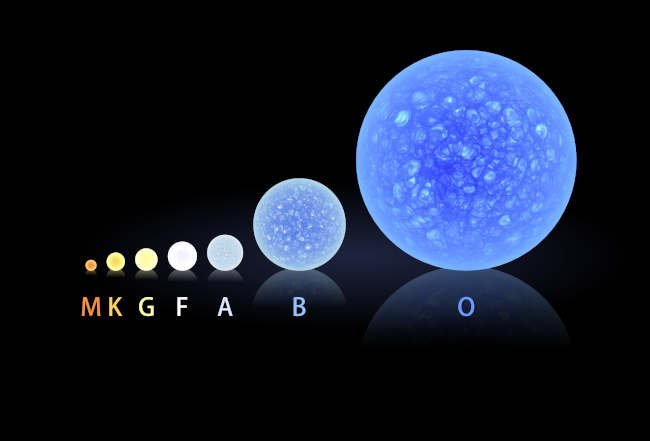
A size comparison of main sequence Morgan-Keenan classifications. Main sequence stars are those that fuse hydrogen into helium in their cores. The Morgan-Keenan system shown here classifies stars based on their spectral characteristics. Our Sun is a G-type star. SISTINE-2's target is Procyon A, an F-type star. Credits: NASA's Goddard Space Flight Center. A NASA sounding rocket will observe a nearby star to learn how starlight affects the atmospheres of exoplanets — key information in the hunt for life outside our solar system.
Using an updated instrument first launched in 2019, the mission has a new target: Procyon A, the brightest star in the constellation Canis Minor. But its question remains the same: How does a star’s light affect potential signs of life on planets that orbit it?
The Suborbital Imaging Spectrograph for Transition region Irradiance from Nearby Exoplanet host stars, or SISTINE-2, mission will have its first opportunity to launch from the White Sands Missile Range in New Mexico on Nov. 8.
Answering the question of whether life exists elsewhere in the universe is beset with technical challenges. We can’t yet travel to planets around other stars, called exoplanets, to see for ourselves. Nor are our telescopes powerful enough to see their surfaces.
Instead, astronomers look to an exoplanet’s atmosphere, scouring it for traces of chemicals associated with life. Water, methane, oxygen, ozone, and other so-called biomarkers produce unique patterns of light that telescopes can detect from afar. But to interpret them correctly, astronomers must look to the planet’s star.
“The interplay between the planet’s atmosphere and ultraviolet light from the host star determines which gases serve as the best biomarkers,” said Kevin France, an astrophysicist at the University of Colorado Boulder and the principal investigator for the mission.
Some ultraviolet wavelengths, for instance, can breakdown carbon dioxide, freeing a single oxygen atom to combine with others and form molecular oxygen (made of two oxygen atoms) or ozone (made of three). Stars that shed enough of this light can create spurious biomarkers on their planets, sending astronomers searching in the wrong places.
The SISTINE team aims to avoid this quandary by creating a guide to the wavelengths each kind of star emits. There are many different types of stars, and we don’t yet have a complete picture of their light output or how it varies over time. With a catalog of starlight, scientists could estimate if a detected biomarker is either a potential sign of life or a false signal cooked up by pesky starlight.
On its upcoming flight, SISTINE-2 will observe Procyon A, some 11.5 light-years away. Procyon A is an F-type star, which is slightly larger, hotter, and brighter than our Sun. Though it does not have any known exoplanets, studying Procyon A can help us understand F-type stars and their exoplanets throughout the universe.
“Knowing the ultraviolet spectra of these stars will help us find the most promising star-planet environments with future NASA observatories,” France said.
SISTINE-2 comprises a telescope and an instrument known as a spectrograph, which breaks light into its separate colors. SISTINE-2 will focus on ultraviolet light from 100 to 160 nanometers, a range that includes wavelengths known to produce false positive biomarkers.
By combining their data with existing observations of X-ray, extreme ultraviolet, and visible light from other F-type stars, the team hopes to assemble a reference spectrum that will help astronomers interpret biomarkers on exoplanets orbiting F-type stars.
SISTINE-2 is also testing hardware. Before its 2019 flight, the team applied an enhanced lithium fluoride optical coating to the instrument’s mirrors to improve its UV reflectivity. The results some three years later help evaluate whether this specialized coating may be suitable for larger, longer-duration space missions.
As in its 2019 flight, the instrument will launch on a sounding rocket, a small suborbital rocket that makes brief observations in space before falling back to Earth.
Ascending to an estimated altitude of about 174 miles to access ultraviolet light otherwise absorbed by our atmosphere, SISTINE-2 will observe Procyon A for about five minutes. The instrument will then fall back to Earth, descending by parachute for recovery and refurbishing.
The team hopes for a soft landing to aid in a quick turnaround to be ready for its third launch in July 2022, from the Arnhem Space Centre in Nhulunbuy, Australia.
There, a refurbished SISTINE instrument will observe Alpha Centauri A and B, G- and K-type stars, respectively, similar to and slightly cooler than our Sun, and the closest such stars to us.
This system is also home to Proxima Centauri, a cool red dwarf star orbited by the closest known exoplanet, Proxima B.
These observations will add additional entries to the growing star catalog — small but critical steps in the search for life.
Miles Hatfield works with NASA’s Goddard Space Flight Center in Greenbelt, Maryland.
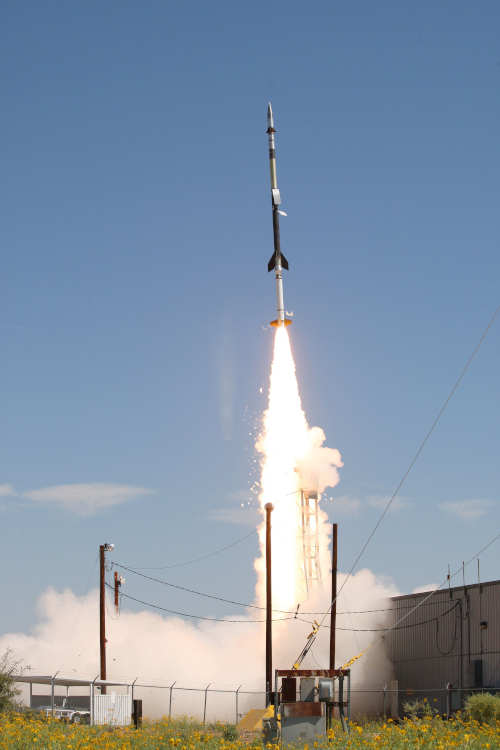
A sounding rocket launches from the White Sands Missile Range, New Mexico. Credits: NASA/White Sands Missile Range.
The two members of Congress who represent portions of Lake County in the House of Representatives reported that they cast votes in favor of the Infrastructure Investment and Jobs Act, hailed as a once-in-a-generation investment in America’s infrastructure and economy.
The legislation passed the House by a bipartisan vote of 228 to 206 on Friday and now heads to President Joe Biden’s desk to be signed into law.
Both Rep. John Garamendi (CA-03), who represents the northern portion of Lake County, and Rep. Mike Thompson (CA-05), whose district includes the other half of the county, cast votes in favor of the bill.
The bill was first passed by the Senate last summer with a wide, bipartisan majority.
It provides $550 billion in new spending and $450 billion for existing surface transportation programs.
Important funding for California includes:
— $25.3 billion for highways; — $4.2 billion for bridges; — $9.45 billion for transit; — $3.5 billion for clean drinking water; — $1.5 billion for airports; — $384 million for electric vehicle charging stations; and — $100 million for broadband.
Garamendi, a senior member of the House Committee on Transportation and Infrastructure, said he’d met in the Oval Office this spring with President Biden, Vice President Harris, Secretary of Transportation Pete Buttigieg and a small bipartisan group of his colleagues on the House Committee on Transportation to begin negotiations on a bipartisan infrastructure bill.
He said Friday’s vote was “the culmination of months of hard work and negotiations.”
Garamendi added, “This is a historic piece of legislation, and a strong investment in our infrastructure and the middle class. The legislation includes much-needed support for America’s roads and bridges, water infrastructure, rural broadband, and more. It will also create new middle-class jobs by rebuilding our nation’s crumbling infrastructure using American materials and workers.”
Thompson said the bipartisan bill, crafted by Republicans and Democrats, provides a 21st century infrastructure.
“It will help rebuild our transportation system with $25.3 billion for our highways, $4.2 billion for bridges, and $9.45 billion for transit projects. Our state will get $84 million to help protect against wildfire, including funding to increase federal firefighter salaries, implement wildfire mitigation programs, carry out forest management projects, and help homeowners fireproof their homes. California will also get at least $100 million for broadband in our state, at a time when more than 545,000 people in our state can’t access the internet,” Thompson said.
“Finally, the bill is an important down payment in our efforts to combat climate change, with $21 billion to protect our environment and over $15 billion to invest in clean energy infrastructure, such as a national network of electric vehicle chargers, zero emission school buses, and research into next generation clean electricity technologies,” Thompson said. “I am proud to vote to pass this bill today and move our state and our nation’s infrastructure into the next generation.”
LAKE COUNTY, Calif. — With the days getting shorter, it’s once again time to turn the clocks back for fall.
Daylight saving time ends at 2 a.m. Sunday, Nov. 7. It began on Sunday, March 14.
Clocks will go back one hour in order to adjust for the shorter days.
Daylight saving time goes into effect on the second Sunday in March and ends on the first Sunday in November, dates established by Congress in the Energy Policy Act of 2005.
Cal Fire uses the time change to remind people to check safety features in homes, including smoke alarms and making sure batteries are charged.
Smoke alarms should be installed in all sleeping rooms, hallways that lead to sleeping areas, basements and each additional level of the home because most fatal fires occur at night, Cal Fire reported.
For more information about smoke alarms visit Cal Fire’s Web site at www.fire.ca.gov or contact your local fire department.
CLEARLAKE, Calif. — Clearlake Animal Control has three adoptable dogs waiting to go to their new families.
The City of Clearlake Animal Association also is seeking fosters for the animals waiting to be adopted.
Call the Clearlake Animal Control shelter at 707-273-9440, or email This email address is being protected from spambots. You need JavaScript enabled to view it. to inquire about adoptions and schedule a visit to the shelter.
Visit Clearlake Animal Control on Facebook or on the city’s website.
The newest dogs are listed at the top of the following list.
“Fiona.” Photo courtesy of Clearlake Animal Control. ‘Fiona’
“Fiona” is a female pit bull terrier mix with a short gray coat.
She is dog No. 48750483.
“Mitzi.” Photo courtesy of Clearlake Animal Control. ‘Mitzi’
“Mitzi” is a female Australian cattle dog mix with a medium-length black and white coat.
She has been spayed.
She is dog No. 48443306.
“Luscious.” Photo courtesy of Clearlake Animal Control. ‘Luscious’
“Luscious” is a male pit bull terrier mix with a short gray coat.
He has been neutered.
He is dog No. 48757611.
Email Elizabeth Larson at This email address is being protected from spambots. You need JavaScript enabled to view it.. Follow her on Twitter, @ERLarson, or Lake County News, @LakeCoNews.
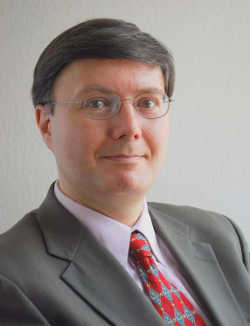
Dennis Fordham. Courtesy photo. In California, what options does a person married to a spouse who suffers from cognitive impairment have to get the couple’s affairs in order, e.g., to establish and fund a trust? Let us discuss.
Let us consider a married person with diminished capacity — such as, unable to have an involved estate planning discussion or unable to understand the terms of a living trust — but who nonetheless still retains sufficient capacity to understand and to execute a power of attorney to appoint someone else who has capacity to engage in estate planning.
In California, a person can execute a power of attorney if they have the capacity to sign a contract, which is anyone except minors, persons of unsound mind and persons deprived of civil rights can contract. Thus an adult who is neither of unsound mind nor deprived of their civil rights can sign a power of attorney.
However, what if the spouse with diminished capacity is of unsound mind (and so unable to sign a power of attorney)?
When the married couple’s estate consists of community property assets (such is often the case in a long marriage) then a court petition under section 3100 of Probate Code can ask the court to authorize a particular transaction. This is usually transferring the community property to the well spouse as the well spouse’s sole and separate property.
With complete ownership of the assets, the well spouse can then engage in estate planning for the couple’s best interests.
Being able to use the section 3100 petition, however, depends on the character of the subject assets being community property.
If a proposed transaction involves mixed community and separate property, i.e one in which a spouse also has a separate property interest, then for good cause the court may still include that separate property in the transaction.
Nonetheless, if some of the incapacitated spouse’s assets are exclusively his or her own separate property alone — such as, bank accounts from before their marriage or real property assets acquired as an inheritance during their marriage — then this approach probably will not work, unless the court is willing to be flexible and to see the bigger estate picture which is mainly community property assets.
Clearly, however, if the incapacitated spouse’s major assets are his or her separate property assets alone then it very hard to impossible to argue that the section 3100 is applicable to such separate property assets.
Next, with separate property assets, commencing a conservatorship court proceeding may be necessary. A conservatorship must be opened in order to then make a substituted judgment petition asking the court to authorize estate planning.
The section 3100 petition and the court conservatorship petition are court proceedings that each require the following: (1) a determination of incapacity with respect to spouse with diminished capacity; (2) notification to the relatives within the 2nd degree of the spouse with diminished capacity regarding the hearing; (3) representation of the interests of the spouse with diminished capacity; and (4) service of a citation to appear at the court hearing on the spouse with diminished capacity.
Each petition invites the possibility of opposition and further litigation.
Getting one’s affairs in order prior to losing one’s capacity avoids court petitions, usually brought by a spouse or child.
If a person has diminished capacity but still is not yet of unsound mind — a gray area to be sure — then they may still be able to appoint an agent to engage in estate planning.
The foregoing is not legal advice. If needing guidance regarding a person with diminished capacity consult an attorney.
Dennis A. Fordham, attorney, is a State Bar-Certified Specialist in estate planning, probate and trust law. His office is at 870 S. Main St., Lakeport, Calif.He can be reached at This email address is being protected from spambots. You need JavaScript enabled to view it. and 707-263-3235.
What's up for November? Sunset planets, a partial lunar eclipse and the return of the winter stars.
From Nov. 6 through the 11, watch the Moon glide past Venus, Saturn and Jupiter after sunset in the south/southwest.
In particular, if you step outside for a look on Nov. 7, you'll find the four-day-old crescent moon just about 2 degrees away from Venus. Should be really pretty, so don't miss it.
And from now through early December, you'll find Jupiter and Saturn drawing a little closer to Venus each night.
A partial lunar eclipse is on the way, taking place overnight on Nov. 18 and 19, when the moon slips into Earth's shadow for a couple of hours. Weather permitting, the eclipse will be visible from any location where the moon appears above the horizon during the eclipse. Depending on your time zone, it'll occur earlier or later in the evening for you.
Now that's a huge swath of the planet that'll be able to see at least part of the eclipse, including North and South America, Eastern Asia, Australia and the Pacific Region. So check the timing of its visibility for your area.
For U.S. East Coast observers, the partial eclipse begins a little after 2 a.m., reaching its maximum at 4 in the morning. For observers on the West Coast, that translates to beginning just after 11 p.m., with a maximum at 1 a.m.
Partial lunar eclipses might not be quite as spectacular as total lunar eclipses — where the Moon is completely covered in Earth's shadow — but they occur more frequently.
And that just means more opportunities to witness little changes in our solar system that sometimes occur right before our eyes.
All month long, if you're up late and cast your gaze toward the east, you'll notice some familiar companions have begun rising late in the night. The familiar stars of Northern winter skies are returning, rising late at night and sitting high in the south by dawn.
You'll find the Pleiades star cluster leading the constellations Taurus the bull and the hunter Orion, followed by the brightest star in the sky, Sirius — all of them back to keep us company on the long winter nights here in the Northern Hemisphere. (And for those in the Southern Hemisphere, they're keeping you company on shorter nights as spring gives way to summer there.)
A fun note about the Pleiades this month is that several of the 8 asteroids to be visited by NASA's Lucy mission are located in that part of the sky.
The Lucy spacecraft launched on Oct. 16 on its 12-year mission to visit a bunch of special asteroids called the Trojans. They share the orbit of Jupiter, with a group of them leading the planet, and another group following behind it.
Lucy will be the first space mission to explore this unique group of asteroids, providing new insights about the formation and early history of our solar system.
Preston Dyches is with NASA's Jet Propulsion Laboratory.
 How to resolve AdBlock issue?