 How to resolve AdBlock issue?
News

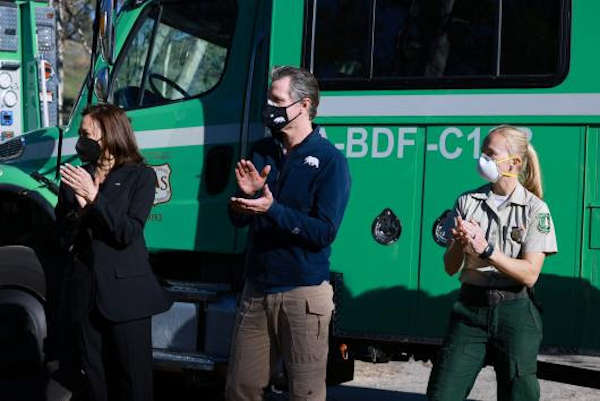
Gov. Gavin Newsom on Friday joined Vice President Kamala Harris and U.S. Agriculture Secretary Tom Vilsack on a visit to the San Bernardino National Forest to highlight new federal funding for wildfire recovery and mitigation efforts and discuss state-federal collaboration to tackle the wildfire crisis, complementing California’s bold investments and ongoing work to build wildfire resilience statewide.
The California Blueprint proposes an additional $1.2 billion as part of a total $2.7 billion multiyear package to step up forest management and other projects to decrease catastrophic wildfire risk amid the extreme climate impacts across the West.
“California is on the front lines of the climate crisis, experiencing record-breaking heat waves, wildfire seasons, and droughts. We’re fortunate to have the Biden-Harris Administration’s partnership in meeting this existential challenge head-on,” said Gov. Newsom. “Our state is leading the nation with transformative investments and innovative strategies to protect Californians and the environment. We look forward to our continued collaboration with the federal government to scale up this vital work, and I thank Vice President Harris for her leadership in this space.”
Vice President Harris announced $1.3 billion in federal funding for post-wildfire and hurricane recovery in states across the country, including $600 million to support California communities hit hard by recent wildfires with cleanup efforts, reforestation, watershed restoration and infrastructure repairs.
In addition, the vice president announced more than $48 million in funding for Joint Chief’s Landscape Restoration Partnership projects — including four in California — that mitigate catastrophic wildfire risk and help create climate-resilient landscapes, protect water quality and enhance wildlife habitat.
Friday’s announcements build on the Biden-Harris Administration’s recently-released 10-year strategy that aligns with the Governor’s Wildfire and Forest Resilience Action Plan.
The strategy calls for the U.S. Forest Service to significantly expand fuels and forest health treatments, prioritizing high-risk areas including the Sierra Nevada Range in California. Joint state-federal management is crucial to California’s overall forest health and wildfire resilience, as the federal government owns 57% of California’s forestlands while the state owns 3 percent.
Following an aerial tour of fire scars from the 2020 El Dorado Fire and Apple Fire, the governor, vice president and Secretary Vilsack joined officials including Sen. Alex Padilla (D-CA) and Rep. Pete Aguilar (D-CA) at the USFS Del Rosa Fire Station for a briefing by state and federal fire officials.
USFS Chief Randy Moore, USFS Regional Forester Jennifer Eberlien, California Natural Resources Agency Secretary Wade Crowfoot and Cal Fire Acting Director Michael Richwine provided an overview of this year’s fire outlook, current drought impacts and the extreme weather conditions that are driving catastrophic wildfires in the Western U.S.
Building on the governor’s previous budget investments in emergency management and executive actions to help combat catastrophic wildfires, the California Blueprint proposes an additional $1.2 billion as part of a total $2.7 billion multiyear investment to step up forest management and other projects to decrease catastrophic wildfire risk.
The blueprint also includes $648 million for firefighters and firefighting equipment, including new fire hawks and helitankers.
In addition, a proposed $175.2 million, as part of a planned $1.1 billion investment over the next five years, will fund major capital outlay projects that include replacing fire stations and making improvements to accommodate Cal Fire’s new helicopter and aircraft fleet.
In 2020, the Newsom Administration and the U.S. Forest Service announced a shared stewardship agreement under which they are working to treat one million acres of forest and wildland annually to reduce the risk of catastrophic wildfire.
The governor last year launched an expanded and refocused Wildfire and Forest Resilience Task Force with federal, local and tribal leaders to deliver on key commitments in his Wildfire and Forest Resilience Action Plan.
Additional information on the California Blueprint’s proposals to advance the state’s climate leadership and protect communities from wildfire, drought, extreme heat and carbon pollution can be found here.

The Research Brief is a short take about interesting academic work.
The big idea
The discontinuation of the Biden administration’s monthly payments of the child tax credit could leave millions of American families without enough food on the table, according to our new study in JAMA Network Open. The first missed payment on Jan. 15, 2022, left families that had come to rely on them wondering how they would make ends meet, according to many news reports.
The American Rescue Plan Act, a $1.9 trillion COVID-19 relief package passed in March 2021, made significant changes to the existing child tax credit. It increased the size of the credit by 50% or more, depending on a child’s age, to either $3,000 or $3,600 per year. It also made more low-income families eligible and paid half of this money out as a monthly “advance” payment.
Biden’s Build Back Better plan calls for a second year of an expanded child tax credit disbursed monthly. But that package of measures stalled in the Senate after passing the House in November 2021. As a result, the monthly advance payments of the child tax credit that American families with children had been receiving since July 2021 were left hanging in the balance.
Nearly 60 million families with children received the first payment, which was sent out in July 2021. The payments were widely credited with bringing about huge declines in poverty and malnutrition. Our study found that the introduction of these advance payments was associated with a 26% drop in the share of American households with children without enough food.
We used nationally representative data from over 585,000 responses to the Census Household Pulse Survey from January through August 2021 to assess how the introduction of the child tax credit advance payments affected food insufficiency in the weeks following the first payment on July 15, 2021. Food insufficiency is a measure of whether a household has enough food to eat. It is a much narrower measure than food insecurity, which is a more comprehensive measure based on 18 questions used by the U.S. Department of Agriculture.
Importantly, we were able to separate the effect of these payments from other types of support, like the use of food pantries, the Supplemental Nutrition Assistance Program, unemployment benefits and COVID-19 stimulus payments.
Why it matters
Food insufficiency spiked during the COVID-19 pandemic, particularly among families with children: It rose from 3% among all households in December 2019 to 18% in December 2020. Even after many, if not most, U.S. families received pandemic stimulus checks and other benefits, food insufficiency still hovered around 14% in June 2021. But following the first advance payment, from July 23 to August 2, 2021, food insufficiency among households with children fell drastically, to 10%.
This support is ending just as the omicron variant of COVID-19 is leaving many families without work, child care and, in many places, child care via in-person instruction at school.
All these factors are leading to lower income and, where school is virtual once again, creating the need for more meals at home. Other analyses of the Census Household Pulse Survey have found that most families were using the child tax credit advance payments for food and other necessities, such as housing and utilities.
What’s next
We are going to look further into how the advance payments affected low-income families through the rest of 2021, analyzing which groups of Americans saw the most benefit and what happened once the advance payments expired in 2022.
[Over 140,000 readers rely on The Conversation’s newsletters to understand the world. Sign up today.]
The full impact of the expansion of the child tax credit for the 2021 tax year has not yet been seen either. Eligible families will get the rest of that money, equal to all six monthly payments combined, when they file their 2021 tax returns this year.
Paul Shafer, Assistant Professor of Health Law, Policy and Management, Boston University and Katherine Gutierrez, PhD Candidate in Economics, University of New Mexico
This article is republished from The Conversation under a Creative Commons license. Read the original article.

After analyzing powdered rock samples collected from the surface of Mars by NASA’s Curiosity rover, scientists have announced that several of the samples are rich in a type of carbon that on Earth is associated with biological processes.
While the finding is intriguing, it doesn’t necessarily point to ancient life on Mars, as scientists have not yet found conclusive supporting evidence of ancient or current biology there, such as sedimentary rock formations produced by ancient bacteria, or a diversity of complex organic molecules formed by life.
“We’re finding things on Mars that are tantalizingly interesting, but we would really need more evidence to say we’ve identified life,” said Paul Mahaffy, who served as the principal investigator of the Sample Analysis at Mars, or SAM, chemistry lab aboard Curiosity until retiring from NASA’s Goddard Space Flight Center in Greenbelt, Maryland, in December 2021. “So we’re looking at what else could have caused the carbon signature we’re seeing, if not life.”
In a report of their findings, published in the Proceedings of the National Academy of Sciences journal on Jan. 18, Curiosity scientists offer several explanations for the unusual carbon signals they detected.
Their hypotheses are drawn partly from carbon signatures on Earth, but scientists warn the two planets are so different they can’t make definitive conclusions based on Earth examples.
“The hardest thing is letting go of Earth and letting go of that bias that we have and really trying to get into the fundamentals of the chemistry, physics and environmental processes on Mars,” said Goddard astrobiologist Jennifer L. Eigenbrode, who participated in the carbon study. Previously, Eigenbrode led an international team of Curiosity scientists in the detection of myriad organic molecules — ones that contain carbon — on the Martian surface.
“We need to open our minds and think outside the box,” Eigenbrode said, “and that’s what this paper does.”
The biological explanation Curiosity scientists present in their paper is inspired by Earth life. It involves ancient bacteria in the surface that would have produced a unique carbon signature as they released methane into the atmosphere where ultraviolet light would have converted that gas into larger, more complex molecules. These new molecules would have rained down to the surface and now could be preserved with their distinct carbon signature in Martian rocks.
Two other hypotheses offer nonbiological explanations. One suggests the carbon signature could have resulted from the interaction of ultraviolet light with carbon dioxide gas in the Martian atmosphere, producing new carbon-containing molecules that would have settled to the surface.
And the other speculates that the carbon could have been left behind from a rare event hundreds of millions of years ago when the solar system passed through a giant molecular cloud rich in the type of carbon detected.
“All three explanations fit the data,” said Christopher House, a Curiosity scientist based at Penn State who led the carbon study. “We simply need more data to rule them in or out.”
To analyze carbon in the Martian surface, House’s team used the Tunable Laser Spectrometer, or TLS, instrument inside the SAM lab.
SAM heated 24 samples from geologically diverse locations in the planet’s Gale crater to about 1,500 degrees Fahrenheit, or 850 degrees Celsius, to release the gases inside. Then the TLS measured the isotopes from some of the reduced carbon that was set free in the heating process.
Isotopes are atoms of an element with different masses due to their distinct number of neutrons, and they are instrumental in understanding the chemical and biological evolution of planets.
Carbon is particularly important since this element is found in all life on Earth; it flows continuously through the air, water, and ground in a cycle that’s well understood thanks to isotope measurements.
For instance, living creatures on Earth use the smaller, lighter carbon 12 atom to metabolize food or for photosynthesis versus the heavier carbon 13 atom. Thus, significantly more carbon 12 than carbon 13 in ancient rocks, along with other evidence, suggests to scientists they’re looking at signatures of life-related chemistry.
Looking at the ratio of these two carbon isotopes helps Earth scientists tell what type of life they’re looking at and the environment it lived in.

On Mars, Curiosity researchers found that nearly half of their samples had surprisingly large amounts of carbon 12 compared to what scientists have measured in the Martian atmosphere and meteorites.
These samples came from five distinct locations in Gale crater, the researchers report, which may be related in that all the locations have well-preserved, ancient surfaces.
“On Earth, processes that would produce the carbon signal we’re detecting on Mars are biological,” House said. “We have to understand whether the same explanation works for Mars, or if there are other explanations, because Mars is very different.”
Mars is unique because it may have started off with a different mix of carbon isotopes than Earth 4.5 billion years ago. Mars is smaller, cooler, has weaker gravity, and different gases in its atmosphere. Additionally, the carbon on Mars could be cycling without any life involved.
“There’s a huge chunk of the carbon cycle on Earth that involves life, and because of life, there is a chunk of the carbon cycle on Earth we can’t understand, because everywhere we look there is life,” said Andrew Steele, a Curiosity scientist based at the Carnegie Institution for Science in Washington, D.C
Steele noted that scientists are in the early stages of understanding how carbon cycles on Mars and, thus, how to interpret isotopic ratios and the nonbiological activities that could lead to those ratios.
Curiosity, which arrived on the Red Planet in 2012, is the first rover with tools to study carbon isotopes in the surface. Other missions have collected information about isotopic signatures in the atmosphere, and scientists have measured ratios of Martian meteorites that have been collected on Earth.
“Defining the carbon cycle on Mars is absolutely key to trying to understand how life could fit into that cycle,” Steele said. “We have done that really successfully on Earth, but we are just beginning to define that cycle for Mars.”
Curiosity scientists will continue to measure carbon isotopes to see if they get a similar signature when the rover visits other sites suspected to have well-preserved ancient surfaces.
To further test the biological hypothesis involving methane-producing microorganisms, the Curiosity team would like to analyze the carbon content of a methane plume released from the surface.
The rover unexpectedly encountered such a plume in 2019 but there’s no way to predict whether that will happen again. Otherwise, researchers point out that this study provides guidance to the team behind NASA’s Perseverance rover on the best types of samples to collect to confirm the carbon signature and determine definitively whether it’s coming from life or not. Perseverance is collecting samples from the Martian surface for possible future return to Earth.
Curiosity’s mission is led by NASA’s Jet Propulsion Laboratory in Southern California; JPL is managed by Caltech.
Lonnie Shekhtman works for NASA’s Goddard Space Flight Center, Greenbelt, Maryland.


LAKE COUNTY, Calif. — An Occidental man has been arrested for the killing of a Lucerne resident this past summer.
The Lake County Sheriff’s Office said it has officially arrested Nova Maye Deperno, 26, for the murder of Ronald Meluso.
Deperno was arrested on Thursday afternoon and booked into the Lake County Jail. Jail records show he is being held on $1 million bail.
Authorities so far have not suggested a motive in the case.
Meluso, 63, was last heard from on Aug. 18. He was reported as missing to the sheriff’s office on Aug. 22.
In December, the sheriff’s office determined Meluso was the victim of foul play and that Deperno was a person of interest.
Authorities were seeking Deperno for assault with a deadly weapon, vandalism and brandishing a firearm, and on Jan. 13, Deperno was taken into custody in Sonoma County, as Lake County News has reported.
After the Jan. 13 arrest, detectives from Lake County Sheriff’s Major Crimes Unit were able to interview Deperno regarding Meluso’s disappearance.
Deperno provided statements linking him to the disappearance and subsequent murder of Meluso, authorities said.
The sheriff’s office said that on Jan. 14, Deperno assisted detectives in locating human remains in a rural area off Bartlett Springs Road in northern Lake County.
The remains are strongly believed to be those of Meluso, and detectives are in contact with Meluso’s family, the sheriff’s office said.
The sheriff’s office said arrangements are being made to confirm positive identification.
Jail records show Deperno is due to appear in Lake County Superior Court on Tuesday.
Anyone with information related to this case is asked to contact Detective Jeff Mora at 707-262-4224 or by email at
Email Elizabeth Larson at
Chief Brad Rasmussen presented the request during the council’s Tuesday night meeting, receiving a 4-1 vote to authorize it. Councilman Michael Green voted no, citing privacy concerns.
The contract with Flock Safety will cost the city $22,000 in the first year and result in the installation of eight cameras. That first-year cost breaks down as $2,000 for installation costs and an annual cost of $2,500 per camera, Rasmussen reported.
Rasmussen said Flock Safety operates on a two-year contract requirement but only bills for a year at a time. The second year will cost the city $20,000. The city can cancel the contract at a cost of $4,000 to remove the equipment.
He said the automatic license plate reader program has been added to the police department’s goals for fiscal year 2021-22, and earlier this year the council authorized a budget amendment that included the first year of costs to start the program.
Rasmussen said the technology will prevent officers from having to review video, noting it’s an inexpensive way to have the equivalent of another officer on the street in many locations.
He cited an estimate from the International Association of Chiefs of Police that 70% of all crimes involve the use of a motor vehicle.
Only authorized personnel who have been trained will be granted access, as required by law. Rasmussen said the data will be shared with other law enforcement and prosecutorial agencies.
The city of Clearlake and county of Lake have already implemented such programs and are using Flock Safety as their vendor, Rasmussen said.
Thanks to interagency agreements, Lakeport Police officers already have access to data in those systems, and Rasmussen added that both the Clearlake and county systems have registered stolen vehicles from the city of Lakeport.
He said the city of Lakeport has had crimes committed with vehicles involved where, if they’d had the system in place, it could have helped them identify suspects.
John Anderson from Flock Safety told the council, “Our mission is to eliminate crime.”
Anderson said the company is in more than 1,400 cities, with Northern California one of its biggest markets.
He explained Flock Safety does not use facial recognition and doesn’t plan to do so, and that it has created a transparency portal in the form of a website to report on its work.
The system is used proactively and is tied in with the California Stolen Vehicle System, so it will alert Lakeport Police about stolen vehicles, Anderson said.
Anderson said the majority of stolen vehicles are associated with crimes, and in many situations, the vehicle was stolen with the purpose of committing another crime.
Rasmussen said a majority of serious crimes — like strings of burglaries — are committed in Lakeport by people who don’t live there and are using vehicles to come into town.
Green said there are several privacy concerns with these types of systems, noting that recording driving habits could raise First Amendment concerns.
He said he would prefer the money be spent on salaries rather than this technology and didn’t see why Lakeport Police needed the system if other local agencies had it.
Anderson explained that Lakeport Police can’t search for anything they want under any circumstances when using the system, noting the audit trail.
Parlet said he agreed with some of Green’s concerns, but didn’t think it would be a problem for Lakeport and said it was a good idea to move forward for the next few years.
Councilman Michael Froio also acknowledged the risks raised by both Green and Parlet. However, he supported implementing the system.
“I see this as being a huge benefit to the people of Lakeport,” Froio said. “I’d like to see this move forward.”
Mayor Stacey Mattina said she felt it would be negligent not to use the system, and Mayor Pro Tem Mireya Turner agreed, adding that equipping the police force with every tool it needs has always been a top priority for her.
Turner offered the motion to approve the system, with Froio seconding. The council voted 4-1, with Green the lone dissenter.
In other police-related business, Rasmussen received approval from the council to purchase a new Dodge Charger patrol vehicle from Matt Mazzei Chevrolet in Lakeport.
Mazzei’s bid was for $39,323.60, but the total cost will be up to $65,000 to cover the vehicle and additional equipment, Rasmussen said.
The new vehicle will replace the department’s last 2010 Ford Crown Victoria patrol car, he said.
Rasmussen said the cost of these patrol vehicles has increased by $8,000 since the department last ordered a vehicle in April of 2021.
He said it could be six to seven months before they get the car due to factory delays.
Councilman Kenny Parlet said that, based on what he’s heard about the vehicle supply, it could be up to a year before the department gets the new patrol car. “Let’s just be patient.”
In other business on Tuesday, the council authorized the professional services agreements with Dokken Engineering totaling $196,540 for the Forbes Creek Headwall Repair Project and the Hartley Street Culvert Repair Project.
Public Works Superintendent Ron Ladd told the council that Caltrans allowed the city to do a noncompetitive contract for a consultant due to not being able to get more bids.
City Manager Kevin Ingram said the project has been anything but simple, but it’s important.
The council also presented a proclamation designating January 2022 as Human Trafficking Awareness Month in the City of Lakeport, heard a brief update from members of the All Children Thrive Youth Governance Council, received traffic safety reports and approved a resolution to submit an application to the Small Community Drought Relief Program for the modification of the city’s intake structure.
Email Elizabeth Larson at
“We believe shutting off the supply of ghost guns is essential, but we also need a strong local response to address the existing supply of ghost guns,” the members wrote.
“Cities across the country have begun to pass ordinances that prohibit the possession, purchase, sale, receipt, and transportation of ghost guns in order to give local law enforcement the tools they need to keep our communities safe. We respectfully request that USCM consider encouraging all of its members to pass the strongest local ordinances possible to address the problem of ghost guns already in circulation as we work to save lives and prevent gun violence.”
Thompson represents California’s Fifth Congressional District, which includes all or part of Contra Costa, Lake, Napa, Solano and Sonoma counties.
Full text of the letter is available here and follows:
January 19, 2022
The United States Conference of Mayors
1620 Eye St. NW
Washington, D.C. 20006
Dear Mayor Suarez, Mayor Schieve, Mayor Lucas, and Mr. Cochran,
We commend you on the efforts of the United States Conference of Mayors (USCM) to prevent gun violence in our nation’s cities. We write today to request your consideration in addressing the challenge of ghost guns, the fastest growing gun safety threat facing the nation. Mayors on the front lines of gun violence prevention should take action to pass local measures to prohibit ghost guns — a critically needed measure to address the existing supply of ghost guns in our communities.
Ghost guns are firearms that are built with parts that can be acquired without a background check and require only common tools and minimal time to be converted into a functioning and deadly weapon. The finished firearm does not have a serial number and is untraceable by law enforcement seeking to understand how that firearm ended up being used in crime.
These attributes have made ghost guns a desirable tool for those who seek to evade the law. As detailed in a recent National Police Foundation report, law enforcement agencies across the country are growing increasingly concerned about the threat that ghost guns pose to the safety of their communities. According to a report on California gun crimes in The New York Times, “[g]host guns have accounted for 25 to 50 percent of the firearms recovered at crime scenes” in California.
The Biden-Harris Administration has proposed important action to stop the proliferation of these untraceable weapons by regulating the companies that make and sell the core parts for ghost guns. We believe shutting off the supply of ghost guns is essential, but we also need a strong local response to address the existing supply of ghost guns.
Cities across the country have begun to pass ordinances that prohibit the possession, purchase, sale, receipt, and transportation of ghost guns in order to give local law enforcement the tools they need to keep our communities safe. We respectfully request that USCM consider encouraging all of its members to pass the strongest local ordinances possible to address the problem of ghost guns already in circulation as we work to save lives and prevent gun violence.