 How to resolve AdBlock issue?
News
LAKE COUNTY, Calif. — The Clearlake City Council this week will continue a hearing on the appeal of a cannabis operation approved by the Clearlake Planning Commission in November.
The council will meet in closed session at 5 p.m. to hold negotiations for property at 6820, 6828 and 6885 Old Highway 53 between the city, Sutter Equities and Margetich Development Inc. before the council convenes in open session at 6 p.m. Thursday, Jan. 20, in the council chambers at Clearlake City Hall, 14050 Olympic Drive.
The meeting will be broadcast live on the city's YouTube channel or the Lake County PEGTV YouTube Channel. Community members also can participate via Zoom or can attend in person.
The agenda can be found here.
Comments and questions can be submitted in writing for City Council consideration by sending them to City Clerk Melissa Swanson at
To give the council adequate time to review your questions and comments, please submit your written comments before 4 p.m. Thursday, Jan. 20.
Each public comment emailed to the city clerk will be read aloud by the mayor or a member of staff for up to three minutes or will be displayed on a screen. Public comment emails and town hall public comment submissions that are received after the beginning of the meeting will not be included in the record.
The meeting will feature an appearance by one of January’s adoptable dogs.
On the agenda is a public hearing, continued from Jan. 6, on the Clearlake Planning Commission's approval of conditional use permit applications and approval of the corresponding mitigated negative declaration for commercial cannabis operations located at 2185 Ogulin Canyon Road (Ogulin Hills, LLC).
City documents indicate that the project on the 21.25-acre parcel includes two 5,000 square foot manufacturing and processing buildings, a 3,000 square foot building for distribution, retail delivery only and the office, 10 greenhouses totaling 18,750 square feet, five 5,000-gallon water storage tanks, a parking lot, loading areas, and related site and security improvements.
The council held a lengthy hearing on the matter on Jan. 6. Staff is recommending denial of the appeal, filed by Dave Hughes.
Following that hearing, the council will consider Ordinance No. 258-2022, approving a development agreement for Ogulin Canyon Holdings LLC to allow a cannabis operation at 2185 Ogulin Canyon Road.
Under council business, council members will review and approve the submittal of the fiscal year 2022-23 recognized obligation payment schedule for the period of July 1, 2022.
Submission of six-month recognized obligation payment schedules for approval to the State Department of Finance is required under AB 1484 as part of the dissolution of redevelopment agencies and state control over the release of former property tax increment funds by the county to the successor agency, according to Finance Director Kelcey Young’s report to the council.
On the meeting's consent agenda — items that are not considered controversial and are usually adopted on a single vote — are warrants; authorization of an amendment of agreement with ECORP Consulting Inc. for extended environmental/archaeological services for the Dam Road Roundabout Project in the amount of $17,000; continuation of authorization to implement and utilize teleconference accessibility to conduct public meetings pursuant to Assembly Bill 361; continuation of declaration of local emergency issued on Aug. 18, 2021, and ratified by council action on Aug. 19, 2021; continuation of declaration of local emergency issued on Aug. 23, 2021, and ratified by council action on Sept. 16, 2021; continuation of declaration of local emergency issued on March 14, 2020, and ratified by council action on March 19, 2020; award of contract for design services for the ATP Dam Road/South Center Improvement Project; amendment of construction contract for additional work for the 2021 Measure V Improvement Project in an amount of up to $180,000; and approval of the continuation of planning services agreement with Price Consulting Services (Gary Price) to extend the contract through Dec. 31, 2023, and increase the contract by an amount not to exceed $70,000.
Email Elizabeth Larson at
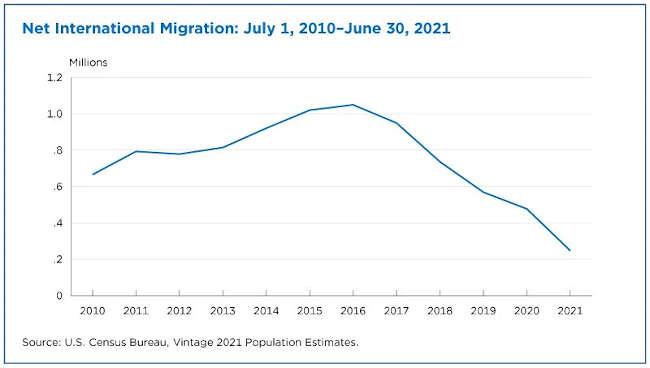
The COVID-19 pandemic significantly impacted international migration patterns both to and from the United States, resulting in the lowest levels of international migration in decades and affecting the data typically used to measure migration flows.
Net international migration, or NIM, added 247,000 to the nation's population between 2020 and 2021, according to U.S. Census Bureau July 1, 2021 population estimates released today.
This is a notable drop from last decade’s high of 1,049,000 between 2015 and 2016. This is also lower than the 477,000 added between 2019 and 2020, which overlapped with the start of the COVID-19 pandemic.
Most COVID restrictions remained in place over the 2021 estimates year (July 1, 2020-June 30, 2021), greatly reducing the movement of people to and from the country.
For example, through June 2021, land borders between the United States, Mexico and Canada remained closed to non-essential travel and three-fourths of U.S. consulates abroad, which issue visas, remained closed.
Travel restrictions from certain countries remained in place and despite changes in immigration policies, the tremendous backlog for issuing visas and settling refugees continued.
All these disruptions required an adjustment to our NIM estimates to reflect the impact of COVID-19 on international migration.
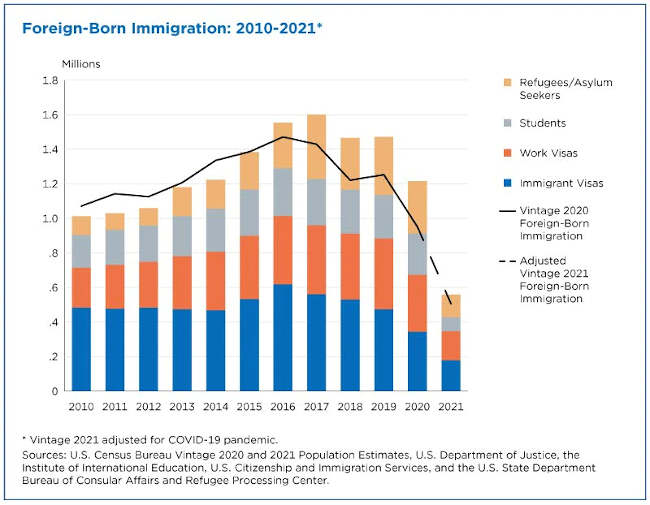
Using publicly available administrative data sources, we adjusted our American Community Survey (ACS)-based NIM estimates based on trends seen with these data, which more accurately reflected migration patterns during the pandemic period. This resulted in the lowest NIM totals in decades.
International migration trends
After last decade’s peak from 2015 to 2016, NIM declined between 2016 and 2019, reflecting three major trends:
• Declining immigration of the foreign born.
• Increasing emigration of the foreign born.
• Changes in Puerto Rican migration following Hurricane Maria in September 2017.
The decline in NIM since 2020 can be attributed in part to the COVID-19 pandemic and associated changes in migration policy.
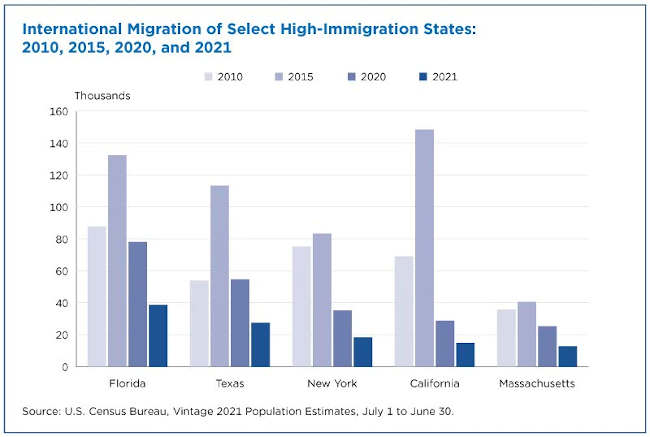
Florida, Texas, New York, California, and Massachusetts typically gain the most migrants from abroad and comprise about half of NIM for the nation most years.
All five of these states saw decreases in NIM between 2015 and 2021, including a nearly 50% drop from 2020 to 2021.
California experienced the largest decline of these states (both in numeric and percent change) from 148,000 in 2015 to 15,000 in 2021.
Adjusting methodology for COVID-19
In addition to reducing levels of migration, the pandemic also affected data collection. It had a particularly significant impact on the 2020 ACS, which would have been the basis for most of our Vintage 2021 NIM estimates.
The ACS sample was greatly reduced — one-third of the interviewed survey sample was lost — after the start of the COVID-19 pandemic, which disproportionately affected certain groups and resulted in nonresponse bias in the estimates for the foreign born.
The data collection issues experienced by the 2020 ACS severely affected data quality, so the Census Bureau only released experimental estimates from the 1-year data.
As a result, we decided the 2020 ACS was not a good fit for our purposes, and instead adjusted 2019 ACS data based on trends noted in administrative data between 2019 and 2021.
Administrative sources used included data from the U.S. Department of Justice, the Institute of International Education, the U.S. Citizenship and Immigration Services and the U.S. State Department Bureau of Consular Affairs and Refugee Processing Center.
Given immigration trends seen in 2019-2021 administrative data and the strong historical relationship between these data and foreign-born immigration ACS estimates, we reduced our 2019 ACS-based estimate by the same degree.
The adjustment factor was created by calculating the percent difference between administrative sources measuring immigration in estimate years 2019 and 2021.
This provided a reasonable adjustment for our foreign-born immigration component, which we then applied to other NIM components (excluding net migration between the United States and Puerto Rico).
We worked under the assumption that the reduction in immigration during the pandemic also applied to both foreign-born emigration and net native migration.
Jason Schachter is chief of the International Migration Branch in the U.S. Census Bureau’s Population Division. Pete Borsella and Anthony Knapp are demographers in the International Migration Branch.
Call Lake County Animal Care and Control at 707-263-0278 or visit the shelter online for information on visiting or adopting.
The following cats at the shelter have been cleared for adoption.

‘Chowder’
“Chowder” is a 4-year-old female domestic shorthair cat with a calico coat.
She is in cat room kennel No. 15, ID No. LCAC-A-982.

‘Blackette’
“Blackette” is a young male domestic shorthair with a black and white coat.
He is in kennel No. 53b, ID No. LCAC-A-2385.

‘Blackie’
“Blackie” is a young male domestic shorthair with a black and white coat.
He is in cat room kennel No. 53c, ID No. LCAC-A-2386.

Male domestic shorthair
This young male domestic shorthair has a unique striped gray tabby coat.
He is in cat room kennel No. 53d, ID No. LCAC-A-2383.

Male domestic shorthair kitten
This male domestic shorthair kitten has an orange tabby coat.
He is in cat room kennel No. 96a, ID No. LCAC-A-1871.

Male domestic shorthair kitten
This male domestic shorthair kitten has an orange tabby coat.
He is in cat room kennel No. 96c, ID No. LCAC-A-1873.

Female domestic shorthair kitten
This female domestic shorthair kitten has an orange tabby coat.
She is in cat room kennel No. 96d, ID No. LCAC-A-1874.

Female domestic shorthair kitten
This female domestic shorthair kitten has a gray tabby coat.
She is in cat room kennel No. 101a, ID No. LCAC-A-1945.
Email Elizabeth Larson at
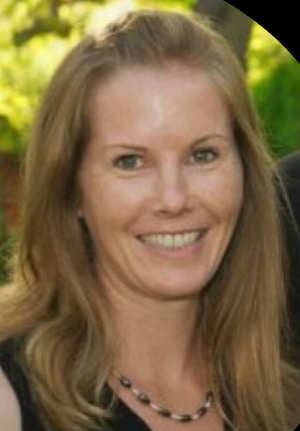
LAKE COUNTY, Calif. — The Board of Supervisors has appointed a new agricultural commissioner, a Lake County native who also will be the first woman to hold the position.
The board emerged from closed session at 3:15 p.m. on Tuesday, Jan. 11, to announce the appointment of Katherine Vanderwall as agricultural Commissioner/Sealer of Weights and Measures.
Her appointment is effective Feb. 12.
She will succeed Steve Hajik, Lake County’s longest-serving agricultural commissioner. Hajik retires in February after 20 years of service in the job.
Born and raised in Lake County, Vanderwall brings experience, insight and lived-in local perspective. She is also a highly connected and respected statewide authority. This combination carries great promise for a critical local industry, the county reported.
“Agriculture is a key facet of Lake County’s economy, and it is important to have a Commissioner in place that understands the unique opportunities and challenges our local farmers experience,” said Board Chair Eddie Crandell. “No one could be better positioned to step into this role than Katherine, and we are very excited she has stepped up to serve Lake County communities in this new and expanded way.”
For the past five years, Vanderwall has served as deputy agricultural commissioner and sealer of weights and measures, supporting the work of the department she will soon lead.
In total, she has been in service with the county of Lake for 14 years, starting as an entry-level biologist. Over that time, she has worked hard to expand her qualifications and contributions to her department and County residents.
Now, Vanderwall is fully licensed by the California Department of Food and Agriculture as both an Agricultural Commissioner and Sealer of Weights and Measures.
She is a past president of the California Association of Standards and Agricultural Professionals and received the association’s Distinguished Service Award in 2021. Vanderwall also holds a Bachelor of Science degree from UC Davis, and earned a Senior Executive Credential from the California State Association of Counties’ CSAC Institute, also in 2021.
Many county residents and leaders know Vanderwall from her service on the Executive Board for Lake County’s 4H program and her annual Ag Venture presentations.
“It was a great privilege for me to make the Motion to appoint Katherine to this critical County leadership role,” enthuses Tina Scott, vice chair and District 4 supervisor. “She brings a strong theoretical understanding and lived-in, local experience. Our board is truly looking forward to seeing how the relationships and knowledge Katherine has developed will benefit all Lake County residents in the years to come.”
As commissioner and sealer, Vanderwall will build on effective partnerships with local farmers, gas station and grocery store owners and staff and other stakeholders to promote sustainable success.
Vanderwall said she will be able to hit the ground running because of her experience and familiarity with the programs the department administers and the relationships that have been built.
She said her previous work has given her the opportunity to promote agriculture, as well as protect consumers by building equity in the marketplace.
Serving her home County in such a vital role is truly a logical next step for Vanderwall.
“I sincerely care for the well-being of the communities we serve and staff in the department,” Vanderwall said.
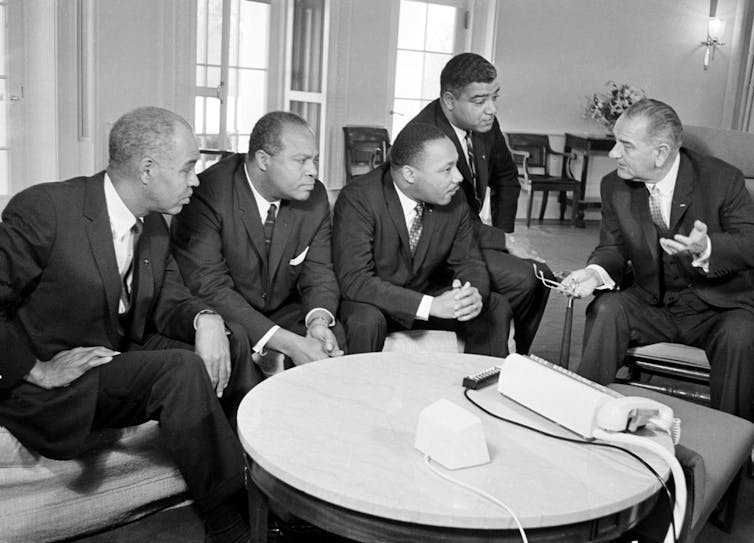
On July 2, 1964, Martin Luther King Jr. stood behind President Lyndon Baines Johnson as the Texan signed into law the Civil Rights Act of 1964. Although not the first civil rights bill passed by Congress, it was the most comprehensive.
King called the law’s passage “a great moment … something like the signing of the Emancipation Proclamation by Abraham Lincoln.” Johnson recognized King’s contributions to the law by gifting him a pen used to sign the historic legislation.
A year later, as Johnson signed the Voting Rights Act of 1965 into law, King again joined the president for the occasion.
But by the start of 1967, the two most famous men in America were no longer on speaking terms. In fact, they would not meet again before King fell to an assassin’s bullet on April 4, 1968.
King was foremost a minister who pastored to a local church throughout his career, even while he was doing national civil rights work. And he became concerned that his political ally Johnson was making a grave moral mistake in Vietnam. Johnson quickly escalated American troop presence in Vietnam from 75,000 to 125,000 in 1965. And by 1968, more than a half a million troops were stationed in the Southeast Asian nation.
As I write in my 2021 book “Nonviolence Before King,” the Baptist preacher had been on a “pilgrimage to nonviolence” for years. And by 1967, he was a radical apostle of Christian nonviolence.
King called on the United States to “be born again” and undergo a “radical revolution of values.” King believed that Jim Crow segregation and the war in Vietnam were rooted in the same unjust ethic of race-based domination, and he called on the nation to change its ways.
Speaking against the Vietnam War
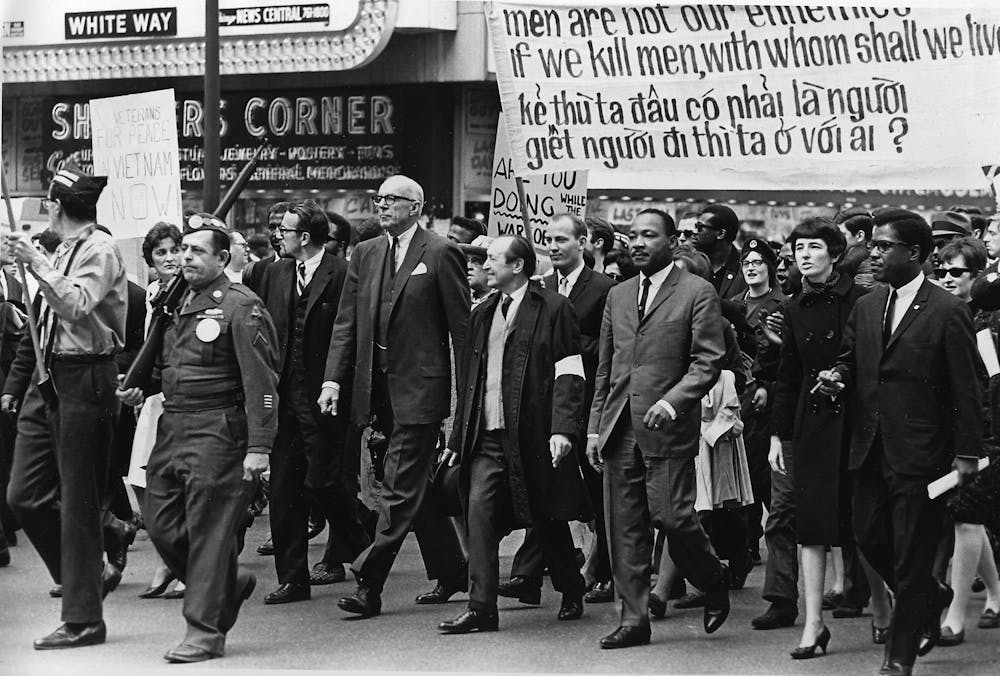
King preached nonviolent direct action for years, and his team organized massive protest movements in the cities of Albany, Georgia, and Selma and Birmingham in Alabama. But by 1967, King’s religious vision for nonviolence went beyond nonviolent street protest to include abolishing what he called the “triple evils” crippling American society. King defined the triple evils as racism, poverty and militarism, and he believed these forces were contrary to God’s will for all people.
He came to believe, as he said in 1967, that racism, economic exploitation and war were crippling America’s ability to create a “beloved community” defined by love and nonviolence. And on April 4, 1967, he publicly rebuked the president’s war policy in Vietnam at Riverside Presbyterian Church in New York City in a speech titled “Beyond Vietnam.”
“I speak as a child of God and brother to the suffering poor of Vietnam,” he told those gathered in the majestic cathedral. “I speak for the poor of America who are paying the double price of smashed hopes at home, and death and corruption in Vietnam.”
King was initially optimistic that Johnson’s Great Society program, which aimed to make historic investments in job growth, job training and economic development, would tackle domestic poverty. But by 1967 the Great Society appeared to be a casualty of the mounting costs of the war in Vietnam. “I was increasingly compelled to see the war as an enemy of the poor and to attack it as such,” King said in his speech.
King saw the grinding poverty facing Black people at home as inseparable from the war overseas. As he noted, “If our nation can spend 35 billion dollars a year to fight an unjust, evil war in Vietnam, and 20 billion dollars to put a man on the moon, it can spend billions of dollars to put God’s children on their own two feet right here on earth.”
King could no longer ignore that military force ran contrary to the nonviolence he espoused. As urban revolts in Watts and Newark in the late 1960s rocked the nation, he pleaded with people to remain nonviolent.
“But they ask – and rightly so – what about Vietnam?” King said in the same 1967 speech. “They ask if our own nation wasn’t using massive doses of violence to solve its problems, to bring about the changes it wanted. Their questions hit home, and I knew that I could never again raise my voice against the violence of the oppressed in the ghettos without having first spoken clearly to the greatest purveyor of violence in the world today – my own government.”
King’s vision
By 1967, King’s vision of justice was one of flourishing for all people, not only civil rights for African Americans. King was criticized for expanding his vision beyond civil rights for Black Americans. Some worried that aligning with the peace movement would weaken the civil rights movement. The National Association for the Advancement of Colored People even issued a statement clearly opposing what it saw as a merging of the civil rights and peace movements.
But in his 1967 “Beyond Vietnam” speech, King called “for a worldwide fellowship that lifts neighborly concern beyond one’s tribe, race, class, and nation … an all-embracing and unconditional love for all mankind.” Such unconditional love is “the key that unlocks the door which leads to ultimate reality,” and he noted that this unifying principle was present in Hinduism, Islam, Christianity, Judaism and Buddhism.
King was always first a religious leader. He never sought nor gained elected office, because he wanted to maintain a moral voice and be free to challenge policies he believed to be unjust.
But the cost for King’s speaking out was high: By the time of his assassination, King’s national approval rating was at an all-time low.
He was not a morally perfect man. Declassified files show how the FBI Director J. Edgar Hoover tried to target King over his extramarital affairs. Hoover used a wiretap to tape King having sex with other women and sent those to his wife, Coretta Scott King, with a letter indicating King should kill himself because of his moral transgressions.
Honoring King
For those seeking to honor King’s legacy today, his religious nonviolence is demanding. It asks that people go beyond acts of service and charity – as important as those are – to both speak and act against violence and racism as well as to organize to end those pernicious forces.
[3 media outlets, 1 religion newsletter. Get stories from The Conversation, AP and RNS.]
It is a radical concept of love that demands we embrace those we know and those we don’t, to acknowledge, as King said, “that all life is interrelated, that somehow we’re caught in an inescapable network of mutuality tied in a single garment of destiny.”
On Martin Luther King Jr. Day, the challenge may be to decipher the meaning of this idea in action for our own lives. The future of what King called the beloved community depends on it – a world at peace because justice is present.
Editor’s Note: This article has been updated with the correct location of Albany.
Anthony Siracusa, Senior Director of Inclusive Culture and Initiatives, University of Colorado Boulder
This article is republished from The Conversation under a Creative Commons license. Read the original article.
The board will meet at 7 p.m. Tuesday, Jan. 18, in the Tom Aiken Student Center at Kelseyville High School, 5480 Main St.
Those participating in the meeting are asked to wear facial coverings based on state guidelines.
The resolution is listed as an action item on the board’s agenda.
It uses similar language to resolutions accepted last month by the Lakeport Unified, Lucerne Elementary and Konocti Unified school district boards, as Lake County News has reported.
However, the Kelseyville document has introduced some changes, in particular, noting that the district “will continue to partner with public health agencies to provide education material and offer vaccination opportunities for school-age children and employees; however, the governing board respectfully asks that the California Legislature not mandate the COVID-19 vaccine for students and staff of TK-12 grade Local Education Agencies.”
The resolution also resolves that the district governing board will petition the state that the COVID-19 vaccine not be a condition of enrollment for students or employment for staff.
Middletown Unified first considered its own version of the resolution last month but postponed a vote. It is due to consider that resolution again on Tuesday night, after having to delay its meeting for nearly a week due to a board member being in COVID quarantine.
Email Elizabeth Larson at