 How to resolve AdBlock issue?
News

My Facebook feed exploded shortly after noon on Dec. 20, 2021, with news from friends and family in northern California: A “big one!” The 6.2 magnitude earthquake they’d just experienced had its epicenter on the coast near Petrolia.
Yet many social media posts weren’t focused on the earthquake itself, but rather the alert sent to cellphones seconds before – or, for some, just as – major shaking began.

The ShakeAlert system is a remarkable technology, years in the making. It has the potential to save tens of thousands of lives in areas where high-magnitude earthquakes occur by providing a few seconds’ warning – enough time for people to take basic safety precautions. Marvelous as it is, though, ShakeAlert saves lives only if people understand what to do when they receive such an alert – and do it.
I’m part of an interdisciplinary group that includes psychologists like me and other social scientists, natural hazards experts, seismologists, geophysicists and communication and education specialists whose goal is to design earthquake preparedness and response systems that optimize safe outcomes. Some of us are working together to analyze video footage of various earthquakes posted to social media sites, such as Facebook, Twitter and YouTube.
Videos during the Petrolia-centered earthquake are the first we’ve seen of what people do – or don’t do – when they receive a ShakeAlert-powered alert. The footage suggests we have more work to do.

Detection and warning of imminent earthquakes
ShakeAlert depends on a massive network of seismic detectors distributed around the West Coast that pick up initial earthquake shaking.
For people near the epicenter, the time it takes to process the data and send an alert may mean it arrives just as, or possibly even seconds after, major shaking begins. Even this roughly simultaneous notice is valuable, as it helps people realize what is happening, which often isn’t obvious.
For those further away from a quake’s epicenter, an alert may arrive seconds, or even tens of seconds, before strong shaking. That’s enough time to automatically shut down or alter the operations of key systems – for example, to slow or stop trains, control equipment involved in delicate medical procedures, or electrical grids. It’s also enough time to prepare mentally, as well as to take potentially life-saving protective action.
To maximize your chances of coming out of a major earthquake alive and intact, most experts recommend in most cases – for California, Oregon and Washington – that you “Drop, Cover, and Hold On,” or DCHO for short. The alert message appearing on your cellphone reminds you what to do.
ShakeAlert is the only earthquake early warning system for the public in the U.S. It went live in Oregon in March 2021, and in May it expanded to the entire U.S. West Coast. The system sends alerts via a group of delivery partners. For instance, Google Android phones display alerts via their operating system. Depending where people live, they can install alert apps – MyShake, QuakeAlert USA or San Diego Emergency ShakeReadySD – to their smartphone. And the Federal Emergency Management Agency system that sends emergency messages like Amber Alerts also issues earthquake warnings.
Considerable prior research helped to shape the content conveyed in ShakeAlert-powered alerts, as well as key messaging that occurs right after alerts. Getting all of this right is crucial, and it’s still a work in progress.
What people do before and during quakes
Until recently, researchers have had to rely primarily on after-the-fact interviews or “Did You Feel It?” post-earthquake surveys to learn what people remembered doing during an earthquake.
In the last several years, closed-circuit TV footage has started to reveal how people really respond to high-intensity shaking. These recordings aren’t muddled by individuals’ understandably imperfect memories of a chaotic and stressful event. Though people frequently report having taken protective actions such as “Drop, Cover, and Hold On” during an earthquake, analyses of CCTV footage to date show that DCHO is, as yet, actually quite rare.
There are a few encouraging exceptions, though. For instance, CCTV footage from the 2018 7.2 magnitude earthquake in Anchorage, Alaska, shows a teacher and students in one middle-school classroom collectively enacting DCHO immediately and flawlessly.
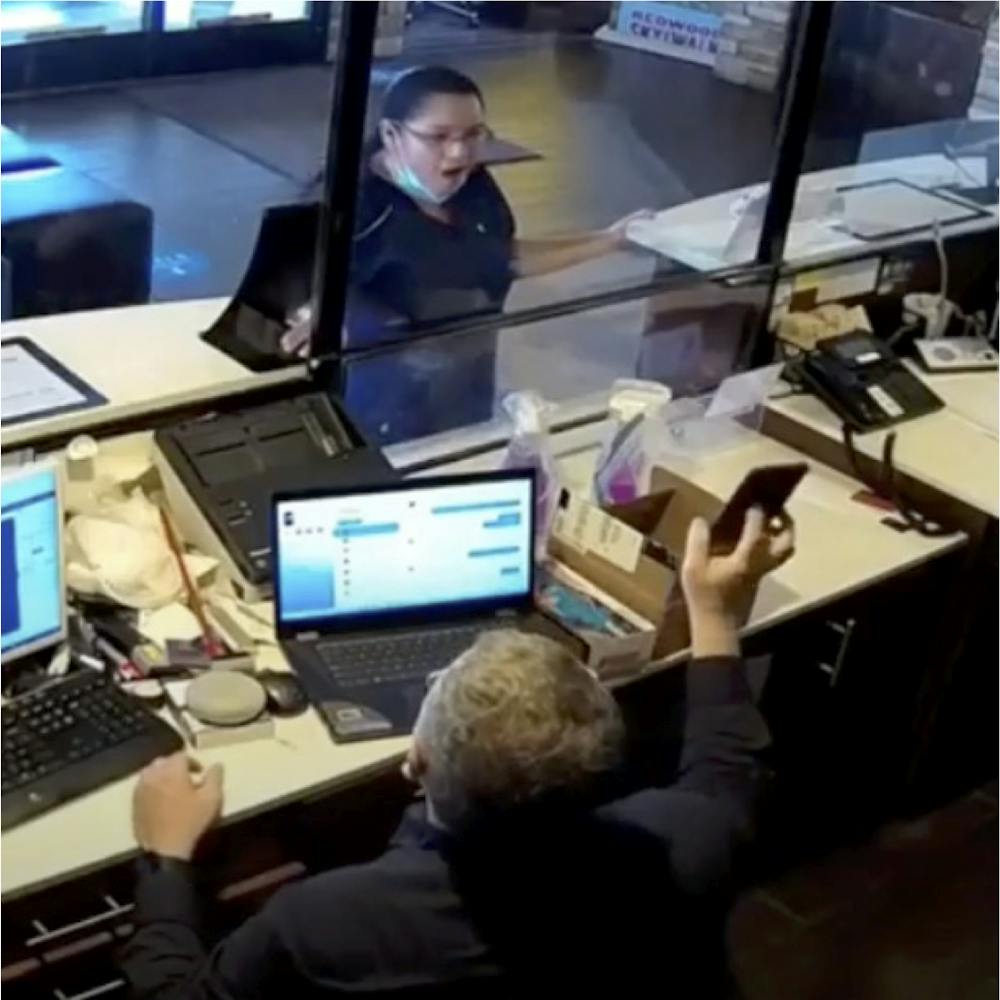
The Petrolia earthquake videos offer the first chance to see if ShakeAlert-powered messages change how people behave before, during and even after a major earthquake. So far, in the footage we’ve seen, people noticed the alert yet did nothing relevant to protecting themselves.
In fact, no one in any of these videos from Dec. 20 undertook “Drop, Cover, and Hold On” precautions, regardless of whether, or when, they received an alert. Many people just stayed where they were, showed the alert on their phones to others and excitedly watched as objects swayed and crashed to the floor.
Frozen in the face of an emergency
My colleagues and I are hoping that a better understanding of what people actually do during major earth shaking will suggest ways to tweak the alerts so they inspire people to take safer actions. It’s a big challenge because doing nothing when an earthquake begins appears to be very common.
A 2021 survey conducted in both Seattle and Sendai, Japan, found that stopping and staying put was the dominant response to major earth shaking, even though it puts people at risk of serious injury from falling or being hit by falling objects. There are several likely reasons.
A major earthquake is a novel experience for many people, and often they simply may not know what to do. In addition, there are potential barriers to carrying out “Drop, Cover, and Hold On.” Age, disability and high body mass can make dropping to the floor and getting under cover problematic, though there are inclusive ways to DCHO.

[Over 140,000 readers rely on The Conversation’s newsletters to understand the world. Sign up today.]
Even when people do know what to do in an emergency, evidence suggests they may feel self-conscious or embarrassed about taking action. Classic social science research points to how contagious it can be, in the face of a variety of emergencies, to do nothing, creating cascading paralysis for everyone present.
By dropping, covering and holding on right when you receive an alert, you might unleash similar protective action in others nearby, possibly saving them, as well as yourself, from injury or death. Seen that way, doing DCHO when you receive an alert – despite the potential for embarrassment – is actually a form of everyday heroism.
Dare A. Baldwin, Full Professor, Psychology and Clark Honors College, University of Oregon
This article is republished from The Conversation under a Creative Commons license. Read the original article.
The City of Clearlake Animal Association also is seeking fosters for the animals waiting to be adopted.
Call the Clearlake Animal Control shelter at 707-273-9440, or email
Visit Clearlake Animal Control on Facebook or on the city’s website.
The newest dogs are listed at the top of the following list.

‘Edgar’
“Edgar” is a male terrier-American pit bull mix with a black and cream coat.
He has been neutered.
He is dog No. 48634546.

‘Jaxx’
“Jaxx” is a male Doberman pinscher mix with a black and rust-colored coat.
He has been neutered.
He is dog No. 49022184.

‘Andy’
“Andy” is a male American pit bull mix with a short gray and white coat.
He is dog No. 48995415.

‘Arnold’
“Arnold” is a male American Staffordshire terrier mix with a short brindle coat with white markings.
He is dog No. 49029348.

‘Bear’
“Bear” is a male Labrador retriever-American pit bull mix with a short charcoal and fawn coat.
He has been neutered.
He is dog No. 48443153.

‘Bear No. 2’
“Bear No. 2” is a male American pit bull mix with a short tan coat.
He has been neutered.
He is dog No. 48731556.

‘Bella’
“Bella” is a female American pit bull mix with a short gray brindle coat.
She has been spayed.
She is dog No. 48448381.

‘Holly’
“Holly” is a female terrier mix with a beige coat.
She is dog No. 49159116.

‘Isabella’
“Isabella” is a female Chihuahua mix with a short tan coat.
She is dog No. 49292130.

‘Levi’
“Levi” is a male golden retriever-Labrador retriever mix.
He has a short golden coat.
He is dog No. 48975687.

‘Maria’
“Maria” is a female Shar-Pei mix with a short tan coat.
She is dog No. 49047315.

‘Nala’
“Nala” is a 1-year-old female German shepherd mix.
She has a medium-length black and tan coat.
She is dog No. 48289638.

‘Priscilla’
“Priscilla” is a female Brittany spaniel mix with a white and copper coat.
She is dog No. 49089138.

‘Sassy’
“Sassy” is a female American pit bull mix with a short black coat.
She has been spayed.
She is dog No. 48443128.

‘Snowball’
“Snowball” is a male American Staffordshire mix terrier with a white coat.
He is dog No. 49159168.

‘Terry’
“Terry” is a male shepherd mix with a short brindle coat.
He is dog No. 48443693.

‘Turk’
“Turk” is a male chocolate Labrador retriever mix.
He is dog No. 48911836.
Email Elizabeth Larson at
Sen. Mike McGuire, who it was announced later on Wednesday had been named State Senate majority leader, gathered with officials from the city of Clearlake, the county of Lake and the state for an online event to give an update on the swap of the two properties.
“We’re making history today in the county of Lake,” said McGuire, explaining the partnership with the city, the county and the state.
In October, the Board of Supervisors voted to approve an agreement to finalize the property exchange with the state.
The county traded a vacant 15.5-acre property at 15837 18th Avenue in Clearlake to the state in exchange for the Lakeport Armory property, located on seven acres at 1431 Hoyt Ave. in Lakeport next to the Lake County Jail.
Three years ago this month, Gov. Gavin Newsom signed Executive Order N-06-19, which directed the state’s Department of General Services to collaborate with the Department of Housing and Community Development and the California Housing Finance Agency to identify and prioritize excess state-owned property to address the state’s affordable housing shortage.
That executive order led to the land swap that McGuire said will build 82 desperately needed affordable housing units in Clearlake and provide the Lake County Sheriff’s Office with a new headquarters.
McGuire said Lake County’s project is also important because it’s the first land swap to take place in the state under Newsom’s January 2019 executive order.
He said no other region of the state has as desperate a need for affordable housing per capita as Lake County, which has seen 60% of its land mass burn due to wildland fires.
Those same fires destroyed 5% of Lake County’s housing stock, amounting to nearly 1,900 homes. McGuire said the rebuilding effort hasn’t kept pace with the need.
In exchange for the armory, the county agreed to transfer to the state the 18th Avenue property, which is strategically located near Clearlake’s largest shopping center, Adventist Clear Lake Hospital, the Woodland Community College Lake County Campus and the site where a new transit hub will be located. McGuire said they couldn’t ask for a more central build area.
The state has secured a developer, Chelsea Investment Corp., which is now in the design phase of the $35 million affordable housing project, McGuire said.
The project’s 82 units will have a mix of one- and three-bedroom units, and keep eight units reserved for people with developmental disabilities, he said.
“This is a huge win for the county of Lake,” and for affordable housing, McGuire said.
“Lake County, you have really turned the corner,” said Assemblymember Cecilia Aguiar-Curry, who McGuire said was a partner in the effort.
Aguiar-Curry said negotiations are always a challenge, and this time especially so due to the delays associated with the pandemic.
“I’m so excited. This is great news,” she said, explaining it’s a perfect example of a state and local partnership benefiting the region.
With this being the first land swap in California, “People are waiting to see how this goes,” she said, adding they want to tell Lake County’s story up and down the state.
McGuire credited Sheriff Brian Martin with making the initial proposal during the Mendocino Complex fire of 2018.
Martin said Wednesday that he’d had a vision that led to the project, and it was hard to believe it was coming to fruition. Bringing it to reality, he added, involved a tremendous amount of work by various government staff.
He said he brought the idea to McGuire and Aguiar-Curry after he heard the armory was shutting down.
The sheriff’s office headquarters at 1220 Martin St. in Lakeport is old and dated, Martin said. With the new location in the armory building, he will be able to have all of his divisions headquartered in the same campus, which will increase the agency’s ability to perform.
Martin said the footprint of the armory is several times larger than the current sheriff’s headquarters and will provide the sheriff’s office a home for decades to come.
There also will be room to grow as they seek to recruit more members, space to add training facilities for law enforcement, community outreach training and emergency response.
McGuire said the swap became official last week when the armory keys were delivered to Martin.
Martin told Lake County News that the keys were delivered last week to the jail administration and he received them on Tuesday.
One of many projects across the state
Jason Kenney, deputy director of real estate services for the Department of General Services, took part in the virtual event on Tuesday.
Kenney said the big thanks goes to Newsom, whose executive order made the project possible. That order, Kenney explained, tasked his department with finding the right properties for affordable housing projects.
Lake County’s project is one of 21 sites across California now in some state of development as a result of the executive order. Kenney estimated about a quarter to a third of those are in areas he would characterize as rural, noting they have been trying to prioritize a mix of areas.
Kenney said the state initially had considered the site for housing before rejecting it. Then the land swap proposal was brought to them. He said it was exactly the type of innovative partnership the executive order called for and a proof of concept.
“We’re thrilled to see this first land swap happen,” Kenney said.
The state is bringing in the developer, and a long-term lease will be developed for the property’s development and operation, Kenney said.
Chelsea Investment is working on the design, which is expected to be done at the end of the calendar year. Kenney said work will be taking place between the staff and city on the planning and permit review, and the developer is expected to hire a contractor by the end of the year.
He said groundbreaking is expected to occur in January 2023, with a 14-month construction duration and the housing project opening in the first quarter of 2024.
“It’s a really exciting development for us. It’s our first land swap deal,” Kenney said.
Supervisor Bruno Sabatier said it’s been a struggle to rebuild following Lake County’s wildland fires. One of the challenges has been the difficulty of attracting developers.
“Housing is a desperate issue we need to solve,” Sabatier said.
Sabatier said the city has a need, the county has a property, and the state has leverage and ability to bring developers.
Clearlake Mayor Dirk Slooten remembered the lunch during which local and state leaders first got together to discuss the idea. He said it seems like a long time ago, but noted that government does work, and the site in Clearlake is just right for the use.
City Manager Alan Flora said every level of state hierarchy has been supportive. He also noted Chelsea’s quality track record and the expectation for a great project.
Flora said Chelsea Investment is applying for Community Development Block Grant funding to support the project. A town hall is expected to take place in the summer to share more details with the community.
The state allocates affordable housing numbers to communities that they must fulfill by 2027. Clearlake must have 162 affordable units over the next five years, Flora said.
He said the new housing project by Chelsea Investment is the third planned to be built in the city, for a total of 264 units. Flora said he believes that makes Clearlake one of the few communities in California that are far exceeding the deadline the state established.
Lake County News asked officials if there are any other state-owned properties in Lake County that have promise for similar housing projects.
McGuire said they are working on other projects in rural counties on the North Coast, and that they’ve discussed with County Administrative Officer Carol Huchingson the possibility of additional land in Lake County. He said the state stands ready to be able to advance funding if there are other projects that come forward.
He also noted that Hope Rising secured a housing grant last year. “The state is very motivated to move.”
Aguiar-Curry said they are looking up and down California for land that will work for housing projects.
“This is a big example of how we can all work together,” she said.
As for what’s next, Martin said with the land swap completed the county will begin the process of upgrading the armory facility to house the sheriff’s office.
“I don’t have an estimate for the time frame, but it’ll be several years,” he said.
He doesn’t yet have an estimate of cost, explaining that he has been saving rural sheriff’s funding for several years for this purpose.
“I’ve been talking with both Sen. McGuire and Congressman Thompson about funding opportunities for this project,” he said.
Martin noted it won’t be a cheap project, but he hopes that it will lead to the former armory being the home for the sheriff’s office for decades to come.
Email Elizabeth Larson at
On Wednesday, Sen. Mike McGuire (D-North Coast) was named majority leader of the California State Senate by Senate President Pro Tem Toni Atkins.
This makes McGuire the second highest ranking member of the state Senate and he will be working with the Senate president to lead the Senate in the months and years to come.
“With bold leadership along with the ingenuity and hard work Californians are known for, the Golden State is poised to emerge from this pandemic stronger. That’s why I am so incredibly grateful for the opportunity to work with our exceptional Senate leader, Pro Tem Toni Atkins,” McGuire said. “With Sen. Atkins in the lead, we’re bringing forward one of America’s strongest climate action plans, building more affordable housing, increasing our wildfire resilience and advancing solutions to the homelessness crisis — and that’s just the beginning. Yes, we’re living in challenging times, but I’m more energized than ever to work with Pro Tem Atkins and the state Senate to ensure our best days are still ahead.
McGuire, 42, grew up in Sonoma County, part of a farming family. He served on the Healdsburg City Council and the Sonoma County Board of Supervisors before he was elected to the District 2 seat in the state Senate in 2014.
During his time in the Senate, he’s been a consistently strong advocate for Lake County, which has endured numerous wildfires and floods during McGuire’s tenure.
McGuire has helped Lake County get disaster assistance and move forward infrastructure projects, such as the one that made possible rebuilding efforts in Anderson Springs.
He’s also been part of the effort to swap a 15-acre county owned property in Clearlake for the Lakeport Armory. The state is bringing in a developer to build affordable housing on the property while the county of Lake has acquired the armory for a new sheriff’s office headquarters. McGuire, along with county and city leaders, gathered to give an update on that project hours ahead of the announcement of McGuire’s new role in the Senate.
For the last three years, Sen. McGuire has served as assistant majority leader.
“I am so incredibly grateful for the opportunity to serve in this new role. And, my top priority will always be the North Coast. We have been through so much together over the last several years — multiple wildfires, floods, extreme drought and this pandemic. Even through our darkest days, we never gave up and we never gave in. Together, we will never quit fighting for the future of the North Coast and the Golden State,” McGuire said.
The founding members of the Vaccine Work Group include Sen. Dr. Richard Pan, Sen. Scott Wiener, Sen. Josh Newman, Assemblymember Akilah Weber, MD, Assemblymember Buffy Wicks, Assemblymember Cecilia Aguiar-Curry — who represents Lake County — and Assemblymember Evan Low.
“Vaccines protect not only individuals but also whole communities when almost everyone is vaccinated at schools, workplaces and businesses, and safe and effective COVID-19 vaccines have already prevented the deaths of hundreds of thousands of Americans,” said Pan (D-Sacramento). “Public safety is a paramount duty of government, and I am proud to join a talented group of legislators in the pro-science Vaccine Work Group who want to end this disastrous pandemic and protect Californians from death and disability by preventable diseases.”
The Vaccine Work Group is examining data, hearing from experts, and engaging stakeholders to determine the best approaches to promote vaccines that have been proven to reduce serious illness, hospitalization and death from COVID-19.
“Science has saved millions of Americans from needless disease, disability, and even death, from smallpox through the COVID pandemic,” said Aguiar-Curry (D-Winters). “There is no excuse to allow people to live at risk when our health systems can protect them. My colleagues and I will rely on science to show us the way to a healthier future for every Californian and visitor to our great state.”
“The current COVID-19 pandemic has brought devastating effects to every city, county and area of California,” said Assemblymember Dr. Akilah Weber (D-San Diego). “Our objectives are clear — we are prioritizing the health and safety of all Californians. I am looking forward to crafting legislation with my colleagues that acts to protect all populations across the state.”
“Vaccines represent the archetype of public health — a social compact, and a belief in doing our part to protect each other and the communities we love,” said Assemblymember Buffy Wicks (D-Oakland). “Getting our vaccination rates up is our best chance of preventing more death and disability across California, and I’m so proud to unite with this group of legislators to advance data-driven policies that will save lives and protect the people we serve.”
“Vaccines are miracles of science — one of the gifts of modern life. I’m energized to be a member of the vaccine working group and to fight alongside my colleagues against the misinformation and extremism that have kept so many from getting vaccinated. Vaccines have saved countless lives during the COVID-19 pandemic — just as they have for horrific diseases like smallpox, polio, and measles — and we need to continue ramping up vaccinations and boosters across California. The Vaccine Work Group will help California get there,” said Sen. Scott Wiener (D-San Francisco).
“The world is suffering from all of the impacts of COVID-19 and Californians are suffering along with everyone else,” said Sen. Josh Newman (D-Fullerton). “We would like to return to our pre-pandemic lives as soon as possible and that will require immunization for everyone. We know that the vaccines are effective, so the challenge now is to educate people to ignore all of the deadly misinformation being served to them daily. It’s an honor to work alongside this group of legislators whose focus is the health and safety of every person in this state.”
Catherine Flores Martin, California Immunization Coalition executive director, said the group’s formation is critical “because we must not lose sight of our fundamental belief in science and facts when forming and implementing public health policies.”
BERKELEY, Calif. — Clearing California’s forests of dense overgrowth is a critical first step for curbing catastrophic wildfire in the state. But forest restoration — whether through prescribed burning or thinning – comes at a high price: Not only are these treatments costly, but cutting down or burning vegetation can release stored carbon dioxide, accelerating the impacts of climate change.
A new analysis by researchers at the University of California, Berkeley, provides a roadmap for how the state can effectively reduce wildfire risk through forest thinning while continuing to limit its carbon emissions.
By creating a market for small diameter trees and other woody biomass — particularly by encouraging the use of long-lived “innovative wood products,” such as oriented strand board — the state can both create an economic incentive for effective forest management and prevent the carbon stored in this vegetation from entering the atmosphere.
“It's hard to manage our forests without releasing carbon,” said study first author Bodie Cabiyo, a Ph.D. candidate in UC Berkeley’s Energy and Resources Group. “But if we're really efficient and careful about how we are using the wood and invest in innovative wood products that can use waste wood, then we can achieve both net carbon benefits and wildfire mitigation benefits in California.”
In 2018, former California Gov. Jerry Brown committed the state to achieving full carbon neutrality by the year 2045, a goal that will require both reducing emissions and investing in carbon sinks, such as forests, that can remove existing carbon from the atmosphere. Two years later, California and the U.S. Forest Service jointly committed to managing a total of 1 million acres of state forest land annually through thinning, prescribed burning and industrial harvesting — treatments that could send some of that carbon back into the air.
“A lot of people are pointing towards forests as a source of sucking carbon out of the air and not adding carbon to the atmosphere,” Cabiyo said. “And while the goal to manage a million acres per year is fantastic and absolutely necessary, the reality is that a million acres per year will cost a lot of money to manage, and it's still unclear where that money is going to come from.”
While data is limited on exactly how much of the state’s forests are currently managed, the researchers estimate that it is currently much less than the 1 million acre-a-year target. Their analysis shows that, with the right set of policies and incentives, the use of innovative wood products could provide both the state and private landowners with necessary funding to expand forest thinning treatments while still limiting carbon emissions.
“California has been on the forefront of both climate change mitigation and adaptation,” said study senior author Daniel Sanchez, an assistant cooperative extension specialist in UC Berkeley’s Department of Environmental Science, Policy, and Management. “We hope our study helps align these two goals, showing how the state can meet both its emissions reduction goals and reduce wildfire hazard, while providing a framework for managing temperate forests across the world while trying to meet the needs of a changing climate.”
Burn piles the size of school buses
To create forests that are more resilient to severe wildfire, forest managers usually focus on removing smaller trees and underbrush, leaving many of the larger and more fire-resistant trees in place. However, while larger trees can be harvested and sold to sawmills as timber, the smaller wood residues produced by forest thinning have little market value in California and are often burned or left to decay.
“If you drive through these forest treatment projects, you'll see massive burn piles that can be over 20 feet tall — the size of multiple school buses — and they're just sitting there waiting to be combusted,” Cabiyo said. “That's a lot of carbon that is going to go back into the atmosphere.”
Small trees and woody residues aren’t useless, however. Industries in other parts of the world, including the southeastern U.S., create engineered lumber by mixing wood residues with adhesives and then compressing them into large sheets. This engineered lumber is strong enough for construction, and many houses in California are already built with imported engineered wood, Sanchez said.
Woody residues can also be converted in biofuel plants to create electricity or liquid fuels, and if these plants are outfitted with carbon capture technology, this energy can be produced while removing carbon dioxide from the atmosphere.
“When it comes to carbon storage or sequestration, some people focus only on what’s in the forest,” Sanchez said. “We wanted to assess the carbon emissions associated with the whole life cycle of these new products.”
The study calculated future carbon emissions under both a business-as-usual scenario, assuming limited forest management, and a scenario in which the state has created a market for wood residues. To make the comparison, the researchers conducted a cradle-to-grave analysis, looking at the carbon emissions associated with every single life stage of a product — from the moment the wood is harvested until the end of the product’s life.
By investing in local industries that create innovative wood products or that convert biomass into biofuels using carbon capture technology, the state could create a market for wood residues that does not add significant carbon emissions, the study found. The study also proposes a model scenario in which the state incentivizes the use of engineered wood in the construction of multi-unit affordable housing.
“If California starts doing thinning treatments at a large scale, then we're going to be producing a lot more lumber and wood residues, and where that material goes is a question,” Cabiyo said. “We found that using that new material for building affordable housing could produce massive carbon benefits, largely because those buildings otherwise would be built with steel and cement, which have significant carbon emissions associated with them.”
Thinning treatments also reduce the risk of severe wildfires that can incinerate millions of acres of vegetation at once and kill even large trees, helping California’s forests maintain their long-term ability to store carbon. Study co-author Brandon Collins, a research scientist with Berkeley Forests and with the U.S. Forest Service, points out that these treatments have also been shown to provide numerous ecological benefits, including increased water availability and habitat diversity.
“Creating a market for forest biomass produced by forest thinning could reduce wildfire hazard, prevent air pollution from smoke, and potentially displace fossil fuels and increase water availability,” Collins said. “We need to deal with this small diameter biomass, and there is a solution if we could just find a way to connect the dots politically and economically.”
Additional co-authors of the study include Jeremy S. Fried of the U.S. Forest Service and William Stewart and Jun Wong of UC Berkeley. This research was supported in part by a National Science Foundation Graduate Research Fellowship and the Conservation 2.0 Program.
Kara Manke writes for the UC Berkeley News Center.